Feeds:
Posts
Comments

Archive for the ‘Hitters’ Category

(Updated Jan. 8, 2025)

In losing their closer and top run producer within a six-day stretch in December 1984, the Cardinals appeared to be a franchise in danger of decline.

george_hendrick2Instead, they became champions.

With Bruce Sutter (45 saves, 1.54 ERA) and George Hendrick (28 doubles and 69 RBI), the 1984 Cardinals achieved 84 wins and finished 12.5 games behind the champion Cubs in the National League East.

Without Sutter and Hendrick, the 1985 Cardinals achieved 101 wins and clinched the National League pennant.

On Dec. 7, 1984, Sutter, a free agent, signed with the Braves. Five days later, on Dec. 12, 1984, the Cardinals dealt Hendrick and minor-league third baseman Steve Barnard to the Pirates for pitcher John Tudor and utility player Brian Harper.

Distraught by the trade of a player who had led the Cardinals in RBI for five consecutive years and in home runs for four seasons in a row, second baseman Tommy Herr told the St. Louis Globe-Democrat, “It’s hard to understand. I think we’ve taken some serious steps backward. … I don’t know why they would trade George, especially to a team in our division. I don’t see how our lineup can withstand the loss of a guy like George.”

Strengthen rotation

Sutter’s departure had created an urgency for the Cardinals to find a pitcher to join Joaquin Andujar as starters who could go deep into games. Without Sutter, the Cardinals are “going to have to have our starters go like hell and get us to the eighth inning,” manager Whitey Herzog told The Sporting News.

Hendrick, 35, was deemed expendable because the Cardinals believed they had candidates to replace him.

Cardinals general manager Joe McDonald told United Press International, “We are sorry to give up George Hendrick and wish him well, but young outfielders like Andy Van Slyke and, a little further into the future, Vince Coleman are deserving of their chances and I’m sure they’ll respond in a way St. Louis fans like.”

In his book “You’re Missin’ a Great Game,” Herzog said Hendrick “became one of the most respected players on my team. When I traded him to the Pirates, it was only out of baseball necessity.”

Herzog told Cardinals Magazine he considered Hendrick “a Gold Glove in right field … Never made mental mistakes, played good team baseball and really grew up to be a heck of a man.”

Cardinals outfielder Willie McGee recalled how he and Hendrick would drive home from the ballpark together during the 1984 season. “George helped me a great deal,” McGee recalled to Rick Hummel of the St. Louis Post-Dispatch. “It was like he thought more about another person than himself. I’d leave the park and I’d be down, but by the time we got home, I’d be laughing and looking forward to the next day.”

Tudor, 30, had a 12-11 record for the 1984 Pirates. McDonald noted, though, that the left-hander had yielded fewer hits (200) than innings pitched (217) and had 117 strikeouts compared with 56 walks. “What I like about him is his ratio of bases on balls to strikeouts,” said McDonald.

Positive Pirates

The Pirates, who had finished in last place in the six-team National League East in 1984, were confident Hendrick would produce runs and excite the fan base. “It was a deal that general manager Pete Peterson needed to convince Pittsburgh fans that there is a desire to improve the club,” The Sporting News reported.

Said Peterson: “Hendrick can hit 20 home runs and drive in 80 runs … I rate him as one of the best clutch hitters in the game.”

Eight days later, on Dec. 20, 1984, the Pirates acquired another run-producing outfielder, Steve Kemp, from the Yankees.

The deals, however, were busts for the Pirates and a boon for the Cardinals.

Terrific Tudor

Tudor was both the winner and the workhorse McDonald and Herzog had hoped he would be for the 1985 Cardinals. After losing seven of his first eight decisions, Tudor won 20 of his last 21. He and Andujar each had 21 wins for the 1985 Cardinals. In 36 starts, Tudor pitched 275 innings and recorded 10 shutouts. His ERA was 1.93.

In his book, Herzog said Tudor “never threw a ball over 85 mph in his life” and credited a “now-you-see-it changeup” for Tudor’s turnaround.

“John Tudor was the most amazing pitcher I ever saw,” Herzog said.

Van Slyke, 24, adequately replaced Hendrick in right field. Van Slyke had 25 doubles and his 13 home runs ranked second on the club.

Coleman, 23, was promoted from the minors in mid-April and became the everyday left fielder, igniting the offense with 170 hits and 110 steals.

First baseman Jack Clark, acquired from the Giants two months after Hendrick was traded, delivered 22 home runs and 87 RBI.

Herzog deftly handled a closer committee of Jeff Lahti, Ken Dayley, Bill Campbell and Neil Allen until rookie Todd Worrell became the stopper in September.

Danny Cox (18 wins) joined Andujar and Tudor in creating a formidable rotation that also included Kurt Kepshire (10 wins) and Bob Forsch (nine wins).

Meanwhile, the Pirates regressed. They were 57-104, finishing 43.5 games behind the 1985 Cardinals. Hendrick hit .230 with two home runs and 25 RBI in 69 games. Kemp hit .250 with two home runs and 21 RBI in 92 games.
 

Read Full Post »

(Updated Nov. 13, 2025)

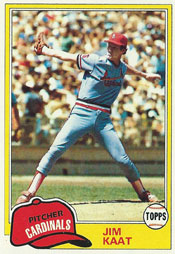
Jim Kaat was 41 when he stole a base and hit a home run in separate games for the 1980 Cardinals.

jim_kaat4At an age when most players are retired, Kaat remained a complete ballplayer.

Speed demon

On June 23, 1980, two months after he was acquired from the Yankees, Kaat earned the win and pitched a complete game for the Cardinals in their 6-1 victory over the Pirates at St. Louis. Kaat didn’t allow a walk or an extra-base hit. He held the Pirates scoreless over the last seven innings and earned his 266th career win, tying Hall of Famer Bob Feller.

In the seventh, he stole a base.

Bobby Bonds was at the plate when Kaat, noticing first baseman Bill Robinson wasn’t holding him on, dashed for second. Bonds took a pitch from Enrique Romo. Catcher Steve Nicosia gunned a throw to Phil Garner, covering second, and Kaat beat the peg.

“Kitty figured as long as somebody wants to give you something, you might as well take it,” Cardinals manager Whitey Herzog said to the St. Louis Post-Dispatch.

Fans at Busch Stadium rewarded Kaat with a standing ovation. “I guess they thought Lou Brock was back,” Kaat said.

In its account of the game, the Associated Press wrote, “It was the aging hurler’s speed that brought the customers to their feet … The accomplishment nearly overshadowed his hurling.”

Said Kaat: “It was the element of surprise. I had a good lead. It was worth it.” Boxscore

The steal was Kaat’s first in nine years. He was 32 when he swiped a base for the Twins against Yankees pitcher Stan Bahnsen and catcher Thurman Munson on July 30, 1971.

His stolen base for the Cardinals was Kaat’s fifth and last in a 25-year career (1959-83) in the majors.

Described by the Post-Dispatch as a “left-handed Methuselah,” Kaat needed only 82 pitches to complete the game. He threw a strike on the first pitch to 25 of 32 Pirates batters.

“He may be 41, but he has the body of a 28-year-old,” said Pirates manager Chuck Tanner.

Sultan of swat

Two months after his steal for the Cardinals, Kaat hit a home run for them.

On Aug. 26, 1980, Kaat homered off the Astros’ Joe Niekro at St. Louis.

“He hit a knuckleball up,” Niekro said to the Associated Press. “He’s a pretty good hitter. I’ve got a brother (Phil) who is 41 and he hits home runs. It’s not the first time I gave up one to a pitcher and it probably won’t be the last.” Boxscore

The home run was the last of 16 hit by Kaat. He slugged his first 18 years earlier on June 19, 1962, off Dom Zanni of the White Sox.

(The oldest player to hit a big-league home run was Mets first baseman Julio Franco, 48, against Randy Johnson of the Diamondbacks on May 4, 2007. Franco was three months shy of his 49th birthday.)

Going strong

Exactly one year after his home run, Kaat, 42, got his last big-league hit, a single for the Cardinals against 25-year-old Giants rookie Bob Tufts on Aug. 26, 1981. Boxscore

The next year, Kaat, 43, appeared in 62 regular-season games for the Cardinals (earning five wins and two saves) and pitched in four games of the 1982 World Series against the Brewers.

He pitched his last game at 44, tossing 1.1 scoreless innings in relief of Joaquin Andujar for the Cardinals against the Pirates on July 1, 1983, at Pittsburgh. Boxscore

Kaat was 19-16 with 10 saves in four seasons (1980-83) with the Cardinals.

Elected to the Baseball Hall of Fame, Kaat totaled 283 career wins and received 16 Gold Glove awards for fielding.


Read Full Post »

(Updated Nov. 24, 2017)

In 1964, Ken Boyer showed the qualities one would expect in a Hall of Fame player. The Cardinals third baseman consistently excelled with the glove and with the bat. He was a champion and a leader. He achieved feats that ranked him among the elite at his position all-time.

ken_boyer8Boyer hasn’t been elected to the National Baseball Hall of Fame at Cooperstown, N.Y. The only other third basemen of the 1958-64 era who fielded and hit at the same level as Boyer were Brooks Robinson of the Orioles, Eddie Mathews of the Braves and Ron Santo of the Cubs. All three have been elected to the Hall of Fame.

Special player

Though one outstanding year doesn’t qualify anyone for the Hall of Fame, Boyer’s 1964 season is important because it caps a seven-year stretch of consistently high quality and puts into context how Boyer elevated himself into a special category of third basemen.

Boyer, 33, played in all 162 Cardinals regular-season games in 1964. He led the majors in RBI with 119. Boyer also ranked in the top five in the National League in triples (10) and walks (70). He hit .295 with 185 hits, 30 doubles and 24 home runs. He scored 100 runs. His on-base percentage was .365.

Among NL third basemen in 1964, Boyer ranked second in both assists and double plays turned.

Calm and steady

His immense value to the Cardinals was proven with these statistics: Boyer hit .335 with 91 RBI in the Cardinals’ 93 wins in 1964; .238 with 28 RBI in the Cardinals’ 69 losses.

Remarkably consistent, Boyer in 1964 hit .296 against right-handed pitching; .291 versus left-handers.

Boyer was at his best against the Cardinals’ closest competitors, the Phillies and the Reds. Each finished a game behind the pennant-winning Cardinals. Boyer hit .351 with 17 RBI in 18 games against the 1964 Phillies; .309 with 13 RBI in 18 games versus the 1964 Reds.

In a profile of the Cardinals team captain in the Nov. 14, 1964, edition of The Sporting News, Ed Wilks wrote that Boyer “does everything well, but in the calm, steady, unspectacular fashion of a professional.”

Said Boyer: “The (1964) season couldn’t have been more satisfying. I think I did just about everything I had hoped to do.”

Rewarding year

Among the feats Boyer achieved in 1964:

_ He was named recipient of the NL Most Valuable Player Award on Nov. 24. Boyer became only the second NL third baseman and just the fourth in the big leagues to win a MVP Award. The others were Bob Elliott of the 1947 Braves in the NL and Al Rosen of the 1953 Indians and Brooks Robinson of the 1964 Orioles in the American League.

Top five in balloting for 1964 NL MVP were Boyer, Johnny Callison of the Phillies, Bill White of the Cardinals, Frank Robinson of the Reds and Joe Torre of the Braves. Boyer received 14 of 20 first-place votes. “That’s a lot when there are only 20 votes altogether and you have all that strong competition,” Boyer said. “Fourteen must be my lucky number. That’s my uniform number.”

_ The Sporting News named Boyer its Major League Player of the Year. He became the third Cardinals player to earn the honor, joining Marty Marion (1944) and Stan Musial (1946 and 1951).

_ For exemplifying the qualities of Lou Gehrig on and off the field, Boyer was presented the Lou Gehrig Memorial Award by the late Yankees first baseman’s Phi Delta Theta fraternity at Columbia University. He joined Musial (1957) as the second Cardinals player to receive the honor.

Run producer supreme

_ He became the first third baseman to lead the NL in RBI since Heinie Zimmerman (102) of the 1917 Giants. Boyer also was the first Cardinals player to lead the major leagues in RBI since Enos Slaughter (130) in 1946 and the first Cardinals player to lead the NL in RBI since Musial (109) in 1956.

_ Named to the all-star team for the seventh and last time, Boyer started at third base in the 1964 Midsummer Classic at Shea Stadium in New York and went 2-for-4, with a home run off Athletics reliever John Wyatt, in a 7-4 NL victory. Boxscore

_ Despite a hamstring injury, Boyer played in all seven games of the 1964 World Series against the Yankees. He hit a grand slam off Al Downing for all the Cardinals’ runs in a 4-3 Game 4 triumph Boxscore and produced three hits, including a solo home run against Steve Hamilton, in the Cardinals’ championship-clinching 7-5 victory in Game 7. Boxscore

_ The 1964 season was the last of seven in a row in which Boyer hit 23 or more home runs and produced 90 or more RBI.

Previously: If Ron Santo goes into Hall, Ken Boyer should, too

Previously: Ken and Clete Boyer: 1st brothers to each hit 25 HRs

Read Full Post »

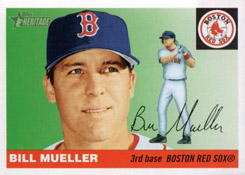
As an 11-year-old Cardinals fan, Bill Mueller attended Game 7 of the 1982 World Series at Busch Stadium in St. Louis and witnessed his hometown team clinch the championship against the Brewers.

bill_muellerTwenty-two years later, Mueller returned to a World Series for the first time.

As a 33-year-old big-league veteran, Mueller was the third baseman for the Red Sox in Game 4 of the 2004 World Series at Busch Stadium in St. Louis and witnessed Boston break the hearts of his hometown team by clinching the championship against the Cardinals.

Ten years after that, Mueller has come full circle.

On Nov. 17, 2014, Mueller was named assistant hitting coach of the Cardinals, replacing David Bell, who was promoted to bench coach after Mike Aldrete departed for a coaching job with the Athletics. Mueller had been hitting coach of the Cubs during the 2014 season. He will serve under Cardinals hitting coach John Mabry in 2015.

McGee a favorite

A native of the St. Louis suburb of Maryland Heights, Mo., Mueller grew up a Cardinals fan. Center fielder Willie McGee was his favorite player, Mueller told Jeff Horrigan of the Boston Herald in October 2004.

As a rookie in 1982, McGee sparked the Cardinals to their first National League pennant in 14 years. After splitting the first six games of the 1982 World Series with the Brewers, the Cardinals faced a Game 7 showdown at Busch Stadium.

Mueller attended the game with his father. Their seats were in the upper deck of the outfield. “The nosebleed section,” Mueller told The Patriot Ledger of Quincy, Mass., in 2004.

The Brewers’ Ben Oglive smacked a home run off Joaquin Andujar near the section where the Muellers sat. That’s one of Bill Mueller’s enduring memories of the game. What’s most memorable, of course, is that the Cardinals won, 6-3, earning their first World Series title since 1967. “Pretty cool,” Mueller said of the experience. Boxscore

Turning pro

Mueller became a baseball standout at De Smet Jesuit High School in Creve Coeur, Mo., and at Missouri State University in Springfield. He was drafted by the Giants and made his big-league debut with them in 1996.

In his first appearance at Busch Stadium with the Giants in August 1996, Mueller got five hits in 10 at-bats during a four-game series. Three years later, on May 25, 1999, Mueller hit a grand slam off Kent Mercker at Busch Stadium before more than 30 family and friends in a 17-1 Giants victory over the Cardinals. Boxscore

After the 2000 season, the Giants traded Mueller to the Cubs. He spent two years in Chicago, became a free agent and signed with the Red Sox. In his first season with Boston, Mueller was the 2003 American League batting champion, hitting .326 in 146 games.

Mueller vs. Rolen

The next season, Mueller helped Boston win the American League pennant, their first since 1986. He would be going to the World Series for the first time as a player and for the only time since he attended as a fan in 1982.

“That (1982) was my last experience with a World Series and now I’m going back for a World Series in St. Louis and I’m part of it,” Mueller said to Dan O’Neill of the St. Louis Post-Dispatch on the eve of the 2004 World Series. “It’s really a pretty amazing thing when you think about it.”

In most media previews of the 2004 World Series, the Cardinals, with Scott Rolen, were rated as having the advantage at third base over Mueller and the Red Sox. Rolen had hit 34 home runs with 124 RBI during the regular season and would win his fifth consecutive Gold Glove Award in 2004.

Mueller, though, proved the experts wrong.

The Red Sox swept the Cardinals, winning the first two games at Boston and the next two at Busch Stadium, and earned their first World Series championship since 1918, ending what some considered to be a curse placed on the franchise after it had traded Babe Ruth to the Yankees.

Mueller played an integral role in Boston’s dominance of the Cardinals. He batted .429 (6-for-14) with four walks in the World Series. His on-base percentage was .556. He scored three runs and drove in two.

His counterpart, Rolen, was hitless in 15 at-bats.

Previously: Paul Molitor vs. Cardinals: Sensational, strange 1982 World Series

Read Full Post »

(Updated May 24, 2025)

A central figure in an unpopular trade, Alvin Dark responded with a hitting display that endeared him to Cardinals fans and gained him satisfaction against his former team.

al_darkDark was a three-time all-star shortstop with the Giants and 1948 National League Rookie of the Year with the Braves. He played for 14 seasons in the major leagues and hit a combined .323 in 16 World Series games for the Braves (1948) and Giants (1951 and 1954). Dark also managed four big-league clubs, winning a pennant with the 1962 Giants and a World Series championship with the 1974 Athletics.

On June 14, 1956, Cardinals general manager Frank Lane traded second baseman Red Schoendienst, a nine-time all-star, to the Giants. The key player the Cardinals received in return was Dark.

The full trade was Schoendienst, outfielder Jackie Brandt, catcher Bill Sarni, pitcher Dick Littlefield and two players to be named (shortstop Bob Stephenson and pitcher Gordon Jones) to the Giants for Dark, outfielder Whitey Lockman, catcher Ray Katt, pitcher Don Liddle and cash.

Lane made the trade because he wanted to move Don Blasingame from shortstop to second base. He figured trading Schoendienst would land him a shortstop in return. Lane had been trying for months to get Dark.

“The Giants wanted a second baseman, the Cardinals a shortstop and everybody was pleased except the Cardinals fans, who, understandably, loved Red. He was the finest second baseman in the game,” Dark said in his book “When in Doubt, Fire the Manager.”

Said Lane to The Sporting News: “We let Schoendienst go with great reluctance, naturally, but to get a star like Dark you’ve got to give a star.”

Cardinals fans expressed their displeasure. “The switchboard at Busch Stadium lighted up like a Christmas tree and stayed that way for more than two hours June 14,” wrote The Sporting News.

Dark, 34, hit .366 in his first 28 game for the Cardinals.

On July 12, the Giants visited St. Louis for the first time since the trade. Dark had nine hits in 11 at-bats and seven RBI, sparking the Cardinals to a three-game sweep. Schoendienst had three hits in 11 at-bats and walked twice.

In the first game of the series, won by the Cardinals, 5-3, on July 12, Dark drove in the winning run with a sacrifice fly in the seventh. Boxscore

Dark drove in the winning run again in Game 2, a 7-5 Cardinals triumph on July 13. With the score tied at 5-5 in the eighth, he hit a two-run double against Hoyt Wilhelm. Boxscore

In the series finale on July 14, Dark was 3-for-3 with three RBI against starter Al Worthington in the Cardinals’ 5-2 triumph. Boxscore

Dark had seven hits in his last seven at-bats of the series.

“He’s a polished professional, a real leader who leads without being ostentatious,” Lane said.

Dark hit .286 in 100 games for the 1956 Cardinals. According to the 2004 Cardinals Yearbook, no one in the majors used a bat as light as Dark’s: 28 ounces.

In 1957, Dark batted .290. One of his best games occurred July 24 when he tripled twice _ against Sal Maglie and Sandy Koufax _ and scored twice in a 3-0 Cardinals victory over the Dodgers. Boxscore

By 1958, Dark, 36, had lost fielding range. The Cardinals had a replacement, shortstop Eddie Kasko, on the roster. Dark was traded to the Cubs on May 20, 1958, for pitcher Jim Brosnan.

Dark had 306 hits in 258 games over three seasons for the Cardinals and batted .289. He produced four hits in a game seven times.


Read Full Post »

(Updated on April 5, 2022)

In 2014, I interviewed Tommy Davis and Jerry Reuss about some of their peers who were candidates for election to the National Baseball Hall of Fame.

boyer_davisDavis played 18 seasons in the big leagues (1959-76), primarily as an outfielder, and was the National League batting champion in both 1962 and 1963 with the Dodgers. Overall, Davis hit .294 in his major-league career.

Reuss, a St. Louis native who began his career with the Cardinals. pitched 22 seasons in the big leagues (1969-90) and earned 220 wins.

Here is what Davis and Reuss said about some of the candidates:

Dick Allen

Primarily a first baseman and third baseman, Allen was 1964 National League Rookie of the Year with the Phillies and 1972 American League Most Valuable Player with the White Sox. He led the American League in home runs in 1972 (37) and 1974 (32) and was a league leader in extra-base hits three times.

Dubbed “the bad boy of baseball,” Allen hit .292 with 1,848 hits, 351 home runs and 1,119 RBI in 15 major-league seasons (1963-77).

In 1970, his lone Cardinals season, Allen primarily played first base and hit .279 with 34 homers and 101 RBI in 122 games. Allen and Reuss were teammates that year.

_ Tommy Davis on Dick Allen: “Great hitter. He had a 40-ounce bat that he used. He couldn’t pull the ball, but he could go about 400 feet, 450, to right-center. Easily.”

_ Jerry Reuss on Dick Allen: “Tremendous power. Good teammate. Personally, I like him. Hall of Fame chances: No.”

Ken Boyer

Boyer was the 1964 National League Most Valuable Player with the Cardinals and he won five Gold Gloves as a St. Louis third baseman. Boyer ranked in the top 10 in RBI in the NL seven times and in the top 10 in total bases six times.

In 15 major-league seasons (1955-69), Boyer batted .287 with 2,143 hits, 282 home runs and 1,141 RBI.

He played for the Cardinals for 11 years and hit .293 for them with 1,855 hits and 1,001 RBI in 1,667 games.

Boyer and Davis were teammates on the 1967 Mets and 1968 White Sox. Boyer coached the 1971 Cardinals team that included Reuss as a starting pitcher.

_ Tommy Davis on Ken Boyer: “He was consistent at third base. Good hitter. His defense was so good it was ridiculous.”

_ Jerry Reuss on Ken Boyer: “That’s a tough one. He had leadership capabilities. I don’t know how he stacked up against other third basemen. He’s a maybe, but more toward the no side.”

Jim Kaat

A three-time 20-game winner, Kaat earned 283 wins. Kaat had 15 consecutive seasons (1962-76) with double-figure wins. He was the 1962 American League leader in shutouts (five) with the Twins and the 1966 AL leader in wins (25).

Kaat spent his last four big-league seasons (1980-83) with the Cardinals, winning 19, saving 10 and appearing in four of the seven games of the 1982 World Series.

_ Tommy Davis on Jim Kaat: “He was sneaky. He knew how to pitch. He knew how to set you up. He was a tough left-hander.”

_ Jerry Reuss on Jim Kaat: “Yes for the Hall of Fame. He won 16 Gold Gloves. Enough said.”

Minnie Minoso

The outfielder won three Gold Gloves (1957, 1959, 1960) and finished in the top 10 in the American League in hitting eight times. Minoso three times led the AL in triples and three times led the AL in stolen bases.

Playing primarily for the White Sox and Indians from 1951-64 (he appeared in nine games in 1949, three in 1976 and two, at age 54, in 1980), Minoso batted .298 with 1,963 hits, 186 home runs, 1,023 RBI and 205 stolen bases.

In 1962, his lone National League season, Minoso was plagued by injuries and hit .196 in 39 games for the Cardinals.

I didn’t ask Reuss about Minoso because the Cuban Comet’s last full big-league season was 1964 when Reuss was just 15.

_ Tommy Davis on Minnie Minoso: “Good outfielder. He could fly. He was already good when he got to the major leagues. He helped baseball as a pioneer for Cuban ballplayers and later as an ambassador for Chicago.”

Read Full Post »

« Newer Posts - Older Posts »