Feeds:
Posts
Comments

Archive for the ‘Hitters’ Category

(Updated Jan. 5, 2021)

During spring training in 2014, Orioles manager Buck Showalter told a Baltimore prospect to write a report on the career of Frank Robinson after the minor-league player admitted he was clueless about the Hall of Fame slugger who became baseball’s first black manager.

frank_robinsonThat got me thinking: How many fans know about Robinson’s achievements versus the Cardinals?

In tribute to Frank Robinson, here’s my written report on the feats you should know he achieved while playing against the Cardinals:

Turning anger into runs

Robinson produced 586 home runs, 1,812 RBI and 2,943 hits in a 21-year major-league playing career from 1956-76. He spent 11 seasons _ 10 with the Reds; one with the Dodgers _ in the National League. In 203 games against the Cardinals, Robinson had 220 hits, including 46 home runs and 41 doubles, and drove in 127 runs. His career batting average versus St. Louis was .290.

Against the Cardinals, Robinson made his major-league debut, had his greatest single-game home run performance, delivered several game-winning shots and won a couple of dramatic duels with Bob Gibson.

In the book “Sixty Feet, Six Inches,” Gibson said, “Frank Robinson might have been the best I ever saw at turning his anger into runs. He challenged you physically as soon as he stepped into the batter’s box, with half his body hanging over the plate.

“His fearlessness played a tremendous part in making him the hitter he was. He practically dared you to clip him or knock him down and, when you did, he’d use it as intensity. He seemed to gain strength from it. If you couldn’t drive him off the plate _ and you couldn’t _ then you couldn’t take away his outside corner.

“As a rule, I’m reluctant to express admiration for hitters, but I make an exception for Frank Robinson.”

In the book “Pure Baseball,” first baseman Keith Hernandez said Robinson would wear out a pitching staff if they threw at him. According to Hernandez, Cardinals manager Red Schoendienst “called a meeting and told his pitchers he’d fine them $100 for hitting Frank Robinson. Leave him alone. We want to win these games.”

Vinegar Bend Mizell

In his first big-league game, April 17, 1956, at Cincinnati, Robinson, batting seventh and playing left field, was 2-for-3 with a walk versus Cardinals starter Vinegar Bend Mizell. In his first at-bat in his debut game, Robinson doubled. “Second pitch,” Robinson said to the Washington Post, “line drive off the center field fence. Missed being a home run by a couple of feet.” Boxscore

Three years later, Robinson hit three home runs in a major-league game for the only time. It happened against the Cardinals on Aug. 22, 1959, at Cincinnati. All three homers were hit with two outs.

The first of the three came against Mizell. It was a three-run shot in the fifth inning that broke a 1-1 tie. It was one of eight homers Robinson hit against Mizell in his career. Robinson followed that with a two-run homer off Dean Stone in the sixth and a solo blast against Bob Duliba in the eighth. Boxscore

Larry Jackson

Robinson hit 10 home runs in his career against Larry Jackson. Seven occurred while Jackson was with the Cardinals. The most damaging was struck on Sept. 2, 1957, at Cincinnati.

In the second game of a doubleheader with the Cardinals, the Reds batted in the 10th inning with the score 1-1. Jackson, the starter, walked the leadoff batter, Bob Thurman, and Robinson followed with a walkoff, two-run home run, lifting the Reds to a 3-1 victory. Boxscore

Two-homer games

On April 30, 1958, at Cincinnati, Robinson hit a fifth-inning solo home run off Lindy McDaniel, giving the Reds a 4-2 lead. After the Cardinals rallied with two runs in the ninth to tie the score at 4-4, Robinson led off the 10th against Morrie Martin, who had held the Reds scoreless for three innings, and hit a walkoff home run, giving the Reds a 5-4 victory. Boxscore

Robinson also had a pair of other two-homer games against the Cardinals:

_ He hit a solo home run in the second inning off Ernie Broglio and the winning shot in the 11th, also off Broglio, in a 4-3 Reds victory on Sept. 10, 1962, at St. Louis. Boxscore

_ He hit a pair of home runs off Tracy Stallard in a 6-3 Reds victory on April 24, 1965, at Cincinnati. Boxscore

Bob Gibson

In showdowns between Hall of Famers Gibson and Robinson, the Cardinals pitcher usually had the upper hand, but Robinson also enjoyed spectacular successes against Gibson.

Robinson hit .229 (19-for-83) versus Gibson and struck out 12 times. He also hit four home runs.

In his book ‘Stranger to the Game,” Gibson said, “I brought the ball in close to Frank Robinson … although I believe most pitchers tried him outside. The way he crowded the plate, they figured he was waiting to pounce on the inside pitch, but it seemed to me that he beat a hell of a lot of guys who pitched him away.”

In an interview with former baseball commissioner Fay Vincent for the book, “We Would Have Played For Nothing,” Robinson said, “Bob threw what we called a heavy ball. He had a hard slider. He was just mean enough, you know, he was up under your chin and that type of thing. So he was tougher to hit against than Sandy Koufax, but Koufax was tougher to get hits off of.”

Here is a look at the four home runs Robinson hit off Gibson:

_ Gibson blew leads in the ninth and 10th innings of a game at Cincinnati on Sept. 7, 1962.

The Cardinals led, 4-3, entering the bottom of the ninth before the Reds scored a run off Gibson to tie.

In the 10th, St. Louis regained the lead, 5-4, giving Gibson another chance to seal the win, but Robinson hit a solo home run against him in the bottom of the 10th.

The Reds won, 6-5, on a RBI-double by Vada Pinson off Curt Simmons in the 11th. Boxscore

_ Gibson was matched against fellow power pitcher Jim Maloney on May 4, 1963, at Cincinnati.

In the third inning of a scoreless game, Pete Rose walked, Pinson singled and Robinson followed with a three-run home run off Gibson. Maloney shut out the Cardinals on four hits and the Reds won, 6-0. Boxscore

_ In the opener of a doubleheader on Sept. 19, 1964, at Cincinnati, Gibson took a 5-4 lead into the ninth. With two outs and pinch-runner Tommy Harper on third, Gibson walked Pinson, bringing Robinson to the plate.

Robinson crushed a three-run, walkoff home run, lifting the Reds to a 7-5 triumph. Boxscore

_ In the first game of a doubleheader at Cincinnati on June 22, 1965, Robinson hit a solo home run off Gibson in the sixth inning, helping the Reds to a 5-4 victory. Boxscore
 

Read Full Post »

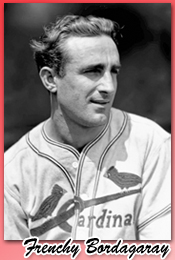
Frenchy Bordagaray was a deluxe pinch-hitter for the Cardinals.

frenchy_bordagarayBordagaray, 5 feet 7, 175 pounds, led the major leagues in pinch-hitting batting average in 1938.

Using a short right-handed swing, Bordagaray, 28, hit a club-record .467 (21-for-45) as a Cardinals pinch-hitter in 1938.

Proud to be Basque

Stanley George Bordagaray was born Jan. 3, 1910, in the California town of Coalinga, near Fresno. His mother nicknamed him Frenchy, according to the New York Times. (Bordagaray told an interviewer, “I had five brothers and we were all called Frenchy. But I’m not a Frenchman. I’m a Basque. Nobody ever got that right.”) His father, a sheepherder who immigrated to the United States from the Basque region between Spain and France at 15, wanted Stanley to become a violinist, but the youth preferred sports.

An outfielder and third baseman, Frenchy Bordagaray made his big-league debut in 1934 with the White Sox and was traded to the Dodgers at the end of the year. After the 1935 season, Bordagaray got a bit part in the John Ford film “The Prisoner of Shark Island.” When Frenchy showed up at Dodgers spring training camp in 1936 still sporting the moustache and goatee he had grown for the movie role, manager Casey Stengel ordered him to shave, saying, “If anyone is going to be a clown on this club, it’s going to be me.”

After the 1936 season, the Dodgers dealt Bordagaray, pitcher Dutch Leonard and infielder Jimmy Jordan to the Cardinals for outfielder Tom Winsett.

Boys in the band

Bordagaray hit .293 as a utility player for the 1937 Cardinals, but he became best known as a member of teammate Pepper Martin’s Mudcats band. The one-time violinist played washboard and fiddle.

Showing no signs of what was to come in 1938, Bordagaray was abysmal as a pinch-hitter in 1937, getting one hit in 16 at-bats for an .063 average.

In 1938, he had three doubles, nine RBI and scored 13 runs in his 21-for-45 performance as a pinch-hitter. Overall, he hit .282 for the 1938 Cardinals.

The Cardinals traded Bordagaray to the Reds for outfielder Dusty Cooke in December 1938. Bordagaray played for the Yankees and returned to the Dodgers before ending his 11-year big-league playing career in 1945.

Bordagaray appeared in the 1939 World Series for the Reds and in the 1941 World Series for the Yankees, but never had a World Series at-bat. His two appearances in the 1939 World Series were as a pinch-runner for Ernie Lombardi. His lone appearance in the 1941 World Series was as a pinch-runner for Bill Dickey.

In two seasons with the Cardinals, Bordagaray batted .289 (132-for-456).

His big-league career batting average as a pinch-hitter was .318 (62-for-195).

Read Full Post »

(Updated Nov. 21, 2024)

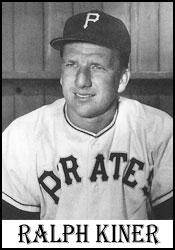
Ralph Kiner, the Hall of Fame left fielder who hit 369 home runs in a 10-year major league career, slugged three home runs in a game for the Pirates against the Cardinals.

ralph_kinerThroughout his career, Kiner was a Cardinals nemesis, hitting .309 with 50 home runs and 142 RBI against them.

A .279 career hitter with the Pirates, Cubs and Indians, Kiner’s batting mark against the Cardinals was his highest versus any National League team.

Kiner blooms at Greenberg Gardens

In 1947, Kiner, 24, was in his second big-league season with Pittsburgh. The Pirates had acquired Hank Greenberg, 36, the longtime Tigers slugger, to play first base and mentor Kiner.

(In the book “Voices from Cooperstown,” Kiner told author Anthony J. Connor that as a boy he rooted for Greenberg and the 1934 Tigers. “I can still rattle off the whole lineup,” Kiner said. “The funny thing is I never saw them play. I was in southern California then and there was no TV. It just goes to show what an 11-year-old boy can do with a newspaper box score and a good imagination.”)

To capitalize on the right-handed power of Kiner and Greenberg, the Pirates extended the bullpen fence about 30 feet in front of the left field wall at Forbes Field, shortening the distance for a home run from about 360 feet to about 330 feet, and dubbed the area Greenberg Gardens.

Though the 1947 Pirates were an awful team _ they would finish in last place at 62-92 _ they topped one million in home attendance for the first time in franchise history because of the slugging of Kiner (51 home runs) and Greenberg (25).

On Aug. 16, 1947, Kiner had three home runs, five RBI, four runs scored and two walks in the Pirates’ 12-7 victory over the Cardinals at Forbes Field.

The Pirates and Cardinals combined to hit 10 home runs in the game. The Pirates accounted for seven _ three by Kiner and two each by Greenberg and Billy Cox. Whitey Kurowski hit two homers for the Cardinals and Terry Moore hit one. All 10 home runs were hit by right-handed batters.

Kiner’s first home run came with the bases empty in the third off starter Ken Burkhart and landed against the light tower in the bullpen. He hit a three-run shot over the scoreboard in left off Ted Wilks in the fourth before capping his day with another solo homer off Johnny Grodzicki in the eighth. The third home run was the longest and “seemed headed for Carnegie Museum in nearby Shenley Park,” according to the St. Louis Post-Dispatch. Boxscore

Thanks, Hank

Kiner struggled early in the 1947 season and Pirates manager Billy Herman wanted to send him to the minors but Greenberg convinced the front office to keep Kiner on the club, according to the book “Voices From Cooperstown.”

According to author Anthony J. Connor, when Kiner reached a low point, going hitless in five at-bats against the Cubs, Greenberg said to Kiner, “Stay with it. The fundamentals are there and it is going to work.”

Kiner credited Greenberg with making him into a consistent power hitter. “Right from the start of spring training down in Florida, Hank was at my side constantly,” Kiner told The Sporting News. “He got me to move up a little closer at the plate to protect the outside (corner) and to spread my feet a bit, too.

“Hank gave me confidence and he taught me how to relax. Last year, I was usually tense at the plate. When a pitcher had two strikes on me, I was always afraid I’d be called out on strikes and I’d go after that bad one … I bet I’ve hit most of my home runs this year with two strikes on me.”

Said Greenberg: “Ralph had what it takes all the time. I merely gave him a bit of advice here and there when he asked me … Kiner and Ted Williams are probably the best wrist hitters in the game today.”

In his book “Stan Musial: The Man’s Own Story,” the seven-time batting champion of the Cardinals said Kiner “was the most consistent home run hitter in the National League. Hank Greenberg helped him and so did Greenberg Gardens at Pittsburgh, but Ralph worked at his game and improved himself as a hitter. He had a good eye and good power, plus a type of swing that sent the ball high with good backspin so that it kept sailing.”


Read Full Post »

(Updated Sept. 10, 2025)

On Feb. 28, 1989, the day the veterans committee was to announce its selections to the National Baseball Hall of Fame, coach Red Schoendienst was at Cardinals spring training camp in St. Petersburg, Fla., with his wife, Mary.

red_schoendienst7“When is the announcement?” Mary asked.

“3 o’clock,” replied Red.

“I’m not going shopping,” Mary said.

In relaying the conversation to the Associated Press, Schoendienst said, “Anytime you can stop a gal from going shopping, that’s pretty big news.”

Schoendienst, the longtime Cardinals second baseman, got the call from Ed Stack, Hall of Fame president, informing him he’d been elected to the Cooperstown shrine, ending a wait of 20 years.

Two days after the veterans committee announcement, Bob Broeg, the St. Louis journalist who covered Schoendienst since his debut with the Cardinals in 1945, wrote, “I don’t think the Cardinals are going to get Schoendienst out of uniform anytime soon, even though he’s 66. He still likes a hot ballgame and a cold beer.”

Schoendienst and umpire Al Barlick each got the necessary 14 votes from a committee of 18 which included Red’s friend and former teammate, Stan Musial.

Joining them in the 1989 Hall of Fame induction class were Johnny Bench and Carl Yastrzemski, each of whom was elected by the Baseball Writers Association of America. Harry Caray, the former Cardinals broadcaster, also was headed to Cooperstown as 1989 winner of the Ford C. Frick Award for broadcast excellence.

“A great player and a winner,” Caray said of Schoendienst to Rick Hummel of the St. Louis Post-Dispatch.

Schoendienst had been on the Baseball Writers Association of America ballot for 15 years (1969-83) but failed to receive the necessary 75 percent of the votes for election. His best showing was 42.6 percent in 1980.

When he got the call he’d been elected by the veterans committee (ahead of candidates such as Richie Ashburn and Phil Rizzuto), Schoendienst told Hummel, “I was standing up. Then I had to sit down.”

In 19 seasons (1945-63) with the Cardinals, Giants and Braves, Schoendienst was named an all-star 10 times and collected 2,449 hits. He six times led National League second basemen in fielding percentage, prompting Musial to declare Schoendienst had “the greatest pair of hands I’ve ever seen in baseball.”

In the book “Few and Chosen,” catcher Tim McCarver said, “There’s a saying in baseball that you can tell the guys who were good fielders by the way they shake hands. When you shake Red’s hand, it’s as soft as a pillow, and that’s the way he was as a fielder. Soft, pliable, flexible hands. An infielder is taught to field a ground ball below the hop, to absorb the hop, and Red was a master at that … Another thing about Red, he had a quick bat. Howard Pollet, the fine left-hander, said you couldn’t throw a fastball past Red.”

Schoendienst played 15 seasons for the Cardinals. He managed them for 14 years, achieving 1,041 wins, two league pennants and a World Series title.

Informed by Hummel of his former teammate’s election by the veterans committee, Enos Slaughter, a Hall of Fame outfielder for the Cardinals, said, “It’s long overdue … Red would have to rank with any second baseman, bar none, that I played with.”


Read Full Post »

(Updated Nov. 10, 2019)

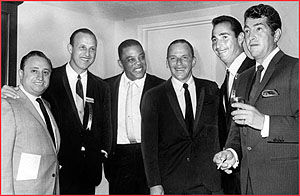
Imagine a gathering of 1960s icons that included Stan Musial, Sandy Koufax, Willie Mays, Frank Sinatra and Dean Martin.

musial_friarsThose athletes and entertainers were together at a 1964 Friars Club roast.

A black-and-white photo from the event, reproduced here, shows (from left to right) Dodgers publicist Danny Goodman, Musial, Mays, Sinatra, Koufax and Martin (the latter in a classic pose, with cigarette in one hand and a drink in the other).

They were at the Friars Club in Beverly Hills on Nov. 10, 1964, for a testimonial dinner in honor of Musial, the Cardinals standout who had retired as a player a year earlier. Less than a month before the gala, the Cardinals, with Musial in the front office as an executive, clinched the 1964 World Series championship against the Yankees.

The Friars Club, founded in 1904 in New York City, primarily attracted comedians and entertainers as its members and became best known for its bawdy celebrity roasts. A Beverly Hills branch of the club opened in 1947.

The dinner for Musial attracted a stellar group from the baseball and entertainment worlds.

Among the baseball celebrities joining Koufax and Mays in honoring Musial were Don Drysdale, Leo Durocher, Bob Feller, Hank Greenberg, Vin Scully and Duke Snider.

Sinatra and Martin were joined by personalities such as Gene Autry, Milton Berle, Gene Barry, Arthur Godfrey and master of ceremonies George Jessel.

Following the standard Friars Club format, several of the entertainers took turns on the dais poking fun at the honored guest.

An example of the cutting humor was this line from Godfrey about Musial’s restaurant in St. Louis: “After eating there, I can understand why Stan came all the way to Los Angeles for a meal.”

Comedian Corbett Monica quipped, “He’s such a nice guy. I might even say he’s holy. He reminds me in fact of Saint Joseph, a dull little town in nothern Missouri.”

In rare serious moments, Autry spoke of how his friendship with Musial began when Stan was a Cardinals rookie, and Mays told the audience Musial and Joe DiMaggio were his idols when he began his baseball career, the Los Angeles Times reported.

“Stan is the kind of man you want your kids to remember for a long time,” Mays said.

The highlight of the evening came when Sinatra and Martin “ran through a half-dozen song parodies filled with jabs at Musial,” The Sporting News reported. The Rat Pack duo’s special lyrics to popular tunes were so risqué that none “is in danger of ever being published,” wrote Sporting News correspondent Bob Hunter.

Sinatra and Martin ended on a high note with a duet to the tune of the song “The Lady is a Tramp.” Changing the lyrics to salute Stan the Man, Sinatra and Martin made the signature line, “Mr. Musial, you’re a champ.”

The Sporting News observed, “Musial received several standing ovations, the final one lasting for a lengthy period after he had responded to the barbs and roasts with a witty, humble speech of thanks.”

In opening his remarks, Musial said to the celebrity club members, “It’s been a great evening and it’s great to be with such famous and good friends _ even if they don’t know a darn thing about baseball.”

Previously: How Bing Devine helped Stan Musial plan retirement

Read Full Post »

Lou Brock was expected to have a breakout year in 1964 _ with the Cubs, not the Cardinals.

lou_brock8From October 1963 until the start of the 1964 season, Brock was heralded as an emerging superstar who, along with Billy Williams and Ron Santo, gave the Cubs legitimate hope of building a contender.

Instead, the Cubs deviated from their plan to construct a team with Brock as a cornerstone. Desperate for experienced pitching, the Cubs traded Brock and pitchers Jack Spring and Paul Toth to the Cardinals on June 15, 1964, in a deal that brought them pitchers Ernie Broglio and Bobby Shantz along with outfielder Doug Clemens.

Brock propelled the Cardinals to the 1964 National League pennant with his hitting (.348 batting average in 103 games) and speed (33 steals) after being acquired from the Cubs.

Many had predicted he would produce those kinds of numbers for Chicago.

After hitting .258 with 24 steals for the Cubs in 1963, his second full season in the major leagues, Brock, 24, finished runner-up to Cardinals catcher Tim McCarver in balloting by the Associated Press for the honor of National League sophomore of the year.

“Brock is going to be one of the great players in the game within a few years,” Cubs executive Bob Whitlow told The Sporting News in October 1963.

A month later, The Sporting News reported, “In order to acquire (an) extra starting hurler, the Cubs will not break up their infield nor will they deal either Billy Williams or Lou Brock of the outfield.”

Said Santo: “As for Brock, he’s just going to keep getting better.”

Brock led the Cubs in hitting at .380 during the 1964 spring training season.

In a poll of National League writers conducted by The Sporting News before the start of the 1964 regular season, Brock was selected the Cubs player “likeliest to improve.”

Brock started the season well, hitting .306 in April, but batted .221 in May. He entered June in a 4-for-29 slump. On the day he was traded to the Cardinals, his batting average was .251.

Cubs beat writer Edgar Munzel sensed the Cubs were erring in dumping Brock. Calling Brock “a great young prospect,” Munzel wrote, “Even though he was hitting only .251, the youngster combines power with tremendous speed. He was a constant base-running threat.”

Brock, acquired by the Cardinals three days before his 25th birthday, went on to enjoy a spectacular 19-year big-league career, with 3,023 hits, 938 stolen bases and election to the National Baseball Hall of Fame in 1985.

Previously: Bill White: We thought Brock deal was nuts

Read Full Post »

« Newer Posts - Older Posts »