Feeds:
Posts
Comments

Archive for the ‘Hitters’ Category

(Updated April 28, 2025)

In a 1954 series against the Cardinals, Hank Aaron hit his first and second home runs in the big leagues, solidifying his status with the Braves and launching him on a path toward breaking Babe Ruth’s most storied record.

musial_aaron

Aaron was 18 when he played his first season in the Braves’ system as a shortstop for Eau Claire (Wis.) in 1952. Braves scout Billy Southworth, the former Cardinals and Braves manager, filed a glowing account on the prospect. According to the book “Baseball’s Greatest Players,” Southworth wrote in his report, “For a baby-faced kid of 18, his playing ability is outstanding.”

Two years later, Aaron, 20, was on the Opening Day roster of the 1954 Braves. Six games into the season, the rookie outfielder was struggling, batting .217 with no home runs and no RBI.

As the Braves entered a three-game series against the Cardinals at St. Louis, speculation was Aaron might be benched whenever outfielder Bill Bruton recovered from a viral infection and returned to the lineup.

Aaron ended that talk with a strong series at St. Louis, hitting .500 (8-for-16) with a pair of home runs and three RBI. He went on to have a solid rookie season (.280 batting average, 27 doubles, 13 home runs and 69 RBI.).

Victim No. 1

In the opener of the Braves-Cardinals series on April 23, 1954, Aaron, batting sixth and playing right field, was 3-for-7 with two runs scored and two RBI in Milwaukee’s 7-5 victory in 14 innings.

In the sixth, with the Cardinals ahead, 4-2, Aaron hit the first of his 755 career home runs, a solo shot off starter Vic Raschi. A week earlier, Aaron got his first hit, a double, also against Raschi. In his autobiography, “I Had a Hammer,” Aaron said, “I was fortunate to be facing him near the end of his career.”

The Braves tied the score in the ninth and each team scored in the 13th.

In the 14th, with Cot Deal pitching for St. Louis, Andy Pafko singled with one out and Aaron also singled, moving Pafko to second. Joe Presko relieved and the first batter he faced, Johnny Logan, reached on an error by shortstop Solly Hemus, loading the bases. Jim Pendleton, batting for pitcher Dave Jolly, singled, scoring Pafko and Aaron. Boxscore

Two days later, on April 25, 1954, in the fifth inning against starter Stu Miller, Aaron hit his second career home run, tying the score at 1-1. Aaron was 5-for-6 in a game won by the Cardinals, 7-6, in 12 innings. Cardinals right fielder Stan Musial was 4-for-6 with a home run. Boxscore

Powerful wrists

Aaron and Musial eventually developed a mutual admiration.

In his book “Stan Musial: The Man’s Own Story,” Musial said Aaron was “one of the best hitters I ever saw … He has tremendous wrist action.”

In choosing his all-time National League outfield, Musial put Aaron in right, Willie Mays in center and Duke Snider in left. The one weakness Musial noticed in Aaron was “the slider bothered him enough to cause him to lose patience and often swing more wildly than he probably intended.”

Aaron said in his autobiography, “Stan Musial was one of my favorite ballplayers because he treated everybody the same _ black or white, superstar or scrub _ and he genuinely loved the game … When he and I were part of a group of players who toured Vietnam, Musial became the first white man I ever roomed with.

“We had been good friends for quite a while,” Aaron said. “Whenever the Braves played the Cardinals, he and I would always manage to meet up at the batting cage and talk about hitting … Basically, his method was to study the pitchers and swing the bat, and that was the way I felt about it … I concentrated on the pitcher. I didn’t stay up nights worrying about my weight distribution, or the location of my hands, or the turn of my hips.”

Big hits

On Sept. 23, 1957, at Milwaukee, Aaron hit a walkoff home run against the Cardinals’ Billy Muffett in the 11th inning, clinching the National League pennant for the Braves.

“I came up with Johnny Logan on first, looking for a pitch I could drive hard enough to bring Logan around,” Aaron said in his autobiography. “I got the breaking ball I was waiting for.” Boxscore

Aaron hit 91 career home runs against the Cardinals. Only the Reds (97) and Dodgers (95) yielded more home runs to him.

The Cardinals pitcher who gave up the most home runs to Aaron was a fellow Hall of Famer, Bob Gibson. Aaron hit eight home runs against Gibson, but batted .215 (35-for-163) versus the Cardinals ace. Aaron had more strikeouts (32) than RBI (26) versus Gibson.

In an interview with Joe Schuster for the 2018 Cardinals Yearbook, Aaron said, “Facing Bob Gibson was kind of like going to the dentist to get a tooth pulled. You know the doctor will give you a shot of Novocaine _ but it ain’t going to be enough. So you just hope it doesn’t hurt too much.”

Aaron’s first home run off Gibson on July 3, 1962, was No. 272 of his career Boxscore and his last home run off Gibson on June 14, 1974, was No. 724. Boxscore

In the book “Sixty Feet, Six Inches,” Gibson said of Aaron, “The man did not miss a fastball … The worst pitch in baseball is the changeup slider, but I’d throw Aaron that changeup slider and he’d be out on that front foot and hit rockets, two hops to the shortstop. All of our shortstops took balls in the chest off the bat of Aaron. They’d go, ‘Damn, Gibby.’ I’d say, ‘Hey, this is the way I get him out. He’s going to knock you over, so be ready for it.’ “

Read Full Post »

(Updated Sept. 10, 2025)

When 17-year-old Tim McCarver made his big-league debut with the Cardinals in September 1959, the catcher he hoped to replace someday was an all-star with a powerful arm and a reputation for handling a pitching staff well.

hal_r_smithHal Smith was regarded as one of the best catchers in the National League when he played for the Cardinals.

In the 2003 book “Few and Chosen,” McCarver said, “Behind the plate, Hal was as good as they come. He could catch. He could really catch, with soft, pliable hands, and he could throw lasers. He was a lot like Jerry Grote of the Mets, who was the best defensive catcher I ever saw. Hal Smith was on a par with Grote, and the pitchers loved to pitch to him … All pitchers loved Hal Smith.”

In the 1950s and 1960s, there were two players named Hal Smith in the major leagues and both were catchers.

Harold Wayne Smith, known as Hal, played for the Orioles, Athletics, Pirates, Colt .45s and Reds from 1955-64 and hit a three-run home run for Pittsburgh against the Yankees in the eighth inning of Game 7 of the 1960 World Series.

Harold Raymond Smith, also known as Hal, played for the Cardinals from 1956-61 and briefly for the Pirates in 1965.

In the book “We Played the Game,” Cardinals pitcher Tom Cheney said, “I liked when Hal Smith caught me. He was one of the best catchers in baseball. We were in synch … Vets like Smith really knew the hitters and you could depend on them.”

Taught by the best

After six seasons (1949-55) in the Cardinals’ minor-league system, including two at Omaha under manager George Kissell, Smith debuted with St. Louis in 1956. He established himself as an all-star in his second season, 1957, by hitting .279, ranking fourth in assists among National League catchers and committing just five errors in 795 innings. (Smith did lead the league in passed balls, primarily because the Cardinals had knuckleball specialist Hoyt Wilhelm.)

On May 8, 1957, Smith was 3-for-5 with six RBI, including a two-run home run, in the Cardinals’ 13-4 victory over the Giants at New York. Boxscore

However, Smith fell into disfavor with Cardinals manager Fred Hutchinson in 1958 for being overweight and having a sore arm, The Sporting News reported.

When Solly Hemus replaced Hutchinson for the 1959 season, he had Smith and Gene Green compete in spring training for the starting job. Smith won the role and earned the respect of his manager.

“You just can’t give enough credit to Hal Smith for the pitching improvement (of the Cardinals),” Hemus told The Sporting News in April 1959. “He takes charge out there and quickly gains the confidence of his pitchers.

“Defensively, I’ll rate Smitty right up with Del Crandall of Milwaukee. With that strong, accurate arm of his, Smitty isn’t going to let many runners steal on him this season. He can hit .220 or .230 and be my regular catcher.”

Smith hit .270 with 13 home runs and 50 RBI for the 1959 Cardinals and earned all-star status.

Slugging for Sharon

On May 9, 1959, Smith hit two home runs _ a three-run shot off Glen Hobbie and a two-run shot off Joe Schaffernoth _ in the Cardinals’ 11-1 victory over the Cubs at St. Louis. Boxscore

According to The Sporting News, Smith hadn’t been expected to start the game because he and his wife earlier rushed daughter Sharon to DePaul Hospital.

It was feared Sharon had a kidney ailment that would require surgery. When it was discovered the girl had a minor kidney infection and no surgery was required, Smith told Hemus he was ready to play and Hemus inserted Smith into the lineup. Relieved to learn of his daughter’s improved health, Smith responded with the only two-homer game of his big-league career.

Smith led National League catchers in highest percentage of runners caught attempting to steal in both 1959 and 1960. He threw out 32 of 76 attempted base stealers (42 percent) in 1959 and 34 of 66 (52 percent) in 1960.

A heart condition shortened Smith’s playing career with St. Louis. In 1962, Smith became a coach on the staff of Cardinals manager Johnny Keane. The next year, McCarver, 21, replaced Gene Oliver as the Cardinals’ catcher and helped them to three pennants and two World Series championships.

Cardinals connections helped Smith continue his coaching career. He coached for the 1965-67 Pirates staff of manager Harry Walker, who was a former Cardinals player and coach.

In 1968 and 1969, Smith coached on the staff of Reds manager Dave Bristol. The Reds were run by former Cardinals general manager Bob Howsam. Smith mentored Reds catcher Johnny Bench. In the Baseball Hall of Fame magazine “Memories and Dreams,” Bench said, “Hal always had the gentlest manner, even with the younger players. He told me, ‘I don’t have to work with you a lot, kid.’ I can never say enough about Hal.”

Smith returned to the Cardinals as a scout, coached on the 1976-77 Brewers staff of manager Alex Grammas, his former Cardinals teammate, and went back to the Cardinals to scout again.


Read Full Post »

(Updated April 5, 2026)

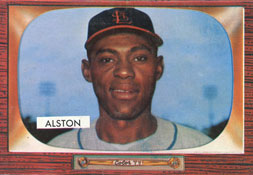
Two years after his professional baseball debut at the Class C level of the minor leagues, Tom Alston was the Opening Day first baseman for the Cardinals. Making that leap in such a short time would be a challenge for any prospect. Alston had the additional pressure of being the player who integrated the Cardinals.

tom_alstonOn April 13, 1954, Thomas Edison Alston was the first African-American to play in a regular-season game for the Cardinals, batting sixth and playing first base against the Cubs at St. Louis.

Seven seasons after Jackie Robinson joined the Dodgers, the Cardinals were the 10th of the 16 big-league teams to integrate.

Alston, 28, was the 14th African-American player in the Cardinals’ organization, but the only one on the big-league roster. (Among the other blacks in the Cardinals’ system in 1954 were pitchers Bill Greason, Brooks Lawrence and John Wyatt. All eventually pitched in the big leagues.)

Rapid rise

Alston and Jackie Robinson were born on the same date, Jan. 31. Robinson’s birth year was 1919 and Alston’s was 1926.

Alston’s rise from baseball novice to Cardinals pioneer was fast and unexpected. After serving in the Navy from 1945-47, Alston enrolled at North Carolina A&T in his hometown of Greensboro and earned a degree in physical education and social sciences. College was where Alston first played organized baseball.

In 1952, he entered professional baseball with Porterville, Calif., of the Class C Southwest International League, hit .353 in 54 games and caught the attention of the San Diego club of the Class AAA Pacific Coast League.

Alston joined San Diego midway through the 1952 season and hit .244.

In 1953 for San Diego, Alston had 207 hits in 180 games, with 101 runs scored, 23 home runs, 101 RBI and a .297 batting average. Cardinals scouts recommended him.

On Jan. 26, 1954, the Cardinals sent first baseman Dick Sisler, pitcher Eddie Erautt and $100,000 to San Diego for Alston. San Diego manager Lefty O’Doul called Alston “a great prospect who can field as good as any first baseman in the big leagues.”

He “looks like he’s going to be a great hitter, too,” O’Doul told The Sporting News.

Said Cardinals owner Gussie Busch: “When we purchased the Cardinals, I promised there would be no racial discrimination. However, Alston was not purchased because of his race. Our scouts and manager Eddie Stanky believe he is a great prospect. While he may need more experience, we didn’t want him to slip away from us.”

Bill Starr, president of the San Diego club, offered to cut the cash portion of the deal to $75,000 if the Cardinals would wait until 1955 to take Alston, according to the Los Angeles Daily Mirror, but the Cardinals wanted Alston for 1954. The incumbent at first base was Steve Bilko, who hit 21 home runs for the 1953 Cardinals but also led the National League in striking out (125 times). The Cardinals used spring training in 1954 as a competition between Alston and Bilko for the first base job.

“I think we have a real ballplayer in this colored boy,” Stanky said to The Sporting News in March 1954.

Said Alston: “They treat me here just the same as any other ballplayer and that’s how I want to be treated.”

Major leaguer

Stanky said he’d platoon Alston (a left-handed batter) and Bilko (right-handed), but Alston got the Opening Day start against Cubs left-hander Paul Minner.

“I guess I’ve come a long way in a short time,” Alston said. “I guess I came up like a real rocket.”

Alston went 0-for-4 with a strikeout and committed an error in his debut game. Boxscore

In his next game, April 17, 1954, at Chicago, Alston went hitless in his first four at-bats. In the eighth, he led off with a home run, his first big-league hit, against Cubs reliever Jim Brosnan. Boxscore

The next day, April 18, Alston got his second hit, a pinch-hit, three-run homer off left-hander Jim Davis, lifting the Cardinals to a 6-4 triumph. Boxscore

On April 30, in an endorsement of Alston, the Cardinals sent Bilko to the Cubs.

In a doubleheader against the Giants on May 2, Alston was 5-for-6 with five RBI, an inside-the-park home run and three walks. His performance was overshadowed by teammate Stan Musial, who hit five home runs with nine RBI. Game 1 boxscore Game 2 boxscore

In The Sporting News, Bob Broeg wrote of Alston’s inside-the-park home run: “His speed enabled him to circle the bases easily after Willie Mays misjudged his long wind-blown drive to left-center.”

Slowed by slump

Alston hit .301 (37-for-123) in May and was at .285 overall on May 30, but he slumped in June, enduring a 2-for-27 stretch and batting .181 (15-for-83) for the month. He had seven RBI in his last 42 games.

Alston complained that a mysterious physical ailment was causing him to feel weak. Medical exams turned up nothing. Eventually, Cardinals trainer Bob Bauman determined Alston was suffering from neurasthenia. A psychiatrist confirmed the diagnosis. According to the St. Louis Post-Dispatch, “The complicated emotional disorder somehow manifests itself in physical symptoms such as unexplained fatigue, sweating, vertigo and inability to sleep or concentrate.”

In June 1954, the Cardinals called up a black pitcher, Brooks Lawrence, from the minors and arranged with Lawrence and Alston to stay with a black family. As Lawrence recalled to Wendy Conlin of the Post-Dispatch, Alston would pray out loud at night in bed. “I would lie there and hear him praying, ‘I can hit, I can hit, I can hit.’ He made it kind of difficult to sleep sometimes,” Lawrence said.

On June 30, the Cardinals sent Alston to Class AAA Rochester and called up another rookie, Joe Cunningham, to replace him at first base. Alston’s overall numbers for the 1954 Cardinals: 60 hits in 66 games, 14 doubles, four home runs, 34 RBI and a .246 batting average. He made 62 starts at first base.

Said Cardinals general manager Dick Meyer: “Alston wasn’t ready … Eddie (Stanky) and I still have a very high regard for Alston as a prospect.”

Cunningham hit .284 with 11 home runs in 85 games for the 1954 Cardinals. The next season, the Cardinals moved Musial from the outfield to first base.

Alston made brief appearances with the Cardinals in 1955, 1956 and 1957. According to the Associated Press, when Gussie Busch asked Cardinals manager Fred Hutchinson why he didn’t play Alston, Hutchinson coldly replied, “If you want a clown to play first base, why don’t you hire (circus performer) Emmett Kelly?”

In 91 big-league games, all with St. Louis, Alston had 66 hits and batted .244.

In the 1990 book “Redbirds Revisited,” Alston told authors David Craft and Tom Owens, “I got a fair shake. It was just my physical condition that kept me from playing ball the way I knew I could play, the way the Cardinals expected me to play. My teammates treated me fairly. I don’t think they thought I was that good a hitter, though, and I guess I didn’t show them much while I was there.”

Ten years after Alston’s big-league debut, the Cardinals became World Series champions, building a reputation as a franchise that embraced diversity with players such as Bob Gibson, Bill White, Curt Flood, Lou Brock and Julian Javier.

Tom Alston took the first steps toward making that possible.

Troubled times

In 1958, Alston was arrested on arson charges after he admitted setting fire to a North Carolina church, the St. Louis Argus reported.

Police inspector M.L. Riley told the Argus that when he asked Alston why he set the church afire, Alston replied, “I had a fight with my sister and I just wanted to show her something.”

Alston spent from 1959 to 1969 in two state institutions in North Carolina, the Post-Dispatch reported.

In 1990, the Cardinals invited Alston to throw the ceremonial first pitch before a game against the Cubs at St. Louis. “I had more fun that visit than I ever had when I was playing,” Alston told Wendy Conlin of the Post-Dispatch.


Read Full Post »

(Updated April 11, 2020)

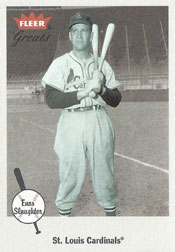
Uncertain whether outfielder Enos Slaughter could adjust to being a role player, the Cardinals decided to trade him.

enos_slaughter3Caught off-guard, Slaughter and teammate Stan Musial broke into tears.

On April 11, 1954, the Cardinals sent Slaughter to the Yankees for three prospects: outfielders Bill Virdon and Emil Tellinger and pitcher Mel Wright.

The trade occurred two weeks before Slaughter turned 38. He was the Cardinals team captain, a 10-time all-star who held the team record for games played (1,820) and RBI (1,148). Slaughter joined the Cardinals in 1938 and helped them to a World Series championship in 1942. After three years in the service, he returned to the Cardinals in 1946 and led them to another World Series title, scoring the winning run with his mad dash from first to home in Game 7.

In 13 seasons with the Cardinals, Slaughter batted .305 with 2,064 hits and an on-base percentage of .384. Known for his all-out hustle, he twice led the National League in triples (17 in 1942 and 13 in 1949). In 1942, he was the league leader in hits (188) and total bases (292). He also led the league in RBI (130) in 1946 and doubles (52) in 1939.

Slaughter showed no signs of slowing. In 143 games for the 1953 Cardinals, he produced 143 hits, 34 doubles, 89 RBI, a .291 batting average and .395 on-base percentage as the right fielder.

Youth movement

Slaughter went to spring training camp in St. Petersburg, Fla., in 1954 expecting to be a regular again in an outfield with Musial and Rip Repulski. He was surprised when, late in spring training, Cardinals manager Eddie Stanky told The Sporting News, “I’ll be satisfied if we can get 75 to 90 games out of the captain.”

Slaughter groused about the possibility of becoming a role player. Whether that was the normal grumbling of a proud veteran who didn’t want to concede playing time, or a tone of dark dissent that threatened to divide the team isn’t certain.

The Cardinals weren’t taking any chances. They wanted rookie Wally Moon to be the starting center fielder, moving Musial from left to right and Repulski from center to left.

Moon “is the best young prospect I’ve seen here in three years outside of Repulski,” Stanky told the St. Louis Post-Dispatch.

Informed of the trade by general manager Dick Meyer and Stanky after an exhibition game, Slaughter sobbed.

Slaughter called the trade “the greatest shock I ever had in my life.”

“You give everything you’ve got for an organization and then you get stepped on,” Slaughter said to the St. Louis Globe-Democrat.

Crying game

In his book “Stan Musial: The Man’s Own Story,” Musial said, “In the clubhouse, when the rest of us got the word, we were stunned. Dressing even more slowly than usual, I was the last one out. At the lot where I parked my car … I found Slaughter, still wiping his eyes. We looked at each other _ and both burst into tears.”

In justifying the trade, Stanky said, “A player like Slaughter just can’t stand sitting on a bench.”

“We are building this club with young talent,” Stanky said, “I’m sold on the way Wally Moon performed for us. If we kept Slaughter, it would mean Moon would go back to the minors.”

Said Slaughter: “I’ll be around when a lot of these guys are gone. I’m not finished. I’ll prove it to them.”

According to newspaper reports, the trade was the most unpopular with Cardinals fans since the club dealt Rogers Hornsby to the Giants after winning the 1926 World Series championship.

St. Louis writers reflected the mood of their readers. Among the tributes to Slaughter:

_ Bob Broeg in The Sporting News: “There never was a more determined competitor or hustler than the last of the old Gashouse Gang _ a hard runner, brilliant outfielder, clutch hitter.”

_ Bob Burnes in the Globe-Democrat: “Slaughter was more than a ballplayer, as any Cardinals fan could tell you. He was an institution _ not only among the fans but among the players as well.”

_ J. Roy Stockton in the Post-Dispatch: “Enos was the best competitor the club had. He still was a standout for batting skill and hustle.”

Desperate move?

The Yankees, who had an outfield of Gene Woodling in left, Mickey Mantle in center and Hank Bauer in right, were delighted with the deal for Slaughter. “We gave up practically nothing for him, so why not take him?” Yankees co-owner Del Webb said.

Other baseball executives saw Slaughter as a fading talent. The Sporting News polled the seven National League general managers besides Meyer and each said he wasn’t interested in pursuing a deal with the Cardinals for Slaughter.

Buzzy Bavasi of the Dodgers, who were planning to put rookie Sandy Amoros into an outfield with Duke Snider and Carl Furillo, said, “Personally, I wouldn’t take Slaughter over Amoros, would you?”

In response to the Yankees, Frank Lane, general manager of the American League White Sox, scoffed, “You can’t pack Old Man Time on your back and still be a great ballplayer … It was a desperate move by them.”

Actually, it was a good move for the Cardinals and Yankees.

Moon hit a home run in his first at-bat for the Cardinals on Opening Day and went on to win the 1954 National League Rookie of the Year Award, generating 193 hits, 106 runs, 18 steals, a .304 batting average and a .371 on-base percentage.

The next year, Virdon came up to the Cardinals and won the 1955 National League Rookie of the Year Award.

Slaughter adjusted well to being a role player with the Yankees. He hit .355 with 12 walks as a pinch-hitter for the 1954 Yankees. He played in the major leagues until 1959, appeared in three World Series (1956, 1957 and 1958) for the Yankees and was elected to the National Baseball Hall of Fame.


Read Full Post »

(Updated April 26, 2020)

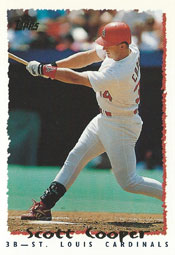
Scott Cooper enjoyed a storybook start to his Cardinals career.

scott_cooperCooper, a St. Louis native and lifelong resident, got a walkoff RBI in his Cardinals debut.

On April 26, 1995, two weeks after he was dealt to St. Louis by the Red Sox, Cooper lifted the Cardinals to a 7-6 Opening Day victory over the Phillies at Busch Memorial Stadium in St. Louis. The season began later than usual because of the players’ strike that carried over from the 1994 season.

Playing third base and batting fourth, Cooper was 3-for-5 with four RBI.

In his first plate appearance for the Cardinals, Cooper struck out against Curt Schilling. “My first at-bat I was more nervous than any at-bat in my life,” Cooper said to the Springfield (Ill.) State Journal-Register. “I have played in front of 50 million fans in the All-Star Game, but in that first at-bat I had problems getting down to the basics.”

In the ninth inning, with the Phillies ahead, 6-5, the Cardinals loaded the bases with none out against Norm Charlton, who was making his first regular-season appearance since undergoing ligament transplant surgery in his left elbow in 1993. Bernard Gilkey sparked the rally with a single. Ozzie Smith and Ray Lankford each followed with a four-pitch walk.

Cooper, acquired along with reliever Cory Bailey in a April 9, 1995, trade for pitcher Rheal Cormier and outfielder Mark Whiten, stepped to the plate with the chance to be a hometown hero. He had supplied 40 tickets to the game for friends and family, including his mother, father, sister and two brothers.

The first two pitches Charlton delivered to Cooper nearly hit him. He fouled off a pitch, then grounded the next past diving first baseman Dave Hollins for a single into right field, scoring Gilkey and Smith. Boxscore and Video

Cardinals fans chanted “Coop” in tribute.

“I’ve probably dreamed up 50,000 different scenarios for how this game would go,” Cooper said to the Associated Press, “but I probably couldn’t have written it any better.”

Said Cardinals manager Joe Torre: “He knows he’s up there to knock in runs. He was up there swinging. That’s very aggressive and I like that.”

Charlton told the Philadelphia Daily News, “We played a great game and I screwed it up.”

After a fast start to his Cardinals career _ he was batting .325 on May 17 _ Cooper tailed off. A .284 hitter in five years with the Red Sox, Cooper batted .230 in 118 games for the Cardinals. He had almost as many strikeouts (85) as hits (86).

Granted free agency after the season, Cooper played in Japan in 1996. He returned to the big leagues with the 1997 Royals in his final season as a player.

Read Full Post »

(Updated June 9, 2024)

Ken Oberkfell got called up to the Cardinals in the second half of 1978, didn’t hit, began pressing and never did achieve his potential in his brief trial that year. The next season, Oberkfell, relaxed but aggressive, became the Cardinals’ starting second baseman and enjoyed a successful rookie year.

ken_oberkfell2Oberkfell, a left-handed batter, hit .120 for the season after being promoted to the Cardinals in July 1978.

He was one of the Cardinals’ top hitters in 1979 spring training games, hitting better than .300. Still, Oberkfell didn’t have the starting second base job when the 1979 season opened. That belonged to veteran Mike Tyson.

Oberkfell impressed manager Ken Boyer by going 4-for-4 (three singles and a triple) in an April 22, 1979, game against the Reds. Boxscore

“I had one four-hit day in the minors, but it wasn’t nearly as big a thrill as this,” Oberkfell said to The Sporting News.

In May 1979, Boyer began platooning Oberkfell with Tyson, a right-handed batter. Fighting to remain a starter, Tyson tried switch-hitting in June, but Boyer allowed Tyson to hit left-handed only when the Cardinals were ahead, or when the score was tied, in games Tyson started as a right-handed batter. Oberkfell got the starts versus right-handed pitching. “I don’t think (Tyson) is as good a hitter left-handed as Oberkfell yet,” Boyer said.

Oberkfell “has fielded almost flawlessly,” wrote Rick Hummel in The Sporting News. When Tyson stretched ligaments in his left knee, Oberkfell was the fulltime starter for the last third of the season.

“I’ve always had the attitude that I’d be the Cardinals second baseman some day,” Oberkfell told Hummel. “It’s a great feeling playing for the Cardinals … The key to me this year (1979) is being more aggressive and more relaxed.”

Oberkfell led National League second basemen in fielding percentage (.985) in 1979. He made eight errors in 875.1 innings at second base and turned 65 double plays. Hummel cited Oberkfell for “standing in strongly on the double play.”

Oberkfell also batted .301 in 135 games in 1979. His .396 on-base percentage was the best of his 16 years in the majors. He hit .305 against right-handers and .287 versus left-handers.

Tyson was traded to the Cubs for reliever Donnie Moore after the 1979 season and Oberkfell remained the Cardinals’ everyday second baseman in 1980.

In 1981, the Cardinals made Tommy Herr the starter at second base and moved Oberkfell to third base, where he replaced Ken Reitz, who was traded to the Cubs in the deal that brought closer Bruce Sutter to St. Louis.

“Oberkfell could play third base,” manager Whitey Herzog told Cardinals Magazine. “He never made a bad throw to first in his life. If he could get to something, he could get it over to first perfect.”

Oberkfell led National League third basemen in fielding percentage in 1982 (.972) and 1983 (.960). He and Herr and Sutter were key players in the Cardinals’ 1982 World Series championship season.

Previously: From Les Bell to David Freese: Cardinals 3rd base champions

Read Full Post »

« Newer Posts - Older Posts »