Feeds:
Posts
Comments

Archive for the ‘Hitters’ Category

With the most important pitch of his big-league career, Frank Castillo tried to slip a fastball by Bernard Gilkey.

Wrong choice.

frank_castilloOne strike away from a no-hitter, Castillo’s high fastball was lined by Gilkey into right-center field. Sammy Sosa attemped a diving catch, but the ball landed about eight feet away from him and rolled to the wall for a triple.

In 13 major-league seasons, Castillo was 82-104 with a 4.56 ERA. His best game was the one-hitter against the Cardinals, a 7-0 Cubs victory on Sept. 25, 1995, at Chicago’s Wrigley Field. Castillo, a right-hander, struck out a career-high 13.

Throwing strikes

Facing a Cardinals club that ranked 27th in the major leagues in batting average at .248, Castillo was in command from the start.

“I knew right from the first pitch … that I could throw any pitch I wanted for a strike,” Castillo said to the Chicago Sun-Times.

Benefitting from a wide strike zone by home plate umpire Jerry Layne, Castillo walked two: Ray Lankford in the first and Tripp Cromer in the seventh.

With two outs in the ninth inning, Castillo appeared poised to complete the Cubs’ first no-hitter since Milt Pappas in 1972.

All that stood in Castillo’s way was Gilkey, the Cardinals’ left fielder and leadoff batter.

Cat and mouse

“Nobody was on my side,” Gilkey told the St. Louis Post-Dispatch. “I was up there all alone. It was a very intense situation, everybody in the stands yelling all kinds of stuff.”

After Gilkey fell behind in the count 0-and-2, Castillo threw a slider outside, followed by a low changeup, evening the count.

“I thought I threw a good pitch on the 1-and-2 changeup,” Castillo said. “I was hoping he would bite.”

Said Gilkey: “When he threw me the slider and then a changeup down, I felt like he was trying to lull me to sleep.”

Cubs catcher Scott Servais said he figured Gilkey would be looking for another slow pitch. “So, I thought, ‘OK, let’s try a fastball up and away,’ ” Servais said. “Frankie got it up fine, but it caught too much of the plate.”

Said Castillo to the Chicago Tribune: “It was one of those pitches that, as soon as I threw it, I wanted it back.”

Command and focus

Sosa had no real chance to catch the sinking liner.

“When I walked up to the plate, I had to lock in,” Gilkey said. “I had to use every ounce of energy, mentally and physically, to get that hit.”

Castillo retired the next batter, Cromer, on a fly out, preserving the shutout and earning his second complete game of the season. The Cardinals were shut out for the 19th time, most in the big leagues in 1995. Boxscore

“This definitely was the best command I’ve had all year and probably in my career,” Castillo said.

Said Cubs first baseman Mark Grace: “I’d have to say that’s the best (pitched) game I’ve played behind.”

Read Full Post »

George Scott tried to psyche out Bob Gibson before Game 7 of the 1967 World Series. Naturally, it didn’t work. Instead, Gibson struck out Scott for the final out to seal the championship for the Cardinals.

george_scottIn 1967, Scott, a first baseman, won the first of eight Gold Glove awards and batted .303 with 19 home runs and 82 RBI for the Red Sox.

In Game 1 of the World Series, Scott had a double, single and walk against Gibson. The Cardinals ace ran the count to three balls on only one batter, Scott in the ninth inning, before walking him on a 3-and-2 pitch. In Game 4, Scott singled off Gibson. The Cardinals won both games.

On Oct. 12, 1967, the morning of the decisive Game 7 at Boston, a headline in the Boston Herald Traveler newspaper blared, “We’ll KO Gibson in Five _ Scott.”

The article by George Sullivan led with this sentence: “George Scott poetically predicts Bob Gibson ‘won’t survive five’ in Thursday’s World Series Game 7.”

Brash words for a second-year big-leaguer.

Gibson and the Cardinals were neither impressed nor intimidated. Instead, they were angered, motivated.

In his book “Stranger to the Game,” Gibson said Scott gave “a poor imitation of Cassius Clay (as Muhammad Ali was known at the time).”

Said Cardinals reliever Joe Hoerner of Gibson’s reaction to Scott’s comments: “He responded … by taking it personally.”

Fifth-inning fireworks

Scott was wrong in his prediction that Gibson wouldn’t survive five, but the fifth inning did turn out to be memorable for both players.

Leading 2-0, the Cardinals scored twice in the fifth. Gibson slugged a solo home run off starter Jim Lonborg and Roger Maris produced a sacrifice fly.

Scott opened the bottom of the fifth with a triple off Gibson and scored Boston’s first run when second baseman Julian Javier, taking the relay from center fielder Curt Flood, made an errant throw trying to nail Scott at third.

That was one of the few Red Sox highlights. As he had in Games 1 and 4, Gibson dominated Game 7.

Sweet revenge

In the ninth, Scott came to bat with two outs. Gibson fanned him for his 10th strikeout of the game, securing a 7-2 Cardinals victory and their second championship in four years. Video

Gibson’s pitching line for Game 7: 9 innings, 3 hits, 2 runs, 3 walks, 10 strikeouts. Boxscore

In three wins in the 1967 World Series, Gibson struck out 26 in 27 innings.

Scott hit .231 (6-for-26) during the World Series. Against Gibson, he was 4-for-11 (.364) with a double, triple and two singles.

“There are pitchers in our league with his stuff, guys like (Dean) Chance and (Joel) Horlen and (Gary) Peters,” Scott said to The Sporting News about Gibson after Game 7. “But the thing that makes Gibson is that he’ll never give in. He’ll always challenge you. He’ll throw the ball across the plate with something on it and say, ‘There it is. See if you can hit it.’

“Other good pitchers will give you the ball when they get in trouble. But not him. He won’t give you anything. That’s what makes him a winner.”

Previously: Dick Williams couldn’t intimidate 1967 Cardinals

Read Full Post »

Ozzie Smith thought the Cardinals were being bullied and he needed to show them how to stand up for themselves. Will Clark thought Smith was behaving like a bully by attacking him from behind.

will_clark2Clark, Smith and Jose Oquendo were the principal figures in a memorable brawl during a Giants-Cardinals game at St. Louis.

On July 24, 1988, nine months after the Cardinals defeated the Giants in a seven-game National League Championship Series, the teams played a Sunday afternoon game at Busch Stadium.

In the eighth inning, Clark was on first base when Candy Maldonado hit a grounder to Smith at shortstop. Smith tossed the ball to Oquendo at second base in time to get the forceout on Clark. Attempting to prevent Oquendo from completing a double play, Clark slid over the bag and toward Oquendo.

Clark called it an aggressive, clean slide. Oquendo thought Clark could have avoided contact.

“In the old days, they played hard and aggressive and that’s the way I was brought up,” Clark said to the Associated Press.

Said Oquendo to the St. Louis Post-Dispatch: “I was just trying to get out of the way and I didn’t think that was a right slide. He slid late. I was ticked off.”

With Clark on the ground, Smith and Oquendo stood over the baserunner.  Oquendo either kicked or kneed Clark.

“When I slid, I hit the bag and bounced off to the side and I was laying against Oquendo’s leg,” Clark said. “He kneed me and said, ‘What are you doing, man?’ or something like that. There’s really no answer to that. I was trying to break up two.”

As Clark began to rise, Oquendo slapped him in the head. “I couldn’t understand what that was all about,” Clark said. “Then I just went off.”

Enraged, Clark got up and grabbed Oquendo.

Approaching from behind, Smith punched Clark in the head. “It was a cheap shot,” Clark said.

Said Cardinals manager Whitey Herzog: “Any shortstop and second baseman would do the same thing.”

Smith took several more punches, connecting with at least a couple, as Clark and Oquendo grappled.

Smith to Cards: Toughen up

”It’s become embarrassing,” Smith said to Mike Shannon of radio station KMOX. “You have a guy like Will Clark … He’s taking liberties. He’s coming down to second base at will, thinking nobody’s going to do anything, doing whatever he wants to do out there … As a competitor, it’s embarrassing for me.

”Sometimes you’ve got to stand up and be a man. That’s been part of our problem around here, guys not taking the initiative to tell people that, ‘Hey, I’m not going to be bullied.’

”I’ve never run from anybody,” Smith continued. “I’ve never been intimidated by anyone and I’m not going to start now. As a team, we have to learn that if that’s the way people want to play, that’s the way we have to play.”

Clark told reporters covering the Giants, ”I thought Ozzie Smith had a little more (class) than to sucker-punch somebody from behind. If you’re going to whup somebody, you might as well whup them face to face.”

A video of the incident showed players from both teams quickly rushed toward the combatants and piled onto one another. Maldonado took a swing at Smith. “That’s the fastest I’ve seen Maldonado run from first to second,” Giants manager Roger Craig said.

Clark and Oquendo were ejected. Asked why Smith wasn’t ejected, umpire Dutch Rennert said he hadn’t seen Smith land any punches.

“I saw Clark swing first at (Oquendo) and both were ejected for fighting,” Rennert said. “… I just saw one punch by Clark. I didn’t know Ozzie hit him. If I had seen Ozzie sucker-punch him, I would have thrown him out.”

Terry gets the message

After order was restored, Mike Aldrete came to bat against Scott Terry. The first pitch from Terry was high and wide. The second was high and inside, near Aldrete’s head. Home plate umpire Randy Marsh ejected Terry for the brushback pitch. Both benches emptied. Smith and Giants catcher Bob Brenly argued near third base, but no punches were thrown.

“By no means was I trying to hit Aldrete,” Terry said. “It was a purpose pitch. He knew it and I knew it.

“The only way the club can protect itself is on the mound. We felt like the Giants were doing things they shouldn’t be doing. We felt they had overstepped their bounds and we were not going to accept that.”

Rennert said Clark’s slide was within the rules. “(Clark) didn’t slide out of the baseline,” Rennert said. “He slid over the base. Straight and direct. A hard slide. Baseball can be a hard game.”

Said Clark: ” If I have the opportunity to do it again, I’m going to go in there the same way.” Boxscore

Previously: 1980s macho match: Whitey Herzog vs. Roger Craig

Read Full Post »

(Updated April 5, 2026)

Bill White and Curt Flood each approached his final at-bat of the 1963 season needing a hit to reach 200 for the year. Each delivered, enabling the Cardinals to have three players get 200 hits in a season for the first time in franchise history.

dick_groatWhite and Flood joined Dick Groat as Cardinals who reached 200 hits in 1963. Groat, who finished with 201, got his 200th hit in the penultimate game of the season.

According to the book “The Curt Flood Story: The Man Behind the Myth,” Flood approached Groat in 1963 after Groat was acquired by the Cardinals from the Pirates and said to him, “I got to learn to hit to the opposite field. You show me.”

“Groat and I would go out to the ballpark for long periods of time and he would help me to learn how to hit to right field,” Flood said. “That Groat, he could hit .300 with a strand of barbed wire.”

On Sept. 28, 1963, Groat entered the next-to-last game of the season with 199 hits. He tripled against the Reds’ Joe Nuxhall in the first inning for hit No. 200 and got his final hit of the season, a double off Nuxhall, in the sixth. Groat became the first Cardinals player to achieve 200 hits in a season since Stan Musial (with 200) in 1953. Boxscore

(In the 2005 book “Cardinals Where Have You Gone?” Groat was asked by writer Rob Rains to explain his hitting success in 1963. “I was hitting in front of Stan Musial all year,” Groat replied.)

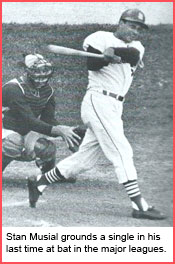
White and Flood each had 198 hits entering the season finale, Sept. 29, 1963, against the Reds at St. Louis, but the spotlight was focused on Musial, who was playing the final game of his illustrious career.

In the sixth, Flood doubled against Jim Maloney and scored on Musial’s single, the 3,630th and final hit of Stan’s career. White also singled in the inning. So Flood and White each had 199 hits.

When Flood grounded out in the seventh and White grounded out in the eighth, it appeared both would fall short of achieving 200, but the Reds scored twice in the ninth, tying the score, 2-2, and the game went to extra innings.

In the 13th, White singled against Joey Jay for hit No. 200. In the 14th, Flood singled off Jay, becoming the third Cardinal that year with 200 hits. The single moved baserunner Ernie Broglio from first to second. Dal Maxvill followed Flood with a double, driving in Broglio with the game-winning run. Boxscore

The 1963 season was the only time Groat and White reached 200 hits in a season. Flood did it one more time, getting 211 hits for the 1964 Cardinals.


Read Full Post »

Tony La Russa had lots of time to think about his faltering Cardinals club during the 1998 all-star break. The Cardinals manager used that time off to devise a batting order that surprised players and fans, creating a controversy that lingered throughout La Russa’s tenure in St. Louis.

todd_stottlemyreIn July 1998, La Russa chose to bat the pitcher eighth rather than ninth in the order.

In an article for the St. Louis Post-Dispatch, reporter Rick Hummel referred to the decision as “The Great Experiment.”

Intelligent innovation or egotistical folly? La Russa’s move was labeled both.

Even with an offense powered by the record-setting home run pace of Mark McGwire, the bullpen-poor, error-prone 1998 Cardinals entered the all-star break having lost 10 of their last 12 games.

In their first game after the break, July 9 vs. the Astros at St. Louis, La Russa posted a batting order that had pitcher Todd Stottlemyre batting eighth and rookie second baseman Placido Polanco batting ninth.

Stottlemyre became the first major-league pitcher to bat anywhere but ninth in the order since the Phillies’ Steve Carlton on June 1, 1979, at Cincinnati.

(In that game, Phillies manager Danny Ozark batted Carlton eighth and shortstop Bud Harrelson ninth. Carlton went 0-for-3 and hit into a double play; Harrelson, who entered the game hitless in five at-bats that season, was 1-for-3 with a single. The Reds won, 4-2. Boxscore)

The Phillies had been shut out in their previous three games, so the move of Carlton to the eighth spot was a gimmick. Ozark never tried it again.

La Russa was committed to the strategy. He batted his pitcher eighth in each of the last 77 games of the 1998 season.

In the 1960s, Cardinals pitcher Bob Gibson had asked manager Red Schoendienst to bat him eighth and to move shortstop Dal Maxvill to the ninth spot. Schoendienst didn’t do it. “If he had,” Maxvill said to Hummel, “I would have been so ticked off I wouldn’t have talked to him for the rest of my life. I don’t think he would want to show me up.”

La Russa informed Hummel he sought the advice of Schoendienst, then a St. Louis consultant, and Cardinals instructor George Kissell before deciding to bat the pitcher eighth in 1998. “They said it was OK,” La Russa said.

In explaining his decision, La Russa told the Post-Dispatch, “I don’t see how it doesn’t make sense for the ninth-place hitter to be a legitimate hitter. This gives us a better shot to score runs. It’s an extra guy on base in front of Ray (Lankford), Mark (McGwire) and Brian (Jordan). The more guys who are on base, the less they’ll be able to pitch around Mark. I don’t have a problem with it.”

Cardinals’ first game with pitcher batting eighth

Polanco, appearing in his third big-league game, was 0-for-2 from the ninth spot on July 9, 1998, before Willie McGee pinch-hit for him in the seventh. Stottlemyre was 1-for-2. The pitcher led off the third with a single and scored on Royce Clayton’s double. Still, the Cardinals made four errors and grounded into three double plays. Houston won, 5-4. Boxscore

Said Stottlemyre: “I stink whether I hit eighth or ninth. I take my swings. I take my seat. And I get ready to pitch.”

The more La Russa continued to bat the pitcher eighth, the more the criticism grew.

“I think the National League is investigating the Cardinals and Tony,” catcher Tom Pagnozzi said after batting ninth for the first time.

Said La Russa: “It would be nice if it would become a non-issue.”

La Russa legacy?

According to the book “Cardinals Journal” (2006, Emmis Books), the 1998 Cardinals scored 4.98 runs per game with the pitcher batting ninth and 4.96 runs per game with the pitcher batting eighth.

From 1998 to 2011 (his last season as manager), La Russa batted the pitcher eighth 432 times. He batted Cardinals pitchers eighth in the last 56 games of 2007 and in 153 games in 2008.

(Until La Russa, the manager who had batted the pitcher eighth the most times in a season was Lou Boudreau of the 1957 Athletics. He batted the pitcher eighth for the first 56 games that season. Boudreau was fired in August that year.)

La Russa batted Cardinals pitchers eighth 55 times in 2009, 77 times in 2010 and 14 times in 2011.

Previously: Tony La Russa: Proud pupil of mentor Paul Richards

Read Full Post »

In 1988, the defending National League champion Cardinals staggered into the all-star break after experiencing a humiliating loss during a series that exposed multiple flaws and severely tested their resolve.

chris_speierThe 1988 Cardinals ended their first half of the season with three games at San Francisco. Mike LaCoss pitched a four-hitter in the opener, a 1-0 Giants win. Terry Mulholland pitched a five-hitter in the finale and the Giants won, 2-1.

It was the middle game of the set that sent the Cardinals reeling.

The Giants beat them, 21-2, on Saturday afternoon, July 9, 1988, at Candlestick Park.

Summarizing the Cardinals’ performance, Rick Hummel of the St. Louis Post-Dispatch wrote, “Their defense was less than airtight and their hitting was poor, but, most strikingly, their pitching was colossally bad.”

The 21 runs allowed were the most a Cardinals team had surrendered in 63 years, according to the Post-Dispatch. The Pirates defeated the Cardinals, 24-6, on June 22, 1925, at St. Louis. Boxscore

The 21 runs also were the most scored by the Giants since they moved to San Francisco from New York in 1958. The previous high was 19.

Two unlikely Giants standouts in the blowout win were infielders Chris Speier and Ernest Riles.

Speier, 38, filling in at second base for ailing all-star Robby Thompson, hit for the cycle and had five RBI. He had two doubles, a triple, a home run and a single. It was the only five-hit game in Speier’s 19-year major-league career.

The oldest big-league player to hit for the cycle was Cy Williams, 39, of the 1927 Phillies, the Post-Dispatch reported. Like Speier, Honus Wagner of the 1912 Pirates was 38 when he hit for the cycle.

Speier entered the game with a .191 batting average. “I hadn’t been doing much the last month and a half,” Speier said to the Associated Press. “I had a long talk with my wife and I just decided to relax and have some fun.”

Riles had been acquired by the Giants a month earlier in a trade that sent outfielder Jeffrey Leonard to the Brewers. Riles, who entered the game in the sixth inning as a replacement for shortstop Jose Uribe, hit a three-run home run in the seventh. It was the 10,000th home run in Giants history and the first for Riles as a Giant.

The ball hit off the facing of the upper deck and caromed back onto the field. Disgusted, Cardinals right fielder Tom Brunansky picked up the historic ball and heaved into the stands. After the game, Brunansky sought a closed-door meeting with Cardinals manager Whitey Herzog.

“This was pathetic,” Brunansky told the Post-Dispatch. “I was embarrassed.”

Shortstop Ozzie Smith said, “Anybody who is proud of this shouldn’t be here.”

Cardinals starting pitcher John Tudor entered the game with a 1.72 ERA. The Giants knocked him out with five runs in two innings.

“You don’t figure to lose a game by that much with John Tudor pitching,” Herzog said. “His location was bad, but even then it shouldn’t have been that bad.”

Relievers Bob Forsch and Steve Peters each gave up eight runs.

“It was ugly,” Forsch told the Post-Dispatch. “Ugly for me.”

Said Peters: “It’s the worst embarrassment I ever had.”

The Giants ended up with 20 hits and six walks.

Herzog, keeping a sense of humor, told the Associated Press, “I wish we were playing a doubleheader today. We would have had them (the Giants) tired out for the second game.” Boxscore

Read Full Post »

« Newer Posts - Older Posts »