Feeds:
Posts
Comments

Archive for the ‘Hitters’ Category

(Updated Jan. 12, 2022)

The 1963 Cardinals infield established an all-star standard that went unmatched for 53 years.

allstar_infieldFor the first time in major-league history, the National League’s All-Star Game starting infield was composed of players from the same team. They were the Cardinals unit of first baseman Bill White, second baseman Julian Javier, shortstop Dick Groat and third baseman Ken Boyer.

The Giants’ Alvin Dark, who managed the 1963 National League all-star team, told The Sporting News, “When you’ve got an infield that starts with Bill White at first base and runs through Julian Javier, Dick Groat and Ken Boyer, you’ve got power and class.”

In 2016, fans selected an all-Cubs starting NL all-star infield of first baseman Anthony Rizzo, second baseman Ben Zobrist, shortstop Addison Russell and third baseman Kris Bryant.

Fans have voted for the all-star starters each year since 1970. In 1963, the starters were selected in voting by players, managers and coaches in each league.

White, Groat, Boyer and Pirates second baseman Bill Mazeroski were voted the starters for the 1963 NL team, but Mazeroski withdrew after he pulled a muscle in his right leg.

Cubs second baseman Ken Hubbs had finished second to Mazeroski in the voting, but Dark picked Javier to replace Mazeroski as the starting second baseman.

United Press International wrote, “Usually, all-star managers in picking reserves for their squad stick mighty close to the way the players themselves voted earlier in choosing the starting lineup.”

Said Dark to the Associated Press: “I feel this is the strongest squad we have.”

Javier “doesn’t have any shortcomings,” Groat told the St. Louis Post-Dispatch. “He runs well, has good range, fine hands and pivots well.”

Here were the top two vote-getters for each NL infield position:

First base: Bill White, 220 votes; Orlando Cepeda, Giants, 38 votes.

Second base: Bill Mazeroski, 227 votes; Ken Hubbs, 14 votes.

Shortstop: Dick Groat, 238 votes; Maury Wills, Dodgers, 25 votes.

Third base: Ken Boyer, 186 votes; Ron Santo, Cubs, 52 votes.

The other starting position players for the 1963 NL all-stars were Giants catcher Ed Bailey and outfielders Hank Aaron of the Braves, Willie Mays of the Giants and Tommy Davis of the Dodgers.

The Cardinals’ Stan Musial, 42, was chosen by Dark as an outfield reserve. It would be a record 24th and final All-Star Game for Musial, who retired after the season.

Best Cardinals infield

In his book “Stan Musial: The Man’s Own Story,” Musial said, “That infield was the strength of the 1963 Cardinals, all right … Marty Marion said the Cardinals’ 1946 infield was a bit better. I’m not so sure, though we did have a good one in ’46. I played first base then, Red Schoendienst second, Marion short and George Kurowski third. That far back, Red hadn’t yet come into his own as a hitter.”

In a 2011 interview, I asked White if the 1963 Cardinals infield was the best he’d seen. White’s response:

“It was a good infield. It probably was not the best. Ken Boyer might have been the best third baseman I’d seen or played with. Groat had mobility problems. He understood how to play the hitters, but he had very little range and he didn’t have that real good arm. Javier was a pretty good second baseman. He made a great double play and he could go way out to center field for pop-ups because Curt Flood played a deep center field.

“It was a good infield, the best infield that I was on, but I’m not sure it was the best ever. It might have been the best Cardinals infield.”

Branch Rickey said the 1963 Cardinals infield was comparable to the 1952 Dodgers infield of first baseman Gil Hodges, second baseman Jackie Robinson, shortstop Pee Wee Reese and third baseman Billy Cox. “I’d still give that Brooklyn infield the edge defensively,” Rickey told The Sporting News in June 1963, “but this Cardinals infield has more offensively and might even get to be better.”

White, Groat aid NL win

White and Groat contributed significantly to the NL’s 5-3 victory over the American League on July 9, 1963, at Cleveland. They and Javier played the entire game. Santo replaced Boyer in the sixth.

In the second, Groat’s single off starter Ken McBride of the Angels drove in Mays from second, giving the NL a 1-0 lead.

With the NL ahead 4-3 in the eighth, White led off against imposing Red Sox reliever Dick Radatz, nicknamed “The Monster,” and singled to center.

Taking his lead off first base, White watched Radatz pitch to Mays and detected a flaw in the pitcher’s motion, he told The Sporting News. As Mays struck out, White swiped second. White ran on his own, Dark said.

Radatz “came set and started his left leg forward a couple of pitches in a way that showed just when he definitely was going to the plate, not to first base,” White told the Post-Dispatch.

Santo singled to center, scoring White and boosting the NL’s advantage to 5-3.

With Dodgers ace Don Drysdale pitching the ninth, the Orioles’ Brooks Robinson singled with one out. The next batter, Bobby Richardson of the Yankees, hit a grounder to White. The Cardinals’ first baseman threw to Groat covering second and Groat’s return throw to White nipped Richardson for a game-ending first-to-short-to-first double play. Boxscore

The NL turned three double plays. White took part in all three and Groat helped turn two. White and Groat each went 1-for-4; Javier and Boyer each was hitless.

(Musial, pinch-hitting for Bailey in the fifth, faced Jim Bunning and lined out to Al Kaline in right field. “I got out in front of the pitch just a fraction or I’d have hit it out of there,” Musial said.)

Groat and Boyer both were elected starters again in 1964, but White and Javier were replaced by Cepeda and the Mets’ Ron Hunt.
 

Read Full Post »

In a season when Mark McGwire pummeled pitchers with his home run power, Bob Tewksbury used lollipop pitches to keep the Cardinals slugger from hitting the ball out of the infield.

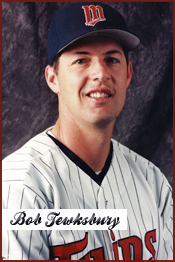
bob_tewksburyIn 1998, Tewksbury, the former Cardinal, was with the Twins in what would be the last of his 13 major-league seasons. McGwire was in his first full year with the Cardinals and headed toward a record-breaking season in which he would hit 70 home runs.

On June 28, 1998, Tewksbury got the start against the Cardinals at the Hubert H. Humphrey Metrodome in Minneapolis.

McGwire entered the game with 36 home runs and a .313 batting average.

When McGwire came to bat in the first inning, Tewksbury lobbed a pitch toward the plate. McGwire watched it float out of the strike zone for ball one. Tewksbury followed with another lob, a pitch accurately described by Dan Barreiro of the Minneapolis Star Tribune as a lollipop. Rather than give it a lick, McGwire swung and dribbled a grounder to first base.

As he headed toward the dugout, McGwire shared a laugh with first-base coach Dave McKay, the Associated Press reported.

“It was all of 44 (mph),” Tewksbury told the St. Louis Post-Dispatch. “… My son (Griffin) calls it The Dominator. (Manager) Tom Kelly calls it The Entertainment Pitch. The hitters probably call it some other things.”

Said McGwire: “It was awesome. I loved it. I tell you what, I’ll swing at it every time if it’s in the strike zone.”

When McGwire came to bat again, in the fourth, Tewksbury got two quick strikes on the slugger before he floated the lob pitch. McGwire swung and popped out near first base.

“The first time it was funny,” Cardinals manager Tony La Russa said. “He kept getting outs with it _ and then it wasn’t funny.”

Said Tewksbury: “I can’t throw the ball by him, but I can throw it slower. I was excited to face McGwire. I couldn’t wait to face him. It was a thrill. He’s one of the best ever to play the game.”

In the sixth, McGwire singled off a Tewksbury curve. “I didn’t want to get crazy with it,” Tewksbury said about why he didn’t try the lob to McGwire again. “He’d hit it in the upper deck.”

When Ray Lankford came up in the same inning, Tewksbury delivered two lobs. Lankford watched one and grounded out on the other, ending the inning.

In 6.1 innings, Tewksbury yielded two runs on seven hits, walked none and struck out two. He threw five lobs _ three to McGwire and two to Lankford _ and recorded three outs with those floaters. The Twins won, 3-2. Boxscore

“From the variance of slowest pitch to fastest in the league, I can probably go farther than anybody,” Tewksbury said. “I can throw 44 (mph) and I can throw 83 (mph).”

Previously: Think Lance Lynn is a surprise? Check out Luis Arroyo

Read Full Post »

(Updated June 11, 2024)

Keith Hernandez was a World Series hero, the best-fielding first baseman in the sport, the most consistent hitter in the Cardinals’ lineup, winner of a league Most Valuable Player Award and a fan favorite.

keith_hernandez2To Whitey Herzog, none of that made up for what the Cardinals manager considered an unforgivable sin _ lack of maximum effort.

In a trade that remains one of the Cardinals’ most unpopular and contentious, Hernandez was dealt to the Mets on June 15, 1983, for pitchers Neil Allen and Rick Ownbey.

The deal, which Mets catcher John Stearns called “the biggest heist since the Thomas Crown Affair,” was made, in part, because of the Cardinals’ need for pitching. Their top two starters, Joaquin Andujar and Bob Forsch, were having subpar seasons and the Cardinals also lacked a reliable replacement for departed No. 5 starter Steve Mura. “Good arms are hard to come by,” Cardinals general manager Joe McDonald said to United Press International. “If Allen was not having a bad year, there’s no way we could have gotten him.”

Herzog told the St. Louis Post-Dispatch, “We had to decide if we were going to have enough hitting if we did this. Or did we have enough pitching if we didn’t do it? We need pitching.”

The primary reason for the deal, though, was the deteriorating relationship between Herzog and Hernandez.

Do the hustle

In his book “White Rat: A Life in Baseball,” Herzog was unsparing in his criticism of Hernandez, saying:

Keith Hernandez was dogging it … He’s the best defensive first baseman I’ve ever seen. But on offense, he was loafing. He loafed down the line on ground balls and he wasn’t aggressive on the bases.

“What I couldn’t live with was his attitude. I’ve got two basic rules _ be on time and hustle _ and he was having trouble with both of them … His practice habits were atrocious. He’d come out for batting practice, then head back to the clubhouse to smoke cigarettes and do crossword puzzles … It was getting to the point where I was fed up with him.”

Herzog began clashing with Hernandez soon after taking over as Cardinals manager in June 1980. In a game at Atlanta during Herzog’s first series as manager, Hernandez didn’t run hard on a fly ball that was dropped. “Hernandez has the ability to be among the best players in the major leagues,” Herzog told The Sporting News, “but one little thing like that can make him a bad guy for a long time. When you’re out there, run hard.”

According to the Post-Dispatch, the Cardinals first offered Hernandez to the Mets after the 1980 season in exchange for Allen, second baseman Doug Flynn and pitcher Tim Leary, but the Mets declined.

Time to go

Early in the 1983 season, Hernandez came close to being dealt to the Astros. According to the Post-Dispatch, the Astros offered to swap first baseman Ray Knight and pitcher Vern Ruhle for Hernandez.

In an interview for the book “Whitey’s Boys,” Hernandez said, “I could tell a trade was coming (in 1983) because I knew I wasn’t in Whitey’s good graces.”

On June 15, 1983, Hernandez was taking batting practice at Busch Stadium when he was called into Herzog’s office. As he approached the office, Hernandez told the Post-Dispatch, “I knew I was gone.”

Herzog informed Hernandez of the trade to the Mets 20 minutes before it was announced. “It wasn’t an easy thing for him to tell me,” Hernandez said.

Hernandez called his agent to find out whether he could block the trade. “I wasn’t shocked I was traded,” Hernandez said. “I was shocked it was to the Mets.”

“I’m disappointed,” Hernandez told the Post-Dispatch. “I loved it here and the fans were great to me.”

When the deal was announced on the Busch Stadium scoreboard, fans booed.

Eight months earlier, Hernandez had produced seven hits and eight RBI in the last three games of the 1982 World Series. He sparked a Cardinals comeback in the decisive Game 7, driving in the tying run with a two-run single. He hit .299 in 10 years with St. Louis, won the 1979 National League batting title, shared the Most Valuable Player Award that year (with the Pirates’ Willie Stargell) and won five consecutive Gold Glove awards from 1978-82.

In a column about the trade, Kevin Horrigan of the Post-Dispatch wrote, “The Mets are getting a great hitter and a great first baseman, but they’re also getting a good guy, a man who has grown up a lot in the last three years.”

In exchange for Hernandez, the Cardinals got Allen (2-7, 4.50 ERA) and Ownbey (1-3, 4.67). Allen had told the Mets he thought he had an alcohol problem. Instead, he was diagnosed as suffering from stress.

“So the Cards had to enter the pitching market, which is so badly inflated it looks like it’s being run by an Argentinian junta,” Horrigan wrote in the Post-Dispatch. “Inflation touches us all. Ten grand for a Chevrolet? Outrageous. A buck for a hamburger? Absurd. Buck and a quarter for a gallon of gas? Ridiculous. A Keith Hernandez for Neil Allen and Rick Ownbey? Outrageous, absurd and ridiculous.”

Said Herzog: “If Allen falls on his butt, then we got jobbed, but everybody in the organization … were in agreement this had to be done.”

Hernandez told Cardinals Magazine, “Whitey was the best manager I ever played for. That’s not a criticism of the others. Whitey made me a better player … He just basically taught us how to win.”

Mets make out

Mets general manager Frank Cashen called the acquisition of Hernandez “the biggest deal” he had made since joining the club, the New York Daily News reported. Cashen said the Cardinals initiated the trade. “Joe McDonald told me right off we could have Hernandez if we were willing to give up Allen,” Cashen told the Daily News.

The Associated Press declared the trade “a total surprise.”

Second baseman Tommy Herr told the Post-Dispatch, “I really don’t understand why they had to trade Keith. It’s difficult taking his bat out of the lineup.”

In remarks to the Daily News, Mets pitcher Tom Seaver said, “This may be the best deal the Mets have ever made because of the overall reaction Keith’s presence will create … The one thing we have not had is a consistent third-place hitter. There are not many more consistent players in baseball than Keith.”

Herzog said to Cardinals Magazine, “He might have been the best hit-and-run man I ever managed. I thought George Brett was good when I managed him and he was very good, but Keith Hernandez never, ever swung and missed a (hit-and-run) ball. He loved to hit-and-run, and we used it an awful lot with him.”

John Stearns spoke for many when he told Frank Dolson of Knight-Ridder Newspapers, “Were they (the Cardinals) drunk when they made that deal? I just couldn’t believe it. I thought, ‘Do they know something about Hernandez that we don’t? Is there a problem somewhere?’ ”

Turns out there was more of a problem than most knew.

Drug deal

In testimony two years later in a federal court case, Hernandez said he had used “massive” amounts of cocaine, starting in 1980 after he was introduced to the drug by Cardinals teammate Bernie Carbo, and had developed an “insatiable desire for more.”

Hernandez testified he broke his cocaine habit on his own just before the trade to the Mets. Hernandez said what motivated him to stop using was seeing teammate Lonnie Smith have a “bad experience” with the drug after a game at Philadelphia.

Herzog said he didn’t know Hernandez had been using drugs, but that he had become suspicious.

Meet the Mets

Hernandez would thrive with the Mets. At the time of the trade, the Mets had the worst record in the major leagues. Hernandez helped transform them into contenders by 1984 and World Series champions in 1986.

In his book “Mookie,” Mets center fielder Mookie Wilson said of Hernandez, “One thing I didn’t envision was what kind of clubhouse presence he would bring. Even before we saw what he could do on the playing field every day, it was his mannerisms and professionalism that made him stand out. He didn’t come in with the rah-rah stuff or any glitter. Instead, it was clear that he was a student of the game and learned a lot about leadership from guys like Lou Brock and some of the other great Cardinals veterans he played with.”

Allen was 20-16 with five saves in three seasons with St. Louis. Ownbey was 1-6 in two Cardinals seasons.

Said Herzog: “People always say it’s the worst deal I’ve ever made, but I don’t believe that … Getting rid of Hernandez was addition by subtraction. I really feel that, if we had kept him, his attitude and his bull would have ruined our ball club. I know he never would have been as good for us as he has been with the Mets.”

Read Full Post »

On the surface, Lonnie Smith in 1983 was having a strong follow-up to his successful first season with the Cardinals. What most, including his manager and many of his teammates, apparently couldn’t see was that an addiction to cocaine had Smith on the verge of a breakdown.

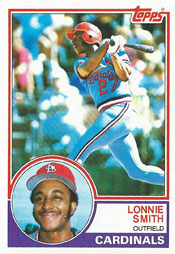
lonnie_smith3In June 1983, Smith approached Whitey Herzog, informed the Cardinals manager he was abusing drugs and needed help. Two days later, with Herzog’s support, Smith left the Cardinals and entered a drug rehabilitation facility, the Hyland Center in St. Louis.

Smith spent a month in the treatment center, returned to the Cardinals’ lineup on July 8 and performed well the remainder of the season, nearly winning the National League batting title. Smith hit .321, two percentage points behind 1983 batting champion Bill Madlock (.323) of the Pirates.

In 1982, Smith had sparked the Cardinals to the World Series championship. The left fielder hit .307, scored 120 runs and had 68 stolen bases. Three years later, Smith testified in court that he had bought cocaine three weeks before the World Series and had used the drug with teammates Keith Hernandez and Joaquin Andujar.

Smith was hitting better than .300 in early June 1983, but his drug use was intensifying.

“I did cocaine and pot mostly and I was even starting to drink,” Smith told the Associated Press in March 1984. “That was a bad sign because my father was an alcoholic and still is. I saw what it did to him and I had stayed away from that. But avoiding alcohol left me wide open to drugs.

“I started in high school in Los Angeles … It progressively got worse. The more you do, the worse it gets.”

On June 8, 1983, Smith went 0-for-2 with a pair of walks at Philadelphia. Boxscore Years later, in an interview with Kent Babb of The State newspaper in Columbia, S.C., Smith said he bought drugs after that game.

Wrote Babb: “(Smith) holed up in his hotel room, plowed through the drugs and began a night that would chill him to the bone. Smith says he did not sleep that night; he sat on the floor, shaking and sweating as the sun rose, and was terrified he was on the edge of a fatal overdose. He did not play in the Cardinals’ game the next day, feeling nauseated in the dugout and stuffing clumps of toilet tissue into his nostrils to stop a chronic nosebleed.”

It was that day, June 9, that Smith told Herzog of his drug problem and asked for help. Babb later reported that “Smith learned he had consumed so much cocaine that he developed a large ulcer in one of his nostrils, a sign he was burning away the flesh of his nose.”

“I felt so terribly drained,” Smith said in the 1984 interview with Hal Bock of the Associated Press. “I was losing interest in everything in life.”

The Cardinals left Philadelphia that night and went to Chicago for a day game with the Cubs on June 10. While arrangements were being made to admit Smith to the rehabilitation center, Herzog put Smith in the lineup that day. Smith produced two singles against Ferguson Jenkins, who shut out the Cardinals, 7-0. Boxscore

The next day, June 11, 20 minutes before the Cardinals-Cubs game, Herzog informed reporters that Smith had left the team and begun “in-patient therapy for a drug problem.”

Herzog said he wasn’t aware of any drug problems with Smith before the player approached him in Philadelphia.

In his book “White Rat: A Life in Baseball” (1987, Harper and Row), Herzog recalled, “(Smith) came to me and asked for help. He said he’d tried, but he couldn’t stop taking coke. He had a bad, bad problem. It later developed at that (1985) drug trial in Pittsburgh that Lonnie was using coke with Hernandez and Andujar. He didn’t tell me that at the time. He only asked for help, and we got it for him. I admired him, and still do, for having the guts to ask for help.”

Dane Iorg, who platooned with David Green as the replacements for Smith, told The Sporting News that Smith’s drug use was “really shocking.” Pitcher Dave LaPoint said, “I had no idea … None of us expected it.” Catcher Darrell Porter, who underwent treatment in 1980 for drug and alcohol addiction, said, “(Smith) never came to me. I didn’t know anything about it.”

Smith’s wife, Pearl, told St. Louis Post-Dispatch reporter Rick Hummel she also was surprised. “This is the first I’d heard of it,” she said. “I’d never seen it at home.”

Said Lonnie Smith to the Associated Press: “At first you deny it. That’s the first step in realizing you’re in trouble. Addicts are the biggest con men in the world.”

In an interview for the book “Whitey’s Boys” (2002, Triumph), Smith said, “After 1982 I started getting (drugs) in the mail through the winter, and in 1983 I was involved pretty bad. I couldn’t function as a husband, a father or a player. I was rushing back to my room, locking the door and doing it. I was constantly doing it until I ran out _ and then I wanted to go out and do more.”

In his first game after rehabilitation, Smith went 2-for-4 at San Diego. Boxscore He later told the Associated Press that the first week in the treatment center was difficult.

“I was undergoing addiction withdrawal,” Smith said. “I felt terrible.

“I still get the craving for drugs. You never get over that.”

Previously: Cardinals beat Pascual Perez on way to 1982 pennant

Read Full Post »

(Updated June 9, 2020)

Tim McCarver and Terry Pendleton each hit an inside-the-park grand slam for the Cardinals against the Mets on the same date, 22 years apart.

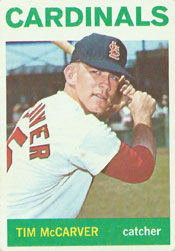
tim_mccarver3Each occurred on June 9 in New York in the second game of a Sunday doubleheader.

McCarver hit an inside-the-park grand slam June 9, 1963, in the Cardinals’ 10-4 win over the Mets in Game 2 of a doubleheader at the Polo Grounds.

Pendleton hit an inside-the-park grand slam June 9, 1985, in the Cardinals’ 8-2 win over the Mets in Game 2 of a doubleheader at Shea Stadium.

Both occurred because of outfield misplays.

Slipping and sliding

The Cardinals led, 6-1, in the eighth inning when McCarver batted with the bases loaded, one out, against Mets rookie reliever Larry Bearnarth and laced a line drive to center.

“I was just figuring on a sacrifice fly,” McCarver told The Sporting News.

Center fielder Rod Kanehl got to the ball and, just as he appeared ready to make the catch, slipped and fell. The ball darted past him and rolled to the wall, 475 feet from home plate. McCarver raced home with his second big-league home run. It was the first grand slam he’d hit at any level of competition.

Cardinals center fielder Curt Flood empathized with Kanehl, informing the St. Louis Post-Dispatch, “The turf is loose and the grass is slippery out there. I slipped three or four times running when the ball wasn’t even hit to me.” Boxscore

Communication breakdown

Like McCarver, Pendleton was looking to extend a Cardinals lead when he came up against Mets reliever Joe Sambito with the bases loaded and one out in the fifth inning. St. Louis led, 4-0.

Pendleton hit Sambito’s first pitch to right-center. Right fielder Danny Heep and center fielder Terry Blocker gave chase.

“At first I thought, ‘Good, we’ll get a run on a sacrifice fly,’ ” Pendleton told the New York Times. “Then I looked in the outfield and saw them flying at each other, not slowing down.”

As Blocker was reaching for the ball, he and Heep collided, and the ball caromed off Blocker’s glove. “We both called for it, but I didn’t hear him until the last second,” Heep said to the New York Daily News.

“I could see it coming,” Cardinals manager Whitey Herzog said to the Associated Press. “Neither one of them knew if they could catch the ball.”

Blocker lay motionless. Heep recovered, retrieved the ball and got it to first baseman Keith Hernandez, whose relay throw was too late to nab Pendleton. Boxscore

“I thought one of them would be able to get up in time,” said Pendleton. “I thought I had a shot at a triple.”

Becker injured both knees and was carried from the field on a stretcher.

“It’s a hell of a way to get a grand slam, isn’t it?” Herzog asked.


Read Full Post »

In 1963, his final season as a player, Stan Musial went on a tear in May that began with a bases-loaded double and ended with one of the most bizarre RBI in his distinguished Cardinals career.

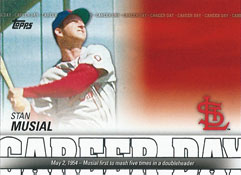
stan_musial24Musial, 42, had 23 RBI in 26 games in May 1963. Those were the most RBI he produced in a month since he had 27 in June 1957. He also hit seven home runs in May 1963. That represented his best output in a month since he clubbed seven in August 1957.

On May 2, his first game played in the month, Musial hit a two-out, three-run double off Cubs reliever Don Elston in the seventh, increasing the St. Louis lead from 1-0 to 4-0 in a game the Cardinals won, 4-3. Boxscore

In late May, Cardinals manager Johnny Keane moved Musial into the cleanup spot. In seven games from May 22 through May 31, Musial had nine RBI and hit .400 (12-for-30) while batting fourth.

On May 31, Musial was credited with an unusual game-winning RBI against the Giants at St. Louis.

In the bottom of the ninth, with the score 5-5, the Cardinals loaded the bases with none out. Giants manager Al Dark brought in left-hander Billy Pierce to face Musial.

With the infield playing in for a play at the plate, Musial hit a pop fly to the right of the second base bag.

“Rookie second baseman Cap Peterson looked about as Willie Mays charged in from his shallow center field spot and speedy Felipe Alou raced in from right field,” The Sporting News reported. “The ball fell among the befuddled trio. The play was ruled an infield fly. Thus, Musial was out, but Curt Flood, who had been on third base, roared home when the ball hit the ground and (Musial) was credited with the strangest of his 1,921 big-league RBI at that point.

“Mays came closest to getting the ball. He tried to scoop it up for a throw home, but the ball bounced away from him. Then in disgust Willie kicked his glove about 30 feet.”

With the 6-5 victory, Boxscore the Cardinals climbed into second place in the National League, two games behind the defending champion Giants. Boxscore

“In May, reinstated in the cleanup spot, (Musial) helped pull the Cards up by their bootstraps,” The Sporting News concluded.

Musial began June the same way he started May. He drove in three runs on June 1 in the Cardinals’ 7-4 victory over the Giants. Boxscore The three RBI gave Musial 1,924 for his career, moving him ahead of Jimmie Foxx for No. 3 on the all-time list. Babe Ruth then was first at 2,200 and Lou Gehrig second at 1,992.

Limited to 17 games in June because of a leg injury, Musial hit .311 for the month but had no home runs in 45 at-bats and drove in six runs.

After a subpar July and August, Musial finished strong in September, batting .299 for the month, with three home runs and 12 RBI.

Read Full Post »

« Newer Posts - Older Posts »