Feeds:
Posts
Comments

Archive for the ‘Hitters’ Category

On the surface, Lonnie Smith in 1983 was having a strong follow-up to his successful first season with the Cardinals. What most, including his manager and many of his teammates, apparently couldn’t see was that an addiction to cocaine had Smith on the verge of a breakdown.
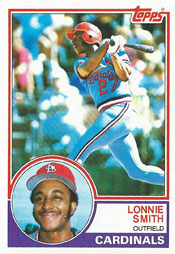
lonnie_smith3In June 1983, Smith approached Whitey Herzog, informed the Cardinals manager he was abusing drugs and needed help. Two days later, with Herzog’s support, Smith left the Cardinals and entered a drug rehabilitation facility, the Hyland Center in St. Louis.

Smith spent a month in the treatment center, returned to the Cardinals’ lineup on July 8 and performed well the remainder of the season, nearly winning the National League batting title. Smith hit .321, two percentage points behind 1983 batting champion Bill Madlock (.323) of the Pirates.

In 1982, Smith had sparked the Cardinals to the World Series championship. The left fielder hit .307, scored 120 runs and had 68 stolen bases. Three years later, Smith testified in court that he had bought cocaine three weeks before the World Series and had used the drug with teammates Keith Hernandez and Joaquin Andujar.

Smith was hitting better than .300 in early June 1983, but his drug use was intensifying.

“I did cocaine and pot mostly and I was even starting to drink,” Smith told the Associated Press in March 1984. “That was a bad sign because my father was an alcoholic and still is. I saw what it did to him and I had stayed away from that. But avoiding alcohol left me wide open to drugs.

“I started in high school in Los Angeles … It progressively got worse. The more you do, the worse it gets.”

On June 8, 1983, Smith went 0-for-2 with a pair of walks at Philadelphia. Boxscore Years later, in an interview with Kent Babb of The State newspaper in Columbia, S.C., Smith said he bought drugs after that game.

Wrote Babb: “(Smith) holed up in his hotel room, plowed through the drugs and began a night that would chill him to the bone. Smith says he did not sleep that night; he sat on the floor, shaking and sweating as the sun rose, and was terrified he was on the edge of a fatal overdose. He did not play in the Cardinals’ game the next day, feeling nauseated in the dugout and stuffing clumps of toilet tissue into his nostrils to stop a chronic nosebleed.”

It was that day, June 9, that Smith told Herzog of his drug problem and asked for help. Babb later reported that “Smith learned he had consumed so much cocaine that he developed a large ulcer in one of his nostrils, a sign he was burning away the flesh of his nose.”

“I felt so terribly drained,” Smith said in the 1984 interview with Hal Bock of the Associated Press. “I was losing interest in everything in life.”

The Cardinals left Philadelphia that night and went to Chicago for a day game with the Cubs on June 10. While arrangements were being made to admit Smith to the rehabilitation center, Herzog put Smith in the lineup that day. Smith produced two singles against Ferguson Jenkins, who shut out the Cardinals, 7-0. Boxscore

The next day, June 11, 20 minutes before the Cardinals-Cubs game, Herzog informed reporters that Smith had left the team and begun “in-patient therapy for a drug problem.”

Herzog said he wasn’t aware of any drug problems with Smith before the player approached him in Philadelphia.

In his book “White Rat: A Life in Baseball” (1987, Harper and Row), Herzog recalled, “(Smith) came to me and asked for help. He said he’d tried, but he couldn’t stop taking coke. He had a bad, bad problem. It later developed at that (1985) drug trial in Pittsburgh that Lonnie was using coke with Hernandez and Andujar. He didn’t tell me that at the time. He only asked for help, and we got it for him. I admired him, and still do, for having the guts to ask for help.”

Dane Iorg, who platooned with David Green as the replacements for Smith, told The Sporting News that Smith’s drug use was “really shocking.” Pitcher Dave LaPoint said, “I had no idea … None of us expected it.” Catcher Darrell Porter, who underwent treatment in 1980 for drug and alcohol addiction, said, “(Smith) never came to me. I didn’t know anything about it.”

Smith’s wife, Pearl, told St. Louis Post-Dispatch reporter Rick Hummel she also was surprised. “This is the first I’d heard of it,” she said. “I’d never seen it at home.”

Said Lonnie Smith to the Associated Press: “At first you deny it. That’s the first step in realizing you’re in trouble. Addicts are the biggest con men in the world.”

In an interview for the book “Whitey’s Boys” (2002, Triumph), Smith said, “After 1982 I started getting (drugs) in the mail through the winter, and in 1983 I was involved pretty bad. I couldn’t function as a husband, a father or a player. I was rushing back to my room, locking the door and doing it. I was constantly doing it until I ran out _ and then I wanted to go out and do more.”

In his first game after rehabilitation, Smith went 2-for-4 at San Diego. Boxscore He later told the Associated Press that the first week in the treatment center was difficult.

“I was undergoing addiction withdrawal,” Smith said. “I felt terrible.

“I still get the craving for drugs. You never get over that.”

Previously: Cardinals beat Pascual Perez on way to 1982 pennant
Read Full Post »

(Updated June 9, 2020)

Tim McCarver and Terry Pendleton each hit an inside-the-park grand slam for the Cardinals against the Mets on the same date, 22 years apart.

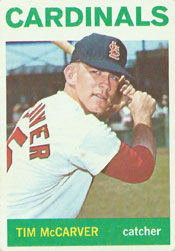
tim_mccarver3Each occurred on June 9 in New York in the second game of a Sunday doubleheader.

McCarver hit an inside-the-park grand slam June 9, 1963, in the Cardinals’ 10-4 win over the Mets in Game 2 of a doubleheader at the Polo Grounds.

Pendleton hit an inside-the-park grand slam June 9, 1985, in the Cardinals’ 8-2 win over the Mets in Game 2 of a doubleheader at Shea Stadium.

Both occurred because of outfield misplays.

Slipping and sliding

The Cardinals led, 6-1, in the eighth inning when McCarver batted with the bases loaded, one out, against Mets rookie reliever Larry Bearnarth and laced a line drive to center.

“I was just figuring on a sacrifice fly,” McCarver told The Sporting News.

Center fielder Rod Kanehl got to the ball and, just as he appeared ready to make the catch, slipped and fell. The ball darted past him and rolled to the wall, 475 feet from home plate. McCarver raced home with his second big-league home run. It was the first grand slam he’d hit at any level of competition.

Cardinals center fielder Curt Flood empathized with Kanehl, informing the St. Louis Post-Dispatch, “The turf is loose and the grass is slippery out there. I slipped three or four times running when the ball wasn’t even hit to me.” Boxscore

Communication breakdown

Like McCarver, Pendleton was looking to extend a Cardinals lead when he came up against Mets reliever Joe Sambito with the bases loaded and one out in the fifth inning. St. Louis led, 4-0.

Pendleton hit Sambito’s first pitch to right-center. Right fielder Danny Heep and center fielder Terry Blocker gave chase.

“At first I thought, ‘Good, we’ll get a run on a sacrifice fly,’ ” Pendleton told the New York Times. “Then I looked in the outfield and saw them flying at each other, not slowing down.”

As Blocker was reaching for the ball, he and Heep collided, and the ball caromed off Blocker’s glove. “We both called for it, but I didn’t hear him until the last second,” Heep said to the New York Daily News.

“I could see it coming,” Cardinals manager Whitey Herzog said to the Associated Press. “Neither one of them knew if they could catch the ball.”

Blocker lay motionless. Heep recovered, retrieved the ball and got it to first baseman Keith Hernandez, whose relay throw was too late to nab Pendleton. Boxscore

“I thought one of them would be able to get up in time,” said Pendleton. “I thought I had a shot at a triple.”

Becker injured both knees and was carried from the field on a stretcher.

“It’s a hell of a way to get a grand slam, isn’t it?” Herzog asked.


Read Full Post »

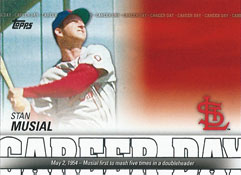
In 1963, his final season as a player, Stan Musial went on a tear in May that began with a bases-loaded double and ended with one of the most bizarre RBI in his distinguished Cardinals career.

stan_musial24Musial, 42, had 23 RBI in 26 games in May 1963. Those were the most RBI he produced in a month since he had 27 in June 1957. He also hit seven home runs in May 1963. That represented his best output in a month since he clubbed seven in August 1957.

On May 2, his first game played in the month, Musial hit a two-out, three-run double off Cubs reliever Don Elston in the seventh, increasing the St. Louis lead from 1-0 to 4-0 in a game the Cardinals won, 4-3. Boxscore

In late May, Cardinals manager Johnny Keane moved Musial into the cleanup spot. In seven games from May 22 through May 31, Musial had nine RBI and hit .400 (12-for-30) while batting fourth.

On May 31, Musial was credited with an unusual game-winning RBI against the Giants at St. Louis.

In the bottom of the ninth, with the score 5-5, the Cardinals loaded the bases with none out. Giants manager Al Dark brought in left-hander Billy Pierce to face Musial.

With the infield playing in for a play at the plate, Musial hit a pop fly to the right of the second base bag.

“Rookie second baseman Cap Peterson looked about as Willie Mays charged in from his shallow center field spot and speedy Felipe Alou raced in from right field,” The Sporting News reported. “The ball fell among the befuddled trio. The play was ruled an infield fly. Thus, Musial was out, but Curt Flood, who had been on third base, roared home when the ball hit the ground and (Musial) was credited with the strangest of his 1,921 big-league RBI at that point.

“Mays came closest to getting the ball. He tried to scoop it up for a throw home, but the ball bounced away from him. Then in disgust Willie kicked his glove about 30 feet.”

With the 6-5 victory, Boxscore the Cardinals climbed into second place in the National League, two games behind the defending champion Giants. Boxscore

“In May, reinstated in the cleanup spot, (Musial) helped pull the Cards up by their bootstraps,” The Sporting News concluded.

Musial began June the same way he started May. He drove in three runs on June 1 in the Cardinals’ 7-4 victory over the Giants. Boxscore The three RBI gave Musial 1,924 for his career, moving him ahead of Jimmie Foxx for No. 3 on the all-time list. Babe Ruth then was first at 2,200 and Lou Gehrig second at 1,992.

Limited to 17 games in June because of a leg injury, Musial hit .311 for the month but had no home runs in 45 at-bats and drove in six runs.

After a subpar July and August, Musial finished strong in September, batting .299 for the month, with three home runs and 12 RBI.

Read Full Post »

(Updated May 26, 2019)

In the time it takes to circle the bases, Ted Simmons experienced the high of hitting an improbable home run and the low of being ejected.

The incident symbolized the frustrations of the 1978 Cardinals.

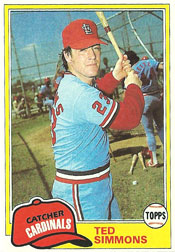
ted_simmons16On May 27, 1978, the Cardinals, who’d lost 13 of their last 14 games, faced the first-place Cubs in St. Louis. Frustrated by the strike zone of Paul Runge, Simmons jawed with the plate umpire.

“(Simmons) seemed to be uptight through most of the game,” Runge said to the Associated Press. “Before the seventh inning, I was joking with him and telling him to relax. There was something working on him.”

In the ninth, the Cubs called in closer Bruce Sutter to protect a 2-1 lead. Simmons, who doubled and tripled in the game, was first to bat.

Sutter got ahead on the count 0-and-2. On his next pitch, “I tried to bounce it up there,” Sutter said to the Chicago Tribune, but the pitch was up in the strike zone. Batting left-handed, Simmons crushed it for a 400-foot home run, tying the score.

As he stepped on the plate after rounding the bases, Simmons tipped his batting helmet in Runge’s direction and, according to the ump, said, “Take that.”

Runge ejected Simmons.

“He definitely showed me up, but he didn’t cuss me,” Runge said. “It was a perfect opportunity for him and he took the opportunity.”

Simmons told the Tribune, “I didn’t say a word.”

Cubs manager Herman Franks said he was surprised Simmons got tossed. “I always thought as long as you didn’t swear you couldn’t get thrown out of a ballgame,” Franks said. “It ain’t so anymore.”

The Cubs scored in the 11th and won, 3-2, sending the Cardinals to their 14th loss in 15 games. The Cardinals filed a protest with the National League, arguing Simmons shouldn’t have been ejected.

“I think this has been happening, or brewing, over a long period of time, but unless you call an umpire a name, he (Simmons) shouldn’t be kicked out,” Cardinals manager Ken Boyer said. “We think very strongly that umpires ought to be fined, suspended or reprimanded, just like players.

“The only job (Runge) had was to see if (Simmons) touched the plate. I don’t think that the average fan knew they were having words before. Teddy never once turned around.” Boxscore

Three decades later, in an interview with the San Diego Union-Tribune, Rick Hummel of the St. Louis Post-Dispatch said the ejection of Simmons remained memorable.

“Teddy was not in agreement with Paul Runge’s strike zone,” Hummel recalled. “They had a little debate about balls and strikes. Then Teddy hits a home run to tie the game and as Teddy steps on home plate he is ejected. That’s one of my favorites. Home run and gone.”


Read Full Post »

The 1968 Cardinals were stocked with players known for producing high drama. Bob Gibson. Lou Brock. Roger Maris. Orlando Cepeda. It was a supporting cast member, though, who delivered a storybook home run.

julian_javier3On May, 15, 1968, second baseman Julian Javier visited Mark Sandusky, 6, of McKeesport, Pa., at Children’s Hospital in Pittsburgh. The youngster’s legs had been crushed in a car accident that killed his sister. Javier often visited children in hospitals, The Sporting News reported.

Javier presented the boy with an autographed ball. “I want you to get better,” Javier told him, according to The Sporting News. “When you do, let me know and I’ll send you a bat to go along with the ball.”

Javier’s visit impressed the boy, who asked the Cardinals’ second baseman to hit a home run for him that night against the Pirates, the Associated Press reported.

“I’ll try,” Javier told the boy with a smile, according to The Sporting News, “but wouldn’t you settle for a couple of singles?”

“You’d better use a heavier bat,” the 6-year-old replied.

Javier, who hadn’t hit a homer that season, did the improbable.

Like a scene from “The Natural,” Javier hit Steve Blass’ first pitch of the fourth inning into the light tower next to the left-field scoreboard at Forbes Field, according to the Associated Press.

“I wasn’t thinking about it (during the at-bat),” Javier said. “But when I was running around the bases I thought, ‘Look what I did.’ ”

The run backed the four-hit pitching of Steve Carlton and carried the Cardinals to a 1-0 victory. Boxscore

In its lead paragraph to its story about the game, the Associated Press wrote, “Julian Javier will never be mistaken for Babe Ruth, but the slender St. Louis Cardinal is the Sultan of Swat today in the starry eyes of a McKeesport, Pa., youngster.”

Javier wouldn’t hit another home run until three months later, Aug, 28, 1968, also at Pittsburgh, against Roy Face. Javier finished the season with four homers.

In a 13-year major-league career, Javier hit 78 regular-season home runs.

Read Full Post »

(Updated June 27, 2020)

When Lukasz Musial settled in Pennsylvania after leaving his native Poland, he enjoyed following the exploits of Babe Ruth, a symbol of all that was possible in America.

babe_ruthLike his father, young Stan Musial also became a fan of Ruth. He remained an admirer, even though his first encounter with Ruth left him somewhat astonished.

Imagine the significance to Musial when he broke one of Ruth’s most prominent records.

On May 8, 1963, Musial, 42, hit a home run off former teammate Bob Miller of the Dodgers, giving him 1,357 career extra-base hits and surpassing the record of 1,356 held by Ruth. Boxscore

In the 1964 book “Stan Musial: The Man’s Own Story,” Musial said, “I’m proud to have more extra-base hits than any player … but, to me, Ruth is still champ. After all, let’s face it, I went to bat some 2,500 more times than the No. 1 slugger.”

Musial was 20 and playing for the Cardinals’ farm club at Rochester, N.Y., in 1941 when he met Ruth, who came to town to put on a batting practice exhibition. In his autobiography, Musial offered a compelling description of that encounter, with help from the book’s contributor, St. Louis journalist Bob Broeg:

“The Babe was 47 then, heavy-bellied and out of competition for six years,” Musial recalled. “His timing was way off, but finally he connected with a pitch … and lifted it far out of the ballpark. I got a big thrill out of watching (him) demonstrate why my father thought there was only one Bambino. Pop was so right.

“I confess, though, that I was awed _ and maybe a little disillusioned _ when Ruth sat on our bench during the game, pulled out a pint of whiskey from his pocket and emptied it.”

Twenty-two years later, shortly after Musial broke Ruth’s extra-base hits record, a memo sheet posted on the Cardinals’ clubhouse bulletin board asked players whether they had participated in Babe Ruth League baseball. On the bottom of the sheet, The Sporting News reported, Musial wrote, “I played with Babe Ruth.”

In his book, Musial opened a chapter with this paragraph: “I believe Babe Ruth was the greatest who ever played because he was an outstanding pitcher and good outfielder who best combined the abilities to hit for great power and high average. Imagine, while hitting 714 homers, he struck out more than 1,300 times and still averaged .342 for his career.”

A couple of weeks after Musial set the extra-base hits mark, he was profiled in The Saturday Evening Post. “I’ll hit until I’m 50,” Musial said.

Asked by the publication for a set of guidelines he’d recommend a young player to follow in seeking a long big-league career, Musial offered six tips:

_ Keep your weight down.

_ Run a mile a day.

_ Get eight hours of sleep regularly.

_ If you must smoke, try lightweight cigars. They cut down on inhaling.

_ Take vitamins as recommended by a doctor.

_ Make it a point to bat .300.

The extra-base hits category (total of doubles, triples and home runs hit) is one of the most underrated in baseball. Musial eventually was surpassed by two others. The top seven in career extra-base hits are:

_ Hank Aaron, 1,477

_ Barry Bonds, 1,440

_ Stan Musial, 1,377

_ Babe Ruth, 1,356

_ Albert Pujols 1,333

_ Willie Mays, 1,323

_ Alex Rodriguez, 1,275

Previously: Total bases tell story of a total player: Stan Musial

Read Full Post »

« Newer Posts - Older Posts »