Feeds:
Posts
Comments

Archive for the ‘Hitters’ Category

(Updated April 3, 2018)

Curt Flood slugged two home runs against Dodgers ace Sandy Koufax. The first was part of a rare feat. The second was the last home run hit against Koufax.

sandy_koufaxOn Aug. 17, 1958, Flood and Gene Freese led off a game for the Cardinals against the Dodgers at the Los Angeles Coliseum with back-to-back home runs against Koufax.

Cardinals manager Fred Hutchinson stacked five right-handed batters among the top six in his order against the left-hander. The Coliseum, the Dodgers’ home in their first season after moving from Brooklyn, enticed right-handed batters to pull pitches to a left field fence 251 feet from home plate. A 42-foot screen was erected atop the fence, but batters weren’t deterred.

Flood, in his first season with St. Louis, opened the game by hitting a home run over the left-field screen. Freese, an infielder acquired by the Cardinals from the Pirates in a June trade, followed with a home run to the same spot.

The Cardinals scored four in the first against Koufax and he was lifted with one out in the second. Koufax faced 10 batters, yielded four hits and two walks and took the loss in a game won by the Cardinals, 12-7. Boxscore

“After going five straight games without coming close to a homer, Curt Flood and Gene Freese helped the Cards find the combination again at Los Angeles’ chummy left field fence in the Coliseum,” The Sporting News reported.

Eight years later, on Sept. 29, 1966, at St. Louis, in what would be his last appearance against the Cardinals, Koufax and Flood faced one another for the final time.

Koufax entered the game with 294 strikeouts, needing six more to become the first big-league pitcher to achieve 300 in a season three times. In the fourth inning, Koufax fanned Flood for strikeout No. 300 and got a standing ovation from the St. Louis crowd.

Seeking his 26th win of the season, Koufax and the Dodgers were ahead, 2-0, before Flood led off the seventh with a home run.

It would be the last home run hit against Koufax, who would retire after the season. (Koufax yielded 204 home runs in 12 big-league seasons, plus two in the 1963 World Series.)

In the ninth, Koufax struck out the first two batters, Lou Brock and Jerry Buchek, before Flood doubled to center.

“I got a little tired near the end and made a mistake with Flood,” Koufax said to United Press International. “Imagine, after eight or nine years in the league, I still don’t know how to pitch to Flood.”

Flood hit .296 [32-for-108] in his career against Koufax.

What happened next sparked much debate. Dodgers manager Walter Alston went to the mound and, according to United Press International and the Los Angeles Times, ordered Koufax to intentionally walk Orlando Cepeda, putting the potential go-ahead run on base.

“I didn’t argue,” Koufax said, “but I doubt that we would have done it if we were playing at home.”

Said Alston to the St. Louis Post-Dispatch: “I kind of stuck my neck out a little.”

Cepeda had five career home runs against Koufax. Alston preferred to take his chances with Mike Shannon, one of the top home run and RBI producers on the 1966 Cardinals.

Said Alston: “I went to the mound to Koufax after Curt Flood doubled and said, ‘Sandy, I think I’d rather have you pitch to the other guy (Shannon).’ Sandy agreed.”

Shannon flied out to center fielder Willie Davis, ending the game, a 2-1 Dodgers victory. Boxscore

“How about Alston putting that winning run on base?” said Cardinals manager Red Schoendienst. “I guess you can get away with it when you have Sandy Koufax on the mound.”

Morris McLemore, sports editor of the Miami News, wrote, “In a situation like that, baseball is the most exciting game ever devised, for the final decision was made of drama, great skill and chance-taking in almost equal proportion.”

Koufax finished with a four-hitter and 13 strikeouts.

“I thought I had a better curve ball than I have had at any other time this season,” Koufax said.
Read Full Post »

(Updated June 11, 2024)

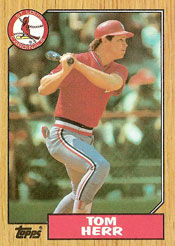
Desperate for a power-hitting right fielder and feeling the sting of the defection of free-agent Jack Clark, the Cardinals stunned nearly everyone when they traded second baseman Tommy Herr, a stalwart of their three pennant-winning teams of the 1980s, to the defending World Series champion Twins in 1988.

tom_herrAs he departed, Herr said he hoped to return to the Cardinals as their manager.

When he arrived in Minnesota, Herr told the Minneapolis Star-Tribune, “I tried to take the trade like a man, but when the plane left St. Louis I cried like a baby for a half hour.”

Surprise move

On April 22, 1988, Herr was dealt to Minnesota for outfielder Tom Brunansky. The trade was announced after the Mets beat St. Louis, 4-0, dropping the Cardinals’ record to 4-11.

Joe Durso of the New York Times wrote, “It stunned Herr and his teammates as they came into the locker room. Herr was asked to step into manager Whitey Herzog’s office, where he received the news from Herzog and Dal Maxvill, the Cardinals’ general manager.”

Said Herr: “Sure, I’m shocked. I’ve loved my years as a Cardinal and it’s hard to say goodbye.”

Acknowledging it was difficult to inform Herr of the trade, Herzog told the St. Louis Post-Dispatch, “Tommy always knew he was my type of player from day one. It was tough.”

Herr played 10 seasons (1979-88) with the Cardinals, batting .274 with 1,021 hits in 1,029 games. He was the starting second baseman on the pennant-winning clubs of 1982, 1985 and 1987. He was an all-star in 1985 when he placed third in the National League in both RBI (110) and doubles (38). Herr ranked among the top three second basemen in the league in fielding percentage six times.

“It’s not an easy thing trading a great ballplayer and a fine gentleman,” Maxvill said to the Associated Press.

Mets third baseman Howard Johnson told the Post-Dispatch, “I think the Cardinals have dealt themselves a blow. A guy like Tommy Herr is a pretty valuable part of your ballclub.”

Three factors prompted the trade:

Factor No. 1

The Cardinals’ top run producer, Clark, signed with the Yankees after the 1987 season. Jim Lindeman, the 1988 Opening Day right fielder, was headed to the disabled list because of back spasms. The Cardinals were averaging 2.8 runs per game. Brunansky, who hit 20 or more home runs in six consecutive seasons (1982-87) for the Twins, provided a much-needed power source.

“The deciding factor was our (poor) run production,” Maxvill said to the Associated Press. “Brunansky can help.”

Cardinals pitcher John Tudor told the Post-Dispatch, “It was kind of pleasant to see that they’re trading to win instead of sitting on their attendance.”

Factor No. 2

The Cardinals feared Herr would depart for free agency. Herr was in the final season of a four-year contract. After losing reliever Bruce Sutter and Clark to free agency, the Cardinals were determined to get value in return for Herr before he could depart.

Herzog told the Minneapolis Star-Tribune, “We just can’t keep losing players like that. It was something we felt had to be done right now.”

“I could see the writing on the wall,” Herr said to the Post-Dispatch, “but I didn’t think it would happen this soon.”

Said Mets first baseman Keith Hernandez, who played with Herr on the 1982 World Series champion Cardinals: “If they had Clark, Tommy Herr’s on the team.”

Herzog told the Post-Dispatch, “If they’d tell me they were going to re-sign him, then who knows what we’d do?”

Regarding whether the Cardinals ever did have interest in re-signing him before he became eligible for free agency, Herr said, “I knew I’d find out sooner or later what the thinking was here. It was sooner rather than later.”

Factor No. 3

The Cardinals had a replacement for Herr. Luis Alicea, a first-round selection of the Cardinals in the 1986 draft, was promoted from Class AAA Louisville to replace Herr at second base.

“We think we have a fine young man who is ready to be an everyday player here in Alicea,” Maxvill said to United Press International.

Timely chat

Twins general manager Andy MacPhail told the Minneapolis Star-Tribune he made a social phone call to Maxvill on April 21. “At the time, I didn’t think there was any chance of a trade,” MacPhail said.

As the conversation evolved, MacPhail mentioned the Twins needed a left-handed batter for the top of their order.

“He made it clear he couldn’t trade Willie McGee or Vince Coleman,” MacPhail said.

Herr, a switch-hitter, fit the need.

MacPhail said Maxvill asked about third baseman Gary Gaetti and outfielder Kirby Puckett.

“I told him I wouldn’t trade Gaetti and that my house would be burned to the ground if I traded Puckett,” MacPhail said.

Familiar foe

The Twins had defeated the Cardinals in a seven-game World Series in October 1987. Six months later, they were swapping position starters.

“I will miss Tom Brunansky,” Gaetti said. “It’s like a cold shower and a slap in the face at the same time.”

Minneapolis Star-Tribune columnist Sid Hartman reported, “Twins officials maintain Brunansky’s speed is down from last year, that he hasn’t covered the ground in right field as well and that his arm is not as strong.”

Herzog told the Post-Dispatch, “To tell you the truth, the only time I’ve ever seen Brunansky play in person was in the World Series, but over the last 10 years he’s always had pretty good bat potential and he’s had good power statistics. He’s always been a good outfielder with a good throwing arm.”

Minneapolis Star-Tribune columnist Dan Barreiro wrote, “Brunansky had his limitations, we all know how streaky he could be, but he still was a hitter with power numbers.”

For Brunansky, the trade was the chance for a new adventure. “It’s going to be exciting,” he said.

For Herr, the trade took him away from his professional roots and a place he had hoped to grow his career. “I’m proud of the accomplishments I’ve had here,” Herr said before leaving. “I wanted to play my whole career here. That dream has gone. It’s been a good time. Maybe I’ll be back and manage this ballclub.”

Years later, when asked about Herzog, Herr told Cardinals Magazine, “Whitey had a profound effect on me. He was the guy who gave me my shot as a regular … The confidence he showed in me really put me over the top.”


Read Full Post »

With a 76-78 record and fourth-place finish in the National League, the 1956 Cardinals lacked enough playing talent, but they did have a high level of leadership skill.

grady_hattonNine players on the 1956 Cardinals became major-league managers. The nine, in alphabetical order: Ken Boyer, Alvin Dark, Joe Frazier, Alex Grammas, Grady Hatton, Solly Hemus, Whitey Lockman, Red Schoendienst and Bill Virdon.

Hatton played 12 years (1946-56 and 1960) in the big leagues as an infielder for the Reds, White Sox, Red Sox, Cardinals, Orioles and Cubs. He had 1,068 hits and a .254 batting average.

As manager of the Astros from 1966-68, Hatton helped develop second baseman Joe Morgan, outfielders Rusty Staub and Jim Wynn and pitchers Larry Dierker and Don Wilson.

Hatton’s stint with the Cardinals was brief. His contract was sold by the Red Sox to the Cardinals on May 11, 1956. Three months later, the Cardinals sent him to the Orioles in a waiver transaction.

A left-handed batter, Hatton appeared in 44 games, mostly as a pinch-hitter and second baseman, and hit .247 for the 1956 Cardinals.

Hatton was acquired by general manager Frank Lane as part of a roster overhaul. Within a one-week stretch in May 1956, Lane acquired Hatton and two other infielders _ Bobby Morgan from the Phillies and Chuck Harmon from the Reds _ to bolster the bench.

“You can see what I was trying to do,” Lane said to The Sporting News. “I wanted to give the Cardinals a tough core; men who’ve been around and who play anywhere, any thing. It wasn’t guesswork. It was me, the coaches and the manager (Fred Hutchinson) pooling ideas, hoping to come up with a club that can go all the way.”

The 1956 Cardinals opened the season with a middle infield of Alex Grammas at shortstop and Red Schoendienst at second base, but after three games rookie Don Blasingame replaced Grammas.

Blasingame was better at second base than he was at shortstop, so in June 1956 the Cardinals swapped Schoendienst to the Giants for Dark, who became the shortstop, with Blasingame replacing Schoendienst at second.

Hatton, expected to back up Blasingame, batted .118 with runners in scoring position and .214 as a pinch-hitter.

On July 31, 1956, the Cardinals claimed Rocky Nelson, a left-handed batter, on waivers from the Dodgers. The next day, Hatton’s contract was sold to the Orioles. The Sporting News reported, “Hatton had not been delivering as the club’s left-handed batting specialist.”

Two years later, Hatton began his career as a manager, starting in the Orioles’ system before moving into minor-league jobs with the Cubs and Astros. In 1965, Hatton managed the Astros’ Class AAA Oklahoma City club to a 91-54 record, mentoring prospects such as catcher Jerry Grote, shortstop Sonny Jackson and future Cardinals pitchers Joe Hoerner, Chuck Taylor and Chris Zachary.

Hatton became manager of the Astros in 1966, replacing Lum Harris. Under Hatton, the Astros were 72-90 in 1966 and 69-93 in 1967. After winning five of their first six in 1968, the Astros faltered. From June 1 through June 17, they lost 14 of 16, including a four-game sweep by the Cardinals. Hatton was fired and replaced by Harry Walker, the former Cardinals player and manager.

“The problem is hitting,” Hatton said to The Sporting News. “We have not hit since the day we left spring training.”


Read Full Post »

Cardinals players Tino Martinez and Mike Matheny were involved in an Easter Sunday brawl on April 20, 2003, at Busch Stadium. Martinez and Diamondbacks pitcher Miguel Batista sparked the fight.

tino_martinezBruised egos were the only serious damage either team experienced in the Holy Day melee.

Leading off the bottom of the fifth inning, Martinez was struck on the shoulder by a Batista pitch. It was the fourth time Martinez had been hit by a pitch in the young season.

Wrote Dan O’Neill of the St. Louis Post-Dispatch, “Martinez glared at Batista as he haltingly made his way toward first base. Instead of resuming his place on the mound, Batista stared back at Martinez, watching him all the way to the bag. Cardinals manager Tony La Russa then came out to first base to check on Martinez, and he exchanged stares and unpleasantries with Batista.”

The next batter, J.D. Drew, grounded to second baseman Junior Spivey, who tossed to shortstop Tony Womack, forcing Martinez at second base.

As Martinez headed toward the dugout, he and Batista exchanged looks, then Martinez charged the mound, the Associated Press reported. Martinez threw a punch; Batista fired the ball at him. Both missed.

Players from both sides poured onto the field and a brawl ensued. Wrote O’Neill, “One of the first Cardinals to join the fray was Matheny, who got in a few licks before he and Martinez were pulled down into the pile. Batista continued to throw punches as umpire Ed Montague and Arizona manager Bob Brenly backed him into left field. Martinez and Batista were ejected.”

Regarding Batista, Cardinals pitcher Brett Tomko said, “What makes it worse is he threw the ball at him. That’s just bush. You don’t do that stuff. I understand the guy is coming at you, but there are more things involved in a brawl. You don’t want to seriously injure somebody chucking a ball five feet away from him.”

Said La Russa: “The only thing I’m going to say is when you drill somebody and you stare at him like he stared, that is so unprofessional and so intentional-looking. I mean, he just stared at him like, ‘Hey, I meant to do it’ the whole time.

“Then he runs. That’s ridiculous. I don’t know what history is there, but that’s the kind of stuff that hitters take offense to when they take a plunking. That was brutal.”

The Diamondbacks accused La Russa of inflaming the situation by glaring at Batista. “Definitely,” said catcher Chad Moeller. “There’s no question about that.”

Said Diamondbacks outfielder Luis Gonzalez: “When that first situation happened, he (La Russa) goes up the line and he’s yelling at our pitcher. He’s trying to rattle our guys. That’s how he does it and that’s how he gets his team fired up.”

Brenly said, “I really don’t know what Batista is supposed to do to protect himself against a 240-pound charging bull who is supposed to leave the field immediately after he’s retired (on the forceout).”

Tempers flared again in the ninth. With two outs, reliever Jeff Fassero plunked Gonzalez with a pitch. Fassero and La Russa were ejected.

“That’s old baseball,” Fassero said. “I play old baseball … I still believe in the old ways, settling scores for teams and stuff like that, protect your guys.”

In the bottom half of the inning, with the Diamondbacks ahead, 1-0, Edgar Renteria led off with a double and Jim Edmonds walked against closer Matt Mantei. After Scott Rolen and Miguel Cairo struck out, Drew was hit by a pitch, loading the bases and bringing Matheny to the plate.

Throwing heat, Mantei struck out Matheny, ending the game. Mantei’s final pitch reached 100 mph.  Boxscore

Summing up the day, Arizona first baseman Mark Grace said, “It was one of those situations where boys will be boys … Guys get hit, guys get (mad), guys fight.”

Eight years later, Batista pitched for the Cardinals and La Russa.


Read Full Post »

From the very first game, Mark McGwire signaled that 1998 would be a special season for him.

mark_mcgwire3McGwire hit home runs in each of the Cardinals’ first four games of 1998, joining Willie Mays of the 1971 Giants as the only major-league players to begin a season in that manner. Since then, two others have done it: Nelson Cruz of the 2011 Rangers and Chris Davis of the 2013 Orioles, according to the Elias Sports Bureau.

The season-opening streak sparked McGwire to a record 70 home runs that year. Though tainted by subsequent revelations that McGwire used performance-enhancing drugs, the slugging feats remain official in the big-league record books.

McGwire’s home runs in the first four games of 1998 accounted for 12 RBI and lifted the Cardinals to three victories. Here is how it happened:

_ Cardinals 6, Dodgers 0, March 31, 1998, at St. Louis: Playing a regular-season game in March for the first time, the Cardinals’ opener was scoreless in the fifth inning when McGwire launched a grand slam off a floating change-up from Dodgers starter Ramon Martinez. Boxscore

The high drive carried 364 feet into the left-center stands at Busch Stadium II.

“You’re not going to see too many people hit a ball that high and have it leave the ballpark,” Dodgers left fielder Todd Hollandsworth said to the St. Louis Post-Dispatch.

Said McGwire to writer Rick Hummel: “It sort of surprised me the way it carried. I knew I hit it high enough. It was just a matter of far enough.

“I was juiced up. I don’t know my own strength. I hope I don’t hurt anybody.”

Speculation already was rampant that McGwire might challenge the single-season homer record of 61 by the Yankees’ Roger Maris. Under a headline of “McGwire’s Slam Drives Cards _ Countdown to 61 Begins,” Mike Eisenbath of the Post-Dispatch wrote in the lead paragraph of his game story, “Mark McGwire took what might be a first step toward immortality.”

_ Cardinals 8, Dodgers 5, April 2, 1998, at St. Louis: With two out in the 12th, McGwire hit a three-run walkoff home run off a curve from rookie reliever Frank Lankford. Boxscore

“You know anything is possible with him _ is that amazing?” said Cardinals manager Tony La Russa.

_ Padres 13, Cardinals 5, April 3, 1998, at St. Louis: McGwire’s two-run homer off Padres starter Mark Langston in the fifth was the highlight for St. Louis. Boxscore

_ Cardinals 8, Padres 6, April 4, 1998, at St. Louis: With the Cardinals clinging to a 3-2 lead in the sixth, McGwire provided a cushion with a three-run homer off reliever Don Wengert.

Counting the home runs he hit for St. Louis in the last two games of 1997, McGwire extended his long ball streak to six consecutive games over two seasons. Boxscore

“It’s unbelievable,” said Cardinals catcher Tom Lampkin. “(McGwire) has a chance to hit the ball out of the ballpark every time he walks up to the plate.”

McGwire’s streak ended on April 5, 1998, when he was limited to a single and a walk in five plate appearances against Padres starter Kevin Brown and reliever Trevor Hoffman. Boxscore

The Cardinals blew a 7-3 ninth-inning lead in that game and lost, 8-7. Wrote columnist Bernie Miklasz: “We have finally discovered Mark McGwire’s weakness: he can’t pitch.”

Previously: Willie McCovey and his legendary St. Louis home run

Read Full Post »

(Updated Jan. 22, 2022)

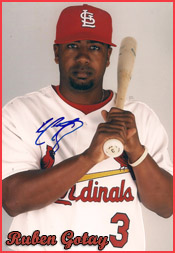
During spring training in 2010, Ruben Gotay was considered a candidate to earn an Opening Day roster spot with the Cardinals as a utility player. Instead, he spent the season in the minors.

ruben_gotayThree years later, Gotay was back in Cardinals spring training camp as a surprise fill-in at the minor-league level.

On March 27, 2013, during the last week of spring training camp at Jupiter, Fla., Gotay signed with the Cardinals and reported to Springfield to become the starting third baseman for the Class AA Texas League club.

The signing was a stunner because Gotay, 30, hadn’t received interest from any major-league organization after spending the 2012 season in the minor-league systems of the Blue Jays and Braves.

Five years removed from his last big-league appearance with the 2008 Braves, Gotay was home in Puerto Rico, trying to land a spot with an independent league team, when the Cardinals called.

According to Kary Booher of the Springfield News-Leader, Gotay became Springfield’s oldest player since infielder Aaron Miles, 34, was on the club in May 2010.

The Cardinals were in need of a Class AA third baseman because the projected starter, Matt Cerda, 22, left camp, saying he may pursue a different career. The Cardinals weren’t ready to put a top third base prospect, such as Patrick Wisdom, at Class AA, so they went looking for a veteran.

“I’ve been blessed,” Gotay said to the Springfield News-Leader. “It feels pretty good to be back in the field.”

Three years earlier, after signing a free-agent contract with the Cardinals, Gotay was considered a versatile talent who could fill a utility role for them.

He had played four seasons in the big leagues with the Royals (2004-05), Mets (2007) and Braves (2008) before spending 2009 in the minor leagues.

Gotay was one of four non-roster infielders at the 2010 Cardinals’ major-league spring training camp. The others: Daniel Descalso, Pete Kozma and Donovan Solano.

In 2010, Gotay was the best-known player in that group. As the starting second baseman for the Royals in 2005, Gotay had a 3-for-3 game against the Cardinals’ Matt Morris on May 21 Boxscore and followed that the next day with a home run off the Cardinals’ Jeff Suppan. Boxscore

His uncle, Julio Gotay, had been the Cardinals’ starting shortstop in 1962.

In January 2010, Joe Strauss of the St. Louis Post-Dispatch wrote, “Gotay is given the best chance among non-roster infielders to break camp with the club.”

That same month, Post-Dispatch columnist Bernie Miklasz wrote, “Gotay is intriguing. Could he surprise and do for the 2010 Cardinals what Abraham Nunez did for the 2005 team?”

In an exhibition game against the Mets at Jupiter, Gotay hit a walkoff home run for a 6-5 Cardinals victory. Noting that Gotay had fouled off several fastballs before hitting the full-count homer, Derrick Goold of the Post-Dispatch reported it was “the kind of ninth-inning at-bat that gets attention.”

Gotay’s chance of earning a spot with the 2010 Cardinals was set back when they signed free-agent infielder Felipe Lopez during spring training. With two weeks left in camp, the Cardinals reassigned Gotay to Class AAA Memphis.

Five months later, August 2010, Cardinals third baseman David Freese suffered a season-ending ankle injury. Gotay was batting .271 with a .400 on-base percentage at Memphis, but the Cardinals traded for fading veteran Pedro Feliz of the Astros rather than call up Gotay.

Strauss of the Post-Dispatch wrote that Gotay “fit a statistical profile” but was “judged unsuitable for promotion.”

“Gotay’s defensive shortcomings became obvious to the major-league staff before spring training ended,” Strauss wrote. “He never received consideration as an emergency option.”

Gotay finished the 2010 season with 135 hits in 139 games for Memphis. He had 30 doubles, 13 home runs, 70 RBI, 95 walks, a .285 batting average and a .410 on-base percentage. He made 17 errors at third base. Gotay was granted free agency after the season and signed with the Marlins organization.

With the Cardinals’ Springfield club, managed by Mike Shildt, in 2013, Gotay played third base, batted .279 in 133 games and led the team in hits (139) and RBI (89).

Read Full Post »

« Newer Posts - Older Posts »