Feeds:
Posts
Comments

Archive for the ‘Hitters’ Category

Mike Aldrete threatened to derail the Cardinals’ pennant push with a knockout smash off the foot of Danny Cox.
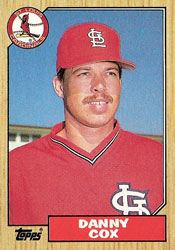
Cox was a starting pitcher for the 1987 Cardinals and Aldrete was a lethal hitter for the 1987 Giants.

Aldrete hit .438 (14-for-32) against the Cardinals during the 1987 regular season. His most damaging swing, however, produced a groundout that broke a bone in Cox’s right foot and sidelined him for a month.

Cox got even in the 1987 National League Championship Series. In a Game 7 pennant-clinching triumph, Cox held Aldrete hitless and shut out the Giants.

Riding a seven-game winning streak, the first-place Cardinals opened a series against the Giants at St. Louis on July 9, 1987.

In the seventh inning, Aldrete smacked a low liner and it struck Cox in the right foot. The ball caromed back to catcher Tony Pena, who threw out Aldrete at first base.

Cox remained in the game and completed eight innings before being relieved by Todd Worrell with the score tied 3-3. The Cardinals won, 7-6, scoring four in the 10th after the Giants had scored three in the top of the inning. Boxscore

The next day, it was discovered during an examination by team physician Dr. Stan London that Aldrete’s shot broke a bone in Cox’s foot. Cox, who had an 8-3 record, went on the disabled list and his foot was placed in a cast.

“I was throwing the ball real well and the team was playing real well,” Cox said to the Associated Press. “If anything good came out of it, at least we got (Aldrete) out.”

Aldrete, a Carmel, Calif., native and former standout for Stanford University, was enjoying a productive year for the Giants. He replaced injured right fielder Candy Maldonado in late June and put together an 11-game hitting streak before the all-star break. In his first 21 outfield starts after replacing Maldonado, Aldrete hit .341 with 15 RBI.

“I’ve tried to be a patient, disciplined hitter,” Aldrete said to The Sporting News. “You swing at strikes and let the balls go _ that’s the key to hitting.”

Nick Peters, a Bay Area baseball reporter, wrote of Aldrete, “He has a classic swing and the ability to foul off pitches until he finds something he likes. When he does, it usually becomes a rope.”

Cox returned to the Cardinals’ rotation Aug. 8, 1987. He finished the regular season with 31 starts, 199.1 innings pitched, an 11-9 record and a 3.88 ERA.

Aldrete posted a .325 batting average and a .396 on-base percentage in 126 regular-season games. He hit .419 with runners in scoring position.

As division champions, the Cardinals and Giants advanced to the National League Championship Series. They split six games, setting up a deciding Game 7 at St. Louis.

For the winner-take-all finale, Cox was named the Cardinals’ starting pitcher by manager Whitey Herzog. Aldrete was placed first in the Giants’ batting order by manager Roger Craig.

Cox set the tone early, retiring Aldrete on a groundout to second to begin the game.

In the third, with the Cardinals ahead 4-0, the first two Giants batters of the inning singled, bringing Aldrete to the plate. Cox got him to ground into a double play.

From there, Cox and the Cardinals were in control. Aldrete flied out to left, leading off the sixth, and he ended the eighth with a groundout to third. Cox pitched a shutout and the Cardinals won, 6-0. Boxscore

“He’s a good pitcher, no matter what the score is,” Aldrete said of Cox. “When he gets a lead, it makes him that much tougher.”

Previously: On 25th anniversary, top 10 facts about 1987 Cardinals
Read Full Post »

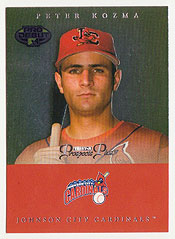
In 2007, Cardinals scout Steve Gossett pushed hard for the franchise to draft Pete Kozma. Gossett saw more than baseball skills from the Oklahoma high school shortstop. He saw a player whose character and dedication could pay dividends.

Gossett was betting on Kozma’s heart.

The Cardinals followed Gossett’s advice and in 2012 they benefitted from it.
After replacing the injured Rafael Furcal in September as the everyday shortstop, Kozma played a significant role in helping the Cardinals reach the 2012 National League Championship Series against the Giants.

Kozma, 24, hit .333 (24-for-72) in the 2012 regular season for the Cardinals and achieved an on-base percentage of .383. In the postseason, his two-run single in the ninth inning capped the Cardinals’ come-from-behind 9-7 victory over the Nationals in Game 5 of the NL Division Series. Boxscore

Because he often struggled in the minor leagues since being selected as the 18th pick in the first round of the 2007 amateur draft, Kozma’s productive play for the Cardinals was a surprise to most, but Gossett saw Kozma as a standout after coaching him in an Oklahoma summer league while Kozma was in high school.

In 2007, his senior season at Owasso High School in suburban Tulsa, Kozma hit .522 and struck out five times in 113 at-bats. His first-inning home run lifted Owasso to a 1-0 victory in the Oklahoma Class 6A state championship game. The Oklahoman newspaper named Kozma all-state player of the year.

“I would play every day if I could,” Kozma said to The Oklahoman.

Owasso coach Larry Turner told the Associated Press that Kozma was “the best player I’ve ever had.”

Draft forecasters expected the Cardinals to take a college player with their first pick. Gossett advised Jeff Luhnow, the Cardinals’ vice president in charge of their draft, to select Kozma.

“I got to know this kid,” Gossett said. “I know what’s in his heart. I know what kind of family he comes from, his work ethic.”

Gossett predicted the Cardinals “are going to love the way (Kozma) attacks the game.”

“The one thing that stuck out in my mind about Pete is you look in his eyes and you see a guy that you really feel is going to play in the big leagues,” Gossett said.

Baseball America magazine had forecast Kozma being selected by the Reds with the 15th choice in the first round. The magazine rated Kozma “the best all-around middle infielder in the draft,” but the Reds chose catcher Devin Mesaraco.

According to the St. Louis Post-Dispatch, the Cardinals were prepared to select pitcher Blake Beavan in the first round, but the Rangers, with the pick just ahead of St. Louis, drafted Beavan.

Though pitchers such as Rick Porcello and Jordan Zimmerman were available, the Cardinals took Kozma.

“This is a first-round talent,” Luhnow told Derrick Goold of the Post-Dispatch. “He has the potential to be a real impact in the big leagues at a premium position.”

(In the third round of that 2007 draft, the Cardinals chose infielder Daniel Descalso. In the Cardinals’ four-run ninth inning against Washington in Game 5 of the 2012 NL Division Series, Descalso got the two-run single that tied the score and Kozma followed with the two-run single that produced the winning runs.)

Kozma became the third infielder selected by the Cardinals in the first round since 1997. The others were Adam Kennedy (1997) and Tyler Greene (2005).

Though he had committed to play college baseball at Wichita State, Kozma signed with St. Louis.

He wasn’t a sensation.

In 2009, his third minor-league season, Kozma appeared to be regressing. He hit .231 and had almost as many strikeouts (104) as hits (111). Baseball America did name him the best defensive shortstop in the Texas League, but in 2010 Kozma committed 34 errors at shortstop.

In 2011, Kozma received fielding instruction from coach Jose Oquendo during a brief stay at the big-league spring training camp. It was enough to steady his defensive play. In May 2011, Kozma was called up to the Cardinals from Class AAA Memphis as a replacement for injured utility player Nick Punto. Kozma produced a RBI-double in his first big-league at-bat (against the Astros’ Bud Norris), becoming the first Cardinal to get an extra-base hit in his first at-bat since Hector Luna (a home run) in April 2004. Boxscore

That was the highlight of his initial St. Louis stay. Kozma batted .176 (3-for-17) for the Cardinals and soon was returned to Memphis. There, his struggles continued. He hit .214 for Memphis and finished the 2011 Class AAA season with more strikeouts (91) than hits (85).

Kozma opened 2012, his sixth professional season, at Memphis again. He hit .232. When the Cardinals tabbed him to replace Furcal in September, some wondered whether rookie Ryan Jackson would have been a better choice, but Cardinals manager Mike Matheny liked Kozma’s defense.

“To me, Pete has impressed everybody at every level with his defensive ability,” Matheny said to the Post-Dispatch on Sept. 8. “When we have a need around here … there is no question that takes priority.”

It proved to be the right choice.

Previously: Cardinals would do well to develop another Dal Maxvill

Read Full Post »

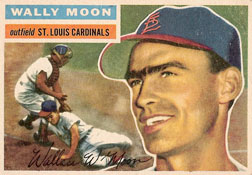
In 1954, Cardinals center fielder Wally Moon batted .304 with 18 stolen bases, had an on-base percentage of .371 and won the National League Rookie of the Year Award.

A left-handed batter, Moon had most of his at-bats from the leadoff or No. 2 spots in the order.
He was part of a 1954 Cardinals team that led the National League in steals (with 63) after having just 18 as a team in 1953.

At 24, Moon took over for Enos Slaughter, who was traded to the Yankees just before the start of the 1954 season. Moon played center field and was flanked by Stan Musial in right and Rip Repulski in left.

Cardinals manager Eddie Stanky, looking for speed and a more aggressive style of play, promised to buy a suit for every St. Louis player who would steal 10 or more bases in 1954.

(According to The Sporting News, National League president Warren Giles later ordered Stanky to stop offering incentives to players for individual performances. Replied Stanky: “I respect authority and I’ll respect Mr. Giles’ wishes, though … I do feel I must live up to the promise to give the prizes for 10 or more stolen bases.”)

Moon was the only Cardinal to reach the goal. With nine steals, third baseman Ray Jablonski fell one short.

On May 25, 1954, Moon swiped four bases in the Cardinals’ 9-4 victory over the Cubs at St. Louis. The National League single-game record at the time was five by first baseman Dan McGann of the 1904 Giants.

With ex-Cardinal Walker Cooper, 39, catching for the Cubs, Moon stole second in the first inning, second in the fourth, and second and third in the fifth. Jim Willis’ pitch on Moon’s steal of third was wild and Moon continued home. Willis was so steamed that he plunked the next batter, Alex Grammas, with a pitch.

In the seventh, Moon flied out. If he had reached base, Stanky said, Moon would have gotten the signal to attempt to steal because Stanky was aware of the record. Boxscore

“I would have given Moon every chance to get that fifth steal,” Stanky told The Sporting News. “He’s a nervy youngster and when he says he’ll have another go at it, I’m sure that he will.”

Moon told reporters he expected to “take another crack one of these days” at the record, but the most steals he ever got in a game after that was two.

Two weeks after his four-steal performance, Moon was reckless rather than savvy on the bases in a game against the Phillies at St. Louis on June 6, 1954.

With the score tied 6-6 in the bottom of the sixth, the Cardinals loaded the bases with two outs and Jablonski at the plate. Moon tried to steal home, but pitcher Bob Miller’s delivery to catcher Smoky Burgess was on time to retire Moon and end the inning.

Stanky, coaching at third, was booed. The fired-up Phillies scored five in the seventh and went on to win, 11-8. Boxscore

Afterward, Stanky told St. Louis writer Bob Broeg, “When things go wrong on the field, it’s my fault. I gave the sign,” but Moon told Broeg he had run on his own.

Moon’s 18 steals in 1954 were the single-season high of his 12-year major-league career. He finished with 89 career steals in the big leagues.

With 17 of 24 votes from the Baseball Writers Association of America, Moon won the Rookie of the Year Award against top-flight competition. The Cubs’ Ernie Banks placed second in the voting (four votes) and the Braves’ Hank Aaron finished fourth (one vote).

Moon had 193 hits in 151 games for the 1954 Cardinals, with 12 home runs, 29 doubles, 71 walks, 76 RBI and 106 runs scored.

Read Full Post »

(Updated May 24, 2025)

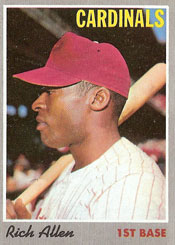
In an era when hitting 30 home runs in a season was an extraordinary feat for a Cardinal, Dick Allen captivated St. Louis fans with his power.

Allen, in his lone season with St. Louis in 1970, was the first player to hit at least 30 homers in his first year with the Cardinals.

Allen was acquired for his power in the October 1969 trade that sent center fielder Curt Flood and catcher Tim McCarver from the Cardinals to the Phillies. Flood refused to report and launched a court challenge against baseball.

Dubbed by syndicated columnist Jim Murray as “the bad boy of baseball,” Allen was suspended by the Phillies during the 1969 season after he failed to show for a doubleheader. He also reported late for games. Murray wrote, “When someone pointed out to his former manager, Gene Mauch, that Richie was a loner, Mauch retorted bitterly, ‘Yeah. He’s fallen in with the wrong crowd.’ ”

Sports Illustrated noted, “He is known as a man who hits a baseball even harder than he hits the bottle.”

Allen was on good behavior from the start with the 1970 Cardinals.

In St. Louis’ Opening Day game, a 7-2 victory over the Expos on April 8, 1970, at Montreal, Allen hit a home run and two doubles, driving in three. Boxscore

He hit 10 home runs in May and nine in July. His jaw-dropping blast at the Reds’ new Riverfront Stadium on July 27 caromed off the facing of the upper deck in left field. Boxscore

Allen ended July with 30 home runs. He became the eighth Cardinal to hit 30 and the first since Ken Boyer in 1960.

“He’s better than any power hitter we’ve had on this club,” Cardinals pitcher Bob Gibson said to the Philadelphia Daily News.

Allen used bats weighing 40 ounces. Jerry Risch, a Cardinals bat boy in 1970, recalled to Cardinals Yearbook in 2004, “He could swing it like a straw, too. No effort … At that time, players used a more moderate bat, ounce-wise, like 34. So 40 ounces was a lot.”

Allen started all but one game of the Cardinals’ first 118, playing mostly at first base. (He also played at third base and in left field.) With 33 home runs, he was on pace to hit 45, according to The Sporting News. The Cardinals’ record was 43 by Johnny Mize in 1940.

However, on Aug. 14, in the second game of a doubleheader against the Giants, Allen pulled a hamstring in his right leg while swiping second base. Boxscore 

He appeared in only five games (three as a pinch-hitter) after the injury.

After at-bats as a pinch-hitter on Aug. 23 and Aug. 25, Allen made his first start in more than three weeks on Sept. 8, the Cardinals’ final appearance of the season at Philadelphia. Batting fourth and playing first base, Allen was 2-for-3 with a walk. In his final at-bat of the game, he hit a home run, his last as a Cardinal, off Rick Wise. Boxscore

With 34 home runs in 122 games, Allen hit the most by a Cardinal since Stan Musial had 35 in 1954. Allen’s total also was the most by a Cardinals right-handed batter since Rogers Hornsby hit 39 in 1925.

The Cardinals wanted Allen to continue receiving treatment on his leg in St. Louis. Allen wanted the work done in Philadelphia. After appearing in a game for the Cardinals at Pittsburgh Sept. 10, he never played in another for St. Louis.

Four days after the Cardinals completed the 1970 season with a 76-86 record, Allen was traded to the Dodgers for second baseman Ted Sizemore and catcher Bob Stinson.

St. Louis general manager Bing Devine told The Sporting News the trade had more to do with the Cardinals’ need for a second baseman to replace aging Julian Javier than it did with unhappiness regarding Allen.

“Allen did everything we could hope for and more,” Devine said. “… If there was any major problem of morale, I was not aware of it and I’m sure I’d have been aware of it if there was. Allen’s a controversial guy and, naturally, if you’re looking to find something wrong about him, you can find it. But I can’t fault him. He was acquired to do a job at bat and on the field, and he did it.”

Said Allen: “I wanted one season that I could play in peace and I sure got to do that. The fans and the ballclub were wonderful. I just wish I could have done a little more to repay them all.”

In his book “Red: A Baseball Life,” Red Schoendienst, the Cardinals’ manager in 1970, said of Allen: “It was hard for right-handed hitters at that time to hit the ball to right-center with any authority, and he could do it. He had a reputation of being a difficult player, but he played hard for me. The only problem I had with him, and it was true throughout his career, is that he never seemed to play the last month of the season. He was always hurt or something was wrong.”

Read Full Post »

(Updated Sept. 13, 2025)

Entering the 1960 season, Cardinals third baseman Ken Boyer, in the prime of his career at 28, set a goal of hitting 30 home runs that year.

Sparked by a sizzling start, Boyer hit a career-high 32 homers for the 1960 Cardinals. It was one of three times Boyer hit 25 or more home runs in a season for St. Louis. He hit 26 in 1956 and 28 in 1959.
Clete Boyer, Ken’s younger brother, also a third baseman, hit a career-high 26 homers for the 1967 Braves. Ken and Clete Boyer became the first brothers to each hit 25 homers or more in a season in the major leagues, according to the Elias Sports Bureau.

The others to do it are: Aaron Boone and Bret Boone, Justin Upton and Melvin Upton, and Kyle Seager and Corey Seager.

The Seagers are the only big-league brother combination to achieve 25 or more homers apiece in the same season. In 2016, Kyle Seager hit 30 for the Mariners and Corey Seager hit 26 for the Dodgers.

Power plus

Ken Boyer started fast in 1960, hitting six home runs (five against the Dodgers) and driving in 15 runs in his first 15 games. The consensus was he had reached elite status in the National League.

In an interview for the May 4, 1960, edition of The Sporting News, Cardinals manager Solly Hemus said of Boyer, “He can do everything _ run with speed, hit for both power and average, and field with the best. In fact, he’s the best defensive third baseman I’ve ever seen.”

Cardinals general manager Bing Devine called Boyer “one of the top five players in the National League on all-around ability.”

Said Fred Hutchinson, who managed the Cardinals from 1956-58: “(Boyer) has terrific speed, a great arm, brute strength. There’s nothing he can’t do. He’s the kind of player you dream about.”

Boyer hit four homers in a span of three consecutive games April 23-25 in 1960. He hit one each against Dodgers pitchers Danny McDevitt and Larry Sherry on April 23. Boxscore He followed that with a homer against the Dodgers’ Stan Williams on April 24 Boxscore and another against the Giants’ Johnny Antonelli on April 25. Boxscore

A month later, May 25, 1960, Boyer hit a pair of homers against the Braves’ Warren Spahn. Boxscore Boyer hit more homers (11) against Spahn, a Hall of Fame left-hander, than he did against any other pitcher in his career.

The 32 home runs by Boyer in 1960 were the most by a Cardinal since Stan Musial slugged 33 in 1955.

(Boyer told Sport magazine that Musial helped him become a better hitter. “I believe Stan gave me one of the secrets of his great hitting when he corrected my batting grip,” Boyer said. “I used to clench the bat deep in the palms of both hands. Musial’s advice was to grip the bat at the base of the fingers of the top hand. The top or right hand, for a right-handed hitter like me, doesn’t lock when I hold the bat in the fingers rather than in the palm. As a result, the hand rolls over at the point of impact, providing freer wrist action, a better follow-through and more power.”)

Boyer was amazingly consistent. He hit 16 homers at home and 16 on the road in 1960. Sixteen were hit against right-handers and 16 were hit against left-handers.

“It doesn’t really make any difference where’s he’s playing,” Hemus said. “None of his homers are flukes anyway.”

Boyer also hit a home run (a two-run shot in the ninth inning off the Indians’ Gary Bell) in the 1960 All-Star Game at Yankee Stadium. It was one of four National League homers hit in the game. Hall of Famers Eddie Mathews, Willie Mays and Stan Musial hit the others. Boxscore

Boyer finished the 1960 regular season with a .304 batting average, 32 homers, 97 RBI, a .370 on-base percentage and 168 hits in 151 games. He placed fourth in the NL in home runs, behind the Cubs’ Ernie Banks (41), the Braves’ Hank Aaron (40) and the Braves’ Eddie Mathews (39).

All in the family

Ken Boyer and Clete Boyer never played together in the majors. Clete received a $35,000 signing bonus from the Athletics in 1955. He came up to the major leagues with Kansas City that year and played shortstop as well as third base.

“My idol always was Ken,” Clete Boyer told Dave Anderson of the New York Times in 1982. “As a kid, I had always fantasized about us being on the Cardinals together, him at third base and me at shortstop. That would’ve been something, the two of us on the same team, but it never worked out.”

(The Boyer brothers played against one another in the 1964 World Series. Ken hit a game-winning grand slam in Game 4. Ken and Clete each homered in Game 7.)

The 26 homers he hit for Atlanta in 1967 represented the only time Clete Boyer hit 20 or more in a 16-season big-league career.

In a May 11, 1960, article, The Sporting News reported how Clete Boyer signed with the Athletics rather than the Cardinals: “The Redbirds had another bonus shortstop on their hands, Dick Schofield, and preferred to devote their bonus dollars to a pitcher, who turned out to be Lindy McDaniel. Otherwise, Cletis, now just 22, might be joining Ken in a rarity, a left-field side of the infield made up of two brothers.”

Read Full Post »

Johnny Podres nearly put a damaging dent into the armor of baseball’s perfect knight.

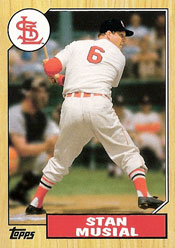
Described by former baseball commisioner Ford Frick as “baseball’s perfect knight,” Stan Musial became a Cardinals icon as much for his good-guy demeanor as for his outstanding baseball ability, but he wasn’t immune from wild-armed pitchers and brushback pitches.

Musial was struck by pitches 53 times in a 22-year big-league career. The pitch that did the most damage was delivered by Podres, a Dodgers left-hander who, like Musial, would be inducted into the National Polish-American Sports Hall of Fame.

In 1955, Musial was hit by pitches a National League-leading eight times. One of those occurred on Aug. 29, 1955, when the Cardinals played the Dodgers at Brooklyn’s Ebbets Field. Though the Dodgers were in first place and the Cardinals were in seventh, the competition between these longtime rivals remained fierce.

In the first inning, catcher Roy Campanella hit a two-run home run off Cardinals starter Tom Poholsky. When Campanella batted again in the third, he was buzzed by a pitch.

Musial, playing in his 593rd consecutive game, led off the Cardinals’ fourth. Podres unleashed a fastball that sailed directly toward Musial’s head. Musial instinctively raised his right hand to protect himself _ and it was fortunate he did.

The ball struck the back of his hand. If it hadn’t, the ball would have struck him in the skull, according to multiple news reports.

Musial felt “acute pain” in the hand, the Associated Press reported. The Sporting News described the hand as “painfully bruised.”

In the bottom of the fourth, a pitch from Poholsky went behind the head of Dodgers batter Jackie Robinson. Umpire Jocko Conlon immediately stepped out from behind the plate, raised a finger on each hand, faced each dugout and declared, “All right, that’s one and one. The next one is out (for the manager and pitcher),” The Sporting News reported.

Soon thereafter, Dodgers pitcher Don Newcombe, out of the lineup that Monday afternoon, was ejected for using offending language within earshot of spectators while yelling at Cardinals manager Harry Walker.

In the seventh, with the hand throbbing, Musial was removed from the game. Boxscore

“It was feared he’d miss his first game since the 1951 season’s wind-up,” The Sporting News reported.

The next day, Aug. 30, Musial was placed sixth in the batting order against the Pirates at Pittsburgh. He played right field in the bottom of the first. When his turn at-bat came up in the second, he was lifted for a pinch-hitter. Boxscore

Musial was listed as the right fielder, batting fifth, the following day at Pittsburgh. When the Cardinals got two on with two out in the top of the first, Musial again was replaced by a pinch-hitter. Though he didn’t appear in the game, the consecutive-game streak officially continued because he was in the starting lineup. Boxscore

Dan Daniel of the New York World-Telegram and Sun wrote, “There is a well-founded suspicion that some of the club owners feel that duster pitching, sparking violent rhubarbs, helps the gate. However, what would have been the popular reaction around the country if Stan Musial had been skulled dangerously by the Johnny Podres pitch which he managed to soften with his hand the other day?”

Seven years later, Podres hit Musial with a pitch again on Sept. 22, 1962. Boxscore

In his book “Stan Musial: The Man’s Own Story,” Musial said of Podres: “If he hadn’t had back trouble, Podres would have been a 20-game winner … Podres has the best changeup since (Howie) Pollet or (Carl) Erskine, good control and a good curve.”

Though Podres twice pelted him with pitches, Musial, as usual, got the last laugh. On Sept. 16, 1963, Musial hit the 475th and last home run of his career. He hit it, of course, off Johnny Podres. Boxscore

Previously: Cardinals drilled Johnny Podres in their L.A. debut

Read Full Post »

« Newer Posts - Older Posts »