Feeds:
Posts
Comments

Archive for the ‘Hitters’ Category

(Updated Sept. 13, 2025)

Entering the 1960 season, Cardinals third baseman Ken Boyer, in the prime of his career at 28, set a goal of hitting 30 home runs that year.

Sparked by a sizzling start, Boyer hit a career-high 32 homers for the 1960 Cardinals. It was one of three times Boyer hit 25 or more home runs in a season for St. Louis. He hit 26 in 1956 and 28 in 1959.

Clete Boyer, Ken’s younger brother, also a third baseman, hit a career-high 26 homers for the 1967 Braves. Ken and Clete Boyer became the first brothers to each hit 25 homers or more in a season in the major leagues, according to the Elias Sports Bureau.

The others to do it are: Aaron Boone and Bret Boone, Justin Upton and Melvin Upton, and Kyle Seager and Corey Seager.

The Seagers are the only big-league brother combination to achieve 25 or more homers apiece in the same season. In 2016, Kyle Seager hit 30 for the Mariners and Corey Seager hit 26 for the Dodgers.

Power plus

Ken Boyer started fast in 1960, hitting six home runs (five against the Dodgers) and driving in 15 runs in his first 15 games. The consensus was he had reached elite status in the National League.

In an interview for the May 4, 1960, edition of The Sporting News, Cardinals manager Solly Hemus said of Boyer, “He can do everything _ run with speed, hit for both power and average, and field with the best. In fact, he’s the best defensive third baseman I’ve ever seen.”

Cardinals general manager Bing Devine called Boyer “one of the top five players in the National League on all-around ability.”

Said Fred Hutchinson, who managed the Cardinals from 1956-58: “(Boyer) has terrific speed, a great arm, brute strength. There’s nothing he can’t do. He’s the kind of player you dream about.”

Boyer hit four homers in a span of three consecutive games April 23-25 in 1960. He hit one each against Dodgers pitchers Danny McDevitt and Larry Sherry on April 23. Boxscore He followed that with a homer against the Dodgers’ Stan Williams on April 24 Boxscore and another against the Giants’ Johnny Antonelli on April 25. Boxscore

A month later, May 25, 1960, Boyer hit a pair of homers against the Braves’ Warren Spahn. Boxscore Boyer hit more homers (11) against Spahn, a Hall of Fame left-hander, than he did against any other pitcher in his career.

The 32 home runs by Boyer in 1960 were the most by a Cardinal since Stan Musial slugged 33 in 1955.

(Boyer told Sport magazine that Musial helped him become a better hitter. “I believe Stan gave me one of the secrets of his great hitting when he corrected my batting grip,” Boyer said. “I used to clench the bat deep in the palms of both hands. Musial’s advice was to grip the bat at the base of the fingers of the top hand. The top or right hand, for a right-handed hitter like me, doesn’t lock when I hold the bat in the fingers rather than in the palm. As a result, the hand rolls over at the point of impact, providing freer wrist action, a better follow-through and more power.”)

Boyer was amazingly consistent. He hit 16 homers at home and 16 on the road in 1960. Sixteen were hit against right-handers and 16 were hit against left-handers.

“It doesn’t really make any difference where’s he’s playing,” Hemus said. “None of his homers are flukes anyway.”

Boyer also hit a home run (a two-run shot in the ninth inning off the Indians’ Gary Bell) in the 1960 All-Star Game at Yankee Stadium. It was one of four National League homers hit in the game. Hall of Famers Eddie Mathews, Willie Mays and Stan Musial hit the others. Boxscore

Boyer finished the 1960 regular season with a .304 batting average, 32 homers, 97 RBI, a .370 on-base percentage and 168 hits in 151 games. He placed fourth in the NL in home runs, behind the Cubs’ Ernie Banks (41), the Braves’ Hank Aaron (40) and the Braves’ Eddie Mathews (39).

All in the family

Ken Boyer and Clete Boyer never played together in the majors. Clete received a $35,000 signing bonus from the Athletics in 1955. He came up to the major leagues with Kansas City that year and played shortstop as well as third base.

“My idol always was Ken,” Clete Boyer told Dave Anderson of the New York Times in 1982. “As a kid, I had always fantasized about us being on the Cardinals together, him at third base and me at shortstop. That would’ve been something, the two of us on the same team, but it never worked out.”

(The Boyer brothers played against one another in the 1964 World Series. Ken hit a game-winning grand slam in Game 4. Ken and Clete each homered in Game 7.)

The 26 homers he hit for Atlanta in 1967 represented the only time Clete Boyer hit 20 or more in a 16-season big-league career.

In a May 11, 1960, article, The Sporting News reported how Clete Boyer signed with the Athletics rather than the Cardinals: “The Redbirds had another bonus shortstop on their hands, Dick Schofield, and preferred to devote their bonus dollars to a pitcher, who turned out to be Lindy McDaniel. Otherwise, Cletis, now just 22, might be joining Ken in a rarity, a left-field side of the infield made up of two brothers.”

Read Full Post »

Johnny Podres nearly put a damaging dent into the armor of baseball’s perfect knight.

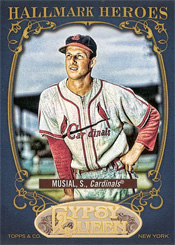
Described by former baseball commisioner Ford Frick as “baseball’s perfect knight,” Stan Musial became a Cardinals icon as much for his good-guy demeanor as for his outstanding baseball ability, but he wasn’t immune from wild-armed pitchers and brushback pitches.

Musial was struck by pitches 53 times in a 22-year big-league career. The pitch that did the most damage was delivered by Podres, a Dodgers left-hander who, like Musial, would be inducted into the National Polish-American Sports Hall of Fame.

In 1955, Musial was hit by pitches a National League-leading eight times. One of those occurred on Aug. 29, 1955, when the Cardinals played the Dodgers at Brooklyn’s Ebbets Field. Though the Dodgers were in first place and the Cardinals were in seventh, the competition between these longtime rivals remained fierce.

In the first inning, catcher Roy Campanella hit a two-run home run off Cardinals starter Tom Poholsky. When Campanella batted again in the third, he was buzzed by a pitch.

Musial, playing in his 593rd consecutive game, led off the Cardinals’ fourth. Podres unleashed a fastball that sailed directly toward Musial’s head. Musial instinctively raised his right hand to protect himself _ and it was fortunate he did.

The ball struck the back of his hand. If it hadn’t, the ball would have struck him in the skull, according to multiple news reports.

Musial felt “acute pain” in the hand, the Associated Press reported. The Sporting News described the hand as “painfully bruised.”

In the bottom of the fourth, a pitch from Poholsky went behind the head of Dodgers batter Jackie Robinson. Umpire Jocko Conlon immediately stepped out from behind the plate, raised a finger on each hand, faced each dugout and declared, “All right, that’s one and one. The next one is out (for the manager and pitcher),” The Sporting News reported.

Soon thereafter, Dodgers pitcher Don Newcombe, out of the lineup that Monday afternoon, was ejected for using offending language within earshot of spectators while yelling at Cardinals manager Harry Walker.

In the seventh, with the hand throbbing, Musial was removed from the game. Boxscore

“It was feared he’d miss his first game since the 1951 season’s wind-up,” The Sporting News reported.

The next day, Aug. 30, Musial was placed sixth in the batting order against the Pirates at Pittsburgh. He played right field in the bottom of the first. When his turn at-bat came up in the second, he was lifted for a pinch-hitter. Boxscore

Musial was listed as the right fielder, batting fifth, the following day at Pittsburgh. When the Cardinals got two on with two out in the top of the first, Musial again was replaced by a pinch-hitter. Though he didn’t appear in the game, the consecutive-game streak officially continued because he was in the starting lineup. Boxscore

Dan Daniel of the New York World-Telegram and Sun wrote, “There is a well-founded suspicion that some of the club owners feel that duster pitching, sparking violent rhubarbs, helps the gate. However, what would have been the popular reaction around the country if Stan Musial had been skulled dangerously by the Johnny Podres pitch which he managed to soften with his hand the other day?”

Seven years later, Podres hit Musial with a pitch again on Sept. 22, 1962. Boxscore

In his book “Stan Musial: The Man’s Own Story,” Musial said of Podres: “If he hadn’t had back trouble, Podres would have been a 20-game winner … Podres has the best changeup since (Howie) Pollet or (Carl) Erskine, good control and a good curve.”

Though Podres twice pelted him with pitches, Musial, as usual, got the last laugh. On Sept. 16, 1963, Musial hit the 475th and last home run of his career. He hit it, of course, off Johnny Podres. Boxscore

Previously: Cardinals drilled Johnny Podres in their L.A. debut

Read Full Post »

For the 1977 Cardinals, there was no doubt about who was the most valuable player in the National League that season: Phillies left fielder Greg Luzinski.

Nicknamed “The Bull” because of his size (6-1, 230 pounds) and power, Luzinski produced one of the most destructive seasons ever against a Cardinals team.

Luzinski’s 1977 performance was referenced recently because of how Pirates third baseman Pedro Alvarez tormented the 2012 Cardinals. With seven home runs and 23 RBI against St. Louis in 2012, Alvarez became the first player to achieve those combinations versus the Cardinals since Luzinski _ and the first Pirates player to do so since left fielder Ralph Kiner in 1950 _ according to the Elias Sports Bureau.

A look at the numbers of that trio against the Cardinals:

PLAYER……………YEAR……..HOMERS……..RBI……..BATTING AVG

Pedro Alvarez……2012……….7…………………..23…….. .397 (23-for-58)

Greg Luzinski……1977……….9…………………..28…….. .351 (20-for-57)

Ralph Kiner………1950………9…………………..23…….. .337 (28-for-83)

In 16 games against the ’77 Cardinals, Luzinski also had seven doubles and nine walks. He posted a .441 on-base percentage and .947 slugging percentage versus St. Louis that year.

Luzinski, 26, did much of his damage against two of the Cardinals’ best pitchers _ Bob Forsch, a 20-game winner in 1977, and Al Hrabosky, St. Louis’ saves leader that year.

Against Forsch, Luzinski hit .467 (7-for-15) with four home runs in 1977. Luzinski was 3-for-4 (.750) with a homer against Hrabosky.

Starter Eric Rasmussen and reliever Butch Metzger were the most effective St. Louis pitchers against Luzinski in 1977. Luzinski was 0-for-10 against Rasmussen and 0-for-5 against Metzger that year. Luzinski was 20-for-42 (.476) against the rest of the 1977 Cardinals staff.

Luzinski had three 5-RBI games against the ’77 Cardinals. The second occurred on July 13 when Luzinski drove in all the Phillies’ runs and hit a pair of homers against Tom Underwood in a 5-2 Philadelphia victory. Underwood had been acquired by the Cardinals from the Phillies a month earlier. Boxscore

“Luzinski is the best two-out hitter in baseball,” Underwood said to the Associated Press. “He never misses a down-and-in pitch. I’m not the first guy he’s going to hit home runs off and certainly not the last. I made two bad pitches and I paid for it.”

Luzinski’s first homer off Underwood went 450 feet to “The Bull Ring,” a section of the left-field stands at Philadelphia’s Veterans Stadium that seated youngsters who were provided tickets by Luzinski.

Luzinski, who had signed a five-year, $1.5-million contract, bought 126 loge box seats for each of 36 Phillies home games and gave all of the tickets to youngsters from organizations such as the Salvation Army and the Big Brothers Association. Each ticket cost $4.50, so Luzinski paid $20,412, with no discount from the Phillies, both The Sporting News and Associated Press reported.

Luzinski also provided autographed pictures of himself to every youngster in “The Bull Ring” and he donated $100 to the organization in that section any night a Phillies home run landed there.

“There are many children who have never had box seats and I want to give some of them a chance to sit there and see how much fun it can be just to go to a baseball game at the Vet,” Luzinski said to The Sporting News.

In a three-game Phillies sweep of the Cardinals Sept. 9-11, 1977, Luzinski drove in eight runs and hit a home run apiece off Hrabosky, John Urrea and John Sutton. Afterward, the soft-spoken slugger surprised reporters when he told them he deserved to win the NL Most Valuable Player Award for his overall 1977 performance.

“I’ve had a hell of a season,” Luzinski said to the Associated Press. “… I’ve been consistent all year. That’s the key.”

Cardinals manager Vern Rapp agreed Luzinski would be the best choice for NL MVP. “What Luzinski has done proves he is the most valuable … Luzinski has always delivered when it meant something toward the ballclub winning,” Rapp said.

Luzinski finished the season with 39 homers, 130 RBI, a .309 batting average, a .394 on-base percentage and a .594 slugging percentage, leading the Phillies to their second consecutive NL East title.

But another left fielder, George Foster, playing for the second-place Reds of the NL West, was voted the NL MVP Award by the Baseball Writers Association of America. Foster received 291 total points and 15 first-place votes; Luzinski had 255 total points and 9 first-place votes.

Though the Reds finished 10 games behind the NL West-champion Dodgers, Foster had better statistics than Luzinski: 52 homers, 149 RBI, a .320 batting average, a .382 on-base percentage and a .631 slugging percentage.

“The way I figure it out we couldn’t win without The Bull,” Phillies catcher Tim McCarver said to The Sporting News, in explaining why Luzinski deserved the award. “And I think the Reds could have finished second without George Foster.”

Countered Reds second baseman Joe Morgan, who had won the award in both 1975 and ’76: “There’s really no comparison. If Foster replaced Luzinski in the Phillies lineup, they’d win by 20 games. George has done better in every offensive category and is a far better defensive player than Greg.”

Previously: Cardinals helped Joe Lis look like all-star

Read Full Post »

Joe Frazier was a bit of a late bloomer who developed into a productive left-handed pinch-hitter as a Cardinals rookie.

Frazier had 15 pinch-hit RBI as a Cardinals rookie in 1954.

In 1947, Frazier made his big-league debut, hitting .071 (1-for-14) in nine games for the Indians.

Frazier didn’t return to the major leagues until seven years later when he made the Opening Day roster of the 1954 Cardinals as a 31-year-old rookie outfielder.

Frazier had caught the attention of the Cardinals while tearing up the Class AA Texas League for Oklahoma City in 1953. Frazier earned the Texas League batting title with a .332 average, slugged 55 doubles and 22 home runs and had 113 RBI.

In October 1953, the Cardinals sent catcher Les Fusselman and cash to Oklahoma City to acquire Frazier. In assessing Frazier, Cardinals scout Joe Mathes told St. Louis journalist Bob Broeg, “Of this I’m certain _ he’s a major-league hitter.”

During spring training in 1954, Cardinals manager Eddie Stanky became impressed by rookie outfielders Frazier, Wally Moon and Tom Burgess. Stanky told reporters Frazier might beat out the venerable Enos Slaughter, soon to turn 38, for the starting right field job.

After the Cardinals left their Florida spring training camp and barnstormed their way back to St. Louis, Broeg filed this report on Frazier for The Sporting News:

Frazier … does not have the speed or outfielding skill of a Slaughter or Wally Moon. But the sturdy slugger has tremendous power that was reflected in long outs in spacious Florida parks before he began to find the range en route home in stadiums of major-league dimensions, hitting two homers April 1 at Birmingham against the White Sox and another two days later at Houston.

“I consider him a left-handed (Ray) Jablonski, a hitter of courage who thrives on men-on-base situations,” said Stanky.

Opting to begin the season with all three rookie outfielders on the roster, along with starters Stan Musial and Rip Repulski, the Cardinals traded Slaughter to the Yankees in April. “It’s the greatest shock I ever had in my life,” Slaughter said to The Sporting News.

The Cardinals’ outfield was Musial in left, Moon in center and Repulski in right, with Frazier and Burgess in reserve.

Frazier excelled as a pinch-hitter and was used primarily in that role. He ripped a two-run pinch-hit homer off the Phillies’ Robin Roberts on May 5. From July 5 through July 24, Frazier had six hits and a walk in eight pinch-hit appearances.

One of Frazier’s hits in that stretch was a two-run walkoff homer in the ninth off the Cubs’ Bob Rush, lifting St. Louis to a 2-1 victory on July 10. Frazier’s blast struck the screen on the pole above the pavilion roof at Busch Stadium. Boxscore

On Aug. 17, Frazier delivered a three-run pinch-hit homer in the seventh off Jim Wilson, leading the Cardinals to a 4-1 victory over the Braves at Milwaukee. The 385-foot shot into the right-field bleachers sealed Wilson’s first loss after eight consecutive wins and snapped the Braves’ nine-game winning streak. Boxscore

Frazier finished the 1954 season with 20 hits as a pinch-hitter _ two shy of tying the big-league mark of 22 established by Sam Leslie of the 1932 Giants. Frazier’s batting average as a pinch-hitter that season was .323, with 15 RBI. Overall, Frazier batted .295 (26-for-88) for the 1954 Cardinals.

Frazier played for the Cardinals in 1955, but hit .200 in 58 games. In May 1956, St. Louis traded Frazier and shortstop Alex Grammas to the Reds for outfielder Chuck Harmon. Frazier finished his big-league playing career that year with the Orioles.

After a stint as a minor-league manager, Frazier was named manager of the Mets in 1976. He led New York to an 86-76 record that year, but when the 1977 Mets stumbled to a 15-30 start, Frazier was replaced by another ex-Cardinal, Joe Torre.

Previously: 1956 Cardinals groomed nine big-league managers

Read Full Post »

In 1987, Vince Coleman established a major-league stolen base record. He also achieved a personal goal with one powerful swing of the bat.

On Aug. 26, 1987, Coleman hit a home run over an outfield wall for the first time in three seasons with the Cardinals. He had logged 1,721 at-bats without hitting a ball out of the park, according to The Sporting News.

(Coleman had hit an inside-the-park home run on May 21, 1985, his rookie year, against the Braves’ Len Barker at St. Louis. Boxscore and video.)

Facing Astros left-hander Jim Deshaies, Coleman drove an opposite-field home run over the right field gate at St. Louis’ Busch Memorial Stadium. The fifth-inning solo shot was estimated to carry 386 feet.

“It’s a lot of fun to do it,” Coleman said to the Associated Press. “I had confidence in my ability that I’d hit at least one. I feel awfully proud.”

It was Coleman’s speed, though, that won that game for St. Louis.

With the score tied 4-4, Coleman doubled against reliever Juan Agosto leading off the seventh and moved to third on Ozzie Smith’s sacrifice bunt.

The next batter, Tommy Herr, grounded to shortstop Dale Berra, who looked toward Coleman, then threw to first to retire Herr. When Berra unleashed his throw, Coleman dashed for home. He slid across the plate with the winning run, beating the peg from startled first baseman Glenn Davis. Boxscore

“That last piece of baserunning was a beauty,” Cardinals manager Whitey Herzog said. “Really, it turned out bigger than the home run.”

Said Berra: “I went to fake him back to third and then I threw. That’s the first time that’s ever happened to me.”

Coleman finished the 1987 regular season with three home runs. He hit 28, three against Deshaies, in a 13-year major-league career. His single-season high was six for the 1990 Cardinals.

Most impressively, Coleman totaled 109 stolen bases during the 1987 regular season, becoming the first major-league player to swipe 100 or more in three consecutive years. He had 110 in 1985 and 107 in 1986.

“I think 100 stolen bases is a hell of an accomplishment,” Coleman said. “MVP honors are presented to the big home run hitters. I just get my personal satisfaction out of stealing bases and hope that I get compensated for it.”

Read Full Post »

For a player who spent all 18 of his big-league seasons in the American League, outfielder Johnny Damon had his share of memorable performances against the Cardinals, including a home run to lead off Game 4 in the historic sweep of the 2004 World Series by the Red Sox.

Yet it was an incident that occurred in 1997, in Damon’s first regular-season series against St. Louis, that may be what many Cardinals fans will most remember about him.

Damon, 38, was released in August 2012 by the Indians, two months after his two-run home run off reliever Maikel Cleto helped Cleveland to a 6-2 victory at St. Louis on June 8, 2012. A left-handed batter with more than 2,700 big-league hits, Damon may be facing the end of his major-league playing career.

He excelled against the Cardinals, batting .330 (31-for-94) with 18 runs in 23 regular-season games. Damon also hit .286 (6-for-21) against them in the 2004 World Series.

From the start, he was a fiery combatant when facing St. Louis. In August 1997, the Cardinals played the Royals in the regular season for the first time. The Cardinals won the opener of the three-game weekend series at Kansas City.

The next night, a Saturday, Aug. 30, the Royals pounded starter Manny Aybar and reliever Mark Petkovsek. When right fielder Jermaine Dye hit a grand slam off Petkovsek in the fourth inning, it increased the Royals’ lead to 14-1.

The next batter was Damon. Petkovsek’s first pitch to him hit Damon in the ankle. Damon charged the mound. He grabbed Petkovsek in a headlock and they tumbled to the ground.

Both benches and both bullpens emptied. During the next five minutes, the Associated Press reported, “play was halted as players wrestled and jostled, screamed and postured.”

Cardinals pitcher Andy Benes went after Tim Belcher and tore the front of the Royals starter’s jersey. Royals bench coach Jamie Quirk and Cardinals pitching coach Dave Duncan wrestled one another to the ground, the Associated Press reported.

Damon and Petkovsek were ejected. Two innings later, Belcher hit St. Louis right fielder Phil Plantier in the hip with a pitch.

There were no serious injuries, but there was plenty of huffing and puffing in the clubhouse after the Royals’ 16-5 victory. Boxscore

“The guys in red versus the guys in blue. Or was it the Bloods versus the Crips?” Chili Davis, the Royals’ designated hitter, said to the Lawrence Journal-World.

Said Damon: “I kind of thought he’d throw at me. I did what I had to do.”

An incredulous Cardinals manager Tony La Russa told the Lawrence newspaper, “Hitting the guy on the ankle? With a sinker? Are you kidding?”

Said Petkovsek: “I was just trying to throw a fastball inside. I was surprised he came out there.”

Asked whether hitting Plantier with a pitch was retaliation, Belcher said, “I was pitching him in all night.”

The Kansas City Star and St. Louis Post-Dispatch gave heavyweight treatment to the melee.

_ La Velle Neal of the Star: Basebrawl broke out at Kauffman Stadium Saturday night.

_ Dick Kaegel of the Star: Now it’s absolutely official. This Royals-Cardinals thing is a rivalry. The boys got down and dirty Saturday night.

_ Rick Hummel of the Post-Dispatch: Emotions already were running reasonably high for this first interleague meeting between the Cardinals and Kansas City Royals. But, in a tumultuous fourth inning Saturday, they reached fever pitch.

Not all bought into the notion the series had created bad blood between Missouri’s major-league teams. Said Royals catcher Mike Macfarlane to the Lawrence Journal-World: “How can there be bad blood? We’ve only played them twice.”

Damon was in the lineup, batting leadoff, the next afternoon, Aug. 31. He struck out three times, including in the ninth inning when he batted with two on and one out against closer Dennis Eckersley. Cardinals pitchers hit two batters and St. Louis won, 5-4.

Previously: Cardinals were Royals’ first opponent in Kansas City

Read Full Post »

« Newer Posts - Older Posts »