(Updated Jan. 30, 2023)
Before Mark McGwire, who played for the Cardinals from 1997-2001, another Big Mac, Willie McCovey of the Giants, hit the longest home run seen in St. Louis.
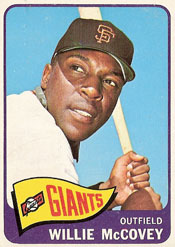 Cardinals broadcaster Mike Shannon has said the longest home run he has witnessed was hit by McCovey on Sept. 4, 1966, at St. Louis.
Leading off the third inning against Cardinals starter Al Jackson, McCovey hit a changeup that landed in the upper deck above the scoreboard in right-center field at Busch Memorial Stadium. The ballpark opened four months earlier, in May 1966.
Shannon was playing right field for the Cardinals that day and “had a good look” at McCovey’s home run. Shannon said he later asked McCovey (who had 521 career home runs in the major leagues) whether it was the longest ball he’d hit. “I don’t know if it was the longest,” Shannon said McCovey replied, “but it was the hardest.” Boxscore
Cardinals catcher Tim McCarver told writer Roger Angell of The New Yorker magazine, “There’s no doubt in my mind about this. It was as if McCovey had hit it off a tee. It caromed off the upper part of the scoreboard and bounced back onto the field.”
The book “Baseball’s Ultimate Power: Ranking the All-Time Greatest Distance Home Run” had this description of McCovey’s St. Louis home run: “The ball was struck on a line drive trajectory that resulted in a 515-foot journey.”
The Cardinals’ 2005 Busch Stadium commemorative yearbook said many who witnessed McCovey’s blast will continue to regard it as the longest home run in that stadium’s history. “That may be the farthest hit anywhere,” Shannon said. “I’ll never forget it as long as I live.”
In the first inning, with the Cardinals using an infield shift against the left-handed slugger, McCovey bunted for a single. Asked by Jack Hanley of The San Mateo Times whether he got more pleasure from the bunt or from the mammoth home run, McCovey replied, “The more I think about it, the more I’m becoming convinced I get a bigger kick out of the bunt. It’s because, when you do the unexpected, the other fellow is completely surprised and it’s a trifle upsetting. The bunt can win a ballgame as much as a homer.”
(On Sept. 16, 1966, 12 days after his shot in St. Louis, McCovey hit a 505-foot home run off Mets starter Jack Fisher at San Francisco’s Candlestick Park. It’s the longest home run hit at that stadium, according to the San Francisco Examiner. Boxscore)
Until McGwire arrived, Pirates first baseman Willie Stargell came closest to challenging McCovey’s home run for longest hit at Busch Memorial Stadium. On July 4, 1979, Stargell hit a slider from reliever Darold Knowles 510 feet, above and to the right of the scoreboard. Boxscore
“That’s the longest home run I’ve ever seen hit in this ballpark by a left-hander,” Cardinals first baseman Keith Hernandez said to the Associated Press.
Said Stargell: “When I saw it go out, I saw (Knowles) flinging something like his cap. He was disgusted. It was a ball that Darold, I’m sure, got in an area he didn’t want. It was a nice, easy swing. I had no idea it was going that far.”
Nineteen years after Stargell’s shot, McGwire hit what officially is called the longest home run at Busch Memorial Stadium. The 545-foot home run on May 16, 1998, against the Marlins’ Livan Hernandez hit the St. Louis Post-Dispatch sign in center field. For the remainder of the season, a giant Band-Aid marked the spot where the ball dented the sign. Boxscore
“It’s the best ball I’ve ever hit,” McGwire said. “I don’t think I can hit one better than that.”
 Musial, in turn, was one of the boyhood idols of Dodgers pitcher Don Drysdale.
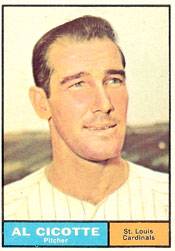 The Pirates beat the Cardinals, 19-0, on Aug. 3, 1961, at St. Louis. It’s the most lopsided shutout loss in Cardinals history. Until then, the only other National League game decided by a 19-0 score was the Cubs’ victory over the Giants on June 7, 1906, according to The Sporting News.
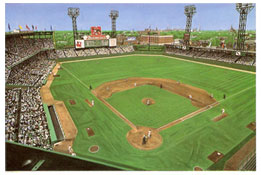 On July 12, 1931, the first-place Cardinals played the Cubs in a Sunday doubleheader at Sportsman’s Park in St. Louis. The Cubs’ player-manager was former Cardinals standout Rogers Hornsby.
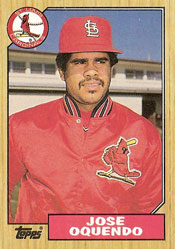 In 1987, during a blowout loss to the Phillies, Herzog made all of those unusual moves. He also batted Oquendo for Jack Clark and used John Tudor as a pinch-hitter with two runners on base.
 On Sept. 14, the 1982 Cardinals were at a critical point in their season. In losing 2-0 the night before to Philadelphia and ex-Cardinal
 RetroSimba