Feeds:
Posts
Comments

Archive for the ‘Hitters’ Category

(Updated Aug. 28, 2022)

George Kernek was so highly regarded by the Cardinals they chose him to replace Bill White as their starting first baseman and issued him the uniform number previously worn by third baseman Ken Boyer.
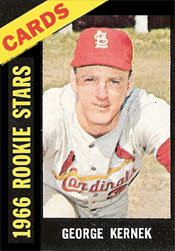
Kernek was the Opening Day first baseman for the 1966 Cardinals, but the rookie held the job for less than a month, was sent back to the minor leagues and never played in the majors again.

Awarded a key position with a storied franchise, Kernek represented one of the biggest misjudgments made by Bob Howsam during his tenure as St. Louis general manager.

After the 1965 season, Howsam shocked St. Louis fans by breaking up his all-star infield. He traded Boyer to the Mets and sent White and shortstop Dick Groat to the Phillies.

News reports speculated the Cardinals would try to acquire a veteran first baseman such as Joe Pepitone of the Yankees, Donn Clendenon of the Pirates or Gordy Coleman of the Reds. Instead, the Cardinals preferred Kernek.

A basketball and baseball standout at the University of Oklahoma, Kernek signed with the Cardinals in 1961 and was assigned to Winnipeg of the Northern League. As he worked his way through the farm system, Kernek developed a reputation as an opposite-field hitter with little power. In his first four minor-league seasons, the left-handed batter averaged about six home runs a year.

Before the 1965 season, Fred Hawn, the scout who signed Kernek, told him he needed to hit with power to reach the big leagues. Kernek began a weight-training program, focusing especially on strengthening his wrists. He also switched to a lighter bat, at one point using a Stan Musial model. With the increased strength and lighter bat, Kernek began to consistently pull the ball.

Playing for Class AAA Jacksonville in 1965, Kernek led the International League in total bases. He hit .295 with 19 home runs and 86 RBI for manager Grover Resinger.

“I owe a lot to Grover,” Kernek told the St. Louis Post-Dispatch. “The last thing he did for me at Jacksonville was to shorten my swing and encourage me to use a lighter thin-handled bat. I got around on the ball better with only a short stroke.”

The Cardinals rewarded Kernek with a call to the big leagues in September 1965 and he impressed with a .290 batting average in 10 games.

In November 1965, White was traded, and Kernek became the leading candidate to replace him.

The Sporting News reported, “Vice president Stan Musial insists the Redbirds are not concentrating on landing a first baseman. The Man feels that there’s a good chance the first base job will be in good hands with George Kernek, Bob Tolan and veteran Tito Francona available.”

Kernek told the Associated Press, “Man, I’m in a heck of a spot. I think one of my biggest problems will be replacing Bill White in the hearts of the St. Louis fans. He’s really a great guy. When I came up at the end of last season, he gave me some good pointers.”

The Cardinals sent Kernek to their Florida instructional camp that winter and George Kissell worked with him on fielding. Kernek mostly had played outfield for Jacksonville in 1965. Kernek’s daily program with Kissell included making 25 throws to the pitcher covering first base, 25 throws to the second baseman on double-play attempts and 25 throws to home plate.

As for hitting, Cardinals coach Dick Sisler said, “I certainly like the way Kernek swings. There’s no use in fooling around with him.”

On March 4, 1966, the Associated Press reported manager Red Schoendienst had tabbed Kernek, 26, the favorite to win the first base job. Three days later, during a rundown play in a practice session, Kernek twisted a knee. He sat out a week before playing his first exhibition game on March 15.

A day later, Kernek, using a Bill White model bat, hit a three-run home run against Orlando Pena of the Tigers. “He’s a better hitter than people give him credit for being,” Cardinals coach Joe Schultz said. “He has good power.”

Troubling signs, however, emerged. Kernek completed spring training with a .224 batting average. In the season opener against the Phillies, Kernek made an error, went 0-for-2 and was lifted for pinch-hitter Mike Shannon with two on and one out in the seventh. Boxscore

Adding to expectations, Kernek was assigned White’s locker and given the uniform number 14 previously worn by Boyer.

Displaying almost no power, Kernek remained the starting first baseman through May 1. After Schoendienst benched him, the Cardinals went with a platoon of Francona and Phil Gagliano for five games.

On May 8, 1966, the Cardinals dealt pitcher Ray Sadecki to the Giants for first baseman Orlando Cepeda. “We needed somebody at first base, a big guy who could hit the ball,” Schoendienst said.

In 20 games, Kernek hit .240 with no doubles, no home runs and three RBI. He was sent to Class AAA Tulsa on the same day the Cardinals acquired Cepeda.

“It was pretty tough being sent down,” Kernek said to The Daily Oklahoman.

Kernek spent the remainder of the 1966 season and all of the 1967 season at Tulsa. Though he had solid numbers (18 home runs, 84 RBI for 1966 Tulsa and 14 home runs, 68 RBI for 1967 Tulsa), he no longer fit in the Cardinals’ plans.

After the 1967 season, Kernek was dealt to the White Sox for outfielder Jim Hicks. Kernek spent 1968 and 1969 with White Sox Class AAA clubs.

In 1970, Howsam, general manager of the Reds, brought Kernek into the Cincinnati organization. Kernek finished his professional career with Class AAA Indianapolis, managed by one of his former Cardinals instructors, Vern Rapp.
 

Read Full Post »

When the Cardinals established the franchise record for most runs scored in an inning, they did it at a critical stage of the National League pennant race.

The 12 runs the 1926 Cardinals scored in the third inning during the opener of a doubleheader at Philadelphia helped them catch the Reds and move toward clinching their first league championship.

On July 21, 2012, the Cardinals scored 12 runs in the bottom of the seventh against the Cubs and won, 12-0. Boxscore That was the first time St. Louis had scored a dozen runs in an inning since the 1926 Cardinals did it against the Phillies on Sept. 16, 1926.

Managed by second baseman Rogers Hornsby, the 1926 Cardinals trailed the first-place Reds by a half-game in the NL standings on the morning of Sept. 16. The doubleheader against the Phillies presented an opportunity for St. Louis to gain ground. Philadelphia was in last place and its pitching was the worst in the league (the 1926 Phillies would finish with a 5.03 team ERA).

In Game 1 of the doubleheader at Baker Bowl, the Phillies led 2-1 after two innings.

The Cardinals then battered five Phillies pitchers for 12 runs on nine hits and two errors in the third. Jack Knight and relievers Mike Kelly, Ed Baecht and Ray Pierce each yielded runs in the inning before Pete Rambo, making his big-league debut, got the third out.

(Unlike the fictional action-film character portrayed by Sylvester Stallone, Rambo, a 5-foot-9, 150-pound right-hander, didn’t become famous or infamous. He pitched 3.2 innings against the Cardinals that day, yielding eight runs on six hits and four walks. It turned out to be the lone appearance of his major-league career.)

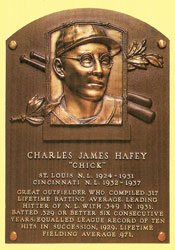
The Cardinals won, 23-3, collecting 22 hits (no home runs) and eight walks. Left fielder Chick Hafey was 3-for-6 with five RBI. First baseman Jim Bottomley drove in four runs. Center fielder Taylor Douthit scored five times. Boxscore

St. Louis also won the second game, 10-2. Wrote the Associated Press:

The first game was poorly played and the second was little better … There was an attendance of about 8,000 and many in the crowd jeered as the Philly pitchers were sent from the mound one after another in the first contest.

Though the Reds beat the Giants, 3-0, that day, the Cardinals’ doubleheader sweep enabled them to move into a first-place tie with Cincinnati. Each team had an 85-60 record, with nine games remaining.

When St. Louis beat Philadelphia the next day and the Reds lost to the Giants, the Cardinals took sole possession of first place. The Reds lost five in a row. On Sept. 24, the Cardinals clinched the pennant with a 6-4 victory over the Giants and finished two games ahead of the Reds.

Previously: Top 10 offensive seasons by a Cardinal in last 100 years

Read Full Post »

(Updated April 23, 2026)

In the 1950s, Tim McCarver was a standout athlete at Christian Brothers High School in Memphis, receiving football scholarship offers from schools such as Notre Dame and Tennessee, but professional baseball offered an immediate opportunity to earn an income for the catching prospect.

“Money was the deciding factor, plain and simple,” McCarver said in his book “Oh, Baby, I Love It.”

The best baseball offers came from the Yankees, Giants and Cardinals. The scout trying to sign McCarver for the Yankees was Hall of Fame catcher Bill Dickey. According to the St. Louis Post-Dispatch, Dickey said McCarver is “a Yankees-type player.”

“They were my No. 2 and a very close No. 2 to the Cardinals,” McCarver said to the Memphis Commercial Appeal.

McCarver said the Yankees offered a $60,000 signing bonus and Dickey told him, “If you sign with the Yanks, I’ll take you along with me on a two-week fishing trip. We’ll talk about catching inside and out.”

(In the 2003 book “Few and Chosen,” McCarver recalled, “In those days, Catholics could not eat meat on Fridays. Bill Dickey wasn’t Catholic, but he knew we were, and he would come to our house on Fridays with a load of fish he had caught and give it to my folks.”)

Despite Dickey’s efforts, the Cardinals’ offer of a $75,000 signing bonus and a guaranteed annual salary of $6,000 per year for five years convinced McCarver he should sign with them instead of the Yankees.

“I think I was swayed by the fact the Cardinals were only 290 miles away (from Memphis),” McCarver said to the Commercial Appeal. “That influenced me somewhat. Also, the Cardinals had given me a take-it-or-leave-it deal and that scared me to death. I was 17 years old.”

In “Few and Chosen,” McCarver said, “The Cardinals’ strongest pitch to me was that they were in need of a catcher, and I would have the best chance of making the major leagues more quickly with them than I would with the Giants or the Yankees … The Cardinals had Hal Smith, an excellent receiver, but … no promising young catchers in their organization.”

Super scout

With his parents in attendance, along with Cardinals farm director Walter Shannon and scout Buddy Lewis, McCarver signed the contract at his Memphis home on June 8, 1959. The $75,000 bonus was the largest given by the Cardinals, according to the Post-Dispatch.

The Cardinals “outbid at least nine other clubs for McCarver, whose high school batting average was .412,” the Post-Dispatch reported. McCarver also hit .390 for an American Legion team which won state and regional championships.

Buddy Lewis, a former big-league catcher, scouted McCarver for four years and said, “Tim is the best young catcher I’ve ever seen.”

According to the Post-Dispatch, Lewis relentlessly pursued McCarver and “spent many an afternoon at the McCarver home, talking baseball, catching and lastly, but not least, telling the St. Louis Cardinals story.”

(In “Few and Chosen,” McCarver said, “My earliest baseball recollection is the sound of Harry Caray’s voice, broadcasting St. Louis Cardinals games … Football was my favorite sport when I was a kid, but I was a big baseball fan, too. I wasn’t a Cardinals fan, just a baseball fan, but because of Harry Caray you couldn’t help but follow the Cardinals.”)

After signing the deal in the early morning before his father, a police lieutenant, went to work, McCarver said, “I am too excited for words.”

(In the book “Oh, Baby, I Love It,” McCarver said he gave $15,000 of his bonus money to his parents to pay off their mortgage. He said he also gave them money to build a den and bought them a 1959 Pontiac.)

Quick rise

McCarver was sent to the Cardinals’ Class D farm club at Keokuk, Iowa. He made his professional debut in the second game of a doubleheader at Waterloo, Iowa, on June 14, 1959, according to the Daily Gate City newspaper of Keokuk.

Years later, McCarver told the Commercial Appeal the plate umpire in his professional debut was Brent Musburger, the future sportscaster. However, that wasn’t so. The plate umpire was Bob Thompson and the base umpire was Chuck Wahl, research by the Daily Gate City showed. Musburger was the plate umpire a week later, June 21, 1959, in a game McCarver caught for Keokuk at Michigan City, Ind. Musburger was the umpire in 11 games McCarver played for Keokuk, according to the Daily Gate City.

McCarver was hailed as Keokuk’s best catching prospect since Russ Nixon, who hit .385 for Keokuk in 1955 before embarking on a 12-year playing career in the majors. “The fans will love this kid,” Keokuk manager Frank Calo said. “If they think Russ Nixon had it, wait until they see this kid.”

Unfazed by professional pitching, McCarver hit .360 in 65 games for Keokuk. He committed 14 errors.

When Rochester (N.Y.) catcher Dick Rand dislocated a right index finger, McCarver was promoted to the Class AAA International League club to replace him. He hit .357 for Rochester in 17 games and made no errors.

In September 1959, McCarver, 17, was promoted to the Cardinals and joined the team in Milwaukee. He showed up wearing a cheap plaid sport coat, gray pants, yellow socks and brown wingtip shoes. In the book “Oh, Baby, I Love It,” McCarver said Cardinals outfielder Bob Nieman barked, “That’s the worst-looking fucking outfit I’ve ever seen, bar none.” Nieman nicknamed the rookie “Bush” because of his bush league outfit.

Major-leaguer

On Sept. 10, 1959, his first day in a big-league uniform, McCarver marveled from the dugout at being in the presence of two of his boyhood heroes, Stan Musial of the Cardinals and Hank Aaron of the Braves.

In the book “Oh, Baby, I Love It,” McCarver recalled, “So when Hank came to bat for the first time that day, I leaped from my perch in the Cardinals’ dugout and did what I always did when I listened to the Braves play the Cardinals. ‘Come on, Henry,’ I yelled. ‘Come on, Henry.’ The action seemed natural to me, but some of my teammates weren’t amused.”

In the ninth inning, with two outs, Bill White on second base and the Cardinals trailing by three, manager Solly Hemus sent McCarver to make his major-league debut as a pinch-hitter for pitcher Marshall Bridges.

“So there I was, younger than Musial’s own son, picking up a bat and advancing to the plate,” McCarver recalled in his book. “As I stepped in to face Don McMahon, a veteran right-handed relief pitcher with a commanding fastball, my knees literally shook with fear.”

McMahon got two strikes on McCarver. Then the teen swung at a curveball and lifted it to right field, where the game-ending catch was made by none other than Hank Aaron. Boxscore

The next day, Sept. 11, 1959, at Chicago against the Cubs, McCarver got his first big-league start at catcher. Batting in the No. 2 spot, he went 0-for-4 against Bob Anderson. The Cardinals’ starting pitcher was Bob Miller, 20. According to The Sporting News, Miller and McCarver formed the youngest battery in big-league history. Boxscore

To put that into comparative perspective, the combined ages of McCarver and Miller was 37 _ younger than the individual ages of two of their teammates, Musial (38) and George Crowe (38).

On Sept. 13, 1959, McCarver, batting leadoff, got his first big-league hit, a single against the Cubs’ Glen Hobbie. Boxscore

(In “Few and Chosen,” McCarver recalled when he was a youth, “It was my sister, Marilyn, who made me a left-handed hitter. I do everything right-handed except hit a baseball and that was Marilyn’s idea.”)

McCarver played in eight games for the 1959 Cardinals, hitting .167 (4-for-24).

Described by The Sporting News as “one of the finest catching prospects the Cardinals have brought up in many years,” McCarver had stints with St. Louis in 1960 and 1961, then spent all of 1962 in the minor leagues before earning the Cardinals’ starting catcher job in 1963.

At spring training in 1963, McCarver, trying to regain his timing after a stint in Army reserves, had a poor batting practice and was criticized by Branch Rickey, the former general manager who returned to the Cardinals as a consultant.

In a 2014 interview with Cardinals Magazine, McCarver said, “It ticked me off. To this day, it ticks me off. I’m not a big Branch Rickey fan as a result of that. Later in 1963, I was swinging the bat well and he says, ‘Twenty-five McCarvers will win all the pennants in the world.’ ”

In his 1991 book “On the Run,” speedster Maury Wills said John Roseboro of the Dodgers and McCarver were the toughest catchers he saw during his career.


Read Full Post »

On his path to earning induction into the National Baseball Hall of Fame, Cubs third baseman Ron Santo was assisted by a Cardinals legend.

Enos Slaughter, the former Cardinals outfielder who was voted into the Hall of Fame in 1985, was Santo’s manager at Class AAA Houston in 1960 and helped prepare him to enter the major leagues.
Like Slaughter, who was enshrined 26 years after he last played in a big-league game, Santo was elected in 2012 by a special committee. His last big-league season was 1974 and he died in 2010.

In 13 years with the Cardinals, Slaughter played on two World Series championship clubs (1942 and 1946) and batted .305. He missed three prime seasons, 1943-45, while serving in the military.

Slaughter completed his 19-year big-league career in 1959. He had a lifetime batting average of .300, with 1,304 RBI.

Marty Marion, the former shortstop who was a teammate of Slaughter’s with the Cardinals, was part of an ownership group that purchased the Houston Buffs minor-league franchise from the Cardinals and transformed it into a Cubs affiliate. On Nov. 9, 1959, Marion, the team president, hired Slaughter to manage Houston.

“I don’t think any man in baseball has been more successful in hustle, determination and the will to win,” Marion said to The Sporting News. “He’ll be a great manager.”

Said Slaughter: “I look on this as a challenge. I want to find out if I can manage. If I can be a successful manager, it will be an opportunity to stay in baseball.”

At the Cubs’ 1960 spring training camp in Arizona, Santo, 20, made a favorable impression on manager Charlie Grimm. “The kid can really swing the bat,” Grimm said. “He has improved tremendously in the field. Last year, he couldn’t find the first baseman. He was making a lot of bad throws. He really has developed fast.”

During the final days of training camp, the Cubs decided Santo would benefit from playing for Slaughter at Houston before facing the pressure of the big leagues.

Santo opened the 1960 season as Houston’s third baseman. Its left fielder was another future Hall of Famer, Billy Williams. Slaughter, 44, was activated as a player-manager.

In the second game of the season, Slaughter injured a rib in a collision at home plate. Relegated mostly to a pinch-hitting role, he batted .289 (13-for-45) during the season.

Santo collected 73 hits in 71 games for Houston. The Cubs promoted him to the major leagues on June 26, 1960, and Lou Boudreau, who had replaced Grimm as manager, installed him at third base.

“Santo has gained tremendous confidence just since last spring,” Boudreau said. “He can make all the plays at third base and he’s got plenty of power at the plate.”

In his big-league debut in the opener of a doubleheader on June 26, 1960, at Forbes Field in Pittsburgh, Santo batted 2-for-4 with three RBI in a 7-6 Cubs victory. Boxscore In the second game, a 7-5 Cubs victory, Santo was 1-for-3 with two RBI. Boxscore

Santo completed his rookie season with a .251 batting average, nine home runs and 44 RBI in 95 games for Chicago. In a 15-year major-league career, Santo won the Gold Glove Award five times and hit 342 home runs with 1,331 RBI.

Meanwhile, Slaughter led Houston to an 83-71 record and third-place finish in the eight-team American Association. His top player was Williams, who hit .323 with 26 home runs.

After the season, Slaughter parted ways with Houston. In 1961, he managed Raleigh, the Class B Carolina League club of the fledgling New York Mets. Raleigh finished 58-80 _ and Slaughter’s managerial career was done.

Previously: If Ron Santo goes into Hall of Fame, Ken Boyer should, too

Read Full Post »

(Updated April 20, 2019)

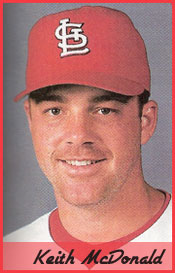
When Keith McDonald was promoted from Class AAA Memphis to replace injured catcher Eli Marrero and serve as the backup to Mike Matheny, he was shocked by the Cardinals’ decision.

McDonald was hitting .246 with one home run and 17 RBI for Memphis when the Cardinals called him to the majors in July 2000.

What happened next was magical.

McDonald hit home runs in his first two big-league at-bats, becoming the second major-league player to accomplish the feat. His first three Cardinals hits were home runs. Those would be his only hits in the major leagues.

Surprise promotion

When Marrero tore ligaments in his left thumb, some speculated the Cardinals might make a trade for a catcher, but they opted instead to bring up McDonald, 27, on July 2, 2000.

McDonald, who spent seven seasons in the minor leagues after being selected by the Cardinals in the 24th round of the 1994 amateur draft, was “shocked” by the promotion, the St. Louis Post-Dispatch reported.

Two days later, before a July 4 crowd of 46,022 at St. Louis, McDonald made his major-league debut, pinch-hitting for shortstop Edgar Renteria in the eighth inning with the Cardinals holding a 13-3 lead over the Reds. McDonald responded with a solo home run against reliever Andy Larkin. Video

“I just kept running, hoping I’d touch every base so I wouldn’t get called out,” McDonald told the Post-Dispatch. “I was running with my head down, so I didn’t see it go out.”

Said Matheny: “I told him before he went up there that when you get your first shot you should take advantage of it.”

The crowd urged a curtain call, but manager Tony La Russa, not wanting to show up the Reds in such a lopsided game, convinced McDonald to stay in the dugout, according to the Associated Press. Boxscore

Encore

In his next appearance, on July 6, McDonald was given the start at catcher against the Reds. Batting in the No. 8 spot, McDonald led off the second inning with a home run against Osvaldo Fernandez, tying the score 3-3. Video

“You got to be kidding me,” Cardinals broadcaster Mike Shannon said on the telecast.

Said broadcast partner Joe Buck: “Is it that easy?”

With a nod to McDonald’s teammate Mark McGwire, a headline in the Post-Dispatch declared, “There’s a new Mac in town.”

“I’m the most surprised of anyone,” McDonald said. “The fans are probably going to expect it every time, but it may be a long time before I hit the next one.”

Teammates Renteria and Jim Edmonds prodded McDonald to wave to the crowd from the dugout steps. “I didn’t want to go,” said McDonald. “I have never done that, but it felt great.”

McDonald became the second big-league player to hit home runs in each of his first two at-bats, tying the mark first achieved by Browns left fielder Bob Nieman on Sept. 14, 1951, at Boston’s Fenway Park.

“It would have been a lot better if we’d have won,” McDonald said after the Reds won, 12-6. Boxscore

McDonald’s final hit in the big leagues came in another blowout, a 15-7 White Sox victory over the Cardinals on July 15, 2000, at Chicago. Pinch-hitting for Matheny, McDonald, in his sixth big-league at-bat, hit a two-run home run against Jesus Pena with two outs in the top of the ninth. Video and Boxscore

Back to minors

After two weeks with the Cardinals, McDonald was returned to Memphis and was replaced by Rick Wilkins, 33, a big-league journeyman. In six games with St. Louis, McDonald had three hits in seven at-bats, with five RBI and three runs scored.

At Memphis, McDonald completed his minor-league season with a .263 batting average and five home runs. He helped Memphis advance to the Class AAA World Series, where he batted .412.

In 2001, McDonald appeared in two games (both in late September) for the Cardinals, going hitless in two at-bats. He left the Cardinals organization after the 2002 season and spent the next four years in the minor-league systems of the Cubs, Pirates, Rangers and Yankees.

In 13 years in the minors, he slugged 78 home runs in 984 at-bats, but it’s those three big-league home runs that make McDonald a permanent part of Cardinals lore.

Read Full Post »

(Updated July 30, 2024)

One measure of the exceptional baseball skills of Stan Musial is the number of triples he hit.

Today, most baseball fans associate a prolific triples hitter with a speedster. Musial was a slugger (475 home runs, 1,951 RBI) who also had the bat control, hitting eye and speed to collect a high number of doubles (725) and triples (177).

Asked about Musial’s baserunning style, Fred Hutchinson, who managed the Cardinals, told Roger Kahn of Sport magazine, “It’s like a wounded turkey. Ever see a turkey run after he’s been wounded by a shotgun? He’s leaning all off to one side, going like hell. That’s what Stan’s running makes me think of.”

Musial led the National League in triples four times _ 20 in 1943, 20 in 1946, 18 in 1948 and 13 in 1949 _ before he turned 29. (He shared the NL lead with teammate Enos Slaughter in 1949.) Musial also was the NL co-leader in triples (with 12) in 1951, becoming the first player to lead the league in that category five times.

(Tigers outfielder Sam Crawford led the American League in triples five times. Crawford, who played for the Reds and Tigers from 1899-1917, is the big-league career leader in triples, with 309.)

In the first three seasons Musial led the NL in triples, he also was the batting champion and winner of the Most Valuable Player Award in each of those years (1943, 1946 and 1948).

When Musial received his first MVP Award, he told The Sporting News he got a bigger thrill from leading the league in triples.

“I guess it’s because I get a chance to run when I hit for three,” Musial said. “Sure, a home run is good for one more base, but I like that contest with the running outfielder and I get a big thrill out of sliding safely to third base.”

No player in the history of big-league baseball hit more triples and as many home runs as Musial. Among the outstanding hitters with fewer career triples than Musial are Rogers Hornsby (169), Roberto Clemente (166), Lou Gehrig (163), Willie Mays (140), Babe Ruth (136), Joe DiMaggio (131), Jimmie Foxx (125), Hank Aaron (98), Barry Bonds (77), Mickey Mantle (72), Mel Ott (72), Frank Robinson (72), Ted Williams (71), Reggie Jackson (49), Willie McCovey (46), Ken Griffey Jr. (38), Alex Rodriguez (31) and Albert Pujols (16).

“To hit a home run, all you need is some strength and quick wrists,” Aaron told Baseball Digest in 1999. “To be able to hit a triple, you need speed, power to the gaps and you need to be a smart baserunner.”

Throughout his big-league career (1941-63), Musial most often was compared with his AL counterpart, Red Sox outfielder Ted Williams. In October 1946, the only time Musial and Williams competed against one another in a World Series, Dodgers manager Leo Durocher rated Musial the best.

“Musial is a two-to-one better hitter,” Durocher told The Sporting News. “You can pitch to Williams, crowd him and keep the ball on the handle. Williams can hit to only one field. Musial can hit to all fields and you can’t fool him. Williams has only one advantage. He has more power _ and power worries you. You are afraid to make one mistake. But I’ll take Musial any day _ and what is more, I’m not comparing dispositions.”

From 1942-60, no one hit more triples than Musial.

Read Full Post »

« Newer Posts - Older Posts »