Feeds:
Posts
Comments

Archive for the ‘Hitters’ Category

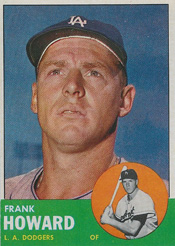
The first time Frank Howard came to the plate against the Cardinals he did what came naturally to him. He hit a home run. Not just any home run. A tape-measure clout, befitting a giant who stood 6-foot-7 and weighed more than 250 pounds.

As Jim Murray of the Los Angeles Times noted, “He’s Gulliver in a baseball suit.”

A right-handed batter capable of launching balls into distant places, Howard ht 382 home runs in 16 years with the Dodgers (1958-64), Senators (1965-71), Rangers (1972) and Tigers (1972-73). He spent another 20 years as a big-league coach and managed the Padres (1981) and Mets (1983).

Hoops hot shot

In Columbus, Ohio, Frank Howard was “kind of a scrawny-looking, mangy-looking kid,” he told the Green Bay Press-Gazette. A son of a railroad machinist, he did construction work during high school and college summers. “I ran a jackhammer on asphalt crews,” Howard told the Press-Gazette, “and I was a hod carrier’s helper (carrying supplies to bricklayers). You work like that, and you’re going to have a strong body.”

When he enrolled at Ohio State, he was 6-foot-6 and 220 pounds. Basketball and baseball were the sports he played. “A lot of people thought I was better at basketball,” Howard said to the Press-Gazette.

In 1955-56, his first varsity basketball season as a sophomore, Howard averaged 15.1 points per game and led the Big Ten Conference in rebounding (12.9).

As a junior in 1956-57, Howard averaged 20.1 points and again was the Big Ten’s top rebounder (15.3). He snared 32 rebounds in a game against Brigham Young at New York’s Madison Square Garden. In Ohio State’s 74-54 home win versus the St. Louis University Billikens, Howard contributed 22 points and 11 rebounds.

In Howard’s senior year, Ohio State came to St. Louis’ Kiel Auditorium and he dazzled with 27 points and 10 rebounds, but the Billikens won, 88-77. Howard averaged 16.9 points as a senior and scouts for the NBA St. Louis Hawks “rated him as an outstanding pro basketball prospect,” The Sporting News reported.

New home

Howard played varsity baseball his sophomore and junior seasons at Ohio State and was “coveted by all 16 major-league clubs” because of his extraordinary power, the Los Angeles Times reported. According to The Sporting News, Dodgers scouts rated Howard higher than Dave Nicholson, the teenage slugger from St. Louis who signed with the Orioles for more than $100,000.

On March 5, 1958, the Dodgers signed Howard for $108,000. When he stepped into the batting cage for the first time at the Dodgers’ training camp in Vero Beach, Fla., Howard “was scared to death” and “actually was shaking,” according to the Los Angeles Times. On his third swing, he hit the ball 400 feet.

Teammates watched in wonder one morning when Howard consumed eight eggs, 24 strips of bacon, two bowls of cereal with sliced bananas, four glasses of orange juice and 10 slices of toast, The Sporting News noted.

The next month, the Philadelphia Warriors took Howard in the third round of the 1958 NBA draft, but by then he was on his way to the Dodgers’ farm club in Green Bay, Wisconsin. Playing for manager Pete Reiser, the St. Louis native and former Dodgers outfielder, Howard hit 37 home runs. “He’s simply fabulous,” Reiser told the St. Louis Post-Dispatch. “He could do for baseball what Babe Ruth did. He hits many a ball completely out of sight in every park.”

Green Bay became important to Howard for reasons other than baseball. He met Carol Johanski, who worked in the circulation department of the Press-Gazette. She recalled to the newspaper, “We met in a pizza place in 1958. I was out with girlfriends and Frank and some fellows came over to our table and introduced themselves. We didn’t believe them when they said they were baseball players.”

Howard asked Carol for a date and they married a year later. Green Bay became Howard’s off-season residence. He spent several winters doing sales and promotional work for a Green Bay paper products company.

Big bopper

After his big season with Green Bay, Howard got called up to the Dodgers in September 1958. In his first game, he hit a home run against a future Hall of Famer, Robin Roberts of the Phillies. Howard’s blast landed atop the left field roof at Philadelphia’s Connie Mack Stadium. Boxscore

In the book “We Played the Game,” Dodgers reliever Johnny Klippstein recalled, “He was frightening looking and the strongest guy I ever saw in baseball, but he was mild and meek and called everybody Mister.”

Howard spent most of 1959 in the minors before a September promotion to the Dodgers, who were headed to becoming World Series champions.

The first time he faced the Cardinals was Sept. 22, 1959, at St. Louis. Batting for reliever Danny McDevitt, Howard drove a pitch from Lindy McDaniel 400 feet to left-center for a three-run home run. The Cardinals “couldn’t recall a ball that was hit as hard” as Howard’s line drive, the Post-Dispatch reported. Boxscore

Howard stuck with the Dodgers in 1960 after his recall from the minors in May, slugged 23 home runs and won the National League Rookie of the Year Award. On July 10, 1960, against the Cardinals at the Los Angeles Memorial Coliseum, Howard had his first 5-RBI game in the majors. Boxscore

In a five-year stretch (1960-64), Howard led the Dodgers in home runs four times. He slugged 31 for them in 1962 and 28 the next year when they became World Series champions.

Howard hit .354 versus the Cardinals in 1961 and .340 in 1964. His home run against Craig Anderson in the 11th inning at St. Louis on July 22, 1961, struck the scoreboard in left, more than 400 feet from home plate. Boxscore

All was not well, though, for Howard with the Dodgers. Manager Walter Alston platooned him in right field and wanted Howard to change his batting stance in order to reach curveballs low and away.

Howard threatened to retire in 1964 and made it known he’d welcome a trade. The Dodgers accommodated him, sending Howard, Ken McMullen, Phil Ortega, Pete Richert and Dick Nen to the Washington Senators for Claude Osteen and John Kennedy on Dec. 4, 1964.

Washington monument

As the Senators’ everyday left fielder, Howard became “the most frightening home run hitter in baseball,” the New York Times noted. On a last-place team in 1968, he led the American League in total bases (330), home runs (44), extra-base hits (75) and slugging percentage (.552).

Ted Williams became the Senators’ manager in 1969 and Howard again was the league leader in total bases (340).

“That son of a gun is the biggest and strongest hitter who ever played this game,” Williams told the New York Times, “and that includes Babe Ruth, Lou Gehrig, Jimmie Foxx, Hank Greenberg _ all of them. Nobody ever hit the ball harder and further, nobody.

“There was only one thing I talked to him about this spring,” Williams said. “He always used to swing at the first pitch that was anywhere near the plate. That’s just like swinging as if you had two strikes on you every time up. Wait. Wait for the pitch you want to hit.”

Howard, who never had more than 60 walks in a season, had 102 walks and 175 hits in 1969 _ an on-base percentage of .402. He was even better in 1970 (.416 on-base mark with 132 walks and 160 hits) and led the league that season in home runs (44) and RBI (126) in addition to walks. Video

Asked about Williams’ influence, Howard said to the New York Times, “He convinced me. I used to be swinging from the time I left the bench. Now I’m not afraid to give them a strike to be more selective … He’s made me more aware of what I’m doing as a hitter, and it has helped.”

Staying busy

After ending his big-league playing career with the 1973 Tigers, Howard returned to baseball as manager of a Brewers farm club in 1976. The next year, Howard became a coach on the staff of Brewers manager Alex Grammas. When Grammas was fired after the 1977 season, general manager Harry Dalton replaced him with George Bamberger. Howard told the Press-Gazette he was disappointed he was bypassed for the job, but Bamberger retained him as a coach.

Howard spent the ensuing winters in Green Bay operating a tavern. He described “Frank Howard’s Lounge” to the Press-Gazette as “intimate, the Fenway Park of saloons.” Howard tended bar and made it a point to talk with customers. As the Press-Gazette noted on a visit, “There he was, pulling on the beer taps, measuring shots of brandy, trying to stab olives and pouring delicate glasses of wine.”

In 1980, Howard’s fourth season as Brewers coach, George Bamberger took a leave of absence because of a heart condition. Howard wanted the job, but Harry Dalton gave it to another coach, Buck Rodgers. “It is tough to live with when you know you can do the job and no one else seems to know it,” Howard told the Associated Press.

After coaching for the 1980 Brewers, Howard was hired to be manager of the Padres, inheriting a last-place team. Howard’s 1981 Padres had Ozzie Smith at shortstop and a former Cardinal, Terry Kennedy, at catcher but not much else. Howard was fired after one strike-shortened season.

George Bamberger, who had replaced Joe Torre as Mets manager, hired Howard for a coaching job in 1982. The next year, Bamberger resigned in June and Howard replaced him. General manager Frank Cashen told Howard the job was only for the remainder of the season.

“He didn’t want to do it under those conditions,” Cashen told the New York Times, “but he finally acceded for the good of the organization … Nobody symbolizes professionalism more than Frank Howard did.”

Howard took over a last-place club. His shortstop was Jose Oquendo and a couple of weeks later the Mets got Keith Hernandez from the Cardinals to play first base.

Davey Johnson became Mets manager in 1984 and Howard was on his coaching staff. Howard went on to coach for the Mariners, Yankees and Rays as well as the Brewers and Mets again.

Read Full Post »

For a time, the battery of pitcher Dizzy Dean and catcher Spud Davis formed a dynamic duo for the Cardinals. Dizzy and Spud. Comic strip names. Gashouse Gang characters.

On Nov. 15, 1933, the Cardinals got Davis and infielder Eddie Delker from the Phillies for catcher Jimmie Wilson. The trade was a reverse of one made five years earlier when the Cardinals sent Davis to the Phillies for Wilson.

A right-handed batter, Davis was a consistent .300 hitter. His return to the Cardinals helped them become World Series champions in 1934, a year when Dean became the last National League pitcher to achieve 30 wins in a season.

The hard-throwing Dean and the hard-hitting Davis seemed right for one another, but then their relationship splintered.

Tater time

Virgil Lawrence Davis was born and raised in Birmingham, Ala. He got the nickname Spud at an early age from a cousin who noted his fondness for potatoes, according to the Birmingham Post-Herald.

Sent to a military academy in Mississippi, Davis was a standout in baseball and football. According to the Post-Herald, he was offered college football scholarships, but opted for professional baseball, joining the Gulfport (Miss.) Tarpons of the Class D Cotton States League in 1926.

On the recommendation of their scout, Bob Gilks, the Yankees signed Davis in September 1926. The Brooklyn Daily Eagle rated him “the best-looking catcher in the minors.”

Placed on the big-league spring training roster, Davis was given a chance to make the leap from Class D to the 1927 Yankees. In a March 8 intrasquad game, he was the catcher on a team managed by Babe Ruth. The New York Daily News described Davis as “garrulous, a bundle of energy.”

Three weeks later, the Yankees sent Davis to a farm club, the Reading (Pa.) Keystones, managed by Fred Merkle, whose baserunning blunder prevented the 1908 Giants from winning the National League pennant.

Davis hit .308 for Reading in 1927. A rival manager, Burt Shotton of the Cardinals’ Syracuse club, was impressed. Afterward, when baseball commissioner Kenesaw Mountain Landis declared Davis eligible for the minor-league draft, the Cardinals chose him on Shotton’s recommendation, the Post-Herald reported.

Contact hitter

Davis, 23, made the Opening Day roster of the 1928 Cardinals and played in two April games for them. In May, he was dealt as part of a package to the Phillies, who had hired Burt Shotton as their manager. The key player the Cardinals got in return was a shrewd, experienced catcher, Jimmie Wilson.

With Wilson as their catcher, the Cardinals won three National League pennants (1928, 1930, 1931) and a World Series title (1931).

Davis, meanwhile, developed into a fearsome hitter with the Phillies. He hit better than .300 for them in each of five consecutive seasons (1929-33). The Sporting News declared Davis “the best-hitting catcher in the National League.”

Davis ranked second in the league in both batting (.349) and on-base percentage (.395) in 1933. The league leader in both categories was his Phillies teammate Chuck Klein, who hit .368 and had a .422 on-base percentage.

Against the Cardinals in 1933, Davis hit .425 (31-for-73).

The Cardinals wanted to get Davis back because of his bat and because Jimmie Wilson was not getting along with Frankie Frisch, who had replaced Gabby Street as manager during the 1933 season, the St. Louis Star-Times reported.

So, the Wilson-for-Davis deal was made. Frisch got the catcher he wanted. The Phillies got both a catcher and a leader. Wilson became their player-manager, replacing Burt Shotton.

Time share

Davis began the 1934 season with a bang. He hit .395 in April. In consecutive games against the Reds in July, Davis totaled eight hits, seven RBI. Boxscore and Boxscore

The Cardinals’ pitching was led by the Dean brothers, Dizzy and Paul. Davis told the Post-Herald, “Paul was the fastest pitcher I ever caught. The difference between him and Diz was Dizzy had everything else _ a good curve, control, change of pace and lots of heart.”

(Davis also told the Birmingham newspaper that the Cardinals’ Bill Hallahan “was the best money pitcher I ever saw. If there was one game you needed, I’d take Hallahan.”)

As the 1934 season unfolded, backup catcher Bill DeLancey impressed when given chances to start. The Cardinals, in third place in the National League at the end of July, surged in August (19-11) and September (21-7) and won the pennant. DeLancey contributed, hitting .345 in August and .311 in September.

In the meantime, friction developed between Davis and Dizzy Dean. According to Dean biographer Robert Gregory in his book “Diz,” Dizzy was complaining in the clubhouse late in the season about how hard it was to keep winning without enough support from his teammates. “I ought to whip the whole bunch of you _ at the same time,” Dean ranted. Davis looked up and said, “Shut the fuck up.”

Davis hit .300 (.375 with runners in scoring position) and had an on-base percentage of .366 for the 1934 Cardinals, but Frankie Frisch decided to start DeLancey (.316 batting mark, .414 on-base percentage) at catcher in the World Series against the Tigers. According to the St. Louis Post-Dispatch, when Frisch, who was fond of Davis, told him about the decision, Davis replied, “The hell with how I or anybody else may feel. Bill (DeLancey) has been hot. He’s winning for us. Keep him in there. The pitchers have confidence in him.”

DeLancey started all seven World Series games and the Cardinals prevailed. Davis made two pinch-hit appearances and singled both times, driving in a run. After his first hit, Davis was replaced by a pinch-runner, Dizzy Dean. On attempting to move from first to second on a grounder, Dean got conked in the right temple by a throw from shortstop Billy Rogell. “The first thing I knew, a thousand little stars and big stars was jumping around before my eyes, but I never did see no tigers,” Dean told the Post-Dispatch. Boxscore

Dissed by Dizzy

Davis and DeLancey split catching duties with the 1935 Cardinals. Davis hit .317 (.398 with runners in scoring position) and had a .386 on-base percentage. DeLancey hit .279 with an on-base mark of .369.

To Dizzy Dean, though, the choice was clear: He wanted DeLancey to be his catcher. With Dizzy on the mound, Davis dropped a pop fly in Cincinnati and called for a pitch in Brooklyn that was drilled for a home run. Dean told the Cardinals he lost faith in Davis after that. “Having confidence in a catcher, no matter how good a pitcher a fellow is, means an awful lot,” Dean wrote in a letter to Cardinals executive Branch Rickey.

(In defending Davis, Frisch told the Post-Dispatch, “Diz didn’t know Spud wasn’t calling the pitches. I was.”

Dean went public with his criticism of Davis after the 1935 season.  According to his biographer, Dean said, “I ain’t pitching no more with him back there.”

Rickey wrote to Dean, “I was utterly amazed that you would think about Davis as you do about him.”

Frisch and the team captain, shortstop Leo Durocher, rallied around Davis. Frisch called Dean’s criticism of Davis “unfair and uncalled for” and described Davis as “a great catcher,” the Star-Times reported.

Durocher told the newspaper, “Spud Davis is probably the most popular man on our ballclub. He’s the smartest catcher in the big leagues today and Dizzy overlooks all those games that Spud won for him with his hitting. Davis can catch for my money every day in the week.”

J. Roy Stockton of the Post-Dispatch noted, “The men in the dugout know that Davis is valuable. They know his stout heart.”

When Dean got to spring training, he and Davis shook hands, and, in a statement prepared for him by Rickey, Dizzy said, “Give me a ball and glove and put Davis behind the plate.”

Davis hit .273 for the 1936 Cardinals, ending a streak of seven straight seasons of .300 or better. He was sent to the Reds after the season.

Davis caught more of Dean’s games (68) than any other catcher, according to baseball-reference.com. Dean’s ERA in games with Davis as catcher was 2.87 _ better than his overall career mark of 3.02.

Hitting the best

Frankie Frisch and Spud Davis stuck together. When Frisch managed the Pirates in the 1940s, Davis was his catcher and then a coach. Davis also was a coach on Frisch’s staff when he later managed the Cubs.

In his 16 seasons as a big-league player, Davis batted .308 and produced 1,312 hits. His on-base percentage was .369. In 459 career at-bats versus the Cardinals, Davis hit .305. He batted .333 (11-for-33) against Dizzy Dean and .406 (13-for-22) against another future Hall of Famer from the Cardinals, Jesse Haines.

Asked by the Post-Herald to name the best right-handed pitcher he played with or against, Davis chose Dizzy Dean. His pick for best left-hander was Carl Hubbell of the Giants.

Davis hit .301 (41-for-133) versus Hubbell, who told the Newspaper Enterprise Association, “He’s hard to outguess. I try to make each pitch something unexpected but somehow Spud anticipates a fair number of my offerings.”

Davis explained to the Post-Herald, “I could hit a low ball well and Hubbell’s best pitch (a screwball) was low.”

Read Full Post »

Joe Christopher was from St. Croix, largest of the U.S. Virgin Islands. Once a port of call for pirates, it is known for its exquisite beaches and excellent rum.

Christopher Columbus visited the island in 1493 and named it Santa Cruz (Holy Cross), and over the years, through multiple translations, it derived into St. Croix.

Almost 500 years later, Christopher _ Joe, that is _ played in Columbus, for a baseball team affiliated, naturally, with the Pirates.

An outfielder trained in a Branch Rickey farm system, Joe Christopher played for both a World Series champion (1960 Pirates) and a team with 120 losses (1962 Mets). After making a fielding blunder, Christopher got a letter of encouragement from Jackie Robinson and went on to have the best season of his career.

A .260 hitter in the majors with the Pirates (1959-61), Mets (1962-65) and Red Sox (1966), Christopher was a terror against the Cardinals. He batted .418 against them in 1964, a season when he led the Mets in nearly every hitting category. Three years later, he was playing in the Cardinals farm system.

Path to the pros

A right-handed batter with speed, Christopher, 18, was playing shortstop with a team from St. Croix at the National Baseball Congress amateur tournament in Wichita, Kansas, in 1954 when he drew the attention of Howie Haak, the same Pirates scout who signed second baseman Julian Javier. According to The Pittsburgh Press, Haak convinced Christopher to accept a Pirates offer of $200.

Branch Rickey was Pirates general manager and he made a lasting impression on Christopher. “Branch Rickey enhanced my spirit,” Christopher told author Edward Kiersh in the book “Where Have You Gone, Vince DiMaggio?” “What a courageous man. He knew all about the hidden order and the way to higher realms.”

In 1959, Christopher, 23, was in his fifth year in the minors, playing for the Columbus (Ohio) Jets, when he got called up to the Pirates in May to replace Roberto Clemente, who went on the disabled list.

“It was tough for me when I joined the Pirates,” Christopher recalled to The Pittsburgh Press. “I knew what the fans thought of Clemente and I knew what they expected of me. I was too tense and I just wasn’t ready.”

Christopher went hitless in 12 at-bats, sprained his right hand making a diving catch, jammed an ankle on the base path and was sent back to Columbus in July.

An energizer

At spring training in 1960, Christopher played so well, hitting better than .400, that the Pirates had to put him on the Opening Day roster as a reserve outfielder.

“The only candidate in the last few years to challenge Roberto Clemente as the most exciting player in Pirates camp is Joe Christopher,” The Sporting News declared. “He has speed to burn and has captured the fancy of the fans and his teammates with his head-first slides. He goes from first to third on singles and scores on short sacrifice flies.”

In the 10th inning of a game against the Dodgers on July 1, 1960, Christopher energized the Pirates and the crowd at Forbes Field in Pittsburgh when he scored from second on Clemente’s infield single. The fans “were up screaming at this burst of speed,” The Sporting News reported. Boxscore

Christopher appeared in three games of the 1960 World Series against the Yankees, reached base in his lone plate appearance and scored twice.

After another season with the Pirates as a reserve in 1961, Christopher was chosen by the Mets in the National League expansion draft. “I thought this was the break I was looking for,” Christopher told the Pittsburgh Post-Gazette.

Mets miseries

The 1962 Mets, who would finish the season 40-120, needed talent, and Christopher seemed to be a plus for them, but near the end of spring training he was sent to Class AAA Syracuse to make room on the Opening Day roster for a utility player, rookie Rod Kanehl.

Christopher, 26, resented the demotion. When Syracuse manager Frank Verdi saw him play, he told the Syracuse Post-Standard, “I think he’s the best outfielder the Mets own.”

(According to Dick Young of the New York Daily News, when the Syracuse team went to Atlanta, a Cardinals affiliate in 1962, and checked into the Henry Grady Hotel downtown, Christopher and three black teammates “were told they had to go across town, to the Negro section, where reservations had been made for them. They went, and it was such a fleabag that Christopher refused to check in.”)

Christopher hit .336 with six home runs for Syracuse and was called up to the Mets on May 21 to replace outfielder Gus Bell, who got shipped to the Braves. A week later, in a doubleheader versus the Dodgers, Christopher got three hits against Sandy Koufax in the opener, then tripled and scored versus Johnny Podres in the second game. Boxscore and Boxscore

Another 1962 highlight for Christopher came on Sept. 2 when his two-run single with two outs in the ninth knocked in the winning run against Cardinals reliever Bobby Shantz, a former teammate with the 1961 Pirates. Boxscore

Christopher hit .244 for the 1962 Mets but .346 versus the Cardinals that season. With nine hits and four walks in 30 plate appearances, his on-base percentage against the 1962 Cardinals was .433.

The Mets again sent Christopher to the minors at the end of spring training in 1963. He ended up with more at-bats (295) for Buffalo that year than he did for the Mets (149).

Breakout season

Based on his first two years with the Mets, it’s hard to imagine anyone could have predicted how productive Christopher would become for them in 1964.

He made the team in spring training, hit a home run on Opening Day against the Phillies’ Dennis Bennett and kept on delivering. Christopher batted .375 in April and .321 in May.

On May 8, 1964, he beat the Cardinals’ Bobby Shantz again with a RBI-single in the ninth. Boxscore

In July, Christopher was 7-for-13 at the plate in a three-game series against the Cardinals at New York. A week later, in four games at St. Louis, he was 8-for-18.

Even then, not all went smoothly for Christopher. On July 14, 1964, Billy Cowan of the Cubs lofted a soft fly ball to right at Chicago’s Wrigley Field. It looked to be an easy catch to end the inning, but Christopher struggled to get under the ball. “So crookedly did he run toward the line, any cop worth his badge would have demanded that Christopher take a sobriety test,” Newsday reported.

The ball plopped to the ground, enabling a runner on second to score the winning run and putting Cowan on third with a triple. To Newsday, Mets pitcher Tracy Stallard said of Christopher, “He’s the only .300 hitter I ever saw in my life who hurts a ballclub.” Boxscore

Soon after, Christopher told The Sporting News, “I received a letter from Jackie Robinson in which he wrote that things like that happen in baseball. He told me not to let it bother me but go out and play my game as if nothing had happened. His advice couldn’t have come at a better time. It gave me confidence just when I needed it most.”

On the next-to-last day of the 1964 season, with the Cardinals needing a win to help their bid for a National League pennant, Christopher had three hits, including a home run versus Mike Cuellar, and scored twice in a Mets rout. Boxscore

For the season, Christopher batted .300 and led the Mets in total bases (253), runs scored (78), hits (163), doubles (26), triples (eight), RBI (76), walks (48) on-base percentage (.360) and slugging (.466).

His on-base percentage against the 1964 Cardinals was .431 in 58 plate appearances.

When former Cardinals general manager Bing Devine joined the Mets as assistant to team president George Weiss in October 1964, he told The Sporting News, “Joe Christopher has progressed as a hitter. There’s an example of a fellow who showed what he could do when he got the chance.”

If the spirit’s willing...

Christopher, paid $10,000 in 1964, was offered $12,500 for 1965. He instead wanted a 100 percent raise to $20,000. When he settled for $17,750 on March 9, he was the last Mets player to sign for 1965, the New York Times reported.

His 1965 season was a bust _ he hit .249 and, according to The Sporting News, was “having a fretful time in the field.” _ and when it ended he was traded to the Red Sox for Eddie Bressoud.

After 13 at-bats for the 1966 Red Sox, Christopher was sent in June to the Tigers, who placed him in the minors. He never returned to the big leagues.

In 1967, Christopher, 31, began the season back in the Pirates’ system at Columbus, but on June 10 he was traded to the Cardinals for pitcher Fritz Ackley. The Cardinals assigned Christopher to the Class AAA Tulsa Oilers, whose manager was Warren Spahn. Three years earlier, Christopher hit a home run against Spahn, who was pitching for the 1964 Braves. Boxscore

Christopher joined a Tulsa outfield with another ex-Met, Danny Napoleon. Among the Tulsa pitchers was Christopher’s former teammate and critic, Tracy Stallard.

Christopher hit .273 in 68 games for Tulsa in 1967. He was put on the roster of the Cardinals’ Class AA Arkansas club in 1968. Cardinals farm director George Silvey told the Tulsa World in March 1968 that Christopher would be given a chance to make the Tulsa club, but it didn’t work out. He spent the 1968 season, his last, with a Class AA Phillies farm team at Reading, Pa.

For his 1983 book about former ballplayers, author Edward Kiersh visited Christopher at his Queens, N.Y., apartment. Kiersh described Christopher as a spiritualist involved in astral geometry.

“Through my mathematical system, I can give you the spiritual characterization of any man, or coordinate him to nature,” Christopher said to Kiersh. “Numerology is sacred. You just have to gain entrance into the hidden order, learn the equations, and the potential for any person becomes visible.”

When Kiersh naturally wondered whether Christopher was touting science or hocus-pocus, Christopher told him, “Most people think I’m into some kind of black magic, but baseball spends millions of dollars on a player’s physical attributes while they should be spending it on his spiritual attributes … This isn’t voodoo. This is truth.”

Read Full Post »

In a special game that featured the best Latino players in the majors, Cardinals second baseman Julian Javier did as well as anyone on the field.

On Oct. 12, 1963, the last baseball game played at the Polo Grounds in New York was a charity event called the Latin American Major League Players Game.

Part of the proceeds from the game were targeted for the Hispanic-American Baseball Federation, a group committed to developing baseball programs for Spanish-speaking youth in the United States.

Growing market

New York sportscaster Guy LeBow was the director of the Latin American charity game. He hoped to make it an annual event, the Bayonne (N.J.) Times reported.

LeBow was a “schmaltzy, do-everything sportscaster,” according to Phil Mushnick of the New York Post. He called hockey, basketball and baseball games, boxing and wrestling matches, hosted a popular bowling show and was a local news TV sports anchor in New York. As a child, he was bedridden with polio for two years. He walked with a limp the rest of his life. LeBow also played a sportscaster in the Woody Allen film “Radio Days.”

(In LeBow’s online obituary, Mets radio broadcaster Howie Rose left this comment: “I learned a lot from you _ some of it has even been put to good use, and I say that lovingly. You were an original.”)

George Schreier, a former Jersey Observer sports reporter who was hired by LeBow to help promote the Latin American game, told the Bayonne Times, “A new crop of promoters has risen today, one very much interested in the Spanish language market, a tremendous one in the greater (New York) metropolitan area.”

The event organizers put together two teams _ one of Latino American Leaguers and the other of Latino National Leaguers. Each player was paid $175 to participate, according to the Society for American Baseball Research.

Though the game was not sponsored by Major League Baseball, it had the approval of commissioner Ford Frick.

The Polo Grounds, most recently the home of the New York Mets, was awaiting to be demolished and replaced by a housing project. Promoters of the Latin American event touted it as a chance to see the last baseball game played at the venerable ballpark.

Talent galore

Played on a Saturday afternoon, the Latin American game drew 14,235 spectators. They were treated to pregame entertainment from bandleaders Tito Rodriguez and Tito Puente, and singer La Lupe.

The starting lineup for the American League squad: shortstop Luis Aparicio, first baseman Vic Power, right fielder Tony Oliva, left fielder Hector Lopez (also the manager), catcher Joe Azcue, center fielder Roman Mejias, third baseman Felix Mantilla, second baseman Zoilo Versalles and pitcher Pedro Ramos.

(Vic Power “was a favorite with the fans because of his one-handed catches of pop fouls,” the New York Times noted.)

For the National League team: shortstop Leo Cardenas, third baseman Tony Taylor, left fielder Felipe Alou, first baseman Orlando Cepeda, center fielder Tony Gonzalez, right fielder Roberto Clemente (also the manager), second baseman Julian Javier, catcher Cuno Barragan and pitcher Juan Marichal.

Six of the players _ Aparacio, Oliva, Cepeda, Clemente, Marichal and an American League reserve, outfielder Minnie Minoso _ would be elected to the Baseball Hall of Fame. (Minoso, 39, a former Cardinal, “received warm applause” when introduced to the Polo Grounds crowd, the New York Times reported.)

Javier, the only Cardinals player in the game, was coming off a successful 1963 season. He was the National League starting second baseman in the All-Star Game, led the league’s second basemen in putouts, produced 160 hits and scored 82 runs.

Javier was in the mix when the Latin American National Leaguers scored three runs in the fourth against Ramos. With the National Leaguers ahead, 1-0, Cepeda and Gonzalez singled. Then Javier drove in Cepeda with a single. Later in the inning, Gonzalez and Javier scored on a single by Manny Mota, who was batting for Marichal.

Al McBean, who relieved Marichal, provided the most entertaining play of the game. Batting in the sixth, the pitcher from the Virgin Islands ripped a deep drive. “There was a Listerine sign in left field (422 feet from home plate) and that’s where I hit the ball,” McBean told Rory Costello of the Society for American Baseball Research.

As Minnie Minoso chased the ball in left, McBean streaked around the bases. He reached third safely as Minoso threw to shortstop Luis Aparicio. Trying for a home run inside the park, McBean continued toward the plate, but Aparacio’s relay to catcher Joe Azcue was strong and McBean was out by five feet.

The Latino National Leaguers won, 5-2. Javier was 2-for-2 with a RBI, a run scored and a stolen base before he was lifted for a pinch-hitter, Chico Fernandez, in the sixth. (The Polo Grounds often was a tough venue for Javier. During the 1963 season, he batted .194 in 31 at-bats in the Polo Grounds. For his career, Javier was a .200 hitter in 70 at-bats there.)

Others with two hits in the Latin American game were Mota and Gonzalez for the National Leaguers and Tony Oliva for the American League side.

Oliva, 25, a Cuban who was in New York for the first time, recalled to MLB.com, “I was very timid.”

He told Adrian Burgos of La Vida Baseball, “I think very fondly of that game because that was where I actually first met Cepeda, Marichal, Clemente and all the others, and we have become friends, like brothers, since then.”

Cepeda said to MLB.com’s Michael Clair, “I was very happy to all get together. For me to be able to participate and to spend some time together with so many great players like Roberto Clemente, Vic Power, Zoilo Versalles _ that was a great day.”

Gate receipts were between $25,000 and $50,000, according to the Society of American Baseball Research. Boxscore

Despite the goodwill generated, the game never was held again.

Read Full Post »

After starting the 1973 season in a funk, the Cardinals finished it with a flourish, but the feeling was the same on both ends of the spectrum: frustration.

In September 1973, the Cardinals won their final five games of the season. Highlighted by the return to health of Bob Gibson and the return to form of Rick Wise and Reggie Cleveland, the Cardinals allowed two runs over 45 innings during the season-ending win streak.

The big finish wasn’t enough, though, to earn them a division title. Weighed down by a miserable start (20 losses in their first 25 games) and more slumps in the second half of the season (11 losses in 12 games from Aug. 6 to Aug. 18, and 13 losses in 17 games from Sept. 7 to Sept. 25), the Cardinals ended up 81-81, 1.5 games behind the division champions.

Slipping away

On the morning of Sept. 25, 1973, the Cardinals (76-80) were in third place in the National League East. Ahead of them were the Mets (79-77) and Pirates (78-77). The division champion would advance to the playoffs.

The Cardinals had six games remaining, all at home _ three with the Cubs (75-80) and three with the Phillies (69-87). If they won all six, the Cardinals figured they’d have a chance to finish tied or alone atop the division.

That night, their hopes seemed to evaporate when they collapsed against the Cubs. The Cardinals blew a 2-1 lead with two outs in the ninth and lost, 4-3. A former Cardinal, Jose Cardenal, delivered a two-run double on an 0-and-2 pitch from Diego Segui. Boxscore

The Cardinals’ loss, coupled with the Mets’ win that night versus the Expos, was a crusher. It meant the Cardinals (76-81) trailed the Mets (80-77) by four with five to play. “We had to win this one,” Cardinals manager Red Schoendienst said to the St. Louis Post-Dispatch.

The newspaper’s headline the next day declared: “Cardinals Face Reality: Loss To Cubs Ends Title Dream.”

Though the Cardinals mathematically still had a chance, the odds against them got higher when it was revealed that one of their best hitters, Joe Torre, would sit out the final five games because of an inflamed right shoulder.

Dominant pitching

The Cardinals saw a glimmer of hope the night of Sept. 26, when they beat the Cubs, 1-0, and the Mets lost to the Expos. Those results put the Cardinals (77-81) three behind the Mets (80-78) with four to play.

Rick Wise pitched his fifth shutout of the season for St. Louis. It was his second consecutive win after losing six in a row. The Cubs threatened in the eighth when Jim Hickman, a career .358 hitter in 53 at-bats versus Wise, came up with two on and two outs. Wise struck him out on three pitches, the last “a high, tight fastball with enough mustard on it to daub all the hot dogs in Busch Stadium,” Bob Logan of the Chicago Tribune reported.

The Cardinals got their run when Ted Simmons drove in Lou Brock from third with a single in the first. Boxscore

Brock and Reggie Cleveland were the standouts the next night, Sept. 27, when the Cardinals beat the Cubs, 2-0.

Cleveland, who had lost his last four decisions, pitched a one-hit shutout. He retired the first 16 batters before Ken Rudolph singled with one out in the sixth.

Brock slammed a two-run home run versus Burt Hooton in the bottom of the sixth. It was Brock’s only homer in 73 career at-bats against Hooton. “That was the first changeup I’ve hit out of the park in five years,” Brock told the Chicago Tribune. Boxscore

With the Mets (80-78) idle that night, the Cardinals (78-81) crept to within 2.5 games of first place. While the Cardinals prepared for three at home against the Phillies, the Mets were scheduled to play four versus the Cubs at Chicago.

Wet and wild

The Sept. 28 Friday afternoon doubleheader between the Mets and Cubs at Wrigley Field was rained out. It poured a lot in St. Louis that night, too, but the Cardinals withstood three rain delays totaling nearly two hours and posted their third consecutive shutout, a 3-0 triumph versus the Phillies.

Mike Thompson and Diego Segui combined for the shutout. Thompson, making just his second appearance for the Cardinals, pitched four hitless innings, then was lifted after an 89-minute rain delay. Segui pitched five innings of relief and yielded two hits. He got the last out as a fourth downpour began. Boxscore

The Cardinals’ outlook suddenly brightened. With a 79-81 record, they were two behind the Mets (80-78), who faced consecutive doubleheaders at Wrigley Field to end the season.

He’s back

The Cardinals got a boost from a franchise icon, Bob Gibson. Sidelined since tearing a right knee ligament on Aug. 4 and undergoing surgery, Gibson returned to start the Saturday afternoon Sept. 29 game against the Phillies. His mound opponent: former teammate and fellow future Hall of Famer Steve Carlton.

Gibson, 37, held the Phillies to one run in six innings and got the win. “It’s just like riding a bike,” Gibson told the Philadelphia Inquirer. “You never forget how.”

The Cardinals scored seven times and had 17 hits, including 11 against Carlton, who allowed five runs in six innings. The loss was Carlton’s 20th of the season. Tim McCarver, playing first base for the Cardinals, had two RBI-singles versus his friend Carlton. Boxscore

Meanwhile, at Chicago, the Mets-Cubs doubleheader was rained out for the second straight day. The Cardinals (80-81) had one game left against the Phillies. The Mets (80-78) still had four scheduled with the Cubs.

Wise choice

For their season finale on Sunday Sept. 30, the Cardinals started Alan Foster. The Phillies went with Jim Lonborg, the former Red Sox ace who six years earlier opposed the Cardinals in the 1967 World Series.

Just like he had done in that World Series, Lou Brock set the tone. He led off the first inning with a double versus Lonborg, stole third and scored on Bake McBride’s sacrifice fly.

In the fifth, with the Cardinals ahead, 2-0, the Phillies had two on, one out, when Foster was relieved by Diego Segui. After allowing a run-scoring single, Segui got the final two outs of the inning and the Cardinals still led, 2-1.

After Tommie Agee batted for Segui in the bottom half of the fifth, Cardinals manager Red Schoendienst made a bold move, choosing Rick Wise to pitch. Wise had not pitched in relief all season and had little experience in that role, but it turned out to be a good choice.

Wise worked the final four innings, yielding no runs or hits, and got the win, enabling the Cardinals to complete the season at 81-81. Boxscore

At Chicago, the Mets (81-79) and Cubs split their Sunday doubleheader. Another was scheduled for Monday Oct. 1. If the Cubs swept, the Mets and Cardinals would finish tied atop the division. The Pirates (80-81) still had one more game to play as well, at home versus the Padres, and needed a win to stay in the mix.

Silly season

Before a Monday afternoon gathering of 1,913 at Chicago, the Mets took a 5-0 lead against the Cubs in the first game of the scheduled doubleheader. Tom Seaver started for the Mets but faltered, allowing four runs and 11 hits before Tug McGraw took over in the seventh.

McGraw rescued the Mets with three scoreless innings and they won, 6-4. Boxscore

The victory gave the Mets an 82-79 mark, securing the division title and making the second game of the scheduled doubleheader unnecessary to play.

At Pittsburgh, the Pirates lost to the Padres, finishing 80-82 and leaving the Cardinals alone in second place.

In the best-of-five playoffs, the Mets, with the fourth-best record in the National League, played the team with the best record in baseball, the Reds (99-63), and beat them three times, winning the pennant.

That put them in the World Series, where the team with the second-best record in the American League, the A’s, prevailed, winning four of seven.

Read Full Post »

(Updated July 3, 2024)

The last home win in St. Louis for the Browns featured two pitchers _ one on the way up; the other on the way down _ who played prominent roles in 1950s baseball lore.

Ralph Branca of the Detroit Tigers and Bob Turley of the Browns engaged in a classic duel at St. Louis on Sept. 5, 1953. Each went the distance in a game the Browns won, 1-0, in 12 innings.

Branca, the Brooklyn Dodgers reject, nearly held the Browns hitless the first nine innings. Turley, a rookie, overpowered the Tigers with a fastball that was perhaps the best in the American League.

As Bob Burnes of the St. Louis Globe-Democrat noted, “This was one of the year’s best ballgames anyplace.”

Witnessed before a mere 1,960 spectators on a Saturday night, it turned out to be the last time the Browns won at home. Three weeks later, the franchise was moved to Baltimore and renamed the Orioles.

Something to prove

Branca was 18 when he debuted with the Dodgers in 1944. He earned 21 wins for them in 1947 and came close to pitching two no-hitters against the St. Louis Cardinals that season.

His good work got obscured by the pennant-clinching home run he gave up to Bobby Thomson of the New York Giants at the Polo Grounds in 1951. 

The next time Branca pitched at the Polo Grounds, he allowed six runs, including a Hank Thompson grand slam, in one inning of work on July 5, 1953. Boxscore

A week later, with his ERA for the season at 9.82, the Dodgers placed Branca on waivers. Every team in the National League, including the Cardinals, declined to claim him. The American League Tigers decided to take a chance.

“I see no reason why he can’t be a big winner for us,” Tigers manager Fred Hutchinson said to the Associated Press. “He’s an intelligent, levelheaded fellow who seems to have all the equipment of a good pitcher.”

In his Tigers debut, against the Browns at Detroit, Branca gave up a home run to the first batter he faced, Johnny Groth. Before the inning was over, Vic Wertz also connected against Branca for a two-run homer. Branca settled down after that and held the Browns scoreless for four innings but was the losing pitcher. Boxscore

Branca got a complete-game win in his next start versus the Athletics. “When the result was announced over the Ebbets Field loudspeaker (in Brooklyn), the jammed stands cheered long and loud,” the New York Daily News reported. Boxscore

Two months later, as he approached his start against the Browns at St. Louis, Branca was 3-4 with a 4.63 ERA with the Tigers.

Local prospect

Bob Turley went to Central High School in East St. Louis, Ill. “He had been a good sandlot pitcher but he wasn’t sensational,” the St. Louis Post-Dispatch noted.

Browns chief scout Jack Fournier, a former Cardinals first baseman, thought otherwise. In the book “We Played the Game,” Turley said, “Fournier had discovered me pitching in a municipal league in East St. Louis in 1948 and asked me to take the nickel bus ride across the river to try out at Sportsman’s Park.”

The Browns signed Turley, 17, on the night he graduated from high school and sent him to the Belleville (Ill.) Stags, their Class D farm club. “Belleville wasn’t pitching him at first, so we almost had to fire the manager in order to get them to let Turley pitch,” Browns general manager Bill DeWitt Sr. recalled to the Post-Dispatch.

Turley was 23-5 for the Class C Aberdeen (S.D.) Pheasants in 1949 and 20-8 for the Class AA San Antonio Missions in 1951. San Antonio manager Jo-Jo White, a former big-league outfielder, told the Post-Dispatch, “Turley has everything _ a good fastball, two of the meanest curves I’ve ever seen, the strength to pitch all day, and nerve.”

Turley, 21, got called up to the Browns in September 1951 and made one appearance, a start at home against the White Sox, and lost on a Saturday afternoon before 1,014 fans. “Almost everybody in the stands was my family,” Turley told author Danny Peary. “I got the loss but it was still a real thrill.” Boxscore

A month later, Turley began a two-year hitch in the Army. When he rejoined the Browns in August 1953, he and Harry Brecheen became road roommates. Turley was 22. Brecheen, the former Cardinals pitcher who joined the Browns for his final season, was 38.

In the book “We Played the Game,” Turley recalled, “When I was 11, a team I was on played a three-inning game in Sportsman’s Park before the Cardinals’ game. Our manager gave each of us baseballs for autographing and I asked Harry to sign my ball. He was pitching that day and said he didn’t have time. When we roomed together, you bet your life I reminded him of that day.

“I liked Harry. He was a funny guy with a dry sense of humor and a lot of common sense. He taught me pitching fundamentals, which was important because in those days there weren’t pitching coaches to help us develop.”

On Aug. 31, 1953, Turley, 22, relieved starter Satchel Paige, 47, in the sixth inning against the Washington Senators. Turley hit a home run against Sonny Dixon, but gave up the winning run and took the loss. Boxscore

Turley’s next appearance came in the start versus Ralph Branca and the Tigers.

Pair of aces

It was evident from the start of the game that both Branca and Turley were sharp.

Branca retired the first 12 batters he faced before Vic Wertz opened the fifth with a walk. The first hit he allowed came in the sixth, an infield single by Johnny Groth off the glove of second baseman Fred Hatfield. Branca told The Sporting News, “Hatfield could have thrown out Groth if he had come up with the ball.”

Groth’s single was the Browns’ only hit against Branca in the first nine innings.

Turley was tough, too, striking out 10 Tigers in the first six innings.

Both pitchers took shutouts into the 12th. In the bottom half of the inning, Dick Kokos ended the drama with a home run onto the pavilion roof in right.

Turley allowed three hits, walked four and struck out 14. Branca gave up four hits, walked one and fanned eight. Boxscore

Different paths

The next day, the Tigers won, 5-2, at St. Louis. Then the Browns embarked on a 14-game road trip and went 6-8. They returned to St. Louis to close out the season with a three-game series against the White Sox. The Browns lost all three. The finale, played on Sept. 27, 1953, before 3,174 customers, went 11 innings. Boxscore

Two days later, American League owners approved the move of the Browns from St. Louis to Baltimore after club owner Bill Veeck agreed to sell his controlling interest to a group led by attorney Clarence Miles for $2.5 million.

Branca and Turley took different career paths in 1954. Branca had a 5.76 ERA in 17 games when the Tigers released him in July. After brief stints with the Yankees and Dodgers, he was done pitching at 30 in 1956.

Turley emerged as a force in the American League with the 1954 Orioles. Though he walked more batters (181) than any pitcher in the league, Turley also struck out the most (185) and had 14 wins for a team that totaled 54.

“He’ll be the next to strike out 300 in a season,” Cleveland Indians fireballer Bob Feller predicted to the Post-Dispatch.

Yankees manager Casey Stengel told the newspaper, “He’s the fastest in our league, I’ll guarantee that. Maybe he’s the fastest in baseball. Turley has a great future. He could be a 30-game winner when he reaches his peak.”

After the 1954 season, Turley, along with pitcher Don Larsen, was traded to the Yankees. He told author Danny Peary it was “the greatest day of my life” because it gave him a chance to pitch for a contender.

In his autobiography “The Mick,” Yankees slugger Mickey Mantle said Turley had a knack for determining when an opposing pitcher was going to throw a fastball. Turley would tip off Mantle and other Yankees batters. “Bob would signal me with a piercing whistle if he saw one coming,” Mantle said.

Also, “Turley could throw hard,” Mantle said. “When he was right, nobody threw harder. He was also very smart businesswise. Wherever we went, I’d find him unfolding The Wall Street Journal and reading it from front to back.”

In 1958, Turley (21-7, 2.97 ERA) won the Cy Young Award and was named most valuable player of the World Series. In Game 5 against the Braves, he pitched a five-hit shutout and struck out 10, including Hank Aaron twice. In the decisive Game 7, he relieved Larsen in the third, held the Braves to a run in 6.2 innings and got the win. Boxscore

Turley pitched in five World Series for the Yankees and won four times.

He and Branca finished with somewhat similar records in the big leagues. Branca: 88-68, 3.79 ERA. Turley: 101-85, 3.69.

Read Full Post »

« Newer Posts - Older Posts »