Feeds:
Posts
Comments

Archive for the ‘Hitters’ Category

The Cardinals collected a club-record 13 doubles in a game against the Cubs, but were aided by unusual circumstances.

On July 12, 1931, the first-place Cardinals played the Cubs in a Sunday doubleheader at Sportsman’s Park in St. Louis. The Cubs’ player-manager was former Cardinals standout Rogers Hornsby.

“The park, with fewer than 35,000 seats, was inadequate to accommodate all who wanted to see the struggle,” The Sporting News reported, “and shortly after daybreak the eager customers began to arrive at the park. The gates were opened at 9 o’clock and long before noon every unreserved seat in the park was occupied and the spectators were standing in the aisles.”

With insufficient security to manage the growing wave of arrivals, ballpark and team officials lost control of the situation and spectators pressed toward the outfield gates in confusion.

“When the gates in the bleacher and pavilion walls were opened, the customers avalanched out into the field like invading hordes,” The Sporting News reported. “There were no police or guards to herd them into position and they spilled all over the field. An attempt was made to herd the fans back to the walls, but it was hopeless.”

According to the Associated Press, “Umpires appealed to the crowd to move back. Finally, a police detail arrived and aided in the work.”

The opener of the doubleheader began with thousands of people standing in the outfield. The overflow, according to The Sporting News, was deepest in right field “about 70 feet beyond first base and extending through center field, not more than 150 feet back of second base and across over (to) the left foul line, perhaps 100 feet beyond third base.”

Official attendance was 45,715. That exceeded by 7,419 the previous regular-season record crowd for a Cardinals home date (against the Giants on May 20, 1928).

The doubleheader was played, The Sporting News opined, “under unspeakable conditions.”

Uncatchable balls hit into the outfield crowd were declared ground-rule doubles.

The Cubs won the opener, 7-5, overcoming a 3-2 Cardinals lead by scoring five runs in the seventh, three on Hack Wilson’s home run off Bill Hallahan. The Cubs hit five doubles; the Cardinals, four.

“Conditions for that first game were bad enough, but they were excellent compared to those that prevailed during the second contest,” The Sporting News reported.

The Cardinals and Cubs combined for 23 doubles in the second game, and the Cardinals won, 17-13.

All of the doubles were official, though most were tainted.

“Pop flies that good infielders could have caught dropped in the crowd for doubles and the two games were more like county fair exhibitions than major league contests,” The Sporting News reported. “In the two games, there were 32 doubles and perhaps six of the two-baggers were legitimate.”

Seven players accounted for the Cardinals’ 13 doubles in Game 2. Rip Collins and Gus Mancuso hit three apiece. Chick Hafey and Frankie Frisch each hit two. George Watkins, Andy High and Ernie Orsatti contributed one each.

The Cubs got doubles from Woody English and Gabby Hartnett (each with three), Footsie Blair (two) and Rogers Hornsby and Les Bell (one apiece). Boxscore

The 1931 Cardinals finished as the major-league leaders in doubles, with 353. The Cubs were second at 340.

Previously: Rip Collins was one-of-a-kind hitter for Cardinals

Read Full Post »

(Updated Aug. 7, 2018)

Imagine a Cardinals lineup of Willie McGee at shortstop, Ricky Horton in right field and Jose Oquendo on the mound.

Manager Whitey Herzog could.

In 1987, during a blowout loss to the Phillies, Herzog made all of those unusual moves. He also batted Oquendo for Jack Clark and used John Tudor as a pinch-hitter with two runners on base.

On Aug. 7, 1987, the Cardinals were in first place in the National League East Division, but on that Friday night at Philadelphia’s Veterans Stadium the Phillies grabbed control early, scoring seven runs in the first two innings off Joe Magrane.

In the fifth inning, with the Phillies ahead 12-1, St. Louis had runners on first and second, two outs, when Herzog lifted Clark, the Cardinals’ slugging first baseman, for Oquendo.

Oquendo struck out against Phillies starter Shane Rawley and stayed in the game, replacing Ozzie Smith at shortstop.

In the eighth, Philadelphia led 12-4 and St. Louis had runners on first and third with one out. Reliever Bill Dawley was due to bat against Kent Tekulve, the Phillies’ sidearm-throwing right-hander. Herzog instead sent another pitcher, Tudor, a left-handed batter, to face Tekulve.

Tudor, a career .154 hitter, grounded into an inning-ending 4-6-3 double play, lost his balance as he tried to beat the relay throw and fell. “He runs down the line like a damn nut,” Herzog said to the St. Louis Post-Dispatch.

Things got even more strange.

Needing a pitcher to replace Dawley for the bottom of the eighth, Herzog turned to his shortstop. Oquendo already had played every position except pitcher and catcher in 1987.

To replace Oquendo in the infield, Herzog moved his center fielder, Willie McGee, to shortstop. The right fielder, John Morris, moved to center. That left the Cardinals without a right fielder. So Herzog put pitcher Ricky Horton in that spot.

It would be the only times in their big-league careers McGee would play shortstop and Horton would appear in the outfield.

Two balls were hit to right field. Both carried over the head of the harried Horton. The first, by Glenn Wilson, was ruled a double and drove in a run. The second was a single by Lance Parrish that scored Wilson.

“Horton played what must be described as periscope outfield,” the Post-Dispatch reported. “He would take two steps and watch from afar as the ball sailed over his head.”

“Some outfielders shy away from the walls,” Horton said to The Sporting News. “I just happened to shy away 30 yards from it.”

After watching the spectacle from the mound, Oquendo said, “I could have got out of the inning. We need better outfielders.”

Said Horton: “I apologized to Jose, but the good thing is I didn’t get anybody hurt, including myself.”

McGee handled his defensive chores at shortstop skillfully. With a runner on first, Milt Thompson grounded to McGee, who fielded the ball and threw to second for the forceout. Later in the inning, with Parrish at first, Steve Jeltz grounded to first baseman Jim Lindeman, who threw to McGee covering second for the forceout.

Oquendo surrendered three runs on four hits and a walk in his inning of relief work. He also hit a batter, his friend and fellow Puerto Rican Luis Aguayo.

“The best pitch he threw was when he hit the guy,” umpire Joe West said to the Post-Dispatch.

Before facing his first batter, Oquendo told catcher Steve Lake he could throw six different types of pitches. After his outing, Oquendo quipped, “He called the wrong pitches.”

Lake good-naturedly replied, “He says he’s got six pitches. I call fastball and he says, ‘Yeah.’ I call another fastball. ‘Yeah.’ Then I call something else. He says, ‘No.’ ”

(Oquendo would pitch for the Cardinals in two more games, one in 1988 and the other in 1991. He went four innings in 1988 against the Braves and took the loss in a 19-inning game won by Atlanta, 7-5.)

After the debacle in Philadelphia, a 15-5 Phillies win that broke a six-game losing streak, Herzog told the Associated Press, “In 162 games, you’ll have one like this.” Boxscore

Previously: How Andy Van Slyke amazed Jose Oquendo

Read Full Post »

An eight-game winning streak over seven days in mid-September broke open a tight division race and propelled the Cardinals to their first National League East title in 1982. From there, St. Louis swept the Braves in the league championship series and defeated the Brewers in a seven-game World Series.

On Sept. 14, the 1982 Cardinals were at a critical point in their season. In losing 2-0 the night before to Philadelphia and ex-Cardinal Steve Carlton, St. Louis had slipped out of first place, a half-game behind the Phillies. Boxscore

With two more to play at Philadelphia before heading to New York for a five-game series, including back-to-back twi-night doubleheaders, against the Mets, the Cardinals appeared to be in jeopardy of falling farther behind.

Instead, buoyed by spectacular pitching (including starts from a Mexican League retread and a 43-year-old left-hander), the Cardinals regrouped and won the next eight in a row from Sept. 14 through Sept. 20. The streak placed the Cardinals comfortably into first place, 5.5 games ahead of Philadelphia.

During the streak against the Phillies and the Mets, the Cardinals held their opponents to seven total runs in winning eight, seven on the road.

Here is how it happened:

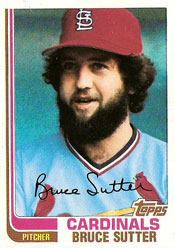
_ Sept. 14 at Philadelphia, Cardinals 2, Phillies 0: Backed by catcher Darrell Porter’s two-run home run, John Stuper (7.1 innings) and Bruce Sutter combined on the shutout. In the eighth inning, with the bases loaded, Sutter got third baseman Mike Schmidt to bounce into an inning-ending double play.

“The eighth and ninth innings belonged to me,” Sutter said to the Associated Press. Boxscore

_ Sept. 15 at Philadelphia, Cardinals 8, Phillies 0: Joaquin Andujar, overcoming a bruised right knee, retired the first 12 batters and finished with a three-hit shutout, his fifth of the season. Right fielder George Hendrick drove in four runs, two with sacrifice flies.

“We still have a long way to go … We have to beat everybody, not just Philadelphia,” Andujar said to United Press International. Boxscore

_ Sept. 17 at New York, Game 1, Cardinals 3, Mets 2: Eric Rasmussen, who spent most of the season with Yucatan in the Mexican League, joined the Cardinals in September. Making his first big-league start since 1980, Rasmussen held the Mets to four hits and two runs in seven innings. Sutter relieved and pitched three scoreless innings for the win.

In the 10th, rookie center fielder Willie McGee doubled, driving in first baseman Keith Hernandez from second with the winning run. Boxscore

_ Sept. 17 at New York, Game 2, Cardinals 7, Mets 1: Steve Mura (5.2 innings) started and earned the win, his last as a Cardinal and his first in more than a month. Doug Bair pitched 3.1 innings of scoreless relief.

After sweeping a doubleheader started by the unlikely duo of Rasmussen and Mura, manager Whitey Herzog told the Associated Press, “My pitching has been good this year. I have no complaints.” Boxscore

_ Sept. 18 at New York, Game 1, Cardinals 2, Mets 0: Bob Forsch (7.1 innings) and Bruce Sutter combined on the shutout. David Green, getting the start in center field, hit a fourth-inning home run off ex-Cardinal Pete Falcone. Boxscore

_ Sept. 18 at New York, Game 2, Cardinals 6, Mets 2: Jim Kaat, 43, got the start, his first since June and the 625th and last of his major-league career. Kaat went three innings and limited the Mets to a run, a solo homer by catcher Bruce Bochy. Jeff Lahti pitched the last six innings for the win. Boxscore

_ Sept. 19 at New York, Cardinals 3, Mets 1: Stuper (6.1) innings and Bair combined on another gem, completing the five-game sweep.

“I never figured on taking all five,” Herzog said to the Associated Press. “Maybe three, possibly four, but never five.” Boxscore

_ Sept. 20 at St. Louis, Cardinals 4, Phillies 1: Hendrick’s two-run double during a three-run fifth knocked out ex-Cardinal John Denny. Boxscore

Seven days later, the Cardinals clinched the division championship with a 4-2 victory over the Expos at Montreal. Boxscore

The 1982 Cardinals received several outstanding individual performances in September. Among the best:

_ Andujar, 5-0 record, 0.81 ERA.

_ Bair, 2 saves, 1.65 ERA.

_ Hendrick, .341 batting average, .383 on-base percentage, 17 RBI.

_ Hernandez, .333 batting average, .438 on-base percentage, 13 RBI.

_ Sutter, 6 saves, 2.04 ERA.

Previously: Jim Kaat interview: 1982 Cardinals were most close-knit club

Read Full Post »

(Updated Aug. 28, 2022)

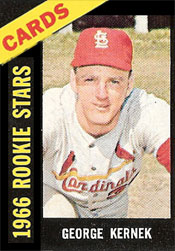
George Kernek was so highly regarded by the Cardinals they chose him to replace Bill White as their starting first baseman and issued him the uniform number previously worn by third baseman Ken Boyer.

Kernek was the Opening Day first baseman for the 1966 Cardinals, but the rookie held the job for less than a month, was sent back to the minor leagues and never played in the majors again.

Awarded a key position with a storied franchise, Kernek represented one of the biggest misjudgments made by Bob Howsam during his tenure as St. Louis general manager.

After the 1965 season, Howsam shocked St. Louis fans by breaking up his all-star infield. He traded Boyer to the Mets and sent White and shortstop Dick Groat to the Phillies.

News reports speculated the Cardinals would try to acquire a veteran first baseman such as Joe Pepitone of the Yankees, Donn Clendenon of the Pirates or Gordy Coleman of the Reds. Instead, the Cardinals preferred Kernek.

A basketball and baseball standout at the University of Oklahoma, Kernek signed with the Cardinals in 1961 and was assigned to Winnipeg of the Northern League. As he worked his way through the farm system, Kernek developed a reputation as an opposite-field hitter with little power. In his first four minor-league seasons, the left-handed batter averaged about six home runs a year.

Before the 1965 season, Fred Hawn, the scout who signed Kernek, told him he needed to hit with power to reach the big leagues. Kernek began a weight-training program, focusing especially on strengthening his wrists. He also switched to a lighter bat, at one point using a Stan Musial model. With the increased strength and lighter bat, Kernek began to consistently pull the ball.

Playing for Class AAA Jacksonville in 1965, Kernek led the International League in total bases. He hit .295 with 19 home runs and 86 RBI for manager Grover Resinger.

“I owe a lot to Grover,” Kernek told the St. Louis Post-Dispatch. “The last thing he did for me at Jacksonville was to shorten my swing and encourage me to use a lighter thin-handled bat. I got around on the ball better with only a short stroke.”

The Cardinals rewarded Kernek with a call to the big leagues in September 1965 and he impressed with a .290 batting average in 10 games.

In November 1965, White was traded, and Kernek became the leading candidate to replace him.

The Sporting News reported, “Vice president Stan Musial insists the Redbirds are not concentrating on landing a first baseman. The Man feels that there’s a good chance the first base job will be in good hands with George Kernek, Bob Tolan and veteran Tito Francona available.”

Kernek told the Associated Press, “Man, I’m in a heck of a spot. I think one of my biggest problems will be replacing Bill White in the hearts of the St. Louis fans. He’s really a great guy. When I came up at the end of last season, he gave me some good pointers.”

The Cardinals sent Kernek to their Florida instructional camp that winter and George Kissell worked with him on fielding. Kernek mostly had played outfield for Jacksonville in 1965. Kernek’s daily program with Kissell included making 25 throws to the pitcher covering first base, 25 throws to the second baseman on double-play attempts and 25 throws to home plate.

As for hitting, Cardinals coach Dick Sisler said, “I certainly like the way Kernek swings. There’s no use in fooling around with him.”

On March 4, 1966, the Associated Press reported manager Red Schoendienst had tabbed Kernek, 26, the favorite to win the first base job. Three days later, during a rundown play in a practice session, Kernek twisted a knee. He sat out a week before playing his first exhibition game on March 15.

A day later, Kernek, using a Bill White model bat, hit a three-run home run against Orlando Pena of the Tigers. “He’s a better hitter than people give him credit for being,” Cardinals coach Joe Schultz said. “He has good power.”

Troubling signs, however, emerged. Kernek completed spring training with a .224 batting average. In the season opener against the Phillies, Kernek made an error, went 0-for-2 and was lifted for pinch-hitter Mike Shannon with two on and one out in the seventh. Boxscore

Adding to expectations, Kernek was assigned White’s locker and given the uniform number 14 previously worn by Boyer.

Displaying almost no power, Kernek remained the starting first baseman through May 1. After Schoendienst benched him, the Cardinals went with a platoon of Francona and Phil Gagliano for five games.

On May 8, 1966, the Cardinals dealt pitcher Ray Sadecki to the Giants for first baseman Orlando Cepeda. “We needed somebody at first base, a big guy who could hit the ball,” Schoendienst said.

In 20 games, Kernek hit .240 with no doubles, no home runs and three RBI. He was sent to Class AAA Tulsa on the same day the Cardinals acquired Cepeda.

“It was pretty tough being sent down,” Kernek said to The Daily Oklahoman.

Kernek spent the remainder of the 1966 season and all of the 1967 season at Tulsa. Though he had solid numbers (18 home runs, 84 RBI for 1966 Tulsa and 14 home runs, 68 RBI for 1967 Tulsa), he no longer fit in the Cardinals’ plans.

After the 1967 season, Kernek was dealt to the White Sox for outfielder Jim Hicks. Kernek spent 1968 and 1969 with White Sox Class AAA clubs.

In 1970, Howsam, general manager of the Reds, brought Kernek into the Cincinnati organization. Kernek finished his professional career with Class AAA Indianapolis, managed by one of his former Cardinals instructors, Vern Rapp.


Read Full Post »

When the Cardinals established the franchise record for most runs scored in an inning, they did it at a critical stage of the National League pennant race.

The 12 runs the 1926 Cardinals scored in the third inning during the opener of a doubleheader at Philadelphia helped them catch the Reds and move toward clinching their first league championship.

On July 21, 2012, the Cardinals scored 12 runs in the bottom of the seventh against the Cubs and won, 12-0. Boxscore That was the first time St. Louis had scored a dozen runs in an inning since the 1926 Cardinals did it against the Phillies on Sept. 16, 1926.

Managed by second baseman Rogers Hornsby, the 1926 Cardinals trailed the first-place Reds by a half-game in the NL standings on the morning of Sept. 16. The doubleheader against the Phillies presented an opportunity for St. Louis to gain ground. Philadelphia was in last place and its pitching was the worst in the league (the 1926 Phillies would finish with a 5.03 team ERA).

In Game 1 of the doubleheader at Baker Bowl, the Phillies led 2-1 after two innings.

The Cardinals then battered five Phillies pitchers for 12 runs on nine hits and two errors in the third. Jack Knight and relievers Mike Kelly, Ed Baecht and Ray Pierce each yielded runs in the inning before Pete Rambo, making his big-league debut, got the third out.

(Unlike the fictional action-film character portrayed by Sylvester Stallone, Rambo, a 5-foot-9, 150-pound right-hander, didn’t become famous or infamous. He pitched 3.2 innings against the Cardinals that day, yielding eight runs on six hits and four walks. It turned out to be the lone appearance of his major-league career.)

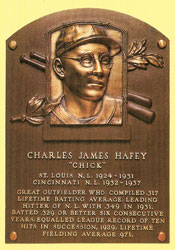
The Cardinals won, 23-3, collecting 22 hits (no home runs) and eight walks. Left fielder Chick Hafey was 3-for-6 with five RBI. First baseman Jim Bottomley drove in four runs. Center fielder Taylor Douthit scored five times. Boxscore

St. Louis also won the second game, 10-2. Wrote the Associated Press:

The first game was poorly played and the second was little better … There was an attendance of about 8,000 and many in the crowd jeered as the Philly pitchers were sent from the mound one after another in the first contest.

Though the Reds beat the Giants, 3-0, that day, the Cardinals’ doubleheader sweep enabled them to move into a first-place tie with Cincinnati. Each team had an 85-60 record, with nine games remaining.

When St. Louis beat Philadelphia the next day and the Reds lost to the Giants, the Cardinals took sole possession of first place. The Reds lost five in a row. On Sept. 24, the Cardinals clinched the pennant with a 6-4 victory over the Giants and finished two games ahead of the Reds.

Previously: Top 10 offensive seasons by a Cardinal in last 100 years

Read Full Post »

(Updated April 23, 2026)

In the 1950s, Tim McCarver was a standout athlete at Christian Brothers High School in Memphis, receiving football scholarship offers from schools such as Notre Dame and Tennessee, but professional baseball offered an immediate opportunity to earn an income for the catching prospect.
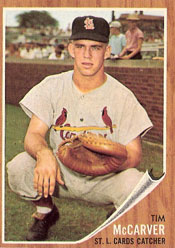
“Money was the deciding factor, plain and simple,” McCarver said in his book “Oh, Baby, I Love It.”

The best baseball offers came from the Yankees, Giants and Cardinals. The scout trying to sign McCarver for the Yankees was Hall of Fame catcher Bill Dickey. According to the St. Louis Post-Dispatch, Dickey said McCarver is “a Yankees-type player.”

“They were my No. 2 and a very close No. 2 to the Cardinals,” McCarver said to the Memphis Commercial Appeal.

McCarver said the Yankees offered a $60,000 signing bonus and Dickey told him, “If you sign with the Yanks, I’ll take you along with me on a two-week fishing trip. We’ll talk about catching inside and out.”

(In the 2003 book “Few and Chosen,” McCarver recalled, “In those days, Catholics could not eat meat on Fridays. Bill Dickey wasn’t Catholic, but he knew we were, and he would come to our house on Fridays with a load of fish he had caught and give it to my folks.”)

Despite Dickey’s efforts, the Cardinals’ offer of a $75,000 signing bonus and a guaranteed annual salary of $6,000 per year for five years convinced McCarver he should sign with them instead of the Yankees.

“I think I was swayed by the fact the Cardinals were only 290 miles away (from Memphis),” McCarver said to the Commercial Appeal. “That influenced me somewhat. Also, the Cardinals had given me a take-it-or-leave-it deal and that scared me to death. I was 17 years old.”

In “Few and Chosen,” McCarver said, “The Cardinals’ strongest pitch to me was that they were in need of a catcher, and I would have the best chance of making the major leagues more quickly with them than I would with the Giants or the Yankees … The Cardinals had Hal Smith, an excellent receiver, but … no promising young catchers in their organization.”

Super scout

With his parents in attendance, along with Cardinals farm director Walter Shannon and scout Buddy Lewis, McCarver signed the contract at his Memphis home on June 8, 1959. The $75,000 bonus was the largest given by the Cardinals, according to the Post-Dispatch.

The Cardinals “outbid at least nine other clubs for McCarver, whose high school batting average was .412,” the Post-Dispatch reported. McCarver also hit .390 for an American Legion team which won state and regional championships.

Buddy Lewis, a former big-league catcher, scouted McCarver for four years and said, “Tim is the best young catcher I’ve ever seen.”

According to the Post-Dispatch, Lewis relentlessly pursued McCarver and “spent many an afternoon at the McCarver home, talking baseball, catching and lastly, but not least, telling the St. Louis Cardinals story.”

(In “Few and Chosen,” McCarver said, “My earliest baseball recollection is the sound of Harry Caray’s voice, broadcasting St. Louis Cardinals games … Football was my favorite sport when I was a kid, but I was a big baseball fan, too. I wasn’t a Cardinals fan, just a baseball fan, but because of Harry Caray you couldn’t help but follow the Cardinals.”)

After signing the deal in the early morning before his father, a police lieutenant, went to work, McCarver said, “I am too excited for words.”

(In the book “Oh, Baby, I Love It,” McCarver said he gave $15,000 of his bonus money to his parents to pay off their mortgage. He said he also gave them money to build a den and bought them a 1959 Pontiac.)

Quick rise

McCarver was sent to the Cardinals’ Class D farm club at Keokuk, Iowa. He made his professional debut in the second game of a doubleheader at Waterloo, Iowa, on June 14, 1959, according to the Daily Gate City newspaper of Keokuk.

Years later, McCarver told the Commercial Appeal the plate umpire in his professional debut was Brent Musburger, the future sportscaster. However, that wasn’t so. The plate umpire was Bob Thompson and the base umpire was Chuck Wahl, research by the Daily Gate City showed. Musburger was the plate umpire a week later, June 21, 1959, in a game McCarver caught for Keokuk at Michigan City, Ind. Musburger was the umpire in 11 games McCarver played for Keokuk, according to the Daily Gate City.

McCarver was hailed as Keokuk’s best catching prospect since Russ Nixon, who hit .385 for Keokuk in 1955 before embarking on a 12-year playing career in the majors. “The fans will love this kid,” Keokuk manager Frank Calo said. “If they think Russ Nixon had it, wait until they see this kid.”

Unfazed by professional pitching, McCarver hit .360 in 65 games for Keokuk. He committed 14 errors.

When Rochester (N.Y.) catcher Dick Rand dislocated a right index finger, McCarver was promoted to the Class AAA International League club to replace him. He hit .357 for Rochester in 17 games and made no errors.

In September 1959, McCarver, 17, was promoted to the Cardinals and joined the team in Milwaukee. He showed up wearing a cheap plaid sport coat, gray pants, yellow socks and brown wingtip shoes. In the book “Oh, Baby, I Love It,” McCarver said Cardinals outfielder Bob Nieman barked, “That’s the worst-looking fucking outfit I’ve ever seen, bar none.” Nieman nicknamed the rookie “Bush” because of his bush league outfit.

Major-leaguer

On Sept. 10, 1959, his first day in a big-league uniform, McCarver marveled from the dugout at being in the presence of two of his boyhood heroes, Stan Musial of the Cardinals and Hank Aaron of the Braves.

In the book “Oh, Baby, I Love It,” McCarver recalled, “So when Hank came to bat for the first time that day, I leaped from my perch in the Cardinals’ dugout and did what I always did when I listened to the Braves play the Cardinals. ‘Come on, Henry,’ I yelled. ‘Come on, Henry.’ The action seemed natural to me, but some of my teammates weren’t amused.”

In the ninth inning, with two outs, Bill White on second base and the Cardinals trailing by three, manager Solly Hemus sent McCarver to make his major-league debut as a pinch-hitter for pitcher Marshall Bridges.

“So there I was, younger than Musial’s own son, picking up a bat and advancing to the plate,” McCarver recalled in his book. “As I stepped in to face Don McMahon, a veteran right-handed relief pitcher with a commanding fastball, my knees literally shook with fear.”

McMahon got two strikes on McCarver. Then the teen swung at a curveball and lifted it to right field, where the game-ending catch was made by none other than Hank Aaron. Boxscore

The next day, Sept. 11, 1959, at Chicago against the Cubs, McCarver got his first big-league start at catcher. Batting in the No. 2 spot, he went 0-for-4 against Bob Anderson. The Cardinals’ starting pitcher was Bob Miller, 20. According to The Sporting News, Miller and McCarver formed the youngest battery in big-league history. Boxscore

To put that into comparative perspective, the combined ages of McCarver and Miller was 37 _ younger than the individual ages of two of their teammates, Musial (38) and George Crowe (38).

On Sept. 13, 1959, McCarver, batting leadoff, got his first big-league hit, a single against the Cubs’ Glen Hobbie. Boxscore

(In “Few and Chosen,” McCarver recalled when he was a youth, “It was my sister, Marilyn, who made me a left-handed hitter. I do everything right-handed except hit a baseball and that was Marilyn’s idea.”)

McCarver played in eight games for the 1959 Cardinals, hitting .167 (4-for-24).

Described by The Sporting News as “one of the finest catching prospects the Cardinals have brought up in many years,” McCarver had stints with St. Louis in 1960 and 1961, then spent all of 1962 in the minor leagues before earning the Cardinals’ starting catcher job in 1963.

At spring training in 1963, McCarver, trying to regain his timing after a stint in Army reserves, had a poor batting practice and was criticized by Branch Rickey, the former general manager who returned to the Cardinals as a consultant.

In a 2014 interview with Cardinals Magazine, McCarver said, “It ticked me off. To this day, it ticks me off. I’m not a big Branch Rickey fan as a result of that. Later in 1963, I was swinging the bat well and he says, ‘Twenty-five McCarvers will win all the pennants in the world.’ ”

In his 1991 book “On the Run,” speedster Maury Wills said John Roseboro of the Dodgers and McCarver were the toughest catchers he saw during his career.


Read Full Post »
« Newer Posts - Older Posts »