Feeds:
Posts
Comments

Archive for the ‘Hitters’ Category

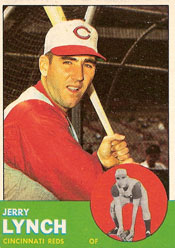
Jerry Lynch, one of the premier pinch-hitters in National League history, had more career hits, including two of his most dramatic, against the Cardinals than any other team.

A career .277 batter in 13 big-league seasons (1954-66) with the Pirates and Reds, Lynch hit .301 with 16 home runs against the Cardinals. His 128 hits off St. Louis pitching were his most against any opponent.

A left-handed batter, Lynch especially enjoyed hitting in Sportsman’s Park (Busch Stadium I). His batting average in that St. Louis ballpark was .321 (71-for-221).

In 1961, when Lynch helped the Reds to their first NL pennant in 21 years, he had a .404 batting average as a pinch-hitter (19-for-47), with five home runs. Against the Cardinals that season, Lynch hit .333 (10-for-30) overall, with two homers.

Lynch retired as the major league career leader in pinch-hit homers (18). He had broken the big-league record of 14 established by ex-Cardinal George Crowe. Though his big-league mark since has been surpassed by Matt Stairs (23 pinch-hit homers) and Cliff Johnson (20), Lynch’s 18 pinch-hit homers remain the NL record.

Lynch, an outfielder, hit two big-league grand slams _ both against the Cardinals.

The first occurred on Aug. 7, 1960, in the opener of a doubleheader at St. Louis. Lynch hit an eighth-inning grand slam off reliever Ron Kline, helping the Reds to an 18-4 victory. (Kline and Lynch had been Pirates teammates and eventually became business partners). Boxscore

Four years later, July 21, 1964, at St. Louis, Lynch hit a fifth-inning grand slam against reliever Ron Taylor, lifting the Pirates to an 8-4 triumph. Boxscore

Lynch had at least three other significant hitting performances against the Cardinals.

Twice in 1959 Lynch had four-hit games against St. Louis.

On June 28, 1959, Lynch, batting third and playing left field, was 4-for-5 with two doubles and a RBI for the Reds in the Cardinals’ 11-8 victory in Game 2 of a doubleheader at Cincinnati. Boxscore

Less than three weeks later, Lynch, batting fifth and playing left field, went 4-for-5 with four RBI, including a two-run homer off Ernie Broglio, in the Reds’ 7-5 win at St. Louis on July 16, 1959. Boxscore

In the May 1959 edition of Baseball Digest, Si Burick wrote of Lynch:

He was an outfielder who performed atrociously on defense. He moved uncertainly after fly balls. He wasn’t adept at fielding ground balls. He had just a fair arm. What kept him in business was his bat. Even when he wasn’t hitting for an average, he swung with an authority that was recognized by all who saw him.

Lynch hit Bob Gibson well. He was 18-for-58 (.310) against the Cardinals ace. In the last game he started for the Reds, Lynch drove in three and hit two doubles, both against Gibson, in Cincinnati’s 10-6 victory at St. Louis on May 19, 1963. Boxscore

Four days later, the Reds traded Lynch to the Pirates for outfielder Bob Skinner (who would play for the Cardinals from 1964-66 and help them to a World Series title).

Lynch had started his big-league career with the Pirates in 1954 before being acquired by Cincinnati in December 1956. After receiving word he had been reacquired by Pittsburgh in May 1963, Lynch told The Sporting News, “I sure was surprised.”

After his playing career, Lynch co-owned a golf course in Pennsylvania with former Cardinals shortstop Dick Groat.

Previously: George Crowe: mentor to Curt Flood

Read Full Post »

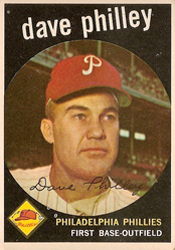
In an 18-year big-league career, Dave Philley spent three seasons in the National League and did some serious damage against the Cardinals.

One of the all-time best pinch-hitters, Philley was a career .270 batter who finished with 1,700 hits. The team against whom he had the highest batting average was the Cardinals.

Philley batted .370 (30-for-81) in 37 career games against the Cardinals. In 1959, playing for the Phillies, Philley blistered Cardinals pitching at a .422 clip (19-for-45).

A switch hitter, Philley made his big-league debut with the White Sox in 1941, served in the military and returned to the majors in 1946. He was an outfielder and first baseman with the White Sox, Athletics, Indians, Orioles and Tigers until joining the Phillies in 1958.

From 1957 through 1959, Philley was one of the premier pinch-hitters in the game. His batting averages as a pinch-hitter in those years:

_ .436 (17-for-39) in 1957 (White Sox and Tigers).

_ .409 (18-for-44) in 1958 (Phillies).

_ .395 (15-for-38) in 1959 (Phillies).

In 1958, Philley hit safely in eight consecutive pinch-hit appearances. When he got a pinch hit in his first appearance of 1959, Philley extended the streak to a major-league record nine.

In 1959, when he turned 40 in May, Philley pounded Cardinals pitching. It began in spring training when Philley ripped a pinch-hit grand slam against Sal Maglie of the Cardinals on March 29 at St. Petersburg, Fla.

Some of Philley’s many highlights versus the Cardinals in 1959:

_ May 5, 1959, Phillies 8, Cardinals 7, at Philadelphia: The Cardinals took a 7-3 lead into the bottom of the ninth, but Philadelphia rallied for five runs against starter Vinegar Bend Mizell and relievers Larry Jackson and Jim Brosnan. Boxscore

Philley, pinch-hitting for catcher Jim Hegan, contributed to the comeback with a RBI-single off Brosnan.

Cardinals manager Solly Hemus told The Sporting News the bullpen collapse was “the worst exhibition I ever saw _ terrible.”

_ June 6, 1959, Phillies 4, Cardinals 3, at Philadelphia: In the 10th inning, Philley, pinch-hitting for catcher Valmy Thomas with two outs and the bases loaded, singled to right against Lindy McDaniel, scoring Richie Ashburn from third for the victory. Boxscore

_ Aug. 9, 1959, Phillies 4, Cardinals 2, at St. Louis: In the ninth inning of the second game of a doubleheader, Philley, pinch-hitting for pitcher Jim Owens, singled to left off Marshall Bridges, driving in Joe Koppe from third with the tie-breaking run. Boxscore

“I’m a better hitter now than I ever was,” Philley said in a 1959 interview with The Sporting News, “and if I had known 10 years ago what I know now, I would have been able to make a potful of money out of this game.

“Of course, as you get older you get smarter up there at the plate and figure the pitchers better, but the main thing is that I’ve cut down on my swing. When I first came up and, in fact, until a few years ago, I was trying to hit home runs. I swung too hard and I had too long a swing. Now I’ve cut my swing down and I have control of the bat and I can wait longer on a pitch.”

In his book “Stan Musial: The Man’s Own Story,” Musial said Philley became “an outstanding pinch-hitter past 40 because he worked so hard to stay in shape.”

Philley was a mentor to the rookie second baseman of the 1959 Phillies, Sparky Anderson. The Sporting News reported Anderson, the future Hall of Fame manager of the Reds and Tigers, “has been one of the most consistent seekers of advice from Philley and believes Dave has helped him in many ways. The two usually sit together on the club’s plane rides and talk baseball by the hour.”

Previously: Cardinals’ collapse part of Larry Jackson’s painful 1961 season

Read Full Post »

(Updated March 24, 2019)

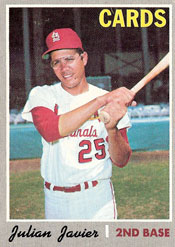
The second baseman who participated in one of the happiest periods in Cardinals history parted with the franchise in an unhappy manner.

Only three players _ Frankie Frisch, Julian Javier and Tommy Herr _ have been the everyday second basemen on three Cardinals pennant winners. Javier started for the National League championship clubs of 1964, 1967 and 1968.

By 1972, Javier, 35, no longer was prominent in the Cardinals’ plans. Ted Sizemore had taken over as St. Louis’ second baseman and Ed Crosby was seen as a capable backup.

On March 24, 1972, the Cardinals traded Javier to the Reds for pitcher Tony Cloninger. Bob Howsam, who’d been Cardinals general manager before taking the same role with the Reds, acquired Javier to back up Joe Morgan at second base and Denis Menke at third.

After the deal was made, Javier indicated he was unhappy with general manager Bing Devine and manager Red Schoendienst for not getting the chance to play more in spring training and compete for a starting job.

“I feel too good, like 20, to be sitting around,” Javier said to the Associated Press.

During the off-season, Devine and Schoendienst had talked with Javier about his future and were of the impression Javier had agreed to a reserve role in 1972, the St. Louis Post-Dispatch reported. “I thought Bing and I had a perfect understanding with Hoolie,” Schoendienst said to The Sporting News.

At spring training, however, Javier asked the Cardinals for his release because he was upset Schoendienst was taking a look at other candidates for a reserve infield role, according to Post-Dispatch sports editor Bob Broeg.

Javier told Schoendienst, “I think I can play everyday for two more years,” the Dayton Journal Herald reported.

Javier’s complaints prompted an uncharacteristic blast from Schoendienst, a former all-star second baseman. “Hoolie wasn’t in shape, didn’t want to play and scarcely could get the ball from second base to first, yet he wants to say we didn’t use him,” Schoendienst told Broeg. “I’m tired of people who don’t want to play but say they do.”

In 12 seasons (1960-71) with the Cardinals, Javier twice was named an all-star (1963 and 1968), twice led National League second basemen in putouts (1963 and 1964) and collected 1,450 hits.

A right-handed batter, Javier hit .299 against left-handed pitching during his major-league career.

Javier’s role with the Cardinals changed after the 1970 season when the club acquired Sizemore from the Dodgers for first baseman Dick Allen.

Javier was found to owe back taxes to the U.S. government, leading to speculation the native of the Dominican Republic could become entangled in a legal case that might jeopardize his career. However, Javier worked out a settlement on his tax problems. When he reported to spring training in 1971, he was 10 pounds lighter (at 180) and performed more like the player he’d been on those championship teams.

Because of an injury to Dal Maxvill, Sizemore opened the 1971 season at shortstop and Javier remained the starter at second base. Javier batted .309 in the first two months of the season, slumped and entered July at .234. Maxvill returned to shortstop and Sizemore moved to second, replacing Javier.

At spring training in 1972, the Cardinals determined they were ready to move on without Javier. The trade to the Reds turned out to be a blessing for him. Javier had several key hits for the Reds and helped them win the 1972 NL pennant. Among the highlights:

_ Reds 11, Cardinals, 2, May 13, at Cincinnati: Facing Cloninger, the pitcher for whom he was traded, Javier delivered a RBI-single, scoring Johnny Bench. Boxscore

_ Reds 4, Giants 3, May 16, at San Francisco: Starting at third base, Javier hit a three-run home run against left-hander Ron Bryant. Boxscore

_ Reds 6, Phillies 5, June 3, at Philadelphia: Javier hit a two-run home run against left-hander Steve Carlton, a former Cardinals teammate. It was the 78th and last homer of Javier’s big-league career. Boxscore

_ Reds 8, Mets 2, June 17, at Cincinnati: Facing another former Cardinals teammate, left-hander Ray Sadecki, Javier hit a two-run single. Boxscore

Javier capped his career by appearing in four games for the Reds against the Athletics in the 1972 World Series.


Read Full Post »

(Updated: Oct. 21, 2018)

Even in the immediate afterglow of their first World Series title in 15 years, the Cardinals and manager Whitey Herzog were willing to trade significant and popular starters in order to secure another all-star for the left side of the infield.

Less than two months after winning the 1982 World Series championship, the Cardinals came close to acquiring third baseman Buddy Bell from the Rangers.

Bell would have paired with Ozzie Smith to give the Cardinals a premier third base/shortstop combination.

To acquire Bell, Herzog was willing to trade right fielder George Hendrick, third baseman Ken Oberkfell and possibly pitcher Bob Forsch.

When trade negotiations collapsed in December 1982, Herzog expressed great disappointment.

In the Dec. 20, 1982, edition of The Sporting News, St. Louis writer Rick Hummel reported the Cardinals made “a strong pitch” for Bell, “but withdrew their offer after several days of negotiating.”

Texas writer Jim Reeves confirmed the Rangers “seriously considered” trading Bell and “were close with St. Louis and Baltimore.”

Hummel reported the Cardinals offered Hendrick, Oberkfell and pitcher Steve Mura for Bell. The Cardinals also were in serious negotiations with free-agent pitcher Floyd Bannister. Hummel reported the Cardinals would have substituted Forsch for Mura if they signed Bannister.

(Bannister spurned a $4.5 million, five-year offer from the Cardinals and signed a similar contract with the White Sox. A major reason he chose the White Sox was because Dave Duncan, Bannister’s pitching coach with the Mariners, had joined the White Sox to become pitching coach for manager Tony La Russa).

In offering Hendrick, Oberkfell and Mura or Forsch for Bell, the Cardinals were offering a lot to the Rangers:

_ Hendrick led the 1982 Cardinals in home runs (19), RBI (104) and slugging percentage (.450). He hit .321 in the 1982 World Series and drove in the go-ahead run in Game 7.

_ Oberkfell batted .289 for the 1982 Cardinals and ranked third among National League third basemen in assists.

_ Forsch had 15 wins in 1982, his sixth consecutive season of double-digit victories for the Cardinals. Mura posted 12 wins in 1982.

Herzog, who perhaps valued defense above all other skills, saw an opportunity to give the Cardinals a pair of Gold Glove winners on the same side of the infield.

Bell, 31, was in his prime. At that time, he had won four Gold Glove awards (Ozzie Smith had just won his third) and Bell had been a four-time American League all-star. Bell also batted .296 with an on-base percentage of .376 in 1982.

Bell had caught the attention of Hall of Fame third baseman Brooks Robinson, who told columnist Peter Gammons that winter, “It’s only recently that I’ve come to appreciate him. I never realized how much range he has or the plays he makes.”

Herzog seemed stunned Rangers general manager Joe Klein rejected his offer for Bell.

“It’s amazing that a team can lose 100 games (Texas lost 98 in 1982) and won’t make a deal,” Herzog told The Sporting News. “I feel sorry for people in baseball who have a million-dollar investment and don’t know what to do.”

In its Dec. 6, 1982, edition, Klein had told The Sporting News, “I won’t say I wouldn’t trade Bell, but I’d have to receive an offer that would knock my socks off.”

Texas reportedly had rejected offers from the Yankees (who refused to part with pitcher Dave Righetti), Reds (who may have offered a package that included pitcher Bruce Berenyi and infielder Ron Oester) and White Sox (who offered pitcher Britt Burns after they had signed Bannister).

Three years later, July 19, 1985, the Rangers traded Bell to the Reds for outfielder Duane Walker and pitcher Jeff Russell. By then, Terry Pendleton had replaced Oberkfell at third base and the Cardinals were headed to their second pennant-winning season under Herzog.

Buddy Bell never did play for the Cardinals, but his son did. David Bell was a Cardinals infielder from 1995-98 and in 2014 he became their assistant hitting coach. On Nov. 3, 2014, the Cardinals promoted David from assistant hitting coach to bench coach. After the 2017 season, he left the Cardinals for a front office position, vice president of player development, with the Giants. On Oct. 21, 2018, David Bell was chosen to be manager of the Reds.

Previously: How the Cardinals’ trade for Ozzie Smith almost collapsed

Read Full Post »

(Updated Feb. 21, 2022)

Big-league scouts touted catcher Ted Simmons as a can’t-miss prospect. The Cardinals chose him in the first round of the 1967 amateur draft and were rewarded. In 13 seasons with the Cardinals, Simmons hit .298, compiled 2,626 total bases and had an on-base percentage of .366.

In June 1967, Simmons, 17, was a highly regarded athlete at Southfield High School in Michigan. According to Sport magazine, Simmons, a fullback, was offered football scholarships to schools such as Michigan, Michigan State, Ohio State and Purdue.

“The pressure my senior year was intense,” Simmons told Sport. “Everyone around me was always speculating about my prospects and options as if I were a hot stock. They were all whispering in my ear and trying to pull me this way and that.”

In an article for The Sporting News, writer Jack Lang polled major-league scouts for their choices on the nation’s top 12 baseball draft prospects and Simmons ranked ninth.

Simmons told Sport, “I knew what was happening to me by around 14, 15 years old. By that time, I was already working out with the Tigers and hitting balls into the upper deck at Tiger Stadium.”

With the 10th overall choice in the first round, the Cardinals caught a break when two teams selecting ahead of them took catchers but bypassed Simmons.

The Senators, with the fifth overall selection, took Johnny Jones, a high school catcher from Tennessee. The Angels, just ahead of the Cardinals with the ninth overall pick, seemed certain to choose Simmons, but instead took Mike Nunn, a high school catcher from North Carolina.

Simmons, two months shy of his 18th birthday, had hoped to be chosen by his home state Tigers, who had the 14th pick of the first round.

After the Cardinals chose him, Simmons said, “The contract will have to be big enough to make it worthwhile for me to pass up college. I’d have to say I’d want about $50,000, although some people have told me it should be $75,000 and some say $100,000.”

Simmons ended up with the best of both. The Cardinals scout who recommended him, Mo Mozzali, signed Simmons for $50,000 and Simmons enrolled at the University of Michigan as a physical education and speech major, beginning classes in the fall of 1967.

In a 2013 interview with Cardinals Gameday Magazine, Simmons recalled, “I got first-round money, which was a ton of money then, and got my school paid for. I bought a Dodge Charger, brand-spanking new. For a poor kid from Detroit, (the money) was huge _ I mean huge _ for me and my family.”

After signing, Simmons reported to the Cardinals’ Gulf Coast League team, managed by George Kissell, in Sarasota, Fla.

On Simmons’ first day there, Kissell met with a group of players and diagrammed a relay play on a chalkboard. According to Cardinals Gameday Magazine, Kissell asked, “Does anyone know what to do or where to go here?”

When no one responded, Kissell said, “I bet Mr. Simmons knows. Mr. Simmons, why don’t you come up here and diagram the play for all of us?”

Simmons looked at the chalkboard and said, “I don’t know.”

“OK, Mr. Simmons, you can sit back down then,” Kissell said. “I’ll tell everyone where to go.”

Years later, Simmons told Cardinals Gameday Magazine, “Yes, I was the No. 1 pick, everyone knew that and I got more money, but I didn’t know anything more than anyone else in that group and George thought it was important to point that out to everyone, especially to me.”

In his debut game as a professional on July 1, 1967, Simmons, playing the outfield, hit a two-run home run in the eighth inning, lifting Sarasota to a 4-2 victory. The Sporting News reported the feat in a story headlined, “Simmons Sock Star In Opener Of Gulf Coast.”

In six games for Sarasota, Simmons batted .350 (7-for-20) with two home runs and eight RBI. That earned him a promotion to Cedar Rapids, where he hit .269 (46-for-171) before reporting to the University of Michigan.

In the book “The Ted Simmons Story,” author Jim Brosnan said a report Cedar Rapids manager Jack Krol sent to the Cardinals on Simmons suggested “wherever he plays, he’ll hit. He’s a natural. From both sides of the plate.”

Three years later, on Memorial Day weekend in 1970, Simmons took over for Joe Torre as the Cardinals’ everyday catcher. Simmons stayed in that starting role for the next decade.


Read Full Post »
(Updated Oct. 25, 2022)

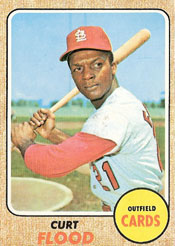
Mike Shannon almost got traded to the Red Sox before he played a game for the Cardinals.

Shannon was loaned by the Cardinals to the Red Sox organization during the summer of 1962. For a while, the Red Sox were interested in acquiring him and the Cardinals were interested in doing a deal.

Shannon began the 1962 season with the Cardinals’ Class AAA Atlanta farm club in the International League. After 31 games with Atlanta, Shannon was among the top 10 in the league in batting at .321. He also had four home runs and 15 RBI.

After that, Shannon’s production dropped. He played a total of 66 games with Atlanta and hit .260 with six homers and 28 RBI.

During the 1962 season, the Cardinals loaned Shannon to the Red Sox, who assigned him to their Class AAA Seattle farm club, managed by Johnny Pesky, in the Pacific Coast League. The move revived Shannon, who hit .311 with seven home runs and 47 RBI in 76 games for Seattle.

“The Red Sox showed some interest in him,” Cardinals manager Johnny Keane told the St. Louis Post-Dispatch. “We would have dealt him if we could have got what we wanted, but then the Red Sox lost interest in him.”

Overall, Shannon’s combined season statistics for Atlanta and Seattle were solid: .288 batting average, 13 home runs, 75 RBI in 142 games.

At age 23, he finally got the call to St. Louis.

In his first big-league game, on Sept. 11, 1962, at St. Louis against the Reds, Shannon, batting seventh and playing right field, went 1-for-4 in the Reds’ 6-2 victory. Shannon’s hit was one of only three the Cardinals managed against Cincinnati ace Bob Purkey.

After grounding out to second baseman Don Blasingame in the second inning, Shannon led off the fourth with a single to left. Dal Maxvill bunted Shannon to second before Purkey struck out Bob Gibson and Julian Javier. Boxscore

That was Shannon’s lone Cardinals highlight that month. After getting that first big-league hit, Shannon went 0-for-12 the rest of September before singling to left in his last at-bat of the season against Billy Pierce in the eighth inning of a 6-3 Giants victory on Sept. 26 at San Francisco. Boxscore

In 10 games for the 1962 Cardinals, Shannon hit .133 (2-for-15) with a walk and three strikeouts.

Shannon also opened the 1963 season in the minor leagues, but by mid-season in 1964 he became the Cardinals’ right fielder and played an important role in sparking them to a World Series title that year.

Converted to a third baseman for the 1967 season, Shannon was a starter for two more Cardinals pennant winners and another World Series championship team. He joined their broadcast team in 1972.

Read Full Post »

« Newer Posts - Older Posts »