Feeds:
Posts
Comments

Archive for the ‘Hitters’ Category

(Updated Feb. 20, 2023)

Hank Aaron could have added to his home run total if not for an unusual call in a game against the Cardinals.

Aaron, who would break Babe Ruth’s career home run record of 714 in 1974 and finish with 755, hit a home run against the Cardinals in 1965 that didn’t count toward his total.

On Aug. 18, 1965, at St. Louis, Aaron came to bat for the Braves against Cardinals starter Curt Simmons with the score tied 3-3 in the eighth.

In his autobiography, “I Had a Hammer,” Aaron said, “I always had difficulty with Curt Simmons because he would put the ball behind his back and then pound his leg with his glove. You never knew where the ball was coming from. Simmons used to drive me crazy with his herky-jerky delivery and his floating change of pace.”

In the 1965 game, Simmons teased Aaron with a changeup so high and so slow it seemed much like a blooper pitch. “I double-hitched my swing,” Aaron said in his book, “and took a big step up to meet the ball.”

Aaron lifted a high fly ball onto the pavilion roof in right for an apparent go-ahead home run.

Instead, Aaron was called out by plate umpire Chris Pelekoudas for being out of the batter’s box when he connected with the ball, nullifying the home run. Pelekoudas, in his sixth season as a National League umpire, ruled Aaron’s left foot was in front of the batter’s box.

“It’s the worst call I’ve ever seen,” Aaron said to the Associated Press. “I did the same thing the time before and popped up, and he (Pelekoudas) didn’t say a word. I always hit Simmons that way.”

Braves manager Bobby Bragan argued with the umpire and was ejected.

“It was either a grudge call, or he wanted to get his name in the paper,” Bragan said. “I’ve never seen such a call.”

Said Pelekoudas: “Bragan’s protest was strictly on judgment. His only argument was about a grudge _ and that is stupid. I didn’t hesitate in making the call.”

Cardinals catcher Tim McCarver said Aaron stepped out of the box and, “I expected (Pelekoudas) to call it.”

Cardinals coach Joe Schultz told the St. Louis Post-Dispatch, “You’ve got to give the umpire credit for having the nerve to call it.”

Aaron said in his book, ‘I won’t swear to you that I didn’t step over the line of the batter’s box, but it was nothing that I or other hitters hadn’t done before.”

Cardinals backup catcher Bob Uecker wasn’t in the game, but years later, in July 1973, he claimed to the Boston Globe and the Associated Press that he “pointed out Aaron’s cleat marks” to Pelekoudas. “It was one of the few occasions I’ve seen Aaron blow his stack,” Uecker said to the Associated Press.

In his 1982 book “Catcher in the Wry,” Uecker told another version. “I had to tell Henry the truth. It wasn’t me,” Uecker said. “Tim McCarver was the catcher who took the homer away from him, but it was the sort of thing I would have been proud to do.”

In the ninth, with Ray Washburn pitching in relief of Simmons, the Braves sent Don Dillard to pinch-hit with a runner on base and two outs. Dillard delivered a home run _ the last of his big-league career.

In a fitting twist, the Cardinals argued the ball hit by Dillard didn’t clear the wall and shouldn’t have been ruled a home run, but the Cardinals lost that argument and the game, 5-3. Boxscore

Umpire Bill Jackowski said the ball hit the top of the wall, caromed off a fan in the stands and bounced back onto the field.

The Post-Dispatch reported the ball Dillard hit “came straight down and hit the outfield wall padding before bouncing onto the field.”

“I came very close to catching the ball,” Cardinals center fielder Curt Flood said to the Post-Dispatch. “I thought it was a big can of corn. There was no way for the ball to come down the way it did if a fan had touched the ball.”

Read Full Post »

(Updated May 7, 2025)

So you think showing a squirrel on a Skip Schumaker Topps baseball card is controversial? How about printing baseball cards for seven years from 1951-57 and never offering a Stan Musial baseball card?

In the first series of its 2012 baseball card set, Topps printed two cards of St. Louis utilityman Skip Schumaker. The common card shows an image of Schumaker sliding. The other card, which has been released in limited supply (driving up demand and price), shows only Schumaker’s shoe as the so-called “rally squirrel” dashes across home plate.

Critics call the squirrel card dumb. Supporters find it fun. For Topps, the card has created publicity.

It may be the most controversy associated with Topps and the Cardinals since its seven-year absence without Musial.

Topps began printing baseball cards in 1951 when Musial was 30 and near the peak of his Hall of Fame career. Musial had a contract to appear on baseball cards produced by a rival company, Bowman.

Bowman produced Stan Musial cards in 1952 and 1953.

For the next four years (1954-57), Musial didn’t appear on any baseball card, even though he may have been the most popular player in the game.

In a 2001 interview with USA Today on the 50th anniversary of Topps baseball cards, Topps executive Sy Berger said Musial “just didn’t want to sign (a contract) for cards.”

The breakthrough came in time for Topps’ 1958 set. Berger said Cardinals owner Gussie Busch was raising money for charity. Berger said Topps offered to donate $1,500 to the non-profit of Busch’s choice if Musial would agree to sign a Topps contract to appear on a 1958 baseball card. Musial did.

(In the book “Musial: From Stash to Stan the Man,” author James N. Giglio claims “insufficient compensation” was the reason Musial didn’t sign with Topps until 1958.)

“Every year after that, Musial told us that he didn’t want the license fee, but would sign a contract in exchange for us making a similar donation to a charity of his choice,” Berger told Cardinals Yearbook in 2001. “That was how Musial ended up on Topps cards.”

Musial continues to be featured on Topps baseball cards today.

When Topps issued its first baseball cards in 1951, the look and feel were more like a deck of playing cards, or game cards for a baseball board game.

The 1951 cards came in two styles: with red backs and with blue backs. The front of the cards featured a player’s face bordered by a baseball diamond. The backs of the cards were colored either red or blue and offered no statistical information.

The red backs and blue backs were issued at the same time.

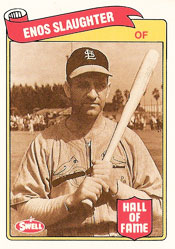
Two Cardinals _ pitcher Howie Pollet and outfielder Tommy Glaviano _ were part of the red backs. Six Cardinals _ pitchers Gerry Staley, Red Munger and Harry Breechen; second baseman Red Schoendienst; outfielder Enos Slaughter; and third baseman Billy Johnson _ were part of the blue backs.

The series had 52 red back and 52 blue back cards. There also were special-feature team cards and all-star cards. These included a Cardinals team card and an all-star card of retired Cardinals pitcher Grover Cleveland Alexander.

In 1952, Topps issued a 407-card set that is the prototype for the traditional baseball card, with statistics on the back and designed images of players on the front.

The first Cardinal to appear in the 1952 set was catcher Johnny Bucha (card No. 19). Bucha played in a total of 24 games for the Cardinals over two seasons (1948 and 1950) but didn’t play in any games for St. Louis in 1952.

Previously: The story behind Stan Musial’s $100,000 contract

Read Full Post »

(Updated June 10, 2023)

In 1962, at age 41, Stan Musial, thought by some to be finished, produced like a star player in his prime. He placed second in the National League in on-base percentage (.416) and third in batting average (.330).

It remains one of the great performances by a player 40 or older.

After hitting .310 or better in each of his first 17 big-league seasons, Musial failed to reach .300 in three consecutive years (1959-61). Many assumed the 1962 season would be his last and that he might be relegated to part-time status.

Musial worked out diligently after the 1961 season and reported to spring training in top shape in 1962. “I came into camp this year weighing 184, four pounds lighter than a year ago,” Musial told The Sporting News. “And believe me, those four pounds make a difference.”

From the start of spring training, Musial hit well _ “The Man had one of the best springs of his career,” The Sporting News reported _ and Cardinals manager Johnny Keane developed a plan to rest Musial as required during the 162-game season schedule.

Keane elected to open the season with an outfield of Musial, 41, in right, Minnie Minoso, 36, in left, and Curt Flood, 24, in center.

At a community luncheon before the season opener, Musial said he told Minoso, “We’re going to keep Flood in good condition. I’ll catch whatever comes to me and you catch whatever comes to you. Curt can have everything else.”

Musial established a blistering pace to open the season. Here is what he did in his first three games:

_ April 11, vs. Mets, at St. Louis: Musial was 3-for-3 with a double, a walk and two RBI in the Cardinals’ 11-4 victory. Boxscore

_ April 13, vs. Cubs, at Chicago: Musial was 2-for-4 in the Cardinals’ 8-5 victory. Boxscore

_ April 14, vs. Cubs, at Chicago: Musial had a home run, two RBI and a stolen base in the Cardinals’ 7-4 victory. The steal was Musial’s first in two years. Surprised Cubs catcher Cuno Barragan, unprepared for Musial’s theft attempt, threw wildly into center field, enabling Stan to scamper to third. Boxscore

“The Cubs, feeling that old guy won’t be going any place, patently ignored him and he was off and running,” reported The Sporting News.

Said Musial: “My boy, Dick, came over from Notre Dame for that game and he said he got a much bigger kick out of watching me steal the base than he did in seeing me hit a home run.”

Musial batted .396 (19-for-48) for April. His batting average dipped below .300 only once (.298 on May 24) all season. In July, undeterred by the steamy St. Louis summer, Musial hit .397 (27-for-68).

On Aug. 9, Musial led the league in batting at .354, nine points better than Tommy Davis of the Dodgers.

All season, Musial continued to defy the odds with sensational performances. Among the most notable:

_ May 19, vs. Dodgers, at Los Angeles: Musial broke an 0-for-9 slump with a ninth-inning single off a Ron Perranoski curveball. The hit was No. 3,431 for Musial, breaking the NL record of Honus Wagner.

“When I finally got to first base after breaking the record, I felt so relaxed I could have fallen over,” Musial told the Associated Press. “That’s when I realized the pressure had been on.” Boxscore

_ July 8, vs. Mets, at New York: Musial hit 3 home runs in the Cardinals’ 15-1 victory. He remains the oldest player to achieve the feat. Boxscore

In his 1998 book, “Baseball for Brain Surgeons and Other Fans,” Musial’s former Cardinals teammate, Tim McCarver, said, “If a batter keeps his shoulder locked in, he can be fooled on a pitch and start forward too early with his body yet still be able to keep his hands back and generate power. Stan Musial was the quintessential guy in this regard. You could fool Musial and his body would commit, but … he had his hands back and, boom, he could still deliver his power.”

_ July 25, vs. Dodgers, at St. Louis: Musial hit a two-run homer off Don Drysdale, giving Stan a NL-record 1,861 RBI, breaking the mark held by Mel Ott. Boxscore

_ Sept. 27, vs. Giants, at San Francisco: Musial went 5-for-5 with 2 runs scored in the Cardinals’ 7-4 victory. Boxscore

After the season, Musial was named the NL comeback player of the year in a poll of national baseball writers conducted by the Associated Press.

In his book “Stan Musial: The Man’s Own Story,” Musial said, “What gave me my greatest thrill in 1962 was the year I had at bat … I walked out there, day after day, certain I would play, confident I would hit. It was like old times.”

Read Full Post »

(Updated Sept. 10, 2022)

My choices for the top 5 iconic moments in Cardinals history:

1: STAN MUSIAL’S FINAL AT-BAT

What happened: In a fitting ending to an illustrious career, Stan Musial went out like he came in. Playing in his final big-league game on Sept. 29, 1963, against the Reds at St. Louis, Musial broke a scoreless tie in the sixth by smacking a single past second baseman Pete Rose, scoring Curt Flood. Lifted for a pinch-runner, Musial left to a thunderous ovation. He finished his final game with two hits and a RBI. Boxscore Ever consistent, Musial began his career in similar fashion, getting two hits and two RBI in his big-league debut on Sept. 17, 1941, against the Braves at St. Louis. Boxscore The Cardinals won both games by the same score: 3-2. Musial had 3,630 career hits (1,815 at home and 1,815 on the road).

Why it qualifies: The final at-bat brought to a close the career of the greatest Cardinal. No Cardinal has been more outstanding.

Fun fact: After being lifted from the game, Jim Maloney, the Reds pitcher who gave up the two hits to Musial, went to the St. Louis clubhouse to seek out the retiring Cardinal and tell him, “It was a pleasure watching you play ball.”

Top quote: “It was a great day and I’m grateful that I was able to do something well in my last game.” _ Stan Musial to the Associated Press.

2: THE STRIKEOUT OF TONY LAZZERI

What happened: On Oct. 10, in Game 7 of the 1926 World Series at New York, the Cardinals led 3-2. In the seventh, the Yankees loaded the bases with two outs against starter Jesse Haines, who split a finger on his pitching hand. Cardinals manager Rogers Hornsby called on Grover Cleveland Alexander to relieve. Alexander had pitched a complete game the day before in the Cardinals’ Game 6 victory. Boxscore In the book “The Glory of Their Times,” Cardinals catcher Bob O’Farrell said Alexander was “tight asleep in the bullpen, sleeping off the night before,” when Hornsby called him into Game 7.

Facing rookie Tony Lazzeri, who had 18 home runs and 114 RBI that season, Alexander struck him out. Alexander shut down the Yankees with 2.1 hitless innings, earning a save to go with two World Series wins and preserving the 3-2 St. Louis victory. Boxscore

Why it qualifies: By defeating the Yankees and winning their first World Series championship, the Cardinals transformed from a perennial also-ran into an elite franchise in the National League.

Fun fact: Alexander retired the first six batters he faced in Game 7. None of them hit a fair ball out of the infield. The seventh, Babe Ruth, walked with two outs in the ninth and was thrown out attempting to steal.

Catcher Bob O’Farrell, who fired the ball to Hornsby at second to nab Ruth, told author Lawrence Ritter, “I wondered why Ruth tried to steal second there. A year or two later, I went on a barnstorming trip with the Babe and I asked him. Ruth said he thought Alexander had forgotten he was there. Also, that the way Alexander was pitching they’d never get two hits in a row off him, so he better get in position to score if they got one. Maybe that was good thinking and maybe not. In any case, I had him out a mile at second.”

Top quote: “I knew he was all rattled and nervous and would go after anything, so I gave him a low curve a foot and a half from the plate and he swung and missed.” _ Grover Cleveland Alexander to The Sporting News, describing the pitch on which he struck out Tony Lazzeri.

3: DAVID FREESE’S HOME RUN

What happened: On Oct. 27, in Game 6 of the 2011 World Series at St. Louis, third baseman David Freese, whose two-out, two-run triple in the ninth tied the score, delivered a game-winning home run to lead off the 11th. The Cardinals rallied from deficits of 1-0, 3-2, 4-3, 7-4 and 9-7 against the Rangers to win 10-9 in 11 innings. St. Louis became the first team to score in the eighth, ninth, 10th and 11th innings of a World Series game. The Cardinals were within one strike of elimination in the ninth and 10th innings, and survived. Boxscore

Why it qualifies: The home run capped the most dramatic World Series comeback victory in Cardinals history. It advanced the Cardinals to Game 7 and they clinched their 11th World Series title.

Fun fact: Freese became the fourth Cardinal to receive the World Series Most Valuable Player Award, joining pitcher Bob Gibson (1964 and 1967), catcher Darrell Porter (1982) and shortstop David Eckstein (2006).

Top quote: “Your Game 6 performance, David, will turn out to be one for the ages.” _ Baseball commissioner Bud Selig, in presenting the World Series MVP Award to David Freese.

4: ENOS SLAUGHTER’S DASH TO HOME PLATE

What happened: On Oct. 15, in the eighth inning of Game 7 of the 1946 World Series at St. Louis, the Cardinals’ Enos Slaughter was on first base with two outs and the score tied, 3-3. Harry Walker hit a line drive that fell into left-center, where Leon Culberson (who had replaced an injured Dom DiMaggio) retrieved the ball and threw to the cutoff man, shortstop Johnny Pesky. Slaughter rounded third and slid home safely, beating Pesky’s throw. The daring baserunning gave the Cardinals a 4-3 victory and the championship. Boxscore

Why it qualifies: Slaughter’s hustle symbolized the smart and sound Cardinals teams that dominated the National League in the 1940s. The Cardinals won four pennants and three World Series championships in the decade and finished second five times.

Fun fact: Slaughter credited third-base coach Mike Gonzalez for waving him to home plate as soon as he reached third. It was redemption for Gonzalez, who was criticized after Game 4 when two Cardinals baserunners he waved home were thrown out at the plate.

Top quote: “They say if Pesky hadn’t held the throw I would have been out by a country mile. I don’t know about that. I know the throw to the plate was a little wide, up the third-base line. I also know I had to score.” _ Enos Slaughter to International News Service.

5: OZZIE SMITH’S HOME RUN

What happened: In Game 5 of the best-of-seven National League Championship Series on Oct. 14, 1985, at St. Louis, Ozzie Smith snapped a 2-2 tie with a home run in the ninth against Dodgers reliever Tom Niedenfuer, giving St. Louis a 3-2 victory. Boxscore It was the first home run Smith hit left-handed in eight years as a big-leaguer.

Why it qualifies: The blast (along with broadcaster Jack Buck’s memorable call of “Go crazy, folks! Go crazy!”) symbolized the spirit of manager Whitey Herzog’s 1980s Cardinals clubs and helped clinch Smith’s reputation as a Hall of Famer.

Fun fact: Niedenfuer said the pitch was supposed to be up and in to Smith, but instead was down and in. That mistake enabled Smith to drop the head of the bat on the ball and golf it over the right-field wall.

Top quote: “All I was trying to do was get the ball down the line, into the corner. Fortunately, I got enough to put it out. It was exciting.” _ Ozzie Smith to the Associated Press.

Read Full Post »

(Updated June 9, 2024)

One of the most remarkable teams in St. Louis history was the 1987 Cardinals.

Managed by Whitey Herzog, the 1987 Cardinals overcame adversity and several back-to-the-wall predicaments to finish 95-67 (three games ahead of the favored Mets in the National League East). The Cardinals then won the pennant by beating the Giants in the League Championship Series and got to Game 7 of the World Series before losing to the champion Twins.

In his book “Mookie,” Mets center fielder Mookie Wilson said, “I loved the Cardinals’ style of play. They were so aggressive, always running on the bases until there was no place else to go … It was an exciting brand of baseball. I always believed that I could have fit in well with that club because I liked running when there were no rules or boundaries.”

The Cardinals started the season with an injury to their top starting pitcher, John Tudor, who suffered a broken kneecap in the dugout when Mets catcher Barry Lyons crashed into him while chasing a pop fly Boxscore, and ended the season without their top slugger, first baseman Jack Clark, who was limited to one postseason at-bat after tearing a tendon in his ankle in a game at Montreal Sept. 9. Boxscore

Two nights after the injury to Clark, the Cardinals were at Shea Stadium to open a three-game series against the second-place Mets, who had moved to within 1.5 games of St. Louis in the NL East standings.

In the ninth, the Mets led 4-1 and were within a strike of getting within a half-game of St. Louis, but Willie McGee delivered a two-out, two-strike RBI-single and Terry Pendleton followed with a two-run home run off Roger McDowell, tying the score. The Cardinals scored twice in the 10th to win, 6-4, stunning the Mets and building their lead to 2.5 games. Boxscore

After clinching the division title Oct. 1 with an 8-2 victory over the Expos at St. Louis, Herzog told the Associated Press, “We could’ve folded when we lost Jack, but we didn’t. The Mets talk about adversity, but we really had it.” Boxscore

In the best-of-seven NL Championship Series, the Giants won three of the first five (on the strength of four Jeffrey Leonard home runs) before the Cardinals won Game 6, 1-0, behind Tudor and two relievers Boxscore and Game 7, 6-0, on a Danny Cox masterpiece. Boxscore

The Cardinals won three of the first five in the World Series against the Twins and held leads in Game 6 (5-2 in the fifth inning) and in Game 7 (2-1 after four) before losing both at Minnesota.

“I look back on that as the biggest miracle year _ the 1987 team,” Herzog said to Cardinals Magazine. “No one even gave us a chance … That was the first year of the juiced-up baseball _ and I didn’t have much juice on that team.”

In honor of this resilient team, here are 10 top facts about the 1987 Cardinals:

1. Shortstop Ozzie Smith led the team in hitting, with a .303 batting average _ the only time he hit .300 or better in a season during his 19-year major-league career.

2. Clark had 57 fewer hits than McGee (120 to 177), but finished with one more RBI (106 to 105).

3. Clark drew 136 walks in 131 games. Mark McGwire (with 162 in 155 games in 1998) is the only Cardinal with more walks in a season.

4. Left fielder Vince Coleman was first in the NL in steals (109), second in runs (121) and second in singles (153).

5. With 35, Clark was the only Cardinal to hit more than 12 home runs.

6. Cardinals hitters were remarkably consistent. They batted .264 at home and .263 on the road.

7. Four Cardinals pitchers posted double-digit win totals, but none won more than 11: Cox (11-9), Greg Mathews (11-11), Bob Forsch (11-7) and Tudor (10-2).

8. Pendleton produced 96 RBI, the most in his seven years with the Cardinals and 22 more than his next-best total for St. Louis.

9. McGee had 37 doubles, 11 triples, 11 home runs and 105 RBI, but also grounded into a league-leading 24 double plays.

10. Catcher Tony Pena, who hit .214 in the regular season, hit .381 (8-for-21) in the NL Championship Series and .409 (9-for-22) in the World Series.

Previously: Sweep of Dodgers gives Cardinals a link to 1987

Read Full Post »

(Updated March 22, 2026)

On July 8, 1988, at San Francisco, the Cardinals featured a batting order with six switch-hitters: first baseman Jose Oquendo, second baseman Luis Alicea, shortstop Ozzie Smith, third baseman Terry Pendleton, left fielder Vince Coleman and center fielder Willie McGee. Catcher Tony Pena, right fielder Tom Brunansky and pitcher Joe Magrane batted right-handed.

Stacking the batting order with switch-hitters didn’t work for manager Whitey Herzog that night, though. Giants right-hander Mike LaCoss pitched a four-hitter in San Francisco’s 1-0 victory. Boxscore

For LaCoss, it was his only shutout of the season and the last of his big-league career. Three of the Cardinals’ hits were singles by switch-hitters Alicea, McGee and Oquendo.

LaCoss “was getting his curveball in on the first pitch,” catcher Bob Melvin told the San Francisco Examiner. “When you are able to throw a strike on the first pitch with a breaking ball, that means you’ve got a lot of room to work from there with your other pitches.”

Mixing in fastballs, split-fingered pitches and changeups, LaCoss never topped 92 mph on the radar gun.

“I don’t think he threw a fastball right over the middle of the plate all night,” Melvin told the Peninsula Times Tribune. “He was hitting the corners with it and keeping the breaking ball down.”

With a cold wind blowing through Candlestick Park and a fog rolling in, it was a “perfect LaCoss night,” the Examiner noted.

“Clubs don’t like to come in and play under these conditions,” LaCoss said to the newspaper. “The wind blows in the hitters’ faces and their eyes start to water. If it’s windy and cool, I feel like I have an advantage. When you know what you’re doing and have some luck, you can make the ball move more.”

St. Louis’ switching-hitting infield that night was reminiscent of the 1965 Dodgers, who also started four switch-hitting infielders _ first baseman Wes Parker, second baseman Jim Lefebvre, shortstop Maury Wills and third baseman Jim Gilliam _ in the World Series against the Twins. Boxscore

In 1993, the Mets opened the season with six switch-hitters in their lineup: catcher Todd Hundley, first baseman Eddie Murray, shortstop Tony Fernandez, third baseman Howard Johnson, left fielder Vince Coleman and right fielder Bobby Bonilla. Boxscore


Read Full Post »

« Newer Posts - Older Posts »