Feeds:
Posts
Comments

Archive for the ‘Hitters’ Category

(Updated March 22, 2026)

On July 8, 1988, at San Francisco, the Cardinals featured a batting order with six switch-hitters: first baseman Jose Oquendo, second baseman Luis Alicea, shortstop Ozzie Smith, third baseman Terry Pendleton, left fielder Vince Coleman and center fielder Willie McGee. Catcher Tony Pena, right fielder Tom Brunansky and pitcher Joe Magrane batted right-handed.

Stacking the batting order with switch-hitters didn’t work for manager Whitey Herzog that night, though. Giants right-hander Mike LaCoss pitched a four-hitter in San Francisco’s 1-0 victory. Boxscore

For LaCoss, it was his only shutout of the season and the last of his big-league career. Three of the Cardinals’ hits were singles by switch-hitters Alicea, McGee and Oquendo.

LaCoss “was getting his curveball in on the first pitch,” catcher Bob Melvin told the San Francisco Examiner. “When you are able to throw a strike on the first pitch with a breaking ball, that means you’ve got a lot of room to work from there with your other pitches.”

Mixing in fastballs, split-fingered pitches and changeups, LaCoss never topped 92 mph on the radar gun.

“I don’t think he threw a fastball right over the middle of the plate all night,” Melvin told the Peninsula Times Tribune. “He was hitting the corners with it and keeping the breaking ball down.”

With a cold wind blowing through Candlestick Park and a fog rolling in, it was a “perfect LaCoss night,” the Examiner noted.

“Clubs don’t like to come in and play under these conditions,” LaCoss said to the newspaper. “The wind blows in the hitters’ faces and their eyes start to water. If it’s windy and cool, I feel like I have an advantage. When you know what you’re doing and have some luck, you can make the ball move more.”

St. Louis’ switching-hitting infield that night was reminiscent of the 1965 Dodgers, who also started four switch-hitting infielders _ first baseman Wes Parker, second baseman Jim Lefebvre, shortstop Maury Wills and third baseman Jim Gilliam _ in the World Series against the Twins. Boxscore

In 1993, the Mets opened the season with six switch-hitters in their lineup: catcher Todd Hundley, first baseman Eddie Murray, shortstop Tony Fernandez, third baseman Howard Johnson, left fielder Vince Coleman and right fielder Bobby Bonilla. Boxscore


Read Full Post »

Gil Hodges hit two of the most important home runs of his career against the Cardinals.

Hodges, a first baseman, played 18 seasons in the big leagues with the Dodgers and Mets.

He was one of the greatest right-handed home run sluggers in the National League in the 1950s, and an outstanding defensive first baseman.

Hodges had more career RBI (190) against the Cardinals than he did against any other team. His 57 career home runs against the Cardinals rank only behind the 58 he hit against the Cubs.

In 1962, as a member of the expansion Mets, Hodges hit a pair of historic home runs against St. Louis.

On April 11, 1962, Hodges hit the first regular-season home run in Mets history. The solo shot leading off the fourth inning against Cardinals starter Larry Jackson was Hodges’ 362nd of his career and moved him ahead of Joe DiMaggio for 11th place on big-league baseball’s all-time list. The Cardinals won, 11-4, at St. Louis in the Mets’ first regular-season game. Boxscore

Almost three months later, July 6, 1962, Hodges hit the 370th and last home run of his big-league career. The solo blast off Ray Sadecki with one out in the second moved Hodges into 10th place on big-league baseball’s all-time list, ahead of Ralph Kiner, and solidified Hodges’ hold on the record (since broken) for most National League home runs by a right-handed batter. The Mets, who had lost nine of their previous 11, beat the Cardinals, 10-3, at New York. Boxscore

With the Dodgers, Hodges three times produced five RBI in a game against the Cardinals. The most important of those was the first.

On Sept. 22, 1949, the Cardinals clung to a 1.5-game lead over the second-place Dodgers heading into the finale of a three-game series with Brooklyn at St. Louis. Hodges delivered three singles, a walk and five RBI, carrying the Dodgers to a 19-6 victory and cutting the Cardinals’ lead to a half-game. Boxscore

Hodges had two-run singles off Ted Wilks in the fourth and fifth innings, and drew a bases-loaded walk against Ken Johnson in the sixth.

Brooklyn took over first place on Sept. 29 and went on to win the pennant, finishing a game ahead of the Cardinals, who had 96 wins.

In his book “Stan Musial: The Man’s Own Story,” Musial expressed his admiration for Hodges as a fielder as well as a slugger.

“Gil Hodges was a remarkable first baseman,” Musial said. “If Hodges had been left-handed, he might have been remembered as the most efficient first baseman ever … The quick-handed, good-natured big guy revolutionized bunt defense. Fact is, the Dodgers as a team popularized the pressure-charging defense that makes sacrificing difficult …

“For his blacksmith build, Gil was quick and had lightning-like hands … A gentle big guy who could really hit the long ball.”

Read Full Post »

(Updated Sept. 25, 2016)

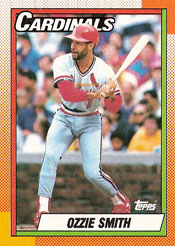
Barry Larkin played shortstop with distinction for the Reds from 1986-2004, but for most of the first half of his career he was overshadowed by the Cardinals’ Ozzie Smith.

In a classy twist, Smith witnessed and cheered Larkin’s greatest individual feat on a baseball field.

Smith won the Gold Glove Award among National League shortstops in each of Larkin’s first seven seasons in the major leagues, including 1990, when Larkin helped lead Cincinnati to its most recent World Series championship.

Larkin didn’t win the first of his three Gold Glove awards until 1994, the year Smith turned 40. Smith, who won the Gold Glove Award 13 times, was inducted into the National Baseball Hall of Fame in 2002.

In 2012, it was Larkin’s turn.

Larkin, 1995 winner of the NL MVP Award, had 2,340 hits and a .295 career batting average.

Larkin had several memorable performances against the Cardinals, including a pinch-hit grand slam off reliever Steve Kline in St. Louis’ 11-10 victory over the Reds on July 28, 2004, at Cincinnati. Boxscore

Larkin’s greatest moment against the Cardinals occurred in the first game of a Sunday afternoon doubleheader on Sept. 22, 1996, at Cincinnati.

In the fifth inning, with St. Louis ahead 3-1, Larkin launched a home run, his 30th of the season, over the left-field wall against starter Donovan Osborne. With that solo shot, Larkin became the first shortstop in major-league history to achieve 30 homers and 30 stolen bases in a season.

As he rounded first base, Larkin thrust both fists in the air in jubilation. Smith, positioned at shortstop for the Cardinals, hollered his congratulations as Larkin trotted past him.

Asked afterward to assess Larkin’s feat, Smith told the Associated Press, “It gives him his own spot in history. It’s a great accomplishment.”

Larkin became the 17th player in big-league history to achieve 30 homers and 30 steals in a season. Fifteen were outfielders and the other, Howard Johnson of the Mets, was a third baseman.

Larkin finished the 1996 season with 33 homers and 36 steals. He would achieve the steals standard again (with 30 in 1999, his fifth season of 30 or more steals), but he never came close to matching 30 homers.

Previously: Ken Boyer belongs in Hall of Fame

Read Full Post »

(Updated Aug. 8, 2019)

A short, successful stint as a Cardinals catcher revived the big-league career of Mike Shannon.
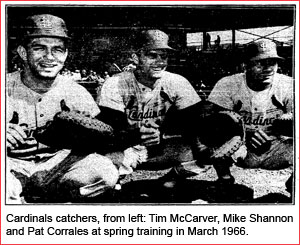
Shannon opened the 1965 season as the Cardinals’ right fielder, but went hitless in his first 14 at-bats and had one hit in his first 23 at-bats.

Lunging for pitches out of the strike zone, Shannon was batting .095 on June 1 when manager Red Schoendienst moved him to the bench and tried other players in right.

On Aug. 6, 1965, the Cardinals were playing the Giants at St. Louis when Hal Lanier slid into home plate and spiked the left thumb of Tim McCarver as the Cardinals’ catcher attempted to apply a tag. McCarver was replaced by Bob Uecker, the Cardinals’ only other catcher. Boxscore

Two days later, Aug. 8, 1965, Uecker was struck by a foul tip off the bat of the Giants’ Dick Schofield in the first inning. The ball split Uecker’s right thumb, forcing him to leave the game.

McCarver was unable to play, so Schoendienst brought in Shannon to catch. According to The Sporting News, Shannon hadn’t caught in a game since he was a youth in sandlot baseball.

It didn’t take long before Shannon was tested. The Giants had runners on second and third with one out in the first when Willie McCovey lifted a pop-up in foul territory. Shannon made the catch.

In the fourth, Shannon provided “the defensive thrill of the game,” the St. Louis Post-Dispatch reported. Willie Mays was on first with one out when Jim Ray Hart lined a double to center. Curt Flood retrieved the ball and fired it to shortstop Dick Groat, whose relay throw to Shannon was in time to tag out Mays. Hart broke for third base on the play and Shannon alertly threw to third baseman Ken Boyer, who tagged out Hart.

Shannon fielded flawlessly (no errors, one assist, six putouts) in the game and broke his batting slump, with a double, triple, walk, RBI and run scored. The Giants, who won 6-4, didn’t attempt a steal against Shannon. “They respected Shannon’s arm,” said coach Joe Schultz.

The Cardinals used five pitchers, including knuckleballers Barney Schultz and Bob Purkey and a left-handed sinkerballer, Hal Woodeshick. Boxscore

“I wouldn’t be afraid to go with Shannon after what he showed me handling Barney Schultz’s knuckleball and Hal Woodeshick’s sinker,” Schoendienst said.

Shannon said he was helped by having caught during batting practice that season. “I didn’t go into the job exactly cold,” Shannon said.

Schoendienst noted, “You could see Shannon’s signs from the scoreboard in the first inning, but coach Joe Becker showed Mike how to hide his signs after that.”

The Post-Dispatch reported Shannon “did superbly” and the San Francisco Examiner noted he “played a tremendous game.”

“Shannon showed he could do an excellent job as a catcher and that makes him even more valuable,” Schoendienst said.

After the game, the Cardinals called up Dave Ricketts from the minor leagues to be the everyday catcher while McCarver and Uecker mended.

Starting catcher

On Aug. 12, 1965, at Milwaukee, Ricketts got a day off and Shannon got his first start at catcher. He caught 12 innings, committing no errors and making six putouts, and the Braves attempted no steals against him.

“Shannon did a great job behind the plate,” said Braves manager Bobby Bragan, a former catcher. “I don’t think he boxed more than one ball all day long.”

In the seventh, Shannon hit a solo home run against Wade Blasingame. In the 13th, Shannon’s two-out single off knuckleballer Phil Niekro scored Boyer from second in the Cardinals’ 5-4 victory. Boxscore

“Shannon showed he could hit a knuckleball as well as he could catch one,” the Post-Dispatch reported.

Ricketts came in to catch the bottom half of the 13th; Shannon moved to right.

“Mike Shannon hits better wearing a catcher’s mitt,” the Associated Press reported. “Shannon, who played himself out of a starting job in the outfield because of a .193 batting average before he turned catcher, now has four hits in eight trips to the plate as a receiver.”

Said Shannon: “I’m an outfielder, but if Red Schoendienst wants me to become a catcher, I’ll become a catcher.”

Shannon made one more start at catcher, Aug. 14, at St. Louis in the Reds’ 4-2 victory. Shannon made no errors, had nine putouts and kept the Reds from attempting a steal. Boxscore

When McCarver returned to the lineup, Shannon returned to the outfield, though he appeared in one more 1965 game at catcher, replacing McCarver for the final three innings of the Cardinals’ 19-8 victory at Houston Sept. 30. Boxscore

Versatile player

After the season, Shannon reported to the Florida Instructional League to develop his catching skills. In November, The Sporting News reported, “The talented outfielder, ready to do almost anything to get untracked after his miserable 1965 showing, is concentrating on catching and boning up on the strike zone.”

“Shannon has been working on the fundamentals of catching, especially throwing,” Cardinals general manager Bob Howsam said. “He’s done a great job, too. We’re figuring him as an outfielder yet, but this gives him a chance to do many things.”

The Cardinals opened the 1966 season by shifting Lou Brock from left field to right and starting Alex Johnson in left, with Shannon on the bench. Johnson was hitting .186 on May 17 when he was sent to the minor leagues. Brock was moved back to left field and Shannon took over in right. He played well all season, hitting .288 with 16 home runs.

Shannon made one appearance as a catcher in 1966. On June 5, in the Braves’ 14-4 victory at Atlanta, Shannon replaced McCarver in the eighth and caught a flawless inning. It was his last game as a catcher. Boxscore

Shannon’s career statistics as a catcher: five games, 33.2 innings, 24 putouts, one assist, no errors, no stolen bases against and a 1.000 fielding percentage.

After the 1966 season, the Cardinals acquired Roger Maris from the Yankees to play right field and asked Shannon to learn another position: third base. He became the starting third baseman for the Cardinals’ pennant-winning clubs in 1967 and 1968.

Previously: Cardinals came close to dealing Shannon

Read Full Post »
Ron Santo _ deserving of election to the National Baseball Hall of Fame but no more so than his Cardinals peer, Ken Boyer _ usually was on the short end of matchups with Bob Gibson, but he did hit three home runs against him.

Santo, elected to the Hall of Fame Dec. 5, 2011, by the 16-member Golden Era committee, played 15 years in the major leagues as a third baseman for the Cubs and White Sox.
Like the Cardinals’ Ken Boyer, Santo won the Gold Glove Award five times. Boyer (.287) had a higher career batting average than Santo (.277). Santo had more home runs (342) than Boyer (282) and more RBI (1,331) than Boyer (1,141) but also had 688 more at-bats than Boyer. (Boyer received fewer than three votes from the 16 members of the Golden Era committee; Santo received 15).

Santo struck out more times against the Cardinals (156) than he did against any other team. Overall against the Cardinals, Santo batted .269 with 33 home runs and 137 RBI.

Against Gibson, Santo hit .243 (37-for-152) with 35 strikeouts. Of his 37 hits against the Cardinals’ ace, 31 were singles, three were doubles and three were home runs. Santo’s first homer off Gibson was the most significant.

On June 4, 1964, the Cardinals were in third place, 3.5 games behind the National League-leading Phillies, when they faced the Cubs at Chicago. With St. Louis ahead 1-0, the Cubs had Billy Williams on second base with one out in the fourth when Santo came up against Gibson. Santo responded with a two-run home run and that was the difference in Chicago’s 2-1 victory. Boxscore

The setback launched the Cardinals into a four-game losing streak that dropped them into fifth place, a game ahead of the seventh-place Cubs. A week later, still scuffling and having fallen three games below .500, the Cardinals, seeking a spark, traded for Cubs outfielder Lou Brock. The deal was the catalyst in igniting St. Louis’ run to the World Series title that year.

Santo’s other two homers against Gibson came on Sept. 16, 1970 (a fifth-inning solo shot in a game the Cardinals won 8-1 at Chicago Boxscore), and June 26, 1971 (a two-out, three-run blast in the Cubs’ 5-1 victory at St. Louis Boxscore).


Read Full Post »

(Updated Nov. 17, 2023)

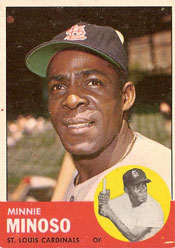
Outfielder Minnie Minoso spent most of his 17-year big-league career with the White Sox and Indians. When Minoso was acquired by the Cardinals after the 1961 season, it was believed he could be the key component in making St. Louis a pennant contender in 1962. Instead, Minoso, injury plagued, was a flop.

The Cardinals traded Joe Cunningham, a first baseman and outfielder, to the White Sox for Minoso on Nov. 27, 1961 _ two days before Minoso’s birthday. Reports varied regarding Minoso’s age. The Associated Press reported Minoso would turn 39 on Nov. 29, 1961, but added “some insist he is at least 42.”

St. Louis had finished 80-74 in 1961, 13 games behind the National League champion Reds. Minoso hit .280 with 28 doubles, 14 home runs and 82 RBI for the 1961 White Sox. The Cardinals saw him as their left fielder, joining an outfield of Curt Flood in center and Stan Musial in right.

Joe Reichler, reporting the trade for the Associated Press, wrote, “Johnny Keane, manager of the Cardinals, was almost as pleased by the acquisition of Minoso as he was when his daughter presented him with his second grandchild last week … Minoso, despite his age, is still one of the fastest men in baseball and swings one of the biggest bats.”

In The Sporting News, Oscar Kahan wrote, “The Cuban Comet, aged as he may be, supplies so many plus factors to the picture that the Redbirds’ outlook has brightened considerably.”

Minoso was a “little bit shocked” by the trade, according to United Press International. The wire service reported Minoso had purchased a $40,000 house in Chicago in 1961 and moved his family there from Cuba. He had been working as a goodwill ambassador for the White Sox during the off-season, selling tickets and promoting the club.

“I don’t know whether I’ll go to the Cardinals,” Minoso said. “I consider myself a free agent. I have a few jobs in mind. I have a lot of friends in Chicago and there are other things I can do in Chicago.”

Minoso eventually relented and opened the 1962 season as the Cardinals’ left fielder. He started two games before pulling a rib muscle in batting practice. It was nearly two weeks before he recovered.

Batting primarily sixth in the order, Minoso struggled, but Keane stuck with him. On May 11, a Friday night in St. Louis, Minoso was in left field when the Cardinals faced the Dodgers. In the sixth inning, with the score 2-2 and the bases loaded, Duke Snider launched a line drive to deep left-center. Minoso chased after it, skidded on the warning track and crashed headfirst into the concrete wall. The ball bounced away for a three-run triple. Boxscore

The collision with the wall left Minoso unconscious. His right eye was completely closed and his head and face were swollen and bleeding, the Associated Press reported. Minoso was carried off on a stretcher and rushed to a hospital. Doctors determined Minoso had a fractured skull and a fractured right wrist. The skull fracture, according to the Associated Press, was three to four inches long above the right ear.

Cardinals center fielder Curt Flood told the Los Angeles Times, “By the time I got to him his right eye already was closing and he was bleeding. He was out cold and didn’t move a muscle. His breathing was labored and I was afraid he’d swallowed his tongue.”

According to The Sporting News, Minoso knew he was quite close to the wall, “but I don’t remember after that.”

Minoso was sidelined for two months before he returned on July 20 and struck out while batting for pitcher Bob Duliba. Boxscore

On Aug. 18, in the second game of a doubleheader against the Mets in New York, Minoso hit his only Cardinals home run, a solo shot off Ray Daviault in a 10-0 St. Louis victory. Boxscore

The next day, batting in the sixth inning, Minoso was hit on the left arm by a pitch from the Mets’ Craig Anderson and was lifted for a runner. Boxscore

Two days later, Aug. 21 at Milwaukee, Minoso appeared as a defensive replacement in left field in the eighth inning against the Braves, but his left arm became swollen. Doctors discovered Minoso had suffered a broken forearm when hit by the Anderson pitch. His season was finished.

In 39 games for St. Louis, Minoso hit .196 with one home run and 10 RBI.

In the book “We Played, the Game,” Cardinals catcher Tim McCarver recalled that Minoso “got so furious at himself after going 0-for-4 that he walked under a cold shower with all his clothes on, including his bat and his spikes. That was a sight.”

Minoso went to spring training with the Cardinals in 1963, hoping to earn a spot as a reserve, but on April 2, a week before the season opener, his contract was sold to the Senators for what The Sporting News reported as “in excess of the $20,000 waiver price.”

Read Full Post »

« Newer Posts - Older Posts »
