Feeds:
Posts
Comments

Archive for the ‘Hitters’ Category

From Curt Davis in 1938 to Jake Westbrook in 2011, 10 Cardinals pitchers have hit grand slam home runs.

Bob Gibson is the only one to do it twice. Gibson and Rick Wise are the only Cardinals pitchers to hit grand slams in the same season.

With grand slams from Chris Carpenter in 2009, Brad Penny in 2010 and Westbrook in 2011, the Cardinals are the only team in major-league history to have a pitcher slug a four-run homer in three consecutive seasons, according to the Elias Sports Bureau.

Here are the Cardinals pitchers who hit grand slams:

_ Curt Davis: A right-hander who earned 158 wins and hit 11 home runs in a 13-year big-league career, Davis slugged a fourth-inning grand slam off Al Hollingsworth, helping St. Louis to a 5-0 lead on April 26, 1938, at Cincinnati. Playing before a Tuesday afternoon gathering of 2,386, the Reds rallied for an 8-7 victory. Boxscore

_ Bob Gibson: Twenty-seven years after Davis’ blast, Gibson connected for a grand slam off Gaylord Perry on Sept. 29, 1965, at San Francisco. With Cardinals runners on second and third, one out, in the eighth, Perry relieved Bob Shaw. Perry issued an intentional walk to Bob Skinner, loading the bases for Gibson, who gave St. Louis an 8-0 lead with his fifth homer of the season. The Cardinals held on for an 8-6 victory. Boxscore

“I knew it was going to the fence,” Gibson told the Associated Press, “but I didn’t think it was going over.”

_ Bob Gibson: In the first game of a doubleheader on July 26, 1973, at St. Louis, Gibson earned a complete-game win and smashed a fifth-inning grand slam off Mets reliever John Strohmayer in the Cardinals’ 13-1 victory. It was the 24th and last home run of Gibson’s 17-year big-league career. Boxscore

_ Rick Wise: Capping a seven-run third inning, Wise powered a grand slam off Roric Harrison on Aug. 21, 1973, at Atlanta. It was the second grand slam of Wise’s career (he hit one for the Phillies in 1971) and the 15th and final homer of his 18-year big-league career. The Braves held St. Louis scoreless the rest of the game and Atlanta won, 11-7. Boxscore

_ Joaquin Andujar: In the eighth inning on May 15, 1984, at St. Louis, Braves reliever Jeff Dedmon gave an intentional walk to Tom Nieto, loading the bases with two out. Andujar, a career .127 hitter in 13 big-league seasons, belted a grand slam, helping the Cardinals to a 9-1 victory. Boxscore

“I usually hit five or six home runs in batting practice every day,” Andujar told United Press International.

_ Bob Forsch: With a fifth-inning grand slam off a hanging curve by Mike Bielecki, Forsch earned his 12th win of the year in the Cardinals’ 5-4 victory over the Pirates on Aug. 10, 1986, at St. Louis. Forsch hit 12 homers in a 16-year major-league career. Boxscore

“I looked terrible on the breaking ball when he struck me out (in the third),” Forsch told the Associated Press, “so I figured he’d throw it again.”

Said Pirates manager Jim Leyland: “He (Bielecki) can’t hang a pitch like that; anybody could hit it out.”

_ Donovan Osborne: A switch-hitter batting left, Osborne slugged a fifth-inning grand slam off Andy Ashby in the Cardinals’ 8-3 victory over the Padres on Sept. 7, 1996, at St. Louis. It was the only homer hit by Osborne in nine big-league seasons. Boxscore

_ Kent Mercker: On the same night Mark McGwire hit two home runs, Mercker had the big blast, a fourth-inning grand slam off Jesus Sanchez, helping St. Louis to a 14-4 victory over the Marlins on Sept. 2, 1998, at Florida. For Mercker, a .113 career hitter, it was his lone homer in 18 major-league seasons and his first since high school. Boxscore

“Mark gave me some batting tips,” Mercker told the Palm Beach Post.

Said McGwire to the St. Louis Post-Dispatch: “I loved his trot.”

_ Chris Carpenter: The first big-league homer of Carpenter’s career was a second-inning grand slam off former St. Louis teammate Kip Wells in the Cardinals’ 13-0 victory on Oct. 1, 2009, at Cincinnati. Boxscore

_ Brad Penny: A third-inning grand slam by Penny off former St. Louis pitcher Joel Pineiro helped the Cardinals beat the Angels, 9-5, on May 21, 2010, at St. Louis, but Penny turned out to have an injury near his right shoulder, was unable to continue pitching and never played another game for the Cardinals. Boxscore

“I left a hanging slider to Penny,” Pineiro told the Associated Press. “I knew he was coming out swinging.”

_ Jake Westbrook: An 11-year big-league veteran, Westbrook’s first homer was a grand slam off Randy Wolf in the Cardinals’ 8-3 victory on Aug. 31, 2011, at Milwaukee. Boxscore

“It’s pretty special,” Westbrook told the St. Louis Post-Dispatch. “Just to go back and say you hit a grand slam in the big leagues is a lot of fun.”
Read Full Post »

(Updated June 8, 2024)

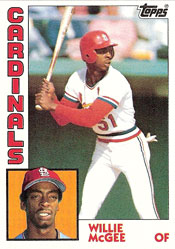
Center fielder Willie McGee batted .294 with 1,683 hits and 301 stolen bases in 13 years with the Cardinals, helping them win three National League pennants and a World Series crown.

Whitey Herzog, his manager on those 1980s title teams, told Cardinals Magazine, “Willie gave me everything I asked for and more. He was one great guy, a great ballplayer. He is the most popular guy during my time (with the Cardinals). If you’re going to talk about the Cardinals, you’re going to talk about (Stan) Musial, (Red) Schoendienst and (Enos) Slaughter, and then along came (Bob) Gibson and (Lou) Brock and Ozzie (Smith). But I don’t think anybody was as dear to the fans’ hearts as Willie McGee.”

Here are five fun facts about McGee’s Cardinals playing career:

McGEE VS. CARLTON

Twice, McGee hit two home runs in a game. Most remember the two homers he ripped against former Cardinal Pete Vuckovich in Game 3 of the 1982 World Series against the Brewers in Milwaukee. What may not be so well-known are the two homers he hit against another former Cardinal, Steve Carlton.

On July 21, 1986, at St. Louis, Carlton, 41, who had been released by the Phillies in June after 15 seasons with Philadelphia, was making his third start for the Giants.

McGee, who would hit just seven home runs in 1986, hit a solo shot into the upper deck in left off Carlton in the first inning and added a two-run blast to right-center in the fourth, tying the score at 3-3. The Cardinals went on to win, 8-3 Boxscore

“I wasn’t swinging for homers,” McGee told the Associated Press. “I was just trying to hit the ball good and just trying to do my job.”

LAUNCH OF LA RUSSA ERA

McGee was the first batter in the first regular-season game Tony La Russa managed with the Cardinals.

Batting leadoff against Bobby Jones, McGee grounded out to shortstop in the first inning of the season opener against the Mets on a rainy, cold April 1, 1996, at New York.

McGee, playing right field, went 2-for-5 with three RBI and two runs scored. In the fourth, he smacked a three-run homer off Jones, giving St. Louis a 6-0 lead before the Mets rallied for a 7-6 victory.

McGee, who made the first out of the game, also made the last out of the game, grounding out to shortstop Rey Ordonez, who made a diving stop of a ball up the middle. Boxscore

HELLO, MAD HUNGARIAN

McGee, called up to the Cardinals from Class AAA Louisville in May 1982, went hitless in his first four big-league at-bats. He broke through in dramatic fashion against the Braves on May 13, 1982, at Atlanta.

In the fifth inning, the Cardinals led 6-5 and had the bases loaded with one out. Herzog called on McGee, a switch-hitter, to bat for Tito Landrum, even though Landrum had three RBI in the game.

Braves manager Joe Torre countered by lifting Preston Hanna and bringing in Al Hrabosky, the former Cardinals closer. McGee greeted the “Mad Hungarian” with a RBI-single to left. St. Louis went on to a 10-9 victory. Boxscore

Asked about lifting Landrum for McGee, Herzog said, “It worked, didn’t it?”

Said McGee: “That was my first big-league hit and I’ve got to feel pretty good about it. I know I can play defense and run the bases. I just hope I can get some bat experience.”

GRAND BEGINNING

By mid-summer of 1982, McGee had become the everyday center fielder and was sparking St. Louis toward its first postseason appearance since 1968.

On July 20, 1982, at St. Louis, the Braves scored five runs in the first against John Stuper. The Cardinals came back with six runs in the bottom of the first. The big blow was McGee’s first big-league home run, a grand slam off fellow rookie Ken Dayley. Boxscore

Dayley would be traded to the Cardinals in 1984 and would team with McGee to help the Cardinals win two more pennants.

THE LAST HOME RUN

On July 26, 1998, at Denver, after entering the game as a replacement for left fielder John Mabry in the eighth, McGee slammed a solo home run off Dave Veres (a future Cardinals closer) with two out in the ninth, helping St. Louis to a 3-1 victory over the Rockies. It was the first homer Veres had yielded since May 31. Boxscore

McGee would have 51 more at-bats in 1998 and 271 at-bats in 1999, but he never would hit another big-league home run.

Read Full Post »

A pair of former Cardinals, Andy Van Slyke and Mike LaValliere, combined to stun St. Louis by making one of baseball’s most sensational defensive plays, one so rare it wouldn’t be accomplished again for 23 years.

On Aug. 21, 2011, in the ninth inning of a game at Detroit, the Indians had runners on second and third with one out when Tigers center fielder Austin Jackson caught a fly ball by Matt LaPorta and unleashed a rocket to catcher Alex Avila, who tagged out Kosuke Fukudome at the plate, completing a double play and sealing an 8-7 win.
According to research by Baseball-Reference.com, it was the first time a major-league game had ended on a double play with a center fielder throwing out a runner at the plate since Sept. 27, 1988, when Van Slyke accomplished the feat.

On April 1, 1987, the Cardinals traded Van Slyke, LaValliere and pitcher Mike Dunne to the Pirates for catcher Tony Pena. The deal helped the Cardinals win the 1987 National League pennant and it also helped the Pirates begin a transformation from also-ran to contender.

On Sept. 27, 1988, the Cardinals were finishing out the final week of the season on their way to a fifth-place finish in the NL East. The Pirates would secure second place, their highest finish since 1983.

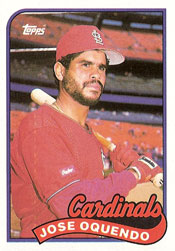
Before a Tuesday night crowd of 8,994 at Three Rivers Stadium, the Pirates took a 3-2 lead into the ninth. Pittsburgh closer Jim Gott, seeking his 34th save, issued a leadoff walk to Jose Oquendo. After Curt Ford struck out, John Morris singled to right, advancing Oquendo to third.

Luis Alicea, a switch-hitting rookie second baseman who had entered the game in the sixth, stepped to the plate and smashed a rising liner to center field _ “a drive,” wrote Paul Meyer of the Pittsburgh Post-Gazette, “that seemed more than deep enough to score Oquendo.”

It seemed everyone in the ballpark, except Van Slyke and LaValliere, thought Oquendo would advance on the sacrifice, tying the score.

“I didn’t think he (Van Slyke) had a chance,” Pirates right fielder Glenn Wilson told Meyer.

Said Pirates manager Jim Leyland: “I thought he (Van Slyke) had no chance, to be honest with you.”

Here’s what Van Slyke said to Meyer:

“I always think I have a chance _ except when I’m standing on the warning track. I threw it as hard as I could. What made it a difficult play was that it was a line drive, and I couldn’t set up (to throw).”

As Oquendo streaked down the third-base line, he saw LaValliere standing motionless at the plate, trying to make it appear a play wasn’t imminent.

“When Andy let the ball go, I caught the runner out of the corner of my eye,” LaValliere said to Meyer. “… I tried to deke the runner to get as much of an advantage as I could. You want the runner to see the plate, so he’ll slide.”

Just before receiving the throw, LaValliere blocked the plate with his left foot. As Oquendo slammed into a shin guard, LaValliere applied the tag and umpire Doug Harvey ruled an out, giving the Pirates a 3-2 victory. Boxscore

“Unbelievable, the way he (LaValliere) kept him off there,’ said Leyland. “That was the key.”

Said Van Slyke: “When I saw Doug Harvey ring him up, it surprised the heck out of me. Mike made just as good a play as I did.”

Cardinals manager Whitey Herzog told the Associated Press, “It was a heck of a play on both ends. Andy made a great throw and he doesn’t get him if Mike doesn’t block the plate.”

In his lead to his game story, Meyer wrote:

You know him as Andy Van Slyke. Tuesday night, though, the Pirates center fielder was Andy Van Strike _ because that’s what he threw to the plate in the ninth inning for the final out of a 3-2 victory over St. Louis that clinched second place for the Pirates.

Twenty-three years later, when the play happened again, the teams and the players were different, but one of the managers was the same. Jim Leyland, Tigers skipper, was the winning manager in both games.

Read Full Post »

(Updated July 29, 2018)

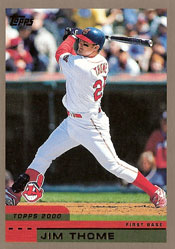
Jim Thome didn’t face the Cardinals often in a 22-year big-league career, but he usually pounded St. Louis pitching when given the opportunity. Of his 612 career home runs, 18 were hit against the Cardinals in 29 games.

Thome, elected to the National Baseball Hall of Fame in 2018, batted .430 (43-for-100) against the Cardinals, with 40 RBI, a .565 on-base percentage and a 1.010 slugging percentage.
Of his 18 home runs against St. Louis, three were hit against Matt Morris. Chris Carpenter and Dan Haren surrendered two apiece.

Thome hit three home runs against the Cardinals _ two off Morris and another off Mike James _ in the Indians’ 14-2 victory on July 6, 2001, at Cleveland. All three were two-run shots. Boxscore

In the eighth, Thome struck out against Steve Kline, missing a chance to become the first American League player to hit four home runs in a game since Rocky Colavito of the Indians in 1959.

“When everybody wants you to hit a home run, it’s pretty tough to do,” Thome told the Associated Press.

The next day, after Thome walked in his first four plate appearances, he led off the 10th inning with a home run against Dave Veres, lifting Cleveland to a 7-6 victory over the Cardinals. “It was supposed to be a sinker away,” Veres said. “I missed my spot by, like, four feet.”

Said Thome: “I wanted to get a pitch up and drive it, and I did.” Boxscore

Thome’s 18th and last home run against the Cardinals was perhaps his most devastating. On June 22, 2006, at Chicago, the Cardinals’ Anthony Reyes pitched a one-hitter _ and lost. The hit was a solo home run by Thome with one out in the seventh, giving the White Sox a 1-0 victory. Boxscore

“I was fortunate it was in the middle of the plate,” Thome said.

Said Reyes: “I just missed a little bit over the plate and you can’t really do that up in this league.”

Thome’s home runs against the Cardinals:

DATE………………..PITCHER

June 14, 1997……Matt Morris

June 25, 1998……Manny Aybar

June 25, 1998……Bobby Witt

June 2, 2000…….Darryl Kile

July 6, 2001……..Matt Morris

July 6, 2001……..Matt Morris

July 6, 2001……..Mike James

July 7, 2001……..Dave Veres

Aug. 15, 2003……Pedro Borbon

Aug. 16, 2003……Dan Haren

Aug. 17, 2003……Brett Tomko

Aug. 22, 2003……Dan Haren

Aug. 22, 2003……Steve Kline

April 29, 2004…..Chris Carpenter

May 4, 2004……..Chris Carpenter

May 6, 2004……..Jeff Suppan

June 21, 2006…..Jason Marquis

June 22, 2006…..Anthony Reyes

Read Full Post »

(Updated April 9, 2019)

Dave Campbell’s brief career with the Cardinals was most notable for what he didn’t do.

In 21 at-bats for the 1973 Cardinals, Campbell failed to get a hit.

Campbell went 45 consecutive at-bats without a hit in 1973. His streak occurred while playing for three teams.
In 2019, Chris Davis of the Orioles set a major-league record for a position player by extending his hitless streak to 47 consecutive at-bats.

Campbell, an ESPN baseball broadcaster from 1999-2010, began his seventh big-league season in 1973 as an infielder for the Padres. He went hitless in his last 17 at-bats for San Diego before he was traded to the Cardinals for infielder Dwain Anderson on June 7, 1973.

In 24 plate appearances in 13 games for St. Louis, the best Campbell could achieve was a walk, a sacrifice bunt and a sacrifice fly.

Campbell’s lone batting highlight as a Cardinal came on July 10, 1973, against the Dodgers at Los Angeles. In the top of the seventh, with the Dodgers ahead 2-1, the Cardinals had Jose Cruz on third, Mike Tyson on first and one out when manager Red Schoendienst called on Campbell to pinch-hit for pitcher Tom Murphy.

Facing Dodgers starter Claude Osteen, Campbell hit a sacrifice fly to center, scoring Cruz with the tying run. The Cardinals went on to a 5-4 victory. Boxscore

Campbell’s final at-bat as a Cardinal came on Aug. 17, 1973, at St. Louis against the Padres. After San Diego scored twice in the 13th inning, snapping a 2-2 tie, the Cardinals had Ted Simmons on second and Hector Cruz on first with two out. Schoendienst chose Campbell to pinch-hit for pitcher Diego Segui. Campbell popped out to second base, ending the game. Boxscore

The next day, the Cardinals traded Campbell to the Astros for outfielder Tommie Agee. St. Louis, in first place in the National League East, was seeking to bolster its bench for a pennant push.

“It’s tough to leave a club that is in first place and has a shot at the big money,” Campbell told The Sporting News. “But due to my past association with (Astros coach) Preston Gomez it could be a break for me. Preston was the manager at San Diego when I was a regular there for four years. So he knows what I can do.”

After a 17 at-bat hitless streak for the Padres and a 21 at-bat hitless streak for the Cardinals, Campbell went hitless in his first seven at-bats for the Astros, tying the major-league mark of 45 consecutive hitless at-bats by a non-pitcher.

On Sept. 19, 1973, in the opener of a doubleheader against the Padres at Houston, Campbell hit a two-run double against Clay Kirby in the first inning, breaking his drought. Boxscore  Campbell had four hits in the doubleheader: two in each game.

In an eight-year big-league career, Campbell batted .213.

Read Full Post »

(Updated July 26, 2020)

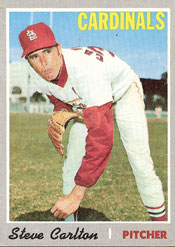
In 1970, Cardinals pitcher Steve Carlton could do almost nothing right against the Reds. The Cincinnati hitter who hurt him the most was Johnny Bench.

On July 26, 1970, a muggy Sunday afternoon in Cincinnati, Bench went 4-for-5 with three home runs, seven RBI and three runs scored in the Reds’ 12-5 victory against the Cardinals. All three home runs were hit versus Carlton. Boxscore
To give Bench a break from catching in the midsummer heat, Reds manager Sparky Anderson started the 22-year-old in left field that day. It was one of 17 games Bench started in the outfield in 1970. Pat Corrales, a former Cardinal, was the Cincinnati catcher.

“If that boy didn’t have to catch, there’s no telling what you might see,” Anderson told the Dayton Journal Herald.

Bench said to the Dayton Daily News, “If I can hit like that, I don’t care where I play, but there’s no question I feel stronger when I’m playing in the outfield.”

Hardball tactics

In the first inning, Bench, batting in the cleanup spot, hit a Carlton fastball over the right-center field wall at Riverfront Stadium for a three-run home run. When Bench followed by hitting a slider for a two-run home run to left in the second, Carlton fired a brushback pitch at the next batter, Lee May, sending him sprawling to the dirt.

“Carlton throwing at May is, well, it’s just baseball, but I don’t like anybody throwing at my hitters,” Anderson said to the St. Louis Post-Dispatch.

Said Cardinals manager Red Schoendienst: “A pitcher doesn’t have a chance any more. There’s the lively ball and the AstroTurf and the smaller strike zone … If you’re a pitcher, you have to brush back those hitters.”

Reds starter Wayne Simpson delivered payback the next inning when Carlton batted and was struck in the right calf by a pitch. Anderson approached Simpson about it between innings. “I told him I didn’t want him bothering with Carlton,” Anderson said. “I don’t like that type of baseball.”

When Simpson came to the plate in the bottom half of the third, Carlton threw a pitch inside. Simpson made a move toward Carlton, but no fight erupted.

Bench let his bat do the talking. He led off the fifth by belting a fastball over the wall in left for his third home run of the game against Carlton. “That’s the best day I’ve had since I hit three homers one day as a nine-year-old playing Little League ball at Cement, Okla.,” Bench told the Cincinnati Enquirer.

Said Anderson: “He’s only 22 and already he’s the best there is. Name me another catcher of our time you’d match him against.”

Fine wine

In his book “Chasing the Dream,” Joe Torre, who was Carlton’s roommate on Cardinals road trips in 1970, recalled, “After the game, Lefty and I commiserated over dinner and a little wine. I guess we had more than a little wine. When we got back to our hotel suite, I think we broke every stick of furniture in the room. When we awoke in the morning and realized what we had done, we tried to glue everything back together.

“When we left the suite, we had to make sure we didn’t close the door too hard because we were afraid the noise would cause everything to fall apart.”

Bench was the first Reds player with seven RBI in a game since Frank Robinson did it in May 1963, and he was the first Reds player with three home runs in a game since Art Shamsky in 1966. Bench went on to lead the National League in home runs (45) and RBI (148) in 1970, winning the Most Valuable Player Award and powering the Reds to the pennant.

Carlton made four starts against the Reds in 1970, posting an 0-4 record and 7.82 ERA. In 25.1 innings versus Cincinnati, Carlton yielded 24 runs and 35 hits.

Three years later, on May 9, 1973, Bench, catching and batting third, again smashed three home runs against Carlton, who was with the Phillies, in Cincinnati’s 9-7 victory at Philadelphia. Boxscore

“I don’t see how a man can cover so much of the plate,” Carlton told The Sporting News. “I threw Bench six inches inside and six inches outside, but it didn’t matter.”

Bench hit .305 (39-for-128) against Carlton in his career. The 12 home runs Bench belted against Carlton were the most he hit in his career against a left-hander.

Both Bench and Carlton are enshrined in the National Baseball Hall of Fame.

Read Full Post »

« Newer Posts - Older Posts »