Feeds:
Posts
Comments

Archive for the ‘Hitters’ Category

In the first at-bat by a Cardinals designated hitter in a regular-season game, Dmitri Young singled to center field in the second inning against the Brewers’ Ben McDonald on June 16, 1997, at Milwaukee. The Brewers then were an American League franchise.

That successful start set the tone for what has been a well-utilized position for the Cardinals.

According to the Elias Sports Bureau, Cardinals designated hitters have a .321 batting average and 83 RBI in regular-season games played in American League ballparks since interleague play began in 1997. No other National League team’s designated hitters have produced more RBI and none have managed a cumulative batting average as high as .280. 

Among the best-producing DHs for the Cardinals are Albert Pujols (.360 in 12 starts), Scott Spiezio (.333 in 11 starts) and Chris Duncan (.333 in nine starts), Elias Sports Bureau reported.

Dmitri Young, a switch-hitting first baseman and outfielder, went 1-for-4 as the first Cardinals designated hitter in a regular-season game. It was his only appearance as a designated hitter that season. Boxscore

(In a 13-year big-league career with the Cardinals, Reds, Tigers and Nationals, Young went on to appear in 318 games as a designated hitter, hitting .285 with 53 home runs from that position).

Cardinals manager Tony La Russa used four players as designated hitters in the first year that National League teams were able to employ the position during the regular season at American League ballparks.

After trying Young in that first game, he played Ron Gant and Scott Livingstone at designated hitter in consecutive games at Milwaukee.

In a three-game series in August 1997 at Kansas City, La Russa exclusively used Willie McGee as designated hitter. McGee’s three-run triple in the eighth inning snapped a 6-6 tie and carried St. Louis to a 9-7 victory on Aug. 29. Boxscore

Here is how Cardinals regular-season designated hitters have fared each year:

_ 1997: .160 batting average (4-for-25), 0 home runs, 3 RBI.

_ 1998: .294 batting average (10-for-34), 0 home runs, 4 RBI.

_ 1999: .320 batting average (8-for-25), 0 home runs, 3 RBI.

_ 2000: .394 batting average (13-for-33), 3 home runs, 11 RBI.

_ 2001: .292 batting average (7-for-24), 0 home runs, 1 RBI.

_ 2002: .200 batting average (4-for-20), 1 home run, 4 RBI.

_ 2003: .424 batting average (14-for-33), 4 home runs, 10 RBI.

_ 2004: .154 batting average (4-for-26), 0 home runs, 3 RBI.

_ 2005: .429 batting average (12-for-28), 3 home runs, 10 RBI.

_ 2006: .342 batting average (13-for-38), 1 home run, 5 RBI.

_ 2007: .378 batting average (14-for-37), 2 home runs, 10 RBI.

_ 2008: .371 batting average (13-for-35), 2 home runs, 7 RBI.

_ 2009: .333 batting average (7-for-21), 2 home runs, 6 RBI.

_ 2010: .211 batting average (4-for-19), 0 home runs, 1 RBI.

_ 2011: .182 batting average (2-for-11), 1 home run, 3 RBI.

The first Cardinals designated hitter in a post-season game was Gene Tenace, who went 0-for-3, in Game 1 of the 1982 World Series. Boxscore Cardinals designated hitters batted .462 (12-for-26) in the seven-game series, playing an integral role in St. Louis winning the championship.

Read Full Post »

(Updated Dec. 2, 2024)

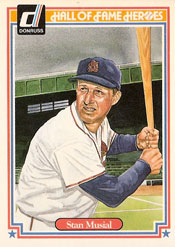
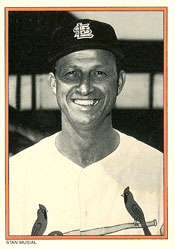
Stan Musial is the oldest player to hit three home runs in a major-league game.

Musial was 41 when he hit three home runs against the Mets on July 8, 1962, at the Polo Grounds in New York.

It capped a stretch of four home runs in four consecutive at-bats for Musial.

Power streak

On July 7, 1962, Musial snapped a 2-2 tie with a home run off former teammate Craig Anderson in the eighth inning of the second game of a doubleheader at the Polo Grounds, lifting the Cardinals to a 3-2 victory over the Mets. Boxscore

The next day, a Sunday afternoon, Musial hit home runs his first three times at-bat, giving him four in a row over two games (tying a major-league record) and helping the Cardinals to a 15-1 victory.

“Trouble with the Amazin’ Mets isn’t that they have old ballplayers; it’s that they don’t have any old ballplayers named Musial,” wrote Dick Young in the New York Daily News.

Musial hit a solo shot in the first inning and a two-run home run in the fourth, both off Jay Hook. The first home run against Hook came on a 2-and-0 changeup. “The ball probably would have been caught in St. Louis, but it found the range in the Polo Grounds, which has a fence only 257 feet from the plate at the foul line,” the St. Louis Post-Dispatch reported.

The second home run off Hook was hit into the upper deck on a 3-and-1 slider.

(In the book “Voices From Cooperstown,” Musial said to author Anthony J. Connor, “Because of the fast break, I found the slider much more difficult to pick up than the fastball, curve or changeup.”)

Musial led off the seventh with a home run against Willard Hunter on a 2-and-2 fastball, up and in. Musial “tomahawked that one viciously against the right field roof,” the Post-Dispatch reported.

In the book “Stan Musial: The Man’s Own Story,” Musial said, “The pitch was too far inside. Hunter seemed surprised I didn’t take it, but I didn’t believe in letting an inside pitch get away at the Polo Grounds.”

It was the second time in his big-league career Musial slugged three home runs in a game, and he was especially thrilled that his wife Lil and daughter Janet were in attendance to witness the feat.

Trying for another

In the eighth, facing former teammate Bob Miller with a chance for a fifth consecutive home run and No. 4 in the game, Musial admitted, “I was going for the fence.”

With the count 2-and-0, Musial watched a fastball cross the plate for a strike. Miller’s next pitch was a curve and Musial took “a wild, off-balance swing” and missed, the Daily News reported. Miller came back with another curve in the dirt. Musial tried to check his swing but couldn’t and struck out, but the ball eluded catcher Chris Cannizzaro and Musial reached first base safely. He was removed for a pinch-runner and received a roaring ovation from the New York crowd. Boxscore

Signing for kids

After the game, Musial posed for photographers with family and friends on the field. “An 11-year-old freckled red-haired boy named Kevin Charkowicz was brought down to the field, where he presented the ball” Musial hit for his third home run of the game, the Post-Dispatch reported. (See his comment in the response section below.)

According to the Post-Dispatch, Musial “stayed on the field to sign for youngsters who clustered around him.”

Among the group of kids cheering for Musial and getting autographs from him were Little League players in gray uniforms, the St. Louis Globe-Democrat noted.

Musial headed into the all-star break with a .333 batting average, .403 on-base percentage and .523 slugging percentage. Not bad for 41 years old.

Other sluggers at 40

Besides Musial, three others who reached 40 years of age hit three home runs in a game. The most recent was Jason Giambi, 40, who hit three home runs for the Rockies on May 19, 2011.

Babe Ruth (in 1935 for the Braves) and Reggie Jackson (in 1986 for the Angels) also hit three home runs in a game at age 40.

Alex Rodriguez of the Yankees was 39 when he hit three home runs in a game vs. the Twins on July 25, 2015 _ two days before his 40th birthday.

Read Full Post »

(Updated Feb. 20, 2023)

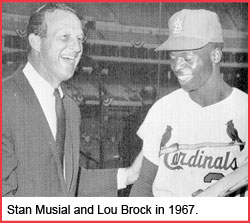
Harmon Killebrew, long an admirer of Stan Musial, got to know the Cardinals icon best when both represented Major League Baseball on a tour of Vietnam.

Killebrew, the Hall of Fame slugger who hit 573 home runs in a 22-year American League career, played primarily for the Twins and Senators. Though he never played a regular-season or postseason game against the Cardinals, Killebrew did have a connection to and fondness for Musial.

In a radio interview with St. Louis station 1380 AM, Killebrew was asked to share his thoughts about Musial, who was about to receive the Presidential Medal of Freedom.

“I always admired Stan from afar as a youngster,” Killebew told radio host Evan Makovsky. “I’ve known him now for over 40-some years and we’ve been good friends. I’ve always just marveled at the records Stan Musial put up. I always felt he did not get the credit he deserved … He has to rank, in my book, as one of the greatest players who ever lived.”

On Nov. 1, 1966, Musial, Killebrew, the Braves’ Hank Aaron and Joe Torre, the Orioles’ Brooks Robinson and broadcaster Mel Allen embarked on a trip to Vietnam to conduct clinics and boost morale of the U.S. troops.

“I got to know Stan very, very well (on that tour),” Killebrew said. “I got to know the kind of person he was, and it really magnified my feelings about Stan Musial.”

According to a November 1966 story by Lou Hatter of the Baltimore Sun, the tour was co-sponsored by the baseball commissioner’s office and the Department of Defense. The baseball group, which left from San Francisco, stopped in Honolulu, Guam and Manila on the way to Saigon. The return trip included stops in Tokyo and Anchorage before concluding in San Francisco.

In his autobiography, “I Had a Hammer,” Hank Aaron said, “Musial was one of my favorite ballplayers because he treated everybody the same _ black or white, superstar or scrub _ and he genuinely loved the game. When he and I were part of a group of players who toured Vietnam, Musial became the first white man I ever roomed with.”

Aaron added that the Vietnam trip enabled him to “develop a deeper friendship” with Musial, “who, for my money, was the greatest gentleman in the game.”

Brooks Robinson told the newspaper the group met with U.S. military personnel at field hospitals and battle stations. Robinson said the group was in daily earshot of gunfire and once saw a U.S. airstrike from their transport helicopter.

“A couple of our helicopters had taken bullet holes from snipers in the brush, though on the way to pick us up,” Robinson said. “We usually flew at about 3,000 feet to avoid sniper fire and never came in for a landing at a gradual descent. We normally came straight down from that altitude in a kind of screwdriver spiral descent. That was some kind of a thrill.”

In an interview for the 2003 Baseball Hall of Fame yearbook, Robinson recalled, “Stan and I visited one hospital where a kid had just lost both legs and was lying there in bed. Stan went over and said, ‘Hi, I’m Stan Musial with the St. Louis Cardinals.’ The kid actually apologized to Stan for not recognizing him. That tore me up right there. I had tears come to my eyes.”

Jim Lucas, a Pulitzer Prize-winning American war correspondent based in Vietnam for Scripps Howard newspapers, told colleagues the baseball group accomplished its mission.

“Wherever I’ve gone, I’ve heard nothing but raves,” Lucas said. “Stan Musial apparently is quite a guy. He’s the one most often quoted … They did a lot for baseball as an entity with the top brass, from General Westmoreland on down, and they did a lot for the morale of the troops.”

In the book “Musial: From Stash to Stan the Man,” author James N. Giglio wrote, “Musial nearly became a fatality; his quarters were bombed while he was elsewhere in the area eating lunch. He flirted with danger at another outpost and in a helicopter over hostile territory.”

Author George Vecsey, in the book “Stan Musial: An American Life,” reported a different version while making the same point: “This was no meet-and-greet opportunity in a secured camp … In Da Nang, the players had lunch with General William Westmoreland, the commander of the U.S. operation in Vietnam, and dinner with Lieutenant General Lewis Walt, the commanding general of the III Marine Amphibious Force. Shortly after that, the general’s quarters were bombed by the Vietcong. Musial was still talking about that bombing when he got home a few weeks later.”

An editorial in the Nov. 19, 1966, edition of The Sporting News opined, “These men are members of baseball’s elite. All have been well-rewarded for their accomplishments _ in money, prestige, applause and publicity. They have captured no headlines in Vietnam nor will they gain financially. Their trip might not be necessary either, but it surely is worthwhile.”

Read Full Post »

Ken Boyer’s unselfishness played an important role in the 31-game hitting streak of Dodgers outfielder Willie Davis in 1969.

On July 21, 1969, in the Pirates’ 2-1 victory over the Dodgers in 15 innings, Davis was 0-for-6, dropping his batting average to .260. Boxscore

One of Davis’ teammates that year was Boyer, who had been the Cardinals’ standout third baseman from 1955-65. Boyer was in the last season of a 15-year big-league career and primarily was being used as a pinch hitter by the Dodgers.

Entering a four-game series against the Cardinals at St. Louis, Davis “put down his slim-handled whip of a bat and picked up a heavier model, one Ken Boyer had been using,” John Kuenster wrote in Baseball Digest magazine.

“He choked up four inches on the knobless handle and started to hit.”

Davis, a left-handed batter, embarked on a 31-game hitting streak, stretching from Aug. 1 in St. Louis to Sept. 3 in Los Angeles, using Boyer’s 38-ounce Louisville Slugger U1 model. It was the longest hitting streak in the National League since Tommy Holmes’ 37-game stretch for the Braves in 1945.

Writing in 2011 for Examiner.com, Jim Smiley reported, “Boyer stopped using his own bats when his supply dwindled down to only two. After all, a teammate with a long hitting streak comes first.”

In a September 1969 interview with Charles Maher of the Los Angeles Times, Davis said, “I choke up about four inches to get more bat control. And I never try to pull the ball. Nine times out of 10, I’ll be trying to hit through the middle or to the opposite side.

“I’m not going to stop using Boyer’s bats … I think I broke one of them and he’s got two left. I don’t think Kenny’s even using them now. He knows I want to use them.”

Boyer understood the importance of teamwork and the elements needed to grow a hitting streak. Boyer had a 29-game hitting streak for the Cardinals in 1959.

Davis faced the Cardinals seven times during his streak:

_ Aug. 1, Cardinals 7, Dodgers 2, at St. Louis: In Game 1 of the streak, Davis went 1-for-4, hitting a double against Steve Carlton. Boxscore

_ Aug. 2, Cardinals 7, Dodgers 6, at St. Louis: Davis had an RBI-single against Mike Torrez and a two-run double against Joe Hoerner. Boxscore

_ Aug, 3, Dodgers 5, Cardinals 0, at St. Louis: Chuck Taylor yielded a double and a single to Davis. Boxscore

_ Aug. 4, Cardinals 2, Dodgers 1, at St. Louis: Davis singled against Nelson Briles, who pitched a complete-game seven-hitter. Boxscore

_ Aug. 11, Cardinals 4, Dodgers 2, at Los Angeles: In his final at-bat of the game, Davis hit an RBI-single off Steve Carlton in the eighth. Boxscore

_ Aug. 12, Dodgers 5, Cardinals 2, at Los Angeles: After starting 0-for-2, Davis singled in the sixth against Ray Washburn and singled in the eighth against Joe Hoerner. Boxscore

_ Aug. 13, Cardinals 5, Dodgers 0, at Los Angeles: Chuck Taylor pitched a six-hit shutout, but Davis had two of those hits _ singles in the seventh and ninth innings. Boxscore

Davis didn’t face Cardinals ace Bob Gibson during the streak. Gibson was 20-13 with a 2.18 ERA in 1969. Davis had a .320 (40-for-125) career batting average against Gibson.

Read Full Post »

(Updated April 11, 2026)

Eight Cardinals have hit a home run from each side of the plate in a game. According to Baseball Almanac, the eight who achieved the feat:

RED SCHOENDIENST

Schoendienst was an unlikely candidate to be the first Cardinal to hit home runs from the left and right sides in the same game.

Schoendienst didn’t hit a home run in the first 56 games he played in 1951. He ended the skid in Game 2 of a July 8 doubleheader against the Pirates at Pittsburgh.

In the sixth inning, Schoendienst, batting left-handed, hit a solo home run against Ted Wilks, a former teammate.

An inning later, facing rookie Paul LaPalme, Schoendienst switched to the right side and hit a two-run home run, helping St. Louis to a 9-8 victory. Boxscore

TED SIMMONS

Simmons twice hit a homer from each side of the plate in a Cardinals game.

On April 17, 1975, after the Mets scored six runs in the first against Lynn McGlothen at Busch Stadium, Simmons, batting right-handed, hit a three-run home run against Jerry Koosman in the bottom of the inning.

In the fifth, Simmons, batting left-handed against Rick Baldwin, launched a solo shot, becoming the first National League player to hit a home run from each side of the plate in a game since Pete Rose of the Reds in 1967. Despite Simmons’ efforts, the Mets won, 14-7. Boxscore

Simmons did it again on June 11, 1979, at Los Angeles, hitting a grand slam right-handed against ex-teammate Jerry Reuss in the third, and snapping a 7-7 tie with a two-run shot in the ninth while batting left-handed against another former Cardinal, Lerrin LaGrow, giving St. Louis a 9-7 victory. Boxscore

REGGIE SMITH

Like Simmons, Smith twice hit a home run from each side of the plate as a Cardinal. His second effort yielded three home runs.

On May 4, 1975, at St. Louis, Smith went 5-for-5, including two solo home runs _ a fourth-inning shot, batting right-handed, against Geoff Zahn of the Cubs, and a fifth-inning shot, batting left-handed, against Oscar Zamora _ but the Cardinals blew a 4-2 lead after six innings and lost, 8-6. Boxscore

Smith hit two home runs right-handed and another left-handed in lifting the Cardinals to a 7-6 victory at Philadelphia on May 22, 1976. He hit a three-run home run against left-hander Jim Kaat in the fifth. His solo shot off right-hander Ron Reed in the seventh tied the score, 6-6. In the ninth, his two-out home run against left-hander Tug McGraw was the game-winner. Three weeks later, Smith was traded to the Dodgers. Boxscore

MARK WHITEN

A week after he hit four homers left-handed in a game at Cincinnati, Whiten hit a seventh-inning solo shot against the Expos’ Kirk Rueter while batting from the right side, and followed with an eighth-inning, three-run shot off Mel Rojas while batting left-handed on Sept. 14, 1993, at St. Louis. Despite Whiten’s efforts, Montreal won, 12-9. Boxscore

GERONIMO PENA

Pena, who hit 30 home runs in his big-league career, hit his first two of 1994 in a game at St. Louis against the Padres on April 17 _ 19 years to the day Ted Simmons first hit a home run from each side of the plate.

A second baseman batting second in the order, Pena hit a solo shot from the left side against Andy Ashby in the third, and added another from the right side against Mark Davis in the seventh, leading St. Louis to a 5-0 victory. Boxscore

LANCE BERKMAN

Culminating his return to Houston for the first time since the Astros traded him to the Yankees in July 2010, Berkman hit a three-run home run against Fernando Abad while batting right-handed in the sixth, and lofted a solo homer while batting left-handed against Aneury Rodriguez in the ninth in the Cardinals’ 11-7 victory on April 28, 2011. Boxscore

Berkman repeated the feat on June 30, 2011, in a 9-6 Cardinals triumph over the Orioles at Baltimore. Batting right-handed, Berkman hit a two-run home run against starter Brian Matusz in the third. Batting left-handed in the seventh, Berkman hit a solo home run against Alfredo Simon. Boxscore

CARLOS BELTRAN

Beltran achieved the feat three times with the Cardinals. The first time was on Sept. 30, 2012, in a 10-4 Cardinals victory over the Nationals at St. Louis.

Batting second, Beltran hit a two-run home run from the right side off Ross Detwiler, a St. Louis native, in a five-run Cardinals second. Batting left-handed, Beltran hit another two-run shot in the fourth against Chien-Ming Wang. Boxscore

Beltran matched the feat twice in 2013.

On April 26, 2013, against the Pirates at St. Louis, Beltran hit a first-inning solo homer from the right side off Jonathan Sanchez. He hit a two-run shot from the left side off Jeanmar Gomez in the fifth, helping the Cardinals to a 9-1 triumph. Boxscore

Two months later, Beltran did it again. On June 15 at Miami, Beltran hit a pair of solo home runs in a 13-7 Cardinals victory over the Marlins. Beltran hit one from the left side off Tom Koehler in the second and another from the right side against Edgar Olmos in the ninth. Boxscore

DYLAN CARLSON

Carlson did it twice in the same month at St. Louis: Sept. 19, 2021, against the Padres and Sept. 30, 2021, versus the Brewers. Boxscore and Boxscore

Read Full Post »

Like the Cardinals, Ray Lankford was having an uninspired season in 1995 when he suddenly jump-started it with a sizzling September.

As part of a 16-game hitting streak from Aug. 29 to Sept. 16, Lankford had multiple hits in seven consecutive games (Sept. 4 to Sept. 11).

As reported by Fox Sports Midwest in a story carried by Cardinals Best News Links, Lankford was the last Cardinal to achieve a multiple-hit streak of seven games until Lance Berkman matched it this year.

In a season that began late with the threat of using replacement players and included the firing of manager Joe Torre and the trading of popular first baseman Todd Zeile to the Cubs, the Cardinals had a 48-66 record the morning of Aug. 29. Lankford, 1-for-14 in his last four games, was batting .258.

The center fielder then hit safely in five consecutive games before entering a three-game series at Atlanta against the Braves. Facing three of the best pitchers of that era _ John Smoltz, Greg Maddux and Tom Glavine _ Lankford launched into his unlikely multiple hits stretch.

Sept. 4 at Atlanta, Braves 6, Cardinals 5: Lankford went 2-for-3. Both hits came against John Smoltz _ a leadoff home run in the fourth and a one-out double in the sixth. Boxscore

Sept. 5 at Atlanta, Braves 1, Cardinals 0: Lankford had a double and two singles against Greg Maddux. But, with two on and two out in the third, Lankford struck out _ the only time Maddux retired him in the game. Boxscore

Sept. 6 at Atlanta, Braves 6, Cardinals 1: A left-handed batter, Lankford singled twice against left-hander Tom Glavine. Boxscore

Sept. 7 at St. Louis, Cardinals 5, Padres 2: Facing another left-hander, Glenn Dishman, Lankford solved him with a run-scoring double in the first and a two-run triple in the fifth. Boxscore

Sept. 8 at St. Louis, Cardinals 5, Padres 2: Lankford led off the fifth with a homer against starter Joey Hamilton and added a seventh-inning single against reliever Andres Berumen. Boxscore

Sept. 9 at St. Louis, Cardinals 7, Padres 5: Lankford lifted a two-out, fourth-inning homer against starter Willie Blair. In the eighth, Lankford greeted rookie left-handed reliever Ron Villone with a run-scoring single. Boxscore

Sept. 10 at St. Louis, Cardinals 13, Giants 4: After he contributed a two-RBI single against starter Jamie Brewington in a six-run second, Lankford smacked a homer against left-handed reliever Joe Rosselli, leading off the fourth. Boxscore

Lankford extended his hitting streak in the next game, hitting a home run in his fourth consecutive game, a shot off Giants starter Mark Leiter, but it was his only hit, ending the multiple hits stretch.

“I’m just … trying to make good contact and drive the ball,” Lankford told the Associated Press. “Fortunately, I’m hitting them out of the ballpark. The balls that I’ve been hitting out, I’ve been hitting on a line.”

After the hitting streak reached 16 games, Lankford went 0-for-3 against Ismael Valdez of the Dodgers on Sept. 17 at St. Louis.

In a syndicated column, Gordon Edes reported Lankford’s hitting streak “coincides with the recovery of his 1-year-old daughter (Racquel) from second-degree burns suffered last month in Los Angeles when she pulled a room service coffee container onto herself.”

“I knew I loved my daughter before,” Lankford said. “But now I realize how lucky I really am to have her.”

Lankford finished the 1995 season with a .277 batting average, 25 home runs and 82 RBI.

Read Full Post »

« Newer Posts - Older Posts »