Feeds:
Posts
Comments

Archive for the ‘Hitters’ Category

If the career of Nate Colbert had gone according to script, he would have been the power-hitting first baseman the Cardinals needed in the early 1970s.

Unfortunately for the Cardinals, the Astros fouled up the plan and the Padres benefitted.

A right-handed slugger with power to all fields, Colbert played 10 years in the big leagues and clubbed 22 or more home runs in five consecutive seasons. He remains the Padres’ career leader in home runs with 163, two more than Adrian Gonzalez hit for San Diego.

Happy at home

Born and raised in St. Louis, Colbert was a Cardinals fan who attended games at Busch Stadium, formerly Sportsman’s Park.

“I lived close to old Busch Stadium,” Colbert said years later to the Los Angeles Times, “and I sat in the bleachers with a glove, trying to catch batting practice home runs.”

On May 2, 1954, Colbert, 8, was supposed to play in a youth baseball game, but skipped it to attend a Sunday doubleheader between the Giants and Cardinals. “I almost never missed a Sunday doubleheader when the Cardinals were at home,” Colbert recalled to the St. Louis Post-Dispatch.

That day, Colbert got to see Stan Musial become the first big-league player to slug five home runs in a doubleheader.

“Stan was my idol after that day,” Colbert said to the Los Angeles Times.

According to the Los Angeles newspaper, Colbert had a congenital defect in his spine that created a constant muscle spasm, but he developed into a standout baseball player, first with the Mathews-Dickey Boys Club team in the Khoury League and then at Sumner High School in St. Louis.

Also, while in high school, Colbert helped out in the Cardinals’ clubhouse, “and sometimes they let me take batting practice,” Colbert told Bob Wolf of the Los Angeles Times. “Before games, I would sit in Stan’s locker, and he was great to me. He was always so kind.”

Cardinals scout Joe Monahan said to the Post-Dispatch, “He was a good-looking hitter. He had fine wrists and was already capable of overpowering the ball.”

As a high school senior, Colbert got a formal tryout with the Cardinals at their ballpark. With manager Johnny Keane watching, Colbert hit two balls against the scoreboard in left and another into the screen in right. The Cardinals signed him three days after he graduated in June 1964.

Major leap

After a summer with a Cardinals rookie league team in Florida, a broken hand limited Colbert to 81 games with Class A Cedar Rapids in 1965 and he was left off the Cardinals’ winter roster. “I guess they figured no one would take a risk on a 19-year-old kid with a broken hand in Class A ball,” Colbert told the Post-Dispatch.

The Astros, though, were in a mood to gamble, and they selected Colbert in the November 1965 draft of unprotected players.

Baseball rules required the Astros to keep Colbert in the majors all of the 1966 season or offer him back to the Cardinals. 

“The Astros knew Colbert wasn’t ready for the major leagues,” The Sporting News noted, “but they liked his potential and decided to make the sacrifice of keeping a youngster on the bench who wouldn’t be able to help them much.”

Though he was in the big leagues with the likes of 1966 Astros teammates Joe Morgan, Rusty Staub and Jim Wynn, “I hated to leave St. Louis,” Colbert later told the Los Angeles Times. “It took me until my mid-20s not to root for the Cardinals. Whenever I saw their uniform, I wished I was in it.”

Colbert appeared in 19 games, 12 as a pinch-runner, with the 1966 Astros and was hitless in seven at-bats. After spending most of the next two seasons in the minors, he was picked by the Padres in the National League expansion draft.

Pride of the Padres

Bill Davis was the Opening Day first baseman for the 1969 Padres, but he struggled to hit early in the season. Colbert got a chance and made the most of it, hitting home runs in three consecutive games for the Padres from April 24-26 and earning the first base job.

When the Padres went to St. Louis for the first time in May 1969, Colbert had six hits in 12 at-bats during the three-game series. One of those hits was a two-run home run versus former Astros teammate Dave Giusti. Padres manager Preston Gomez credited hitting coach and ex-Cardinal Wally Moon with helping Colbert develop a more compact swing without losing power, the Post-Dispatch reported. Boxscore

For the 1969 season, his first as a big-league regular, Colbert hit .293 in 12 games against the Cardinals with an on-base percentage of .370.

Colbert went on to have seasons of 38 home runs in 1970, 27 in 1971 and 38 again in 1972. Contrast that with the home run totals of the primary Cardinals first basemen of that time: Joe Hague (14 in 1970 and 16 in 1971) and Matty Alou (three in 1972).

Before acquiring slugger Dick Allen from the Cardinals in October 1970, the Dodgers asked the Padres whether Colbert was available, Ross Newhan of the Los Angeles Times reported. “If we traded him now,” Preston Gomez responded, “we’d have to leave town.”

Colbert “may be baseball’s best young slugger,” the Times declared in April 1971.

Launching pad

Colbert did some of his best slugging against pitchers such as Don Sutton (seven home runs), Tom Seaver (five) and Phil Niekro (four). “He hits all of us good, but me he wears out,” Seaver told United Press International in July 1972.

A month later, on Aug. 1, 1972, Colbert had his biggest day, hitting five home runs in a doubleheader against the Braves in Atlanta and joining his boyhood hero, Stan Musial, as the only big-leaguers to achieve the feat.

In the first game that Tuesday night, Colbert hit a three-run homer versus Ron Schueler in the first inning and a solo shot against Mike McQueen in the seventh. He also had two singles, including one that drove in a run, and totaled five RBI. Boxscore

In the second game, Colbert slammed home runs against Pat Jarvis (grand slam in second), Jim Hardin (two-run shot in seventh) and Cecil Upshaw (two-run shot in ninth) and totaled eight RBI. For the doubleheader, Colbert produced 13 RBI and 22 total bases. Boxscore

Not only did he hit each home run against a different pitcher, he took just six swings to accomplish the feat. Colbert hit the grand slam on a 1-and-0 offering; the other four homers came on first-pitch swings, the Los Angeles Times reported. “Every pitch was either high in the strike zone or right down the middle,” Colbert told the newspaper.

Hank Aaron played first base for the Braves in both games that evening and after Colbert’s fifth home run, “He stopped me as I went out to first base,” Colbert told the Los Angeles Times. “He said, ‘That’s the greatest thing I’ve ever seen.’ “

According to the Times, Colbert came within inches of hitting two more home runs that evening. Both of his singles came after fly balls that barely curved foul. 

“Nate is just starting to mature as a hitter,” Hank Aaron said to the Post-Dispatch. “The five home runs he hit against us went to all fields and none of them was cheap. He didn’t even swing hard. That’s how strong he is.”

Reds manager Sparky Anderson told the St. Louis newspaper, “I used to think Lee May was the strongest hitter in the league, but now I think Colbert is.”

Stan the Man

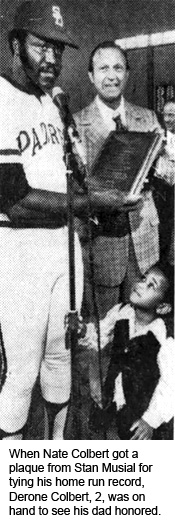
Two weeks later, on Aug. 16, 1972, when the Cardinals were in San Diego, Colbert was honored for his five-homer feat in a ceremony before the game. Stan Musial was on hand to congratulate him.

According to the Associated Press, in presenting a plaque to Colbert, Musial said to him, “Baseball is a game of records and they’re meant to be tied or broken. I’m happy one of mine was tied by a St. Louis boy and a former Cardinal.”

Musial then added, “We made a mistake when we let you go.”

In the game that followed, Colbert hit a home run against Bob Gibson, but the Cardinals won. (For his career, Colbert batted .239 with two home runs, 11 hits and 11 walks versus Gibson). Boxscore

Years later, the Los Angeles Times reported, “Musial and Colbert have a common bond that has made them good friends.”

Colbert said to the newspaper in 1989, “Now when I see him, he says, ‘We’re the only ones to do it.’ “

Trials and tribulations

Chronic back pain shortened Colbert’s playing career. “My back got worse and worse,” he told the Los Angeles Times. “It was deterioration of the vertebrae.”

In a three-way trade involving the Cardinals, Colbert was sent to the Tigers in November 1974. The next year he was shipped to the Expos and he ended his playing career with the 1976 Athletics.

Colbert hit 173 career home runs and had more strikeouts (902) than hits (833). “Considering my medical history, I probably shouldn’t even have played major league baseball,” he told the Los Angeles Times.

After his playing days, Colbert worked for the Padres as a minor-league coach and instructor, and in community relations, until October 1990 when he was indicted on 12 felony counts involving fraudulent loan applications.

Colbert was sentenced to a year in federal custody after he pleaded guilty to a federal bank fraud charge as part of a plea bargain arrangement, said assistant U.S. attorney William Hayes.

Read Full Post »

Given the chance to revive a playing career that appeared finished, Orlando Cepeda took advantage of a gimmick adopted by the American League and added to his Hall of Fame credentials with a productive season for the Red Sox.

On Jan. 18, 1973, Cepeda, 35, became the first big-league player acquired to be a designated hitter. The Red Sox signed him one week after club owners voted to allow the American League to use a designated hitter on an experimental basis for the next three seasons.
A free agent released a month earlier by the Athletics, Cepeda had bad knees that prevented him from playing first base regularly, but did not restrict his hitting.

Wounded knees

The right knee was the first to give Cepeda trouble. He had surgery on the knee in December 1964 and missed most of the 1965 season with the Giants. In May 1966, he was traded to the Cardinals for Ray Sadecki.

Before the knee damage, Cepeda had been a dominant run producer with the Giants. He won the National League Rookie of the Year Award in 1958, led the league in home runs (46) and RBI (142) in 1961, and contributed 35 home runs and 114 RBI for the pennant-winning Giants in 1962. 

Rejuvenated with the Cardinals, Cepeda powered them to a World Series title in 1967 and was named the recipient of the National League Most Valuable Player Award. He helped them repeat as league champions in 1968 before he was traded to the Braves for Joe Torre.

Cepeda delivered for the Braves, too, including 34 home runs and 111 RBI in 1970, until the good knee, the left one, gave out in 1971. He had left knee surgery in September 1971, got traded to the Athletics for Denny McLain in June 1972 and had another operation on the left knee soon after.

Athletics owner Charlie Finley said the surgeon, Dr. Henry Walker, told him that all of the cartilage in Cepeda’s left knee was gone, that it was almost bone on top of bone, The Sporting News reported.

In his autobiography, “Baby Bull,” Cepeda said when the Athletics released him, “I was finished as a major-league player. My legs were shot.”

Opportunity knocks

At home in Puerto Rico in January 1973, Cepeda said he wasn’t aware the American League had gotten approval that month for its teams to substitute a designated hitter for a pitcher in the batting order. He could hardly believe his good fortunate when teams began to inquire about playing in 1973.

The Red Sox were the first to make him an offer ($90,000 and a new car, according to the Boston Globe), and he accepted. Cepeda, who said he’d been a Ted Williams fan as a kid, was joining a Red Sox lineup with three other future Hall of Famers _ Luis Aparicio, Carlton Fisk and Carl Yastrzemski _ plus the likes of Tommy Harper, Rico Petrocelli and Reggie Smith.

Skeptics wondered how much help Cepeda could provide on scarred knees.

“Cepeda may have to be wheeled up to the plate in a jinrikisha, helped out of it and pushed into the batter’s box,” Clif Keane wrote in the Boston Globe.

Noting that Cepeda’s left knee “looks like a road map of Colorado,” columnist Ray Fitzgerald declared, “Maybe the American League executives could meet once more and allow the designated hitters to go to first on a motorcycle.”

Others recalled that Cepeda batted .103 against the Red Sox in the 1967 World Series and was 1-for-17 with no RBI in the four games at Boston. A right-handed batter, Cepeda said the short distance from the plate to the Green Monster wall in left at Fenway Park made him “fence happy” during that World Series.

“Everybody told me how easy it would be to hit the ball over there, and that’s what I tried to do,” Cepeda recalled to the Globe. “I got all mixed up.”

“I’ll get over that,” he promised.

Great expectations

At spring training with the 1973 Red Sox, Cepeda “has been doing a lot of limping but he also has been doing a lot of hitting,” The Sporting News reported.

Trainer Buddy LeRoux told the Globe that Cepeda had “the knees of a 55-year-old man.”

In picking the Red Sox to finish first in the American League East, The Sporting News suggested that Cepeda, “who can’t run but still can hit,” could give Boston the edge.

The first American League game of the 1973 season was Yankees versus Red Sox on April 6 at Boston. In the top of the first, the Yankees’ Ron Blomberg became the first designated hitter to make a plate appearance in a big-league game, drawing a walk from Luis Tiant with the bases loaded. The Red Sox totaled 15 runs and 20 hits in the game, but Cepeda went hitless in six at-bats. Boxscore

The next day, the Red Sox had 13 hits, none by Cepeda. Though he contributed two sacrifice flies, there already were concerns that the player designated as a hitter had thus far failed to get a hit. Boxscore

Feelin’ all right

Those concerns turned into boos in the series finale when Cepeda went hitless in his first three at-bats.

When Cepeda led off the bottom of the ninth, with the score tied at 3-3, “there was a genuine doubt about whether he should be allowed to hit,” Leigh Montville wrote in the Globe.

Pitching for the Yankees was their closer, Sparky Lyle, making his first appearance at Fenway Park since being traded by the Red Sox the year before.

With the count 1-and-1, Lyle tried to throw an inside fastball, but it caught the middle of the plate. Connecting with his 41-ounce bat, the heaviest in the majors, Cepeda’s rising liner soared over the wall in left for a walkoff home run.

“He didn’t cheat himself with the swing he took,” Lyle said to the Globe. “The wind from the swing almost knocked me over flat on my back.”

Leigh Montville described the scene as the ball carried toward the Green Monster: “Cepeda watched it, helping it clear the 37-foot wall with his entire heart, and then he broke into a trot. He came around third base and he came down the line, and when he hit the plate, he gave it a gentle Arthur Murray tap.”

“I’m Cha-Cha,” Cepeda said. “That’s my name.” Boxscore

It was Cepeda’s first walkoff home run since Sept. 30, 1965, versus Joe Nuxhall of the Reds. Boxscore

Big bopper

“It is quite likely if Cepeda hadn’t drilled Sparky’s pitch, he might have lost his designated hitter’s job to Ben Oglivie,” Clif Keane reported in the Globe.

Red Sox manager Eddie Kasko admitted, “I was looking to see better signs” from Cepeda when he came to bat against Lyle.

From then on, Cepeda had a lock on the designated hitter job. Among his highlights:

_ Two home runs and four RBI against the Indians on April 21. “Who cares whether the man can run or not?” Kasko said to the Globe. “We got him to drive in runs. He is doing that better than anyone on the club.” Boxscore

_ A grand slam, the ninth of his career, against the Rangers’ Pete Broberg on May 2. “He’s the best (DH) in the league,” Rangers manager Whitey Herzog told the Globe. Boxscore

_ A two-run home run versus Nolan Ryan in a 2-1 win over the Angels on May 29. Boxscore

_ A tie-breaking homer and the game-winning RBI in a rematch against Ryan on June 12. Boxscore

_  Four doubles and six RBI against the Royals on Aug. 8. “It’s too bad Cepeda doesn’t have a bat to match his bad legs,” Royals manager Jack McKeon said to the Globe. Boxscore

_ Five hits and four runs scored against the Angels on Aug. 12. “The most satisfying year of my career,” Cepeda told the Globe. Boxscore

One and done

Used exclusively as a designated hitter, Cepeda batted .289 with 20 home runs and 89 RBI for the second-place Red Sox. He tied Yastrzemski for the team lead in doubles (25) and was second on the club in total bases (244). He was the first recipient of baseball’s Designated Hitter of the Year Award (renamed the Edgar Martinez Award).

“Considering where my career was and the high level of competition, the designated hitter award in 1973 remains among my most meaningful baseball achievements,” Cepeda said in his autobiography. “I was back on top.”

The good vibes didn’t last long. Darrell Johnson, who replaced Kasko as manager, preferred Tommy Harper and Cecil Cooper for the designated hitter role. Cepeda was released in March 1974.

He went to Mexico, played in 28 games for a Yucatan team managed by former Cardinals teammate Julian Javier and batted .213. Back in the majors with the Royals in August 1974, Cepeda hit .215 with one home run in 33 games, ending his playing career.

Read Full Post »

Denny Doyle was a baseball pixie, a Punch-and-Judy hitter who got to the big leagues because of his fielding at second base.

Standing 5 feet 9, he swung a 32-ounce stick _ “Dick Allen cleans his teeth with bats like that,” Doyle told Stan Hochman of the Philadelphia Daily News _ but he clobbered the Cardinals and, most improbably, their ace, Bob Gibson.

A .240 hitter in the National League, Doyle hit .309 versus the Cardinals and .464 against Gibson for his career.

Batting from the left side, Doyle turned into Tony Gwynn at the sight of a Cardinals pitcher. He had more career hits (58), home runs (three) and runs scored (26) versus the Cardinals than he did against any other foe. 

Caveman cometh

After attending high school in Horse Cave, Ky., near Mammoth Cave National Park, Doyle accepted a basketball scholarship to Morehead State. He averaged 2.7 points in 11 varsity games and switched his focus to baseball.

In the summer of 1965, Doyle got a tryout with the Phillies, who offered him a contract. He signed only after the Phillies agreed to let him earn his college degree before reporting to the minors. “I had nine hours to go to get my diploma,” Doyle told the Philadelphia Inquirer. “The Phillies didn’t like it too much, but I had to graduate first.”

At Spartanburg, S.C., in 1966, Doyle, the second baseman, made an immediate connection with the shortstop, Larry Bowa. They formed both a friendship and a dandy keystone combination. Doyle and Bowa played together for three seasons in the minors and became rookie starters with the Phillies in 1970.

Noting that Bowa was loud and Doyle was quiet, Inquirer columnist Frank Dolson wrote, “Bowa and Doyle complement each other beautifully … Two Larry Bowas might be too explosive. Two Denny Doyles might be too bland. Together they are perfect.”

Phillies coach Doc Edwards told the newspaper, “Anybody breaks up this combination ought to have his head chopped off.”

Getting to Gibson

The second base job with the Phillies opened for Doyle after they traded Cookie Rojas to the Cardinals. The consensus was Doyle, 26, had the fielding skills but the rookie’s ability to hit was in question. “I have to be an artist at the bunting game and the hit-and-run,” Doyle said to the Philadelphia Daily News. “I’ve got to make contact with the bat.”

He was batting .204 for the season when he stung the Cardinals with a four-hit game against them on May 24, 1970, at Philadelphia. Boxscore

Doyle hit .208 for the 1970 season but .298 versus the Cardinals in 14 games.

The next year, he did even better against St. Louis _ .333 in 13 games. The most impressive performance came on July 30, 1971, at Philadelphia. Doyle, batting .226 for the season, reached base safely in five plate appearances against Gibson. He had three singles, a home run and was hit by a pitch. Doyle was plunked leading off the first inning and slugged his home run on the first pitch he saw from Gibson in his next trip to the plate.

Doyle’s home run into the bullpen in right broke a streak of 23 consecutive scoreless innings for Gibson, who, nonetheless, achieved the win, pitching a complete game and driving in the winning run with a home run versus Chris Short in the seventh. Boxscore

According to the Philadelphia Daily News, asked after the game what pitches he threw to Doyle, Gibson growled, “Ask some intelligent questions. I threw him a fastball, slider, fastball and a curve. And I won the ballgame, which is the important thing.”

Gibson had much success when facing the Phillies _ his 30 career wins against them were his most versus any foe _ but it was a different story with Doyle. In 32 career plate appearances against Gibson, Doyle had a .516 on-base percentage, including 13 hits. Gibson struck him out just twice.

Pennant push

Doyle only once achieved four RBI in a game. Naturally, it came against the Cardinals. On Sept. 20, 1973, he had a three-run home run and a sacrifice fly versus Cardinals starter Alan Foster at Philadelphia. Boxscore

For the season, Doyle hit .386 in 14 games against the 1973 Cardinals.

Afterward, at the urging of manager Danny Ozark, the Phillies acquired second baseman Dave Cash from the Pirates, making Doyle expendable. He was shipped to the Angels in December 1973 and then to the Red Sox in June 1975.

Doyle thrived with the Red Sox, putting together a 22-game hitting streak, batting .310 for the season, solidifying the defense and helping them become 1975 American League champions. He started at second base in all seven games of the 1975 World Series and had eight hits.

Bob Ryan of the Boston Globe noted, “Denny Doyle makes the double play. He stops balls from going through when there are men on base. He keeps rallies going. He doesn’t strike out. He wants to win and he usually manages to find a way to do it.”

Doyle’s last season in the majors was 1977. Two brothers also made it to the big leagues _ Brian Doyle, an infielder with the Yankees (1978-80) and Athletics (1981), and Blake Doyle, a coach with the Rockies (2014-16).

Read Full Post »

Looking to cut costs during the Great Depression and open a spot at first base for the aptly named Rip Collins, the Cardinals decided the time was right to peddle a player who was popular and productive.

On Dec. 17, 1932, the Cardinals traded their future Hall of Fame first baseman, Jim Bottomley, to the Reds for pitcher Ownie Carroll and outfielder Estel Crabtree.

Nicknamed Sunny Jim for “his friendly disposition,” as the Associated Press described it, Bottomley had been a consistent run producer in 11 seasons with the Cardinals, and though there had been indications he was being shopped, it was thought he’d bring more than what St. Louis got for him.

Style and substance

Bottomley was born in Oglesby, Ill., and settled with his family in Nokomis, Ill., a farming and mining town. Bottomley’s father and brother worked in the mines. Bottomley’s brother was killed in a cave-in, the St. Louis Post-Dispatch reported.

When Bottomley was 16, he quit high school and clerked in a grocery store, the Associated Press reported. According to the Post-Dispatch, he also worked on a farm and as a blacksmith’s helper.

In his spare time, Bottomley played semipro baseball for $5 a game, walking eight miles each way to the home ballpark, the Associated Press reported. A St. Louis policeman saw him hit two home runs and three triples in a game and told Cardinals executive Branch Rickey he should give Bottomley a look. Invited to a Cardinals tryout camp in 1919, Bottomley was awarded a contract.

During 1922, his third season in their farm system, Bottomley got called up to the Cardinals and became their first baseman. He made an immediate impression with the fans because of his strut and the way he wore his cap.

“He was the only man I ever knew who could strut while he was crouched in the batter’s box,” Rickey told the St. Louis Globe-Democrat.

As for the cap, it “was never pulled down to shade the eyes like most ballplayers wore it,” the Globe-Democrat observed. “Sunny Jim’s was always cocked at a rakish angle.”

Before long, nearly everyone who followed the Cardinals knew Bottomley simply as Sunny Jim. He “smiled and swaggered his way into the hearts of baseball fans,” J. Roy Stockton noted in the Post-Dispatch.

According to the Associated Press, “Sunny Jim was one of those rare ballplayers who combined genuine color with honest-to-goodness ability.”

Playing to win

A left-handed batter, Bottomley hit for power, using a choked grip on a heavy bat.

On Sept. 16, 1924, Bottomley drove in 12 runs in a game against the Dodgers. Boxscore Since then, the only player to match that feat has been another Cardinal, Mark Whiten, versus the Reds on Sept. 7, 1993. Boxscore

Bottomley helped the Cardinals to four National League pennants (1926, 1928, 1930 and 1931) and two World Series titles (1926 and 1931). He won the National League Most Valuable Player Award in 1928 when he led the league in triples (20), home runs (31), RBI (136) and total bases (362).

Bottomley hit better than .300 in nine of his 11 seasons with the Cardinals. (In the other two years, he hit .299 and .296.) He ranks fourth in career RBI as a Cardinal (1,105). Only Stan Musial (1,951), Albert Pujols (1,397) and Enos Slaughter (1,148) produced more RBI for the franchise.

As for his fielding, “It doesn’t make any difference how wide or how high they are thrown to Sunny Jim. He always manages to get them,” the Dayton Daily News reported.

Time to go

Bottomley’s best friend on the Cardinals, another future Hall of Famer, left fielder Chick Hafey, was traded to the Reds on the eve of the 1932 season opener. Rip Collins, a natural first baseman, replaced Hafey in left field on Opening Day.

After Bottomley started slowly, hitting .158 with no home runs in April, manager Gabby Street benched him and moved Collins to first base.

Collins, 28, went on to lead the 1932 Cardinals in hits (153), home runs (21), RBI (91), runs scored (82) and total bases (260). Bottomley, 32, hit .296 with 11 homers.

With Collins making a convincing claim for the first base job, the Cardinals began making plans to move Bottomley. In September 1932, the last-place Reds revealed that manager Dan Howley would depart after the season. Reds owner Sidney Weil was an admirer of Bottomley and sought permission from the Cardinals to interview him for the job.

At the urging of Branch Rickey and Cardinals owner Sam Breadon, Bottomley went to Cincinnati on Sept. 23, 1932, while the season still was being played, and interviewed with Weil for the role of player-manager, the Cincinnati Enquirer reported. Donie Bush, a veteran manager, eventually got the job, but Weil was determined to acquire Bottomley to play for the Reds.

After Cardinals shortstop Charlie Gelbert was shot in a hunting accident in November 1932, the Cardinals offered Bottomley to the Reds for shortstop Leo Durocher and starting pitcher Si Johnson, a 13-game winner, the Enquirer reported.

When the Reds deemed the price too high, the Cardinals settled for Ownie Carroll (10-19 in 1932) and Estel Crabtree (.274, two home runs, in 1932). It was suspected the Reds sent the Cardinals a stack of cash as well.

Asked whether the Cardinals got cash in the deal, Breadon told Red Smith of the St. Louis Star-Times, “I wouldn’t want to say anything on that.”

According to The Sporting News, the trade garnered the Cardinals “a sizeable sum of money.” The Post-Dispatch informed its readers, “Close followers of baseball did not have to be told that it was a cash transaction.”

In addition to reaping the cash, the Cardinals also rid themselves of Bottomley’s $13,000 salary, about double what most players were making in 1932.

Worth the price

The Reds proposed to Bottomley a salary of $8,000, a $5,000 cut, for 1933, The Sporting News reported. After a negotiation, Bottomley, who wed St. Louis beauty shop owner Betty Brawner in February 1933, eventually signed for $10,000.

In May 1933, the Cardinals got the Reds to trade them Leo Durocher. (Three years later, the Cardinals also got Si Johnson from the Reds.)

Bottomley delivered what the Reds hoped from him. He led the 1933 Reds in triples (nine), home runs (13) and RBI (83). He had 16 RBI in 22 games versus the Cardinals. The following year, with the 1934 Reds, Bottomley was their leader in doubles (31), triples (11) and RBI (78). He hit .313 versus the Cardinals.

After a third season with Cincinnati, Bottomley was traded to the St. Louis Browns, finishing his career with them, including a stint as manager in 1937.

Read Full Post »

When Taylor Coleman was 8 years old, her father abandoned her, she said, cutting off all communication and shirking his parental responsibilities.

Her father, Vince Coleman, was known to baseball fans as the stolen base specialist for the Cardinals, a player who created thrills with his speed and daring. Taylor saw a different side: a father in name only, unwilling to even acknowledge her, let alone help raise her.

Bolstered by the commitment and strength of her single mother, Taylor persevered, earning a college degree and becoming a successful businesswoman in cybersecurity sales and a mentor to people entering the technology field.

She has written a book about her father and his rejection of her. It’s called “A Letter To My Dead Beat Dad: The Facade Is Over.”

It’s a powerful read that stirs the emotions. The book is available on Amazon in hardcover and Kindle: Click here

Vince Coleman’s playing career spiraled after he left the Cardinals and reached bottom in 1993 when he was charged with a felony for throwing an explosive device similar to a grenade into a parking lot and injuring three people, including two children. The Cardinals later made him a member of their hall of fame.

During Thanksgiving weekend 2022, I did an e-mail interview with Taylor Coleman about her book. Here are the excerpts:

Q:  The book is written in a very open and heartfelt manner. How did you manage to write such a personal story without holding back?

Taylor Coleman: “I felt a strong need to tell my truth and tell my story. I spent my whole life keeping my abandonment and trauma a secret. Something in me knew I had every right to share my feelings in a raw and genuine manner.

“I wanted this book to be as if someone was opening up a diary. I want the readers to know my anger and sadness, as well as feel the love that I still have for my father. It definitely took a lot of courage to be so honest. There were many times where I thought, ‘Should I really do this?’ But I deserve to be heard. I am becoming the type of woman who isn’t afraid to hold back.”

Q: Was it an emotionally exhausting, or an uplifting experience, to write this book?

Taylor Coleman: “It was a bit of both. I have always loved writing, so there was a genuinely therapeutic aspect of telling my truth. However, there are definitely parts of the book that caused me to cry or become upset while writing it, because I was having to relive those moments and remind myself of the hurt I felt. However, I can say overall it was more positive and uplifting.”

Q: Have you gotten feedback from any readers who also were abandoned by a parent?

Taylor Coleman: “Yes, I have, and it has all been very positive. I have had people tell me the book has helped them not be afraid to speak about their trauma and to learn how to heal. Others stated the book inspired them to tell their own stories and not hold back.

“I think the book also has been comforting to those who just want to know they are not alone. My dream and mission is not only to hold my father accountable, and possibly inspire him to change his ways, but most importantly, my mission is to be the voice and advocate for all humans who have seen a parent walk out of their life. Deadbeat moms and dads deserve to be held accountable for their cruel actions, and we (the offspring) deserve to be heard and recognized.”

Q: The book is as much about the strength, courage and commitment of your Mom. Has she read the book and, if so, what was her reaction?

Taylor Coleman: “She has read it several times, yes, and she loves every bit of it, and is extremely proud of me for doing such a thing. The book would not have been possible without my mother. I was so young when all of this happened, and there was a lot I had either forgotten about, or certain facts that she did not share with me because she never wanted to hurt me. So, I had to ask a lot of questions and confide in her to tell me all the details of what happened between her and my father, as well as the things he was doing, such as decreasing child support to $175 a month.”

Q: Besides your Mom, who are your role models, or mentors, and how have they inspired you?

Taylor Coleman: “My biggest role models outside of my mother are definitely my grandma, on my mother’s side, as well as two teachers I had growing up, Mrs. Pittman and Coach Fahrner. Those two individuals are heaven-sent, and they have always treated me so kindly. They are the types of teachers who make students excited to come to school, and they are always so generous and compassionate to each of their students. They are just genuinely good humans, and that is so hard to come by. They have inspired me to treat humans with kindness.

“My grandma is such a strong and resilient woman, who grew up very poor. However, she made such a beautiful life for herself, and she inspires me to continue being the independent woman I am, and lets me know that I can achieve and do or be anything I want to be in this life.”

Q: What is the most important advice you have for those who have been abandoned by a parent?

Taylor Coleman: “My biggest piece of advice is to learn, and always remember, to love yourself. Oftentimes, when a parent disowns their child, that child feels as if they are worthless or unworthy of love, and that can come to fruition later in life and cause one to chase toxic love or tolerate abuse from others, simply because they want to be loved. I want abandoned children, teenagers and adults to know they are still loved and still valued, and to not allow anyone to treat them poorly.

“Someone’s incapacity to love you, or see your worth, has absolutely nothing to do with you, and everything to do with them. Also, I want the general public to know that seeking therapy is not a bad thing. Everyone on this earth has trauma, and everyone on this earth needs therapy.”

Q: One aspect of the book is about the pitfalls of hero worship by sports fans. What message do you have for them about idolizing sports figures?

Taylor Coleman: “I want every sports fan to know that, at the end of the day, when that athlete steps off that field and takes off that jersey, they are just a normal human being like the rest of us. Being an athlete does not make you special, and does not justify being a terrible human being.

“I cannot stand it when I see comments from people saying things like, ‘Their personal lives don’t matter; he was a good player.’ Their personal lives do matter.”

Q: What would you say to a Vince Coleman fan who wonders whether she or he should read your book?

Taylor Coleman: “I would ask them to take a moment, look inside their heart, and picture themselves in my shoes. Picture an 8-year-old being told she will never hear from her father ever again. I would ask his fans to be empathetic and to understand that I am just a forgotten child that wants to finally be heard, and wants to make a positive impact in this world. His fans deserve to know who they are truly rooting for. They have all been terribly fooled.”

Read Full Post »

(Updated Jan. 20, 2025)

Toward the end of his Hall of Fame career, Fred McGriff gave the Cardinals something to remember him by.

A left-handed power hitter, McGriff grew up in Tampa, four blocks from Al Lopez Field, spring training home of the Reds, and sold soft drinks at Tampa Stadium during NFL Buccaneers games as a youth.

McGriff slugged 22 regular-season home runs against the Cardinals and two more in the playoffs. The very last two came on June 21, 2002, in a Cardinals-Cubs classic at Wrigley Field in Chicago.

The Friday afternoon game matched right-handers Woody Williams, 35, of the Cardinals and Jon Lieber, 32, of the Cubs. Both pitched with precision and smarts.

J.D. Drew, the second batter of the game, slammed a home run, giving the Cardinals a 1-0 lead, before Lieber settled into a groove.

Williams retired the first 12 Cubs batters.

McGriff, who struck out his first time at the plate against Williams, led off the bottom of the fifth.

Traded by the Rays to the Cubs the year before (he made his Cubs debut against the Cardinals), McGriff, a first baseman, had led both the American League and National League in home runs (1989 with the Blue Jays and 1992 with the Padres), and had helped the Braves win two pennants and a World Series title.

At 38, he still was a force. (McGriff would produce 30 homers and 103 RBI for the 2002 Cubs, giving him 10 seasons with 30 homers and eight with 100 RBI.)

After McGriff worked the count to 3-and-1 in his at-bat in the fifth, Williams challenged him with a fastball. McGriff drove it out of the park for a home run, tying the score at 1-1.

When he came to bat again in the seventh, Williams jammed him with a fastball, but McGriff got around on it and belted another home run, which turned out to be the game-winner.

The Cubs won, 2-1. Williams pitched seven innings, walked none and allowed three hits _ the two McGriff home runs and a single by Lieber.

Lieber pitched a three-hit complete game and also walked none.

The game was played in one hour, 49 minutes _ the fastest involving the Cardinals since a May 1981 game against Steve Carlton and the Phillies that was completed in one hour, 45 minutes, according to the St. Louis Post-Dispatch. “Several times, Williams and Lieber used more pitches while warming between innings than in securing their next three outs,” Joe Strauss reported. Boxscore

Williams told the newspaper, “It’s the way the game is supposed to be played … The way baseball is today, it’s set up for a three-hour game, which is a crock.”

Asked about his decision to throw a fastball to McGriff with the score tied in the seventh, Williams told Strauss, “I threw exactly the type of pitch that I wanted to throw when it was a 1-1 game. I got beat.”

Cardinals manager Tony La Russa wanted Williams to work around McGriff and take his chances with other batters. Referring to the fastballs McGriff hit for home runs, La Russa told the Post-Dispatch, “We made a couple of pitching mistakes.”

Williams saw it differently: “I go right at him … I’m not pitching around him.” Boxscore

McGriff hit .389 versus Williams in his career. Four of his seven hits against him were home runs.

Read Full Post »

« Newer Posts - Older Posts »