Feeds:
Posts
Comments

Archive for the ‘Hitters’ Category

Looking to cut costs during the Great Depression and open a spot at first base for the aptly named Rip Collins, the Cardinals decided the time was right to peddle a player who was popular and productive.

On Dec. 17, 1932, the Cardinals traded their future Hall of Fame first baseman, Jim Bottomley, to the Reds for pitcher Ownie Carroll and outfielder Estel Crabtree.

Nicknamed Sunny Jim for “his friendly disposition,” as the Associated Press described it, Bottomley had been a consistent run producer in 11 seasons with the Cardinals, and though there had been indications he was being shopped, it was thought he’d bring more than what St. Louis got for him.

Style and substance

Bottomley was born in Oglesby, Ill., and settled with his family in Nokomis, Ill., a farming and mining town. Bottomley’s father and brother worked in the mines. Bottomley’s brother was killed in a cave-in, the St. Louis Post-Dispatch reported.

When Bottomley was 16, he quit high school and clerked in a grocery store, the Associated Press reported. According to the Post-Dispatch, he also worked on a farm and as a blacksmith’s helper.

In his spare time, Bottomley played semipro baseball for $5 a game, walking eight miles each way to the home ballpark, the Associated Press reported. A St. Louis policeman saw him hit two home runs and three triples in a game and told Cardinals executive Branch Rickey he should give Bottomley a look. Invited to a Cardinals tryout camp in 1919, Bottomley was awarded a contract.

During 1922, his third season in their farm system, Bottomley got called up to the Cardinals and became their first baseman. He made an immediate impression with the fans because of his strut and the way he wore his cap.

“He was the only man I ever knew who could strut while he was crouched in the batter’s box,” Rickey told the St. Louis Globe-Democrat.

As for the cap, it “was never pulled down to shade the eyes like most ballplayers wore it,” the Globe-Democrat observed. “Sunny Jim’s was always cocked at a rakish angle.”

Before long, nearly everyone who followed the Cardinals knew Bottomley simply as Sunny Jim. He “smiled and swaggered his way into the hearts of baseball fans,” J. Roy Stockton noted in the Post-Dispatch.

According to the Associated Press, “Sunny Jim was one of those rare ballplayers who combined genuine color with honest-to-goodness ability.”

Playing to win

A left-handed batter, Bottomley hit for power, using a choked grip on a heavy bat.

On Sept. 16, 1924, Bottomley drove in 12 runs in a game against the Dodgers. Boxscore Since then, the only player to match that feat has been another Cardinal, Mark Whiten, versus the Reds on Sept. 7, 1993. Boxscore

Bottomley helped the Cardinals to four National League pennants (1926, 1928, 1930 and 1931) and two World Series titles (1926 and 1931). He won the National League Most Valuable Player Award in 1928 when he led the league in triples (20), home runs (31), RBI (136) and total bases (362).

Bottomley hit better than .300 in nine of his 11 seasons with the Cardinals. (In the other two years, he hit .299 and .296.) He ranks fourth in career RBI as a Cardinal (1,105). Only Stan Musial (1,951), Albert Pujols (1,397) and Enos Slaughter (1,148) produced more RBI for the franchise.

As for his fielding, “It doesn’t make any difference how wide or how high they are thrown to Sunny Jim. He always manages to get them,” the Dayton Daily News reported.

Time to go

Bottomley’s best friend on the Cardinals, another future Hall of Famer, left fielder Chick Hafey, was traded to the Reds on the eve of the 1932 season opener. Rip Collins, a natural first baseman, replaced Hafey in left field on Opening Day.

After Bottomley started slowly, hitting .158 with no home runs in April, manager Gabby Street benched him and moved Collins to first base.

Collins, 28, went on to lead the 1932 Cardinals in hits (153), home runs (21), RBI (91), runs scored (82) and total bases (260). Bottomley, 32, hit .296 with 11 homers.

With Collins making a convincing claim for the first base job, the Cardinals began making plans to move Bottomley. In September 1932, the last-place Reds revealed that manager Dan Howley would depart after the season. Reds owner Sidney Weil was an admirer of Bottomley and sought permission from the Cardinals to interview him for the job.

At the urging of Branch Rickey and Cardinals owner Sam Breadon, Bottomley went to Cincinnati on Sept. 23, 1932, while the season still was being played, and interviewed with Weil for the role of player-manager, the Cincinnati Enquirer reported. Donie Bush, a veteran manager, eventually got the job, but Weil was determined to acquire Bottomley to play for the Reds.

After Cardinals shortstop Charlie Gelbert was shot in a hunting accident in November 1932, the Cardinals offered Bottomley to the Reds for shortstop Leo Durocher and starting pitcher Si Johnson, a 13-game winner, the Enquirer reported.

When the Reds deemed the price too high, the Cardinals settled for Ownie Carroll (10-19 in 1932) and Estel Crabtree (.274, two home runs, in 1932). It was suspected the Reds sent the Cardinals a stack of cash as well.

Asked whether the Cardinals got cash in the deal, Breadon told Red Smith of the St. Louis Star-Times, “I wouldn’t want to say anything on that.”

According to The Sporting News, the trade garnered the Cardinals “a sizeable sum of money.” The Post-Dispatch informed its readers, “Close followers of baseball did not have to be told that it was a cash transaction.”

In addition to reaping the cash, the Cardinals also rid themselves of Bottomley’s $13,000 salary, about double what most players were making in 1932.

Worth the price

The Reds proposed to Bottomley a salary of $8,000, a $5,000 cut, for 1933, The Sporting News reported. After a negotiation, Bottomley, who wed St. Louis beauty shop owner Betty Brawner in February 1933, eventually signed for $10,000.

In May 1933, the Cardinals got the Reds to trade them Leo Durocher. (Three years later, the Cardinals also got Si Johnson from the Reds.)

Bottomley delivered what the Reds hoped from him. He led the 1933 Reds in triples (nine), home runs (13) and RBI (83). He had 16 RBI in 22 games versus the Cardinals. The following year, with the 1934 Reds, Bottomley was their leader in doubles (31), triples (11) and RBI (78). He hit .313 versus the Cardinals.

After a third season with Cincinnati, Bottomley was traded to the St. Louis Browns, finishing his career with them, including a stint as manager in 1937.

Read Full Post »

When Taylor Coleman was 8 years old, her father abandoned her, she said, cutting off all communication and shirking his parental responsibilities.

Her father, Vince Coleman, was known to baseball fans as the stolen base specialist for the Cardinals, a player who created thrills with his speed and daring. Taylor saw a different side: a father in name only, unwilling to even acknowledge her, let alone help raise her.

Bolstered by the commitment and strength of her single mother, Taylor persevered, earning a college degree and becoming a successful businesswoman in cybersecurity sales and a mentor to people entering the technology field.

She has written a book about her father and his rejection of her. It’s called “A Letter To My Dead Beat Dad: The Facade Is Over.”

It’s a powerful read that stirs the emotions. The book is available on Amazon in hardcover and Kindle: Click here

Vince Coleman’s playing career spiraled after he left the Cardinals and reached bottom in 1993 when he was charged with a felony for throwing an explosive device similar to a grenade into a parking lot and injuring three people, including two children. The Cardinals later made him a member of their hall of fame.

During Thanksgiving weekend 2022, I did an e-mail interview with Taylor Coleman about her book. Here are the excerpts:

Q:  The book is written in a very open and heartfelt manner. How did you manage to write such a personal story without holding back?

Taylor Coleman: “I felt a strong need to tell my truth and tell my story. I spent my whole life keeping my abandonment and trauma a secret. Something in me knew I had every right to share my feelings in a raw and genuine manner.

“I wanted this book to be as if someone was opening up a diary. I want the readers to know my anger and sadness, as well as feel the love that I still have for my father. It definitely took a lot of courage to be so honest. There were many times where I thought, ‘Should I really do this?’ But I deserve to be heard. I am becoming the type of woman who isn’t afraid to hold back.”

Q: Was it an emotionally exhausting, or an uplifting experience, to write this book?

Taylor Coleman: “It was a bit of both. I have always loved writing, so there was a genuinely therapeutic aspect of telling my truth. However, there are definitely parts of the book that caused me to cry or become upset while writing it, because I was having to relive those moments and remind myself of the hurt I felt. However, I can say overall it was more positive and uplifting.”

Q: Have you gotten feedback from any readers who also were abandoned by a parent?

Taylor Coleman: “Yes, I have, and it has all been very positive. I have had people tell me the book has helped them not be afraid to speak about their trauma and to learn how to heal. Others stated the book inspired them to tell their own stories and not hold back.

“I think the book also has been comforting to those who just want to know they are not alone. My dream and mission is not only to hold my father accountable, and possibly inspire him to change his ways, but most importantly, my mission is to be the voice and advocate for all humans who have seen a parent walk out of their life. Deadbeat moms and dads deserve to be held accountable for their cruel actions, and we (the offspring) deserve to be heard and recognized.”

Q: The book is as much about the strength, courage and commitment of your Mom. Has she read the book and, if so, what was her reaction?

Taylor Coleman: “She has read it several times, yes, and she loves every bit of it, and is extremely proud of me for doing such a thing. The book would not have been possible without my mother. I was so young when all of this happened, and there was a lot I had either forgotten about, or certain facts that she did not share with me because she never wanted to hurt me. So, I had to ask a lot of questions and confide in her to tell me all the details of what happened between her and my father, as well as the things he was doing, such as decreasing child support to $175 a month.”

Q: Besides your Mom, who are your role models, or mentors, and how have they inspired you?

Taylor Coleman: “My biggest role models outside of my mother are definitely my grandma, on my mother’s side, as well as two teachers I had growing up, Mrs. Pittman and Coach Fahrner. Those two individuals are heaven-sent, and they have always treated me so kindly. They are the types of teachers who make students excited to come to school, and they are always so generous and compassionate to each of their students. They are just genuinely good humans, and that is so hard to come by. They have inspired me to treat humans with kindness.

“My grandma is such a strong and resilient woman, who grew up very poor. However, she made such a beautiful life for herself, and she inspires me to continue being the independent woman I am, and lets me know that I can achieve and do or be anything I want to be in this life.”

Q: What is the most important advice you have for those who have been abandoned by a parent?

Taylor Coleman: “My biggest piece of advice is to learn, and always remember, to love yourself. Oftentimes, when a parent disowns their child, that child feels as if they are worthless or unworthy of love, and that can come to fruition later in life and cause one to chase toxic love or tolerate abuse from others, simply because they want to be loved. I want abandoned children, teenagers and adults to know they are still loved and still valued, and to not allow anyone to treat them poorly.

“Someone’s incapacity to love you, or see your worth, has absolutely nothing to do with you, and everything to do with them. Also, I want the general public to know that seeking therapy is not a bad thing. Everyone on this earth has trauma, and everyone on this earth needs therapy.”

Q: One aspect of the book is about the pitfalls of hero worship by sports fans. What message do you have for them about idolizing sports figures?

Taylor Coleman: “I want every sports fan to know that, at the end of the day, when that athlete steps off that field and takes off that jersey, they are just a normal human being like the rest of us. Being an athlete does not make you special, and does not justify being a terrible human being.

“I cannot stand it when I see comments from people saying things like, ‘Their personal lives don’t matter; he was a good player.’ Their personal lives do matter.”

Q: What would you say to a Vince Coleman fan who wonders whether she or he should read your book?

Taylor Coleman: “I would ask them to take a moment, look inside their heart, and picture themselves in my shoes. Picture an 8-year-old being told she will never hear from her father ever again. I would ask his fans to be empathetic and to understand that I am just a forgotten child that wants to finally be heard, and wants to make a positive impact in this world. His fans deserve to know who they are truly rooting for. They have all been terribly fooled.”

Read Full Post »

(Updated Jan. 20, 2025)

Toward the end of his Hall of Fame career, Fred McGriff gave the Cardinals something to remember him by.

A left-handed power hitter, McGriff grew up in Tampa, four blocks from Al Lopez Field, spring training home of the Reds, and sold soft drinks at Tampa Stadium during NFL Buccaneers games as a youth.
McGriff slugged 22 regular-season home runs against the Cardinals and two more in the playoffs. The very last two came on June 21, 2002, in a Cardinals-Cubs classic at Wrigley Field in Chicago.

The Friday afternoon game matched right-handers Woody Williams, 35, of the Cardinals and Jon Lieber, 32, of the Cubs. Both pitched with precision and smarts.

J.D. Drew, the second batter of the game, slammed a home run, giving the Cardinals a 1-0 lead, before Lieber settled into a groove.

Williams retired the first 12 Cubs batters.

McGriff, who struck out his first time at the plate against Williams, led off the bottom of the fifth.

Traded by the Rays to the Cubs the year before (he made his Cubs debut against the Cardinals), McGriff, a first baseman, had led both the American League and National League in home runs (1989 with the Blue Jays and 1992 with the Padres), and had helped the Braves win two pennants and a World Series title.

At 38, he still was a force. (McGriff would produce 30 homers and 103 RBI for the 2002 Cubs, giving him 10 seasons with 30 homers and eight with 100 RBI.)

After McGriff worked the count to 3-and-1 in his at-bat in the fifth, Williams challenged him with a fastball. McGriff drove it out of the park for a home run, tying the score at 1-1.

When he came to bat again in the seventh, Williams jammed him with a fastball, but McGriff got around on it and belted another home run, which turned out to be the game-winner.

The Cubs won, 2-1. Williams pitched seven innings, walked none and allowed three hits _ the two McGriff home runs and a single by Lieber.

Lieber pitched a three-hit complete game and also walked none.

The game was played in one hour, 49 minutes _ the fastest involving the Cardinals since a May 1981 game against Steve Carlton and the Phillies that was completed in one hour, 45 minutes, according to the St. Louis Post-Dispatch. “Several times, Williams and Lieber used more pitches while warming between innings than in securing their next three outs,” Joe Strauss reported. Boxscore

Williams told the newspaper, “It’s the way the game is supposed to be played … The way baseball is today, it’s set up for a three-hour game, which is a crock.”

Asked about his decision to throw a fastball to McGriff with the score tied in the seventh, Williams told Strauss, “I threw exactly the type of pitch that I wanted to throw when it was a 1-1 game. I got beat.”

Cardinals manager Tony La Russa wanted Williams to work around McGriff and take his chances with other batters. Referring to the fastballs McGriff hit for home runs, La Russa told the Post-Dispatch, “We made a couple of pitching mistakes.”

Williams saw it differently: “I go right at him … I’m not pitching around him.” Boxscore

McGriff hit .389 versus Williams in his career. Four of his seven hits against him were home runs.

Read Full Post »

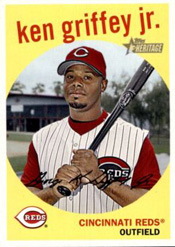
Ken Griffey Jr. should have been in the lineup for the Padres when the Cardinals faced them in the 2005 and 2006 National League playoffs. Instead, Griffey remained with the Reds, a team that never reached the playoffs during his nine seasons with them.

In November 2002, the Reds and Padres agreed to a trade of Griffey for Phil Nevin. Griffey would have been a Padre if Nevin hadn’t blocked the deal by invoking a no-trade clause in his contract.

The idea of trading Griffey for a journeyman such as Nevin would have been deemed preposterous a few years earlier, but the Reds were ready to cut their ties with a player once considered to be the best in baseball.

Special treatment

With the Mariners from 1989 to 1999, Griffey four times led the American League in home runs, and won 10 Gold Glove awards and a Most Valuable Player honor, but he wanted out of Seattle.

Born in the the same town (Donora, Pa.) and on the same date (Nov. 21) as Stan Musial, Griffey grew up in Cincinnati, where his father played for the Reds, and eventually relocated to Orlando. After the 1999 season, he rejected an eight-year, $140 million offer from the Mariners, saying he wanted to play for a team closer to his Florida home.

Though the Cardinals tried to acquire him, Griffey was traded to the Reds. According to Bill Madden of the New York Daily News, Reds general manager Jim Bowden “made no secret of the fact that Griffey was going to get special treatment, a grievous mistake … Numerous Reds, past and present, have blasted Griffey as being self-absorbed and an island unto himself in the clubhouse.”

Limited to 70 games because of leg injuries in 2002, Griffey produced eight home runs and 23 RBI.

Content in California

A few days after Griffey turned 33, the Reds agreed during the Thanksgiving weekend to swap him to the Padres for Nevin, the Associated Press reported.

Primarily a third baseman and first baseman, Nevin had come to the Padres after stints with the Astros, Tigers and Angels. After producing 41 home runs and 126 RBI for the 2001 Padres, Nevin, 31, totaled 12 homers and 57 RBI in 2002.

The Reds viewed Nevin (due $31 million for the next four years) as a less expensive alternative to Griffey (due $86 million for the next six years). Also, Nevin was friends with Reds manager Bob Boone.

“Boone and Nevin have a longstanding friendship dating to Nevin’s childhood, when he grew up in the same Southern California neighborhood where Boone lived,” The Cincinnati Post reported.

Nevin’s agent, Barry Axelrod, said his client rejected a trade to the Reds because he wanted to remain on the West Coast, The Cincinnati Post reported.

Acting on orders from the Reds’ front office, Boone met with Nevin for lunch and tried to convince him to change his mind, but was unsuccessful, according to the Dayton Daily News.

Bargain basement

The Reds initially denied trying to trade Griffey, but came clean after Nevin confirmed to reporters he had blocked the deal.

Reds chief operating officer John Allen said the trade, orchestrated by Bowden, had the support of team owner Carl Lindner, The Cincinnati Post reported.

According to USA Sports Weekly, after the proposed deal with the Padres collapsed, the Reds offered Griffey to the White Sox for outfielder Magglio Ordonez, but were quickly turned down.

Among the reactions to the Reds’ attempts to peddle Griffey:

_ Mike Anthony, Hartford Courant: “How quickly Griffey has fallen off the map of baseball stars in three years with the Reds. The minute he left Seattle, he got old. He’s been injured and, at times, unhappy.”

_ Dan O’Neill, St. Louis Post-Dispatch: “Seems hard to believe Ken Griffey Jr., considered hands-down the best player in the game a few years back, is now being shopped like a used lawn mower.”

_ Bill Simmons, ESPN.com: “He’s 33, plagued by injuries, miserable and bitter, on the downside of his career, and his team can’t even give him away.”

_ Paul Daugherty, Cincinnati Enquirer: “Griffey can be paranoid when he has no reason. Now, he has plenty of reason.”

Still got game

Three years later, in July 2005, the Padres traded Nevin to the Rangers. He went on to play for the Cubs and Twins, too. In 12 years in the majors, Nevin hit 208 home runs. During the 2022 season, he replaced Joe Maddon as Angels manager.

Griffey had more injury-marred seasons in 2003 and 2004 (when he hit his 500th career home run versus the Cardinals), but returned to form in 2005, when he was named the National League Comeback Player of the Year with the Reds.

Griffey produced 35 home runs and 92 RBI for the 2005 Reds. If he had been with the Padres that season, he would have been their team leader in home runs and RBI. The 2005 Padres, with top producers Ryan Klesko (18 home runs) and Brian Giles (83 RBI), qualified for the playoffs but were eliminated by the Cardinals in the first round.

In 2006, Griffey slugged 27 home runs for the Reds, three more than the Padres’ team leader, Adrian Gonzalez. The Padres again were eliminated by the Cardinals in the first round of the playoffs.

The Reds traded Griffey to the White Sox in July 2008. Granted free agency after the season, he returned to the Mariners for two more years. In 22 seasons in the majors, Griffey batted .284 with 2,781 hits, 630 home runs and 1,836 RBI, but never played in a World Series.

Read Full Post »

At a time when St. Louis had two of baseball’s most exceptional hitters, Rogers Hornsby of the Cardinals and George Sisler of the Browns, another appeared on the verge of joining their ranks.

Cardinals left fielder Austin McHenry was a ballplayer with special gifts. He hit steadily and with authority, got on base often, generated bundles of runs and fielded with an athletic grace. He also had an easygoing likeability. The kids in the Knothole Gang program adored him and so did his teammates.
A right-handed batter with a knack for getting extra-base hits, McHenry was in his fourth year with the Cardinals when he had a season that elevated him into the top tier of his profession. He batted .350 for the 1921 Cardinals, with 201 hits, 102 RBI and an on-base percentage of .393.

He was headed for another big season in 1922 before he began experiencing intense headaches and blurred vision. He was only 27, a player entering his prime and showing signs of brilliance. How could he feel so out of sorts, he wondered?

On the rise

McHenry was born and raised in rural Adams County in southern Ohio. When he was 18, he attended a baseball camp in Portsmouth, Ohio, operated by a scout, Billy Doyle. Converted from second baseman to outfielder, McHenry blossomed and turned pro the next year, signing with a minor-league team in Portsmouth. One of his teammate on the 1915 Portsmouth club was catcher Pickles Dillhoefer.

From Portsmouth, McHenry and Dillhoefer advanced to the American Association minor-league club at Milwaukee in 1916. The Cubs acquired Dillhoefer after the season and he reached the majors with them in 1917.

A year later, it was McHenry’s turn to get a shot at the big time. Acting on the recommendation of their scout, Billy Doyle, who had been tracking him since the Portsmouth baseball camp, the Reds signed McHenry and brought him to spring training in 1918, the Cincinnati Enquirer reported.

In late March, McHenry’s nose got split when he was struck by a baseball bat, according to The Cincinnati Post, and Reds manager Christy Mathewson sent him back to minor-league Milwaukee.

The last-place Cardinals acquired McHenry from Milwaukee in June 1918 and made him their left fielder. Cardinals president Branch Rickey, who made the deal, told the St. Louis Star-Times, “McHenry may prove a sensation.”

A year later, McHenry was reunited with his former minor-league teammate, Pickles Dillhoefer, who was acquired by the Cardinals in January 1919.

Among the best

From 1918 to 1920, McHenry improved his hits and RBI totals each year with the Cardinals, then had his breakout season in 1921. The Giants tried to acquire him, and so did the Reds, without success, the New York Times reported.

“McHenry is without question one of the game’s greatest outfielders, and he is one of the game’s greatest hitters,” The Sporting News declared in January 1922.

According to the Star-Times, McHenry was “fast and an accurate judge of a driven ball. He was flashy on defense. At the bat, he was one of the most efficient hitters … Next to Hornsby, probably one of the hardest hitters in the league.”

Teammates called McHenry “The Airedale,” like the breed of terrier, “because of his fleetness of foot, his tenacity, courage and spirit,” the St. Louis Post-Dispatch reported.

To the Knothole Gang youngsters, admitted without charge to the left field bleachers in St. Louis, McHenry “could do no wrong,” the Star-Times reported.

According to the Post-Dispatch, “Their favorite chant was, ‘Oooooh, Mack!’ ‘Oooooh, Mack!,’ with the Mack snapped out.”

As the Star-Times noted, “He was a great big boy himself _ unspoiled, unselfish and gifted with the finest of natures.”

Troubled times

On Feb. 23, 1922, McHenry and the Cardinals were jolted by the death of teammate Pickles Dillhoefer, 28, from typhoid fever.

If Dillhoefer’s death foreshadowed more dark days, it wasn’t evident two months later when the Cardinals opened the season, with Hornsby and McHenry each driving in two runs in a 10-1 drubbing of the Pirates. Boxscore

McHenry streaked on. On April 28, he had four hits and two RBI versus the Cubs. Boxscore A month later, he had another four-hit game and three RBI against the Phillies. Boxscore

On June 12, his batting average for the season reached .326.

Mysteriously, soon after, McHenry “gradually lost strength and couldn’t see a ball while he was running,” the Post-Dispatch reported. “When he stood still, he could trace the flight of a ball very easily, but the moment he ran after it, his vision immediately became blurred.”

According to his hometown Portsmouth Daily Times, during a game against the Reds on June 26, McHenry went to Rickey and said, “Branch, I can’t see the balls as they hit out my way.”

Rickey told McHenry to return to his village home in Blue Creek, Ohio, to seek treatment and rest.

A month later, McHenry informed Rickey he was ready to return to the Cardinals. He appeared in two games, but it was clear McHenry was suffering. His head ached violently and he still had eyesight problems, The Cincinnati Post reported.

Rickey advised McHenry to go home and consult with physicians. That’s when it was discovered McHenry had a brain tumor.

Final days

The scout, Billy Doyle, said he believed the brain tumor could be attributed to a pitch that struck McHenry in the temple during a minor-league game in 1916. “Doyle was in the grandstand when (McHenry) was felled in his tracks by the pitched ball,” the Portsmouth Daily Times reported. “Six years later, McHenry began to feel a sore spot over his left temple, where he was hit by the ball. It gradually became more acute and finally began to affect his eyesight.”

McHenry was admitted to Good Samaritan Hospital in Cincinnati and doctors determined an operation was necessary. On Oct. 19, 1922, Dr. George Heur, who performed the surgery, said part of the tumor was removed  but because of its location it was impossible to remove all of it, the Portsmouth newspaper reported.

A month later, McHenry, still in the Cincinnati hospital, took a turn for the worse. When doctors informed him his condition was terminal, he was taken home to Blue Creek at his request, the Cincinnati Enquirer reported.

McHenry, 27, lapsed into unconsciousness on Nov. 26 and died the next morning, according to the Portsmouth newspaper. He was survived by his parents, his wife and their two children, ages 5 and 3.

At the funeral two days later, pallbearers included three members of the Cardinals _ pitcher Jesse Haines, outfielder Burt Shotton and secretary-treasurer Hi Mason. Branch Rickey couldn’t attend because of an illness in his family.

“The sorrow of the loss of a great ballplayer is overshadowed by the loss of a dear friend,” Rickey said to the Post-Dispatch.

As the Portsmouth Daily Times concluded, “It seems a queer twist of fate that so young a man and who had so much to live for must be cut down when he really was coming into the best days of his short but brilliant career.”

Read Full Post »

(Updated Nov. 10, 2024)

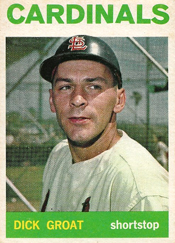
A power struggle within the front office nearly cost the Cardinals a chance to get the shortstop they needed to win a championship.

On Nov. 19, 1962, the Cardinals acquired shortstop Dick Groat and reliever Diomedes Olivo from the Pirates for pitcher Don Cardwell and shortstop Julio Gotay.

With his exceptional hitting and base running, Groat helped the Cardinals become World Series champions in 1964.

At the urging of manager Johnny Keane, Cardinals general manager Bing Devine made the trade over the objections of consultant Branch Rickey.

From a baseball perspective, Devine and Keane made the right move _ Groat was a key contributor to the Cardinals becoming contenders _ but it cost them. The trade widened a rift between Devine and Rickey, and Keane and Groat eventually had a falling out.

Terrific talent

Born and raised in the Pittsburgh area, Groat went to Duke University and became an all-America in baseball and basketball. A 5-foot-10 guard, he averaged 26 points and 7.6 assists per game as a senior for the basketball team.

Branch Rickey was the Pirates’ general manager when Groat signed with them in June 1952 and went directly from the Duke campus to the major leagues. Picked by the Fort Wayne Pistons in the first round of the NBA draft, Groat played in 26 games for them in the 1952-53 season, averaging 11.9 points.

After two years of military service, Groat chose to focus on baseball and resumed his big-league career with the Pirates in 1955.

The Pirates nearly traded Groat to the Athletics for Roger Maris in December 1959, but called off the deal at the last minute. The Athletics then swapped Maris to the Yankees. Groat won the National League Most Valuable Player Award in 1960, Maris was named the American League MVP, and the Pirates prevailed in the World Series against the Yankees.

Your move

On Oct. 7, 1962, Bob Broeg of the St. Louis Post-Dispatch broke the story that the Cardinals offered starting pitcher Larry Jackson to the Pirates for Groat.

Jackson led the 1962 Cardinals in wins (16) and innings pitched (252.1). Groat produced 199 hits, including 34 doubles, and batted .294 for the 1962 Pirates.

According to The Pittsburgh Press, the Pirates countered, offering backup shortstop Dick Schofield, a former Cardinal, but Devine and Keane were interested only in Groat.

When the Pirates dawdled, the Cardinals on Oct. 17 dealt Larry Jackson, Lindy McDaniel and Jimmie Schaffer to the Cubs for George Altman, Don Cardwell and Moe Thacker.

Pirates general manager Joe Brown admitted the swap of Jackson to the Cubs “surprised him” and he “didn’t know the trade was in the making,” The Sporting News reported, but he liked Cardwell as much as he did Jackson.

According to the Pittsburgh Post-Gazette, “Brown called Devine and said he thought there was still basis on which the clubs could make a trade.”

Power plays

While Devine was trying to acquire Groat, Cardinals owner Gussie Busch was on a business trip to Los Angeles and met with a friend, Bob Cobb, owner of the Brown Derby restaurant. Cobb suggested to Busch that he should hire Branch Rickey, 80, as a consultant, the Post-Dispatch reported. “He’ll help you win a pennant more than any other person could,” Cobb said to Busch.

The Cardinals hadn’t won a pennant since Busch bought the franchise in 1953 and he was tired of waiting. Acting on the advice of the restaurateur, Busch hired Rickey, who had built the Cardinals into a powerhouse before departing for the Dodgers in October 1942. In the consultant role, Rickey would advise Devine on player personnel matters and report to Busch.

In his autobiography, “The Memoirs of Bing Devine,” Devine said, “To be honest, I rather resented that Rickey was back … I was still in charge, but Rickey still had Busch’s ear.”

The relationship was rocky from the start. Rickey acted like he was Devine’s boss, and they disagreed on personnel matters.

Devine had gotten the Pirates to agree to trade Groat, 32, but Rickey thought the Cardinals would be better keeping Julio Gotay, 23, as their shortstop.

“Rickey hated giving up young players for veteran players,” Devine said in his book. “I had to set it up so that Rickey would approve the Groat deal and take it to Mr. Busch.”

At the Florida Instructional League in St. Petersburg, director of player development Eddie Stanky, coach Harry Walker and others joined Devine in approaching Rickey and making a case for Groat.

In his book, Devine recalled that Rickey said to him, “You’ve kind of loaded this meeting for me, haven’t you?”

Devine replied, “I know it looks like that way, but we need Groat to make this team go.”

After a long discussion, Rickey said, “I’ll talk to the boss … I’ll tell him you feel strongly about it and that he should do what he wants to do.”

Busch approved the trade for Groat, but Rickey wasn’t happy. “The Groat trade started cooling the relationship between Rickey and me,” Devine said in his book.

Getting it done

Though, as The Sporting News noted, “Groat still has the reputation of being the best hit-and-run man in the league,” he led National League shortstops in errors five times with the Pirates. Devine and Keane were hoping Groat’s knowledge of playing the hitters would compensate for the errors and a lack of range.

Pittsburgh Press sports editor Chester L. Smith wrote of Groat after the trade, “Maybe he has slowed up a half stride or so, perhaps his hands aren’t quite as sure as they once were, but he plays the hitters so well that he minimizes any loss of speed. He reminds you a great deal of Lou Boudreau when the artful codger was on the downside of the hill and was using his head to get the results his legs had produced in his youth.”

Groat said to Sports Illustrated, “I’m aware of my shortcomings. I’m not fast. I have limited range and my arm isn’t strong.”

As it turned out, Groat was everything Devine and Keane hoped he’d be for the 1963 Cardinals, who placed second with 93 wins, their most since 1949.

In the book “We Played the Game,” Groat said, “I went to St. Louis with the intention of showing Joe Brown that he made a very bad mistake trading me. In 1963, I had the best year of my career, a better year than in 1960. I hit the ball with more authority.”

Groat produced career highs in hits (201), doubles (43), triples (11), RBI (73) and on-base percentage (.377) for the 1963 Cardinals. He and teammates Bill White, Julian Javier and Ken Boyer were the starting infielders for the National League in the All-Star Game. “We were really proud of that because we were chosen by our peers, not the fans,” Groat told author Danny Peary.

In his autobiography “Stan Musial: The Man’s Own Story,” Musial said, “I’d learned to respect Dick playing against him, but not until I played with him my last year did I realize fully how smart and thorough he is … Groat and Bill White are the best players the Cardinals obtained by trade in my many years with the club.”

In his book “Few and Chosen,” Tim McCarver said of Groat, “I learned more about base running from him than from anybody else … I never saw anybody as good as Groat going from first to third. He did everything instinctively on the bases.”

Ken Boyer said to Sports Illustrated, “It adds to your confidence to have a player of Dick’s stature standing next to you.”

Plots and schemes

The underachieving Cardinals had a losing record at the all-star break in 1964 and a rift developed between Groat and Keane. Because of how well Groat could handle a pitch, Keane allowed him to call a hit-and-run play when he wanted to while batting. Eventually, Keane decided Groat abused the privilege and took it away. That angered Groat and he sulked. In his book “October 1964,” author David Halberstam wrote that Keane “saw Groat as a challenge to his control.”

At a team meeting in the clubhouse, Keane confronted Groat, accusing him of undermining the manager. Groat apologized, and the the matter appeared settled.

A month later, Gussie Busch learned of the incident from his daughter, who heard about it from the player she was dating, Braves third baseman Eddie Mathews. Petty and paranoid, Busch accused Devine of hiding the matter from him. Meanwhile, Rickey, on the outs with Devine, was advising Busch to get another general manager.

On Aug. 17, 1964, Busch fired Devine and replaced him with Rickey’s choice, Bob Howsam. Busch schemed to replace Keane with Leo Durocher after the season.

“That Groat situation was an issue,” Devine said in his autobiography, “but I don’t think that’s why Busch fired me. I really think it had more to do with us being so far back in August.”

Helped by Groat, who hit .282 in September and .417 in October, the Cardinals surged and won the National League pennant on the last day of the season. After prevailing in the World Series against the Yankees, Keane quit and became Yankees manager.

Groat hit .292 with 35 doubles and 70 RBI for the 1964 Cardinals but he also made a career-high 40 errors.

After the 1965 season, he was traded by Howsam to the Phillies.

Groat had 2,138 hits in 14 seasons in the majors and batted .302 against the Cardinals.

Read Full Post »

« Newer Posts - Older Posts »