Feeds:
Posts
Comments

Archive for the ‘Hitters’ Category

Roger Maris didn’t like being criticized. Rogers Hornsby didn’t like being snubbed. Subsequently, Maris and Hornsby didn’t like one another.

On March 22, 1962, in the usually relaxed setting of spring training, an impromptu encounter between Maris, the Yankees’ outfielder, and Hornsby, the Mets’ hitting coach, turned ugly before an exhibition game at St. Petersburg, Fla.

Maris, who broke Babe Ruth’s single-season home run record five months earlier, refused to pose for a photo with Hornsby, who holds the mark for top career batting average by a right-handed hitter.

The incident went public when Hornsby, stung by Maris’ disrespect, lashed out at him in comments to newspaper reporters.

Though eventually linked by their prominent roles in Cardinals championship success _ Hornsby was the manager and second baseman for the 1926 World Series champion Cardinals, and Maris was the right fielder on Cardinals World Series clubs in 1967 and 1968 _ their differences kept them apart.

Mantle fan

In 1961, when Maris and teammate Mickey Mantle were in pursuit of Ruth’s home run record, Hornsby, scouting big-league clubs for the Mets in Chicago, publicly supported Mantle because he considered him a better player than Maris.

“I told a writer that there was only one thing Maris could do better than the Babe _ that was run,” Hornsby said to The Sporting News. “I also said Mantle has all types of ability Maris doesn’t have. I said I’d like to see Mantle lead in home runs.”

In the book “Roger Maris: Baseball’s Reluctant Hero,” authors Tom Clavin and Danny Peary wrote that Maris “took it personally” when Hornsby criticized him.

Hornsby was a career .358 hitter who batted better than .400 in a season three times for the Cardinals and led the National League in hitting seven times. He preferred a player such as Mantle, who hit .317 with 54 home runs in 1961, to Maris, who batted .269 in 1961 and never hit .300 in the big leagues.

“I’ll give Maris credit for hitting all those homers,” Hornsby told The Sporting News, “but he has the advantage of playing in Yankee Stadium. He’s got the short right field there and he’s a right field hitter.”

Maris, who hit 31 of his 61 home runs away from Yankee Stadium in 1961, silently bristled at Hornsby’s remarks. Hornsby wasn’t alone in his criticism and, as spring training neared in 1962, Maris had heard enough.

“This stuff about not hitting for an average gets me,” he told The Sporting News. “Eighteen more hits would have brought me to .300. Lots of guys bloop in that many or more.”

Bad vibes

Mets manager Casey Stengel, 71, put Hornsby, 65, on his coaching staff in 1962. Stengel had managed the Yankees to seven World Series championships and 10 American League pennants before he was fired after the 1960 World Series.

When the defending World Series champion Yankees, featuring Maris and Mantle, came to St. Petersburg to play Stengel’s expansion team Mets in March 1962, it drew a lot of attention.

Joel Schrank, an enterprising photographer for United Press International, got the idea to pose the two rajahs, Hornsby and Maris. Schrank approached Hornsby, who agreed to the request. Hornsby grabbed a bat and followed Schrank to the Yankees dugout, where they found Maris.

According to the St. Petersburg Times, when Maris was asked to pose with Hornsby, he said to Schrank, “Why should I? He’s done nothing but run me down. He says I can’t hit.”

Maris turned his back on them and walked away, the Associated Press reported.

“That bush leaguer,” Hornsby said to The Sporting News. “I’ve posed for pictures with some major league hitters, not bush leaguers like he is. He couldn’t carry my bat.”

According to the Associated Press, Hornsby also called Maris a “little punk.”

By comparison, Hornsby told The Sporting News, Yankees first baseman Bill Skowron approached Stengel before the same game and asked him whether Hornsby could share advice about hitting.

“There were a few things he thought I could straighten out for him,” Hornsby said. “We talked for about 15 minutes. That’s the difference between a high-class fellow and a swelled-up guy.”

Regarding Hornsby, Maris said to the New York Daily News, “All last year I kept reading how he said I was a lousy hitter. So why should I pose with him? He says I’m a lousy hitter and a busher. Well, I think he is a lousy hitter, too _ that is, in my category, home runs.”

(Hornsby twice led the National League in home runs, with 42 in 1922 and 39 in 1925, and ranked in the top 10 in the league 14 times.)

Difference of opinions

New York Herald Tribune columnist Red Smith, who described Hornsby as the “mightiest of all National League hitters and the roughest right-handed bruiser in human history,” wrote that Hornsby was justified for being miffed by Maris’ slight.

Noting that Maris “has not yet learned to live with fame,” Smith advised the Yankees slugger to learn from the experience. “If, through stubbornness, he becomes embittered, it can warp what should be a productive professional life,” Smith cautioned.

Yankees manager Ralph Houk told The Sporting News that when he was a boy Hornsby “was sort of an idol,” but he said he disagreed with Hornsby’s characterization of Maris.

“He says Maris is a bush leaguer and a lousy .269 hitter. I know differently,” Houk said.

About three weeks after the incident, Hornsby’s book, “My War With Baseball,” was published.

In the chapter titled “There Won’t Be Any More .400 Hitters,” Hornsby said, “Maris, a left-handed hitter, is strictly a right field pull hitter … They didn’t pitch him very smart in 1961. Threw him too many inside pitches, which is all he’s looking for so he can pull the ball. He’ll never have a big average, let alone hit .400. He couldn’t hit .400 if he added all his averages together.”

(Maris remains the only big-league player to hit 61 home runs in a season without using performance-enhancing drugs. Barry Bonds, Mark McGwire and Sammy Sosa all hit more than 61 but needed steroids to do it, and attempted to cover up their fraud. The Cardinals rewarded McGwire, a career .263 hitter, for the revenue his flimflam generated for them by putting him alongside Hornsby in their club hall of fame. Imagine what Hornsby would say about that.)
Read Full Post »

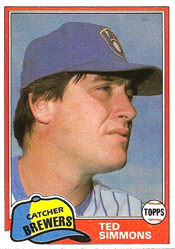
In his only opportunity to experience free agency, Ted Simmons had a chance to return to the National League with the Giants.

Instead, he decided to stay with the American League Brewers.
Compensation was an issue, but so was playing position. The Brewers planned to shift Simmons from catcher to designated hitter. The Giants, with no designated hitter rule in the National League, wanted Simmons to play first base.

Run producer

Simmons had a stellar season as a hitter for the Brewers in 1983, the year after they played the Cardinals in the World Series.

Starting 83 games at catcher and 66 games as designated hitter, Simmons had a career-high 108 RBI in 1983. He batted .308 and produced 185 hits.

According to The Sporting News, Simmons’ batting average in 1983 was the highest among all big-league switch-hitters who had enough at-bats to qualify for a batting title that season.

Simmons was a significant force in the clutch in 1983, hitting .373 with runners in scoring position and .500 (7-for-14) with the bases loaded.

After the season, Simmons, 34, became a free agent for the first time since he entered the majors with the Cardinals in 1968.

Simmons said he wanted to stay with the Brewers, who he joined when traded by the Cardinals in December 1980, but he also wanted to find out his value on the open market.

Establishing terms

Though the Brewers sought to keep Simmons for his bat, they wanted a defensive upgrade at catcher. In 1983, runners were successful on 82 of 116 stolen base attempts when Simmons was catcher. His backup, Ned Yost, threw out a mere eight of 65 runners trying to steal.

On Dec. 8, 1983, while Simmons was a free agent, the Brewers acquired six-time American League Gold Glove Award winner Jim Sundberg from the Rangers to be their catcher.

If Simmons wanted to return to the Brewers, it would be as a designated hitter. Simmons was OK with the role proposed for him, but he wanted a four-year contract and the Brewers were offering no more than three.

Simmons, who was negotiating without an agent, said seven teams besides the Brewers had been in contact with him, the San Francisco Examiner reported.

The Giants showed the most interest among the new suitors. Their first baseman, Darrell Evans, who hit 30 home runs in 1983, also had become a free agent and signed with the Tigers. The Giants viewed Simmons as a replacement for him.

“San Francisco still needs a first baseman and is making bids for Ted Simmons,” Tracy Ringolsby reported in the Kansas City Star.

In The Sporting News, Stan Isle wrote, “The Giants are said to be making a strong bid for Ted Simmons with the intention of playing him at first base.”

Making it work

If Simmons was hoping to use the Giants’ interest as leverage, the Brewers weren’t budging.

In early January, Simmons changed his contract terms when he met with Brewers general manager Harry Dalton, The Sporting News reported. Two weeks later, on Jan. 16, 1984, he and the Brewers agreed to a three-year guaranteed contract for $1 million per year, with a club option on a fourth year.

“Up until 10, 12 days ago, I was very concerned it wasn’t going to happen,” Simmons told The Sporting News. “I wanted a four-year guaranteed situation and it was a structure the organization could not live with. It was a concession I made.”

Dalton told the Associated Press, “He likes it here and we like .308 hitters.”

Simmons told The Sporting News, “Being a DH is something I’ve looked forward to.” Noting that he caught in excess of 100 games in 11 of his big-league seasons, Simmons said, “Even though at age 34 I think I could continue to do it, I think I’m at the point of my career where I don’t want to do it.”

End of the line

A month later, in February 1984, the Giants acquired Al Oliver, 37, from the Expos to be their first baseman. Oliver, who had two years left on a contract that paid $800,000 per year, hit .300 for the Expos in 1983 and led the National League in doubles for the second consecutive season.

On Opening Day in 1984, Oliver was the Giants’ cleanup hitter, batting between Jack Clark and Jeffrey Leonard. He hit .298 for them in 91 games, but was traded to the Phillies in August after the Giants fell to the bottom of the standings.

Simmons, like the Brewers, had a terrible season in 1984, hitting .221. It was the only season in his Hall of Fame career that he didn’t play a game as a catcher. He made 75 starts as a designated hitter, 37 at first base and 14 at third base. He hit .091 (1-for-11) with the bases loaded.

Simmons “lost all sense of the strike zone,” columnist Peter Gammons wrote in The Sporting News.

Like the Giants, the Brewers finished last in their division in 1984.

Simmons rebounded in 1985, the second year of his three-year deal with the Brewers. He had 144 hits and 76 RBI. He made 11 starts at catcher, 27 at first base, two at third base and 99 as designated hitter.

In March 1986, Simmons was traded to the Braves, and he spent his last three seasons with them, serving as a utility player and an unofficial coach for manager Chuck Tanner.

“I thoroughly enjoyed my five years in Milwaukee,” Simmons told Cardinals Magazine in 2020. “The people there are wonderful, a lot like you see in St. Louis. They’re down to earth, work hard, expect to be paid, and they love their baseball.”

Read Full Post »

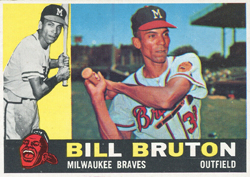
After giving Curt Flood a chance at the center field job, the Cardinals decided they needed an upgrade at the position. The player they wanted was Bill Bruton.

A left-handed batter, Bruton became the Braves’ center fielder in 1953 and helped transform them into National League champions in 1957 and 1958. 
In December 1960, the Cardinals made multiple offers for Bruton, including one that likely involved trading Bob Gibson.

Impact player

Bruton got his start in pro baseball when his father-in-law, future Hall of Fame third baseman Judy Johnson, put out the word about him, The Sporting News reported. Bruton was 24 when Braves scout Johnny Ogden signed him in 1950.

Bruton made an impact his first season in the minors, swiping 66 bases for Eau Claire. The next year, he had 27 triples for Denver.

“I’ve seen no player in baseball today who is as fast as Bruton,” Braves scout Walter Gautreau told The Sporting News.

With Class AAA Milwaukee in 1952, Bruton totaled 211 hits and scored 130 runs.

Before the 1953 season, the Braves relocated from Boston to Milwaukee and Bruton was named their Opening Day center fielder.

Splendid start

The Braves began the 1953 season at Cincinnati. Bruton, 27, had a dazzling debut. Batting leadoff, he had two hits, a stolen base and scored a run.

Described by the Cincinnati Enquirer as a “mercury-footed” outfielder who covered center “like the morning dew,” Bruton made six putouts, “two of them only short of sensational.”

“In the third inning, he leaped high in front of the center field seats to take what looked like a surefire double away from Willard Marshall,” the Enquirer reported. “He repeated the performance at the expense of Bobby Adams in the ninth.” Boxscore

The Braves took a flight to Milwaukee after the game and were greeted at the airport by 1,500 admirers, according to United Press.

Heroics at home

The next day, in their first regular-season home game since moving from Boston, the Braves played the Cardinals, and Bruton again was sensational.

In the eighth inning, with the score tied at 1-1, the Cardinals had two on and two outs when Stan Musial drove a Warren Spahn pitch into left-center. Bruton made a running catch, depriving Musial of a two-run double.

In the bottom half of the inning, the Braves had two outs and none on when Bruton, described by The Sporting News as the “Jesse Owens of the baselines,” hit an inside fastball from Gerry Staley over the head of right fielder Enos Slaughter for a triple. Sid Gordon’s single scored Bruton, giving the Braves a 2-1 lead.

The Cardinals tied the score in the ninth.

Batting with one out and none on in the 10th, Bruton got a knuckleball from Staley. “Man, it just hung there,” Bruton told the Associated Press.

Bruton drilled the pitch to deep right. According to the St. Louis Post-Dispatch, Slaughter “ran back to the waist-high wire fence, reached up and almost made the catch, but as his fingers began to close on the ball, his elbow struck sharp prongs protruding from the wire barrier.”

The impact jarred the ball loose and it dropped over the fence for a home run, Bruton’s first in the majors. It also turned out to be his only home run of the season and his only walkoff home run in 12 years in the big leagues. Boxscore

As Bob Broeg of the Post-Dispatch noted, Bruton’s dramatics made him “as popular in Milwaukee as beer and cheese.”

Multiple talents

Bruton was the Braves’ center fielder for eight years (1953-60). Hank Aaron, who joined the Braves in 1954, was his outfield teammate for seven of those seasons.

The Braves won the pennant in 1957 but Bruton sat out the World Series because of a knee injury. The next year, when the Braves repeated as National League champions, Bruton had a .545 on-base percentage in the World Series, reaching base 12 times (seven hits and five walks) in 22 plate appearances.

Bruton led the National League in stolen bases three times: 1953 (26), 1954 (34) and 1955 (25).

In 1960, Bruton, 34, had one of his best seasons, leading the league in runs scored (112), triples (13) and assists by a center fielder (11). He also ranked fourth in hits (180).

The Braves, though, had been searching for a second baseman ever since Red Schoendienst came down with tuberculosis, and general manager John McHale decided Bruton’s trade value would bring an experienced infielder.

Determined to deal

The Cardinals preferred Bruton to Flood.

In three seasons as Cardinals center fielder, Flood’s batting average and on-base percentage decreased every year: 1958 (.261 batting average, .317 on-base percentage), 1959 (.255 and .305) and 1960 (.237 and .303). He also had a mere two stolen bases in both 1958 and 1959, and none in 1960.

“We’ve been interested in Bruton for some time,” Cardinals general manager Bing Devine told the Post-Dispatch.

According to The Sporting News, the Cardinals offered their shortstop, Daryl Spencer, for Bruton. Spencer had been a second baseman with the Giants.

When the Braves reacted unenthusiastically, the Cardinals approached the Phillies about making a three-way trade with the Braves.

According to the Associated Press, the Braves were interested in Phillies second baseman Tony Taylor and reliever Turk Farrell. In exchange, the Phillies wanted outfielder Wes Covington from the Braves, and first baseman Joe Cunningham and pitcher Bob Gibson from the Cardinals, the Philadelphia Daily News reported. Bruton would go to the Cardinals.

(Later that month, the Cardinals offered Gibson to the Senators for Bobby Shantz.)

According to The Sporting News, the three-way deal “went down the drain” when the Phillies “stepped up their demands.”

“We wanted to make a deal,” Cardinals manager Solly Hemus said, “but it wound up with the Phillies wanting too many of our established players. We would have had to give up four or five, and would have gotten one or two.”

The Cardinals tried again to interest the Braves in a swap of Spencer for Bruton. “The Braves began to warm up to his possibilities,” The Sporting News reported, but then the Tigers entered the picture.

Flood is the answer

When the Tigers proposed dealing second baseman Frank Bolling to the Braves for Bruton, talks with the Cardinals ceased. Braves general manager John McHale had been general manager of the Tigers and he was an admirer of Bolling.

“When I was at Detroit, I thought Bolling was just as valuable to the club as Harvey Kuenn or Al Kaline,” McHale told The Sporting News.

To ensure the Tigers didn’t waver, McHale sweetened the deal. On Dec. 7, 1960, the Braves traded Bruton, catcher Dick Brown, infielder Chuck Cottier and pitcher Terry Fox for Bolling and a player to be named, outfielder Neil Chrisley.

According to the Sporting News, Hemus contacted Tigers manager Bob Scheffing and asked whether the Tigers would flip Bruton to the Cardinals, but was told no.

Don Landrum, acquired from the Phillies in September 1960, opened the 1961 season as the Cardinals’ center fielder. The Cardinals also tried Don Taussig and Carl Warwick there.

In July, Hemus was fired and replaced by Johnny Keane, who committed to Flood in center. Flood rewarded Keane’s confidence by hitting .324 in July, .330 in August and .355 in September. He went on to be the center fielder on Cardinals clubs that won three league championships and two World Series titles.

Read Full Post »

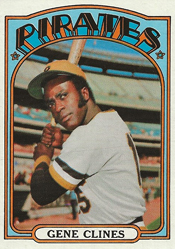
A clever bit of baserunning by Gene Clines fooled Cardinals center fielder Jose Cruz and helped the Pirates to a comeback victory.

An outfielder who played 10 seasons (1970-79) in the majors, primarily with the Pirates and Cubs, Clines hit for average and ran well.

He was especially effective against the Cardinals. A career .277 hitter in the majors, he batted .316 versus the Cardinals.

Hit and run

A right-handed batter, Clines was 19 when he was picked by the Pirates in the sixth round of the 1966 amateur baseball draft. He reached the majors with Pittsburgh in June 1970.

In his first three big-league seasons, Clines, used mostly as a backup outfielder and pinch-hitter, batted .405 in 31 games in 1970, .308 in 97 games in 1971 and .334 in 107 games in 1972.

Clines figured he’d earned a shot to be a starter. “All He Does Is Bat .300,” declared a headline in The Sporting News.

What he didn’t do was hit home runs. He totaled one in his first three big-league seasons.

The Pirates went to spring training in 1973 with outfield openings in right and left.

Clines was bypassed for both.

Pirates manager Bill Virdon chose a catcher, Manny Sanguillen, to be the Pirates’ 1973 Opening Day right fielder, replacing the late Roberto Clemente, and a first baseman with creaky knees, Willie Stargell, to play left.

“It seems like they don’t have any plans for me,” Clines said to The Pittsburgh Press.

Virdon explained that playing Stargell in left opened a spot at first for another slugger, Bob Robertson. Virdon said he liked Sanguillen in right because he threw better than Clines and was a better run producer.

“A home run and RBI man can give the team more of a boost,” Virdon told The Pittsburgh Press. 

Timely triple

The Pirates opened the 1973 season at Pittsburgh against the Cardinals. St. Louis led, 5-2, until the Pirates scored five runs in the eighth inning.

Batting for pitcher Jim Rooker, Clines’ triple against Diego Segui drove in the tying and go-ahead runs. Clines hit the ball into the gap in left-center. Lou Brock attempted a backhanded grab, but the ball bounced off his glove.

“That ball was catchable,” Brock said to The Pittsburgh Press. “When it hits off the glove like that, you’ve just got to hang on.”

Cardinals manager Red Schoendienst told the St. Louis Post-Dispatch, “You got to make those plays if you’re going to win.” Boxscore

Faked out

Two days later, in their second game of the season, the Cardinals led the Pirates, 3-2, in the bottom of the ninth.

With one out and none on, Clines batted for pitcher Nelson Briles and singled against starter Rick Wise. Rennie Stennett followed with a single to center.

Center fielder Jose Cruz gloved the ball just as Clines rounded second base. “No one in the stadium, particularly Jose Cruz, expected Clines to go to third,” The Pittsburgh Press reported.

Clines did what he called “a little stutter step” and appeared to be applying the brakes.

“A magnificent decoy,” Bob Smizik of The Pittsburgh Press observed.

Cruz dropped his arms. When Clines saw that, he shifted into high gear, bolted toward third and got there without drawing a throw.

“Cruz appeared befuddled, not knowing where to throw the ball,” Al Abrams of the Pittsburgh Post-Gazette noted. “He could have thrown out the fleet Clines by 10 feet had he been thinking.”

Schoendienst told the Post-Dispatch, “If he throws to third, the runner has to stop at second.”

Virdon, a center fielder before becoming Pirates manager, said, “You don’t make any money holding the ball out there.”

Cruz explained to the Pittsburgh Post-Gazette, “I heard Brock yelling, ‘Third base,’ but I thought it would be too late.”

Clines said to The Pittsburgh Press, “It’s a gamble, but I don’t think about being thrown out.”

Big run

The significance of Clines’ daring dash was illustrated when the next batter, Sanguillen, lofted a fly ball to medium right-center.

If Clines had held at second, Sanguillen’s fly ball would have been a harmless second out and the Cardinals still would have led by a run.

With Clines at third, Sanguillen’s fly ball became a scoring opportunity.

Stennett, thinking the ball might drop for a hit, moved part way toward second. Cruz, sensing he might nab Stennett, looked to first base, but no one was on the bag. First baseman Joe Torre had moved to the center of the diamond to cut off a throw if Stennett attempted to continue to second.

When Cruz hesitated, “I thought I could make it,” Clines told The Pittsburgh Press.

He raced toward the plate and easily beat Cruz’s throw, scoring the tying run.

In the 10th, Bob Robertson belted a home run against Wayne Granger, giving the Pirates a 4-3 victory. 

Asked about Cline’s performances, Virdon told the Post-Gazette, “You know, I think Gene is trying to give me some kind of message.”

Clines told The Sporting News, “I just want to remind them that I’m here and can do the job.” Boxscore

Gene the machine

Sanguillen eventually returned to catching, and Clines became the right fielder on June 15, but a month later he tore ligaments in his right ankle and was replaced by Richie Zisk.

Clines, who was hitting .291 before the injury, finished at .263 for the season, but he batted .368 against the Cardinals. It was one of four seasons in which Clines hit better than .360 versus the Cardinals. The others were 1971 (.361), 1975 (.364) and 1978 (.368).

In that 1978 season, when he was with the Cubs, Clines had a .500 on-base percentage against the Cardinals, getting seven hits and five walks in 24 plate appearances.

Clines was productive versus two of the era’s best pitchers _ Bob Gibson and Tom Seaver. He had the same career batting average against each (.364), producing four hits in 11 at-bats versus Gibson and the same versus Seaver.

On Sept. 1, 1971, Clines, the center fielder, was part of the first big-league starting lineup of all African-American and Hispanic players. Boxscore and Video interview

After his playing days, Clines coached for 20 years in the majors with five clubs _ Cubs, Astros, Mariners, Brewers and Giants.

Read Full Post »

Great expectations followed David Green from Nicaragua to the United States, creating golden opportunities along with a multitude of pressures.

Green had successes, but his drinking held him back, and his recklessness had devastating consequences.

Dad’s influence

Green’s father, Eduardo Green, was an outfielder on the Nicaraguan national teams in the 1940s and 1950s. Nicknamed “The Black Gazelle,” Eduardo was described by sportswriter Edgard Tijerino as having “the soul of a ballet dancer” and “the reflexes of a panther,” according to the Society for American Baseball Research.

In 1951, Eduardo joined the Dodgers at their minor-league spring training camp in Daytona Beach, but left because of the racism he encountered in Florida.

Eduardo and Bertha Green had 10 children. One of their five sons, David, was born in Managua, Nicaragua, and named in honor of his paternal grandfather, a missionary who immigrated from Jamaica.

Like his father, David Green developed into an exceptional athlete. “Soccer was my best sport,” he told the San Francisco Examiner.

He played baseball, too, and Eduardo advised him to pursue a career in the sport.

Prime prospect

David Green was playing for the Nicaraguan national team in 1978 when he caught the attention of Ray Poitevint, the Brewers’ director of scouting and player development. “He’s got Willie Mays’ physical abilities,” Poitevint told the Milwaukee Journal Sentinel.

Green was 17 when he signed with the Brewers in September 1978.

“He has all the tools _ not only to be a big-league player, but a big-league star,” Poitevint said to The Sporting News. “If you were a betting man, you would have to bet on this kid.”

Eduardo Green died in September 1980. His son had just completed his second season in the Brewers’ farm system and was rated their top prospect.

Whitey Herzog, Cardinals manager and general manager, envisioned Green as a center fielder who could become the centerpiece of the team.

The Brewers wanted to make a trade, but were reluctant to give up Green. 

In the book “You’re Missin’ a Great Game,” Herzog said, “He was so good that some of the Brewers executives damn near came to blows over giving him up.”

Years later, Herzog told Rick Hummel of the St. Louis Post-Dispatch that he’d heard from a Brewers scout that Green had a drinking problem, but Herzog wanted him anyway.

In his book “White Rat: A Life in Baseball,” Herzog said, “He was absolutely the key to the deal.”

On Dec. 12, 1980, the Cardinals traded two future Hall of Famers, Ted Simmons and Rollie Fingers, and a future Cy Young Award winner, Pete Vuckovich, to the Brewers for Green, Dave LaPoint, Lary Sorensen and Sixto Lezcano.

“I had a little buyer’s remorse afterward,” Brewers general manager Harry Dalton told the Milwaukee Journal Sentinel. “I wondered if I had done the right thing.”

Ups and downs

Promoted to the Cardinals in September 1981, Green was the first National League player born in Nicaragua. The first in the American League was Orioles pitcher Dennis Martinez in 1976.

Green, 20, got his first big-league hit, a single, against the Pirates’ Luis Tiant, 40. Boxscore

At spring training in 1982, Green “probably was the Cardinals’ best player in camp,” The Sporting News reported, and he won the center field job.

“He had more raw ability than any young player I’ve ever managed,” Herzog said in “White Rat.” Video

Green, 21, began the 1982 season with a flourish, hitting .381 in April. His batting mark was at .316 on May 7 when he tore a hamstring.

While Green was on the disabled list, Willie McGee took over in center. McGee did so well he kept the job when Green returned.

The Cardinals sent Green to the minors for two months so that he could play every day. He was back with the Cardinals for their pennant push.

In the pivotal Game 2 of the National League Championship Series against the Braves, Green led off the ninth inning with a single, moved to second on a bunt and scored the winning run on Ken Oberkfell’s hit. Boxscore

Facing the Brewers in the World Series, Green had two hits, a double and a triple, in Game 5 versus Mike Caldwell. Boxscore

Dealing with change

At spring training in 1983, Herzog told The Sporting News, “We’ve got to find a place for Green. It’s almost a must.”

Toward the end of spring training, McGee separated a shoulder and began the season on the disabled list, opening a starting spot for Green in the outfield.

In June, after first baseman Keith Hernandez was traded, Herzog moved right fielder George Hendrick to first and Green took over in right.

Two months later, Green told the Post-Dispatch that an older brother, Edward, was jailed in Nicaragua. In September, Green’s mother, Bertha, and a younger brother, Enrique, joined him in the U.S.

Green led the 1983 Cardinals in triples (10) and had 34 stolen bases.

Wrong direction

Just before the start of spring training in 1984, Green’s mother died. That is when “Green’s downfall began,” the Post-Dispatch noted.

Herzog moved Hendrick back to right field and started Green at first base. In May, Green went into a funk. “He’s really gone downhill the last two or three weeks,” Herzog told The Sporting News. “His reactions were not good. Balls (thrown to him) were hitting him on the wrist.”

The Cardinals suspected Green’s drinking was to blame and convinced him to enter a rehabilitation center in St. Louis.

In “White Rat,” Herzog said, “The young man developed a real problem with alcohol. Everybody on the club knew it. He’d show up late, hung over real bad … His tolerance for booze was about zero.”

Green spent three weeks in the rehabilitation center. He told the Post-Dispatch, “I didn’t need to go, but I went anyway because somebody had to do it.”

Herzog told the Post-Dispatch, “He didn’t give himself much of a chance. You spend only 10 or 12 days there and you’re not going to be cured.”

In “You’re Missin’ a Great Game,” Herzog recalled an incident that occurred soon after Green completed his rehabilitation stint.

“I’m driving home from the ballpark and I end up a couple of car lengths behind him on the highway,” Herzog said. “He doesn’t see me. I’m keeping a safe distance. Pretty soon, here come the beer cans flying out of the car. One right after the other, every five minutes. We drove past the hospital where he did rehab. More cans!

“When they get hooked on this stuff, they turn into con artists. They’re conning themselves, and they expect you to swallow their bull, too.”

Moving on

In February 1985, in a deal that put them back on the championship track, the Cardinals traded Green, Dave LaPoint, Jose Uribe and Gary Rajsich for Jack Clark.

“Of all the players I’ve had the opportunity to manage, David Green has more ability than anyone as far as hitting, hitting with power, speed and throwing arm,” Herzog told The Sporting News after the deal. “Garry Templeton and George Brett are in that category, but Green has more power than either, he runs better than either, and he throws better than George.”

Asked about his time with the Cardinals, Green told the San Francisco Examiner, “They were expecting too much of me and then they didn’t play me. Sometimes they called me the franchise, then they played Andy Van Slyke. I think I did great in the outfield, then they moved me to first base.”

The Giants started Green at first base but he had a dreadful beginning to the 1985 season. His batting average on May 11 was .080.

“It’s a matter of concentration,” Giants hitting coach Tom McCraw told the Examiner. “I tell him something in the dugout, and he says, ‘Yeah,’ and by the time he gets to the plate he’s forgotten it.”

The Giants traded Green to the Brewers after the season, but he was released at the end of spring training in 1986.

Comeback try

After playing in Japan and Mexico, Green contacted the Cardinals and asked for a tryout with the Class AAA Louisville club.

Green signed in July 1987, hit .356 for Louisville and was called up to the Cardinals, who were contending for a division crown, in September.

The Cardinals projected him to compete for an outfield spot in 1988.

“This is my last chance,” Green told The Sporting News, “and I’m trying to take advantage of it.”

He was only 27 when he arrived at spring training in 1988, though speculation had swirled for years that his December 1960 birthdate was inaccurate.

In the book “Whitey’s Boys,” Herzog said, “David might have been a couple of years older than we thought he was. I don’t know anybody who has ever seen his birth certificate from Nicaragua.”

Cardinals general manager Dal Maxvill said to the Post-Dispatch, “He might be anywhere between 28 and 32, but I don’t care if he is 32, if he does the job.”

Green’s bid to make the Opening Day roster failed. Sent back to Louisville, he hit .216, clashed with manager Mike Jorgensen and was waived in June 1988.

Fatal accident

Seven years later, in January 1995, Green was arrested on suspicion of drunk driving in a car accident in suburban Country Club Hills, Mo. 

According to the Post-Dispatch, a passenger in the car Green struck, Gladys Yount, 85, of Jennings, Mo., suffered a fractured pelvis in the accident and died of a heart attack two hours later.

Green was charged with involuntary manslaughter and served six months in jail, the Post-Dispatch reported.

He went on to help operate a dog grooming business in south St. Louis and was a youth baseball instructor.

Read Full Post »

Alex Cora appealed to the Cardinals as a potential player-coach in Mike Matheny’s first season as manager.

On Feb. 7, 2012, Cora signed a minor-league contract with the Cardinals, who invited him to spring training to compete for a spot on their Opening Day roster.

The defending World Series champions were seeking an experienced utility infielder, and Cora’s resume met the requirements. He also was interested in transitioning into a coaching role, and the Cardinals thought he could begin to hone those skills by mentoring their young infielders, including Matt Carpenter.

As it turned out, the Cardinals released Cora, 36, before the start of the regular season, bringing an end to his playing days but opening a multitude of new paths, both rewarding and treacherous, in his baseball career.

Learning to lead

Born and raised in Puerto Rico, Alex Cora was 11 when his brother, second baseman Joey Cora, 21, made his debut in the majors with the Padres in 1987. Joey played 11 years in the majors with the Padres, White Sox, Mariners and Indians before becoming a big-league coach.

During Joey’s time as a White Sox player (1991-94), he introduced a teen-age Alex to Hall of Fame shortstop Luis Aparicio, and the team’s shortstop then, Ozzie Guillen. Aparicio and Guillen became role models, Alex told the Boston Globe.

Alex enrolled at the University of Miami and helped the baseball team reach the College World Series three times.

Regarding Cora’s college career, Alex Speier of the Boston Globe noted, “He wasn’t a standout athlete or a great hitter, yet he proved a difference-maker on the field, someone whose game awareness produced outs on defense as well as timely hits in the batter’s box.

“Cora projected a confidence that spread to teammates and defined him as a leader _ someone who was unafraid to communicate with teammates in both English and Spanish _ by the time he was a sophomore, a stature that continued to grow as a junior.”

Making the majors

Alex began his professional career with the Dodgers, who chose him in the third round of the 1996 amateur baseball draft.

On June 7, 1998, when Alex made his big-league debut for the Dodgers, it came in Seattle against the Mariners, whose second baseman was his brother, Joey. Boxscore

Alex had stints as the Dodgers’ starter at shortstop (2000-01) and at second base (2003-04). He played against the Cardinals in the 2004 National League Division Series.

Granted free agency in December 2004, Alex was pursued by the Cardinals, who needed a second baseman after Tony Womack departed for the Yankees, but they lost interest when Alex sought a multiyear contract. The Cardinals instead went with Mark Grudzielanek, and Alex signed with the Indians.

The Indians, who had Ronnie Belliard at second and Jhonny Peralta at shortstop, traded Alex to the Red Sox in July 2005. Playing for manager Terry Francona, Alex excelled in a utility role and was a member of the Red Sox’s World Series championship team in 2007. Francona told Dan Shaughnessy of the Boston Globe, “He was tremendous. He was a manager-in-waiting.”

After four years (2005-08) with the Red Sox, Alex played for the Mets (2009-10), Rangers (2010) and Nationals (2011). In 2009, he also played for Puerto Rico, managed by the Cardinals’ Jose Oquendo, in the World Baseball Classic.

Short stay

According to the St. Louis Post-Dispatch, “Cora had considered retiring to start a career in coaching,” but when the Cardinals made him an offer in February 2012, he couldn’t refuse.

Alex, who played all four infield positions, seemed an ideal fit for the Cardinals. General manager John Mozeliak said Alex also would provide “an on-field coach” during spring training.

Derrick Goold of the Post-Dispatch noted, “Cora is highly regarded within the game for his instincts, and the Cardinals see him as help for some of the less experienced infielders.”

That group included Matt Carpenter, Daniel Descalso and Tyler Greene.

The 2012 Cardinals shared a spring training facility with the Marlins in Jupiter, Fla. While Alex was making a bid for a roster spot with the Cardinals, his brother Joey was serving as a coach on the staff of Marlins manager Ozzie Guillen.

The brothers took advantage of the chance to connect in their spare time.

Alex told the Miami Herald, “It’s been great being able to sit down together and just have dinner. Our father died in 1988. When you lose your dad when you’re a young kid, your big brother becomes everything for you. This is the most time we’ve been able to spend together since we were kids in Puerto Rico.”

The Post-Dispatch described it as “something of a surprise” when the Cardinals released Alex on March 25.

With Skip Schumaker on the disabled list because of a rib injury, Daniel Descalso opened the 2012 season as the Cardinals’ second baseman, and Matt Carpenter and Tyler Greene were the reserve infielders.

Success and shame

For the next five years (2012-16), Alex was general manager of a team in the Puerto Rican winter league. He also managed the team for two seasons and did TV work for ESPN.

In 2017, Alex was bench coach on the staff of Astros manager A.J. Hinch. The Astros won their first World Series title that year.

Hired by the Red Sox to be their manager, Alex led them to the 2018 World Series championship.

After the 2019 season, it was revealed that the 2017 Astros and 2018 Red Sox used technology to steal the signs relayed to players by opposing teams.

For his role in the scandal, Alex was suspended for the 2020 season by baseball commissioner Rob Manfred. When the suspension ended, the Red Sox rehired him as manager. “I am sorry for the harm my past actions have caused,” Alex said.

Read Full Post »

« Newer Posts - Older Posts »