Feeds:
Posts
Comments

Archive for the ‘Hitters’ Category

Johnny Bench could have ended his playing career as a member of the Cardinals, but turned down the chance.

In June 1983, the Cardinals contacted the Reds with a trade offer for Bench. According to the Cincinnati Enquirer, the Cardinals were willing to send first baseman Keith Hernandez to the Reds for Bench and starting pitcher Frank Pastore.

Cardinals manager Whitey Herzog envisioned playing Bench at first base and third base against left-handed pitching. “We inquired about Bench,” Herzog confirmed to the St. Louis Post-Dispatch.

Good try

Bench, 35, was the Opening Day third baseman for the Reds in 1983 and Alex Trevino was the catcher. Bench was destined for election to the Baseball Hall of Fame as a catcher, but hadn’t played the position regularly since 1980. Bench was a Reds first baseman in 1981 and their third baseman in 1982.

On June 10, 1983, Bench said he would retire from playing after the season. When Bench informed Reds management of his decision, “he was asked if he would consider going to another club,” the Dayton Daily News reported.

According to the Cincinnati Enquirer, “They offered him the chance to continue his career with the St. Louis Cardinals.”

Reds general manager Dick Wagner explained to Bench that the Cardinals had called with the trade offer. The Cardinals were the defending World Series champions and were contending again in 1983, leading the East Division on June 10. The Reds were in last place in the West.

Joining the Cardinals would enable Bench to be involved in a pennant chase in his final season, but he “politely declined,” the Cincinnati Enquirer reported.

“I wouldn’t sacrifice my association with Cincinnati to go to St. Louis for two or three months,” said Bench, who played his entire career with the Reds.

Later that season, when Bench and Herzog exchanged lineup cards before a game, Herzog said Bench asked, “Just where did you plan to use me if you got me?” Herzog replied, “We’d been vulnerable to left-handed pitching. I’d have used you against them.”

Bench strength

Herzog was looking to trade Keith Hernandez because the relationship between the two had deteriorated. Herzog said Hernandez was loafing during games.

Bench appealed to Herzog because of his ability to play multiple positions and he could hit. A right-handed batter with power, Bench hit .282 in April and .298 in May for the 1983 Reds.

“He has given me everything he has,” Reds manager Russ Nixon told The Sporting News. “He’s one veteran who has run out every ground ball.”

If the Cardinals had obtained Bench, Herzog could play him at first base against left-handers, and shift Dane Iorg or Andy Van Slyke from the outfield to first base versus right-handers. Bench also could play third base against left-handers, substituting for Ken Oberkfell, a left-handed batter. in 1983, Bench batted .284 versus left-handers.

The Cardinals wanted Frank Pastore in the deal to add to a starting rotation with Joaquin Andujar, Bob Forsch, John Stuper and Dave LaPoint. “We’ve been talking about him since spring training,” Herzog told the Post-Dispatch.

Pastore was 5-0 versus the Cardinals in his career.

Keith Hernandez would have provided a significant upgrade to the Reds in the field and at the plate. Dan Driessen (.277) ended up leading the 1983 Reds in batting and Ron Oester had the most RBI (58).

When Bench turned down the Cardinals, they traded Hernandez to the Mets for pitchers Neil Allen and Rick Ownbey. Herzog moved George Hendrick from right field to first base for the remainder of the season.

Delivering drama

Three months after the trade talk, the Reds were in St. Louis for the final time that season. Before the series finale on Sept. 4, Cardinals players presented Bench with a gold-plated golf putter as a retirement gift. Cardinals management gave him a plaque featuring an illustration by Post-Dispatch artist Amadee.

In the eighth inning, the Cardinals led, 4-1, when the Reds got two runners on base with one out against Joaquin Andujar. Bruce Sutter relieved and fanned Gary Redus for the second out. Rookie right fielder Dallas Williams was up next, but Bench was sent to bat for him.

Bench swung at Sutter’s first pitch, a split-fingered fastball, and pulled it into foul territory along the line in left.

As left fielder Lonnie Smith gave a futile chase, Cardinals catcher Glenn Brummer yelled, “Catch the ball, catch the ball,” Bench said to the Cincinnati Enquirer.

“(Brummer) told me, ‘You’ll hit that pitch out if you get it again,’ ” Bench recalled.

Sutter’s next delivery was another split-fingered pitch and Bench slammed it over the wall in left for a three-run home run, tying the score at 4-4.

“When I crossed the plate,” Bench said, “I told (Brummer), ‘You were right.’ “

The Cardinals came back with a run in the ninth and won, 5-4, but the story of the game was Bench’s home run in his final Busch Memorial Stadium plate appearance.  Boxscore

The home run was the 388th of his career. It was Bench’s only hit versus the Cardinals in 10 at-bats against them that year. For his career, Bench hit .247 versus the Cardinals with 24 home runs and 85 RBI. Those were the fewest home run and RBI totals he had versus any team.

On Sept. 17, when the Reds held Johnny Bench Night at Riverfront Stadium, Bench started at catcher in a game for the final time. In the third inning, he hit his last home run, a two-run shot against the Astros’ Mike Madden. Boxscore and Video

Read Full Post »

The Brewers nearly added a fourth future Hall of Famer to the formidable lineup that challenged the Cardinals in the 1982 World Series.

In December 1981, the Phillies were prepared to deal Ryne Sandberg to the Brewers, but their offer was rejected. A month later, Sandberg was traded to the Cubs.

If the Brewers had taken Sandberg, he would have joined a batting order with three other future Hall of Famers _ Paul Molitor, Ted Simmons and Robin Yount _ along with run producers such as Cecil Cooper, Ben Oglivie and Gorman Thomas.

Trade chip

At the 1981 baseball winter meetings in Hollywood, Fla., the Phillies sought starting pitchers to add to a rotation of Steve Carlton, Larry Christenson and Dick Ruthven. First, they acquired Mike Krukow from the Cubs. Then they looked for one more starter.

The Phillies were offering a package of prospects, with Sandberg, 22, being a centerpiece. As the shortstop for Class AAA Oklahoma City in 1981, Sandberg hit .293 with 32 stolen bases.

In addition to shortstop, Sandberg could play second base, third base and center field, but the Phillies felt they were flush at those positions. They had Larry Bowa at shortstop, Mike Schmidt at third base, Manny Trillo at second and Garry Maddox in center.

Also, another shortstop prospect, Julio Franco, 23, had impressed in 1981, hitting .301 with 27 stolen bases at Class AA Reading, and the Phillies were looking to make room for him.

“The Phillies are particularly enthusiastic about Franco’s chances of becoming a top-flight big league shortstop,” the Philadelphia Inquirer reported.

As for Sandberg, “Ryne is a good prospect,” Phillies general manager Paul Owens said to the Wilmington (Del.) News Journal, “but we never felt he would play regularly for us.”

The Phillies included Sandberg in trade talks for starting pitchers Dave Stieb of the Blue Jays, Floyd Bannister of the Mariners and Mike Scott of the Mets, but came up empty, the Wilmington (Del.) Morning News reported.

Something brewing

The Phillies also approached the Brewers about starting pitcher Mike Caldwell. The Phillies initially offered outfielder Bake McBride, pitcher Marty Bystrom and infielder Luis Aguayo, the Philadelphia Inquirer reported, “but the Brewers were haggling for the inclusion of Sandberg.”

Because the Phillies had offered Sandberg in other trade proposals, it surprised some that it became “a large point of contention among people in the organization” whether to include him in a deal with the Brewers for Caldwell, according to the Philadelphia Inquirer.

“Everybody wants him, but he’s too good,” Phillies president Bill Giles said. “We figure his value is going to be much higher in a year.”

As the winter meetings neared an end, “the Phillies were wavering on throwing Sandberg back onto the market,” the Philadelphia Inquirer noted. “They knew that, if they did, they could have Caldwell.”

According to the Philadelphia Daily News, the Phillies proposed sending Sandberg, Marty Bystrom and catching prospect Don McCormack to the Brewers for Caldwell. “For a while, they thought they had that deal made,” the Daily News reported.

According to Hal Bodley in his reporting for the Wilmington (Del.) Morning News and The Sporting News, the Phillies’ offer was Sandberg, McCormack and pitching prospect Jon Reelhorn for Caldwell.

In his response to the Phillies, Brewers general manager Harry Dalton said, “Substitute Julio Franco and it’s a deal.”

The Phillies said no.

Picture this

If the Brewers had obtained Sandberg, he might have replaced Jim Gantner as their second baseman in 1982, when they won the American League pennant and opposed the Cardinals in the World Series. 

Managed by an American League batting champion, Harvey Kuenn, who replaced Buck Rodgers in June 1982, the Brewers’ hitters were called “Harvey’s Wallbangers,” because, like the classic cocktail, they were potent.

Three 1982 Brewers had more than 200 hits: Robin Yount (210), Cecil Cooper (205) and Paul Molitor (201). Each of those three also scored more than 100 runs. Four of the 1982 Brewers had more than 95 RBI: Cooper (121), Yount (114), Gorman Thomas (112) and Ted Simmons (97). The club’s top home run hitters were Thomas (39), Ben Oglivie (34) and Cooper (32).

Adding Sandberg to that lineup takes it to another level, but it might not have been enough to offset the loss of Mike Caldwell to the starting rotation.

Caldwell became a 17-game winner for the 1982 Brewers. He got two more wins in the World Series. Without Caldwell, the Brewers likely would have added Jim Slaton to an Opening Day rotation of Pete Vuckovich, Moose Haas, Randy Lerch and Bob McClure.

My kind of town

During contract negotiations in January 1982, shortstop Larry Bowa had a falling out with Phillies management.

Dallas Green, who had been the Phillies’ manager before becoming general manager of the Cubs, offered to deal shortstop Ivan DeJesus for Bowa and Sandberg. The Phillies tried to expand the deal, asking for reliever Lee Smith as well as DeJesus, but Green held firm.

“They think it’s heavy, but I don’t think so,” Green told the Philadelphia Daily News. “I won’t trade Ivan even-up for any shortstop and they know that … They have to make a decision on Sandberg. If they say OK, the deal is done.”

The trade of Bowa and Sandberg to the Cubs for DeJesus was made on Jan. 27, 1982.

In his book, “White Rat: A Life in Baseball,” Cardinals manager Whitey Herzog said Green “robbed his old club in a deal I’m still jealous of … I’d seen Sandberg play in the minor leagues and I knew Dallas had a sleeper.”

The 1982 Cubs’ Opening Day lineup had Bump Wills at second base and Sandberg, who replaced Ken Reitz, at third. Sandberg completed the season with 172 hits in 156 games. He also scored 103 runs and had 32 stolen bases.

After the 1982 season, Wills went to Japan and Sandberg shifted to second base.

Sandberg had 35 home runs and 122 RBI against the Cardinals in his career. His signature game occurred on June 23, 1984, when he had five hits, including a pair of home runs against Cardinals closer Bruce Sutter, and seven RBI. Boxscore and Video

When Sandberg became a free agent in 1996, the Cardinals pursued him before opting for Delino DeShields as their second baseman.

Sandberg remained with the Cubs and was elected to the Baseball Hall of Fame, but he never played in a World Series, an opportunity he may have gotten if the Brewers had accepted the Phillies’ 1981 trade offer.

Read Full Post »

(Updated June 9, 2024)

The Cardinals weren’t looking to trade for outfielder Lonnie Smith. The deal fell into their laps.

On Nov. 19, 1981, the Cardinals obtained Smith in a three-way trade with the Indians and Phillies. The Indians sent catcher Bo Diaz to the Phillies for Smith and a player to be named (pitcher Scott Munninghoff). The Indians then swapped Smith to the Cardinals for pitchers Lary Sorensen and Silvio Martinez.

Smith and another outfield newcomer, Willie McGee, became the catalysts of the Cardinals’ offense, igniting the team’s run to the 1982 National League pennant and World Series championship.

Mix and match

Whitey Herzog, who had the dual role of Cardinals manager and general manager, sought to swap two unhappy players, shortstop Garry Templeton and outfielder Sixto Lezcano, after the 1981 season. Herzog wanted a shortstop and starting pitcher in return.

Neither the Indians nor the Phillies seemed a likely trade partner for the Cardinals. The Indians wanted pitching and the Phillies needed a catcher. Neither was looking for Templeton or Lezcano.

Bo Diaz of the Indians was the catcher the Phillies coveted. Phillies scout Hugh Alexander rated Diaz “the best-throwing catcher in the major leagues,” the Philadelphia Daily News reported. Phillies manager Pat Corrales, a former catcher, managed Diaz during winter baseball in Venezuela and viewed him as a successor to Bob Boone.

The Indians, who had catchers Ron Hassey and Chris Bando, were willing to trade Diaz, but the Phillies didn’t have the pitching needed to get him.

An offer you can’t refuse

A pitcher the Indians wanted was Lary Sorensen, who was 7-7 with a 3.27 ERA for the 1981 Cardinals. Sorensen had seasons of 12, 15 and 18 wins for the Brewers before being traded to the Cardinals in December 1980.

Indians general manager Phil Seghi “has long been a fan of” Sorensen, The Sporting News reported, “and continually pestered the Cardinals” about dealing him. The Indians didn’t have what it took to get Sorensen from the Cardinals, but the Phillies suggested a creative solution. They thought the Cardinals would like Lonnie Smith.

The Cardinals were solid in right field with George Hendrick, but planned to try rookie David Green in center in 1982 and go with a platoon of Dane Iorg and Tito Landrum in left.

The Phillies, figuring Smith would be an upgrade for the Cardinals in either center or left, suggested sending Smith to the Indians for Diaz, and, in turn, the Indians would swap Smith to the Cardinals for Sorensen.

In his book, “White Rat: A Life in Baseball,” Herzog said Phil Seghi called Cardinals assistant general manager Joe McDonald and asked whether the club would be interested in Lonnie Smith.

McDonald relayed the message to Herzog: “(Seghi) says he needs pitching more than he needs Lonnie Smith, and you can have him for Silvio Martinez and Lary Sorensen.”

Herzog replied, “Get (Seghi) on the phone and make that deal right now.”

“All we gave up was two guys who didn’t figure to pitch much for us anyway,” Herzog said. “It’s deals like that which make you look like a genius.”

As good as advertised

In Philadelphia, the trade “provoked a firestorm of fan outrage that lit the Phillies’ switchboard like the White House Christmas tree,” the Philadelphia Daily News reported. Smith was “the club’s most explosive young offensive player.”

Smith finished the 1981 season with a 23-game hitting streak. The year before, he batted .339 with 33 stolen bases for the World Series champions. The Phillies planned to replace him with rookie Bob Dernier.

Though “shocked and disappointed” to be traded, Smith said to the Philadelphia Daily News, “I’m glad to go to a team that can beat the Phillies.”

After acquiring Lonnie Smith, the Cardinals traded Templeton and Lezcano to the Padres and got another important player, shortstop Ozzie Smith, and starting pitcher Steve Mura.

Lonnie Smith settled into left field for the Cardinals and Willie McGee, called up from the minors in May to replace injured David Green, became the center fielder.

The 1982 Cardinals won the National League East Division title, finishing three games ahead of the runner-up Phillies, and Smith had a lot to do with it. He led the league in runs scored (120). He also led the Cardinals in hits (182), doubles (35), stolen bases (68), batting average (.307) and total bases (257).

In the 1982 World Series, when the Cardinals prevailed in seven games versus the Brewers, Lonnie Smith batted .321 with nine hits, including four doubles and a triple, and six runs scored. Video

“Lonnie was a very tough ballplayer, very good hitter,” Herzog told Cardinals Magazine. “Below average defensively, below average arm, but … a good offensive player. He could bust up the double play as good as anybody in the league.”

When left fielder and speedster Vince Coleman emerged as a force for the Cardinals, Lonnie Smith was traded to the Royals in May 1985.

Though he battled cocaine addiction, Lonnie Smith went on to play 17 seasons in the majors and appeared in a total of five World Series _ one each for the Phillies, Cardinals and Royals, and two with the Braves.

Read Full Post »

(Updated July 31, 2023)

In a game that brought together the three best National League hit producers _ Hank Aaron, Pete Rose and Stan Musial _ the most prominent catcher of the era started in center field.

On May 17, 1970, Johnny Bench was the Reds’ center fielder in the second game of a doubleheader against the Braves at Cincinnati. For Bench, the National League’s Gold Glove-winning catcher, it was the first time he played the outfield in a major-league game.

Bench fielded flawlessly and hit a home run, helping the Reds complete a doubleheader sweep, but the spotlight was on Aaron, who got his 3,000th career hit in the game. 

Musial, the retired Cardinals’ standout and the last player before Aaron to achieve 3,000 hits, was in the stands to witness the feat, and Rose, who would become baseball’s all-time hits leader, was in right field that day for the Reds.

Hot ticket

With Sparky Anderson in his first season as their manager, the Reds won 13 of their first 17 games in 1970. Entering the Sunday doubleheader on May 17, the Reds were 25-10 and five games ahead of the second-place Braves.

A combination of the Reds’ hot start and the chance to possibly see Aaron get his 3,000th hit generated a big turnout at Crosley Field. Swelled by 4,000 standing room-only tickets sold, the doubleheader drew 33,217 spectators, the Reds’ largest home crowd since 36,961 came out for a Sunday doubleheader versus the Pirates on April 27, 1947.

The Braves were playing at Crosley Field for the last time. When they next returned to Cincinnati to open a series on June 30, the Braves were the Reds’ first opponent in the new Riverfront Stadium.

Special support

Aaron got his 2,999th career hit on Saturday afternoon, May 16, at Crosley Field. Musial wanted to be present when Aaron got No. 3,000. Wearing a blue suit, Musial, 49, arrived at the Cincinnati airport at 10:48 on Sunday morning, May 17, stopped to get his shoes shined and headed to Crosley Field.

At 11:55 a.m., Aaron and Musial posed for pictures inside the clubhouse. “They laughed and swapped stories about baseball,” the Atlanta Constitution reported.

As Aaron headed to the field for batting practice, Musial took a front-row box seat next to Braves owner Bill Bartholomay.

In Game 1, Aaron went hitless in four at-bats against Jim Merritt. Bench caught all nine innings and had a RBI in the 5-1 Reds victory. Boxscore

Bold move

Bench, 22, entered Game 2 of the doubleheader with 10 home runs and 30 RBI for the young season. Wanting to keep Bench’s bat in the lineup but not wanting him to catch two games in one day, Sparky Anderson looked to shift Bench to another position in Game 2.

Bench had started three games at first base in place of an ailing Lee May in April, but the Braves were starting a left-hander, George Stone in Game 2, and Anderson wanted all of his right-handed sluggers, Bench, May and third baseman Tony Perez, in the lineup. The Reds’ regular center field, ex-Cardinal Bobby Tolan, batted left.

Bench’s favorite player as a youth was Yankees center fielder and fellow Oklahoman Mickey Mantle, so when Anderson suggested Bench play center field in Game 2, he got an enthusiastic response.

“This sort of fulfills a boyhood dream,” Bench told the Cincinnati Enquirer.

Anderson said, “I believe Bench can play anywhere and do a major-league job. I was going to play him in right field, but he said he has trouble with balls curving away from him. In center, everything is hit straight at you, so he shouldn’t have any trouble.”

Magic moment

The Reds’ starting outfield in Game 2 was Hal McRae in left, Bench in center and Pete Rose in right. Ex-Cardinal Pat Corrales was their catcher. The Reds’ starting pitcher, rookie Wayne Simpson, was 5-1 with a 2.05 ERA.

Aaron, 36, got his 3,000th hit when he faced Simpson, 21, in the first inning. Aaron’s grounder was scooped on the shortstop side of second by second baseman Woody Woodward, who couldn’t make a throw. Felix Millan scored from second on the play. Video

As the crowd gave Aaron a standing ovation, Musial vaulted over the railing in front of his seat and joined him at first base. Photographers snapped pictures of the only living 3,000-hit players.

According to the Dayton Daily News, Musial said to Aaron, “It’s a thrill for me to be here and see this.”

Aaron replied, “I really appreciate your taking the time to come from St. Louis to Cincinnati for this.”

In his autobiography, “I Had a Hammer,” Aaron said, “I was proud to be joining a man I admired so much and pleased to carry on his tradition.”

Musial was playing left field the night Aaron got his first hit in the majors. It came against the Cardinals’ Vic Raschi on April 15, 1954, at Milwaukee.

After witnessing Aaron get his 3,000th hit, Musial told the Cincinnati Enquirer, “Right after I got my 3,000 hits (the milestone came in May 1958), I was playing against the Braves. I was standing around the batting cage and I told Henry he’d be the next man to reach 3,000. It wasn’t too hard to predict. He looked like a great hitter, he could run, and you could see he wasn’t the kind of player who would be injured often.”

Elite group

Hit No. 3,000 for Aaron came in the 2,460th game of his career.

Aaron was the ninth player with 3,000 hits. The others: Cap Anson, Ty Cobb, Tris Speaker, Honus Wagner, Eddie Collins, Nap Lajoie, Paul Waner and Musial.

Aaron was the first to get 3,000 hits and 500 home runs.

Two innings after his 3,000th hit, Aaron hit his 570th home run, a two-run shot against Simpson.

“If he hits like this now,” Simpson said to the Dayton Daily News, “how did he hit 10 years ago? I’m glad I wasn’t pitching then.”

After the game, Aaron told the Atlanta Constitution that Willie Mays and Pete Rose were the most likely to next reach 3,000 hits.

Rose, who played his entire career in the National League, went on to become baseball’s all-time leader in hits (4,256). Cobb, an American Leaguer, is second at 4,189. Aaron ranks third (3,771) and Musial is fourth (3,630).

Aaron had 3,600 hits as a National League player with the Braves and 171 as an American Leaguer with the Brewers. Thus, the top three in career hits in the National League are Rose (a switch-hitter), Musial (who batted left) and Aaron (who batted right).

Versatile and durable

Almost overlooked in the drama surrounding Aaron was the play of Bench in center. He had no problems fielding the position, but in the ninth inning, with the score tied at 3-3, Bench went back to catching and Tolan took over in center.

After the Braves scored three times in the top of the 10th, the Reds rallied against Ron Kline, an ex-Cardinal. Tony Perez stroked his fifth hit of the game, and Bench and Lee May followed with home runs, tying the score at 6-6.

The game reached the 15th inning before 19-year-old rookie Don Gullet, who pitched two scoreless innings, drove in the winning run for the Reds with a single. Boxscore

Nine days later, against the Padres at San Diego, Bench started in center field for the second and last time. Boxscore

In 15 total innings as a center fielder, Bench made three putouts and no errors.

Bench made 17 outfield starts _ eight in left, seven in right and two in center _ in 1970, plus five starts at first base.

In 17 seasons in the majors, Bench made 1,627 starts at catcher, 182 at third base, 98 at first base and 96 in the outfield.

In the book “Season Ticket,” Cardinals catcher Ted Simmons told author Roger Angell that as a catcher “Bench was picture perfect. A marvelous mechanical catcher. There’s no better.”

Read Full Post »

In a decision that impacted the course of baseball broadcasting, the Braves rejected a chance to acquire Mike Shannon from the Cardinals for Bob Uecker.

During spring training in 1964, the Cardinals were in the market for a backup catcher and the Braves were seeking a reserve outfielder.
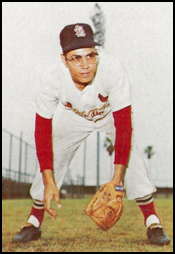
The Cardinals targeted Uecker because of his strong arm, quick release and defensive skills. To get him, they offered the Braves their choice of an outfielder _ Shannon or Gary Kolb. The Braves picked Kolb.

If the Braves had taken Shannon, he likely wouldn’t have contributed as he did to Cardinals clubs that won two World Series championships and three National League pennants in the 1960s.

If Shannon hadn’t had a prominent role as a Cardinals player, he likely wouldn’t have gotten the opportunity to become a team broadcaster.

As it turned out, Uecker, with the Brewers, and Shannon, with the Cardinals, built successful careers as broadcasters and continued in those roles into their 80s.

Outfield glut

After being called up from the minors to the Cardinals during the 1962 and 1963 seasons, Shannon was looking to be on their Opening Day roster in 1964.

Shannon had lots of competition for one of the six outfielder spots. The favorites to open the season as outfield starters were Charlie James in left, Curt Flood in center and Carl Warwick in right, The Sporting News reported.

Competing with Shannon for backup jobs were Doug Clemens, Ron Cox, Gary Kolb, Johnny Lewis, Bobby Tolan, Corky Withrow and Don Young.

As spring training neared its end, the Cardinals settled on Clemens and Lewis for two of the three reserve outfield spots. Clemens and Lewis batted left-handed, giving the Cardinals the chance to platoon them with James and Warwick.

The last outfield spot came down to Kolb and Shannon.

What the Cardinals needed was a backup to catcher Tim McCarver. The Cardinals had Jim Coker and Dave Ricketts as candidates, but were looking for an upgrade.

Uecker, who had spent parts of the 1962 and 1963 seasons with the Braves, was available because he was third on the depth chart behind Joe Torre and Ed Bailey.

Easy choice

The Cardinals offered Coker and an outfielder for Uecker.

“We had a choice of Gary Kolb or Mike Shannon,” Braves general manager John McHale told the St. Louis Post-Dispatch.

Kolb produced a .403 on-base percentage (26 hits, 22 walks) with the 1963 Cardinals. He also batted .500 (9-for-18) against the Braves that year. Shannon batted .308 (eight hits) for the 1963 Cardinals. “We asked 15 people, some with the Braves and others who were friends of mine in baseball, which one they preferred,” McHale said. “It was 14-to-1 in favor of Kolb.”

McHale said Walter Shannon, a former Cardinals farm director who had joined the Indians’ scouting staff, cast the lone vote for Mike Shannon. A couple of St. Louis natives, Walter and Mike were not related, but those Shannons stuck together.

Taking advantage

The trade of Uecker to the Cardinals for Kolb and Coker was made on April 9, five days before the Cardinals opened the season.

Cardinals consultant Branch Rickey rated Kolb a top prospect and opposed the deal made by general manager Bing Devine. According to the book, “October 1964,” when Uecker was introduced to Rickey in the Cardinals’ clubhouse, Rickey replied, “I didn’t want you. I wouldn’t trade 100 Bob Ueckers for one Gary Kolb.”

Uecker, though, gave the 1964 Cardinals the defense they desired. He threw out 38 percent of runners attempting to steal. By comparison, McCarver’s rate was 29 percent. Uecker also contributed a game-winning hit against the Braves in the pennant stretch.

Shannon hardly played early in the 1964 season. He had three at-bats and struck out each time. The Cardinals sent him to their Jacksonville farm club in early May. Called back to the majors in July, Shannon took over in right field and drove in 43 runs in 88 games. He also hit a home run against Yankees ace Whitey Ford in Game 1 of the World Series.

Kolb hit .188 with no home runs in 64 at-bats for the 1964 Braves and was traded to the Mets in July 1965.

Read Full Post »

Sparky Anderson had a hand in convincing the Cardinals to stick with Julian Javier as their second baseman.

In March 1965, the Cardinals were considering trading Javier, their second baseman since 1960. Anderson, three weeks into his job as a manager in the Cardinals’ farm system, spoke up at an organizational staff meeting and advocated for keeping Javier.

Anderson’s assessment wasn’t the sole reason Cardinals general manager Bob Howsam didn’t trade Javier, but it was a contributing factor.

Until he joined the Cardinals that month, Anderson hadn’t worked with Howsam. The discussion about Javier gave Howsam the chance to see how Anderson evaluated talent and how he expressed himself when offering opinions that were contrary to others in the organization.

It was the start of a strong working relationship. Five years later, when Howsam was general manager of the Reds, he hired Anderson to be the Cincinnati manager, launching him on a path to a Hall of Fame career.

Performance review

Julian Javier was part of the all-Cardinals National League starting infield in the 1963 All-Star Game, and he helped the Cardinals become World Series champions in 1964.

Bing Devine, the Cardinals’ general manager when Javier was acquired from the Pirates in 1960, was replaced by Howsam in August 1964. Naturally, Howsam began making his own evaluations of the roster.

Javier produced a career-high 65 RBI in 1964 and reached double figures in home runs (12) for the first time, but he batted .241 and his on-base percentage of .282 was awful. Javier also made a career-high 27 errors. After the season, while playing winter baseball in the Dominican Republic, Javier lost control of his emotions and punched umpire Emmett Ashford.

Some within the Cardinals’ organization concluded Javier might be more of a liability than an asset. Internal options to play second base included a couple of local candidates, Jerry Buchek and Dal Maxvill. When a hip injury prevented Javier from being able to play in the 1964 World Series, Maxvill started all seven games at second base and didn’t commit an error.

Dinner conversation

Sparky Anderson got fired after managing minor-league Toronto in 1964 and was selling cars at a dealership in Los Angeles. Anderson wanted to get back into baseball, and when the manager of the Cardinals’ farm club at Rock Hill, S.C., suddenly resigned on the eve of spring training in 1965, Anderson got the job.

In his third week with the Cardinals at spring training, Anderson went to dinner with farm director Sheldon “Chief” Bender, minor-league manager George Kissell and scout Mo Mozzali.

In his book, “The Main Spark,” Anderson said, “There was a lot of conversation about Julian Javier. They were talking about the possibility of dealing Hooley to another club before the start of the season.”

Anderson asked his dinner companions, “Does he have good range?” Probably the best in the league among second basemen, he was told.

“Does he throw well?,” Anderson asked. The best of the second basemen in the league, came the response.

“Does he make the double play?” Anderson wanted to know. Again, the answer was he was the best at it in the National League.

“Then why the hell are you talking about trading him?,” Anderson said.

According to Anderson, his colleagues said Javier was inclined to be lazy and loafed a bit.

In his book, Anderson said he told the group if Javier did so many things well, “but was a little on the lazy side, the organization should be able to find someone who can handle him and get the most out of him. A club should have a better reason for trading a good player than the fact he dogs it a little.”

No to yes men

The next day, Howsam led an organizational staff meeting in the Cardinals’ spring training clubhouse. Joining Howsam were Bender, Cardinals manager Red Schoendienst, his coaches, Mozzali and all of the club’s minor-league managers.

After Schoendienst talked about the big-league roster, Howsam called on Mozzali, who raised the topic of trading Javier. In the middle of his remarks, Mozzali said, “Mr. Howsam, at dinner last night, Sparky here had some opinions that I think you might want brought out to all of us.”

As a newcomer to the organization, Anderson was surprised to be called out to express an opinion about a prominent player. In his book, Anderson said, “I was petrified.”

“Yes, I’d like to hear his opinion,” Howsam replied.

Anderson said he “sort of apologized” and explained his comments were intended as casual dinner conversation, but Howsam repeated that he’d like for Anderson to share his views.

“So I told him what I’d told the others, emphasizing that it didn’t seem logical to want to trade the No. 1 man at a position for that reason,” Anderson said. “Why not try to find somebody who could motivate him?”

Howsam thanked Anderson for his perspective.

Javier remained the Cardinals’ second baseman.

“Not that I believe I had that much influence at that stage,” Anderson said in his book, “but the point is Howsam is a listener. He’ll hear any man’s opinion. He doesn’t always go with your recommendation, but he’ll hear you out, then make up his own mind.”

Javier helped the Cardinals win two more pennants and another World Series title. In the 1967 World Series, when the Cardinals prevailed against the Red Sox, Javier batted .360, hit a three-run home run in Game 7 and fielded splendidly, making 12 putouts and contributing 20 assists.

Howsam was gone from the Cardinals by then. He left in January 1967 to become general manager of the Reds. Anderson, still managing at the Class A level in the Cardinals’ system, departed after the 1967 season to manage a Class AA club with the Reds.

After coaching for the Padres in 1969, Anderson was hired by Howsam to manage the Reds.

In March 1972, Howsam acquired Javier from the Cardinals. Used as a utility player by Anderson, Javier completed his playing career by helping the Reds win the 1972 National League pennant.

Read Full Post »

« Newer Posts - Older Posts »