The Cardinals had visions of a lineup featuring Ken Griffey Jr. and Mark McGwire.
In November 1999, the Cardinals sought to acquire Griffey from the Mariners.
Though Griffey was swapped to the Reds instead, the Cardinals’ pursuit of him was sincere.
Deal me out
After the 1999 season, Griffey, nearing his 30th birthday, told the Mariners he wanted to be traded to a team closer to his home in Orlando, Fla.
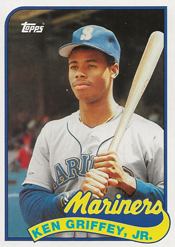 Griffey, a center fielder who won 10 Gold Glove awards and four times led the American League in home runs with the Mariners, was eligible to become a free agent in another year.
The Mariners offered him an eight-year contract worth about $140 million, but Griffey rejected it. Unable to keep him beyond 2000, the Mariners opted to trade him rather than lose him to free agency.
Griffey, who debuted with the Mariners when he was 19, had the right to approve or reject any proposed trade. According to the St. Louis Post-Dispatch, Griffey’s first choice was to go to Atlanta, “but the Braves decided a deal wouldn’t fit their situation.”
If the National League champion Braves weren’t interested, the Associated Press speculated, the Reds and Mets were the leading contenders. Though Griffey was born in Donora, Pa., the same hometown as Cardinals icon Stan Musial, he grew up in Cincinnati, where his father played as an outfielder on the Big Red Machine teams of the 1970s. Ken Griffey Sr. was a Reds coach in 1999.
Twin towers
The Cardinals were intrigued with the idea of acquiring Griffey and putting him in a lineup with McGwire, who in his two full seasons with St. Louis hit 70 and 65 home runs. Griffey twice hit 56 home runs in a season (1997 and 1998) and slugged 48 in 1999.
“We’ve discussed it with the owners and we’re going to look into it,” Cardinals general manager Walt Jocketty told the Post-Dispatch. “We’re going to at least take a look at it to see if we can do it realistically. It might be very tough to do, but people thought we were crazy when we traded for McGwire.”
A few days later, at the general managers meetings in California, Jocketty and manager Tony La Russa met McGwire for dinner and asked him whether he would like the Cardinals to obtain Griffey, who would get a more lucrative contract than the one McGwire had, the Post-Dispatch reported.
“He thought it was great,” Jocketty said.
No go
According to the Seattle Times, the Cardinals were one of four teams “having serious discussions” with the Mariners about Griffey. The others were the Reds, Mets and Astros.
“The Cardinals might be on the short list of teams entertaining serious dreams of obtaining superstar Ken Griffey Jr.,” the Post-Dispatch reported.
The Mariners “would be certain to ask” for pitcher Rick Ankiel, the Seattle Times reported, but the Post-Dispatch declared, “Jocketty isn’t likely to give him up in any trade.”
According to the Post-Dispatch, the Cardinals might consider dealing to the Mariners some combination of third baseman Fernando Tatis, outfielder J.D. Drew, second baseman Adam Kennedy and pitcher Chad Hutchinson.
Eventually, the Mariners’ asking price was too high and the Cardinals backed off.
“We’ve had a couple of discussions, but player-wise it was going to be too rich for us,” Jocketty said. “They were looking for a killing on this deal.”
At the baseball winter meetings in December 1999, the other suitors for Griffey also broke off talks with the Mariners. Refusing to include infielder Pokey Reese in a trade for Griffey, Reds general manager Jim Bowden said, “There’s no chance at all” for a deal.
A month later, the Reds and Mariners resumed trade talks. The Reds insisted a deal would be contingent on Griffey agreeing to a long-term contract and giving up his chance to become a free agent after the 2000 season.
On Feb. 10, 2000, after Griffey accepted a nine-year contract proposal worth $116.5 million, the Mariners traded him to the Reds for four players, including outfielder Mike Cameron and pitcher Brett Tomko.
A month later, on March 23, 2000, the Cardinals acquired Jim Edmonds from the Angels to be their center fielder.
 Noren was an outfielder for 11 seasons in the major leagues, including five (1952-56) with the Yankees and three (1957-59) with the Cardinals.
 On Nov. 21, 1969, the Cardinals dealt right fielder
 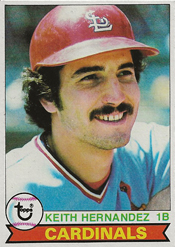 The link became even stronger on Nov. 13, 1979, when it was announced they would share the National League Most Valuable Player Award, finishing in a tie for first place in balloting by the Baseball Writers Association of America (BBWAA).
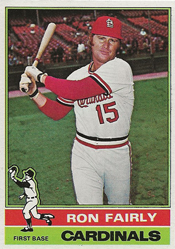 A first baseman and outfielder, Fairly played 21 years (1958-78) in the major leagues, primarily with the Dodgers and Expos, and spent two seasons (1975-76) with the Cardinals. He played in four World Series for the Dodgers, including 1965 when he batted . 379 against the Twins.
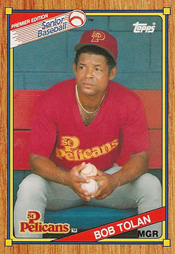 On Nov. 1, 1989, the Senior Professional Baseball Association launched its inaugural season. Each of the eight teams played a 72-game schedule from November to February in Florida.
 RetroSimba