Eddie Waitkus fought in combat in World War II, returned home to resume a major-league baseball career and found himself in another life-and-death struggle against a determined foe.
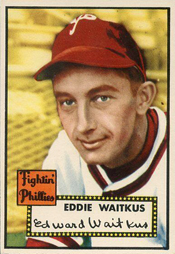 On June 14, 1949, Waitkus, 29, was shot in the chest by a deranged admirer, 19-year-old Ruth Steinhagen, in a Chicago hotel room.
Waitkus, a Phillies first baseman, was seriously wounded, underwent six operations, survived and came back the following season to be a key contributor for the National League champions.
His story inspired the Bernard Malamud novel, “The Natural,” in 1952, a fictionalized account featuring a protagonist, Roy Hobbs, who is shot by a mysterious woman. The 1984 film, “The Natural,” starring Robert Redford as Hobbs, was based on the novel, but, unlike the book, featured a happy ending.
Real life wasn’t so kind to Waitkus.
Athlete and soldier
Eddie Waitkus was the son of Lithuanian immigrants who settled in Cambridge, Mass. He was an honor student and standout athlete who excelled at baseball.
Waitkus was mentored by Jack Burns, a Cambridge native who played first base in the American League for the Browns and Tigers. Like Burns, Waitkus hit consistently well from the left side and developed into a sure-handed fielder.
In 1938, while playing semipro baseball, Waitkus was named to an all-America team, prompting a Boston sports writer to hail him as a “natural,” according to the Society for American Baseball Research.
The Cubs signed Waitkus after giving him a tryout in September 1938. After two years in the minors, Waitkus, 21, made his big-league debut as the starting first baseman for the Cubs on Opening Day in 1941.
After returning to the minors with the 1942 Los Angeles Angels, where, according to “Memories and Dreams,” the magazine of the Baseball Hall of Fame, Waitkus doubled for Gary Cooper in the movie “The Pride of the Yankees,” he began a three-year hitch in the Army in 1943. An amphibious engineer, he experienced extensive combat in the Pacific, narrowly escaped being taken prisoner by the Japanese and earned four bronze stars.
Waitkus returned to the Cubs after the war and was their first baseman from 1946-48. He hit .304 in 1946, .292 in 1947 and .295 in 1948, when he was selected to the National League all-star team.
Dangerous obsession
Ruth Ann Steinhagen was born in Cicero, Ill., and grew up in a Chicago household with her parents, who were German immigrants, and a sister. As a teen-ager, Steinhagen became infatuated with actor Alan Ladd and Cubs outfielder Peanuts Lowrey. In 1947, when she was 17, she turned her attention to Waitkus.
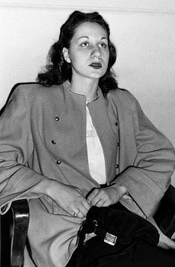 Steinhagen built a shrine to Waitkus in her bedroom, talked about him constantly and regularly bought tickets for seats near first base at Wrigley Field. “I used to go to all the ballgames just to watch him,” Steinhagen informed a court-appointed psychiatrist.
Steinhagen waited outside the Cubs’ clubhouse after games to get a glimpse of Waitkus, but they never met and never had contact.
“She has been crazy about Eddie for about three years and she had hundreds of pictures of him,” Steinhagen’s mother, Edith, told the Associated Press. “She used to spread them out on the table and even on the floor and look at them for hours.”
Steinhagen told International News Service, “I liked Eddie because he was clean-cut and I liked the way he played baseball. I was in love with him.”
Steinhagen’s mother urged her “to seek the help of a psychiatrist,” the Chicago Tribune reported. Steinhagen consulted with two, but her behavior didn’t change. Her father, Walter, a die setter, “tried to persuade her to forget Waitkus,” according to the Tribune, but his suggestions upset her.
Steinhagen received a jolt on Dec. 14, 1948, when the Cubs traded Waitkus to the Phillies. A month later, in January 1949, she left her parents’ house, moved into an apartment, which she filled with mementoes of Waitkus, and worked as a typist for an insurance company.
In early May 1949, Steinhagen said, she decided to kill Waitkus. She told her mother and a friend of her intentions, according to United Press, but they didn’t believe her.
“I guess I got the idea to shoot him because he reminded me of my father,” Steinhagen said.
According to the New York Times, Steinhagen also said, “I was building in my mind the idea of killing him. As time went on, I just became nuttier and nuttier about the guy. I knew I would never get to know him in a normal way, so I kept thinking, I will never get him, and if I can’t have him, nobody else can. Then I decided I would kill him.”
Intent to kill
Aware the Phillies were headed to Chicago to play the Cubs, Steinhagen went to a pawn shop and paid $21 for a .22-caliber rifle. She told the pawnbroker she needed the gun for protection. He showed her how to disassemble the weapon and put it back together.
Steinhagen reserved a room at the Edgewater Beach Hotel, where the Phillies stayed, and registered as Ruth Anne Burns of Boston.
Steinhagen told police she got the rifle into the hotel by separating it into two parts. “I wrapped the parts in newspaper and put them in my traveling bag and brought it into the hotel,” she said.
She also brought with her a paring knife featuring a 3.5-inch blade.
“I was planning to stab him,” Steinhagen said. She intended to use the gun to commit suicide.
In her hotel room, Steinhagen reassembled the rifle, loaded it with one cartridge and placed it in a closet.
Fateful day
On June 14, 1949, the Phillies played the Cubs at Wrigley Field. Waitkus had a single, a walk and scored twice in the Phillies’ 9-2 triumph. The Tuesday afternoon game drew 7,815 spectators, including Steinhagen. Boxscore
After the game, she went to the hotel room. Waitkus went to a restaurant to have dinner with friends. While he was out, Steinhagen tipped a bellhop $5 and asked him to deliver a note to Waitkus.
Her plotting completed, Steinhagen ordered two whiskey sours and a daiquiri from room service, settled in with her drinks and waited for Waitkus to respond.
When Waitkus returned to the hotel, the bellhop informed him a woman left a note for him at the front desk. The unsigned note asked Waitkus to come to Room 1297-A. “It’s extremely important that I see you as soon as possible … I have something of importance to speak to you about,” Steinhagen wrote. “I think it would be to your advantage to let me explain it to you.”
“It was cleverly written to attract interest without arousing suspicion,” Dr. O. Spurgeon English, head of the Department of Psychiatry at Temple University, told the Philadelphia Inquirer.
Waitkus asked a desk clerk to tell him who was registered in Room 1297-A. When informed it was Ruth Anne Burns of Boston, Waitkus wondered whether it might be a relative of his hometown baseball mentor, Jack Burns.
Waitkus joined teammates Bill Nicholson and Russ Meyer for a drink at the hotel bar, showed them the note and decided to act “out of curiosity.”
Violent meeting
Waitkus called Steinhagen’s room at about 11 p.m.
“I had started to fall asleep when the phone rang and a voice said, ‘What’s this all about?’ It was Eddie,” Steinhagen said to International News Service. “I told him it was important I see him but could I see him tomorrow. He said he couldn’t make it and I said, ‘How about tonight?’ ”
Waitkus agreed to come to the room in 30 minutes. When he arrived about 11:30, he knocked on the door. Steinhagen opened and asked him to enter. She was holding a purse containing the knife.
Waitkus entered the room briskly, startling Steinhagen and giving her no time to reach for the knife. He walked toward a far corner and sat down in an armchair.
“I might not have shot him if he had come in differently without so much confidence,” Steinhagen said to United Press. “He swaggered in.”
As Waitkus settled into the chair, Steinhagen reached into the closet for the rifle, pointed it at him and told him to stand near the window, the Chicago Tribune reported.
“I thought at first it was a practical joke,” Waitkus said. “I thought the players had planned it.”
Steinhagen wasn’t fooling.
“She had the coldest-looking face I ever saw,” Waitkus said. “Absolutely no expression.”
“I have a surprise for you,” Steinhagen told Waitkus. “You are not going to bother me anymore.”
“What have I done?” he pleaded.
Steinhagen shot him in the right side of the chest at a range of 5 feet. The bullet pierced a lung, ripped into thick muscles in his back and lodged near his spine.
Waitkus slumped to the floor and rolled onto his back. “Oh, baby, why did you do that?” he said.
Steinhagen told police she lacked the courage to commit suicide as planned. She called the hotel operator and said she shot a man, then knelt next to Waitkus and held his hand, the New York Times reported.
A hotel house detective arrived and found Steinhagen sitting on a bench near an elevator on the 12th floor, The Sporting News reported. Waitkus was rushed to a hospital and Steinhagen was arrested.
Mentally ill
Steinhagen told police she “just had to shoot somebody.”
“Only in that way could I relieve the nervous tension I’ve been under the last two years,” she said. “The shooting has relieved that tension.”
In subsequent interviews, she said, “Since I shot Eddie, I have felt that I have a little control of myself for the first time.
“I know just why I did it. First, for revenge for everything that ever happened to me. Second, I liked him so much, I didn’t want anybody else to have him. Third, I know I couldn’t have him forever, so I wanted him for those few minutes.”
Steinhagen “is suffering from schizophrenia,” or split personality, Dr. William Haines of the Cook County Behavior Clinic in Chicago said. Dr. Edward Kelleher, director of the Municipal Court Psychiatric Institute, agreed, saying Steinhagen “is either schizophrenic or deep in the influence of a major hysteria.”
On June 30, 1949, two weeks after the shooting, Steinhagen was arraigned on a charge of assault with intent to commit murder, indicted on the charge by a grand jury and found insane by the jury. Chief Justice James McDermott of Criminal Court in Chicago committed Steinhagen to a state mental health hospital.
Dr. Haines spoke at the hearing and said Steinhagen was insane the night of the shooting and “for some years heretofore.”
At the mental health hospital, Steinhagen “underwent electroconvulsive therapy to alter the chemical balance in her brain, as well as hydrotherapy and occupational therapy,” the Chicago Tribune reported.
Remarkable recovery
Waitkus spent a month in a Chicago hospital before returning to Philadelphia on July 17, 1949.
Living alone in a Philadelphia apartment, unsure of his baseball future, and physically weak and emotionally scarred, Waitkus told J.G. Taylor Spink of The Sporting News, “If I thought I had to go through the same thing again, the many operations, the fears, the uncertainty, the mental torture, I think I would rather die. It was really rugged.”
In November 1949, Waitkus went with Phillies trainer Frank Wiechec to Clearwater Beach, Fla., and underwent a grueling three-month program to get physically fit to play baseball.
“There were many times when I wondered and feared whether I would get back that confidence, that coordination of muscle and eye that baseball demands,” Waitkus told The Sporting News.
By the time the Phillies reported for spring training in Florida in February 1950, Waitkus was ready to join them.
“If it had not been for Frank Wiechec, our trainer, I don’t think I could have done it,” Waitkus said. “He was a combination of a father confessor and a Simon Legree. It was he who felt the wrath of all my worries, my pent up fears, who listened sympathetically when my nerves were jagged.”
While at Clearwater Beach, Waitkus met 20-year-old Carol Webel, who was vacationing there with her family from Albany, N.Y. The couple were married a year later on Nov. 17, 1951.
Waitkus earned back his job at spring training in 1950. Dick Sisler, the former Cardinal who replaced Waitkus at first base after the shooting, went to left field.
Waitkus batted .284, had 182 hits and scored 102 runs for the 1950 Phillies, who won the National League pennant. Though the Phillies were swept by the Yankees in the World Series, Waitkus had four hits and two walks in the four games.
Rough times
Soon after the start of the 1952 baseball season, Steinhagen was released from the psychiatric hospital where she had spent three years. She moved back into the Chicago house with her parents and sister and “disappeared into near obscurity,” according to the Chicago Tribune.
Waitkus continued to hit for average _ .289 in 1952 and .291 in 1953 _ but the Phillies sold his contract to the Orioles in March 1954. At 34, he no longer was considered an everyday player. The Orioles released Waitkus in July 1955. The Phillies signed him and released him again after the season. He finished his playing career with a .285 batting average and 1,214 hits.
According to the Society for American Baseball Research, Waitkus began drinking heavily. He went to work for a trucking company but battled alcoholism and depression. His marriage suffered and he and Carol, the parents of two children, separated in 1960.
In 1961, Waitkus, suffering from anxiety, was admitted to a hospital for treatment.
His son, Eddie Waitkus Jr., known as Ted, told the Denver Post the shooting was “an emotional part” of his father’s life.
“His nerves were shattered for a while,” the son said to the New York Times.
Regarding the shooting, the son said, “He survived three years in the jungles of the Philippines with barely a scratch and he comes back here and this crazy honey with a gun, as he used to say, takes him out.”
In 1963, Waitkus moved back to his hometown of Cambridge and rented a room in a house. He lived alone and spent summers as a coach at the Ted Williams baseball camp in Lakeville, Mass.
A longtime smoker, Waitkus, 53, died at a Veterans Administration Hospital in Boston on Sept. 16, 1972, a victim of esophageal cancer.
Forty years later, Steinhagen, 83, died on Dec. 29, 2012, after an accidental fall in her house. There were no survivors. A recluse who never spoke of the shooting, her death went unnoticed until the Chicago Tribune reported it three months later, on March 15, 2013, while reviewing public records for another story.
Read Full Post »
 On June 27, 2009, the Cardinals acquired third baseman Mark DeRosa from the Indians for reliever Chris Perez and a player to be named, pitcher Jess Todd.
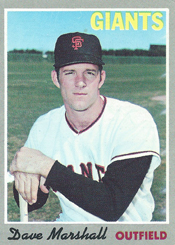 Marshall played in the big leagues from 1967-73 as an outfielder for the Giants, Mets and Padres.
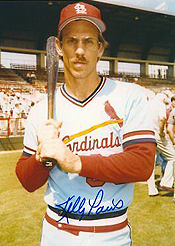 On Sept. 1, 1982, Cardinals manager Whitey Herzog sent Kelly Paris to bat for pitcher Doug Bair to lead off the 13th inning of a game against the Dodgers at Los Angeles.
 Buckner played 22 seasons in the major leagues, primarily as a first baseman, and was a premier hitter, winning a National League batting title in 1980 and generating a career total of 2,715 hits. A left-handed batter with a .289 career average, Buckner never struck out more than 39 times in a season.
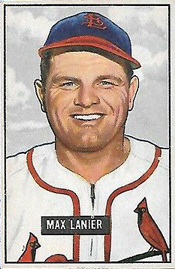 On June 5, 1949, baseball commissioner Happy Chandler granted amnesty to 18 major-league players and six minor-leaguers who defected to the Mexican League, lifting their five-year bans and allowing them to apply for reinstatement to professional baseball in the United States.

