Feeds:
Posts
Comments

Archive for the ‘Hitters’ Category

Bob Gibson and Jim Baxes, two rookies whose careers went in opposite directions, are connected by one swing of the bat.

On April 15, 1959, Gibson made his major-league debut for the Cardinals against the Dodgers at Los Angeles and the first batter he faced, Baxes, hit a home run.

Gibson went on to have a Hall of Fame career. Baxes played one year in the major leagues.

Who are you?

After posting a 2.84 ERA in 190 innings pitched for Cardinals farm teams in 1958, Gibson was a candidate to earn a spot on the big-league club’s 1959 Opening Day roster.

Early in spring training at the Cardinals’ camp in St. Petersburg, Fla., first-year manager Solly Hemus approached a player and asked, “Are you Olivares?”

The player replied, “No, I’m Bob Gibson.”

According to The Sporting News, Gibson turned to a teammate and said, “I must have made a hell of an impression on the manager. After a week, he doesn’t even know who I am.”

Gibson’s fastball got him the attention he desired and the 23-year-old rookie won a spot on the 1959 Cardinals’ pitching staff as a reliever.

Though the St. Louis Post-Dispatch expressed concern Gibson “needs either a better curve or a changeup to go with his blazer and his slider,” Cardinals pitching coach Howie Pollet said, “He’s fast enough to throw one quick one by them a lot of times, even when they’re looking for it. Within a few weeks, we might have him getting his breaking ball over better.”

In a column for the Post-Dispatch on the eve of the 1959 season opener, Bob Broeg, rating the Cardinals’ pitchers, said, “If there’s one who does stir the imagination a bit, though he’s green, it’s Bob Gibson.”

Waiting his turn

Meanwhile, at Dodgers spring training camp in Vero Beach, Fla., Baxes, a 30-year-old rookie, was manager Walter Alston’s surprise choice to open the regular season as the third baseman.

Baxes’ father immigrated to the United States from Greece in 1900, went to work in a San Francisco rope factory, married and started a family. His son, Dimitrios Speros Baxes, became known in the Russian Hill neighborhood of San Francisco as Jim.

Jim Baxes and his younger brother, Mike, developed into professional ballplayers. Mike made it to the majors with the Athletics in 1956, but Jim, who started his career in the Dodgers’ farm system in 1947, waited 12 years until getting his shot in the big leagues in 1959.

Baxes was a right-handed power hitter who slugged 30 home runs for Fort Worth in 1953 and 28 home runs for Spokane in 1958, but, according to the Los Angeles Times, he was a “ferocious flailer” who swung and missed too often.

“I’m confident I can cut it,” Baxes said to The Sporting News. “I’ve improved the last couple of seasons and I don’t think my age will prove any handicap.”

Temper tantrum

After losing three of their first four games of the 1959 season, the Cardinals faced Dodgers right-hander Don Drysdale at the Los Angeles Memorial Coliseum.

In the sixth inning, Stan Musial of the Cardinals tried to score from second on Joe Cunningham’s line single to center, but was called out by umpire Dusty Boggess.

“I almost fell off the bench when Musial was called out,” Hemus told the Post-Dispatch.

Convinced he slid into the plate before catcher John Roseboro applied a high tag after fielding a throw from Don Demeter, Musial argued with Boggess, “but he was Casper Milquetoast compared to his boss,” the Los Angeles Times reported.

Hemus ran onto the field, charged at Boggess, “threw his cap to the ground and repeatedly kicked the dirt” before he was ejected, according to the Post-Dispatch.

“He took the ballgame away from us,” Hemus said. “That was the worst so-called exhibition of baseball umpiring I ever saw.”

Rude greeting

In the seventh inning, with the Dodgers ahead, 3-0, Gibson, wearing uniform No. 58, relieved starter Larry Jackson. Baxes led off and hit Gibson’s third big-league pitch into the seats in left-center for his first big-league home run.

Gibson “received a rough welcome into major-league warfare,” the Post-Dispatch reported.

Baxes gave Gibson “quite an initiation,” the Los Angeles Times wrote.

Gibson retired the next three batters in order, getting Drysdale to line out to second, Ron Fairly to fly out and Wally Moon to ground out.

In the eighth, Roseboro singled, moved to second on Demeter’s sacrifice bunt, stole third and scored on Charlie Neal’s sacrifice bunt. Gil Hodges, the last batter Gibson faced in the game, popped out to the catcher. Boxscore

Gibson made two more relief appearances for the Cardinals before he was sent back to the minor leagues on April 28, 1959.

In his book, “Stranger to the Game,” Gibson said, “Hemus had me convinced that I wasn’t any damn good and consequently I wasn’t.”

Different paths

On May 9, three weeks after his home run against Gibson, Baxes was assigned to the minors because the Dodgers wanted Jim Gilliam at third base. The demotion was devastating to Baxes, who batted .303 for the Dodgers. “I think that entitled me to a better chance than I received,” Baxes said to the Associated Press.

Baxes refused to report to the minors, went home to Long Beach, Calif., and got a job at a sheet metal company. The Indians, seeking a backup infielder, contacted the Dodgers and on May 22, 1959, Baxes was dealt to Cleveland.

In his first at-bat for the Indians, on May 23, 1959, Baxes slugged a pinch-hit home run against Jim Bunning of the Tigers. Boxscore

Baxes played in 77 games for the 1959 Indians and hit 15 home runs, but he wasn’t brought back. He played two more seasons in the minors, finishing in 1961 with a Cardinals farm club, the Portland Beavers.

Gibson, meanwhile, was called up to the Cardinals on July 29, 1959, and put in the starting rotation.

Read Full Post »

Stepping foot on foreign soil for the first time in the regular season, the Cardinals felt the ground shift beneath them.

On April 14, 1969, the Cardinals opposed the Expos at Montreal in the first regular-season major-league game played outside the U.S.

Led by the slugging of Mack Jones, the Expos, a National League expansion team, overcame a seven-run inning by the Cardinals and won, 8-7, before 29,184 at sold-out Jarry Park.

It was a joyous day for the baseball fans of Montreal, who naturally were proud to have a team and were thrilled to win a home opener against the two-time defending National League champion Cardinals, but there were glitches.

Though the weather was sunny, the playing field was a mess, despite the efforts of the grounds crew.

“When the frost began to thaw underground, the mound and area behind the plate sank a few inches,” according to The Sporting News, and the field became soft and lumpy.

“It was like running on a hunk of Gouda cheese,” the Montreal Gazette noted.

Oh, Canada

The National League awarded Montreal a franchise, even though it didn’t have a suitable ballpark. The Expos had a few months to renovate 3,000-seat Jarry Park and get it up to major-league standards before the start of the 1969 season.

The Expos opened their inaugural season with six road games, three at New York against the Mets and three at Chicago against the Cubs, and won two.

Four days before the home opener, Expos management “feared the game might never happen” because Jarry Park wasn’t ready, The Sporting News reported, but workers “toiled around the clock.”

About 3,000 temporary folding chairs still were being installed in sections of the ballpark on game day, delaying the opening of the gates. Expos general manager Jim Fanning pitched in, putting up chairs in the section behind home plate, the Gazette reported.

“Stadium workers were still bolting in seats and shoveling snow as the first fans arrived,” the Canadian Broadcasting Corporation (CBC) reported.

Sinking feeling

Players were disappointed to find the field “rough” and “rubbery,” according to The Sporting News.

Cardinals third baseman Mike Shannon teasingly told the St. Louis Post-Dispatch that his burly teammate, Joe Torre, will “sink six inches into that infield.”

Torre good-naturedly replied, “This soft infield ought to bring everyone else down to my speed.”

The infield was “extremely spongy and seemed to have foam rubber under it,” the Post-Dispatch reported. Cardinals shortstop Dal Maxvill said, “You step here and ground sinks a yard away.”

Indeed, the ground literally was shifting. “As the earth settled, the mound dropped five inches below the official 10-inch height, which was already five inches lower than last year’s regulation elevation,” the Gazette observed. “Pitchers had the feeling they were throwing uphill.”

“To further complicate the situation,” the Gazette added, “home plate was off kilter and pointing slightly toward left field.”

The ground was so soft “plate umpire Mel Steiner was standing ankle deep in the turf behind home by the end of the game,” according to the Associated Press.

According to columnist Bob Addie in The Sporting News, catchers Tim McCarver of the Cardinals and John Bateman of the Expos “were sunk in the soft stuff up to their ankles. It was the first time a catcher ever had to throw from a foxhole.”

“I’ve played on some bad diamonds, but this is the worst,” said Cardinals center fielder Curt Flood. “I pray I don’t get killed out there.”

Flood continued, “It was unbelievable. The infield was soft and it was tough to go from first to third. A stolen base is going to be unheard of here until something is done about it. You just can’t get the proper footing …. The outfield is rough and it’s tough to figure out which way the ball is going to bounce.”

Flood’s remarks offended Expos manager Gene Mauch, who wanted him fined. “The commissioner should turn Flood upside down and shake a little money out of his pocket,” Mauch said to The Sporting News. “It’s not in the best interest of baseball to say what he did.”

Recalling his days as Phillies manager, Mauch said, “The infield at Jarry Park was better than the infield when we played at Busch Stadum for the first time” after the downtown ballpark opened in St. Louis in 1966.

Hits and errors

For the first game at Montreal, the batting orders were:

_ Cardinals: Lou Brock, left field; Curt Flood, center field; Vada Pinson, right field; Joe Torre, first base; Mike Shannon, third base; Tim McCarver, catcher; Julian Javier, second base; Dal Maxvill, shortstop; Nelson Briles, pitcher.

_ Expos: Don Bosch, center field; Maury Wills, shortstop; Rusty Staub, right field; Mack Jones, left field; Bob Bailey, first base; John Bateman, catcher; Coco Laboy, third base; Gary Sutherland, second base; Larry Jaster, pitcher.

Jaster was a former Cardinal and Laboy was developed in their farm system.

Jones, nicknamed “Mack the Knife,” looked sharp. In the first inning, he hit a three-run home run, and in the second he produced a two-run triple.

“I hit a pretty good breaking ball for the homer and the triple was a fastball,” Jones said.

The Expos added a run in the third on Jaster’s single and led, 6-0, but in the fourth they committed five errors and a balk, helping the Cardinals score seven times. Maxvill’s grand slam, his only one in the majors, and Torre’s two-run homer were the big hits.

Referring to the Expos’ miscues, Cardinals manager Red Schoendienst said, “They tried to give us the game, but we didn’t want it.”

The Expos tied the score, 7-7, in the bottom of the fourth and got the winning run in the seventh when pitcher Dan McGinn drove in Laboy from second with a single against Gary Waslewski. McGinn, a former punter for Notre Dame’s football team, got the win with 5.1 scoreless innings and avenged the loss he suffered seven months earlier in his major-league debut for the Reds against the Cardinals.

Said Cardinals general manager Bing Devine: “It was a badly played game on both sides, but we’re not supposed to be playing as badly as the Expos.” Boxscore and video


Read Full Post »

A friendship with general manager Bing Devine enabled first baseman Bill White to finish his playing career with the Cardinals.

On April 2, 1969, the Cardinals reacquired White from the Phillies for infielder Jerry Buchek and utility player Jim Hutto.

The trade gave White, 35, the opportunity to return to the team for whom he’d achieved the most success.

White no longer was an everyday player and he was preparing to transition into a television career in Philadelphia, but Devine wanted him to fill a bench role and White was willing to do so as a favor to his friend and to bring closure to his playing days.

Ties that bind

In White’s first stint with the Cardinals, from 1959-65, he topped 100 RBI three times, hit 20 or more home runs five years in a row and won the Gold Glove Award six times as a first baseman. He also was a National League all-star in five of his seasons with the Cardinals and helped them become 1964 World Series champions.

In October 1965, Cardinals general manager Bob Howsam traded White to the Phillies. He had 22 home runs and 103 RBI for them in 1966, but he injured an Achilles tendon in 1967 and his production declined considerably.

According to the Philadelphia Inquirer, White decided in August 1968 he would retire after the season, but Phillies general manager John Quinn convinced him to play another year.

At spring training in 1969, when the Phillies shifted Richie Allen from third base to first base, White asked Quinn what the club planned to do with him. Quinn said the Phillies wouldn’t cut White from the roster but might trade him to the Cardinals.

“Bing Devine has expressed an interest in you,” Quinn told White.

Devine was Cardinals general manager in March 1959 when the club acquired White from the Giants. Devine and White developed a mutual respect and their bond remained strong, even after Devine was fired by Cardinals owner Gussie Busch in August 1964.

In 1967, when White was with the Phillies and Devine was with the Mets, Devine visited White at his home to offer support and encouragement while White was attempting to recover from the Achilles tendon injury. “I think a lot of him,” White said to the Inquirer.

Welcome back

In his 2011 autobiography, “Uppity,” White said, “At first I said no to the proposed trade, but Bing was persuasive.”

White told Quinn he agreed to the trade because of Devine, who returned to the Cardinals after the 1967 season. “I wouldn’t have gone to any other team,” White said to the Inquirer. “I wouldn’t even have gone to St. Louis if it were not for Bing Devine.”

The Philadelphia Daily News described the two-time defending National League champion Cardinals as “a dynasty.” Joe Torre, acquired from the Braves for Orlando Cepeda, was the first baseman for the 1969 Cardinals and Devine saw White as being an ideal backup as well as a left-handed pinch-hitter.

“Bill fits the bill,” Devine said to the St. Louis Post-Dispatch.

In a 2011 interview, White told me another reason Devine wanted him back with the Cardinals is he hoped to groom him to become a manager when White was done playing, but White wasn’t interested.

“Bing brought me back because he wanted me to manage at (Class AAA) Tulsa and eventually manage the Cardinals,” White said. “I didn’t want to manage. I didn’t want to try to tell 25 other guys how to play the game. I’d rather do something where the success depends on me, not on other people.”

Open and shut

White wore No. 12 for most of his first seven seasons with St. Louis, but backup outfielder Joe Hague had that number with the 1969 Cardinals. White asked for and received No. 7 because he liked low numbers, he said to the Post-Dispatch.

“I’m ready to do anything they want me to _ even pitch batting practice,” White said to the Post-Dispatch.

“This isn’t a knock at the Phillies’ organization _ they’ve been good to me _ but the difference between playing in St. Louis and Philadelphia is night and day,” White said to the Inquirer. “It’s depressing playing in that Philadelphia ballpark. Heck, my locker was over a sewer … And it’s depressing to hear your teammates booed.”

On April 8, 1969, the Cardinals opened the season against the Pirates at St. Louis. In the 12th inning, with the score tied at 2-2, two outs and Mike Shannon on first base, Cardinals manager Red Schoendienst sent White to bat for second baseman Julian Javier.

White was “cheered loudly” as he stepped to the plate, the Post-Dispatch reported.

Facing right-hander Ron Kline, White lined a pitch to left-center.

“What appeared to be a sure double turned out to be a mere out because the ball hooked toward” left fielder Willie Stargell, who made a one-handed catch while on the run, according to the Post-Dispatch.

If the ball had eluded Stargell, Shannon likely would have circled the bases and scored the game-winning run.

“That could have been a great way to open up,” hitting coach Dick Sisler said to White.

White replied, “Yeah, that would have carried me all year.”

Instead, the Pirates scored four runs in the 14th against Mel Nelson and won, 6-2. Boxscore

The 1969 season turned out to be disappointing for the Cardinals, who finished in fourth place in a six-team division, and for White. He suffered sore ribs and cuts to his left elbow in a car accident in St. Louis on May 3. For the season, White hit .211 with no home runs and four RBI in 57 at-bats. As a pinch-hitter, he batted .167 (5-for-30).

White retired as a player after the 1969 season and launched a broadcasting career before becoming president of the National League.

Read Full Post »

Luke Easter was a popular player with a power-packed swing who produced home runs well past age 40, including two seasons with a Cardinals farm club.

Easter grew up in St. Louis and played semipro baseball there. He became one of the top sluggers in the American League with the Indians in the 1950s before extending his career in the minors at Buffalo and Rochester.

His life ended tragically, on March 29, 1979, when he was robbed and murdered by two gunmen outside a bank in Euclid, Ohio.

Hard hitting

Easter was born in Jonestown, Mississippi, and moved with his family to St. Louis when he was a boy. At 21, he joined a semipro team, the St. Louis Titanium Giants, in 1937 and played for them until he entered the Army in 1942.

A left-handed hitter, Easter was 6 feet 4 and 240 pounds. After his stint in the military, he eventually signed with the Pittsburgh-based Homestead Grays of the Negro National League and played for them in 1947 and 1948.

In 1949, two years after Jackie Robinson of the Dodgers integrated the major leagues, Easter signed with the defending World Series champion Indians and was assigned to their San Diego farm club in the Pacific Coast League. Though he missed time because of a broken right kneecap, Easter hit .363 with 25 home runs and 92 RBI for San Diego and was called up to the Indians in August 1949, a week after he turned 34.

Over the next three seasons, Easter was the Indians’ first baseman and produced 28 home runs with 107 RBI in 1950, 27 home runs with 103 RBI in 1951 and 31 home runs with 97 RBI in 1952. Easter was one home run short of tying teammate Larry Doby for the American League crown in 1952.

In 1950, Easter hit the longest home run at Cleveland’s Municipal Stadium. The ball carried 477 feet into the upper deck in right.

A broken left foot limited Easter to 68 games for the Indians in 1953. He batted six times for them in 1954 before being sent to the minors.

Better with age

Though he’d never again play in the big leagues, Easter, 38, wasn’t done as a player. He hit 28 home runs in the minors in 1954 and 30 in 1955.

In 1956, Easter joined the Buffalo Bisons of the International League and over the next three seasons he became their most popular and productive player. He hit 35 home runs with 106 RBI in 1956 and 40 home runs with 128 RBI in 1957. Many of Easter’s home runs were prodigious. In 1958, the year he turned 43, Easter hit 38 home runs with 109 RBI for Buffalo.

The spring weather was especially cold in upstate New York in 1959 and Easter struggled. He was batting .179 with one home run when he was released by Buffalo on May 13. “He gave it all he had, but it wasn’t enough,” Buffalo manager Kerby Farrell said to the Rochester Democrat-Chronicle.

Easter was immensely popular with fans, who marveled at his home run prowess and could count on him to accommodate autograph requests. The Rochester Red Wings, a farm club of the Cardinals, saw an opportunity and signed him. “We’ve been looking for another left-hand hitter with power,” said Rochester manager Cot Deal. “This could be the answer.”

Before sealing the deal, Rochester general manager George Sisler Jr., consulted with Cardinals farm director Walter Shannon and got approval to open a spot at first base for Easter by moving prime prospect Gene Oliver to left field, the Rochester newspaper reported.

Sisler wanted to be certain Oliver’s development wouldn’t be hurt by shifting positions. “As he goes, the team seems to go,” Sisler said, “and we don’t want to do anything to upset his playing or hitting.”

Right for Rochester

Easter got six hits in his first nine at-bats for Rochester and became a mainstay in the lineup. In August 1959, catcher Tim McCarver, 17, joined Rochester and became a teammate of Easter, 44.

Easter hit 21 home runs for Rochester in 1959. The last produced a walkoff win against Buffalo.

“There can be no arguing about Luke’s popularity, so clear-cut is the big man’s superiority in the goodwill department,” wrote Rochester sports editor Paul Pinckney. “He always will be the No. 1 choice of the youngsters.”

Though productive, the Cardinals didn’t call up Easter because they had George Crowe, 38, a left-handed batter who served as their backup first baseman and pinch-hitter.

In 1960, the year he turned 45, Easter produced a 22-game hitting streak for Rochester and overall hit .302 with 14 home runs.

After the 1960 season, Rochester dropped its affiliation with the Cardinals and became a farm club of the Orioles, but Easter remained. In 1962, the year he turned 47, Easter batted .281 with 15 home runs for Rochester. His last full season as a player was 1963. He also appeared in 10 games for Rochester as a pinch-hitter in 1964, the year he became 49.

Gentle giant

After his baseball career, which included a stint as Indians coach in 1969, Easter worked in Cleveland for TRW Inc., an aerospace and automotive manufacturer.

As chief steward for the Aircraft Workers Alliance at TRW, Easter provided a service to co-workers who couldn’t get to a bank. Easter regularly collected their paychecks, cashed them at a bank and delivered the cash back to his fellow employees at work.

Easter, 63, was leaving a bank with thousands of dollars in cash when he was approached by two men who demanded he give them the money. When Easter refused, they shot him dead.

In an interview with David Condon of the Chicago Tribune, Bill Veeck, the Indians owner who signed Easter in 1949, called him “a wonderful, gentle person.”

“Everyone will miss Luke as a man,” Veeck said. “Baseball also will mourn him as a superstar talent never fulfilled. Luke’s talent would have found fulfillment if he’d reached the big-time as a youth.”

Said Hall of Fame pitcher Bob Feller, who was Easter’s teammate with the Indians: “If Luke had come into the majors 10 years earlier, I think he’d have been one of the top hitters all-time.”

Read Full Post »

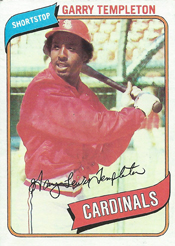
Feeling disrespected by management at the bargaining table and on the field, shortstop Garry Templeton lashed out at the Cardinals.

On March 27, 1979, Templeton asked to be traded and threatened to play at less than his best if his request wasn’t granted.

Templeton, 23, was upset because general manager John Claiborne wanted him to take a pay cut and because manager Ken Boyer and coach Dal Maxvill wanted him to change the way he played shortstop.

A day after expressing his unhappiness, Templeton apologized and remained the St. Louis shortstop.

Hurt feelings

In 1978, his third season with St. Louis, Templeton hit .280 with 31 doubles, 13 triples and 34 stolen bases, but he committed 40 errors.

After the season, the Cardinals hired Maxvill, their former Gold Glove shortstop, as a coach and assigned him to work with Templeton in 1979.

When Claiborne made a contract offer to Templeton for 1979, it called for a 10 percent cut in the $100,000 salary he received in 1978, according to the St. Louis Post-Dispatch. Claiborne proposed the cut because of Templeton’s high number of errors. Templeton was insulted because he led the 1978 Cardinals in hits (181) as well as triples and stolen bases and believed his production should be rewarded.

“There are guys in this league making more than I am who can’t even hold my shoestrings, or tie my shoestrings,” Templeton told The Sporting News in February 1979.

The sides resolved the matter, with Templeton getting a 1979 salary of $130,000, but the increase didn’t erase the sting of his bruised feelings.

“That really hurt him,” Templeton’s friend and teammate, outfielder Jerry Mumphrey, said. “He hasn’t gotten over it.”

At spring training, Maxvill worked with Templeton on fielding fundamentals, but Templeton resisted the instruction because he believed he was being constrained.

Playing chicken

When Templeton’s frustration reached a breaking point, he went to the media to express his views.

“I’m not going to play hard,” Templeton said to Rick Hummel of the Post-Dispatch. “I’m not going to do my best here. Hopefully I’ll be traded if the Cardinals aren’t too chicken to trade me.

“Either get me traded or get me more money. They can take the Cardinals uniform and shove it.”

Templeton said he twice asked the Cardinals to trade him. “They’d rather mess with you instead of sending you to someplace where you’ll be happy,” Templeton said.

In an interview with Mike Shannon of KMOX, Templeton said, “I don’t want to play with the Cardinals. I think they’re giving me too much trouble and I’m not happy here. I don’t want to play here and I’m not trying to play hard.”

After the outburst, Templeton met with his agent, Richie Bry, the Post-Dispatch reported. Bry met with Claiborne. After that, Templeton and Bry met with Claiborne and Boyer.

On second thought

The next day, Templeton attempted to control the damage he caused. He apologized for his words, claimed he no longer wanted to be traded and said “my contract is not and has never been the problem.”

In a prepared statement, Templeton said, “I regret the statements I made yesterday in the heat of anger for they do not accurately reflect my feelings for the Cardinals team, the city of St. Louis or the fans.

“The crux of my problem with management has always been my style of playing shortstop. Since I was 7 years old, I have developed certain habits and routines which have now become second nature to me. I believe that they give me more mobility, speed and range.”

Templeton contended his error total was high because he covered more ground than most shortstops. “Cardinals management and I disagreed on this and thus my anger and frustration,” he said.

Hummel noted, “Templeton’s style has on occasion been one of seeming nonchalance. He emphasizes catching balls with one hand, something Boyer and infield coach Dal Maxvill have suggested he alter.”

Said Boyer: “We haven’t tried to drive anything down his throat.”

To err is human

Reaction from Cardinals players and media generally was supportive of Templeton.

“All I know is that before long this guy is going to be the greatest shortstop I ever saw,” said Cardinals catcher Ted Simmons. “I just wish that when that happens he’ll be in St. Louis.”

Said first baseman Keith Hernandez: “I hope they can resolve the problem because we need him.”

Post-Dispatch sports editor Bob Broeg declared no Cardinals shortstop “has had anywhere near the basic all-round talent” of Templeton. “If Templeton is miffed most because Boyer had Maxvill trying to tell the kid how to do it at shortstop … tell Maxie to learn a few jokes to keep the kid loose and let him alone,” Broeg wrote.

Post-Dispatch columnist Doug Grow offered, “There is no greater insult to any working person than a reduction in pay. My guess is that management never will recover from that offer. An effort to save a few thousand a few months ago eventually could cost the Cardinals a shortstop worth millions.”

Templeton hit .314 with 32 doubles, 19 triples and 26 stolen bases for the Cardinals in 1979. He produced 211 hits and made 34 errors.

Two years later, in August 1981, Templeton created another controversy when he made obscene gestures to fans who booed him for lack of hustle in a game at St. Louis. He was traded after the season to the Padres for shortstop Ozzie Smith.

Read Full Post »

To acquire Bill White, the Cardinals had to give up their best pitcher.

On March 25, 1959, the Cardinals traded pitchers Sam Jones and Don Choate to the Giants for White and utility player Ray Jablonski.

Jones was National League strikeout leader (225) in 1958 and shattered the Cardinals’ single-season record of 199 set by Dizzy Dean in 1933. Jones also led the 1958 Cardinals in wins (14) and ERA (2.88).

White, a first baseman and outfielder, was highly regarded, but couldn’t get a spot in the Giants’ lineup and wasn’t the Cardinals’ first choice. Giants outfielder Leon Wagner was the hitter the Cardinals wanted before they took White, according to the St. Louis Post-Dispatch.

The Cardinals took heat for the deal, but it turned out to be the right move.

Who’s on first?

White made his major-league debut with the Giants in 1956 and hit 22 home runs as their first baseman. He served in the Army in 1957 and the first six months of 1958. Orlando Cepeda became the Giants’ first baseman in 1958 and excelled.

When White returned to the Giants in July 1958, he was relegated to a reserve role. White hit .241 in 26 games for the 1958 Giants. Cepeda hit .312 with 25 home runs and won the National League Rookie of the Year Award.

At spring training in 1959, Cepeda was back and a power-hitting prospect, Willie McCovey, whose best position was first base, was close to joining the team. White, seeing his path blocked, asked the Giants to trade him.

Help wanted

Cardinals general manager Bing Devine was determined to acquire a hitter to boost the 1959 lineup. In 1958, Ken Boyer was the only Cardinal to hit as many as 20 home runs.

According to Post-Dispatch sports editor Bob Broeg, the Cardinals set their sights on Wagner, who hit 13 home runs in half a season as a Giants rookie in 1958 after producing impressive power numbers in the minor leagues.

Wagner’s ability to hit home runs was appealing, but Cardinals talent evaluators concluded White was a better player.

While scouting winter baseball in the Dominican Republic, Cardinals manager Solly Hemus and farm director Walter Shannon saw White and were impressed. Cardinals minor-league manager Joe Schultz, who managed a team in the Dominican Republic, also raved about White.

After Cardinals scout Ollie Vanek filed glowing reports about White from Arizona spring training in 1959, Devine sent his special assistant, Eddie Stanky, to take a look. Stanky managed the Cardinals from 1952-55 and managed White in the minor leagues.

Stanky scouted White for a week. In his 2004 autobiography, “The Memoirs of Bing Devine,” Devine said he called Stanky in Arizona from a phone booth on the beach near St. Petersburg, Fla., to get his opinion on whether to acquire White.

“How well do you like him?” Devine asked Stanky.

Stanky replied, “Let’s not debate it. You sent me out here to see him. I like him. I’m telling you right now I’d make the deal. I suggest you do, too.”

Worth a risk

The trade was unpopular in St. Louis because Jones was so well-regarded. “He was, and we do not mind saying it out loud, one of our special favorites,” the Post-Dispatch declared in an editorial.

Broeg noted the deal “took nerve” because “the Cardinals gambled front-line pitching for potential batting power.”

The Cardinals were heartened by the reaction of former Giants manager Leo Durocher, who told the Associated Press, “I’ll bet you that in one or two years White will be one of the great players in the National League.”

Cardinals reliever Marv Grissom, a former Giant, said the Cardinals made the right choice. “Wagner has more power, all right, as much as anybody in the game,” Grissom said. “White is a smarter player, faster, better defensively and good and strong enough at the plate.”

White told The Sporting News, “I’m happy with the trade. With the Cardinals, I’ll get to play regularly. Naturally, I’m in baseball for the money, and when you play regularly you have a better argument for salary terms.”

In his autobiography, “Uppity,” White said he was glad to be traded, but “St. Louis was the worst city in the league for black players” because of segregationist attitudes. In 2011, when I interviewed White about the deal, he said, “St. Louis wasn’t my first choice, but it ended up that it was a great trade for me.”

Finding the groove

The Cardinals opened the 1959 season with an outfield of Stan Musial in left, Gino Cimoli in center and Joe Cunningham in right, with White at first base.

Pressing to fulfill expectations of being a power hitter, White struggled and had one hit, a single, in his first 19 at-bats. Cardinals coach Harry Walker urged him to relax and make contact rather than try for home runs. “White was lunging too much, was ahead of the pitch, wasn’t getting a good look,” Walker said.

After starting three games at first base and another in left field, Hemus had White make six starts in center field, even though Curt Flood was available.

In his autobiography, White said, “I was a terrible outfielder. I couldn’t judge fly balls. I couldn’t throw and I couldn’t cover the ground.”

On April 29, 1959, Hemus moved Musial to first base and shifted White to left. White was the left fielder from late April until early June. After that, he alternated between first base and left field.

After batting .195 in April, White hit .393 in May and .382 in June. He finished the season at .302, with 33 doubles and 12 home runs.

Jones was 21-15 for the 1959 Giants and led the league in ERA at 2.83.

After the season, the Cardinals acquired Wagner from the Giants, hoping he’d fill an outfield spot, but he played one season for them as a reserve before going to the American League and becoming an all-star for the Angels.

In eight seasons with the Cardinals, White batted .298, topped 100 RBI three times and hit 20 or more home runs five years in a row. He won the Gold Glove Award six times as a Cardinals first baseman. He also was a National League all-star with the Cardinals in 1959, 1960, 1961, 1963 and 1964 and helped them become 1964 World Series champions.


Read Full Post »

« Newer Posts - Older Posts »