Feeds:
Posts
Comments

Archive for the ‘Hitters’ Category

During his time with the Cardinals, Juan Gonzalez lived up to his nickname, but not in the way he and the team hoped.

Invited to try out for a spot as an outfielder on the 2008 Cardinals, Gonzalez was Juan Gone _ as in, headed home _ before spring training ended.

In his heyday with the Rangers, Gonzalez was called Juan Gone because balls he hit frequently were sent into orbit and gone out of sight.

When he came to the Cardinals, though, Gonzalez, 38, looked different than he did in his prime. Gone was the bulk he had when he twice led the American League in home runs. Gone was a lot of the swagger, too.

Suspected in the 1990s of using banned performance-enhancing steroids to help him become one of the most powerful hitters, Gonzalez was trying to return to the majors for the first time in three years. The Cardinals, a haven for players linked to performing-enhancing drugs, welcomed him.

Great expectations

“Using a broomstick as a bat and a bottle cap as a ball on the dusty streets of Vega Baja,” Gonzalez developed into a baseball standout as a youth in Puerto Rico, according to the Los Angeles Times. His boyhood nickname was Igor because of his fascination with a professional wrestler of the same name.

At 16, when he was signed by Rangers scout Luis Rosa in May 1986, Gonzalez was “tall and gangly but with athleticism and serious bat speed,” according to MLB.com’s T.R. Sullivan.

The Rangers brought Gonzalez to Florida, where he was introduced by scouting director Sandy Johnson as the “next Babe Ruth,” and put in the outfield alongside 17-year-old Sammy Sosa on their Gulf Coast League rookie team. As Fort Worth Star-Telegram columnist Randy Galloway noted, “Babe Ruth’s bat had to have been heavier than young Juan.”

Three years later, Gonzalez, 19, made his big-league debut. He was 22 when he won his first American League home run crown. In April 1994, the Fort Worth newspaper did a story speculating whether Gonzalez would break Hank Aaron’s career record of 755. Gonzalez had 121.

Gonzalez also twice received the AL Most Valuable Player Award _ in 1996 (.314 batting mark, 47 homers, 144 RBI) and in 1998 (.318, 45 homers, 157 RBI). That 1998 season was his best. Gonzalez had 101 RBI before the all-star break and his final total of 157 were the most in the American League since 1949 Red Sox teammates Vern Stephens and Ted Williams each had 159. Gonzalez also scored 110 runs and produced 50 doubles.

“Juan in a million,” the Fort Worth Star-Telegram declared.

Success didn’t always bring happiness, however. Gonzalez was married and divorced three times before he turned 25. One of the failed marriages was to the sister of Braves catcher Javy Lopez. (A fourth marriage, to pop singer Olga Tanon, also resulted in divorce.)

“His mistakes, I think, were from a lack of education,” Luis Mayoral, the Rangers’ Latin American liaison and Gonzalez’s confidant, told Mike DiGiovanna of the Los Angeles Times. “He didn’t know what he needed to cope with fame and fortune.”

Columnist Randy Galloway noted, “No one who knows Gonzalez calls him a bad person. He’s not. He can be immature, he can pout, he can be unreasonable at times, and he can make stupid decisions.”

He also had a philanthropic side to him. In 1998, Gil LeBreton of the Fort Worth newspaper wrote, “In his old neighborhood on the rugged streets of Vega Baja, Gonzalez has opened a standing account with the local pharmacy. For those who can’t pay for their prescriptions, Juan will buy the medicine.”

Other Gonzalez projects included a $50,000 donation to build a youth ballpark in southeast Dallas; the purchase of Rangers tickets for underprivileged youngsters from 1995-99; donations for every RBI to Literacy Instruction for Texas reading and writing program from 1997-99; a $25,000 donation to help victims of Hurricane George.

Cheating with chemicals

In his book “Juiced,” Jose Canseco said he introduced Gonzalez to banned performance-enhancing drugs when they were Rangers teammates from 1992-94. Canseco said he injected Gonzalez with the steroids. Canseco was traded to the Rangers from the Athletics, where he played for manager Tony La Russa. In his book, Canseco said he injected Athletics teammate Mark McGwire with banned performance-enhancing drugs and witnessed McGwire and Jason Giambi administer needles to one another.

Rangers owner Tom Hicks told the Associated Press in June 2007 that he suspected Gonzalez used banned steroids when he was with the team. “His number of injuries and early retirement just makes me suspicious,” Hicks said.

In the December 2007 Mitchell Report, an investigation into the use of anabolic steroids and human growth hormone in big-league baseball, Gonzalez was linked to a bag of steroids discovered during a search at the Toronto airport in 2001.

The 2001 season was Gonzalez’s last big year in the majors. He hit .325 with 35 homers and 140 RBI for the Indians that season. After that, his body broke down. Injuries to his hamstrings, hands, shoulders and back cut short his seasons with the Rangers in 2002 and 2003, and with the Royals in 2004.

Gonzalez, 35, rejoined the Indians for spring training in 2005 but injured a hamstring while making a catch on the same day that manager Eric Wedge named him the starting right fielder. In his first game back with the Indians on May 31, Gonzalez injured the hamstring again while running to first base in the first inning. He never played in another big-league game.

Hear no evil, see no evil

The big-league totals for Gonzalez included 434 home runs and 1,404 RBI. In February 2007, he told USA Today he hoped to return to the majors and reach 500 homers. “That’s still my goal and I remain confident I will attain it,” he said.

To get himself into condition for a comeback, Gonzalez attended a training program in Puerto Rico operated by ex-Cardinal Eduardo Perez. “He really never stopped playing,” Perez told Derrick Goold of the St. Louis Post-Dispatch. “He looks great, like he hasn’t missed a beat. His legs look strong. Once a hitter, always a hitter.”

Perez recommended Gonzalez to Cardinals manager Tony La Russa. “You’re going to see a very humble guy,” Perez told the Post-Dispatch. “It’s a lot different than before. He just wants to prove he can still play.”

Intrigued, the Cardinals signed Gonzalez to a minor-league contract in February 2008 and invited him to compete at spring training for a role on the big-league club. The deal called for him to be paid $750,000 if he made the big-league team.

“We all know what he was in his prime,” La Russa told the Post-Dispatch. “He had one of the most gorgeous swings around.”

Cardinals general manager John Mozeliak said to reporter Joe Strauss, “There’s not a great deal of risk involved, but there is the potential for significant upside.”

Actually, there was a risk _ to the Cardinals’ image _ because club management looked like enablers, or protectors, for users of performance-enhancing drugs.

In December 2006, La Russa urged the Cardinals to sign free agent Barry Bonds. Even without Bonds, the Cardinals at 2008 spring training had five players (more than any other team) who were implicated in the Mitchell Report: Rick Ankiel, Ryan Franklin, Troy Glaus, Juan Gonzalez and Ron Villone. Also, La Russa had given Mark McGwire, whose use of banned performance-enhancing drugs created a fraudulent pursuit of the single-season home record, an open invitation to join the Cardinals that spring as an instructor.

Eyes wide shut

Here are excerpts from a February 2008 interview Post-Dispatch columnist Bryan Burwell did with La Russa at spring training:

Burwell: Does it bother you that there’s a perception that you give safe harbor to steroid guys?

La Russa: “No, and I’ll tell you why not … I know there isn’t anything we’ve done in all those years that was _ with one small exception where we stole signs, a little hiccup _ there isn’t anything else that has happened on our ballclubs in Oakland or St. Louis that there’s a hint of illegality. There isn’t anything that we didn’t actively and proactively attempt to do it right.”

Burwell: Does it bother you that you and coach Dave McKay have gained the unflattering label as the so-called godfathers of baseball’s steroids era with your connections to Jose Canseco and Mark McGwire?

La Russa: “That’s one of the crosses you have to bear … Dave McKay has as much or more integrity as any man I’ve met … There’s no chance that what happened officially at Oakland was tainted. Does it mean … when our guys are not in our facilities, not in our weight rooms, that guys didn’t experiment? No.”

Burwell: Would you have cared if you did know they were experimenting?

La Russa: “Yeah, I would care, because when I saw a guy who got stronger quickly without working hard, oh yeah, that implies a lot of other things about what he’s willing to do.”

Burwell: You still don’t believe McGwire used performance-enhancing drugs?

La Russa: “Absolutely not.”

Burwell: Come on.

La Russa: “Absolutely not. If you see Mark today, he still looks like he did then.”

Burwell: No he doesn’t.

La Russa: “Yes he does.”

Asked when he got to camp whether he’d ever used performance-enhancing drugs, Gonzalez told reporter Derrick Goold, “I never used it. I’m clear.”

Assigned uniform No. 22, Gonzalez singled twice and scored a run in the Cardinals’ exhibition opener against the Mets.

In 26 spring training at-bats, Gonzalez hit .308 with one homer (against Johan Santana) and five RBI before straining an abdominal muscle.

Placed on the temporarily inactive list, Gonzalez opted to go home to Puerto Rico. The Cardinals informed him he could return for an extended spring training when he felt ready to play.

“I told him he made a real good impression,” La Russa said to the Post-Dispatch. “I’m disappointed because he could have provided something special to our club.”

The Cardinals didn’t hear back from Gonzalez.

Six years later, in 2014, La Russa was inducted into the Baseball Hall of Fame. In an interview he did that year with Cardinals Yearbook, La Russa said McGwire did “a limited amount” of performance-enhancing drugs. Here are excerpts from that 2014 interview:

Cardinals Yearbook: How do you respond to those who say you were an enabler of baseball’s steroids era?

La Russa: “The only way you could know about what was going on was if you ran an investigation … I know on our team you couldn’t be a policeman and get detectives involved. Nobody is going to do that. If something is happening, it’s happening away from the ballpark.”

Cardinals Yearbook: How could it have been handled differently?

La Russa: “That’s the great unknown … All I know is on a personal basis I have no regrets. I don’t feel guilty about any part of it. We did what we could do.”

Read Full Post »

In a fundraising game to honor the memory of slain civil rights activist Dr. Martin Luther King Jr., two of the top performers on a genuine field of dreams were Cardinals Lou Brock and Bob Gibson.

On March 28, 1970, the East-West Major League Baseball Classic was played at Dodger Stadium in Los Angeles. According to the National Baseball Hall of Fame, the Saturday afternoon exhibition netted more than $30,000 for two beneficiaries:

_ Southern Christian Leadership Conference, a regional organization founded by King and others in 1957 to help coordinate grassroots efforts in civil rights and voting rights activities.

_ Martin Luther King Jr. Center for Nonviolent Social Change, also known as King Center. Located in Atlanta, the center was founded in 1968 by Coretta Scott King to preserve and advance her husband’s legacy. It houses a library, archives and exhibits. It’s also the burial site of Dr. King and his wife.

Most of baseball’s top players participated in the game, taking time out from spring training to show their support for King and his mission.

Baseball tribute

After King was assassinated on April 4, 1968 (the convicted murderer, James Earl Ray, was born in Alton, Illinois, 20 miles north of St. Louis), Bob Gibson spoke with emotion about the bitterness and frustration he felt. In his autobiography, “Stranger to the Game,” Gibson said, “I reeled from the impact of the assassination _ the cold-blooded murder of the one man in my lifetime who had been able to capture the public’s attention about racial injustice, break through some of the age-old social barriers and raise the spirits and hopes of black people across the country.”

According to the Baseball Hall of Fame, shortly after King was killed, ballplayers asked King’s associates what they could do as a public tribute to him, Joseph Peters, sports project director for the Southern Christian Leadership Conference, explained in a November 1968 letter to baseball commissioner William Eckert.

When Southern Christian Leadership Conference members suggested a fundraising game, Major League Baseball officials agreed to cooperate. The game initially was planned for March 1969, but the Southern Christian Leadership Conference asked for more time. That’s why the event was held in March 1970.

Though spring training exhibitions were under way, every big-league team made players available for the fundraising game and paid their expenses, the Associated Press reported.

Among those who came to Los Angeles to play were Hank Aaron, Ernie Banks, Johnny Bench, Lou Brock, Orlando Cepeda, Roberto Clemente, Bob Gibson, Reggie Jackson, Al Kaline, Willie Mays, Joe Morgan, Tony Oliva, Frank Robinson, Pete Rose, Ron Santo, Tom Seaver and Willie Stargell.

Mays traveled from Japan, where his club, the Giants, were playing goodwill games. In explaining why he made the long trip to Los Angeles, Mays told the Torrance Daily Breeze, “This cause is too important to pass up. At last, baseball players can show their feelings about the late Dr. King and his work through the medium of this game. I wouldn’t miss it.”

Players from the East divisions of the American and National leagues were placed on an East team. The West team had players from the West divisions of both leagues. That gave fans the chance to see Angels and Dodgers, Mets and Yankees, and Athletics and Giants perform as teammates.
Joe DiMaggio was chosen to manage the East team. His coaching staff: Billy Martin, John McNamara, Stan Musial and Satchel Paige.

The West team manager was Roy Campanella. His coaching staff: Don Drysdale, Elston Howard, Sandy Koufax and Don Newcombe.

Entertainer Bill Cosby held a reception for the teams at the Warner Brothers Studio the night before the game, the Los Angeles Times reported.

Star power

Starting lineups were selected by members of the Los Angeles-Anaheim chapter of the Baseball Writers Association of America and the Southern California Sportscasters Association.

The East batting order: 1. Ron Fairly, first base; 2. Reggie Smith, center field; 3. Frank Robinson, right field; 4. Willie Stargell, left field; 5. Ron Santo, third base; 6. Ernie Banks, shortstop; 7. Don Buford, second base; 8. Tim McCarver, catcher; 9. Tom Seaver, pitcher.

Banks, 39, a Cubs first baseman, was at shortstop for the first time in nine years.

East bench warmers included Lou Brock, Roberto Clemente and Al Kaline.

The West batting order: 1. Maury Wills, shortstop; 2. Pete Rose, center field; 3. Hank Aaron, left field; 4. Reggie Jackson, right field; 5. Johnny Bench, catcher; 6. Orlando Cepeda, first base; 7. Joe Morgan, second base; 8. Sal Bando, third base; 9. Don Wilson, pitcher.

Willie Mays and Tony Oliva couldn’t crack the starting lineup.

Ticket prices ranged from $10 to $2. Among the 31,694 spectators for the 2 o’clock game were baseball pioneers Jackie Robinson and Larry Doby, baseball commissioner Bowie Kuhn (successor to William Eckert) and entertainers Sammy Davis Jr. and Danny Kaye.

Mudcat Grant sang the national anthem, a recording of Dr. King’s “I Have A Dream” speech was played on the public address system, and Coretta Scott King threw the ceremonial first pitch to Johnny Bench.

(Bench, 22, impressed fellow catcher Roy Campanella, who told the Los Angeles Evening Citizen News, “Now there’s a kid who has it all. His future is unlimited.”)

A scheduled home run hitting contest featuring Frank Robinson, Ron Santo and Willie Stargell for the East versus Hank Aaron, Orlando Cepeda and Reggie Jackson for the West was canceled without explanation, the Long Beach Independent reported.

Aces prevail

The East’s pitching combination of Tom Seaver and Bob Gibson kept the West from scoring.

When Pete Rose batted in the first, Seaver surprised him with a blooper pitch. As Rose watched it drop into catcher Tim McCarver’s mitt, plate umpire Emmett Ashford gave his emphatic “stee-rike-ah” call. Rose stepped out of the box and smiled at Seaver, who grinned back. “It was a little slip curve,” Seaver told the Long Beach Independent. Rose finished the at-bat by flying out to left.

Seaver completed his three-inning scoreless stint with back-to-back strikeouts of Pete Rose and Hank Aaron. Then Bob Gibson took over and also held the West scoreless for three innings. The only hit against Gibson was a Sal Bando single.

Despite his performance, Gibson told Rich Roberts of the Long Beach Independent, “I sure didn’t feel good. I wouldn’t be telling no lie. I just used fastballs, but you better call them straight balls because they weren’t very fast.”

The East went ahead, 1-0, in the third when Ron Fairly hooked the first pitch from Lew Krausse into the stands in right, just inside the foul pole, for a home run. Ron Santo made it 2-0 when he led off the fourth with a homer to left against Krausse.

(Krausse was representing the Seattle Pilots, who were only a few days away from becoming the Milwaukee Brewers.)

Both managers substituted often, trying to get as many players as possible into the game. In a pinch-hit appearance, Willie Mays grounded into a force out.

The East went up 5-0 with three runs in the eighth against Mudcat Grant. After Al Kaline singled, Lou Brock lined a shot that carried over the head of left fielder Hank Aaron for a run-scoring double. A Roberto Clemente smash that eluded Maury Wills was ruled a double and scored Brock. Ken McMullen drove in Clemente with a single.

Facing Grant Jackson in the bottom half of the inning, the West scored a run when Willie Davis singled and came home on a Ken Berry double.

The East won, 5-1, but it wasn’t the outcome that mattered.

“I thank these fellows for giving their time,” West manager Roy Campanella told the Long Beach Independent.

As Pete Rose noted in a column he did for the Cincinnati Enquirer, “Even though it was an exhibition game, it had meaning … I feel good inside because I’ve contributed to a worthy cause.”

Read Full Post »

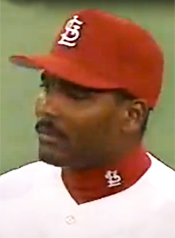
Manny Lee was a one-of-a-kind Cardinal.

In the long history of the franchise, Lee is the only Cardinal to play in just one game for them and have a 1.000 batting average.
A 10-year veteran of the American League and shortstop for the 1992 World Series champion Blue Jays, Lee made his Cardinals debut as their 1995 Opening Day second baseman _ and never appeared in another big-league game.

Caribbean to Canada

Manuel Lora Lee was from San Pedro de Macoris, a Dominican Republic city noted for its poets and baseball players. Joaquin Andujar, Rico Carty, Pedro Guerrero, Alfonso Soriano, Sammy Sosa, Fernando Tatis and his son, Fernando Tatis Jr., are some of the many big-league players who came from there.

Lee was 16 when Mets scout Eddy Toledo signed him for $2,000 in May 1982. A switch-hitting shortstop, Lee led the Class A South Atlantic League in hitting (.330) in 1984, his third season in the Mets’ farm system.

To get Ray Knight from the Astros, the Mets sent them Lee and two other prospects near the end of the 1984 season. When the Astros neglected to place Lee on their 40-man winter roster, the Blue Jays claimed him in December 1984.

Boston Globe columnist Peter Gammons noted, “Houston was furious that the Blue Jays took Manny Lee, but if he were one of the best prospects in the Astros’ organization, why didn’t they protect him?”

Rules required the Blue Jays to keep Lee in the big leagues in 1985, or offer him back to the Astros. When Lee, 19 reported to the Blue Jays at 1985 spring training, he weighed 141 pounds on a 5-foot-9 frame, the Toronto Star reported, but he showed enough in the field to make the jump from Class A to the majors. He was the only teen on a 1985 big-league Opening Day roster.

Used mostly as a defensive replacement and pinch-runner, Lee produced no RBI in 40 at-bats and had more strikeouts (nine) than hits (eight). Looking back on that rookie season, Lee told the Star, “I was too young. I was like a little baby.”

Infield shift

Shortstop was the position Lee liked best, but an all-star, Tony Fernandez, had that role with the Blue Jays. After splitting time between the majors and minors in 1986 and 1987, Lee became the Blue Jays’ second baseman in 1988. He hit .291 overall and .316 with runners in scoring position that season.

Though he led American League second basemen in fielding percentage in 1990, Lee sometimes bailed out on double play pivots and was criticized for “indifferent play,” according to the Star.

When the Blue Jays acquired second baseman Roberto Alomar from the Padres after the 1990 season in a trade that included Tony Fernandez, manager Cito Gaston chose Lee to be the shortstop. “We’ve got confidence in Manny,” Gaston told the Star. “He played a decent second base for us, and he was improving, but I think shortstop was in his heart. He loves playing shortstop. Now he’s got the job.”

Star columnist Dave Perkins wrote, “Returning to his natural position should take the whitecaps off Manny’s brainwaves; he never did take to second base, or at least the idea of it.”

At 1991 spring training, the Star described Lee as “the happiest Blue Jay in camp.”

The good vibes didn’t last throughout the season, though. Lee swung like a slugger, but became the first big-league player with 100 or more strikeouts (107) and no home runs.

Blue Jays fans booed “the much-maligned and often maddening shortstop,” the Star reported.

Highs and lows

Larry Hisle joined the 1992 Blue Jays as hitting coach and said the flaw in Lee’s batting approach was obvious. “There is a lot of movement in the upper body,” Hisle told the Star. “On some pitches, his head moves as much as 12 inches.”

At spring training, “I have spent more time with (Lee) than with any other player,” Hisle said. “He has listened and he has worked. I’m urging him to concentrate on putting the ball in play.”

Lee improved, producing a career-best .343 on-base percentage and hitting .330 with runners in scoring position for the 1992 Blue Jays. He also achieved the second-highest fielding percentage among American League shortstops and didn’t commit an error on a ground ball all season. According to the Star, Blue Jays coach Gene Tenace called Lee “one of the unsung heroes of this team.” Lee credited Hisle. “He gave me confidence,” Lee told the newspaper.

In Game 3 of the playoffs against the Athletics, Lee’s two-run triple with two outs in the seventh propelled the Blue Jays to victory. They went on to win the pennant and the World Series championship. Boxscore

Granted free agency, Lee got a two-year guaranteed $3.4 million contract from the Rangers, but his time in Texas didn’t begin well. In 1993, he clashed with manager Kevin Kennedy and had what the Fort Worth Star-Telegram described as “an injury-riddled, error-prone, turmoil-laden debut season with the Rangers.”

The next year, strike-shortened 1994, Lee did better. He hit .278 (second-best batting average of his big-league career) and .337 with runners in scoring position. Though primarily the shortstop, Lee also played second base for the first time in four years and made no errors in 108.1 innings there.

Opening and closing

The Cardinals took notice. After the strike ended on April 2, 1995, the Cardinals went looking for infield help. On April 18, a week before the start of the season, they signed two free agents _ Lee and Luis Rivera _ and had them compete for a spot on the Opening Day roster. Lee won the job, expecting to back up Ozzie Smith at short and Geronimo Pena at second.

However, two days before the season opener, Pena pulled a hamstring running to second base _ on a ground-rule double. Manager Joe Torre picked Lee, 29, to replace him.

“I never thought that I would be the Opening Day second baseman,” Lee said to the Belleville (Ill.) News-Democrat. “I feel comfortable here, relaxed. There’s no pressure on me any more.” He also told the newspaper that playing alongside Ozzie Smith was “a dream for me.”

The dream turned into a nightmare, though, in the season opener against the Phillies at St. Louis.

In batting practice, Lee’s line drive struck coach Gaylen Pitts in the chest. Though Pitts wasn’t seriously hurt _ “It didn’t get me in the heart,” he told the St. Louis Post-Dispatch. “My heart is not big enough.” _ it was an omen of bad things ahead for Lee.

In the second inning, Phillies catcher Darren Daulton got an infield single on a ball Lee backhanded but couldn’t get out of his glove in time. In the third, pitcher Curt Schilling also got an infield hit on a bouncer to Lee, who again had trouble releasing the ball after fielding it and threw low and late to first.

Later in the inning, with Mickey Morandini the runner on second, Gregg Jefferies hit another bouncer toward Lee. “The ball glanced off the glove of Lee, who reached for it again and then tumbled flat on his back,” the Post-Dispatch reported. “Morandini, who had held at third, motored home” and Jefferies reached first on the error.

Adding injury to insult, Lee sprained his right ankle on the play. He received medical attention but stayed in the game.

Asked whether he should have made the plays on the grounders hit by Daulton, Schilling and Jefferies, Lee told the Post-Dispatch, “I used to, but I haven’t played second base for a full year.”

Leading off the bottom of the third in his first Cardinals plate appearance, Lee singled to left and eventually scored on a Scott Cooper single. After the inning, Lee was unable to continue on the sprained ankle and was replaced at second by Jose Oquendo.

Rick Hummel of the Post-Dispatch wrote, “It’s fairly probable that the Manny Lee Show at second base will have a short run.” Boxscore and Video

More to the story

Lee was placed on the 15-day disabled list and the Cardinals called up Tripp Cromer from the minors to replace him.

When Lee’s ankle healed, he played in 12 games for Cardinals farm clubs on an injury rehabilitation assignment. Ready to rejoin the Cardinals, he returned to St. Louis but was told the club was happy with Cromer. Lee was released and finished as a player.

In his quirky stint as a Cardinal, Lee had a higher batting average (1.000) than his fielding average (.800). As the Post-Dispatch noted, it “was a generous” .800.

According to baseball-reference.com, Lee remains the only Cardinal to play in just one game for them and have a 1.000 batting average.

Nine others have 1.000 batting averages as Cardinals, but all played in multiple games for them, according to baseball-reference.com. In alphabetical order, those nine are:

_ Bryan Augenstein, 2011, five games, one plate appearance, one hit.

_ Justin Burnette, 2000, four games, one plate appearance, one hit.

_ Eddie Fisher, 1973, six games, one plate appearance, one hit.

_ Larry Herndon, 1974, 12 games, one plate appearance, one hit.

_ Bob McClure, 1991-92, 103 games, one plate appearance, one hit.

_ Kevin Ohme, 2003, two games, one plate appearance, one hit.

_ Tige Stone, 1923, five games, three plate appearances, one hit, two walks.

_ Abe White, 1937, five games, one plate appearance, one hit.

_ Esteban Yan, 2003, 35 games, one plate appearance, one hit.

After his playing days, Lee stayed in the Dominican Republic. In August 2004, he was in the news there but not for baseball. Using a .38-caliber pistol, Lee shot and killed Edwin Gomez Vasquez, 28, who Lee suspected was trying to rob his residence in San Pedro de Macoris, the daily newspaper, Diario Libre, reported.

Read Full Post »

Game 4 of the 2004 World Series was remarkable for more than the obvious reason. It was the game the Red Sox won to become World Series champions for the first time in 86 years. The magnitude of that achievement overshadowed another facet of that game: a drama that underscored the fortitude of the Cardinals’ rookie catcher, Yadier Molina.

Ever since his unplanned ascension from the minors to the Cardinals in June 2004, Molina faced a myriad of challenges, ranging from runners crashing into him at the plate to pitchers trying to embarrass him when he batted.

In his first World Series start, Molina encountered a different kind of test. Two of baseball’s prominent players, David Ortiz and Manny Ramirez, conspired to steal signs he was flashing to the pitcher.

Molina didn’t back down. Instead, the rookie intimidated the intimidators.

Climbing the ladder

After entering the Cardinals’ farm system in 2001, Molina made a steady rise. The 2004 season was his fourth year in the minors and his first at Class AAA Memphis.

Asked during 2004 spring training about Molina making the move to Class AAA, Cardinals director of player development Bruce Manno said to the Memphis Commercial Appeal, “Defensively, there’s no doubt in my mind (Molina) can play there. Offensively … we’ll see how he responds.”

Manno told the St. Louis Post-Dispatch, “We would like to see him play the full season (with Memphis).”

Memphis manager Danny Sheaffer, a former big-league catcher who played three seasons (1995-97) with St. Louis, managed Molina at Class A Peoria in 2002. That year, Molina threw out 52 percent of runners attempting to steal and hit .280.

Sheaffer assured the Memphis newspaper that Molina was a good  hitter _ “He uses the whole field” _  and had superb catching skills. “There’s not a whole lot he needs to improve on to catch in the big leagues right now … He’s real special,” Sheaffer told the Commercial Appeal in May 2004. “He’s head and shoulders above where I was at his age … He’s got a chance to be a good one.”

Call for help

The adjustment to Class AAA was no problem for Molina. In 37 games with Memphis, he hit .302 and nailed 17 of 28 runners trying to steal.

“He’s our top catching prospect,” Bruce Manno told the Memphis newspaper. “We feel that at some point he’s going to make a major contribution to our club at the major league level.”

That time came sooner than the Cardinals and Molina expected. On June 2, 2004, Sheaffer woke Molina during the night to inform him he was going to the Cardinals. Starting catcher Mike Matheny strained a muscle under his right rib cage, necessitating a stint on the disabled list. Molina was called up to join backup Cody McKay (son of Cardinals coach Dave McKay) as the St. Louis catchers.

Molina phoned his brothers, Angels catchers Bengie and Jose, to inform them of his promotion. Never before had three brothers been in the big leagues at the same time as catchers, according to research done by the Post-Dispatch and Joe Hoppel of The Sporting News.

Join the club

Manager Tony La Russa put Molina in the starting lineup for his big-league debut on June 3, 2004, at Pittsburgh. Before the game, Molina told the Post-Dispatch, “I’m ready. This is the best day of my life.”

Molina, 21, was in synch with starting pitcher Woody Williams, 37, who worked six scoreless innings. In the second inning, when Abraham Nunez tried to score from second base on a two-out single to right, Molina made a diving tag to prevent the run. In the eighth, he threw out Jack Wilson attempting to steal second, a key play in helping to short-circuit a Pirates comeback bid.

At the plate, Molina stroked two hits _ a single in the fifth and a double in the seventh _ against starter Oliver Perez. After the double, Molina advanced to third on So Taguchi’s sacrifice bunt and scored the winning run on a sacrifice fly by Woody Williams. Video

(The focus of the game changed in the ninth when La Russa and Pirates manager Lloyd McClendon were ejected after getting into a shouting match.)

After the Cardinals won, 4-2, Molina was praised for his successful debut. “He’s got so much composure,” La Russa told the Post-Dispatch. “He plays like he’s got 10 years of experience.” Pitching coach Dave Duncan said to the reporter Rick Hummel, “He’s not intimidated by the major leaguers. He should do all right.” Boxscore

Good job

On June 23, 2004, a few days after Matheny came off the disabled list, the Cardinals sent Cody McKay to Memphis and kept Molina. Two days later, against the Royals, Molina collected three hits, including two against 20-year-old rookie starter Zack Greinke. Boxscore

Matheny remained the No. 1 catcher but La Russa mixed in starts for Molina, making sure he didn’t rust on the bench. As the summer unfolded, it became evident Molina belonged in the majors. In addition to his brothers, Molina was the latest in a long line of big-league catchers from Puerto Rico. Others in the game then included Sandy Alomar Jr., Javy Lopez, Jorge Posada, Ivan Rodriguez and Benito Santiago.

In explaining why so many accomplished catchers were Puerto Ricans, Molina told the Post-Dispatch, “To me the difference between the Americans and us is we want the hard job.”

On Aug. 7, with the score tied at 1-1 in the ninth inning at St. Louis, the Mets issued an intentional walk to Larry Walker, loading the bases with two outs and bringing Molina to the plate. “If we were going to lose the game, we were going to make the rookie do it,” Mets manager Art Howe told the Post-Dispatch.

Mike Stanton threw a tough pitch, a fastball down and away, but Molina poked a single over the shortstop, giving St. Louis a 2-1 walkoff win. “You don’t have to be afraid in this game,” Molina said to Dirk Chatelain of the Post-Dispatch. “You just have to play the game hard. Respect the game … I’m a rookie but I know what it’s about.” Boxscore

Three weeks later, Molina earned more admiration from his teammates with a play he made at Pittsburgh. In the second inning, Ty Wigginton, trying to score from second on Jose Castillo’s single to right, steamed toward the plate. As Molina gloved Larry Walker’s one-hop throw, the 200-pound baserunner arrived. Wigginton crashed into Molina, bowling him over, but the rookie held onto the ball for the out.

“To take a hit like that and shake it off is just impressive,” Cardinals pitcher Matt Morris said to the Associated Press. “That shows you how much heart he has.”

Wigginton told the news service, “I thought I was going to score, and the next thing I know Molina is right in front of me … If he drops the ball, it might be a different ballgame.”

Two innings later, Molina tagged out Jose Castillo on Jim Edmonds’ throw from center. The Cardinals won, 6-4. Boxscore

In September, Molina hit his first big-league home run. The solo shot against the Brewers’ Matt Wise snapped a 2-2 tie in the eighth and carried the Cardinals to their 100th win of the season. Boxscore

In 59 games for the 2004 Cardinals, including 39 as a starter, Molina hit .267, made just two errors in 344 innings, and caught eight of 17 runners (47 percent) attempting to steal.

Taking a stand

After Matheny started the first three games (all won by the Red Sox) of the 2004 World Series, La Russa wanted him rested in case the Cardinals extended it beyond Game 4. So he gave Molina the Game 4 start. The Cardinals’ starting pitcher, Jason Marquis, worked well with Molina during the season. In 90.2 innings with Molina as his catcher, Marquis had a 3.38 ERA, which was better than his overall season total of 3.71.

In his first two plate appearances of the game, Manny Ramirez of the Red Sox walked and singled. While Ramirez was on base, Molina suspected Ramirez was relaying to cleanup batter David Ortiz the signs Molina was sending to Marquis.

(Years later, Reds first baseman Joey Votto, in discussing Molina with Derrick Goold of the Post-Dispatch, said, “It’s like he can sniff out, he can sense, where any hitter is looking, or what they’re attempting. It’s something that I don’t think you can measure. That seems like an intangible, but he has it.”)

In the dugout, Molina asked Matheny for advice on what to do about Ramirez’s sign stealing. According to the Post-Dispatch, Matheny replied, “When he comes up, make sure he knows you’re on to it.”

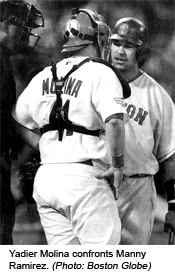
As Ramirez came to bat in the fourth, Molina stood up, stepped forward, got nose to nose with Ramirez and scolded him in Spanish.

“I was sitting over there saying, ‘That’s probably not what I would have done … but that will work,’ ” Matheny recalled to Stan McNeal of Cardinals Yearbook.

As Molina and Ramirez argued, Red Sox manager Terry Francona rushed over to umpire Chuck Meriwether. In pleading Ramirez’s case, Francona said he told Meriwether, “Chuck, Manny doesn’t even know our signs.”

The Cardinals lost the game, but the sight of their rookie catcher confronting Ramirez and refusing to back down made a powerful impression on them.

As La Russa told Cardinals Yearbook, “Yadi got in his face and started jawing at him. He told them to stop that stuff now, or somebody was going to get hurt because he would cross them up … I told him I was glad he did that, that he could not allow that stuff to happen. For a young catcher to do that in the World Series says all you need to know about his competitiveness.” Boxscore and Video at 1:15:46.

After the World Series, Matheny became a free agent and signed with the Giants. The Cardinals’ catching job belonged to Molina.

Read Full Post »

Early in his big-league playing career, Curt Flood had a tendency to try hitting home runs, which wasn’t a good idea for someone his size.

In 1958, his first season with the Cardinals, Flood, 20, clouted 10 homers. Those are the most home runs of any Cardinals player 20 or younger, according to researcher Tom Orf.
The long balls caused Flood to overswing. It wasn’t until a teammate helped him kick the habit that Flood became one of the National League’s top hitters.

Big talent

As a youth in Oakland, Flood was a standout art student and high school baseball player. A mentor, George Powles, also coached him with an American Legion team and in the semipro Alameda Winter League.

“This kid can do everything,” Powles told the Oakland Tribune. “He can run, throw, field and hit a long ball. He is smart and has great desire to get ahead.”

Big-league scouts took a look, but most determined Flood was too small to reach the majors.

In his autobiography “The Way It Is,” Flood recalled, “One day George Powles sat me down for a talk. He told me I had the ability to become a professional, but that I should prepare for difficulties and disappointments. He pointed out I weighed barely 140 pounds (and) was not more than five feet, seven inches tall … Small men seldom got very far in baseball.”

Reds scout Bobby Mattick, a former big-league shortstop, took a chance on Flood. In January 1956, after Flood turned 18 and graduated from high school, he signed with the Reds for $4,000.

Down in Dixie

Assigned to a farm club in High Point, N.C., a furniture factory town, Flood experienced racist teammates and fans.

“Most of the players on my team were offended by my presence and would not even talk to me when we were off the field,” Flood said in his autobiography. “The few who were more enlightened were afraid to antagonize the others.

“During the early weeks of the season, I’d break into tears as soon as I reached the safety of my room … I wanted to be free of these animals whose 50-cent bleacher ticket was a license to curse my color and deny my humanity. I wanted to be free of the imbeciles on the ball team.”

Flood’s pride kept him from quitting and he answered the bigots by performing better than any other player in the Carolina League. “I ran myself down to less than 135 pounds in the blistering heat,” he said in his book. “I completely wiped out that peckerwood league.”

The 18-year-old produced an on-base percentage of .448 (190 hits, 102 walks). He scored 133 runs, drove in 128 and slugged 29 home runs.

Called up to the Reds in September 1956, Flood made his big-league debut at St. Louis as a pinch-runner for catcher Smoky Burgess. Boxscore

The next season became another ordeal when the Reds returned Flood, 19, to the segregated South at Savannah, Ga. Adding to the pressure was the Reds’ decision to shift Flood from outfield to third base. One of his infield teammates was shortstop Leo Cardenas, a dark-skinned Cuban.

“Georgia law forbade Cardenas and me to dress with the white players,” Flood said in his book. “A separate cubicle was constructed for us. Some of the players were decent enough to detest the arrangement. I particularly remember (outfielder) Buddy Gilbert (of Knoxville, Tenn.), who used to bring food to me and Leo in the bus so that we would not have to stand at the back doors of restaurants.”

A future seven-time Gold Glove Award winner as a National League outfielder, Flood made 41 errors at third base with Savannah, but produced a .388 on-base percentage (170 hits, 81 walks), 98 runs scored and 82 RBI.

Earning another promotion to the Reds in September 1957, Flood’s first hit in the majors was a home run at Cincinnati against Moe Drabowsky of the Cubs. It turned out to be Flood’s last game with the Reds. Boxscore

Good deal

At the 1957 baseball winter meetings in Colorado Springs, Cardinals general manager Bing Devine and manager Fred Hutchinson met until 3 a.m. with Reds general manager Gabe Paul and manager Birdie Tebbetts, trying to make a trade, the St. Louis Globe-Democrat reported.

After much give and take, the Reds proposed sending Flood and outfielder Joe Taylor to the Cardinals for pitchers Marty Kutyna, Willard Schmidt and Ted Wieand. Devine, in his first trade negotiations since replacing Frank Lane as general manager, “had some fear and trepidation” about doing the deal, he said in his autobiography “The Memoirs of Bing Devine.”

As Devine recalled in his book, Hutchinson said to him, “Awww, come on. I’ve heard about Curt Flood and his ability. Flood can run and throw. He could probably play the outfield. Let’s don’t worry about it.”

Bolstered by his manager, Devine made the trade, his first for the Cardinals.

(Concern of having an all-black outfield of Frank Robinson, Vada Pinson and Flood prompted the Reds to trade him, Flood said in his autobiography.)

Devine told the St. Louis newspapers that Flood had potential to become the Cardinals’ center fielder. “We’re counting on him for 1959, not next year,” Devine told the Globe-Democrat.

Cardinals calling

The Cardinals opened the 1958 season with Bobby Gene Smith in center and sent Flood to Omaha, but Smith didn’t hit (.200 in April) and Flood did (.340 in 15 games). On May 1, they switched roles, Flood joining the Cardinals and Smith going to Omaha.

(When the Cardinals sent Flood a ticket for a flight from Omaha, he was concerned how he would get his new Thunderbird automobile to St. Louis. Omaha general manager Bill Bergesch kindly offered to drive the car there for him and Flood accepted, according to Bergesch’s son, Robert. Not knowing anyone in St. Louis, Flood rented a room in a house called the Heritage Arms on the recommendation of pitcher Sam Jones. In the book “The Curt Flood Story,” author Stuart L. Weiss noted that when Bill Bergesch arrived in St. Louis with Flood’s car, he found Flood was residing in one of the city’s most notorious bordellos.)

Flood, 20, played his first game for the Cardinals on May 2, 1958, at St. Louis against the Reds. The center fielder had a double and was hit by a Brooks Lawrence pitch. Boxscore

His first home run for the Cardinals came on May 15 at St. Louis against the Giants’ 19-year-old left-hander, Mike McCormick. Flood belted a changeup into the bleachers just inside the left field foul line. He also singled to center and doubled to right, prompting the Globe-Democrat to declare, “Flood resembled a junior grade Rogers Hornsby with a surprising ability to hit to all fields.” Boxscore

Among Flood’s 10 homers in 1958 were solo shots against Warren Spahn and Sandy Koufax. Boxscore and Boxscore

The power impressed, especially on a club with one 20-homer hitter (Ken Boyer), but Flood’s .261 batting average didn’t (the Cardinals had hoped for .280) and he struck out 56 times, the most of any Cardinal.

“I had fallen into the disastrous habit of overswinging,” Flood said in his autobiography. “Worse, I had developed a hitch in my swing. When the pitcher released the ball, my bat was not ready because I was busy pulling it back in a kind of windup.”

Fixing flaws

In February 1959, Flood got married in Tijuana, Mexico, to Beverly Collins, “a petite, sophisticated teenager with two children,” according to “The Curt Flood Story.” They’d met during the summer at her parents’ St. Louis nightclub, The Talk of the Town.

Solly Hemus, who’d replaced Fred Hutchinson as Cardinals manager, wanted a center fielder who hit with power. Trying to deliver, Flood went into a deep slump in 1959 and entered July with a batting mark of .192 for the season. “I now became more worried about my swing and more receptive to help,” Flood recalled in his book.

According to Flood’s book, when he asked Stan Musial for advice, Musial said, “Well, you wait for a strike. Then you knock the shit out of it.”

Help came from another teammate, pinch-hitter George Crowe, 38. “George straightened me out,” Flood said in his autobiography. “He taught me to shorten my stride and my swing, to eliminate the hitch, to keep my head still and my stroke level. He not only told me what to do, but why to do it and how to do it. He worked with me by the hour.”

It took a while, but Flood finally found his groove. In 1961, he hit .322, the first of six .300 seasons for the 1960s Cardinals. Flood twice achieved 200 hits in a season and finished with 1,854 in the majors.

In 1968, he told the Associated Press, “It took me five years to learn I’m not a home run hitter, and that’s the hardest thing in the world for a baseball player to tell himself. It’s a blow to your ego. You have to tell yourself you’re not as big and strong as the next guy. It hits at your masculinity, your manhood.”

Of Flood’s 85 big-league home runs, the most (15) came against the Reds. Flood hit four homers versus Juan Marichal and two each against Don Drysdale, Ferguson Jenkins and Sandy Koufax.

Read Full Post »

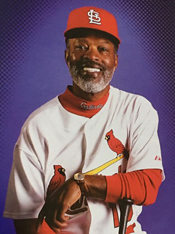
As a pinch-hitter in 1985, Hal McRae helped the Royals emerge from the brink of elimination against the Cardinals and advance to their first World Series championship. As a hitting coach two decades later, McRae helped the Cardinals become World Series champions for the first time in 24 years.

McRae spent more than 40 years in the big leagues _ 19 as a player, 15 as a coach, six as a manager and two in the front office. His last five seasons in the majors were as hitting coach of the Cardinals from 2005 to 2009.

During McRae’s St. Louis stint, the Cardinals won a World Series title in 2006, their first since 1982.

Segregated South

Harold McRae was from Avon Park, Fla., 85 miles south of Orlando. From 1927 to 1929, Avon Park was spring training home of the Cardinals.

As a youth in the 1950s, McRae developed into a right-handed hitter playing stickball on a makeshift diamond at the corner of Delaney and Castle streets in Avon Park. “A lot of skills I exhibited in the big leagues began right (there),” McRae recalled to the Tampa Tribune. “I remember a certain Mrs. Austin who lived on that corner. We knew that if we hit a ball into her yard, which was left field, she wouldn’t give it back. So that’s how I first learned to hit to right field.”

(In 1991, Castle Street was renamed Hal McRae Boulevard.)

McRae attended segregated E.O. Douglas High School in Sebring, Fla. Named for banker Eugene Oren Douglas, it was the only high school in the county available to blacks. (The school remained open until 1970, when integration finally occurred in Highlands County.)

After graduating in 1963, McRae attended Florida A&M in Tallahassee. Two years later, the Reds signed him. “I really enjoyed sliding headfirst, taking out the middle infielders, running into the catcher,” McRae told the Tampa Tribune. “I credit that outlook to my baseball coach (Costa Kittles) at Florida A&M. He was really a football coach. I was never afraid of contact.”

A few months after turning pro, McRae married his wife, Johncyna, in April 1966. Forty years later, in 2006, she was presented with an unsung hero award from the Florida Department of Health for “working tirelessly to end disparities in health care for racial and ethnic minorities.”

The award was presented with accolades from Florida Gov. Jeb Bush. According to the Bradenton Herald, Dr. Gladys Branic, director of the Manatee County Health Department, praised Johncyna “for her mentoring of migrant workers, her volunteer work for troubled teens, and the many scholarships and nurturing programs she helped develop for black girls.”

Slotted for second

In his first three seasons in the Reds’ system (1966-68), McRae was a second baseman. His minor-league manager in 1967 was former second baseman Don Zimmer. At the Florida Instructional League that fall, McRae’s instructor was former second baseman Sparky Anderson. Reds manager Dave Bristol told The Cincinnati Post, “Everyone, including scouts on the other clubs, tells me McRae is going to be Cincinnati’s next second baseman.”

McRae was called up to the Reds during the 1968 season and started 16 games at second base. Then in the winter, playing in Puerto Rico, he fractured his right leg in four places trying to knock the ball loose from a catcher on a play at the plate. That put an end to his ability to move nimbly as a second baseman.

After sitting out most of the 1969 season, McRae was shifted to the outfield and was with the Reds from 1970-72. In two World Series, he hit .455 against the Orioles in 1970 and .444 versus the Athletics in 1972. Video

(McRae also played in two World Series with the Royals. In 17 World Series games, he hit .400.)

Rough stuff

Traded to the Royals in November 1972, McRae benefitted from the American League’s adoption of the designated hitter in 1973. He told the Tampa Tribune, “Some people considered it being half a ballplayer … It just so happened that my best role was as the DH.”

Working well with hitting coaches such as Charley Lau and Rocky Colavito, McRae hit better than .300 seven times in 15 years with the Royals.

In 1976, when McRae hit .332, his teammate, George Brett, won the American League batting title at .333. In his final at-bat, Brett got an inside-the-park home run when Twins outfielder Steve Brye misjudged the ball. McRae suggested Brye intentionally let the ball drop.

Because of his aggressiveness, McRae was not a popular opponent. According to the Baseball Hall of Fame, while managing the White Sox, Tony La Russa said of McRae, “When you play against him, you detest him, but you would love to have him on your side.”

Mariners pitcher Glenn Abbott told Sports Illustrated, “I feel McRae has played dirty, but he plays to win, and that’s what it’s all about.”

Attempting to thwart a double play during a 1977 playoff game, McRae barreled into Yankees second baseman Willie Randolph with a rolling body block. The Yankees cried foul, but McRae said to United Press International, “I wasn’t trying to hurt Randolph … There was nothing dirty about it … We’re not supposed to be buddy-buddy out there.” Video

Teammates respected McRae. George Brett said to Sports Illustrated, “I look up to him. He learned the game from Pete Rose, and I learned it from him.” Whitey Herzog, McRae’s manager from 1975-79, told the Kansas City Star, “He’s the best designated hitter in baseball. He gives you everything he has on every play.”

Patience pays

The 1985 World Series between the Royals and Cardinals was played without designated hitters, but McRae still was involved in the drama.

With the Cardinals ahead, 1-0, in the ninth inning of Game 6 and on the verge of clinching the championship, the Royals got a break when umpire Don Denkinger ruled Jorge Orta safe at first, though TV replays clearly showed he was out.

As the inning unfolded, the Royals had runners on first and second, one out, when McRae batted for Buddy Biancalana. The Cardinals’ right-handed rookie closer, Todd Worrell, hoped to get McRae to ground into a game-ending double play.

According to the Kansas City Star, McRae said he reminded himself as he approached the plate to be patient and swing only if the pitch was a strike.

With the count 1-and-0, Worrell threw a slider that eluded catcher Darrell Porter for a passed ball, enabling the runners to move up to second and third. That changed the strategy. Behind in the count 2-and-0, Cardinals manager Whitey Herzog ordered Worrell to walk McRae intentionally, loading the bases and setting up a potential force-out at any base.

A left-handed batter, ex-Cardinal Dane Iorg, thwarted the plan with a two-run single. The Royals clinched the title the next night in Game 7. Boxscore

Good teacher

McRae batted .290 and totaled 2,091 hits in a big-league playing career that ended in 1987.

He managed the Royals (1991-94) and Rays (2001-02). A son, Brian, became a big-league outfielder and played for him on the Royals.

McRae coached for the Royals (1987), Expos (1990-91), Reds (1995-96), Phillies (1997-2000) and Rays (2001). As hitting coach, he was credited with helping develop Reggie Sanders with the Reds and Scott Rolen with the Phillies.

“Hitting instruction is probably my first love,” McRae told Todd Jones of The Cincinnati Post. “I enjoy the interaction with the players. As a manager, you look for results. As a hitting instructor, you look for improvement.”

After McRae helped Deion Sanders snap a slump, Reds veteran Lenny Harris told The Post, “Deion said to us, ‘It’s time to start listening to Hal McRae. He understands us.’ “

In a report on McRae’s hitting philosophy, Jim Salisbury of the Philadelphia Inquirer noted, “The plate is 17 inches wide. McRae teaches his hitters to concede the inner and outer two inches to the pitcher. That leaves 13 inches for the hitter.”

After being replaced as Rays manager by Lou Piniella, McRae moved into the role of assistant to Rays general manager Chuck LaMar, but there were “few requests for his input,” according to the St. Petersburg Times.

“I felt miserable half the time,” McRae told the newspaper.

Back in uniform

With Mitchell Page as hitting coach, the 2004 Cardinals won the National League pennant and led the league in hits and runs scored, but he was fired for reasons related to alcoholism. Page said to Joe Strauss of the St. Louis Post-Dispatch, “I have an alcohol problem and I’m going to get treatment for it.”

The Cardinals offered the job to McRae, 59, and he welcomed the chance to coach again. Recalling his start as a big-league manager with the White Sox in 1979, Cardinals manager Tony La Russa told the Bradenton Herald, “Winning was defined by George Brett and Hal McRae. In the West Division, Kansas City was the team to beat, and those were the two guys who showed how it was done. I always said I’d like to be a teammate of Hal McRae.”

After his hiring, McRae watched video and learned the habits of Cardinals batters. At 2005 spring training, he spent each day talking with the players and tailored his philosophies to their needs. As Roger Mooney of the Bradenton Herald noted, “McRae coaches like he played. He’s prepared, works hard and gets results.”

The 2005 Cardinals were loaded with big hitters such as Jim Edmonds, Albert Pujols, Scott Rolen, Reggie Sanders and Larry Walker. “With a veteran club, you’re talking about the (opposing) pitcher,” McRae said to the Herald. “We’re more concerned with the pitcher than ourselves.”

Helping hand

The 2006 Cardinals were a deeply flawed team that became World Series champions. Part of their success stemmed from the performance of rookie Chris Duncan, who slugged 22 home runs in 280 at-bats during the season.

“Hal McRae has been the biggest help because he’s working with me day in, day out,” Duncan told the Post-Dispatch. “He’s helped me the most to get through different phases and whatever is going on with me.”

In assessing McRae’s contributions to the 2006 Cardinals, Tony La Russa said to the St. Petersburg Times, “He’s a very smart man. He understands what hitting is about … and he understands winning.”

When Albert Pujols slumped early in the 2007 season, McRae gave him a tutorial _ “He needs to use his hands more,” the coach told the Post-Dispatch _ and used a video to convince Pujols that by being impatient, or jumpy, at the plate he was opening his hips too early in his swing. “He showed me, and I saw the difference,” Pujols said to reporter Joe Strauss.

In 2008, the Cardinals led the league in hits and batting average (.281, well above the league norm of .260), and got big production from a journeyman (Ryan Ludwick, 37 home runs, 113 RBI) and a former pitcher (Rick Ankiel, 25 homers).

Though division champions in 2009, the Cardinals were swept by the Dodgers in the playoffs, totaling six runs in three games. McRae, 64, was fired.

“You’re always disappointed when you get laid off,” McRae told the Post-Dispatch, “but I’m not disappointed in my work.”

Read Full Post »

« Newer Posts - Older Posts »