Feeds:
Posts
Comments

Archive for the ‘Hitters’ Category

Ray Jablonski was an infielder who couldn’t field or throw well, but he excelled at stroking line drives for extra-base hits and generating large numbers of runs.
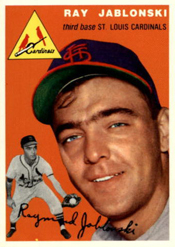
On Nov. 24, 1948, the Cardinals selected Jablonski from the Red Sox in the minor-league draft.

The minor move turned into a big deal for the Cardinals, who sought a right-handed batter with power to balance a lineup with left-handers Stan Musial and Enos Slaughter. Jablonski produced more than 100 RBI in each of his two seasons with St. Louis.

As a third baseman, though, Jablonski had the skills of a designated hitter. When prospect Ken Boyer proved ready to move from the minor leagues and play third base for the Cardinals, Jablonski became expendable.

Climbing the ladder

Ray Jablonski was born and raised in Chicago. As a youth, he was “an accomplished singer and piano player,” according to a biography by the Society for American Baseball Research.

A coach encouraged him to play high school baseball and he showed an ability to hit the ball hard and often. Jablonski enlisted in the Army in July 1945, spent most of his military service in France and was discharged in January 1947.

When he returned to Chicago, he attended a Red Sox tryout camp in Elgin, Ill., and was the only one of the 300 participants to get a contract offer, according to The Sporting News. The Red Sox assigned Jablonski to their Class D affiliate in Milford, Del., and he hit .326 in 1947 and .354 in 1948, primarily as a shortstop.

After the 1948 season, the Red Sox fired their farm director, former Cardinals shortstop Specs Toporcer, and in the reshuffling that followed the Red Sox left Jablonski exposed to the minor-league draft. He was selected by the Cardinals and assigned to their Class A Columbus (Ga.) club.

The leap from Class D Milford to Class A Columbus was a steep one and after Jablonski hit .275 for Columbus in 1949 he was sent down to Class B Lynchburg, Va., in 1950. Lynchburg was a turning point in Jablonski’s career because the manager there was Whitey Kurowski, the former third baseman who played in four World Series for the Cardinals. Kurowski put Jablonski at third base and mentored him.

After hitting .289 for Lynchburg, Jablonski played for Class B Winston-Salem in 1951 and led the Carolina League in batting at .363.

The Cardinals promoted Jablonski to Class AAA Rochester in 1952 and he played all four infield positions, committing 33 errors and batting .299 with 103 RBI.

Jablonski “has strong wrists and can get the bat through at the last split-second,” The Sporting News reported.

Competition at third

Billy Johnson was the incumbent at third base for the Cardinals. Johnson played in four World Series for the Yankees and was an American League all-star in 1947 before being traded to the Cardinals on May 14, 1951. A smooth fielder with a strong arm, Johnson gave the Cardinals “the best defensive play they’ve had at the hot corner in years,” according to writer Bob Broeg.

In 1952, Johnson hurt his elbow and the injury affected his throwing. Depriving Johnson “of his shotgun arm would be like taking a paint brush away from Rembrandt,” Broeg observed.

At spring training in 1953, the three contenders for the Cardinals’ third base job were Johnson, Jablonski, and Vern Benson, who’d spent parts of the 1951 and 1952 seasons with St. Louis.

Broeg concluded Jablonski’s “defensive play might be the drawback that could cost him the job.”

After observing Jablonski, former Cardinals infielder Frank “Creepy” Crespi said, “He’s got a lot to learn defensively and needs plenty of work, but he’s got a big thing in his favor and that’s willingness to listen and practice.”

In preseason exhibition games, Jablonski batted .302 with six home runs.

On April 14, when the Cardinals opened the 1953 regular season at Milwaukee in the Braves’ first game since relocating from Boston, Jablonski made his major-league debut as the starting third baseman.

He and two other newcomers to the starting lineup, first baseman Steve Bilko and center fielder Rip Repulski, became known as the Polish Falcons.

Jablonski finished his rookie season with 21 home runs and 112 RBI. He made 27 errors, the second-most among National League third basemen.

Too many errors

In 1954, Jablonski hit .296 with 104 RBI for the Cardinals and he was the starting third baseman for the National League all-star team, but his 34 errors were the most by any third baseman in the league.

Post-Dispatch sports editor J. Roy Stockton, citing Jablonski’s fielding problems, described him as “a defective player who broke the hearts of the pitchers.”

Cardinals pitcher Gerry Staley “was openly critical of the slow defensive reactions and uncertain throwing of Jablonski,” the Post-Dispatch reported.

In his two seasons with St. Louis, Jablonski had many of his best games against the Reds. He had five hits versus the Reds on July 8, 1953 (Boxscore), and he twice produced five RBI against them _ on May 28, 1953 (Boxscore) and on May 23, 1954 (Boxscore). Jablonski hit .315 with 20 RBI against the Reds in 1953 and .359 with 22 RBI versus them in 1954.

In December 1954, the Cardinals offered to trade Staley to the Reds for reliever Frank Smith. The Reds wanted second base prospect Don Blasingame as well but the Cardinals “flatly refused,” according to the Post-Dispatch.

The Cardinals, desperate to improve their relief pitching, countered by giving the Reds their choice of Jablonski or infielder Solly Hemus. On Dec. 8, 1954, the Cardinals dealt Jablonski and Staley to the Reds for Smith.

Cardinals general manager Dick Meyer admitted “we might have given too much,” but added, “We felt the need for relief pitching was that great.”

The Cardinals were influenced by the emergence of Boyer, a highly regarded prospect who was ready to take over at third base in 1955. Cardinals scout Joe Mathes predicted Boyer “could become the greatest third baseman in Cardinals history” and former Cardinals manager Eddie Dyer said Boyer “will hit the ball as far as any third baseman in the National League and he’ll outrun any third baseman I know of in the league.”

Boyer fulfilled those expectations and Jablonski, unable to overcome his fielding deficiencies, went on to have a journeyman career. After two seasons (1955-56) with the Reds and two seasons with the Giants (1957-58), Jablonski and Bill White were traded by San Francisco to the Cardinals on March 25, 1959, for pitchers Sam Jones and Don Choate.

Used in a reserve role, Jablonski hit .253 with the 1959 Cardinals and on Aug. 20 he was claimed on waivers by the Athletics. He ended his major-league career with the Athletics in 1960 and played another four years in the minors.

Jablonski was 58 when he died of kidney failure on Nov. 25, 1985.
Read Full Post »

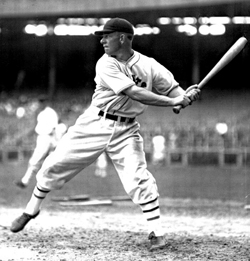
In a life tragically cut short, Mel Ott established the standard for power hitting in the National League and was an endearing role model to legions of baseball fans, including a young Stan Musial, for his humble, considerate manner.

On Nov. 21, 1958, Ott, 49, died in a New Orleans hospital from injuries suffered in a car accident a week earlier.
The sudden death of a popular baseball icon who represented vitality and decency stunned the nation.

Ott was the top slugger in the National League with the Giants from 1926-47. When his playing days ended, he was the National League career leader in home runs (511), RBI (1,860), extra-base hits (1,071), walks (1,708) and runs scored (1,859). Only Babe Ruth (714) and Jimmie Foxx (534) had hit more home runs. Ott had a career batting average of .304, with 2,876 hits, and was elected to the National Baseball Hall of Fame in 1951.

His journey to the major leagues began in storybook fashion.

Bayou to Broadway

In 1925, Ott was a catcher for a New Orleans semipro team owned by lumber tycoon Harry Williams, a friend of Giants manager John McGraw. Williams recommended Ott to McGraw, who agreed to take a look at the prospect. Ott, 16, traveled alone to New York, arrived at the Polo Grounds carrying a straw suitcase after getting lost in the subway system and met McGraw, who took a liking to the well-mannered teen. After watching Ott crush the ball in batting practice, McGraw knew he had a special talent.

Ott debuted with the Giants in April 1926 and became a regular after the Giants traded right fielder George Harper to the Cardinals in May 1928.

Primarily an outfielder, Ott had a strong arm and “learned to play rebounds from the right field wall at the Polo Grounds with the precision of a billiard player,” The Sporting News observed.

A left-handed batter, he had a peculiar approach to hitting. As described by the New York Daily News, Ott “lifted his right leg from the ground completely, accentuating a bend in the knee, and swung as the leg came down again.”

At 5 feet 9, 170 pounds, Ott was not large, but he was, according to The Sporting News, “as solid as a piece of Louisiana cypress.” Ott led the National League in home runs six times, produced 100 RBI or more in eight consecutive seasons (1929-36), was a 12-time all-star, and helped the Giants win three pennants and a World Series title.

“One of the things that made him a great hitter was hard practice,” said teammate Lefty O’Doul. “We used to spend hours, just the two of us, practicing hitting the ball down the right field foul line. We got so we could keep it fair by a few inches.”

Gentle giant

On Oct. 3, 1930, Ott married Mildred Rosina Wattigny. Both were 21 and friends since childhood.

Ott and his road roommate, pitching ace Carl Hubbell, were the most popular Giants players. Ott was admired as much for his demeanor as for his skill.

“Even Brooklyn (Dodgers) fans used to applaud Mel Ott,” Sports Illustrated noted.

In his book “Stan Musial: The Man’s Own Story,” the Cardinals standout recalled Ott as “one of my early idols” during his boyhood in Donora, Pa.

“I liked his mannerisms and his manners,” Musial said.

A Sporting News editorial cited Ott as “a quiet, modest hero” and declared his “gentleness, kindness and good sportsmanship always set a fine example.”

Ott could be hard-driving “but had something in his personality beyond all this that endeared him to people,” Sports Illustrated noted. “He was boyish, mannerly square. He looked like the beau ideal of American youth: the rugged kid who could win ballgames but who would stand up when a woman came into the room.”

Not nice

Ott was player-manager of the Giants from 1942-47 and remained the manager in 1948 when he no longer was playing. However, his teams never won a pennant and in July 1948 the Giants fired Ott and replaced him with Leo Durocher, longtime manager of the archrival Dodgers and a man whose brash, confrontational style was the opposite of Ott’s.

Giants fans “hated the sight of me, hated my guts,” Durocher said in his autobiography.

As Dodgers manager, Durocher was talking to columnist Frank Graham of the New York Sun in the dugout before a game against the Giants when he motioned toward Ott and said, “Look over there. Do you know a nicer guy than their manager, Mel Ott? Or any of the other Giants? Why, they’re the nicest guys in the world. And where are they? In last place.”

Over time, the sentences got melded into one, and the term “Nice guys finish last” came to define Durocher and highlighted what he viewed as the difference between antagonists like him and gentlemen such as Ott.

Ott remained with the Giants, assisting his friend Hubbell, who was the club’s farm director. Ott managed the minor-league Oakland Oaks in 1951 and 1952. In 1956, he became a Tigers broadcaster.

The Tigers consulted with Ott on player personnel matters. After the 1958 season, Ott returned to his home in Metairie, La., and was in contact with Tigers general manager John McHale, who sought his advice on trade proposals. “In Mel’s three years in Detroit as radio and television announcer, we always regarded him as an extra coach,” McHale said.

Fatal accident

On Nov. 14, 1958, Mel and Mildred Ott went to the coastal town of Bay St. Louis, Miss., to check on a cottage they had purchased. After dinner at a restaurant, Mel drove their station wagon onto a fog-shrouded highway. Their vehicle collided head-on with a car driven by Leslie S. Curry Sr., 50, a carpenter, who was killed instantly. Curry, a married father of seven, was alone in the car.

Mel suffered fractures of both legs, a broken arm, six broken ribs and injuries to his head and kidneys, according to United Press International. Mildred suffered a severe concussion and also broke both legs, an arm and ribs. The Otts were taken to a hospital in Gulfport, Miss.

On Nov. 20, Mel was transferred to a New Orleans hospital because of kidney failure and underwent surgery that night. He died the next day, “a tragic end to an around-the-clock attempt by doctors to save his life,” United Press International reported. Cause of death was uremia, a kidney poisoning resulting from a damaged kidney.

Mildred Ott recovered and lived until 1999 when she was 90, according to the Web site MyHeritage.

Althea Curry sued Mel Ott’s estate for the wrongful death of her husband Leslie. A district court judge dismissed the complaint when evidence showed the left wheels of Curry’s car were across the center line on Ott’s side of the road. An appeals court upheld the ruling, saying the plaintiff failed to prove negligence on the part of Ott.

Read Full Post »

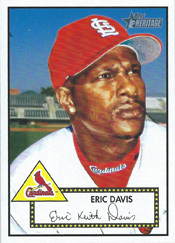
Eric Davis, who conquered cancer, convinced the Cardinals he could help them as an inspirational and productive player.

On Nov. 19, 1998, Davis, a free-agent outfielder, signed with St. Louis for two years at $8 million.
Davis, 36, was acquired to provide run production, defense and clubhouse leadership for an underachieving Cardinals club. Even with Mark McGwire clouting 70 home runs, the Cardinals finished 83-79, 19 wins fewer than the division champion Astros, in 1998.

In May 1997, Davis was diagnosed with colon cancer, had a portion of his colon removed and underwent months of chemotherapy. Remarkably, he returned to the Orioles in September 1997 and played well in the last weeks of the season. Then, in 1998, Davis performed like a player in his prime, producing a 30-game hitting streak and batting .327 with 28 home runs for the Orioles.

A star is born

Davis made his major-league debut with the Reds on May 19, 1984, against the Cardinals and soon displayed a special combination of power and speed. His first big-league hit was a triple off Dave LaPoint.

In 1986, Davis had 27 home runs and 80 stolen bases for the Reds. Over the next three seasons, 1987-89, Davis won three Gold Glove awards and excelled on offense, too. He produced 37 homers, 100 RBI and 50 steals in 1987, 26 homers, 93 RBI and 35 steals in 1988, and 34 homers, 101 RBI and 21 steals in 1989.

The Reds won the National League pennant in 1990 and advanced to the World Series against manager Tony La Russa’s American League champion Athletics. In Game 4, with the Reds on the verge of a sweep, Davis suffered a lacerated kidney when he dived for a drive by Willie McGee.

After that, Davis experienced a series of injuries and setbacks. The Reds traded him to the Dodgers after the 1991 season. Two years later, on July 24, 1993, Davis was with Vince Coleman when the former Cardinal tossed a powerful explosive device into a parking lot and injured three people. A month later, the Dodgers dealt Davis to the Tigers.

In 1994, Davis had surgery for a herniated disc in his neck and sat out the 1995 season. In 1996, he made a successful comeback with the Reds, hitting 26 home runs, and became a free agent after the season, signing with the Orioles.

Profile in courage

On June 13, 1997, Davis had surgery for colon cancer. He returned to the Orioles on Sept. 15, 1997, while still undergoing weekly chemotherapy and hit .310 in eight games that month, helping the club secure a berth in the postseason.

Davis’ courageous return in 1997 positioned him for more achievements in 1998. The 1998 Orioles were loaded with hitters such as Cal Ripken Jr., Roberto Alomar, Rafael Palmeiro and Harold Baines. Davis led the club in batting average (.327), on-base percentage (.388) and slugging percentage (.582).

Baltimore Sun columnist John Eisenberg called Davis “a positive and inspirational leader in a sour clubhouse.”

Davis expressed interest in staying with the Orioles, but wanted $8 million for two years. The Orioles offered him two years at $5.6 million, the Sun reported.

“They were either forcing me to leave, or to come in at a lower salary than I deserved,” Davis said. “I wasn’t looking forward to leaving Baltimore, but it became clear I wasn’t part of their thinking.”

Meet me in St. Louis

Davis told his agent the Cardinals were one of his top choices. The Cardinals, looking to restructure their outfield, gave Davis what he wanted.

The Cardinals “are getting one of baseball’s best guys,” declared the Sun.

Davis said he was glad he’d be playing for La Russa, who left the Athletics after the 1995 season to manage the Cardinals, and joining a lineup with players such as McGwire and Ray Lankford.

“Their interest is winning now,” Davis explained to the St. Louis Post-Dispatch. “I’m 36 years old. I can’t be part of rebuilding.”

On the day the Cardinals signed Davis, they also traded outfielder Ron Gant and pitchers Jeff Brantley and Cliff Politte to the Phillies for pitchers Ricky Bottalico and Garrett Stephenson. With Gant gone and outfielder Brian Jordan soon to depart as a free agent, the Cardinals projected a 1999 outfield of Davis in right, J.D. Drew in center and Lankford in left.

“Anybody that knows about hard work, dedication, sacrifice and adversity, who better than I?” Davis said. “I’ve proven my leadership qualities over the years.”

Finishing strong

On June 25, 1999, Davis made two diving catches to help Jose Jimenez preserve a no-hitter against the Diamondbacks, but damaged his left shoulder. Boxscore The injury caused Davis to sit out the last three months of the season and he underwent surgery to repair a torn left rotator cuff. In 58 games for the 1999 Cardinals, Davis hit .257 with 30 RBI and the club finished 75-86.

From the start, Davis’ second season with the Cardinals was more successful than the first. On April 3, 2000, in the Cardinals’ season opener against the Cubs at St. Louis, Davis hit a home run. Boxscore

A month later, on May 7, 2000, Davis hit a grand slam off Denny Neagle of the Reds at Cincinnati. Boxscore

As the designated hitter against the White Sox at Chicago, Davis produced the only five-hit game of his major-league career on July 15, 2000. Boxscore

With Lankford in left, Jim Edmonds in center and Davis platooning with Drew in right, the Cardinals finished 95-67 and won a division title. Davis hit .303 with 40 RBI in 92 games for the 2000 Cardinals. He batted .390 against left-handers and .321 with runners in scoring position.

After the Cardinals were eliminated in the National League Championship Series versus the Mets, Davis became a free agent, signed with the Giants and played his final season for them in 2001.

Read Full Post »

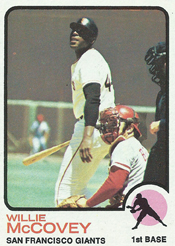
Willie McCovey made the Cardinals pay for disrespecting an elder.

On June 15, 1979, with the score tied at 6-6, a Giants runner on second and two outs in the bottom of the 13th inning, the Cardinals opted to give an intentional walk to Jack Clark and take their chances with McCovey, who was 41 years old and in the twilight of a Hall of Fame career.

McCovey foiled the strategy, hitting the first pitch from Darold Knowles over the fence at Candlestick Park and lifting the Giants to a 9-6 walkoff victory.

McCovey hit 521 home runs, including 41 against the Cardinals, in a 22-year career in the big leagues with the Giants, Padres and Athletics.

One of his most impressive feats came in June 1979 when he silenced skeptics by hitting three home runs in less than 24 hours in a pair of wins against the Cardinals.

Still in the game

At spring training in 1979, critics clamored for the Giants to start Mike Ivie at first base instead of McCovey. Ivie was 26 and batted .308 for the Giants in 1978. McCovey hit .228 for the 1978 Giants and appeared to some to be finished as a ballplayer.

Ivie opened the 1979 season as the Giants’ first baseman but after two months his batting average was .244 and manager Joe Altobelli began playing McCovey more.

When the Cardinals came to San Francisco for a three-game series on June 15, 1979, McCovey was in the lineup as the cleanup batter and first baseman for the Friday night opener.

McCovey led off the fourth inning and lined a 3-and-0 pitch from starter Pete Vuckovich over the wall in left-center for a home run, giving the Giants a 2-1 lead.

The Giants led, 6-5, until the Cardinals got a run in the eighth.

McCovey nearly delivered a game-winning hit in the 11th. With one out and runners on second and first, McCovey hit a line drive to right-center. Rob Andrews, the runner on second, took off, thinking the ball was a hit, but right fielder George Hendrick was positioned to make the catch and throw to second before Andrews could get back, completing a double play.

“They had no business playing me the way they did,” McCovey said to United Press International. “Since when doesn’t the right fielder play me on the line? They did the wrong thing and got lucky.”

Big Mac attack

In the 13th, the Giants had Larry Herndon on first base, one out, when Andrews hit a bouncer to third baseman Ken Oberkfell, who was thinking he could turn a double play, but the ball struck Oberkfell in the chest and he was only able to get the out at first.

“I got caught between hops,” Oberkfell said to the St. Louis Post-Dispatch

With Herndon on second, two outs, Clark was at the plate and McCovey was on deck. Clark, the future Cardinal, was a right-handed batter facing Knowles, a left-hander. After the count went to 2-and-0, Knowles was instructed to walk Clark intentionally.

McCovey batted left-handed and the Cardinals figured Knowles had a better chance of retiring him than he did Clark. McCovey had produced two hits in 14 career at-bats versus Knowles.

The strategy backfired. Knowles’ first pitch to McCovey was a mistake, “a hanging slider,” he said, and McCovey uncoiled his 6-foot-4 frame and crushed a towering drive over the fence in right-center for the sixth walkoff home run of his career.

“I knew it was gone the second I hit it,” McCovey said.

Knowles, disgusted, flung his glove into the air as McCovey circled the bases. Boxscore

Experience matters

The long game required a quick turnaround for the players, who returned to Candlestick Park the next morning, June 16, 1979, for a Saturday afternoon start time.

McCovey was back in the cleanup spot and in the third inning he hit a two-run home run against starter Silvio Martinez, extending the Giants’ lead to 3-0 and propelling them to a 6-1 triumph. Boxscore

“Willie McCovey is one of the chosen people,” Altobelli said to the San Francisco Examiner. “He’s a living legend.”

The home run was the sixth in McCovey’s last eight games.

“You can’t judge a guy on age,” McCovey said. “Guys over 35 can still do it, but for some reason you have to keep proving it. Our society is geared to youth and people are brainwashed that you have to be young to do anything.”

McCovey finished with 15 home runs in 1979 and he returned for a final season in 1980, enabling him to play in four decades during a big-league career started in 1959.

McCovey hit 421 of his career home runs against right-handers and he had success against several Cardinals, including Bob Gibson (.290 batting average against, seven home runs), Nelson Briles (.353, seven home runs) and Ray Washburn (.366, three home runs).

Read Full Post »

Tigers catcher Bill Freehan was a central character in one of the most controversial plays in Cardinals history.

In the 1968 World Series, the defending champion Cardinals won three of the first four games against the Tigers. Freehan was the goat. He went hitless in the first four games, made two errors and was tormented by Cardinals baserunners, especially Lou Brock, who swiped seven bases.

Things changed in Game 5 at Tiger Stadium on Oct. 7, 1968.

In the third inning, Brock was at first when Freehan called for a pitchout and nailed the speedster at second. “That was the first lucky guess I’ve made all Series,” Freehan told Milton Gross of the New York Post.

The big play came two innings later.

The Cardinals led 3-2 in the fifth and were threatening to knock out starter Mickey Lolich. With Brock at second, Julian Javier lined a single to left. Willie Horton, a left fielder not known for his defense, unleashed a strong, accurate throw to the plate. (Lolich told the Associated Press, “As fast as Brock is, I didn’t even figure there would be a throw.”) The peg took one clean hop directly to Freehan, who stood, blocking the plate, “like the towering Washington monument,” wrote Milt Richman, columnist for United Press International.

Brock tried to score standing, collided with Freehan and was called out by umpire Doug Harvey, igniting an animated protest from the Cardinals.

The momentum _and the Series _ shifted to the Tigers with that play. “It was the biggest play of the game,” Brock said to the Associated Press. “It was the turning point. We had the makings of a big inning, and instead of one run, one man on and one out, there were two outs and no runs.”

Detroit rallied to win, 5-3, and send the Series back to St. Louis, but the debate raged about whether Brock was safe or out. Brock said his foot touched the plate before Freehan tagged him. Freehan said Brock came up short of the plate. Others thought Brock stepped on Freehan’s planted foot and bounced off and around the plate. Video

Columnist Milton Gross reported this exchange:

Freehan: “Harvey told me if Lou had slid, he would have been safe. He just never touched the plate.”

Brock: “I was safe. I touched the center of the plate right between Freehan’s legs. Freehan came up behind me as we were arguing after the play and tagged me.”

Freehan: “I was surprised he didn’t slide. There I was, set. With my left foot planted where it was, he’d have had to slide through it or touch the plate with his hand simply because I was between him and the plate. When he hit me on the left side, he just spun away from the plate. The reason I tagged him a second time was I saw him coming back _ like a reflex, you know?”

Brock: “If I slid, he would have had a good chance of blocking me out. He was standing wide-legged, his feet four or five feet apart, one up the third-base line, the other at the corner of the plate. If you slide, he gets down on one knee and you don’t get in.” Boxscore

The on-deck batter, Curt Flood, gestured for Brock to slide, but “I didn’t have time to look at anyone,” Brock said to the St. Louis Post-Dispatch. “The play was in front of me and I had to look at the catcher.”

Flood said Brock was safe because “half of Brock’s foot was on the plate.”

In his World Series column for the Post-Dispatch, Cardinals pitcher Bob Gibson said he thought Brock was safe and did right by not sliding. “When the catcher is blocking the plate, you can slide and never get to it,” Gibson said.

Years later, in his book “Stranger to the Game,” Gibson saw the play differently. “In my heart, I wish Lou had slid,” Gibson said.

The Tigers won Game 6. Facing Gibson in Game 7, Detroit broke a scoreless tie in the seventh, with Freehan’s double driving in Jim Northrup after Northrup lined a two-run triple that was misjudged by Flood in center.

In the ninth, Cardinals catcher Tim McCarver fouled out to Freehan to end the game, won by Detroit, 4-1, giving the Tigers their first World Series championship in 23 years. Boxscore

Though the Cardinals had 11 stolen bases in 16 attempts against Freehan in the Series and he batted .083 (2-for-24), he is remembered most for his block of home plate in Game 5.

Brock, interviewed in 2012 by Mike Stone of CBS Detroit, still insisted he was safe on that play.

“I did not have a great jump, but I thought I could make it,” Brock told Stone. “But Willie Horton made the throw of his life. I never thought Horton could make that throw. The next thing I know I was going to collide with Bill Freehan _ and we know who would have won that. I was safe, but the umpire called me out, so I was out.”

Previously: Should Curt Flood have caught Jim Northrup’s drive?

Read Full Post »

Benny Valenzuela, a pioneering Mexican-born ballplayer, emerged from a humble start in professional baseball and reached the majors, but the Cardinals were the wrong club for a rookie third baseman.

Valenzuela played briefly for the Cardinals in two stints with them in 1958. The Cardinals, though, were set at third base with a premier player, Ken Boyer, and that meant Valenzuela had little opportunity to play.
The Cardinals traded Valenzuela after the 1958 season and he never got back to the big leagues. He did, however, continue his playing career in the minors and he went on to have success as a manager for many years in the Mexican League.

Big break

Benjamin Beltran Valenzuela was born in Los Mochis, a city founded by Americans near the Gulf of California in northwestern Mexico. His nickname was Papelero because as a boy he sold newspapers to help his widowed mother.

Benny Valenzuela, no relation to fellow Mexican and former Cardinals pitcher Fernando Valenzuela, became a bat boy for a Los Mochis team managed by former Washington Senators pitcher Syd Cohen. In 1949, when Valenzuela was 16, Cohen became exasperated by a Los Mochis outfielder who couldn’t track fly balls in the sun. Cohen lifted the outfielder during a game and replaced him with the bat boy, Valenzuela, who’d showed an ability to play.

Three years later, in 1952, Cohen was manager of the Bisbee-Douglas Copper Kings of the Arizona-Texas League and he gave his former bat boy a spot on the team. Bisbee-Douglas was in the low levels of the minors, a remote Class C league with no affiliation to any franchise in the majors, but it was professional baseball in the United States and Valenzuela was grateful to Cohen to get the opportunity.

Valenzuela spent three seasons with Bisbee-Douglas, learning the craft, and produced batting averages of .352 in 1952, .347 in 1953 and .388 in 1954.

The Cardinals took notice and on Nov. 30, 1954, they selected Valenzuela, 21, in the minor-league draft.

Rising above

Valenzuela continued his strong hitting in the Cardinals’ system. He batted .354 for Fresno in 1955, .305 with 107 RBI for Omaha and Houston in 1956 and .286 with 24 home runs and 90 RBI for Houston in 1957.

At spring training with the Cardinals in 1958, Valenzuela impressed general manager Bing Devine and moved “to the front row among candidates for pinch-hitting jobs,” the St. Louis Post-Dispatch reported.

Valenzuela also had a strong arm and the Post-Dispatch reported he “gets a ball away more quickly than any infielder we can remember. He frequently gets the ball to the first baseman before the batter has reached the halfway mark to first base.”

Valenzuela was listed as being 5 feet 10, 175 pounds, but often was described in unflattering terms. The Sporting News called him “thick-legged” and “stubby.” The Post-Dispatch resorted to “chunky.”

“He resembles Yogi Berra,” The Sporting News decided.

Stereotyping was common. The Sporting News, for instance, labeled him “the peppery Mexican” and cited his “chili con carne English.”

Trailblazer

Valenzuela, 24, made the Opening Day roster of the 1958 Cardinals and became the 10th Mexican-born player to reach the major leagues, according to Frontera.info. He was the second Mexican-born player to join the Cardinals. The first was pitcher Memo Luna, whose big-league career with the Cardinals consisted of two-thirds of an inning in 1954.

Mel Almada, an outfielder with the 1933 Red Sox, was the first Mexican-born player in the big leagues.

Valenzuela made his Cardinals debut on April 27, 1958, when he batted for pitcher Larry Jackson and singled to right against Johnny Podres of the Dodgers. Boxscore

“He’s hitting 1.000, a heck of an average in any man’s language,” the Post-Dispatch declared.

On May 6, 1958, Valenzuela doubled against Bob Buhl of the Braves, but the Cardinals demoted him to Omaha on May 14 after he appeared in five games.

Moving on

On June 29, 1958, another Mexican-born player, shortstop Ruben Amaro, who’d been Valenzuela’s teammate for two seasons at Houston, made his major-league debut with the Cardinals.

Meanwhile, Valenzuela hit. 284 with 72 RBI for Omaha and was named the third baseman on the Parade Magazine Class AAA all-star team.

On Sept. 2, 1958, the Cardinals recalled Valenzuela to the big leagues and he appeared in five more games, producing a single against Bob Rush of the Braves on Sept. 18.

For the season, Valenzuela hit .214 (3-for-14) in 10 games for the Cardinals. Boyer, 27 and entrenched at third base, hit .307 and led the Cardinals in runs (101), hits (175), home runs (23) and RBI (90).

On Oct. 7, 1958, the Cardinals traded Valenzuela, pitcher Billy Muffett and catcher Hobie Landrith to the Giants for pitchers Ernie Broglio and Marv Grissom.

Valenzuela played three seasons (1959-61) in the Giants’ farm system before continuing his career as a player and manager in the Mexican League. Among the former major leaguers he managed in Mexico were ex-Cardinals pitchers Diego Segui and Pedro Borbon.

Valenzuela, Vinny Castilla and Aurelio Rodriguez are among the most prominent Mexican-born third basemen to reach the major leagues.

In 1986, Valenzuela and Amaro were inducted together into the Mexican Baseball Hall of Fame in Monterrey.

Read Full Post »

« Newer Posts - Older Posts »