Feeds:
Posts
Comments

Archive for the ‘Hitters’ Category

(Updated Dec. 21, 2024)

At 5-foot-8, Aaron Miles lacked size, not stature, as a Cardinals contributor.

On July 20, 2008, Miles stunned the Padres with a walkoff grand slam in the ninth inning, carrying the Cardinals to a 9-5 victory at St. Louis.

The grand slam was the second of Miles’ big-league career, but his first walkoff home run at any level. “That’s a feeling I never would have expected to get _ a walkoff home run,” Miles told the St. Louis Post-Dispatch.

Cardinals manager Tony La Russa summarized Miles’ achievement in two words: “Fantasy Island.”

Unforced error

The grand slam turned despair into joy for the Cardinals.

In the eighth inning, Troy Glaus hit a three-run home run against Heath Bell, giving the Cardinals a 5-3 lead, but the Padres rallied for two runs in the top of the ninth against Jason Isringhausen and Brad Thompson, tying the score at 5-5.

Padres manager Bud Black sent Bryan Corey to pitch the bottom of the ninth and he got the leadoff batter, Jason LaRue, to ground out to third.

Corey, pitching for his fifth team in his fifth big-league season, walked the next batter, Albert Pujols, on four pitches.

Thompson, the pitcher, came up next and third-base coach Jose Oquendo met him at the plate and instructed him to bunt. Padres catcher Luke Carlin noticed Pujols stretching his lead at first base in anticipation of a Thompson bunt.

As first baseman Adrian Gonzalez moved in toward the plate to be in position to field a bunt, second baseman Edgar Gonzalez started to move toward the first-base bag,

When Thompson didn’t offer at Corey’s first pitch, Carlin snapped a throw toward first base, but the ball arrived before Edgar Gonzalez did and sailed into right field. Pujols raced to third on the two-base error.

“Luke Carlin was throwing to a bag that had no one there,” analyst Mark Grant said on the Padres’ television broadcast.

“It was just a stupid play by me to throw the ball,” Carlin told the Associated Press. “I tried to be overaggressive and unfortunately it hurt us.”

Mighty mite

With Pujols in scoring position, La Russa called on catcher Yadier Molina to bat for Thompson with the count at 1-and-0. Molina ran from the bullpen to the dugout, grabbed a bat and went to the plate.

The Padres, looking to set up a possible forceout at any base, elected to intentionally walk Molina as well as the next batter, Skip Schumaker, loading the bases with one out. Schumaker had hit into 11 double plays for the season, but the Padres decided to take their chances with Miles.

A switch-hitter, Miles stood in from the left side against Corey, a right-hander. Miles was batting .327 against right-handers for the season.

The first pitch was called a ball and Miles swung at the second delivery and fouled it off. The third pitch missed the strike zone, making the count 2-and-1.

Corey’s fourth pitch was in Miles’ wheelhouse and he swung, driving the ball over the right-field fence and into the Cardinals’ bullpen, where it was snared on the fly by joyous teammate Ryan Franklin.

After he connected, Miles dropped his bat at the plate, watched the ball soar and pumped his fist as he headed up the first-base line. Cardinals players poured out of the dugout to mob him at the plate. Video

“Of all the ways you look for Aaron Miles to maybe beat you, that’s not the first thing to come to mind,” said surprised Padres TV play-by-play broadcaster Matt Vasgersian. Boxscore

Rare feat

The home run was the third of the season for Miles. He would finish with four for the season and 19 in a nine-year career in the major leagues. His other grand slam was hit right-handed for the Rockies against Marlins left-hander Al Leiter in the fourth inning of an 8-1 Colorado victory on May 8, 2005, at Miami.

The walkoff home run by Miles gave the Cardinals their first four-game sweep of the Padres since 1990 and moved St. Louis 14 games above .500 for the season. It was the 10th walkoff grand slam all-time by a Cardinals batter and the first since Gary Bennett did it against the Cubs on Aug. 27, 2006.

Cardinals with walkoff grand slams before Miles did it were Pepper Martin (1936), Joe Cunningham (1957), Carl Taylor (1970), Joe Hague (1971), Roger Freed (1979), Darrell Porter (1984), Tommy Herr (1987), David Eckstein (2005) and Bennett (2006).

Since then, Cardinals with walkoff grand slams are Matt Carpenter (2017), Paul Goldschmidt (2022) and Nolan Arenado (2024).

Miles hit 14 of his 19 major-league homers from the left side. Overall, he hit eight homers for the Cardinals, eight for the Rockies and three for the Dodgers.
Read Full Post »

The Cardinals produced 22 hits, four walks and 11 runs in a game against the Pirates, but it wasn’t enough to compensate for an ineffective bullpen.

On July 12, 2008, the Cardinals had 10 extra-base hits and led 8-3 after six innings, 9-4 after seven and 10-6 after eight, but lost, 12-11, to the Pirates in 10 innings.
“That’s a game that you can’t lose that we lost,” Cardinals manager Tony La Russa said to the St. Louis Post-Dispatch.

Jason Bay, who hit a pair of two-run home runs for the Pirates, told the Pittsburgh Post-Gazette, “It’s one of our more amazing games that I’ve been involved in. I’ll never forget it.”

Getting weird

The Saturday night game at Pittsburgh matched starting pitchers Todd Wellemeyer of the Cardinals against Yoslan Herrera, making his major-league debut for the Pirates. The Cardinals scored six times in 4.1 innings against Herrera. Ryan Ludwick did the most damage with a two-run home run and a run-scoring triple.

With a 10-6 lead, the Cardinals turned to the franchise’s all-time saves leader, Jason Isringhausen, to close out the ninth. After Isringhausen struck out Jose Bautista, Jason Michaels walked, Jack Wilson got an infield single and Nate McLouth hit a three-run home run, cutting the Cardinals’ lead to 10-9. “We’re all in that dugout, the whole inning, believing this can happen,” McLouth said.

La Russa said Isringhausen’s biggest mistake was issuing the walk to Michaels with a four-run lead.

“It didn’t seem like it mattered what we threw,” Isringhausen said to the Associated Press. “They got a hit or something weird happened.”

Isrnghausen threw two pitches, both outside the strike zone, to the next batter, Luis Rivas, and was relieved by rookie Kyle McClellan. “The home run (by McLouth) really bothered him,” La Russa said in explaining why he lifted Isringhausen before he finished pitching to Rivas.

McClellan yielded singles to Rivas and Ryan Doumit. With runners on first and third, one out, Bay followed with a ground ball to shortstop Cesar Izturis, who threw to Aaron Miles at second base for the force on Doumit. Miles pivoted to make a throw to first to complete a game-ending double play, but he couldn’t get a grip on the ball. “I knew I had to get rid of it quick,” Miles said. “I just couldn’t get it out of my glove.”

Rivas raced from third base to home plate on the play, tying the score at 10-10, and Bay reached first uncontested. “We had a chance to get out of it and we didn’t get away with anything,” said La Russa.

McClellan got Xavier Nady to pop out to shortstop, ending the inning and sending the game into the 10th.

Walkoff win

Troy Glaus led off the 10th for the Cardinals with a home run against Denny Bautista, giving St. Louis an 11-10 lead.

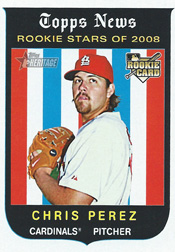
In the bottom half of the inning, Raul Chavez singled, prompting La Russa to take out McClellan and bring in another rookie, Chris Perez. After Jose Bautista popped out to shortstop, Michaels hit a two-run home run, giving the Pirates a 12-11 victory. It was the first walkoff home run for Michaels as a professional ballplayer. Boxscore

“Big situation, coming in like that, chance to protect a lead. I just blew it,” said Perez.

The Cardinals with 22 hits and four walks stranded 12 runners and hit into three double plays. The Pirates had 13 hits, two walks and a hit batsman and left four on base.

Said La Russa: “I don’t care how many hits we had. We got beat. We’ve had games where we pitched and couldn’t get runs. We got runs today and we couldn’t pitch.”

Read Full Post »

(Updated July 21, 2019)

Trailing by eight runs with two outs and one runner on base, the Cardinals produced a 10-run inning and beat the Reds.

The Cardinals’ comeback happened on June 9, 1968, in the first game of a Sunday doubleheader at Crosley Field in Cincinnati. The Reds led, 8-0, scoring all of their runs against starter Steve Carlton, before the Cardinals rallied for 10 in the fifth inning.
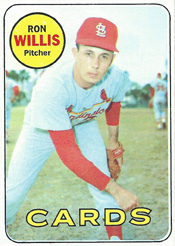
Ron Willis relieved Carlton and shut out the Reds on one hit for the final five innings, earning the win in a 10-8 Cardinals victory.

Game 2 of the doubleheader was the reverse of Game 1. The Cardinals led, 6-0, in the fourth inning, but the Reds rallied with a run in the fourth, four in the sixth and a run in the eighth, tying the score at 6-6. The Reds won, 7-6, with a run in the 12th against Carlton, who relieved in the 10th.

“The wackiest doubleheader in years,” wrote Bill Ford of the Cincinnati Enquirer.

On a roll

In the opener, the Reds reached Carlton for nine hits and three walks before he was relieved by Hal Gilson with two outs in the fourth. Eight of the hits against Carlton were singles and the other was a double.

Reds starter Gerry Arrigo shut out the Cardinals for four innings. In the fifth, Dal Maxvill led off with a shot that deflected off Arrigo’s glove for a single. Maxvill moved to second on a wild pitch, but Arrigo retired the next two batters.

After that, nine in a row reached base for the Cardinals and all scored.

Julian Javier started the hit parade with a double, scoring Maxvill. Curt Flood followed with an infield single, moving Javier to third. Orlando Cepeda singled, driving in Javier, advancing Flood to second and making the score 8-2.

Arrigo walked Mike Shannon, loading the bases, and Tim McCarver singled, driving in Flood and Cepeda, moving Shannon to third and cutting the Reds’ lead to 8-4.

Bob Lee relieved Arrigo and faced Roger Maris, who was batting for right fielder Dick Simpson, the No. 7 batter in the order. Maris walked, reloading the bases. Maxvill followed with his second single of the inning, scoring Shannon and McCarver, advancing Maris to second and getting the Cardinals within two at 8-6.

Johnny Edwards, batting for Gilson, singled, scoring Maris and slicing the Reds’ lead to 8-7, with Maxvill going to third.

Bill Kelso relieved Lee and the first pitch he threw to Lou Brock was hit nearly to the top of the right-field bleachers for a three-run home run, putting the Cardinals ahead, 10-8. Javier lined out to left, ending the inning.

“If I had known we were going to score 10 runs, I’d have done something different,” Carlton told the St. Louis Post-Dispatch.

Fly chasers

The 10-run inning and the comeback from an eight-run deficit weren’t Cardinals records. The 1926 Cardinals had a 12-run third inning in a 23-3 victory over the Phillies Boxscore and the 2012 Cardinals had a 12-run seventh inning in a 12-0 victory over the Cubs. Boxscore In 1952, the Cardinals overcame an 11-0 Giants lead after three innings and won, 14-12. Boxscore

Strong outfield play by Flood and Maris prevented the Reds from denting Willis.

In the bottom of the fifth, Tommy Helms hit a sinking liner to right that Maris caught on the run.

In the sixth, Alex Johnson’s drive to left-center was tracked down by Flood, who raced up the outfield incline to reach the ball. “My knees were up in my chest,” said Flood.

Two innings later, Flood leaped above the fence in right-center to catch a ball and deprive Vada Pinson of a home run. Boxscore

Long day

In the second game, the Cardinals used five pitchers and the Reds used six. Reds starter Billy McCool faced five batters, all reached base and he was lifted before recording an out. The Game 1 starters, Arrigo and Carlton, both relieved in Game 2. Willis pitched again, too, and held the Reds scoreless for 1.2 innings.

After scoring five runs in the first and another run in the fourth, the Cardinals went scoreless over the next eight innings. In the bottom of the 12th, Leo Cardenas doubled with two outs against Carlton, driving in Tony Perez from first with the winning run. Carlton, who had won his last five decisions, took the loss. Boxscore

The Cardinals went to the airport after the game for a flight to Atlanta. They were aboard when an electrical problem on the plane delayed takeoff. The team waited in darkness without air-conditioning inside the plane while repairs were made.

“Nothing like a sauna after a hot doubleheader,” said Flood.

History repeats

Fifty-one years later, the Cardinals repeated the comeback feat of the 1968 team.

On July 19, 2019, the Cardinals came back from a 7-0 deficit with a 10-run sixth inning and beat the Reds, 12-11, at Cincinnati. Boxscore

Read Full Post »

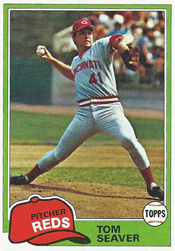
Keith Hernandez provided the biggest challenge to Tom Seaver in his bid to pitch a no-hitter against the Cardinals.

On June 16, 1978, Seaver got the lone no-hitter of his 20-year major-league career in a 4-0 Reds victory over the Cardinals at Cincinnati.
Hernandez twice came close to getting singles, but skillful plays by second baseman Joe Morgan and shortstop Dave Concepcion turned the sharp shots into outs.

Hernandez also almost ruined Seaver’s shutout, drawing a walk and advancing to third with one out before being left stranded.

Early jam

In 1978, Seaver, 33, was in his second season with the Reds. He’d pitched five one-hitters in 11 seasons with the Mets before they traded him to Cincinnati in June 1977.

Facing the Cardinals for the second time in 1978, Seaver retired the first four batters before Hernandez walked with one out in the second. When Hernandez stole second and advanced to third on a throwing error by catcher Don Werner, the Cardinals were positioned to score, but Jerry Morales struck out and, after Ken Reitz walked, Mike Phillips grounded out, ending the threat.

In the fourth, Hernandez hit a one-hop smash between first and second. Morgan moved to his left, snared the ball and threw out Hernandez.

“It wasn’t a tough play if I get to it,” Morgan said to the Cincinnati Enquirer. “The only question was if I’d get to it on the AstroTurf.”

Said Seaver: “Joe has a lot of smarts. He knows how to play the hitters. That was a case of intelligence getting you an out rather than raw ability.”

The Reds scored three runs in the fifth against John Denny on a two-run double by Pete Rose and a RBI-double by Morgan. A home run by Dan Driessen leading off the sixth gave the Reds a 4-0 lead.

Bearing down

In the seventh, Hernandez hit a low rocket that caromed off Seaver’s glove and deflected to Concepcion, who fielded the ball and threw out Hernandez.

“Even if Seaver doesn’t touch the ball, I think I make the play at first,” Concepcion said to The Sporting News.

Seaver survived another scare in the eighth when Morales hit a high chopper off the plate. Third baseman Ray Knight, who’d entered the game as a defensive replacement for Rose, fielded the ball and fired a throw to first to nip Morales.

Seaver retired 19 in a row before walking Jerry Mumphrey to open the ninth. “After that walk, I told myself, ‘Wait a minute, pal, you can lose this game,’ ” Seaver said.

Up next for the Cardinals were Lou Brock, Garry Templeton and George Hendrick. Ted Simmons and Hernandez awaited after that. “If I had to get down to Simmons and Hernandez, I knew the game would be in jeopardy,” Seaver said to the St. Louis Post-Dispatch.

Savvy Seaver

Brock worked the count to 2-and-1, fouled off four pitches and flied out to left. Templeton followed with a ground ball to Concepcion, who tossed to Morgan at second for the forceout of Mumphrey.

Seaver got ahead of the count, 1-and-2, on Hendrick before getting him to ground out to Driessen at first, securing the no-hitter and giving the Reds a 4-0 victory. Video of last out

“I did have a good sinker most of the way and my fastball came along later,” said Seaver. “I had my best stuff at the end.”

The no-hitter “was more a matter of skill over power,” wrote Bob Hertzel of the Enquirer.

Werner, catching in place of Johnny Bench, who had an ailing back, said Seaver called all the pitches. “Tom runs the show out there,” Werner said. “I was more of a spectator.” Boxscore

The no-hitter was the first by a Reds pitcher at Riverfront Stadium. It also was the first by a Reds pitcher since Jim Maloney versus the Astros in April 1969.

Seaver’s no-hitter was the first pitched against the Cardinals since Gaylord Perry of the Giants did it in September 1968.

“If it has to happen,” said Cardinals manager Ken Boyer, “at least it happened to a real pro.”

In 51 career starts against the Cardinals, Seaver was 25-13 with a 2.69 ERA, 21 complete games and four shutouts.

Here is a link to a game video of Seaver’s no-hitter.

Read Full Post »

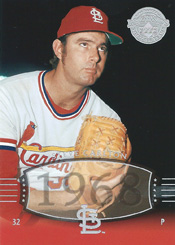
In the Year of the Pitcher, Steve Carlton showed he could hit as well as pitch for the Cardinals.

On June 13, 1968, Carlton hit his first home run in the major leagues, and allowed one run in eight innings, leading the Cardinals to a 3-1 victory over the Braves at Atlanta.

Carlton’s home run was the first by a Cardinals pitcher since Bob Gibson hit one against Jim Lonborg of the Red Sox in Game 7 of the 1967 World Series and the first by a St. Louis pitcher in the regular season since Larry Jaster accomplished the feat on Sept. 23, 1966, against Larry Jackson of the Phillies.

Mistake pitch

The 1968 season became known as the Year of the Pitcher because a mere six major-league players batted .300 or better and the sport was dominated by the likes of Gibson (1.12 ERA, 13 shutouts, 268 strikeouts), the Giants’ Juan Marichal (26 wins, 30 complete games), the Tigers’ Denny McLain (31 wins, 28 complete games) and the Indians’ Luis Tiant (1.60 ERA, nine shutouts).

Carlton, 23, was developing into a premier pitcher. The left-hander would finish the 1968 season with a 13-11 record, 2.99 ERA and five shutouts.

He also was showing an ability to handle the bat.

Carlton, a left-handed batter, had three hits in his last three at-bats entering his start against the Braves and his batting average was .233.

In the third inning, in his first at-bat of the game, Carlton hit an 0-and-2 fastball from Braves starter Ken Johnson over the wall in right-center.

“The pitch was right down the middle with nothing on it,” Johnson said to the St. Louis Post-Dispatch. “I tried to go inside with that pitch and I figured on coming back with a knuckleball. Carlton hit a pitch that my two sons, both pitchers, wouldn’t make in Little League.”

Carlton said he never hit a home run in the minor leagues, but hit some in winter league games.

Knuckle under

Carlton’s home run gave the Cardinals a 1-0 lead. The Braves tied the score in the sixth on Joe Torre’s RBI-single with two outs.

Carlton pitched eight innings, allowing four singles and a walk and striking out seven, and departed with the score tied at 1-1.

In the 12th inning, shortstop Dick Schofield led off for the Cardinals with a home run against Phil Niekro. “A lousy, lousy knuckler,” Niekro told the Atlanta Constitution.

Said Schofield: “It wasn’t one of Niekro’s better knucklers because nobody hits those.”

The home run was Schofield’s 17th in 16 major-league seasons and his only one in 1968.

Phil Gagliano, who batted after Schofield, walked and scored on Lou Brock’s double, extending the Cardinals’ lead to 3-1.

In the Braves’ half of the 12th, Wayne Granger struck out Torre, walked Deron Johnson and yielded a single to Tommie Aaron. Hal Gilson relieved and retired Clete Boyer and Marty Martinez on groundouts, stranding the runners and sealing the win. Boxscore

Power pitchers

Carlton hit two more home runs for the Cardinals _ on July 27, 1968, against the Pirates’ Bob Moose and on Sept. 1, 1969, against the Astros’ Don Wilson _ before he was traded to the Phillies after the 1971 season.

Carlton hit 13 regular-season home runs in his major-league career and one in the postseason. In Game 3 of the 1978 National League Championship Series, Carlton hit a three-run home run against the Dodgers’ Don Sutton.

Bob Gibson holds the Cardinals record for regular-season career home runs by a pitcher, with 24. Gibson also holds the club single-season mark for regular-season home runs by a pitcher, with five.

The all-time major-league leader for regular-season career home runs by a pitcher is Wes Ferrell. He hit 38 in a big-league career from 1927-41 with the Indians, Red Sox, Senators, Yankees, Dodgers and Braves.

After Ferrell, the next best in regular-season career home runs by a pitcher are Bob Lemon (37) and Warren Spahn (35).

Read Full Post »

(Updated April 19, 2019)

In his brief stint with the Cardinals, Mark Worrell provided a lasting impression with his hitting instead of his pitching.

On June 5, 2008, in the second game of a doubleheader between the Cardinals and Nationals in Washington, Worrell hit a three-run home run in his first major-league plate appearance.

Worrell, no relation to Cardinals reliever Todd Worrell, was regarded as a premier pitching prospect, but didn’t last long with St. Louis.

After four relief appearances for the 2008 Cardinals, Worrell was returned to the minors, got traded after the season and hurt his arm.

His place in franchise lore, though, was secured as one of 10 Cardinals to hit a home run in his first plate appearance in the major leagues.

The list:

_ Eddie Morgan, pinch-hitter, April 14, 1936, vs. Cubs.

_ Wally Moon, center fielder, April 13, 1954, vs. Cubs.

_ Keith McDonald, pinch-hitter, July 4, 2000, vs. Reds.

_ Chris Richard, left fielder, July 17, 2000, vs. Twins.

_ Gene Stechschulte, pinch-hitter, April 17, 2001, vs. Diamondbacks.

_ Hector Luna, second baseman, April 8, 2004, vs. Brewers.

_ Adam Wainwright, pitcher, May 24, 2006, vs. Giants.

_ Mark Worrell, pitcher, June 5, 2008, vs. Nationals.

_ Paul DeJong, pinch-hitter, May 28, 2017, vs. Rockies.

_ Lane Thomas, pinch-hitter, April 19, 2019, vs. Mets.

Climbing the ladder

Worrell, a starting pitcher at Florida International University, was selected by the Cardinals in the 12th round of the 2004 amateur baseball draft and established himself as a quality reliever. In 2005, Worrell played for Class A Palm Beach, led all minor leagues in saves with 35 and was named Cardinals minor-league pitcher of the year.

Worrell led the Texas League in saves, with 27 for Class AA Springfield in 2006, and he struck 66 batters in 67 innings for Class AAA Memphis in 2007.

In 21 games for Memphis in 2008, Worrell had a 1.88 ERA and 38 strikeouts in 24 innings before he was called up to the Cardinals.

Worrell had an unorthodox pitching motion. “As he begins his delivery, Worrell bends over and then springs up to throw sidearm while stepping almost toward first base,” the St. Louis Post-Dispatch reported.

“In the end, his success is the ball on the edge and not the middle of the plate,” said Cardinals manager Tony La Russa.

Power pitcher

Worrell made his major-league debut on June 3, 2008, in the Cardinals’ first visit to Nationals Park and pitched a scoreless ninth inning in a 6-1 St. Louis victory. Boxscore

Two nights. later, Worrell made his second appearance when he relieved rookie starter Mike Parisi in the fifth. Parisi allowed eight runs in four innings and also got his first major-league hit, a two-run double against Nationals starter Tim Redding.

After Worrell pitched a scoreless fifth, the Cardinals batted in the sixth against Redding, looking to chip away at an 8-3 deficit. With runners on first and third, two outs, Worrell made his first major-league plate appearance and hit a 3-and-2 fastball from Redding into the left field stands for a three-run home run.

“Look at these pitchers! That’s a home run,” Nationals television broadcaster Bob Carpenter exclaimed as the ball carried over the fence. Video

“I let two different pitchers drive in five runs and a guy that had never swung a bat in the big leagues hit a three-run homer off me,” Redding said to the Washington Times. “Other than those two outcomes, I felt good.”

Worrell pitched a scoreless sixth and exited with the Nationals ahead, 8-6. The Cardinals rallied with two runs in the ninth to tie the score at 8-8 and went ahead, 9-8, with a run in the 10th, but the Nationals got a two-run home run from Elijah Dukes against Ryan Franklin in the bottom half of the inning and won, 10-9. Boxscore

Arm ailment

Worrell made his third appearance for the Cardinals on June 12 against the Reds and was the losing pitcher, yielding two runs in two-thirds of an inning. Boxscore

After one more appearance, in which he gave up three runs to the Phillies, Worrell was sent back to Memphis. His record in four games with the Cardinals was 0-1 with a 7.94 ERA, but his slugging percentage was 2.000.

On Dec. 4, 2008, the Cardinals traded Worrell and a player to be named to the Padres for shortstop Khalil Greene. Three months later, the Cardinals sent the Padres pitcher Luke Gregerson to complete the deal.

At spring training with the Padres in 2009, Worrell injured his right elbow and needed reconstructive surgery, sidelining him for the season.

Two years later, Worrell returned to the major leagues with the 2011 Orioles and yielded eight earned runs in two innings over four appearances for a 36.00 ERA.

In his last big-league appearance, on July 24, 2011, Worrell gave up a three-run home run to Mike Trout, the first in the big leagues for the Angels rookie. Trout, 19, became the first teen to hit a home run in the major leagues since 2007, according to the Los Angeles Times. Boxscore

Read Full Post »

« Newer Posts - Older Posts »