Feeds:
Posts
Comments

Archive for the ‘Hitters’ Category

(Updated May 3, 2020)

Seeking a power bat for a lineup struggling to score, the Cardinals got the slugger they wanted but paid a hefty price, dealing a player who would win the National League batting title.
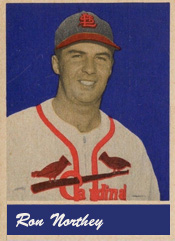
On May 3, 1947, the Cardinals traded outfielder Harry Walker and pitcher Freddy Schmidt to the Phillies for outfielder Ron Northey.

Northey was an established left-handed pull hitter whose swing appeared tailored to take advantage of the short distance (310 feet) down the line from home plate to the right field wall at Sportsman’s Park in St. Louis.

Walker, also a left-handed batter, lacked Northey’s power.

“Walker, a great fielder and fast man, wasn’t hitting far enough or long enough to suit” the Cardinals, The Sporting News reported.

The Cardinals, though, didn’t know Walker was close to mastering a revamped swing that would lead to a breakthrough.

Popgun attack

After winning the 1946 World Series championship, the Cardinals had a dreadful start to the 1947 season. They lost 10 of their first 12 games, including the last eight in a row. They scored two runs or less in five of those 10 losses.

Cardinals manager Eddie Dyer began the season with a starting outfield of Dick Sisler in left, Walker in center and Enos Slaughter in right, with Stan Musial at first base. When Walker started slowly, batting .200 with no RBI in 10 games, the Cardinals stepped up efforts to acquire Northey.

Northey debuted in the big leagues with the 1942 Phillies. He had a strong throwing arm and a power stroke. He also had an ear problem. In his freshman year at Duke University, Northey was beaned by a pitch and experienced a buzzing in his ears “so annoying that Northey often is forced to rattle papers to keep his mind off the buzz,” The Sporting News reported.

Northey had his best year with the Phillies in 1944 when he batted .288 with 35 doubles, 22 home runs and 104 RBI.

He pounded right-handed pitchers and was vulnerable against left-handers. In 1946, Northey batted .266 with 16 home runs versus right-handers and .159 with no home runs against left-handers.

In 1947, Northey reported late to spring training after unsuccessfully holding out for more pay. He also clashed with Phillies manager Ben Chapman.

Let ‘er rip

Walker and Schmidt were in Philadelphia with the Cardinals and about to board a train for their trip to Boston when informed they had been dealt to the Phillies.

Cardinals owner Sam Breadon told the St. Louis Star-Times, “Harry Walker is a fine defensive outfielder, but what we need right now is punch and I think Northey has it.”

The Dayton Herald called the trade “one born of desperation and panic on the part of the world champions” and added, “Ron isn’t the Cardinals type of performer. The pudgy fly-chaser isn’t a speed merchant and just an average outfielder, except for his throwing arm, which is one of the best in the business.”

The Pittsburgh Press noted, “One month ago, Harry Walker was being touted by Eddie Dyer as a can’t-miss star for 1947, while Northey, some 20 pounds too heavy, was reported to be in Ben Chapman’s doghouse.”

Northey joined the Cardinals in Boston for their series with the Braves and Dyer placed him in the lineup for a Sunday doubleheader on May 4. With Terry Moore taking over for Walker in center, Northey replaced Sisler in left.

Northey singled and scored in the opener, a 4-3 Braves victory that extended the St. Louis losing streak to nine.

In the second game, Northey went 3-for-4 with four RBI and three runs scored, sparking St. Louis to a 9-0 triumph. He produced a two-run home run off Mort Cooper, the former Cardinal ace, in the fourth, a solo home run against Glenn Elliott in the sixth and a RBI-single off Dick Mulligan in the seventh. Boxscore

Hot hitting

Walker went on a tear as soon as he joined the Phillies, getting 10 hits in his first 24 at-bats. He stopped trying to pull pitches and perfected a batting style suggested by his brother, Dodgers outfielder Dixie Walker, who urged his sibling to close his stance and spray the ball to all fields.

In 130 games for the 1947 Phillies, Walker batted .371 with 181 hits, including a league-leading 16 triples.

Even with his 5-for-25 effort for the Cardinals added to his season total, Walker easily won the National League batting crown at .363. The runner-up, Bob Elliott of the Braves, hit .317.

Walker also placed second in the NL in on-base percentage at .436. Only the Reds’ Augie Galan (.449) did better.

Northey batted .293 with 15 home runs and 63 RBI for the 1947 Cardinals. True to form, he hit .313 versus right-handers and .154 against left-handers.

The Cardinals ended the 1947 season in second place at 89-65, five behind the Dodgers.

Northey played two more seasons for St. Louis, batting .321 with 13 home runs in 1948 and .260 with seven home runs in 1949.

Walker batted .292 for the 1948 Phillies, was traded to the Cubs and then shipped to the Reds.

After the 1949 season, in a classic example of what goes around comes around, the Cardinals sent Northey and infielder Lou Klein to the Reds to reacquire Walker.
Read Full Post »

Given a pair of assignments that took him outside his customary role, Bob Tewksbury delivered on both and produced an intriguing victory for the Cardinals.

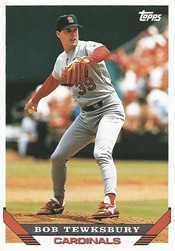
On April 25, 1992, Tewksbury, a starting pitcher, was brought into a game against the Expos as an emergency reliever for a depleted Cardinals bullpen.
He also was tasked with making a plate appearance with two outs and the potential winning run at third base, a situation which usually would have called for a pinch-hitter.

Defying the odds, Tewksbury pitched two innings of scoreless relief and got the hit that brought St. Louis a walkoff win.

April drama

Looking to jump-start their season after losing nine of their first 15, the Cardinals opened a three-game series against the Expos at St. Louis on April 24, 1992. Trailing 3-2 with two outs and none on in the ninth, the Cardinals scored two runs off closer John Wetteland and won, 4-3. Boxscore

The next night, the starting pitching matchup was Ken Hill, the former Cardinal, for the Expos against Jose DeLeon. The Cardinals tied the score, 1-1, in the eighth on a Ray Lankford home run off Hill.

Relief pitching for both teams was sharp and the score remained tied through 15 innings.

In the 16th, after having used all six pitchers in his bullpen, Cardinals manager Joe Torre called on Tewksbury, who hadn’t made a relief appearance since May 5, 1990.

Tewksbury held the Expos scoreless in the 16th and 17th, allowing one base runner, Marquis Grissom, who singled.

Batter up

In the bottom half of the 17th, with Mel Rojas in his fourth inning of relief for the Expos, Rex Hudler and Gerald Perry opened with consecutive singles, but Brian Jordan grounded into a double play.

With Hudler on third and two outs, Torre, out of position players on the bench, let Tewksbury bat.

In 1992, Tewksbury was hitless in six at-bats before facing the Expos.

Confident swing

Tewksbury took the first pitch from Rojas for ball one.

On the next delivery, Tewksbury swung and lined the ball over the head of left fielder John Vander Wal for a game-winning single.

“That’s the hardest ball I’ve ever hit,” Tewksbury told the St. Louis Post-Dispatch. “I felt confident going to the plate. I went to the batting cage three times today to hit.”

The RBI was Tewksbury’s sixth in 120 career at-bats in the big leagues. He would finish his career with a .132 batting average and 19 RBI. To put into perspective the rarity of his hitting feat, consider that Tewksbury batted .073 (3-for-41) in his career against the Expos.

For his effort, Tewksbury also earned the win, the first and only one he would get in relief in his 13 years in the major leagues. His other 109 big-league wins all came as a starter. Boxscore

Previously: Cards turned from skeptics to supporters of Bob Tewksbury

Read Full Post »

Proving he was recovered from major surgery and still had the ability to alter the outcome of a game, Ray Lankford dazzled the Dodgers in an epic ninth-inning performance that delivered a win for the Cardinals against their former closer.

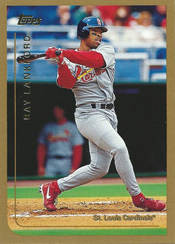
In his first game since having an off-season rotator cuff operation on his left shoulder, Lankford sparked a Cardinals comeback against the Dodgers and Todd Worrell on April 22, 1997.
The Cardinals trailed by a run with two outs and none on in the ninth when Lankford performed his magic.

Help wanted

The Cardinals went to Los Angeles to complete a road trip that began with three games in Miami against the Marlins and continued with three versus the Padres in Honolulu.

Lankford, working his way back to form on an injury rehabilitation assignment with the Class A minor-league affiliate at Prince William, Va., initially wasn’t expected to rejoin the Cardinals until May 1.

However, when the Cardinals struggled to score five total runs over four games _ a pair of 2-1 losses to the Marlins and wins of 1-0 and 2-1 over the Padres _ general manager Walt Jocketty sent Jerry Walker, vice president for player personnel, to watch Lankford at Prince William.

When Jocketty received a glowing report _ “Jerry said he was swinging the bat well and throwing well,” Jocketty told the St. Louis Post-Dispatch _ the Cardinals brought Lankford to Los Angeles for the series opener against the Dodgers.

Call the closer

Manager Tony La Russa put Lankford in center field and batted him third in the order, behind Ron Gant and ahead of Brian Jordan, against Dodgers starter Pedro Astacio. Lankford drew a walk in the first inning, grounded out in the third, doubled in the fifth and flied out in the seventh.

In the ninth, Dodgers manager Bill Russell brought in Worrell to protect a 4-3 lead.

Worrell, 37, had pitched six seasons (1985-89 and 1992) for the Cardinals, amassing 129 saves and a 2.56 ERA. He was a key member of their 1985 and 1987 pennant-winning clubs.

The former Cardinal had gotten off to a good start for the 1997 Dodgers, with five saves and a 1.12 ERA.

Speed burns

Worrell appeared on his way to a routine save against the Cardinals. He retired Delino DeShields on a groundout and struck out Gant.

Lankford came up next and reached first safely on an infield single.

With Jordan at the plate, Lankford swiped second. Then he stole third.

“When we let catchers know that we’re running, that can kind of mess them up a little,” Lankford said.

A rattled Worrell walked Jordan.

“The prevailing theory is that when Lankford got to third with the tying run Worrell was reluctant to throw his slider for fear he would bounce it in the dirt,” wrote Rick Hummel of the Post-Dispatch.

The next batter, Gary Gaetti, was 2-for-19 on the season with runners in scoring position. With Jordan running on the pitch, Worrell grooved a fastball that Gaetti pulled into the left-field corner, scoring Lankford and Jordan and giving the Cardinals a 5-4 lead.

John Mabry followed with a double to right-center, scoring Gaetti.

“You don’t see that happen very often when Todd can’t hold the lead,” Russell told the Los Angeles Times.

Said Worrell: “Some nights you have it, some nights you don’t. I can’t get the third out. It makes it hard to swallow.”

Cardinals closer Dennis Eckersley set down the Dodgers in order in the bottom of the ninth, sealing the 6-4 St. Louis victory. Boxscore

Pressure points

“I figured (Lankford) would provide a spark,” said Jocketty. “I think he put some life into the team.”

Said La Russa: “Could it be any better than that? It was just the way he did it. He got base hits, he walked, he stole bases, he played good defense. Wow.”

The next night, April 23, the Dodgers led the Cardinals, 2-1, with one out and the bases empty in the ninth when Russell brought in Worrell. Gaetti greeted him with an infield single and was lifted for a pinch-runner, Steve Scarsone.

Mabry struck out and Scarsone swiped second.

Up next was Gant. He hit a towering fly into a 25-mph wind to left that was caught for the final out. “If the wind hadn’t been blowing in,” said Worrell, “that ball might have gone out.” Boxscore

Worrell, in the last year of an 11-season major-league career, posted 35 saves for the 1997 Dodgers, but had a 2-6 record and 5.28 ERA.

Lankford had one of his best Cardinals seasons in 1997. He batted .295 with 36 doubles, 31 home runs, 98 RBI and 21 stolen bases in 133 games. His on-base percentage of .411 was his single-season career high.

Previously: Ray Lankford found redemption in 5-strikeout game

Read Full Post »

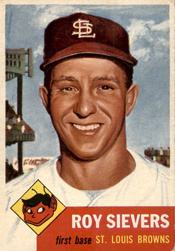
Roy Sievers, a St. Louis native who began his major-league career with the American League Browns, nearly ended it with the National League Cardinals.

Sievers, a premier slugger in the 1950s with the Browns and Senators, was 38 years old and primarily relegated to pinch-hitting when the Cardinals invited him to spring training in 1965.
Tempted by the offer because of his friendship with Cardinals manager Red Schoendienst, Sievers instead chose to return to the Senators because of their proven faith in him.

Tabbed for power

As a youth, Sievers lived in a house three blocks from Sportsman’s Park, home of the Cardinals and Browns. Both clubs scouted him when he played for the Beaumont High School team. According to the Washington Post, Sievers modeled his swing after Cardinals Gashouse Gang slugger Joe Medwick.

After he graduated, Sievers signed with the Browns because he thought he had a better chance of playing for them than the Cardinals, he told a biographer for the Society for American Baseball Research.

A right-handed batter who played first base and outfield, Sievers won the AL Rookie of the Year Award with the Browns in 1949. He hit .306 with 16 home runs and 91 RBI for the seventh-place team.

After five seasons (1949-53) with the Browns, Sievers was traded to the Senators. Sievers four times produced 100 RBI or more for the Senators. His best season was 1957 when he batted .301 and led the AL in home runs (42) and RBI (114) for the last-place club.

While with the Senators, Sievers was selected by Warner Brothers to be the double for actor Tab Hunter in the 1958 movie “Damn Yankees.” Hunter portrayed slugger Joe Hardy, who, like Sievers, wore uniform No. 2.

“Because Hunter took his close-up cuts from the left side of the plate,” the New York Times reported, “Sievers is shown as a left-handed batter, thanks to mirror-image technology.”

Cardinals foe

Though he never played for the Cardinals, Sievers played against them when he was acquired by the Phillies. As the Phillies’ first baseman, Sievers had three home runs and nine RBI versus the Cardinals in 1962 and one home run and 10 RBI versus them in 1963.

Sievers was the Phillies’ Opening Day first baseman in 1964, but a month later John Herrnstein took over and Sievers was benched.

Hobbled by a calf injury, Sievers was batting .183 with four home runs when the Phillies sold his contract to the Senators on July 16, 1964. Sievers was grateful to Senators general manger George Selkirk for taking a chance on him and returning him to Washington.

Used primarily as a pinch-hitter, Sievers batted .172 with four home runs for the 1964 Senators and was released after the season.

Sorry, St. Louis

The Cardinals, who overtook the Phillies to clinch the 1964 NL pennant and defeated the Yankees in the World Series, were seeking a right-handed batter for a role as a pinch-hitter for 1965.

Sievers, a free agent, was interested in filling the role, according to The Sporting News, but wanted a contract and a spot on the roster.

Cardinals general manager Bob Howsam declined to offer Sievers a contract but did invite him to go to spring training and try to earn a roster spot. When the Senators made Sievers the same offer, he accepted, turning down a chance to play for the reigning World Series champions in his hometown.

“I felt I owed it to George Selkirk to go to Florida with the Senators,” Sievers said. “They picked me up when the Phillies let me go last year. They knew I had a bad leg at the time, but still paid $25,000 to get me.”

Sievers told the St. Louis Post-Dispatch he would have gone to the Cardinals if they had signed him to a contract before spring training.

“The Cardinals have the best-balanced team in the National League,” Sievers said. “They just need some right-handed punch on the bench.”

End of the line

Sievers played well enough in spring training to earn a contract and a spot as a backup to first baseman Bob Chance on the Opening Day roster of the 1965 Senators. Sievers got into 12 games, batted .190 and was released in May 1965.

Returning home to St. Louis, Sievers worked out with the Cardinals on June 8, but he was just trying “to keep in trim,” the Post-Dispatch reported. About a week later, Sievers got a tryout with the White Sox but wasn’t signed.

In 17 big-league seasons, Sievers produced 1,703 hits, 318 home runs and 1,147 RBI.

In November 1965, Sievers was hired by the Reds to be a coach on the staff of manager Don Heffner. Like Sievers, Heffner had played for the Browns. Bill DeWitt Sr., Reds president, had been owner and general manager of the Browns.

Rob Sievers, Roy’s son, played baseball for Hazelwood High School in Florissant, Mo., and was selected by the Cardinals in the sixth round of the 1970 amateur draft. Rob Sievers played two years in the Cardinals’ system, primarily as a third baseman and first baseman.

Read Full Post »

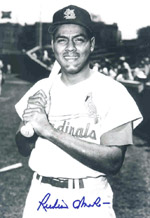
Desperate for a quality shortstop, the Cardinals turned to Ruben Amaro and gave him his first opportunity to play in the major leagues. Amaro fielded splendidly but didn’t hit well enough and the Cardinals quickly gave up on him.

Amaro played one season for the Cardinals. Traded to the Phillies after the 1958 season, he went on to have a long career as a player, coach and scout.
Though Amaro’s time with the Cardinals was relatively short, it covered a lot of ground, beginning in Mexico and ending in Japan.

Career choice

Born in Mexico in 1936, Amaro was the son of Santos Amaro, a powerful hitter who played baseball in Cuba in winter and in Mexico in summer.

As a teen-ager, Ruben Amaro caught the attention of the Cardinals when he played for the Mexican team in the Central American Games. The Cardinals offered him a contract in 1954.

At the time, Amaro, 18, was considering a career in engineering and his older brother, Mario, wanted to be a doctor, the St. Louis Post-Dispatch reported. Amaro saw baseball as a way to help pay for his brother’s education.

“All the time my father played baseball, he didn’t make much money,” Amaro told Jack Rice of the Post-Dispatch. “Maybe I can. I play baseball, Mario goes to medical school.”

The Cardinals sent Amaro to their Class C team in Mexicali, a city situated on the border of Mexico and the United States. Amaro played two seasons for the Mexicali Eagles, batting .285 in 1954 and .305 with 18 home runs in 1955.

Racial prejudice

Promoted to Class AA Houston in 1956, Amaro “arrived with the reputation of being one of the finest fielders in baseball. Possessing a great arm, sure hands and fine speed, Amaro has not disappointed,” The Sporting News reported.

Playing shortstop, Amaro batted .266 with 64 RBI in 1956.

The Cardinals assigned him to Houston again in 1957. When the club went to Shreveport, La., for a series in May, Amaro wasn’t allowed to play “because of the Louisiana racial law,” The Sporting News reported.

Humiliated, Amaro considered quitting but stuck with it after a talk with his father, according to a biography by the Society for American Baseball Research.

Climbing the ladder

Houston won the 1957 Texas League championship and faced Atlanta, the Southern Association champion, in the Dixie Series.

Though Amaro hit .222 during the season, he provided the key hit in the Dixie Series. His two-run home run off Don Nottebart in the seventh inning lifted Houston to a 3-1 series-clinching victory in Game 6.

In 1958, Amaro was assigned to the Class AAA Rochester Red Wings. St. Louis that season primarily started Eddie Kasko at shortstop. In July, when Kasko’s batting average dropped to .195, the Cardinals benched him and called up Amaro, even though he was batting .200 for Rochester.

Stan lends a hand

Amaro got to St. Louis on July 15 and was named a starter by manager Fred Hutchinson for that night’s game against the Braves. “His name was in the lineup card as soon as his foot was in the door,” the Post-Dispatch reported.

The newspaper cautioned that Amaro “is well known to the Cards as a strong fielder but a weak hitter. His batting is the sorrow of his father, Santos Amaro.”

Sports editor Bob Broeg suggested Amaro’s arrival to play shortstop “provides just another chapter in the club’s almost constant trouble at the key defensive position.” With the exception of Marty Marion in the 1940s, the Cardinals “rarely have known satisfaction at a post which ranks second to none in defensive importance,” Broeg wrote.

In his book “Stan Musial: An American Life,” author George Vecsey said the Cardinals issued Amaro a pair of uniform pants at least two sizes too big. When Musial saw the rookie looking awkward in the baggy uniform, he said to clubhouse attendant Butch Yatkeman, “Would you get this young man a pair of pants so he can play like a major leaguer?”

When Amaro stepped onto the Busch Stadium field for the first time, he timidly watched the Cardinals take batting practice. Musial called out to the players, “He’s playing today. Let him have some swings.”

Amaro was forever grateful to Musial for his kindness.

Good glove

At shortstop that night, Amaro went hitless in two at-bats against the Braves’ Joey Jay before being lifted for pinch-hitter Wally Moon, but his fielding impressed.

“After two easy fielding chances, his third was a hard-hit ball that made him range far toward third base and deeply,” the Post-Dispatch observed. “It is a testing place for a shortstop’s arm and he met the test well.” Boxscore

The next night, Amaro got his first big-league hit, a double off future Hall of Famer Warren Spahn. Boxscore

Amaro produced six hits in his first 18 at-bats (a .333 batting average) for the Cardinals, but struggled after that.

In 40 games, including 21 starts at shortstop, Amaro batted .224 for the 1958 Cardinals. He hit .364 (8-for-22) against left-handed pitchers and .167 (9-for-54) versus right-handers.

Strong resume

After the 1958 season, Amaro took part in a series of exhibition games the Cardinals played on a goodwill tour of Japan.

When the club returned home, Amaro was dealt to the Phillies for outfielder Chuck Essegian on Dec. 3, 1958. “I cried when they traded me,” Amaro said.

After a season in the minors, Amaro played for the Phillies from 1960-65. He won a NL Gold Glove Award in 1964. Amaro also played for the Yankees (1966-68) and Angels (1969).

After his playing career, Amaro was a scout, minor-league manager, executive and big-league coach.

His son, Ruben Amaro Jr., a Stanford University graduate, played in the big leagues for eight years (1991-98) as an outfielder with the Angels, Phillies and Indians. He was general manager of the Phillies from 2009-2015.

Read Full Post »

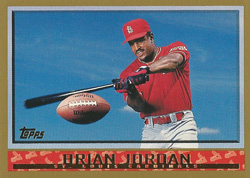
The Cardinals hoped Brian Jordan would spend the 1992 season in the minor leagues and get the at-bats he needed to continue his development as a baseball player. Instead, two games into their season, the Cardinals promoted Jordan and put him into their everyday lineup as the right fielder.

On April 8, 1992, Jordan made his big-league debut and drove in four runs for the Cardinals against the Mets at St. Louis.

Three months later, an overmatched Jordan would be back in the minor leagues.

However, his early-season experience with the 1992 Cardinals wasn’t for naught. Jordan proved he had the potential to succeed in the big leagues. That spurred him to make a fulltime commitment to baseball and end his professional football career.

Getting close

Jordan was selected by the Cardinals as a supplemental pick between the first and second rounds of the June 1988 amateur baseball draft. He split his time in 1989, 1990 and 1991 playing baseball in the Cardinals’ minor-league system and playing football as a defensive back for the NFL Falcons.

In 1991, Jordan batted .264 in 61 games for Class AAA Louisville. When he reported to spring training in 1992, Jordan was hoping to earn a spot on the Cardinals’ Opening Day roster, even though he still was considering playing football for the Falcons that year.

Jordan had a good Grapefruit League season, batting .292 with seven RBI, but with St. Louis planning to go with a starting outfield of Pedro Guerrero in left, Ray Lankford in center and Felix Jose in right, it was determined Jordan should play every day in Louisville.

On April 1, 1992, Cardinals manager Joe Torre told Jordan, 25, he wouldn’t make the Opening Day roster.

“He took it all right,” Torre said to the St. Louis Post-Dispatch. “I told him, ‘You’re really close. You could make the team, but you couldn’t play and we want you to play, to get some at-bats.’ I think he understood. He shook my hand and thanked me for the opportunity.”

Said Cardinals general manager Dal Maxvill: “He’s got an awful lot of confidence. He’s not afraid of anything. You’ve seen him fooled, taking one-hand swings _ and that’s an adjustment he’ll have to make. He knows he has to play every day. If he stayed here, he’d be sitting and that wouldn’t help his development at all.”

Call for help

Five days later, on April 6, 1992, the Cardinals opened the regular season at home against the Mets. Milt Thompson started in right field instead of Jose, who had strained his right hamstring.

The next night, Cardinals first baseman Andres Galarraga broke his right wrist when hit by a pitch from Wally Whitehurst.

With Jose and Galarraga headed for the disabled list, the Cardinals reversed course and called up Jordan. He arrived in St. Louis the morning of April 8 and was put in the lineup for that night’s game against the Mets.

Torre shifted Guerrero from left field to first base and inserted Bernard Gilkey in left field and Jordan in right.

“Jordan is going to contribute a lot and fill in well in the outfield,” said Cardinals third baseman Todd Zeile.

Good game

Torre placed Jordan in the fifth spot in the batting order, behind Guerrero and in front of Gilkey.

In his first big-league at-bat, in the first inning against Sid Fernandez, Jordan struck out on a 2-and-2 fastball.

Two innings later, facing Paul Gibson, Jordan stroked a two-run single off the glove of third baseman Bill Pecota and swiped second.

After Gibson struck him out in the fifth, Jordan contributed a RBI-double off Mark Dewey in the sixth and a RBI-groundout in the eighth. The Cardinals won, 15-7. Boxscore

Learning curve

Torre kept Jordan in the lineup, even though the rookie batted .197 (15-for-76) in April. When Jose came off the disabled list, Jordan got starts in left and center.

After batting .281 (16-for-57) in May, the Cardinals in June gave Jordan a $2.3 million three-year contract, with the stipulation he quit playing football.

After agreeing to the deal, Jordan went into a slump and began to press. It didn’t help that Falcons coach Jerry Glanville kept calling Jordan, trying to convince him to come back to football, according to the Post-Dispatch.

On July 12, the Cardinals returned Jordan to Louisville. He was batting .207 for St. Louis and he had more strikeouts (48) than hits (40).

“He didn’t take it very well,” Torre said of Jordan’s reaction to the demotion. “He was unhappy and mad, but he wasn’t disrespectful. He’s young. He’s impatient … He’s torn and distracted and he has to get himself back on track and get his confidence back. He’s not the same aggressive player we had earlier in the year.”

After several stops and starts, Jordan established himself as the Cardinals’ everyday right fielder in 1995.

In seven years (1992-98) with St. Louis, Jordan batted .291, with 671 hits in 643 games. He became a free agent after the 1998 season and signed with the Braves.


Read Full Post »

« Newer Posts - Older Posts »