Feeds:
Posts
Comments

Archive for the ‘Hitters’ Category

Seeking a right fielder to complete a lineup counted on to contend for a championship, the Cardinals made a bold move and acquired a good one.

On Nov. 17, 2014, the Cardinals obtained outfielder Jason Heyward and reliever Jordan Walden from the Braves for pitchers Shelby Miller and Tyrell Jenkins. The Cardinals needed a right fielder to replace Oscar Taveras, who died in an auto accident three weeks earlier on Oct. 26.
As St. Louis Post-Dispatch columnist Bernie Miklasz presciently noted when the deal was made, Heyward was “an elite defender, the best right fielder in baseball (and) should do an effective job of getting on base and energizing the Cardinals’ speed on the bases.”

Nurturing talent

Heyward moved from New Jersey to suburban Atlanta with his family when he was 2. His parents, Eugene and Laura, graduated from Dartmouth. Eugene became an electrical engineer for ITT Technologies, designing electronic warfare systems for Robins Air Force Base, and Laura was an insurance underwriter for Life of Georgia before joining Georgia Power, according to the Atlanta Constitution.

Laura helped Jason develop a love of writing. “He did a writing project on the Negro baseball league in high school,” Laura told the Atlanta newspaper, “and I could see he really had a talent for writing. I thought maybe he could be a sports writer, because you never know if it’s going to work out with baseball. I wanted him to be well-rounded.”

Though his father played basketball at Dartmouth, baseball became Jason’s favorite sport. He began playing the game when he was 5.

Two decades later, when asked by Bernie Miklasz why he preferred baseball to other sports, Heyward said, “It’s the tradition that it holds. It’s the history. It’s timeless … For me growing up, it was just easy to fall in love with it. There’s all the thought that goes into it. The strategy, the cat and mouse games. It’s also a humbling game, because you will fail more times than you succeed and then it becomes all about how you handle it going forward.”

Heyward became a fan of the Braves, who won five National League pennants and a World Series title in the 1990s when he was a youth. After a stellar high school playing career, the Braves made Heyward the first outfielder taken in the opening round of the 2007 amateur draft.

Dazzling debut

A left-handed batter, Heyward was 6-foot-5, 240 pounds and had all the tools. After three seasons in the minors, Baseball America magazine named him the best prospect in the game.

He had a storybook start to his major-league career.

On April 5, 2010, the Braves opened against the Cubs at Atlanta. Heyward was tabbed by manager Bobby Cox to debut in right field and bat seventh.

Braves icon Hank Aaron was there to throw the ceremonial first pitch and Heyward was given the honor of catching the toss.

After delivering the pitch, Aaron offered advice to the rookie. “He said, ‘Have fun. You’re ready to do this,’ ” Heyward told the Atlanta Constitution.

In the opening inning, with the score tied at 3-3, the Braves had two runners on base against Carlos Zambrano, an imposing right-hander.

Zambrano’s first two deliveries to Heyward missed the strike zone and Heyward didn’t bite at either. On the 2-and-0 pitch, Zambrano threw a sinking fastball toward the inner part of the plate. Heyward sent a drive deep into the right-field stands for a three-run home run. Boxscore and Video

Heyward, 20, became the youngest player to hit a homer in his first big-league plate appearance since Ted Tappe, 19, of the Reds did it in 1950. Boxscore

Heyward followed the Opening Day drama with a strong season (.393 on-base percentage and 83 runs scored) and placed second to Giants catcher Buster Posey, whom he competed against in high school, in National League Rookie of the Year Award balloting.

Good as gold

In his first plate appearance on Opening Day in 2011, Heyward again slammed a home run. He joined Kaz Matsui of the (2004-05) Mets as the only other player to hit a homer on Opening Day in his first at-bat in each of his first two seasons. Boxscore

The next year, Heyward slugged 27 homers for the 2012 Braves, scored 93 runs and earned the first of five Gold Glove awards. In a playoff game, he made a leaping grab above the wall in right to deprive the Cardinals’ Yadier Molina. Video and Boxscore

In 2013, Heyward suffered a fractured jaw after being struck by a pitch from Mets left-hander Jon Niese. The next year, Heyward batted .169 versus left-handers and later admitted he wasn’t swinging aggressively against them. His fielding remained spectacular, though. Heyward had the highest number of total chances (375) among National League right fielders and committed one error.

Mix and match

Like Heyward had been for the Braves, the Cardinals had their own highly touted right field prospect, Oscar Taveras, who debuted with them in 2014 and helped bring a division title. Cardinals general manager John Mozeliak said Taveras, 22, would have been the right fielder in 2015. Taveras’ death in an alcohol-related car crash in the Dominican Republic changed that plan.

With Heyward eligible to become a free agent after the 2015 season, the Braves were willing to trade him, and when the Cardinals offered to part with Shelby Miller, 24, who had 15 wins for them in 2013 and 10 in 2014, the deal was made.

Though there was a risk Heyward could leave the Cardinals after one season, Mozeliak told the Post-Dispatch, “We had to look at a way to add an impact player to our club … We’ve said all along we’re focused on 2015.”

Knowing Heyward wore uniform No. 22 with the Braves, Cardinals manager Mike Matheny, who also wore that number, gave it to his new right fielder. When he’d debuted with the Braves, Heyward chose No. 22 in memory of a former high school teammate, Andrew Wilmot, who was killed in a car accident.

Switching sides

On Opening Day for the 2015 Cardinals, Heyward produced three hits, including two doubles, in a win against the Cubs at Wrigley Field. Boxscore

After a slow April (.217 batting mark), he produced consistently well, achieving career highs in hits (160), doubles (33), stolen bases (23) and batting average (.293) and winning a Gold Glove Award. He was successful on 88 percent of his steal attempts (23 of 26). Video

As Heyward’s 2015 season neared its end, Derrick Goold of the Post-Dispatch wrote, “He’s the best defensive right fielder in the majors … He’s exceptional with his glove, precise with fundamentals and takes extra bases.”

The 2015 Cardinals finished with the best record (100-62) in the majors. Their reward: a matchup in the fall tournament with the third-place finisher in their division _ the Cubs. Heyward batted .357 in the series, but the Cubs prevailed. Then they stung the Cardinals again, signing Heyward to an eight-year $184 million contract.

In explaining why he went to the Cubs, even though the Cardinals’ offer was greater in guaranteed value and more overall money, Heyward said he saw Chicago as more of the up-and-coming franchise.

“You have to look at age, you have to look at how fast the (Cardinals) team is changing and how soon those changes may come about,” Heyward told the Chicago Tribune. “You have Yadier (Molina), who is going to be done in two years, maybe. You have Matt Holliday, who is probably going to be done soon … (Adam) Wainwright is probably going to be done in three or four years … I felt like if I was to look up in three years and see a completely different (Cardinals) team, that would kind of be difficult. Chicago really offers an opportunity to come into the culture and be introduced to the culture by a young group of guys.”

The Cubs further strengthened themselves, while weakening the Cardinals, by signing free-agent pitcher John Lackey, who won 13 for St. Louis in 2015. Reacting to the defections of two prominent Cardinals to the Cubs, Tribune columnist David Haugh wrote, “What’s next, a Mike Shannon Grill in Wrigleyville?”

Heyward was correct about the Cubs being on the rise. In 2016, his first season with them, the Cubs became World Series champions for the first time since 1908.

Heyward won another Gold Glove Award with the 2016 Cubs but he batted .230 with a mere seven home runs. In the World Series versus Cleveland, he had no RBI, scored no runs and batted .150.

In seven seasons with Chicago, Heyward batted .245. The Cubs released him in November 2022. According to the Tribune, the Cubs were on the hook to pay him $22 million for 2023, the final year of the eight-year contract. Heyward also was to get four $5 million installments from 2024 through 2027 as part of his initial signing bonus with Chicago.

Read Full Post »

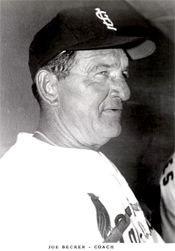
For a club with Bob Gibson and Steve Carlton, the Cardinals hired a coach who caught Bob Feller and aided the development of Sandy Koufax and Don Drysdale.

In October 1964, Joe Becker joined the Cardinals as pitching coach on the staff of newly appointed manager Red Schoendienst.

Becker, a St. Louisan, came to the Cardinals from the Dodgers after serving 10 seasons (1955-64) as their pitching coach. During that time, the Dodgers won three World Series titles (1955, 1959, 1963) and four National League pennants (1955, 1956, 1959, 1963). Becker coached three Cy Young Award winners: Don Newcombe (1956), Don Drysdale (1962) and Sandy Koufax (1963).

A catcher who played in the Cardinals farm system, Becker reached the majors with Cleveland the same year another rookie, Bob Feller, joined the club.

Learning the ropes

Becker grew up on the south side of St. Louis and attended Cardinals games as a Knothole Gang member. His favorite player was catcher Bob O’Farrell.

In 1930, the year he turned 22, Becker signed with Des Moines, an independent minor league team. “I started at $200 a month in the middle of the Depression and I was the richest kid on the block,” Becker told the St. Louis Post-Dispatch.

The Cardinals purchased his contract during the 1930 season on the recommendation of scout Charley Barrett. Becker played four seasons (1930-33) in the Cardinals’ farm system, then was declared a free agent by baseball commissioner Kenesaw Mountain Landis. After sitting out a year, Becker signed with the San Francisco Seals of the Pacific Coast League in 1935 and became a teammate of their 20-year-old center fielder, Joe DiMaggio.

The Seals sold his contract to the Cleveland Indians and that’s how Becker reached the majors as a backup catcher in 1936. His first big-league hit was a home run at Boston’s Fenway Park against winning pitcher Jim Henry. Boxscore

Most of the time, though, Becker, 28, was catching warmup throws of Cleveland pitchers, including those of 17-year-old fellow rookie Bob Feller.

“Feller was just a kid … but he had the liveliest fastball I ever saw,” Becker said to Bob Broeg of the Post-Dispatch in 1965. “Afterward, he developed not only one good curve, but three or four different sizes and speeds.”

Though Feller’s fastball was a rocket, the ball came in “alive and light” rather than heavy and didn’t sting the catcher’s hand, Becker told the Los Angeles Times.

After a second season with Cleveland in 1937, Becker returned to the minors. At 36, he joined the Navy and served for two years (1944-45) as a chief gunner’s mate on the USS Wake Island, a converted Casablanca-class escort carrier in the Pacific during World War II.

Discharged in February 1946, Becker went to play for a Giants farm team but tore cartilage in a knee early in the season. Discouraged, “I just wanted to go home and forget baseball,” Becker told the Sioux City (Iowa) Journal.

Giants farm director Carl Hubbell convinced Becker to try managing instead. Becker took over a club in Seaford, Del., in 1946 and went on to manage in the minors for nine years in the Giants, Browns and White Sox systems.

Special project

After his first season as Dodgers manager in 1954, Walter Alston replaced pitching coach Ted Lyons with Becker, who had impressed Alston when they managed against one another in the minors.

Becker was put in charge of a pitching staff that included Don Newcombe, Carl Erskine, Johnny Podres and a 19-year-old rookie, Sandy Koufax.

When he first saw Koufax, the left-hander “had a world of stuff,” Becker told the Chicago Tribune, but “was so damn wild he couldn’t throw the ball through an open barn door.”

At spring training in Vero Beach, Fla., “we had a half-dozen mounds and home plates so that several pitchers could work at the same time,” Becker said to Bill Bryson of the Des Moines Register. “They were spaced far enough so there wasn’t any danger from wild pitches _ until Koufax came along.”

Becker moved Koufax to a secluded area of the training site. “Sandy was a sensitive boy and he was getting awfully self-conscious about his wildness,” Becker told Bryson. “The guys were laughing at him and he was losing what little confidence he had. So we had the groundkeepers build us a mound over behind the barracks where nobody could see us.”

Though it took six years to get the desired results _ “Many kids would have given up,” Becker told the Post-Dispatch _ he and Koufax put in the effort to improve the pitcher’s poise, control and confidence. “I’d made up my mind that what the boy needed most was kindness and encouragement _ and work,” Becker said to the Des Moines newspaper. “I never had a pitcher who worked harder.”

Koufax told Bill Bryson, “Becker taught me the curve and just about everything else about pitching. I don’t know whether I ever would have mastered control if Joe hadn’t been so patient with me in those early years.”

(Don Drysdale, a more polished rookie, joined the Dodgers a year after Koufax did, in 1956. Though Becker helped him, too, such as on location of pitches and footwork, the approach was sometimes different. “Becker will bawl me out and chew me out and even tell me I’m lousy, but I like that,” Drysdale told the Los Angeles Mirror. “He does it face to face.”)

Change of scenery

In 1964, the Cardinals won the pennant, dethroning the Dodgers, who finished 80-82, even though Becker’s pitching staff had the best ERA (2.95) in the National League. Management reacted by overhauling Alston’s entire coaching staff. Becker was banished to the minors to manage Spokane. “I’d spent too many years in the minors to go back,” Becker told the Post-Dispatch.

After the Cardinals beat the Yankees for the World Series title, manager Johnny Keane resigned (in part, because club owner Gussie Busch clumsily schemed during the season to hire Dodgers coach Leo Durocher as manager) and joined the Yankees. Red Schoendienst, who replaced Keane, told the Post-Dispatch he talked with pitching coach Howie Pollet about staying but Pollet indicated he wanted to spend more time on his insurance business in Houston.

Schoendienst and the Cardinals then reached out to Becker, who agreed to replace Pollet as pitching coach. (A week after Becker was hired, Pollet was named pitching coach of the Astros.)

“I had talked with some of the Dodgers pitchers abut Joe,” Schoendienst told the Post-Dispatch. “They all said Joe helped them quite a bit, especially with control.”

Though the Cardinals were champions in 1964, their pitching staff allowed more runs than all but three National League teams. Becker said to the Los Angeles Times, “It’s quite a challenge to see if I can improve the Cardinals’ staff and make it easier for the club to win the pennant again.”

Good stuff

Bob Gibson was the ace of the Cardinals’ staff. He earned 19 wins in 1964, including the pennant-clinching season finale, and also won Games 5 and 7 of the World Series.

“Of 100 pitchers in the National League, not more than five or six can throw high strikes,” Becker said to the Toronto Star. “By that, I mean throwing strikes to a batter’s strength _ up where he can hit them. Koufax and Drysdale can do it. So can Bob Veale and Jim Maloney. Gibson is on that list, too.”

Becker said to the Post-Dispatch, “With what Gibson has going for him, there’s no reason in the world why he can’t become the best pitcher in the league.”

Gibson was averaging 140 to 145 pitches per game, according to Becker. He worked with Gibson to cut that to 120 to 125 by getting ahead in more counts.

The results were impressive: Gibson won 20 in a season for the first time with the 1965 Cardinals and struck out 270 batters.

(At spring training in 1965, Becker also took notice of a 20-year-old Steve Carlton. “He can be a good one in the future,” Becker told the Post-Dispatch.)

Moving on

A year later, with a mix of established starters (Gibson, Al Jackson and Ray Washburn) and emerging prospects (Carlton, Larry Jaster and Nelson Briles), Becker’s pitching staff ranked second in the National League in ERA.

Gibson won 21 in 1966 and his 78 walks were quite an improvement from the 119 he totaled five years earlier when he joined the starting rotation.

“The big thing about Gibson is that he’s continuing to cut down on his pitches and he’s not just trying to overpower the hitters,” Becker told the Post-Dispatch. “No doubt it, Gibson has been much more a pitcher than a thrower. His concentration is so much better. He’s (pitching) to spots much better.”

Despite the strides he made, Becker resigned after the 1966 season because he objected to “interference from the front office,” the Post-Dispatch reported.

According to the newspaper, “It is no secret that Becker has resented numerous suggestions and memorandums from general manager Bob Howsam regarding the pitching staff.”

Red Schoendienst tried to get Becker to reconsider but was unsuccessful. “My relationship with Schoendienst has been happy,” Becker told the Post-Dispatch. “Red has done a real good job under the circumstances. I’ve enjoyed working with the Cardinals players, especially the pitchers.”

A couple of weeks later, at the urging of manager Leo Durocher, the Cubs hired Becker to be their pitching coach. He completed the conversion of Ferguson Jenkins from reliever to starter and worked with another emerging left-hander, Ken Holtzman.

Becker wanted to retire after the 1969 season but the Cubs convinced him to come back for another year. In August 1970, Becker, 62, suffered a heart seizure and collapsed in the clubhouse. He recovered but his coaching days were finished.

Read Full Post »

Though the minor leagues were where Gaylen Pitts spent most of his long and accomplished baseball career, he twice reached the majors _ and both times with the help of Dal Maxvill.

Pitts was a player, manager, coach and instructor in the minors, primarily with the Cardinals.

An infielder, he played 13 years in the farm systems of the Cardinals, Athletics and Cubs. He managed in the minors for 19 years for the Cardinals, A’s and Yankees.

Pitts got to the big leagues with the A’s for the first time in 1974 as an infield replacement for Maxvill, who got injured. Then, after the 1990 season, it was Maxvill, the Cardinals’ general manager, who recommended Pitts for the role of bench coach on the staff of manager Joe Torre.

Down on the farm

Pitts moved with his family from Wichita, Kan., to Mountain Home, Ark., when he was a boy. He listened to Cardinals games on the radio, played baseball in high school and caught the attention of scout Fred Hawn, who arranged for a tryout in St. Louis. Pitts was 18 when the Cardinals signed him for $8,000 in 1964. “I bought a car; a good one,” he recalled to the Arkansas Democrat Gazette.

Early in the 1966 season, Pitts was drafted into the Army and served in Vietnam. He returned to baseball in 1968. Two years later, Pitts, a utility infielder candidate, got invited to the Cardinals’ big-league spring training camp for the only time. He didn’t make the club, but he did become pals with the Cardinals’ shortstop, Dal Maxvill, Pitts recalled to the Society for American Baseball Research.

“When I was with the Cardinals, they wanted only veteran players,” Pitts told the Wichita Beacon. “If something went wrong with the big club, they’d go out and trade or buy a veteran. When they started their youth movement, I was traded.”

During the 1971 season, his seventh in the Cardinals’ farm system, Pitts was dealt to the A’s for Dennis Higgins, and sent to Class AAA Iowa, where he took the place of another veteran infielder, Tony La Russa, who got called up to Oakland.

Pitts never hit .300 in the minors. His single-season career highs in home runs (12) and RBI (58) were not robust. His hope for reaching the majors came from his ability to play multiple infield positions (second, short and third).

In May 1974, 10 years after he started out in the minors, Pitts got the call. With A’s second baseman Dick Green and third baseman Sal Bando sidelined because of injuries, Maxvill, their reserve infielder, got hurt. Needing someone who could fill in at multiple spots, the A’s promoted Pitts.

That’s a winner

When Pitts arrived in Oakland, Maxvill’s name was marked above the locker he was given, indicating the club didn’t expect the 27-year-old rookie to be around long. Nonetheless, his teammates “treated me great, from Catfish Hunter to Reggie Jackson,” Pitts recalled to the Memphis Commercial Appeal.

A highlight came on May 14, 1974, at Oakland against the Royals when Pitts drove in both runs with doubles in a 2-1 victory for the A’s.

Facing Lindy McDaniel, the 38-year-old former Cardinal _ “I used to follow him when I was a kid,” Pitts told the Oakland Tribune _ Pitts drove in Angel Mangual from second with a double in the fifth.

With the score tied at 1-1 in the 10th, Ted Kubiak was on first, one out, when Pitts lined a McDaniel slider over the head of left fielder Jim Wohlford. Kubiak slid around catcher Fran Healy to score just ahead of the relay throw and give the A’s a walkoff win.

Ron Bergman of the Oakland Tribune wrote of Pitts’ game-winning double, “He put some cream in his major league cup of coffee.”

Pitts told the newspaper, “I’ll remember this no matter what happens.” Boxscore

A month later, Pitts was back in the minors. He returned to the A’s in September 1975 and got three at-bats, his last as a big leaguer.

Follow the leader

After playing his final season in the minors in 1977, Pitts was named manager of an A’s farm club at Modesto, Calif. On a salary of $8,000, he couldn’t afford a car, so he rode a bicycle back and forth from his residence to the ballpark.

Recalling that first season as manager, Pitts told the Modesto Bee, “They say you learn from your mistakes, and I want to tell you, I did a lot of learning.”

After two years with Modesto, Pitts rejoined the Cardinals and spent 16 seasons managing their farm clubs. In other years with them, he was special assistant for player development, minor league field coordinator and a coach on the staff of Louisville manager Jim Fregosi.

“I’ve picked up a little from every manager I’ve ever played for or worked with,” Pitts told the Louisville Courier-Journal, “but I probably learned the most with Fregosi, not just on the field, but off the field, too.”

(According to the Courier-Journal, in 1990, when Pitts was Louisville manager, the team was waiting in the Denver airport for a flight when he struck up a conversation with a woman. They hit it off and eventually married.)

Among the Cardinals prospects Pitts managed were Rick Ankiel, Allen Craig, Daniel Descalso, J.D. Drew, Bernard Gilkey, Jon Jay, Ray Lankford, Joe McEwing, Adam Ottovino, Placido Polanco and Todd Zeile. Pitts also managed Andy Van Slyke and later Andy’s son, A.J. Van Slyke.

Future big-league managers who were managed by Pitts included Terry Francona, Oliver Marmol and Jim Riggleman.

“I’m really impressed with the job that Gaylen does,” Tony La Russa, the Cardinals’ manager, said to the St. Louis Post-Dispatch in 2000.

In describing Pitts as a manager who stressed fundamentals, Don Wade of the Memphis Commercial Appeal noted, “Pitts was old school before old school was retro. He’s brick foundation old school, not prefab.”

Regarding his managing style, Pitts told the Courier-Journal, “You’ve got to know when to bark and when not to. It’s just mutual respect. There’s a fine line there.”

Pitts briefly left the Cardinals’ organization. In 2003, he was the hitting coach on the staff of manager Cecil Cooper at Indianapolis, a Brewers farm team. Noting that Cooper had 2,192 big-league hits and Pitts had 11, the Post-Dispatch suggested the roles should be reversed. Pitts said with a laugh, “Cecil told me he would help me with the hitting stuff if I would help him with the managing.”

In 2006, Pitts managed a Yankees farm club, Staten Island, to the championship of the New York-Pennsylvania League.

Cardinals candidate

After Cardinals manager Whitey Herzog quit the team in July 1990, general manager Dal Maxvill interviewed seven candidates for the job: Don Baylor, Pat Corrales, Mike Jorgensen, Hal Lanier, Gene Tenace, Joe Torre and Pitts, according to the Post-Dispatch. (Ted Simmons removed himself from consideration.)

Noting that Pitts “has done a good job developing talent for the Cardinals,” columnist Bernie Miklasz wrote that Pitts would be “in over his head” as Cardinals manager because he “doesn’t have any experience working with major league players.” Miklasz suggested Pitts “needs to become a major league coach first to receive the needed exposure.”

Maxvill hired Torre in August 1990. After the season, Torre chose Pitts for his coaching staff on the suggestion of Maxvill, Pitts told researcher Gregory H. Wolf.

Pitts was Torre’s bench coach from 1991-94 and third-base coach in 1995.

When Torre was fired in June 1995 by Maxvill’s replacement, Walt Jocketty, Pitts and fellow coach Chris Chambliss were considered for the role of interim manager, but the job went to the club’s director of player development, Mike Jorgensen.

According to the Post-Dispatch, Jocketty said Pitts and Chambliss “were very qualified to manage, but I wanted to bring in someone who could change the dynamics a little … someone familiar with the situation, yet who was not there on the front line every day.”

Though he never got the chance to manage in the majors, Pitts told the Baxter (Ark.) Bulletin in 2004, “For a country boy from Arkansas who had never been out of Mountain Home much before I got out of high school, I’ve had a great ride.”

Read Full Post »

A month into his rookie year with the 1963 Reds, Pete Rose was struggling to hold on to his job. Then he played the Cardinals for the first time and got his career back on track.

Making a leap from the Class A level of the minors to the big leagues, Rose won the starting second base spot with the Reds at 1963 spring training. Once the season began, the player who would become baseball’s all-time hits king looked feeble at the plate.

Rose was batting .158 for the season when the Reds opened a four-game series against the Cardinals on May 3, 1963, at Cincinnati. Cardinals pitching turned out to be the remedy for Rose’s slump. He produced seven hits in 14 at-bats and drew five walks in the four games. He also totaled four RBI and scored three times, helping the Reds win three of the four.

After that, Rose thrived and went on to win the 1963 National League Rookie of the Year Award. The switch-hitter eventually totaled 4,256 career hits.

The Cincinnati Kid

A Cincinnati native, Rose was 19 when scout Buzz Boyle signed him for the Reds. Boyle said most clubs overlooked Rose because he only weighed 150 pounds in high school. “Knowing his family and seeing the kid and knowing his ambition, I felt he was well worth the chance,” Boyle told the Cincinnati Enquirer. “I don’t think he can be a mediocre player.”

Though he wasn’t on the Reds’ 40-man roster, Rose was invited to their Tampa spring training camp for a look in 1963 after hitting .330 for manager Dave Bristol’s Class A Macon (Ga.) Peaches the year before.

Don Blasingame, a former Cardinal who hit .281 for Cincinnati in 1962, was the Reds’ incumbent second baseman. Blasingame had a strong connection with Reds manager Fred Hutchinson. He was the second baseman when Hutchinson managed the Cardinals (1956-58) and again when Hutchinson led the Reds to a National League pennant in 1961.

Conventional wisdom had Rose ticketed to start the 1963 season at Class AAA San Diego but he took advantage of the spring training invitation with the Reds.

“The most exciting young ballplayer in the Cincinnati camp this spring is Pete Rose,” Si Burick of the Dayton Daily News proclaimed. “He gives the club added speed, enthusiasm, drive. He wants to play. Hutchinson has become so fond of the youngster, he doesn’t want to let him out of his sight.”

Hutchinson said to the Cincinnati Enquirer, “You’ve got to like a kid like Rose. He’s the winning type of player that a manager looks for.”

Reds third baseman Gene Freese told the newspaper, “Pete is another Nellie Fox, with power.” (Fox, a future Hall of Famer, was the all-star second baseman for the White Sox.)

Before a spring training game, Hutchinson and Phillies manager Gene Mauch watched Rose take his cuts in the batting cage. According to Si Burick, Hutchinson said to Mauch, “This boy came to play. He runs to first when he draws a walk and we’ve timed him going down to first on a pass in 4.2 seconds.”

The newspaper noted Rose was “nicknamed Charlie Hustle by his teammates.”

Asked by Si Burick why he ran hard to first base when issued a walk, Rose replied, “When I was a little kid, my dad took me to (Cincinnati’s) Crosley Field to see the Reds play the Cardinals. I saw (Enos) Country Slaughter run to first on a walk and I figured if it was good enough for him it was good enough for me.”

Bumpy beginning

As spring training neared an end, Hutchinson sought the advice of his coaches on whether Rose should be the Reds’ second baseman. According to Ritter Collett of the Dayton Journal Herald, Hutchinson asked them, “Do any of you think we’d hurt our chances by giving him a trial? Is there any of you who feels he hasn’t earned it?”

The answers to both were no.

Si Burick reported that on the day before the Reds’ season opener, Blasingame shook hands with Rose and said, “Kid, good luck. You’ve got a chance to make a lot of money in this game. Don’t do anything foolish to waste your chance.”

Rose told Burick, “You have to respect him for that.”

In the Reds’ season opener at home against the Pirates, Rose, batting second, was the first Cincinnati player to reach base (on a four-pitch walk from Earl Francis) and the first to score (on Frank Robinson’s home run). He helped turn three double plays. Rose also struck out looking and booted a routine grounder. In explaining the error, Rose told the Dayton Daily News, “I was still cussing myself for looking at that (third) strike. I wasn’t thinking about my job in the field.”

Hutchinson said to the newspaper, “He’ll learn that all this is part of the game … If you brood about a mistake and it leads to another mistake, you can’t make it in this game.”

Asked whether he was nervous in his debut, Rose replied to the Dayton Journal Herald, “Sure, I was nervous, but not scared. There’s a difference.” Boxscore

Hutchinson started Rose in the first six games (he batted .130), then benched him for Blasingame. As the Reds headed on a trip to Los Angeles and San Francisco, there was speculation Rose “probably will be dropped off at San Diego” to join the farm club there, the Journal Herald reported.

Instead, after Blasingame made eight consecutive starts at second and batted .160, Hutchinson restored Rose to the starting lineup on April 27.

Power hitter

When the first-place Cardinals (15-7) arrived in Cincinnati on May 3 for a weekend series with the ninth-place Reds (7-11), Rose was in a funk. He had one hit in 15 at-bats since regaining his starting status and was “perilously close to a return to the minors,” according to the Dayton Daily News.

The task didn’t figure to get any easier against the Cardinals’ Game 1 pitcher, Ernie Broglio. He was 3-0, and two of the wins were shutouts.

In his first at-bat against Broglio, Rose grounded out, but the next two turns at the plate were spectacular. Rose drove a Broglio pitch over the head of George Altman in right for a triple. Then he slammed a Broglio fastball for a two-run home run, “a prodigious blast that soared high over the center field wall,” the Daily News reported.

The homer, RBI and multi-hit game all were firsts for Rose as a big leaguer.

(According to the Daily News, after the home run, Rose crowed, “Sixty more and I tie [Roger] Maris.” Overhearing the remark, Hutchinson barked, “Don’t let that homer give you the idea you’re a slugger.”)

Facing Diomedes Olivo, 44, in the ninth, Rose, 22, grounded to short and nearly beat the throw to first. According to the Daily News, the brash rookie turned to umpire Jocko Conlan, 63, and said, “I need those close ones, Jocko. I’m only hitting .170.” Conlan replied, “I don’t care if you’re hitting .470. You’re still out.” Boxscore

Going against Gibson

In Game 2 of the series, Rose was perfect, with two singles and three walks in five plate appearances. He had a single and two walks against starter Bob Gibson, and a single and a walk versus Ed Bauta.

Rose’s one-out walk against Gibson in the third ignited a four-run outburst from the Reds, who won, 6-0, for the second day in a row. Boxscore

In his 1994 book “Stranger to the Game,” Gibson said, “For a singles and doubles hitter, Pete Rose carried himself with a big man’s swagger and could give a pitcher a hard time just through his sheer will to make something happen.”

(Gibson versus Rose was the ultimate in competitiveness and intensity. For his career against Gibson, Rose had a .307 batting average and .385 on-base percentage, with 35 hits, 12 walks and three hit by pitches. In 1967, Gibson and Rose were involved in a brawl. Another time, Gibson said in his autobiography, “I thought for sure I was getting to Pete Rose when I knocked him down and he got up and spit at me. When he got back to the dugout, though, I saw [manager] Sparky Anderson say something to him. I heard later Sparky advised Rose never to show me up.”)

On the way

The series ended with a Sunday doubleheader. Rose had two walks (one each against Ray Sadecki and Ron Taylor) in the opener, a 5-4 Reds triumph, and three hits (two versus Curt Simmons and one against Bobby Shantz) with two RBI in the finale, a 7-4 victory for the Cardinals. Boxscore and Boxscore

Steadied by his performances against the Cardinals, Rose produced consistently the remainder of his rookie season. On May 24, Hutchinson moved him into the leadoff spot and kept him there. In July, Blasingame was dealt to the Senators.

Rose played in 157 games for the 1963 Reds, batted . 273 and led the team in runs scored (101). He also ranked second on the club in hits (170), doubles (25), triples (nine) and walks (55).

Rose remained a thorn against Cardinals pitching. In 18 games against St. Louis in 1963, Rose had a .373 batting mark and a .435 on-base percentage. He had more hits (28) and more RBI (eight) versus the Cardinals than he did against any other club that year.

In nine games at St. Louis in 1963, Rose hit .419. Before the last of those games, the season finale, Rose shook hands with Stan Musial near the batting cage. Playing the final game of his career, Musial smacked two singles, both past Rose at second and into right field. Musial’s 3,630 hits were the National League record until Rose broke the mark 18 years later in 1981. Boxscore

Rose, who went 3-for-6 with a walk in Musial’s last game, finished his career with a .299 batting mark versus the Cardinals. Following the 1978 season, after he became a free agent and left the Reds, Rose considered an offer from the Cardinals but opted to sign instead with the Phillies.

Read Full Post »

Call it boldly creative or plain folly, 72-year-old Mets manager Casey Stengel defied convention when he chose an 18-year-old rookie first baseman to be his Opening Day right fielder against the 1963 Cardinals.

Ed Kranepool was the teen Stengel started that day, putting him in the No. 3 spot in the order ahead of cleanup hitter and future Hall of Famer Duke Snider.

Twelve years earlier, when he managed the Yankees, Stengel made a similar move, selecting a 19-year-old rookie shortstop to be his Opening Day right fielder against the 1951 Red Sox. Mickey Mantle batted third that day ahead of cleanup hitter and future Hall of Famer Joe DiMaggio. Boxscore

Mantle went on to become an acclaimed slugger and a Hall of Famer. Not so with Kranepool. Though he spent 18 seasons with the Mets and set their franchise record for most games played (1,853), Kranepool was a career .261 hitter who did some of his best work late in his playing days as a pinch-hitter.

Preps to pros

Kranepool’s father, a U.S. Army sergeant, was killed in action serving in France during World War II in the summer of 1944. Kranepool was born a few months later, in November, and was raised in the Bronx by his mother, Ethel.

At James Madison High School, Kranepool, a left-handed batter, broke the school home run record of Hank Greenberg, who became a Hall of Fame first baseman with the Tigers.

In June 1962, scout Bubber Jonnard, a former Cardinals catcher, and scouting supervisor Johnny Murphy went to the Kranepool house with an offer from the Mets. “I can still remember when they signed me on the dining room table,” Kranepool said to the New York Times years later. “I got $85,000 _ that included the bonus and salary.”

(Kranepool bought his mother a house in White Plains, N.Y., with some of the bonus money, according to Newsday. He bought himself a white Thunderbird.)

Kranepool went to the minors, hit .301 in 41 games and was called to the Mets in September 1962. He was 17 when he got into three games that month against the Cubs. After his first hit, a double sliced to left against Don Elston, “I was so happy, I danced around second base,” Kranepool told the Times.

Casey’s boy

At spring training with the 1963 Mets, Kranepool became a favorite of Stengel and Mets owner Joan Payson. Kranepool described Payson to the Times as “like a grandmother to me.” 

Over the objections of his boss, club president George Weiss, who wanted Kranepool to play in the minors all season, Stengel insisted on him being on the Mets’ 1963 Opening Day roster. “He’s a ballplayer,” Stengel said to Newsday. “He stands up there with that bat in his hands and he’s not afraid of anybody.”

Kranepool told the newspaper, “I appreciate what Casey is doing for me. Very few managers would ever look at an 18-year-old.”

(Stengel was 22 when he debuted with the 1912 Dodgers and went 4-for-4 with a walk against the Pirates.)

Duke Snider, acquired from the Dodgers a week earlier, made his Mets debut in the season opener against the visiting Cardinals. Snider, 36, was twice the age of Kranepool, 18. It was a striking contrast to see the teen prospect in right field, and the graying former Brooklyn favorite positioned beside him in center.

(Snider, though, was a comparative pup to the Cardinals’ left fielder, 42-year-old Stan Musial.)

After the Cardinals cruised to a 7-0 victory on Ernie Broglio’s two-hitter, Stengel said to Newsday, “I thought we had two good players today _ one of them (Kranepool) is maybe too young and the other (Snider) is maybe too old.”

Regarding Kranepool, Stengel told the New York Daily News, “The kid in right didn’t look a bit nervous and he was the one everybody seemed worried about.” Boxscore

The next day, the Mets were shut out again (on Ray Washburn’s four-hitter), but Kranepool had two of the hits. Boxscore

Ups, downs

Kranepool’s first month with the 1963 Mets was fun. He hit a home run in their first win and batted .300 for April. “He excited the imagination with his good early start,” Newsday noted.

The good times faded quickly, however. Overmatched, especially against veteran left-handers, Kranepool slumped. When the Cardinals’ Curt Simmons struck him out four times in a game, Dick Young of the Daily News wrote, “Kranepool was made to look sick by Simmons.” Boxscore

Hearing the cheers turn to jeers, Kranepool batted .175 in May, .169 in June and got ornery. (Asked a decade later how he would describe himself during his early days with the Mets, Kranepool told Times columnist Dave Anderson, “Young, temperamental, a spoiled brat.”

Kranepool’s road roommate, pitcher Larry Bearnarth, said to Newsday, “He started getting very defensive when things got bad. Instead of trying to overlook things, everything bothered him. He heard people yell at him, or took to heart the little needling that all young fellows get.”

Hitless in July, Kranepool was taking his cuts in the batting cage when Snider suggested he quit trying to pull the ball so much. According to the Daily News, Kranepool snapped at Snider, “You’re not going so hot yourself.” (Snider hit .243 for the 1963 Mets.)

Though Snider laughed off Kranepool’s remark, the incident displeased Stengel, who believed young players shouldn’t disregard the advice of respected veterans.

Kranepool was shuffled off to Buffalo, a Mets farm club.

Snider said to Newsday, “He’ll be better off down there … I was sent down twice before I stuck and those two seasons in the minors helped.”

Change of tune

If the demotion was meant to serve as a wakeup call, it worked. Kranepool went 4-for-5 in his first game with Buffalo, and kept on hitting. His attitude was better, too. When Buffalo teammate Marv Throneberry, who played for Stengel with the Yankees and Mets, offered advice, Kranepool listened. “Marv has helped me tremendously,” Kranepool told the Buffalo Courier Express.

In 53 games with Buffalo, Kranepool hit .310. The Mets rewarded him with a September promotion. In his first game back, Kranepool played left field for the first time in his life and, batting in the leadoff spot, smacked four singles against the Cardinals. Boxscore

(Overall, Kranepool hit .209 for the 1963 Mets, but .265 against the Cardinals.)

Lost luster

When Kranepool pulled a thigh muscle the first week of 1964 spring training, Stengel seemed to sour on him. “You don’t pull muscles when you’re 19 if you’re in shape,” Stengel said to Newsday.

According to the newspaper, “Casey thinks Kranepool could run faster, throw harder, hustle more often.”

When Kranepool hit .167 in April and .184 in May, a couple of fans at Shea Stadium unfurled a banner: “Is Kranepool Over the Hill?”

He was 19.

The player who had bristled at Duke Snider’s suggestion now sought the advice of retired masters. Kranepool “has discussed hitting at every opportunity with Stan Musial, Paul Waner and any other acknowledged expert he has been able to find,” Times columnist Arthur Daley wrote.

Kranepool did better the second half of the 1964 season. He nearly sank the Cardinals’ pennant hopes. On the penultimate day of the season, Kranepool drove a curveball from former teammate Roger Craig deep to left-center for a three-run homer, the game-breaking blow in a Mets victory at St. Louis. The loss dropped the Cardinals into a tie for first with the Reds. Boxscore

(St. Louis won the pennant the next day, winning the season finale against the Mets while the Reds lost to the Phillies.)

Gap hitter

On July 16, 1967, reliever Jack Lamabe woke up in his St. Louis hotel room as a member of the Mets. When he got to Busch Memorial Stadium for that day’s doubleheader, he learned he’d been traded to the Cardinals.

The 1967 Cardinals were on their way to becoming World Series champions, but Kranepool knocked them backwards that Sunday afternoon. His two-run homer versus Ray Washburn carried the Mets to a 2-1 victory in Game 1. In the second game, Kranepool slugged another two-run homer, against Lamabe, giving the Mets the lead and sparking them to a sweep. Boxscore and Boxscore

Two years later, Kranepool hit a home run in Game 3 of the 1969 World Series versus Orioles reliever Dave Leonhard. Video

Kranepool, though, never hit more than 16 homers in a season. He said to columnist Arthur Daley, “I’m primarily a line drive hitter, don’t strike out much, and can wait for the final split second before committing myself.”

That approach helped Kranepool become a deluxe pinch-hitter late in his career. As a pinch-hitter, he batted .486 in 1974, .400 in 1975, .400 again in 1976 and .448 in 1977.

Turn back the clock

Kranepool batted .313 (36 hits, including two home runs) versus Bob Gibson and had some big years against the Cardinals (.323 in 1967, .429 in 1971, .348 in 1972 and .440 in 1974).

Nonetheless, he didn’t become the standout some hoped he’d be when he got the big bonus and reached the majors rapidly. As Newsday’s Tony Kornheiser noted, “There is a certain sadness to his career. It speaks of broken promises and wasted youth … He has never really been a symbol of the Mets. When the team was bad, he wasn’t bad enough. When the team was good, he wasn’t good enough.”

Looking back, Kranepool told Newsday’s Steve Jacobson it would have been better for him to spend three seasons in the minors before coming to the Mets.

“I might have been good at 20 instead of mediocre at 17 and staying there,” Kranepool said. “I might have grown and matured in three years in the minors.”

Read Full Post »

(Updated Dec. 14, 2024)

Cubs rookie catcher Steve Swisher took the blame for a passed ball that cost the Cardinals a chance to reach the playoffs, but it might not have been his fault. Swisher may have been crossed up by his pitcher.

On Oct. 2, 1974, the Pirates’ Bob Robertson swung and missed at strike three, a strikeout that should have ended the game. A Cubs win would have kept alive the Cardinals’ division title hopes.

Instead, the ball got away from Swisher, who retrieved it but couldn’t throw out Robertson at first as the tying run streaked home from third. The Pirates went on to win in extra innings, clinching the division crown.

Swisher’s misplay made him a villain to some, but he may have been the fall guy. A gifted receiver, it’s suspected the ball eluded him because he wasn’t expecting his pitcher, Rick Reuschel, to throw a spitter.

Change in plans

Shortstop was the position Swisher played best in high school at Parkersburg, W.Va., but when he got to Ohio University, the team had a shortstop, junior Mike Schmidt (the future Hall of Fame third baseman). Swisher shifted to catcher, a position he hadn’t played, and he learned it well.

Impressed by his catching and what The Sporting News described as “a howitzer arm,” the White Sox selected Swisher in the first round of the June 1973 amateur draft and sent him to the minors.

(Nearly 30 years later, Swisher’s son, Nick, an outfielder, was a first-round choice of the Athletics in the 2002 draft. The Swishers joined Tom and Ben Grieve, and Jeff and Sean Burroughs, as father and son first-rounders at that time.)

Six months after they drafted Swisher, the White Sox reluctantly dealt him to the crosstown Cubs. Ron Santo, the Cubs’ iconic third baseman, triggered the trade.

Second City swap

On Dec. 5, 1973, Cubs general manager John Holland asked Santo if he’d consent to a trade to the Angels, The Sporting News reported. Santo said no and told the Cubs he wanted to stay in Chicago. Two days later, the White Sox got involved.

Swisher wasn’t part of the White Sox’s initial offer, but the Cubs refused to make a deal unless he was included. The White Sox relented, swapping Swisher, pitchers Steve Stone and Ken Frailing and a player to be named (pitcher Jim Kremmel) for Santo. “Swisher apparently was the key,” The Sporting News reported.

At 1974 spring training, the Cubs assigned Swisher to their Wichita farm club, managed by ex-catcher and future Cardinals pitching coach Mike Roarke, “with the intention of keeping him there all season,” according to The Sporting News.

The timetable got moved up in June 1974 when Cubs catcher George Mitterwald injured a knee and his backup, Tom Lundstedt, also had chronic knee pain.

Batting a mere .196 at Wichita, Swisher, 22, got called to the Cubs and was put in the starting lineup. Cubs coach Pete Reiser said to The Sporting News, “He’s going to be another Johnny Bench.”

Umpire John McSherry told the publication, “He’s a beautiful catcher defensively.”

Though Swisher struggled to hit (.214) in the National League, the rookie turned into Gabby Hartnett against the 1974 Cardinals (.343, including a grand slam against Barry Lersch. Boxscore)

Tuning in 

On Oct. 1, 1974, Mike Jorgensen stunned the Cardinals, belting a two-run home run with two outs in the eighth inning against Bob Gibson to erase a 2-1 deficit and carry the Expos to a 3-2 victory. Boxscore

The loss put the Cardinals (86-75) a game behind the Pirates (87-74) entering the final day of the regular season.

At Montreal on Oct. 2, the Cardinals’ game with the Expos was rained out. The Pirates played that night at home against the Cubs. If the Pirates lost, the Cardinals would play the Expos on Oct. 3 with a chance for a win that would put them in a tie with the Pirates atop the standings. If that happened, the Cardinals and Pirates would face off in a one-game playoff at Pittsburgh on Oct. 4 to decide the division champion.

In the lobby of the Queen Elizabeth Hotel in Montreal, the Cardinals gathered around TV broadcaster Jay Randolph as he listened by telephone to an account of the Cubs-Pirates game relayed to him by colleague Ron Jacober from the station in St. Louis. Tension soared with each pitch.

The Cubs took a 4-2 lead into the bottom of the ninth. After scoring a run to make it 4-3, the Pirates had a runner, Manny Sanguillen, on third with two outs and pinch-hitter Bob Robertson, batting on his 28th birthday, at the plate against starter Rick Reuschel.

Reuschel’s first three pitches to Robertson were out of the strike zone. Then Robertson took two called strikes before fouling off a pitch.

Swisher said he then signaled for a curve.

All wet

Whatever Reuschel threw on the 3-and-2 pitch, no one was quite sure.

The Pittsburgh Press called it a sharp slider.

Robertson said to the Pittsburgh Post-Gazette, “It was the best sinking fastball I’ve seen all this year.”

Swisher told the St. Louis Post-Dispatch, “His curve had been breaking away from right-handed hitters all night, but, for some reason, this one broke down.”

Robertson said to the Chicago Tribune, “It sure came in strange.”

Angels scout Grover Resinger said to reporter Neal Russo, “I’m convinced that the pitch by Reuschel was a spitball, and Reuschel failed to let the kid catcher know it was coming.”

Resinger said he scouted Reuschel a week earlier and saw him throw five spitters. “They fell right off the table,” Resinger said to the Post-Dispatch.

Dave Nightengale of the Chicago Daily News wrote that the pitch Reuschel threw to Robertson was a spitter. According to The Sporting News, a spitball dips down and in to a right-handed batter.

Miracle workers

Robertson swung at the mystery pitch and missed for strike three. (“I’m not sure it was a strike, but I couldn’t afford to take it,” Robertson told the Post-Gazette.)

Swisher said to the Post-Dispatch, “It hit the bottom of my glove and it just bounced away. I missed it. It was my fault. I have no excuses.”

As Swisher chased after the ball, Manny Sanguillen steamed toward the plate from third with the tying run, and Robertson, facing knee surgery after the season, hobbled toward first.

According to the Post-Gazette, “Swisher had trouble picking up the ball about 20 feet behind the plate. When he did throw toward first, he had a good chance to nab Robertson.”

The Pirates’ Al Oliver said to The Pittsburgh Press, “There’s no doubt he would have been out with a good throw.”

Swisher’s throw was strong but it tailed toward Robertson, hitting him in the left shoulder and bounding into right field.

Swisher was charged with a passed ball and an error.

According to the Post-Dispatch, when word of Swisher’s blunder that enabled the Pirates to tie the score reached the Cardinals in Montreal, rookie first baseman Keith Hernandez said, “How could they make a bonehead play like that?”

In the Pirates’ 10th, Al Oliver tripled versus Ken Frailing and Sanguillen then topped a slow roller toward third. Bill Madlock charged in but couldn’t make a barehand grab, and Oliver scored the winning run on the weak single. Boxscore

The Pirates’ victory meant the Cardinals couldn’t catch them, making it unnecessary to play the rained out finale with the Expos. The Cardinals immediately took a flight home.

In his memoir, Keith Hernandez recalled, “On the plane back to St. Louis, Anheuser-Busch products were aplenty as well as hard liquor. Most of the guys opted for the latter … and most everyone was getting a bit boxed _ especially Reitzie (Ken Reitz), who was ranting that Swisher had let the ball get by him on purpose. He kept getting madder and madder, saying he was going to go after Swisher the first time the Cardinals and Cubs met next April.”

Back in Pittsburgh, Robertson told the Post-Dispatch, “I didn’t want that playoff game with the Cardinals. They’re a tremendous team.”

Switching sides

Swisher rebounded from the Pittsburgh mess. He was the Cubs’ Opening Day catcher from 1975 to 1977. National League manager Sparky Anderson put him on the all-star team as a backup to Johnny Bench in 1976.

In St. Louis during that time, Swisher’s appearances with the Cubs “were greeted with boos,” the Post-Dispatch reported.

So it was a quirk of fate when on Dec. 8, 1977, Swisher was traded with Jerry Morales to the Cardinals for Hector Cruz and Dave Rader. Asked whether he was concerned about lingering hard feelings, Swisher said to the Post-Dispatch, “I think that’s water over the dam.”

Swisher understood he was acquired to back up Ted Simmons. He said to the Decatur (Ill.) Daily Review, “I consider playing behind Ted Simmons a compliment. He’s unbelievable. He doesn’t receive enough credit.”

Though he didn’t play often in his three seasons (1978-80) with St. Louis, Swisher was respected. After Pete Vuckovich got a win versus the Expos, he said to the Post-Dispatch, “Swisher carried me. He called a hell of a game … His input is registering in my mind at various times of the game.”

In December 1980, Swisher was sent to the Padres as part of the trade that brought Rollie Fingers, Gene Tenace and Bob Shirley to the Cardinals.

After his playing career, Swisher was a manager in the farm systems of the Indians, Mets, Astros and Phillies. As manager at Tidewater in 1991, his catcher was Todd Hundley, son of former Cubs catcher Randy Hundley. Swisher also was a Mets coach from 1994 to 1996.

Read Full Post »

« Newer Posts - Older Posts »