Feeds:
Posts
Comments

Archive for the ‘Hitters’ Category

The Cardinals were a significant part of the baseball career of Jim Hickman. He signed his first professional contract with the Cardinals, played in their farm system for six seasons and ended his big-league playing days with them. Also, Hickman’s two best games in the major leagues came against the Cardinals.
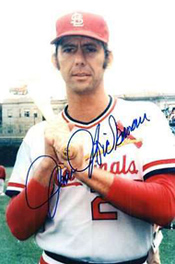
jim_hickmanHickman was an outfielder and first baseman for 13 years in the majors. Best known as a member of the original 1962 Mets and for an all-star season with the 1970 Cubs, Hickman grew up a Cardinals fan and was 18 when he signed with St. Louis in 1956.

“As a kid, I didn’t know there was any other club except the Cardinals,” Hickman told The Sporting News.

Helped by expansion

Displaying power but failing to hit for average, Hickman played in the Cardinals’ system from 1956-61 without getting a call to the big-league club. His best seasons in the Cardinals organization were 1957 when he produced 26 home runs and 113 RBI for Class D Albany (Ga.) and 1959 when he had 22 home runs and 81 RBI for Class AA Tulsa.

“The closest he ever got to the big club was a couple of early spring training camps,” The Sporting News reported. “They gave Jim big uniform numbers reserved for no names … and he didn’t get much of a look.”

After Hickman hit 11 home runs with 57 RBI for Class AAA Portland (Ore.) in 1961, the Cardinals made him available in the National League expansion draft. According to The Sporting News, the Cardinals lost interest in Hickman when they received a scouting report that said he lacked aggressiveness.

Said Hickman: “I know people say I’m not aggressive … I give it all I got.”

Hickman was drafted by the expansion Mets and made his big-league debut with them in 1962. He became one of their everyday outfielders, batting .245 with 13 home runs in 140 games.

Cycle in sequence

In July 1963, Mets manager Casey Stengel experimented with converting Hickman into a third baseman. Hickman was batting .223 entering the Aug. 7, 1963, game between the Cardinals and Mets at the Polo Grounds.

Batting leadoff and playing third base, Hickman became the first Mets player to hit for the cycle. He was 4-for-5 with two RBI and two runs scored in the Mets’ 7-3 victory.

Hickman, a right-handed batter, got his first three hits off starter Ernie Broglio: a single in the first, a double in the second and a RBI-triple in the fourth. In the sixth, Hickman hit a solo home run off Barney Schultz to complete the cycle.

“If this fellow can learn to cut down on his strikeouts, he could be one of the top hitters around,” Stengel said. “He has all the power he needs, but by now he should know that you can’t hit a ball with the bat on your shoulder. You have to swing.” Boxscore

Trio of homers

Two years later, on Sept. 3, 1965, Hickman became the first Mets batter to hit three home runs in a game. He did it against Cardinals starter Ray Sadecki, leading the Mets to a 6-3 triumph at St. Louis.

Batting sixth and playing first base, Hickman, who entered the game with a .212 batting average, was 4-for-4 with four RBI and three runs scored.

A look at his three home runs off Sadecki:

_ Home run #1: Swinging at the first pitch, a high, outside fastball, Hickman hit it 403 feet the opposite way, clipping the pavilion roof in right-center.

_ Home run #2: The count was 3-and-0 when Hickman looked toward third-base coach Don Heffner and was surprised to see he was being given the freedom to swing away.

According to The Sporting News, “Hickman, knowing the Mets have an automatic $10 fine for a missed sign, stepped out of the batter’s box and looked again.”

Heffner shouted to him, “Go ahead. It won’t cost you 10 bucks.”

Sadecki threw a fastball and Hickman pulled it over the left-field wall.

_ Home run #3: On a 1-and-2 count, Hickman swung at a slider down in the zone and golfed it into the left-field bleachers.

When Hickman batted for a fourth time in the game, Nelson Briles was pitching in relief. Asked later whether he was trying for a fourth home run, Hickman replied, “You bet.”

Instead, he produced a single on a groundball that took a bad hop and eluded third baseman Ken Boyer. Boxscore

Nostalgia tour

In 1970, Hickman was named an all-star for the only time. Playing for the Cubs, he produced 32 home runs and 115 RBI and was named NL Comeback Player of the Year by The Sporting News.

On March 23, 1974, the Cubs traded Hickman to the Cardinals for pitcher Scipio Spinks. Eighteen years after he had signed with St. Louis, Hickman finally was getting his chance to play for the Cardinals.

“I’m 36, but I know I still can hit a baseball,” Hickman said. “And I still can half-catch a baseball.”

Used primarily as a pinch-hitter and backup to Joe Torre at first base, Hickman hit .267 with the 1974 Cardinals. He hit two pinch-hit home runs _ off George Stone of the Mets and Danny Frisella of the Braves _ but his batting average as a pinch hitter was .182.

On July 16, 1974, four months after they acquired him, the Cardinals released Hickman, who made it clear he would retire rather than seek a chance with another club.

“This is it,” Hickman said. “So what if I hooked up with another club for the last two months? It would be the same thing after the season ended.”

In a big-league career from 1962-74 with the Mets, Dodgers, Cubs and Cardinals, Hickman batted .252. He had a .242 career mark with 20 home runs in 153 games versus the Cardinals.

Previously: Bob Gibson nearly was unbeatable against Mets
Read Full Post »

(Updated June 22, 2020)

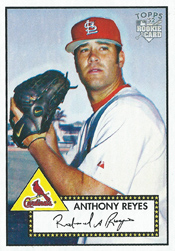
In his fourth major-league start for the Cardinals, Anthony Reyes delivered a brilliant and frustrating performance.

anthony_reyes2On June 22, 2006, Reyes pitched a one-hitter for the Cardinals against the White Sox in Chicago, but lost. The hit he surrendered, a home run by Jim Thome in the seventh inning, carried the White Sox to a 1-0 victory.

“There is no justice that he is the losing pitcher,” Cardinals manager Tony La Russa said to the St. Louis Post-Dispatch.

White Sox coach Joey Cora, who was filling in for suspended manager Ozzie Guillen, said of Reyes’ pitching: “Hall of Fame stuff.”

Changing speeds

Reyes, 24, was called up to the Cardinals from Class AAA Memphis before the game to replace injured Mark Mulder in the rotation. Reyes debuted with the Cardinals in August 2005 and also made two starts for them in May 2006 before being sent to Memphis.

A right-hander, Reyes was facing a White Sox lineup that pummeled Cardinals pitching in the first two games of the series. The White Sox won those games by scores of 20-6 and 13-5.

Using fastballs, changeups and curves, Reyes kept the batters off balance. “He changed speeds, moved the ball in and out,” Cora said to the Chicago Sun-Times. “He was outstanding.”

Good wood

With one out in the seventh and the score at 0-0, Reyes hadn’t yielded a hit. Asked whether he was aware he had a chance for a no-hitter, Reyes told the Associated Press, “I never thought about it.”

Thome, the designated hitter for the White Sox, came to the plate.

“You’re not thinking home run when a guy is pitching like that,” Thome said to the Chicago Tribune. “You’re thinking about a certain pitch and putting good wood on it and getting something started.”

Reyes’ first pitch to Thome was a fastball. The slugger swung and launched a shot into the bleachers.

“The ball was in the middle and I was fortunate to hit it,” Thome said.

Said Reyes: ‘I just missed a little bit over the plate and you can’t really do that up in this league.”

Series star

Reyes pitched the 23rd one-hitter in Cardinals franchise history.

His line for the game: 8 innings, 1 hit, 1 run, 0 walks, 6 strikeouts.

It was the first time the White Sox won with one hit since May 21, 2000, a 2-1 victory versus Toronto.

The Cardinals were kept in check by starter Freddy Garcia. He limited them to four hits _ a David Eckstein double and singles by Scott Rolen, Juan Encarnacion and Aaron Miles _ in eight innings. Bobby Jenks pitched a hitless ninth.

“This was a very tough game to lose,” La Russa said. “We had a chance to win and we didn’t win it.” Boxscore

Reyes made 17 starts for the 2006 Cardinals and was 5-8 with a 5.06 ERA. His gem against the White Sox was his only complete game that season.

In the 2006 World Series, Reyes delivered another surprise. He started and won Game 1 for the Cardinals, holding the Tigers to four hits and two runs in eight innings in a 7-2 St. Louis triumph at Detroit.


Read Full Post »

(Updated April 5, 2025)

On the day Ozzie Smith announced his plans to retire as a player, there was as much focus on his icy relationship with manager Tony La Russa as there was on his Hall of Fame career.

ozzie_smith9On June 19, 1996, Smith tearfully said he would retire after the Cardinals’ final game of the season. “I feel the time is here now,” Smith, 41, said to the Associated Press. “This is the best time. I’m ready for it.”
Impacting Smith’s decision, though, was his demotion to a reserve role at shortstop behind Royce Clayton, 26.

“I know that if I chose to do it I could play somewhere else,” Smith said to Rick Hummel of the St. Louis Post-Dispatch, “but my thinking was to finish my career as a St. Louis Cardinal.”

Smith used the attention created by his retirement announcement to express his unhappiness with La Russa.

Post-Dispatch columnist Bernie Miklasz wrote, “Unfortunately, Ozzie didn’t make it through (the day) without sniping at La Russa. Let’s hope the sourness will clear.”

Communication breakdown

Smith, who won 13 consecutive Gold Glove awards from 1980-92, went to spring training in 1996 determined to compete with Clayton for the starting shortstop job. La Russa, in his first year as Cardinals manager, said the player who performed best in spring training would be the shortstop during the season.

“I was told that the position would be earned in spring training,” Smith said at his retirement announcement. “I thought I did that.”

When La Russa declared Clayton the regular shortstop, Smith said he believed the manager hadn’t done what he said he would.

“This was the most disappointing thing in my career in St. Louis,” Smith told Hummel at the retirement announcement. “All I can go by is a person’s word. Going into spring training, I knew I had a job to do and I did that job.”

In response, La Russa said of Smith, “It’s fair to say he misunderstood how he compared to Royce in spring training. By what he was able to do defensively and on the bases, Royce deserved to play the majority of the games. Royce is capable of making more plays.”

Strain remains

Irked that Smith had brought up the controversy at the retirement announcement, La Russa complained to Hummel, “It doesn’t go away. It’s a constant irritation for him and for me _ his misunderstanding of that.”

Responding to a suggestion that the Cardinals owed a player of Smith’s caliber the chance to play regularly, La Russa said, “You can’t put a player ahead of any club … We don’t owe anybody. If Stan Musial comes back tomorrow and says, ‘I want to play’ _ that’s not what you do.”

Acknowledging that “there is a strain in the relationship” between he and Smith, La Russa added, “I’ll always feel like there’s a little edge in our relationship. I don’t think that ever will go away.”

Blame game

The next day, before the Cardinals faced the Expos at Montreal on June 20, 1996, Smith responded angrily to La Russa’s comments about Clayton performing the best in spring training.

“That’s cowardice as far as I’m concerned,” Smith told Hummel, “but should I expect anything different?”

Said La Russa of Smith: “All he’s got to do is look in the mirror and he can go out with honor and dignity rather than some kind of attempt at camouflage. I thought the purpose of his (retiring) was to be a positive influence on our ballclub. It doesn’t sound too positive to me.”

In a followup column, Miklasz reiterated that Smith is “a civic treasure” who “deserves a statue outside Busch Stadium,” but gave Smith an error for fueling the feud with La Russa.

“Ozzie is embarrassing himself … The only reputation that will be damaged is Ozzie’s,” Miklasz wrote.

In looking back on that 1996 tension with Smith, La Russa told Cardinals Yearbook in 2014, “Ozzie thought he played the best in spring training. It was obvious to us Royce would play better over 162 games. Both had a really important spot.”

In the book “Whitey’s Boys,” Smith said, “I don’t think he (La Russa) ever gave me a chance. I had been here 18 years and had a pretty good track record. If he had gotten to know me, find out about me, I think it could have been different.”


Read Full Post »

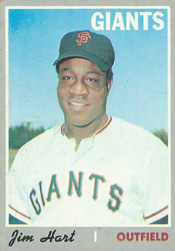
Jim Ray Hart had a prominent role in contributing to Bob Gibson’s worst start with the Cardinals, an outing so poor the pitcher was booed by the home crowd.

jim_hartHart, batting cleanup, had two key hits in the Giants’ 11-run first inning against the Cardinals on June 29, 1967, at St. Louis.
Nine of those runs, all earned, were charged to Gibson. Those are the most earned runs yielded in a game by Gibson in his Hall of Fame career.

The first eight batters Gibson faced reached base _ seven hits and a walk _ and the Giants led 7-0 before Gibson recorded an out. He was lifted before the Giants completed the inning.

In his book “Stranger to the Game,” Gibson called the outing “possibly the worst start of my life.”

In a Giants lineup that featured Willie Mays and Willie McCovey, no one did more damage that Thursday night than Hart, who drove in four runs in the opening inning with a single and a home run. Four years earlier, Hart suffered a fractured collarbone when hit by a Gibson fastball.

In 12 years (1963-74) with the Giants and Yankees, Hart, a third baseman and outfielder, batted .278 and produced 1,052 hits. He led the Giants in hits in each of three consecutive seasons (1965-67).

Stacking southpaws

The Giants began a four-game series with the first-place Cardinals on June 26, 1967, at St. Louis. The Cardinals won the opener, beating right-hander Gaylord Perry and dropping the fifth-place Giants 8.5 games behind the frontrunners.

The Giants, behind left-handed starters Mike McCormick and Ray Sadecki, won the second and third games. McCormick and Sadecki combined to limit the Cardinals to one run in 18 innings.

The series finale was scheduled to be a matchup of right-handed aces, Gibson for the Cardinals and Juan Marichal for the Giants. However, based on the performances of McCormick and Sadecki, Giants manager Herman Franks decided to start another left-hander against the Cardinals. Franks replaced Marichal with Joe Gibbon, a left-hander who had started and won against the Cardinals two weeks earlier, on June 17, at San Francisco. Gibbon had pitched in relief vs. the Cardinals on June 26 in the series opener at St. Louis.

All of the maneuverings were for naught. Gibson and Gibbon, similar in name, had similar results: Both were ineffective.

Opening salvo

The first two Giants batters, Jim Davenport and Tom Haller, each singled.

Willie Mays also singled, scoring Davenport and advancing Haller to second base.

Next up was Hart. He hit a line drive to left for a single, scoring Haller. Lou Brock, the left fielder, bobbled the ball, enabling Mays to score on the error and giving the Giants a 3-0 lead. Hart, credited with one RBI, reached second on the play.

With first base open, Gibson issued an intentional walk to Willie McCovey.

The next batter, Ollie Brown, singled, scoring Hart and putting the Giants ahead, 4-0. McCovey advanced to third.

Hal Lanier, the shortstop and son of former Cardinals pitcher Max Lanier, was up next. Lanier, batting .202, tripled, scoring McCovey and Brown and increasing the Giants’ lead to 6-0.

Unhappy fans

No. 8 batter Tito Fuentes singled, driving in Lanier and making the score 7-0.

Gibson struck out Gibbon and got Davenport to pop out to second.

When Gibson walked the next batter, Haller, Cardinals manager Red Schoendienst replaced him with Nelson Briles.

In the book “El Birdos,” author Doug Feldmann wrote that as Gibson departed “he was booed voraciously by the Busch Stadium crowd. Upon receiving the unfriendly goodbye from the home folks, Gibson tauntingly flung his cap in the air, which only increased the volume of the derision.”

Hammer from Hart

The first batter Briles faced was Mays, who singled, scoring Fuentes, advancing Haller to second and boosting the Giants’ lead to 8-0.

Hart, using a bat borrowed from Lanier, capped the outburst by hitting a three-run home run into the left-field bleachers, making the score 11-0.

The final line on Gibson: 0.2 innings, 9 runs, 7 hits, 2 walks.

Redbirds respond

Given a huge lead, Gibbon couldn’t taken advantage.

Brock led off the Cardinals’ half of the first with a triple. Julian Javier singled, scoring Brock. Curt Flood singled, moving Javier to third.

Orlando Cepeda delivered the Cardinals’ fourth consecutive hit, a single that scored Javier, moved Flood to third and made the score 11-2.

So much for using a left-hander.

Franks removed Gibbon, who failed to record an out, and replaced him with Bobby Bolin. The right-hander did the job. He got Mike Shannon to ground into a double play and Tim McCarver to fly out, ending the inning.

Bolin pitched nine innings of relief and got the win in a 12-4 Giants triumph. Boxscore

“So, a right-hander finally won one,” Giants pitching coach Larry Jansen said to the Oakland Tribune.

Beware of Bob

Gibson had entered the game with a 3.01 ERA and exited it with a 3.68 ERA.

“This, of course, put me in the mood to take it out on somebody and the opportunity quickly presented itself against the Reds,” Gibson said.

Facing the Reds in his next start, July 3, 1967, at St. Louis, Gibson struck out 12 in 7.2 innings, gave up three runs (two earned), took part in a brawl and got the win in a 7-3 Cardinals victory. Boxscore.


Read Full Post »

(Updated Aug. 15, 2026)

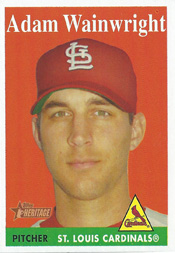
Adam Wainwright turned a special at-bat into a special feat.

On May 24, 2006, Wainwright swung at the first pitch in his first major-league plate appearance and hit a home run for the Cardinals at San Francisco.

adam_wainwright9Leading off the fifth inning, with the Giants ahead, 4-2, Wainwright hit a Noah Lowry pitch over the left field wall.
Wainwright, 24, had appeared in three games for the 2005 Cardinals and 14 games for the 2006 Cardinals before getting a plate appearance. He hadn’t taken batting practice since spring training.

Asked by the St. Louis Post-Dispatch his thoughts when the ball cleared the wall, Wainwright said, “I wasn’t thinking anything until I hit third (base). I was wandering around the bases, making sure I was going the right way. I hit third (base) and I said, ‘Oh, my goodness. I just hit a home run in my first at-bat.’ It was crazy.”

A win and a blast

Chris Carpenter had been scheduled to start for the Cardinals, but he developed bursitis under his right shoulder and was scratched.

Brad Thompson got the start and pitched two innings. After Tyler Johnson pitched the third inning, Wainwright relieved.

With the score tied at 2-2, Wainwright yielded two runs in the fourth.

Before Wainwright went to bat in the fifth, Cardinals manager Tony La Russa approached him.

“Tony told me to have a good at-bat, so I made sure I swung at the first pitch,” Wainwright told the San Jose Mercury News.

Lowry, a left-hander, threw a fastball. “One of the few fastballs Noah threw for strike one,” Giants manager Felipe Alou said to the Alameda Times-Star. Video of home run

After Wainwright pitched a scoreless fifth, the Cardinals scored twice in the sixth, taking a 5-4 lead. Wainwright held the Giants scoreless again in the sixth.

For his three innings of relief, Wainwright earned the win in the Cardinals’ 10-4 triumph. Boxscore

Wainwright was one of three Cardinals pitchers to get an extra-base hit in the game. Jason Marquis tripled and Braden Looper doubled.

“They almost hit for the cycle, the pitchers,” Alou said to the San Francisco Examiner. “They surprised everybody.”

Sweet swings

Wainwright is one of 11 Cardinals to hit a home run in his first plate appearance in the major leagues.

The list:

_ Eddie Morgan, pinch-hitter, April 14, 1936, vs. Cubs.

_ Wally Moon, center fielder, April 13, 1954, vs. Cubs.

_ Keith McDonald, pinch-hitter, July 4, 2000, vs. Reds.

_ Chris Richard, left fielder, July 17, 2000, vs. Twins.

_ Gene Stechschulte, pinch-hitter, April 17, 2001, vs. Diamondbacks.

_ Hector Luna, second baseman, April 8, 2004, vs. Brewers.

_ Adam Wainwright, pitcher, May 24, 2006, vs. Giants.

_ Mark Worrell, pitcher, June 5, 2008, vs. Nationals.

_ Paul DeJong, pinch-hitter, May 28, 2017, vs. Rockies.

_ Lane Thomas, pinch-hitter, April 19, 2019, vs. Mets.

_ Joshua Baez, left fielder, Aug. 15, 2026, vs. Cubs. In a game at Wrigley Field, Baez hit a home run in each of his first three at-bats in the majors. He crushed the first pitch he saw about 450 feet.


Read Full Post »

(Updated April 2, 2026)

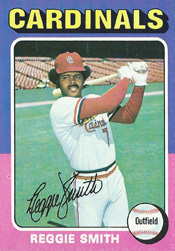
Mired in a slump, Reggie Smith got into the right frame of mind and snapped out of his funk, hitting three home runs, including the winning shot, for the Cardinals in a game against the Phillies.

reggie_smith3Following the lead of teammate Ted Simmons, Smith practiced transcendental meditation for inner peace before the Cardinals played on May 22, 1976, at Veterans Stadium in Philadelphia.
“I had good meditation today,” Smith told The Sporting News.

Both sides now

Hampered by an ailing left shoulder, Smith entered the Saturday night game with a .168 batting mark and three homers for the season.

He connected with home runs in each of his last three at-bats.

A switch-hitter, Smith hit two of the home runs right-handed and one left-handed. It was the sixth time Smith hit a home run from each side of the plate in a game.

It also was the only time in his 17 years in the big leagues that Smith hit three home runs in a game. All three occurred with two outs.

Smith, 31, became the first Cardinals batter to hit three home runs in a game since Stan Musial, 41, did so on July 8, 1962, vs. the Mets.

“I’m sorry it took me so long to start hitting,” Smith said to the Bucks County (Pa.) Courier Times. “I haven’t been doing much to help the club.”

Smith, who had been moved from right field to first base to third base during the season, was approached before the game by manager Red Schoendienst, who may have helped put him in a proper state of mind.

“I called Reggie into my office and asked him if he was relaxed enough when he was being shifted from position to position,” Schoendienst said. “He told me that, if I had enough confidence in him, he’d play anywhere anytime. I told Reggie that we needed his power in the lineup.”

Smith usually hit well at Veterans Stadium. “The background here has a lot to do with it,” he told the Philadelphia Inquirer. “Most backgrounds around the league are green and tend to create fuzziness. Here it’s black and you see better.”

Going deep

In the fifth inning, with the Phillies ahead, 2-1, Smith, batting right-handed, hit a Jim Kaat slider to left for a three-run home run, giving the Cardinals a 4-2 lead.

With the Phillies ahead, 6-5, in the seventh, Smith, batting left-handed, hit a Ron Reed changeup to right for a solo homer.

In the ninth, with the bases empty and the score tied at 6-6, Smith, batting from the right side, hit a Tug McGraw fastball to center for his third homer, putting the Cardinals ahead. Smith told the St. Louis Post-Dispatch that McGraw “tried to run (the fastball) away from me … to set me up for his screwball.”

The Phillies nearly rallied in the bottom of the ninth. Smith, moved from first base to third, helped thwart them, making a diving catch of a Larry Bowa liner. “In a way, I’m more proud of the catch,” he told the Inquirer.

Cardinals coach Fred Koenig said to the Post-Dispatch of Smith’s catch, “It’s almost inhuman for a man to get that close to a ball after going that far for it.”

Later in the inning, the Phillies had runners on first and second with two outs when Garry Maddox, facing Al Hrabosky, ripped a line drive that appeared headed for extra bases before shortstop Don Kessinger made a diving catch, ending the game and preserving the 7-6 Cardinals triumph. Boxscore

Four weeks later, on June 15, 1976, with his batting average at .218 and his home run total at eight, the Cardinals traded Smith to the Dodgers for catcher Joe Ferguson and minor-leaguers Bob Detherage and Freddie Tisdale.


Read Full Post »

« Newer Posts - Older Posts »