Chuck Stobbs was a left-hander who made his major-league debut at age 18, pitched for three American League franchises, yielded an epic home run to Mickey Mantle, experienced a streak of 16 consecutive losses and was given a chance to extend his career with the Cardinals.
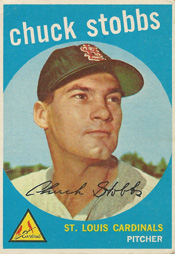 On July 9, 1958, Stobbs, 29, was claimed by the Cardinals from the Senators for the waiver price of $20,000.
The Cardinals utilized Stobbs as a reliever the remainder of the season before they released him. He returned to the Senators, reviving his career after discovering and correcting an eye problem.
Young pro
Stobbs was a standout athlete at Granby High School in Norfolk, Va., and was recruited by several college football programs. He chose to pursue a professional baseball career and was signed in May 1947 by Red Sox scout Specs Toporcer, a former Cardinals infielder.
Stobbs was 18 when he made his major-league debut with the Red Sox in a relief role on Sept. 15, 1947, against the White Sox. He became a starter in 1949 and had one of his best seasons in 1950, posting a 12-7 record.
After the 1951 season, the Red Sox traded Stobbs to the White Sox and he spent one season with them before he was dealt to the Senators in December 1952.
“Stobbs suffers from asthma and the changeable spring weather makes him weak,” columnist Bob Addie reported in The Sporting News. “Once the weather gets hot and dry, Chuck feels human again and becomes a better pitcher.”
Stobbs made his first regular-season appearance for the Senators on April 17, 1953, in a start against the Yankees at Griffith Stadium in Washington and it was memorable. In the fifth inning, Mantle hit a pitch from Stobbs out of the ballpark, a home run estimated to have traveled more than 500 feet and the only ball to clear the left field bleachers at Griffith Stadium. Boxscore
In 1956, Stobbs was 15-15 for the Senators, but lost his last five decisions. The losing streak stretched to 16 when Stobbs lost his first 11 decisions in 1957.
Stobbs was 8-20 with a 5.36 ERA for the Senators in 1957 and 2-6 with a 6.04 ERA for them in 1958 when he was placed on waivers and claimed by the Cardinals.
Seeking relief
Cardinals manager Fred Hutchinson had pitched and managed in the American League for the Tigers, was familiar with Stobbs and thought the breaking-ball specialist could help in the bullpen.
“I suppose I’ll be called in to pitch to Duke Snider, Eddie Mathews and some of those other sluggers,” Stobbs said. “Maybe I’ll get past them by walking them.”
Stobbs disliked airplane travel and was dismayed to learn the Cardinals took flights on longer road trips. “I didn’t know the train was so obsolete,” Stobbs said. “I thought I was in baseball, but it seems somewhere along the way I joined the Air Force.”
Stobbs made his Cardinals debut on July 13 against the Pirates at St. Louis. Entering the game in the fifth inning with a 6-5 lead, he yielded a two-run home run to Bill Mazeroski and took the loss. Boxscore
On July 16, in a four-inning relief stint against the Braves at St. Louis, Stobbs gave up back-to-back home runs to Mathews and Hank Aaron and took another loss. Boxscore
A week later, on July 23 at Milwaukee, Stobbs relieved starter Larry Jackson and shut out the Braves for six innings. Boxscore
When the Cardinals fell into an eight-game losing streak from July 27 to Aug. 3, Stobbs offered to contribute the rabbits feet and other good-luck charms fans sent him when he experienced his 16-game skid with the Senators. “The charms apparently are easier to find than prospects from Redbird farms who can help right away,” wrote Neal Russo of the St. Louis Post-Dispatch.
Stobbs lost his first three decisions with the Cardinals before earning his lone win on Aug. 6 with five scoreless relief innings against the Giants at St. Louis. Stobbs also walked, scored a run and executed a sacrifice bunt. Boxscore
On Sept. 9, Stobbs earned a save against the Cubs at St. Louis, entering with two on, two outs and an 8-7 lead in the ninth and retiring Walt Moryn on a fly out. Boxscore
Stobbs finished with a 1-3 record, a save and a 3.63 ERA in 17 relief appearances for the 1958 Cardinals. Left-handed batters hit .300 (15-for-50) against him.
Eye opener
Described by The Sporting News as a “carefree bachelor,” Stobbs got married in November 1958 and was preparing to report to spring training before the Cardinals released him in January 1959.
Stobbs was home in Washington, D.C., when he went to renew his driver’s license and nearly flunked the eye test. He saw an optometrist and learned he had weak vision in his right eye. The eye problem “seriously affected his depth perception and could easily account for his increasing inability in recent years to find home plate with his pitches,” Shirley Povich reported in The Sporting News.
After being fitted for glasses, Stobbs met with Calvin Griffith and convinced the Senators owner to give him a chance to compete for a job in spring training. Able to hit his spots with his improved vision, Stobbs had a string of 16 scoreless innings in 1959 spring training games and opened the regular season as a Senators reliever.
Stobbs was 1-8 with seven saves and a 2.98 ERA for the 1959 Senators. In 1960, Stobbs had one of his best Senators seasons, finishing 12-7 with a 3.32 ERA.
When the Senators relocated to Minnesota and became the Twins in 1961, Stobbs went with them and pitched his final season there. In 15 years in the majors, Stobbs was 107-130 with a 4.29 ERA.
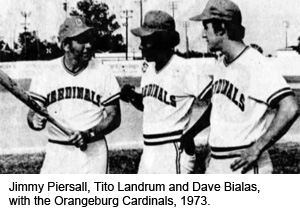 The man who hired Piersall to manage the 1973 Orangeburg (S.C.) Cardinals didn’t know the former big-league outfielder was being treated for a mental health issue at that time, though Piersall’s history certainly was no secret. In 1952, while playing for the Red Sox, Piersall suffered a nervous breakdown. He wrote a book, “Fear Strikes Out,” about that experience and Hollywood made it into a film, starring Anthony Perkins.
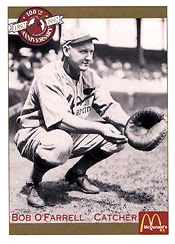 On Nov. 7, 1927, Breadon changed managers, replacing O’Farrell with coach Bill McKechnie, even though in his first season as player-manager, O’Farrell, a catcher, led the 1927 Cardinals to a 92-61 record and second place in the National League, 1.5 games behind the Pirates.
 In August 1980, when Whitey Herzog was promoted from manager to general manager of the Cardinals, Mauch was Herzog’s choice to replace him.
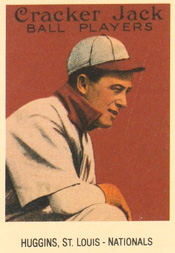 Rickey, the Cardinals’ president, and Huggins, their manager, were smart, innovative and effective. Both would build careers that would earn them election to the Baseball Hall of Fame.
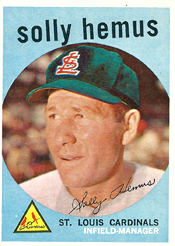 Disgusted when the Cardinals lost 15 of their first 20 games in 1959, Hemus resorted to insults and intimidation in an effort to rattle the opposition and motivate his team.

