Feeds:
Posts
Comments

Archive for the ‘Managers’ Category

Leo Durocher, combative shortstop of the Cardinals’ Gashouse Gang teams of the mid-1930s, fell out of favor with manager Frankie Frisch.
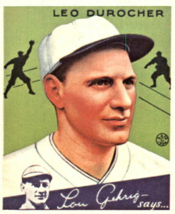
Their relationship deteriorated so badly Frisch issued an ultimatum to Cardinals executive Branch Rickey: Either Durocher goes or I go.

On Oct. 5, 1937, the Cardinals dealt Durocher to the Dodgers for third baseman Joe Stripp, second baseman Jim Bucher, outfielder Johnny Cooney and pitcher Roy Henshaw.

The trade, it turned out, created a career-boosting opportunity for Durocher. After a season as the Dodgers’ starting shortstop, he became their player-manager in 1939. Durocher went on to a successful, sometimes stormy, managerial career that earned him election to the National Baseball Hall of Fame.

Meanwhile, none of the players acquired by the Cardinals for Durocher contributed much. Frisch, who had been player-manager since 1933, was fired in September 1938 near the end of the Cardinals’ first losing season in six years.

Battle of wills

Durocher had come to the Cardinals from the Reds in a May 1933 trade. As their starting shortstop, Durocher helped the Cardinals to a World Series title in 1934. He led National League shortstops in fielding percentage in 1936.

Complaining of a kidney ailment and bad back, Durocher had a poor start to the 1937 season. After going hitless in a May 4 game at Boston against the Braves, Durocher’s batting average was at .132.

After the game, Durocher asked Frisch for permission to stay out of the hotel past the manager-mandated midnight curfew. The request upset Frisch, who accused Durocher, the team captain, of being focused more on fun than on performance.

The next day, May 5, Frisch benched Durocher and started Jimmy Brown at shortstop against the Braves.

After an off day on May 6, the Cardinals opened a series against the Giants at New York. Brown started at shortstop in the May 7 game.

When Frisch posted a lineup with Brown at shortstop again on May 8 against the Giants, Durocher declined to take batting or fielding practice at the Polo Grounds.

Durocher’s defiance was intolerable to Frisch.

“Nobody on my team _ even you _ can show such a lack of spirit,” Frisch said to Durocher.

When Durocher spoke up for himself, saying he had played earlier despite being ill and in pain, Frisch barked, “Get a train and go back to St. Louis. Get out of here.”

Durocher didn’t depart, but he didn’t get back into the starting lineup until May 12 against the Phillies at Philadelphia.

Big deal

Durocher, 32, played out the rest of the season as the Cardinals’ primary shortstop. He batted .203 in 135 games and grounded into a team-high 17 double plays.

In summarizing Durocher’s season, the St. Louis Star-Times wrote, “He was off stride at the very start, complained of illness and injuries, and was anything but the brilliant defensive player he had been. Durocher gained weight and was unable to handle the important shortstop position with his old-time finesse. Batted balls to his left and to his right became base hits.”

On Oct. 5, two days after the completion of the Cardinals’ season, Rickey was in New York to attend the World Series between the Giants and Yankees when he made the trade with the Dodgers.

Dick Farrington, in a column for The Sporting News, declared, “Leo Durocher’s passing from the Cards to the Dodgers was a case of ‘It’s Durocher or me’ with Frankie Frisch.”

A headline in The Sporting News blared, “Frisch Responsible For Durocher Going.”

The key players in the deal for the Cardinals were Stripp and Bucher. Stripp _ “Generally regarded as one of the best third sackers in the major leagues,” according to the Post-Dispatch _ long had been coveted by Frisch. Rickey liked Bucher, who had started his career in the Cardinals’ system before being drafted by the Dodgers.

“Bucher, alone, is a better ballplayer than Durocher,” Giants manager Bill Terry told International News Service in rating the deal a steal for St. Louis.

According to The Sporting News, “The first impulse of Brooklyn fans was heavily against the switch” because they thought four players were too high a price for Durocher.

However, Pie Traynor, Pirates manager, said, “The Dodgers got a great shortstop and they didn’t give up anybody who could help them.”

Dodgers benefit

The 1938 season was a failure for Frisch and the Cardinals.

Stripp squabbled with management over his contract and got a late start to the season. He batted .286 in 54 games but was sent to the Braves on Aug. 1.

Bucher, who spent most of the year in the minors, hit .228 in 17 Cardinals games.

Henshaw had a 5-11 record and 4.02 ERA for the Cardinals.

Cooney was released on the eve of the season opener.

On Sept. 11, with the Cardinals’ record at 63-72, Frisch was fired and replaced by a coach, Mike Gonzalez, for the rest of the season.

Durocher in 1938 led National League shortstops in fielding percentage and was named to the all-star team.

Previously: Rift with Branch Rickey led Cards to oust Frankie Frisch
Read Full Post »

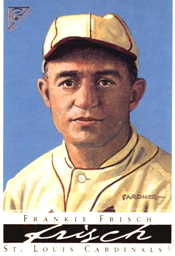
The last hit of the Hall of Fame career of Frankie Frisch completed a ninth-inning comeback that carried the Cardinals to a walkoff victory and inspired his teammates to carry Frisch off the field.

In 1937, Frisch, 40, was manager of the Cardinals. He also was in his last season as a player.

Frisch had been a standout second baseman for the Giants from 1919 to 1926. After he was dealt for Rogers Hornsby, Frisch continued his success with the Cardinals, helping them to four National League pennants and two World Series titles. He became their player-manager in 1933.

As late as 1936, Frisch played 59 games at second base and 22 at third base for the Cardinals, batting .274 with an on-base percentage of .353.

In 1937, however, Frisch seldom appeared in the lineup.

His last game at second base was on May 29, 1937. Over the next two months, he had five at-bats as a pinch hitter. Frisch failed to reach base in any of those plate appearances.

So it was a bit of a surprise when, with the outcome on the line in the Cardinals’ game against the Braves on Aug. 4 at St. Louis, Frisch put himself at the plate as a pinch hitter.

Keep the line moving

The Braves led, 6-2, entering the bottom of the ninth inning of the Wednesday afternoon game before 2,303 spectators at Sportsman’s Park.

Braves starter Lou Fette, who had a 13-3 record, appeared to be in control. The rookie from Alma, Mo., retired two of the first three batters in the ninth. Terry Moore, who had walked, was on first base when Johnny Mize came to the plate, representing the Cardinals’ last hope.

With a four-run lead, the Braves weren’t holding Moore at first. So, he went to second base uncontested while Fette focused on Mize.

Mize singled to right, scoring Moore and cutting the Braves’ lead to 6-3.

Joe Medwick followed with a double to left-center, driving home Mize and making the score 6-4.

Braves manager Bill McKechnie, the former Cardinals skipper, brought in Guy Bush to relief Fette. Bush had a 2.76 ERA.

Don Padgett greeted him with a single to right, scoring Medwick and reducing the Braves’ lead to 6-5.

Don Gutteridge got the Cardinals’ fourth consecutive hit _ a single to left. When Padgett advanced from first to third on the play, drawing the throw from the outfield, Gutteridge alertly took second.

With runners on second and third, Pepper Martin, sent to pinch-hit for Leo Durocher, received an intentional walk, loading the bases.

Stout heart

Mickey Owen was due up next for the Cardinals. A rookie catcher, Owen was the Cardinals’ eighth-place batter. He was 1-for-4 in the game, giving him a .214 batting mark for the season.

Frisch, who was batting .194 and hadn’t produced a hit since May 28, grabbed a bat and stood in at the plate for Owen.

“I felt I was the right man in this spot,” Frisch said to the St. Louis Star-Times. “I believed I could deliver the much-needed hit in the pinch … Why should I put some other man in that spot when I figured I could get a hit myself?”

Frisch, a switch hitter, batted from the left side against Bush, a right-hander. Swinging at the first pitch, Frisch “slashed it down the first-base line like a shot out of a howitzer,” the Star-Times reported.

The ball eluded first baseman Elbie Fletcher and bounded into right field. Padgett scored from third with the tying run and Gutteridge raced from second to the plate with the winning run for a 7-6 Cardinals victory. Boxscore

Frisch’s teammates rushed toward him, lifted him onto their shoulders and carried him triumphantly to the dugout.

“The best pinch-hit I’ve ever seen,” Medwick said.

Frisch, the Star-Times observed, “still packs a pretty stout heart beneath those red birds on his Cardinals uniform shirt.”

The hit gave Frisch 2,880 for his big-league career.

The next day, Frisch batted for the final time. Pinch-hitting in the ninth for Moore, Frisch grounded into a double play in a game the Cardinals lost 4-1 to the Braves.

Frisch finished with a career batting mark of .316 and 1,244 RBI. He was inducted into the National Baseball Hall of Fame in 1947.

Previously: Kolten Wong, Frankie Frisch gave Cards pop at 2nd

Read Full Post »

In July 1977, when Al Hrabosky ignored manager Vern Rapp’s facial hair ban and let his whiskers grow, Cardinals owner Gussie Busch intervened and tried to get the pitcher to follow orders. Rather than obey, Hrabosky fought back. He told Busch he would file a grievance with the players’ union if the Cardinals tried to force him to shave.

If Hrabosky filed a grievance, the matter would go to arbitration. To Busch, the prospect of appearing before an arbiter and likely losing to Hrabosky and the union was more distasteful than having the pitcher grow a moustache.
Outmaneuvered, Busch lifted the facial hair ban Rapp had imposed at the start of 1977. At the same time, in an effort to show he maintained confidence in Rapp, Busch extended the manager’s contract through the following season.

Busch, though, was angry and humiliated.

Unaccustomed to defiance from an employee, Busch lashed out publicly at Hrabosky. He challenged him to become a better pitcher and warned Hrabosky to quit being disruptive.

“You pushed me into a corner,” Busch said, addressing Hrabosky, “and no one does that to me.”

Hrabosky realized his victory came at a price. He predicted the Cardinals would get rid of him.

Hairy situation

Hrabosky had established himself as an effective Cardinals reliever in 1973. Soon after, he developed a persona as the “Mad Hungarian.” With a Fu Manchu moustache, flowing black hair and menacing glower, Hrabosky tried to intimidate or irritate batters by standing behind the mound, facing the infield, muttering to himself and pounding his fist into his glove before whirling around and preparing to pitch.

After Rapp replaced Red Schoendienst as manager, he imposed the facial hair ban for 1977. Clean-shaven, Hrabosky no longer looked like the “Mad Hungarian.” He said he believed that took away from his ability to pitch at his best.

Unhappy and resentful, Hrabosky ripped Rapp in spring training, then apologized. In May, he refused Rapp’s request to meet and briefly was suspended for insubordination.

On July 4, the Cardinals began a 15-game road trip. They didn’t play well and tension mounted between manager and players.

Rapp called a clubhouse meeting in Philadelphia on July 14, and began the session by saying he’d noticed 5 o’clock shadows on the faces of some players. He considered that a violation of the facial hair ban and said he’d suspend anyone who didn’t shave, The Sporting News reported.

Cardinals outfielder Lou Brock spoke up and asked Rapp to “bend a little” on his rules. Rapp replied, “I’m not going to change,” and left the clubhouse.

Jack Buck, Cardinals broadcaster, told listeners, “It’s one against 25.”

After the game, Hrabosky told a Philadelphia radio station “there’s no way” he could play another season with Rapp as manager. Soon after, Hrabosky began letting his facial hair grow.

Plenty of trouble

The Cardinals lost 11 of 15 games on the trip _ Hrabosky was 0-2 with a save and an 11.42 ERA _ before entering the all-star break.

When the team got back to St. Louis, Busch met with Hrabosky on July 21, the pitcher’s 28th birthday. Rather than a gift, Hrabosky received scorn.

“Well, young man, if you’re looking for trouble you can believe August A. Busch Jr. will give you more than you can handle,” Busch said.

Hrabosky told Busch he had the backing of Marvin Miller, leader of the players’ union. Miller encouraged Hrabosky to file a grievance.

That’s when Busch lifted the ban, saying management wouldn’t give Hrabosky “the satisfaction of dragging the Cardinals and baseball into the courtroom.”

Said Hrabosky: “From the legal standpoint, they knew they’d lose.”

Put up or shut up

Hrabosky at that time had a record of 2-4 with seven saves and a 4.58 ERA.

“You said … you can only get batters out by being psyched up with your moustache and beard,” Busch said. “Then go ahead and grow it. But, boy, are you going to look like a fool if you don’t get batters out.”

Said Hrabosky: “After much thought and personal reflection, I know it will be in the best interests of the ballclub and of my career to go back to being Al Hrabosky. I sincerely believe my appearance had a great effect on my performance … I sincerely believe my decision will help me on the field.”

Busch told Hrabosky: “My suggestion … would be for you to stop causing this trouble in the middle of a pennant race, obey the rules of the team, work your butt off for a pennant and quit this complaining.”

Jeff Meyers, St. Louis Post-Dispatch columnist, wrote that Hrabosky “deserves applause for having had the courage to stand up for what he thought was right,” but added that Busch had “deflated Hrabosky’s massive ego.”

Fading fastball

Cardinals infielders Mike Tyson and Garry Templeton were among the players who said they would grow facial hair in support of Hrabosky. Another infielder, Don Kessinger, said he wouldn’t try a moustache or beard.  “If I grow one, my wife won’t kiss me and there ain’t nothing worth that,” Kessinger said.

On July 23, Hrabosky made his first Cardinals appearance since his meeting with Busch and received mostly applause from the spectators at Busch Stadium. He pitched 2.1 innings of scoreless relief and the Cardinals beat the Astros, 4-3.

Hrabosky had a productive August (3-1 record, one save, 3.52 ERA) and a dismal September (0-0, no saves, 6.75 ERA).

“His fastball isn’t what it used to be and the whole league knows it,” Buck said.

Hrabosky’s overall statistics for 1977: 6-5, 10 saves, 4.38 ERA.

In The Sporting News, Neal Russo wrote, “Al Hrabosky was as bad with his beard as without.”

On Dec. 8, 1977, the Cardinals traded Hrabosky to the Royals for pitcher Mark Littell and catcher Buck Martinez.

Read Full Post »

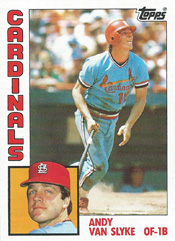
What began as the feel-good story of Cardinals spring training dissolved into a feud between comeback hopeful Andy Van Slyke and manager Tony La Russa.

The rift, just as the 1997 Cardinals were launching into their season, was created by miscommunication, overreaction and ego from both sides.
Van Slyke, who had come out of retirement in a bid to earn a job as a Cardinals utility player, batted .545 in spring training in 1997 before being sidelined by a leg injury. He wanted assurances he would have a spot on the active roster when he healed. The Cardinals refused to make that kind of commitment.

That led to a war of words between Van Slyke and La Russa.

Versatile talent

Plagued by recurring back pain, Van Slyke retired after playing the 1995 season with the Orioles and Phillies.

A first-round pick of the Cardinals in the 1979 draft, Van Slyke made his major-league debut with St. Louis in 1983. He played 69 games in the outfield, 30 at third base and nine at first base.

In 1984, Cardinals manager Whitey Herzog again used Van Slyke in the outfield (81 games) and at third base (32 games) and first base (30 games).

Sticking primarily to the outfield, Van Slyke’s best Cardinals seasons were 1985 (25 doubles, 13 home runs, 34 stolen bases) and 1986 (23 doubles, 13 home runs, 21 stolen bases).

On April 1, 1987, the Cardinals traded Van Slyke, catcher Mike LaValliere and pitcher Mike Dunne to the Pirates for catcher Tony Pena. In eight years (1987-94) with the Pirates, Van Slyke won a National League Gold Glove Award five times for his outfield defense and three times was named an all-star.

Comeback candidate

After his retirement, Van Slyke, who continued to reside in St. Louis, spent 1996 as a baseball analyst for ESPN and did a radio show. With his back feeling better, Van Slyke began working out, hoping to play again.

In February 1997, Rick Hummel of the St. Louis Post-Dispatch reported La Russa had invited Van Slyke to Cardinals spring training camp at St. Petersburg, Fla., to compete for a job.

“It’s intriguing,” Van Slyke said. “I’ve always wanted to end my career with a Cardinals uniform on.”

A week later, the Cardinals signed Van Slyke and another utilityman candidate, former Indians slugger Cory Snyder, to minor-league contracts.

Third base training

When Van Slyke, 36, arrived at Cardinals camp, he was given a locker between those of pitcher Dennis Eckersley, 42, and outfielder Willie McGee, 38. “They’re trying to make me feel young,” Van Slyke said.

Cardinals coaches Carney Lansford, an all-star third baseman for La Russa with the Athletics, and Mark DeJohn, a former Tigers infielder, were assigned to work with Van Slyke. The Cardinals wanted to see whether he could be a backup to Gary Gaetti at third base.

“You can’t just take a guy from the outfield and stick him at third base,” Lansford said. “But given the proper amount of time and the right instruction he could have a chance.”

Van Slyke said of playing third base, “I’m better than I was 11 years ago.”

Replied Lansford: “He’s got a long way to go.”

Big bat

What Van Slyke still could do best was hit.

In his first exhibition game, Van Slyke delivered a RBI-single off Reds reliever Jeff Shaw. “That was a professional at-bat, a big-league at-bat,” La Russa gushed.

Van Slyke produced 11 hits in his first 20 at-bats.

“He’s shown that his talent is alive and kicking,” said La Russa.

Said Van Slyke: “My biggest concern was to get a fair shot and I’ve gotten that. Even if I don’t make the team, there will be absolutely no animosity toward Tony or this organization. This organization owes me nothing. I owe the Cardinals and baseball everything.”

On March 22, Van Slyke tore a muscle in his left calf.

Hummel wrote that Van Slyke “would have made the club” if he hadn’t been injured.

Next step

On March 26, needing to set their roster as they prepared to leave Florida, the Cardinals told Van Slyke to remain at training camp and work on getting healthy.

“When I’m ready, there’s only one place I want to play _ and that’s not extended spring training or (Class AAA) Louisville,” Van Slyke said.

La Russa indicated Van Slyke likely would need to accept a minor-league rehabilitation assignment before he could be considered for a spot on the Cardinals’ roster.

“We have to see if he really wants to do this,” La Russa said. “He wants some guarantees, but there are no guarantees in this game. He has to decide if he wants to take his best shot, with no guarantees.”

Go home

On the eve of the Cardinals’ April 1 season opener, Van Slyke, working out in Florida, complained to the Post-Dispatch about his status.

“I’d like to have some communication with (general manager) Walt Jocketty and Tony La Russa,” Van Slyke said. “Communication with this new group is something that needs to be worked on … Right now, a lukewarm response would be great. At least I’d be getting one.”

Van Slyke’s comments irked La Russa, who, after stewing for a couple of days, delivered a salvo.

“That’s just not accurate,” La Russa told Hummel. “I talked to him Wednesday or Thursday before we left (Florida). I think the problem is he’s not hearing what he wants to hear.

“If he wants communication and he needs certainty, he can go home … The Cardinals don’t need to be criticized for handling his situation. He hasn’t had any communication? Well, my communication is to go home. It was all explained to him. If he can’t understand that, then go home. What he said was extremely disappointing. It just shocked me.”

End of the line

With his wife about to deliver a baby, Van Slyke returned to St. Louis and waited. By the end of April, it was clear Van Slyke’s bridges had been burned.

“I don’t think there’s any more interest from their point of view,” Van Slyke said of the Cardinals.

Said La Russa: “There are a lot of things he needs to do before he comes here that he hasn’t shown a willingness to do.”

Van Slyke’s comeback bid had ended.

Previously: How Andy Van Slyke amazed Jose Oquendo

Read Full Post »

Struggling to score, the Cardinals opened the 1997 season by losing a franchise-record six in a row.

From April 1-6, the 1997 Cardinals scored a total of 12 runs in losing three to the Expos at Montreal and three to the Astros at Houston. All the games were played indoors.
It was the first time the Cardinals started a season 0-6.

The ugly start put the Cardinals in a hole from which they couldn’t recover. Never getting their record above .500, the 1997 Cardinals finished 73-89.

Expectations had been for a much different outcome.

High hopes

In 1996, Tony La Russa’s first season as St. Louis manager, the Cardinals (88-74) won the National League Central Division title and swept the Padres in the NL Division Series. After getting within a win of clinching the 1996 pennant before losing to the Braves in the NL Championship Series, the Cardinals were supposed to be contenders in 1997.

At a banquet in February 1997, La Russa raised the stakes, predicting the Cardinals would repeat as division champions.

The Cardinals had a successful spring training in Florida, posting a 19-11 record in exhibition games.

“So far, the signs are outstanding _ the way they’ve gone through the drills, the way they’ve competed in the games and the way they’ve related to each other and the coaches,” La Russa said to the St. Louis Post-Dispatch. “The signs are all go.”

After departing Florida, the Cardinals went to Arlington, Texas, and to Baltimore to play exhibition games against the Rangers and Orioles before opening the season on April 1 at Montreal.

In his column for the Post-Dispatch, Bernie Miklasz wrote, “La Russa has had the game face on since, oh, about Dec. 26. It should be a good year. The Cardinals should repeat as Central Division champions.”

Loss #1, April 1, at Montreal

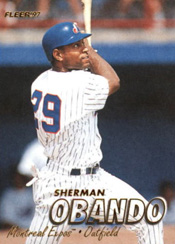
In the bottom of the ninth inning, with the score tied at 1-1, Cardinals reliever Tony Fossas walked pinch-hitter Sherman Obando with the bases loaded, forcing in the winning run and giving the Expos a 2-1 victory. Boxscore

Obando never took a swing in the six-pitch at-bat. “I didn’t see the ball up, so I didn’t swing,” Obando said.

The Cardinals scored their run in the sixth when Delino DeShields scampered home from third on a wild pitch from Jim Bullinger.

Loss #2, April 2, at Montreal

The Expos, behind the pitching of Jeff Juden, Omar Daal and 39-year-old Lee Smith, held the Cardinals to two singles and won, 4-1.

For the second consecutive game, the lone Cardinals run was scored by DeShields advancing from third to home on a wild pitch.

Said La Russa: “I have confidence that good hitters are going to hit.” Boxscore

Loss #3, April 3, at Montreal

The Cardinals blew leads of 2-0 and 4-2, losing 9-4. The Expos raked starter Alan Benes for 10 hits and seven runs in 4.2 innings.

“You can draw any conclusions you want to,” said La Russa. “They just flat outplayed us all three games.” Boxscore

The next day, in Houston, Miklasz met with La Russa before the game and described the manager as looking “as cheerful as your basic werewolf.”

“Those three insipid losses (at Montreal) made baseball’s most famous vegetarian more nauseated than he would by a plate stacked high with pepperoni, sausage and bacon,” Miklasz wrote.

Said La Russa: “We should have been more competitive in each of those three games. There’s no reason why we shouldn’t have done better in how we played _ and the manager should have done a better job.”

Loss #4, April 4, at Houston

Jeff Bagwell’s bases-loaded single off Eric Ludwick in the 11th snapped a 2-2 tie and lifted the Astros to a 3-2 victory.

The Cardinals started a season 0-4 for the first time since 1985.

St. Louis stranded 13 base runners. John Mabry drove in both Cardinals runs. Boxscore

In four games, the Cardinals were batting .167 with runners in scoring position.

“I feel terrific about our club,” La Russa said. “There isn’t anything we didn’t try to do tonight. The effort was there, the intensity, everything.”

Loss #5, April 5, at Houston

The Astros beat the Cardinals, 6-2. With their 0-5 record, the 1997 Cardinals matched the teams of 1902, 1919, 1960 and 1973 for worst start in franchise history.

Wrote Miklasz: “The lineup is as lethal as a Pez dispenser.”

Sid Fernandez started and earned the win in his final appearance of a 15-year major-league career. Ramon Garcia pitched four scoreless innings in relief for the save. Boxscore

“It’s a six-month test … I still like our club a lot,” said La Russa.

Loss #6, April 6, at Houston

Bagwell, hitting for infielder Tim Bogar in the eighth, delivered a two-run, two-out double off John Frascatore, erasing a 2-1 Cardinals lead and carrying the Astros to a 3-2 victory. Boxscore

The three-game sweep gave the Astros more wins against the Cardinals in 1997 than they had in 1996, when they lost 11 of 13 to St. Louis.

Having set the franchise record for most losses to begin a season, the Cardinals limped back to St. Louis for their home opener.

“I think I see guys trying to force things,” La Russa said. “It’s human nature. I hope they do. Otherwise, it means they don’t care.”

Said Cardinals third baseman Gary Gaetti: “It’s hard not to press when you’re really trying to get that first one.”

That’s a winner

After an off-day in St. Louis on April 7, the Cardinals played their home opener on April 8.

Willie McGee, 38, hitting for pitcher Mark Petkovsek, rescued the Cardinals by slashing a home run off Ugueth Urbina with two outs in the bottom of the ninth, giving St. Louis a 2-1 triumph over the Expos. Boxscore

“You couldn’t write a better script,” Mabry said of McGee’s streak-busting blast.

Said La Russa: “This was more dramatic than anything I’ve seen in a movie.”

Previously: Why Cards chose Delino DeShields over Ryne Sandberg

Read Full Post »

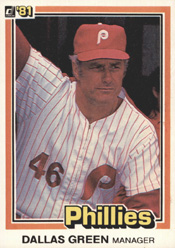
(In tribute to Dallas Green, who died March 22, 2017, at 82, I am posting here a story I did that was published in the Dec. 31, 2007, farewell edition of The Cincinnati Post.)

When Lou Piniella was chosen to manage the Reds, the ball club called a press conference at Riverfront Stadium on Nov. 3, 1989.

It was unusual for me, sports editor of The Post, to attend. I usually worked from the newsroom. But I went to the stadium that day.

The Reds were a troubled franchise. Pete Rose, who had managed them since 1984, had been banned from baseball. His interim successor, Tommy Helms, had departed bitterly, saying he never would work for club owner Marge Schott again.

Piniella, who had worked for New York Yankees owner George Steinbrenner, made a strong impression. He spoke convincingly about why the Reds would succeed.

When Piniella finished, I approached Schott. I had been named sports editor in August, a few days before Rose’s banishment, and hadn’t met Schott.

“I’m Mark Tomasik, new sports editor of The Post.”

“Nice to meet you, honey,” Schott said. “I hope you’ll bring some class to The Cincinnati Post.”

From March 1989 to December 1997, I had the privilege of working for The Post, most of that time as its sports editor. It was an era of big personalities and big stories in local sports: Rose, Schott, Piniella, Sam Wyche, Paul Brown, Boomer Esiason, Bob Huggins, Pete Gillen, Rick Pitino and dozens more.

The Post already had a lot of class when I arrived. Our sports section regularly was voted best in Ohio and one of the top 10 in the nation.

The staff talent was deep, diverse. Its best attribute: aggressiveness. Most big breaking-news local sports stories of that era were reported first by The Post.

The newsroom culture was to pursue news hard. So when I came to work at 5:30 the morning of Oct. 18, 1989, and was greeted by a story across Page 1 of the Enquirer headlined, “Dallas Green offered Reds’ manager’s job,” I knew what to expect.

Within minutes, the managing editor was at my door. “We have to have something that matches or advances that story for our Page 1,” he said.

“I don’t have any reporters at this hour,” I replied.

Our Reds reporter was in San Francisco, where that night an earthquake had rocked the Bay Area, led to more than 60 deaths and halted Game 3 of the World Series. I wasn’t going to call at 2:30 a.m. Pacific time and ask him to chase the Green story.

“I’ll take care of it,” I told the managing editor.

The Post had a source list of phone numbers for many of the biggest names in sports. Green, who lived near Philadelphia, was on the list.

Just before 7, with deadline an hour away, I dialed Green’s number. He answered. I identified myself and began to explain the call.

Green responded with a string of profanities, and hung up.

“He’s not talking,” I told the managing editor.

“You’ve got to find a way to get the story,” he said.

I waited 30 minutes.

I dialed again.

“Hello.”

“Please don’t hang up,” I pleaded. “I need your help.”

Green paused. I told him what the Enquirer was reporting and asked him to deny or confirm.

“You want to know why I was so upset when you called earlier?” he said.

“OK.”

“My daughter lives in San Francisco. That mean anything to you? We’ve been trying to contact her all night. We haven’t been able to get through. We’re worried sick. When the phone rang, we were hoping it was her.”

My impression of Dallas Green changed that instant.

“I haven’t been offered the Reds’ job,” he said. “Is that what you need?”

Yes. We printed it. Page 1. All editions.

Two weeks later, Piniella was named manager.

_ _ _

Copyright: Copyright (c) 2007 The Cincinnati Post

Read Full Post »

« Newer Posts - Older Posts »