Feeds:
Posts
Comments

Archive for the ‘Managers’ Category

Playing for a new manager, Vern Rapp, and with a core of young, highly regarded players, such as Keith Hernandez, Garry Templeton and John Denny, the Cardinals enjoyed a successful opening to the 1977 season.
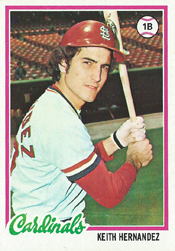
keith_hernandez5On April 7, 1977, amid strong winds and a mix of rain and light snow, the Cardinals beat the Pirates, 12-6, at Three Rivers Stadium in Pittsburgh.

New approach

The 1977 Cardinals opened the season as a franchise looking to rebuild.

In 1976, the Cardinals finished 72-90. Red Schoendienst, who had managed the Cardinals since 1965, was fired after that 1976 debacle. He was replaced by Rapp, a St. Louis native who had played and managed in the Cardinals’ system but who never had reached the major leagues.

A disciplinarian, Rapp instructed Cardinals players during 1977 spring training to shave off their moustaches and beards and keep their hair trim.

In the opener at Pittsburgh, the Cardinals started Denny, 24, against Jerry Reuss, a St. Louis native who began his career with his hometown team.

Along with established standouts such as left fielder Lou Brock and catcher Ted Simmons, the Cardinals’ lineup included Hernandez, 23, at first base and Garry Templeton, 21, at shortstop.

Denny and Templeton were making their first Opening Day starts in the big leagues.

Helped by three Pirates errors, the Cardinals scored four runs in the opening inning off Reuss. The Pirates’ sloppy start prompted “lusty boos from many of the 35,186 spectators,” the Associated Press reported.

The Cardinals never trailed. Denny held the Pirates to three runs in 5.2 innings and got the win. Templeton had two hits and scored three runs.

Hernandez, a left-handed batter, scored twice and had key hits against a pair of left-handed relievers. Hernandez hit a two-run double off Grant Jackson and a two-run home run (estimated at 425 feet) against Terry Forster. For Hernandez, it was his first four-RBI game in the big leagues.

Playing to win

“The thing about Vern Rapp is that he has us playing aggressive baseball, taking the extra base, playing at our maximum,” Hernandez said after the game. “We don’t have a lot of power, but we do have good hitting and exceptional speed and I think we’re going to make the most of it.”

Asked about playing without his signature moustache, Hernandez replied, “I’m here to play baseball. That’s what is important to me. I’ve got five months in the off-season to grow a moustache and long hair, but right now I want to help the Cardinals play winning baseball.” Boxscore

Behind stellars seasons by Hernandez (.291 batting average, 41 doubles, 91 RBI), Templeton (.322 batting average, 200 hits, 18 triples, 28 stolen bases), Simmons (.318 batting average, 21 home runs, 95 RBI) and pitcher Bob Forsch (20 wins), the 1977 Cardinals improved to 83-79.

Hernandez’s effective hitting against left-handers continued through the season. He batted .313 in 201 at-bats versus left-handers in 1977.

Previously: Cardinals debut was dream come true for Keith Hernandez

Previously: Pete Vuckovich was fearless in great escape for Cardinals
Read Full Post »

Johnny Keane made a commitment to the heart of Bob Gibson and the outcome was successful for the Cardinals.

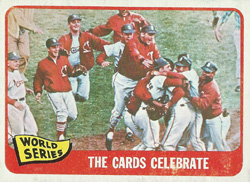
cards_celebrateOn Oct. 15, 1964, the Yankees and Cardinals played the decisive Game 7 of the World Series at St. Louis. The Cardinals started their ace, Gibson, and led, 7-3, entering the ninth inning.

Gibson, 28, had pitched eight innings in Game 2 and 10 innings in Game 5. He also had pitched eight innings in his final start of the regular season on Oct. 2 and four innings of relief in the pennant-clinching season finale on Oct. 4.

Keane, the Cardinals’ manager, never wavered in sending out Gibson to pitch the ninth inning of Game 7.

In his book, “Stranger to the Game,” Gibson said, “By this time, I was simply throwing as hard as I could on every pitch, grunting up my best frazzled-arm fastballs. Keane had sent me out there with the advice to throw nothing but fastballs, remarking that he didn’t think the Yankees could hit four home runs in one inning.”

Author David Halberstam, in his book “October 1964,” wrote, “Rarely had Bob Gibson wanted anything so badly as to finish this game. Johnny Keane, who knew (Gibson) was tired and knew he was wearing down, came over to Gibson and told him he was going to stay with him.”

Said Keane to Gibson: “Bob, I’m going with you in the ninth. Just throw it over the plate. Don’t be cute. Don’t go for the corners. Just get it over.”

Strikeouts and homers

The first batter, Tom Tresh, struck out. The next, No. 8 batter Clete Boyer, “jumped on the fastball he knew was coming,” Gibson said, and hit a home run over the left-field wall, making the score, 7-4.

Gibson struck out Johnny Blanchard, who was batting for pitcher Pete Mikkelsen.

With one more out, the Cardinals would be World Series champions.

Phil Linz, a shortstop who had hit five home runs during the regular season, batted next and hit a home run over the left-field wall.

The score was 7-5. Up next was Bobby Richardson, who had produced 13 hits in the Series. If Richardson reached base, Roger Maris would follow, then Mickey Mantle.

“I looked over to the dugout at Keane,” Gibson said, “wondering if perhaps he had overestimated my speed and underestimated the Yankees’ power.”

Lots of heart

Ray Sadecki, a left-hander who had started Games 1 and 4, was loosening in the bullpen. Keane decided he would bring in Sadecki to face the left-handed Maris if Richardson got on base.

After Gibson worked the count to 1-and-1 on Richardson, Keane went to the mound to talk with his pitcher. Catcher Tim McCarver “did not go all the way out because he knew Gibson hated it when the catcher came out _ and, besides, there was nothing to say,” Halberstam wrote.

The next pitch from Gibson was a fastball. Richardson swung and hit a pop-up to second baseman Dal Maxvill, who made the catch. Video

The Cardinals were World Series champions for the first time in 18 years.

Asked why he stayed with a tiring Gibson in the ninth, Keane replied, “He didn’t pitch only with his arm. He pitched with his heart. He’s got lots of heart … I went all the way with him because I was committed to this fellow’s heart.” Boxscore

Privately, a proud Keane said to Gibson after the game, “You’re on your way.”

In the New York Daily News, Phil Pepe wrote, “The story of the Cardinals’ world championship is the story of Johnny Keane and yesterday it was the story of Bob Gibson. It is the story of faith … of John Keane’s faith in Bob Gibson and of Bob Gibson’s faith in himself.”

Previously: 4 Series aces for Cards: Gibson, Porter, Eckstein, Freese

Previously: Johnny Keane to Gussie Busch: Take this job and shove it

Read Full Post »

(Updated March 17, 2022)

Among Cardinals general manager Walt Jocketty’s many successful acquisitions, including players such as Jim Edmonds, Scott Rolen, Edgar Renteria and Chris Carpenter, the most significant was the manager he hired, Tony La Russa.

tony_larussa14On Oct. 23, 1995, La Russa left the Athletics and joined the Cardinals, signing a two-year contract, with an option for a third, at $1.5 million a year.

In replacing Mike Jorgensen, who had been interim manager after Joe Torre was fired in June 1995, La Russa was seen by Jocketty and team president Mark Lamping as the on-field leader needed to transform the Cardinals from underachievers to contenders.

“The hiring of Tony La Russa to manage the Cardinals is a huge step in the rebuilding process of this organization,” said Jocketty, who replaced Dal Maxvill as general manager a year earlier.

Said La Russa to the St. Louis Post-Dispatch: “I believe in high goals and I believe in big dreams. My dream real quickly for this franchise is to draw 3 million fans. And, as early as possible, to get to Sept. 1 with a chance to win.

“When you look at me, you’re going to find a very simple perspective. Everything from this moment on will be geared to win the next game that the Cardinals play.”

Winning ways

After he was fired by the White Sox, La Russa became Athletics manager in July 1986 and led them to three consecutive American League pennants (1988-90) and a World Series crown (1989). Before that, he led the White Sox to their first division title (1983).

La Russa, 51, inherited a Cardinals club that had experienced consecutive losing seasons (1994-95) and hadn’t been to the postseason since 1987 when Whitey Herzog was manager.

Observers such as Post-Dispatch columnist Bernie Miklasz said too many Cardinals players had developed poor attitudes and “disgraced the uniform and sacred tradition of St. Louis baseball with their selfish, lax play.”

Said La Russa: “My statement to all Cardinals fans is that we’re going to have a hustling, aggressive ballclub that plays the game right.

“If somebody loafs, they will embarrass our franchise and everybody else. The first time they do that, you pull them aside. The second time they do it, you take their money. The third time they do it, you take them out of the lineup.”

In endorsing the hiring of La Russa, Cardinals catcher Tom Pagnozzi said, “He’s kind of like bringing Whitey Herzog back.”

Cards make a pitch

In October 1995, Jocketty and La Russa met informally in San Francisco to discuss the Cardinals job and soon after that Jocketty and Lamping met with La Russa in St. Louis.

On Oct. 19, 1995, the Cardinals made La Russa an offer. He asked for time to consider it. Davey Johnson, former manager of the Mets and Reds, was a backup candidate if La Russa balked at the opportunity, the Post-Dispatch reported.

In his book “One Last Strike,” La Russa revealed he was considering other offers.

“I had a few opportunities to consider, including returning to Chicago and the White Sox,” La Russa said. “I’d hoped to sign on with Baltimore; something about that legendary franchise and the great tradition of Earl Weaver really appealed to me. But when I’d interviewed with them, I’d thought the position was already vacant. As it turned out, it wasn’t, so when I found that out I immediately called back and said thanks but no thanks.”

Providing the tools

Jocketty had worked in the Oakland front office and was a big reason La Russa eventually felt comfortable going to St. Louis. La Russa was able to bring with him from Oakland coaches Dave Duncan, Dave McKay and Tommie Reynolds.

Miklasz, noting Oakland finished in last place under La Russa in 1995, suggested the Cardinals “owe it to La Genius to give him a competitive roster.”

Jocketty delivered, acquiring impact players such as third baseman Gary Gaetti, shortstop Royce Clayton, outfielders Ron Gant and Willie McGee and pitchers Andy Benes, Todd Stottlemyre, Dennis Eckersley and Rick Honeycutt for La Russa’s first Cardinals team.

“People are probably thinking we got a lot of American League rejects,” La Russa told Cardinals Magazine, “All I know is that the American Leaguers we brought over are not personally intimidated by winning. That’s very important.”

After a rocky start, including a public feud with shortstop Ozzie Smith, La Russa led the 1996 Cardinals to a National League Central Division championship.

La Russa managed the Cardinals for 16 seasons, earned a franchise-record 1,408 wins and joined Billy Southworth as the only managers to win two World Series titles with the Cardinals.

On July 27, 2014, La Russa and Torre, who achieved success with the Yankees after leaving the Cardinals, were inducted into the National Baseball Hall of Fame at Cooperstown, N.Y.


Read Full Post »

If Tommy Lasorda had ordered Tom Niedenfuer to intentionally walk Jack Clark in the ninth inning of Game 6 in the National League Championship Series, Brian Harper likely would have been facing Jerry Reuss with the outcome on the line.

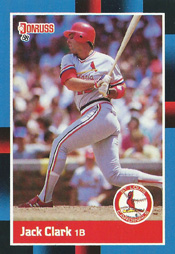
jack_clark5Instead, Lasorda, the Dodgers’ manager, made the fateful decision to allow Niedenfuer to pitch to Clark with Willie McGee on third, Ozzie Smith on second, first base open and two out.

On Oct. 16, 1985, Clark cracked a first-pitch fastball from Niedenfuer for a three-run home run, erasing a 5-4 Dodgers lead and carrying the Cardinals into the World Series with a 7-5 pennant-clinching victory at Los Angeles.

“After he hits the home run, even my wife knows I should have walked him,” Lasorda told the Daily Breeze of Torrance, Calif.

Match game

Jay Johnstone, a Dodgers reserve outfielder, wrote in his postseason column for the Daily News of Los Angeles that “Tommy, in fact, was going to walk him. Then he changed his mind.”

Andy Van Slyke, a left-handed batter, was on deck when Clark stepped to the plate against Niedenfuer.

“I was looking into the Dodgers dugout, waiting for Tommy to put up four fingers,” Van Slyke told reporters.

“If you were Tommy Lasorda, wouldn’t you rather pitch to me than to Jack Clark?”

Not, it turns out, if the pitcher is a right-hander, such as Niedenfuer.

If Clark had been walked intentionally, Lasorda intended to have a left-hander face Van Slyke. The left-hander the Dodgers had warming in the bullpen was Reuss, a former Cardinal.

In his book “White Rat: A Life in Baseball,” Cardinals manager Whitey Herzog said, “If Tommy walks Clark and brings in a lefty to pitch to Andy, I would have countered with Brian Harper, the only right-handed pinch-hitter I had left.”

Harper, a utility player, had batted .250 with no home runs in 43 games for the 1985 Cardinals.

In a rebuke of Lasorda, Herzog said, “I would rather let Brian Harper try to beat me than Jack Clark.”

Watching from the dugout, Harper was preparing for the chance to bat with the bases loaded. “Even when they pitched to Jack, I figured they would pitch around him,” Harper told the Daily Breeze.

Clark agreed, saying, “When they decided to pitch to me … I didn’t expect to get a pitch to hit.”

Cat and mouse

Niedenfuer was thinking the same. In the seventh inning, with the score tied 4-4 and Cardinals runners on first and third, Niedenfuer struck out Clark on sliders.

So, when Clark came to bat in the ninth, “I figured he wouldn’t be looking for a fastball,” Niedenfuer said.

Niedenfuer’s assumption had merit. In his book “You’re Missin’ a Great Game,” Herzog called Clark “the greatest fastball hitter of his era,” but said the slugger “took more heaters for strikes than any player I’ve ever seen.”

Said Herzog: “Jack Clark might have been the worst guesser I ever saw. He terrified people as a fastball hitter, but he took the wrong message from that. He believed nobody _ nobody _ would ever throw him a fastball. So he never sat on his best pitch. Jack would stand there waiting for the curve and … those pitchers would sneak heaters right by him.”

Knowing this, Niedenfuer said he intended to start Clark with a fastball on the outside part of the strike zone and try to get Clark to chase subsequent pitches outside the zone.

There were, however, two problems with this approach:

_ “I was looking for a fastball,” Clark said to the Daily News.

_ The fastball Niedenfuer delivered wasn’t on the outside corner. Instead, it was in the middle of the plate, about belt high.

Clark swung at the pitch and lifted a drive deep into the left-field bleachers.

“The only hope was that it would hit the Goodyear blimp and fall straight down,” Niedenfuer told Knight-Ridder Newspapers.

Said Clark: “It was the biggest, furthest, most important hit of my career.” Video

It also was the only home run Clark would hit in 47 career postseason at-bats. Boxscore

Previously: Trade for Jack Clark shook Cardinals from slumber

Read Full Post »

At each significant step in the Cardinals career of pitcher Barney Schultz, Johnny Keane played a prominent role.

barney_schultz2Keane was the minor-league manager who helped Schultz reach the majors for the first time with the 1955 Cardinals. Eight years later, when Schultz was placed on waivers by the 1963 Cubs, Keane, then manager of the Cardinals, convinced general manager Bing Devine to make the deal that returned Schultz to St. Louis. A year later, in August 1964, when the Cardinals appeared to have slipped out of contention, Keane made Schultz the closer. The knuckleball specialist rewarded his mentor with a stretch of outstanding relief that carried St. Louis to a National League pennant and a World Series championship.

After his playing career, Schultz remained with the Cardinals as a minor-league instructor and then pitching coach on the big-league staff of manager Red Schoendienst.

His story is one of how being prepared for opportunity and not giving up can lead to success.

Long journey

Schultz was 17 when he debuted as a professional player in the Phillies system in 1944. The right-hander played for five organizations _ Phillies, Tigers, Braves, Cubs and Pirates _ without getting to the big leagues.

After the 1953 season, Schultz was acquired by the Cardinals from the Pirates’ Denver farm club. The Denver executive who made the deal was Bob Howsam.

The Cardinals assigned Schultz to their Class AAA club Columbus club for 1954. The Columbus manager was Keane. Schultz posted an 8-8 record and 3.86 ERA in 41 games for Columbus. “Barney had a good fastball then, too, and I’d urge him to use it often with his knuckler,” Keane told The Sporting News.

Convinced Schultz had found his role as a reliever, Keane recommended the Cardinals give Schultz a good look at spring training in 1955. The Cardinals agreed and Schultz delivered. At 28, he made the Opening Day roster of the 1955 Cardinals, joining another rookie knuckleball pitcher, Bobby Tiefenauer, in the bullpen.

In 19 games with the Cardinals, Schultz was 1-2 with four saves and a 7.89 ERA. On June 16, Schultz was demoted to Class AA Houston.

Back with Keane

Schultz spent the next two seasons, 1956 and 1957, playing for Keane with the Cardinals’ Class AAA club at Omaha. He was 9-12 with a 4.19 ERA in 1956 and 8-7 with a 2.83 ERA in 1957.

Schultz, 31, began his third consecutive season under Keane with Omaha in 1958. On May 26, the Cardinals traded him to the Tigers for Ben Mateosky, a minor-league outfielder.

Freed from the Cardinals’ organization, Schultz worked his way back to the big leagues. He pitched for the 1959 Tigers and for the Cubs from 1961-63.

In June 1963, the Cubs placed Schultz, 36, on waivers. Keane, in his third season as Cardinals manager, urged Devine to acquire the pitcher. The Cardinals submitted a bid to claim Schultz on waivers, and sweetened the deal by offering utility player Leo Burke in exchange. On June 24, 1963, the transaction was made, reuniting Schultz with Keane and the Cardinals.

“We had talked about Schultz all spring,” Devine said. “We were the only ones to put in a bid for him when the Cubs asked waivers on him.”

The only players remaining on the 1963 Cardinals who were with St. Louis when Schultz debuted in 1955 were Stan Musial, Ken Boyer and Schoendienst.

Schultz was 2-0 with a save and a 3.57 ERA in 24 games for the 1963 Cardinals.

Closer in waiting

In 1964, the Cardinals sent Schultz to Class AAA Jacksonville before leaving spring training. Schultz posted an 8-5 record and 1.05 ERA in 42 games before the Cardinals recalled him from Jacksonville on July 31 _ two weeks before his 38th birthday.

Reunited again with Keane, Schultz yielded no runs in his first nine appearances for the 1964 Cardinals, earning five saves in that stretch.

With Schultz protecting leads and closing out games, the Cardinals rallied to win the pennant on the final day of the regular season. Schultz had six saves in his final eight appearances, all scoreless. Overall, Schultz was 1-3 with 14 saves and a 1.64 ERA in 30 games over the last two months of the 1964 season for St. Louis.

After the Cardinals defeated the Yankees in a seven-game World Series, Keane resigned and became Yankees manager.

Pitching for rookie manager Schoendienst, Schultz was 2-2 with two saves and a 3.83 ERA in 34 games for the 1965 Cardinals before he was demoted to Jacksonville.

In 1966, Schultz was a player-coach for the Cardinals’ minor-league Tulsa team. He was a Cardinals minor-league instructor from 1967-70 and served as Cardinals pitching coach under Schoendienst from 1971-75. Among those who praised him as a mentor were Cardinals pitchers Bob Forsch and John Denny.

In 1977, Schultz was pitching coach for the Cubs. His prize pupil was Bruce Sutter, who developed into a closer under Schultz and capped a Hall of Fame career by helping the Cardinals win the 1982 World Series title.

Previously: Why the Cardinals played baseball in Delaware on D-Day

Previously: 20th win for Ray Sadecki put 1964 Cardinals into 1st place

Previously: 5-game sweep of Pirates positioned Cardinals for pennant

Read Full Post »

(Updated Oct. 22, 2022)

On Aug. 25, 2005, Tony La Russa got his 2,195th win as a big-league manager when the Cardinals beat the Pirates, 6-3, at Pittsburgh. The victory moved him into third place for career wins as a manager, ahead of Sparky Anderson (2,194) and behind Connie Mack (3,731) and John McGraw (2,763).

larussa_leylandSix years later, when La Russa left the Cardinals after leading them to the 2011 World Series championship, he remained third in career wins with 2,728, just 35 shy of tying McGraw.

On Oct. 29, 2020, La Russa was named manager of the White Sox, giving him a chance to pass McGraw. After the 2022 season, La Russa retired, ranking second in career wins with 2,902.

Mack and McGraw compiled all of their wins between 1894 and 1950.

Mack managed the Pirates from 1894-96 and the Athletics from 1901-50.

McGraw managed the Orioles in 1899 and from 1901-02 and the Giants from 1902-32.

La Russa managed the White Sox from 1979-86 and from 2021-22, the Athletics from 1986-95 and the Cardinals from 1996-2011.

Sparky helps Tony

Anderson, while managing the Tigers, offered advice to La Russa when he was with the White Sox.

“Nobody was as ready to help or impart knowledge as Sparky,” La Russa told the St. Louis Post-Dispatch.

In the book “Tony La Russa: Man on a Mission,” La Russa said Anderson, who managed in the Cardinals minor-league system in the 1960s, taught him a major responsibility of a manager “is to try to figure out what your guys do well and where they struggle _ and try to play one away from the other.”

“For example,” said La Russa, “if a guy can’t bunt, don’t put him in a position to bunt. If someone is a bad runner, don’t give him a green light to run. If a guy has trouble going back on the ball but can come in, play him deeper. If a guy can go better to his right, shade him to the left. All of that crystallized the idea to play to strengths and away from weaknesses.”

Cardinals celebrate

On the night La Russa passed Anderson in career wins, Cardinals outfielder Jim Edmonds told the Post-Dispatch, “To have the most wins in the modern era is pretty special.” Boxscore

The Cardinals made sure the achievement was treated as special.

After the game, Edmonds spoke to his teammates in a closed-door meeting to make certain everyone understood the significance of the win.

Reliever Jason Isringhausen presented La Russa with the ball from the final out.

The players doused La Russa with beer. First baseman Albert Pujols playfully dumped a tub of ice water on him.

Isringhausen said the beer shower was planned; the ice water dump was spontaneous _ and momentarily worrisome. “We were afraid his heart was going to stop,” Isringhausen told reporter Rick Hummel.

The club brought out a case of Dom Perignon champagne and made a toast to their field leader.

Jim Leyland, a coach for La Russa with the White Sox from 1982-85 and a scout for the 2005 Cardinals, presented La Russa with a personal check for $2,194 _ a dollar for each win that tied La Russa with Anderson _ to be donated to the manager’s Animal Rescue Foundation.

Asked what career he would have pursued if he had flopped as a baseball manager, La Russa said, “I’d be an attorney. That would have been bad. I don’t think I would have been a very good one.”

La Russa thanked his wife, Elaine, and daughters Bianca and Devon.

“Without the support of Elaine and the two girls, I would have been gone a long time ago,” La Russa said.

Third will suffice

Anderson had said La Russa could pass McGraw on the wins list. “I don’t think so,” La Russa told Hummel.

Pujols predicted La Russa would aim higher. “I’m pretty sure he’s going to shoot for No. 1,” Pujols said. “Knowing him, it’s going to be real tough for him to walk out of this game.”

During the 2011 season, though, La Russa privately determined he was ready to stop managing. He wasn’t getting enough enjoyment from the job, even though he still loved the game.

In the book “One Last Strike,” La Russa said he spoke with his wife Elaine in September 2011 about his plan to leave the Cardinals that year.

“She said it would mean a lot to her and the girls if I passed John McGraw for second on the list for most managerial wins in a career,” La Russa said. “I could understand their thinking, but I couldn’t give in to it because that was something personal and not professional. Doing it for them, knowing that I shouldn’t be there, wasn’t something I could do. I hated to disappoint them.”

Read Full Post »

« Newer Posts - Older Posts »