Feeds:
Posts
Comments

Archive for the ‘Managers’ Category

(Updated Oct. 30, 2024)

In January 1985, the Cardinals forced out general manager Joe McDonald, friend and working partner of Whitey Herzog. The move signaled to Herzog, the Cardinals’ manager, that he, too, was vulnerable and could be ousted if his club didn’t contend in 1985.

joe_mcdonaldHerzog responded by leading the Cardinals to National League pennants in two of the next three seasons (1985 and 1987), securing his reputation as an innovative winner and capping a managerial career that would lead to his election to the National Baseball Hall of Fame.

Front office upheaval

On Jan. 3, 1985, Cardinals owner Gussie Busch said McDonald, the franchise’s general manager since 1982, had resigned and would remain with the club as a consultant. While vaguely acknowledging McDonald had made “a number of contributions to the team,” Busch also said “a change was needed to build the club into a pennant winner.”

In The Sporting News, Rick Hummel noted Busch’s statement “did not sound as if the move (by McDonald) was voluntary.” McDonald, 55, confirmed as much, telling the Associated Press he’d “look for another job” and was “too young to retire.”

Internal strife

After the Cardinals won the World Series championship in 1982 with Herzog as manager and McDonald as general manager, they finished fourth in the six-team NL East in 1983 and third in 1984.

Expectations were the Cardinals would finish out of contention in 1985, too. After the 1984 season, closer Bruce Sutter became a free agent and bolted the Cardinals for the Braves and McDonald dealt the club’s top run producer, right fielder George Hendrick, to the Pirates.

Concern about the direction the Cardinals were headed was one reason Busch was unhappy with McDonald. Another: Busch was irked McDonald hadn’t informed him about personal problems plaguing Cardinals outfielder David Green, who was entering a treatment center.

In his book, “That’s a Winner,” Cardinals broadcaster Jack Buck wrote, “McDonald made the mistake of not informing Mr. Busch before the story was in the news. Busch had made it clear he did not want to be surprised by anything he heard about his team. He wanted the information first _ and that was one of the reasons McDonald was fired as general manager.”

Committee rules

In a story headlined “Herzog’s Future Could Be In Doubt,” Hummel wrote, “Now that Joe McDonald has resigned, or been fired, as the St. Louis Cardinals general manager, what will become of manager Whitey Herzog, McDonald’s close friend? … Herzog couldn’t be blamed for wondering what the future of the Cardinals is … His input in the organization seems to have been lessened considerably in the past couple of years.”

A three-man executive committee of Busch, attorney Lou Susman and chief operating officer Fred Kuhlmann played a larger role in key Cardinals decisions.

Wrote Hummel, “Herzog and McDonald found it increasingly difficult to work within that framework because they had to get approval from the executive committee on most proposed transactions and, as often as not, they could not find all three members of the committee in town at the same time.”

In his book “White Rat: A Life in Baseball,” Herzog said, “I’d never seen an organization that was as screwed up as ours was when 1985 began.”

Met as Mets

McDonald and Herzog worked together in the Mets organization from 1966-72. In 1967, Bing Devine, the former Cardinals general manager who had become a Mets executive, named McDonald director of scouting and Herzog director of player development.

Herzog went on to become a big-league manager. McDonald became general manager of the Mets in 1975, replacing Bob Scheffing, and held that position through 1979 until new ownership replaced him with Frank Cashen.

McDonald and Herzog were reunited in 1980 when McDonald joined the Cardinals as assistant to Herzog, who was both general manager and manager.

In February 1982, Herzog, tired of negotiating player contracts, suggested to Busch that McDonald should become general manager. Busch agreed and the announcement was made in April 1982.

(Years later, in recalling how he relinquished the general manager job, Herzog said to Cardinals Yearbook, “He (Busch) tore up my contract and gave me a $75,000 raise. I gave up one job and got a $75,000 raise. Pretty good deal, huh?”)

Life after Cardinals

After the Cardinals ousted McDonald, they contracted with consultant Tal Smith to assist them in a search for a replacement. On Feb. 25, 1985, Dal Maxvill, the former Cardinals shortstop, was named general manager.

Meanwhile, McDonald pursued his plan to find another front-office job.

In 1987, McDonald joined the Tigers as director of player development. He replaced Bill Lajoie as Tigers general manager in 1991 and held that position for two years before he was replaced by Jerry Walker.

After leaving the Tigers, McDonald became a scout for the Angels, Rockies and Red Sox. He was a Red Sox scout when they won World Series championships against the Cardinals in 2004 and 2013.

Previously: Why Gussie Busch fired Bing Devine in championship year

Read Full Post »

(Updated Jan. 21, 2026)

Branch Rickey is well known for being the Dodgers executive who broke baseball’s color barrier by bringing Jackie Robinson to the major leagues. What is less known is Rickey was the Cardinals executive who made Mike Gonzalez the first Cuban manager in the major leagues.

mike_gonzalezGonzalez, a Havana native, had three stints with the Cardinals as a catcher: 1915-18, 1924-25 and 1931-32. He also played for the Braves, Reds, Giants and Cubs.

During his 17-year playing career in the majors, Gonzalez developed a reputation for his baseball savvy. It was while scouting for the Giants that Gonzalez wired a report to manager John McGraw about a prospect: “Good field, no hit.” The phrase became part of baseball’s lexicon.

Shrewd strategist

In 1934, Gonzalez became a coach on the staff of Cardinals manager Frankie Frisch. Four years later, when Frisch was fired on Sept. 11, 1938, Rickey chose Gonzalez to manage the Cardinals.

Though it was a stopgap measure _ most reports indicated Rickey would hire someone from within the minor-league system to manage the 1939 Cardinals _ the move was significant.

In reporting that Gonzalez, 47, was the first Cuban to manage in the big leagues, The Sporting News described him as “a shrewd diamond strategist, a keen judge of talent and a capable instructor.”

Frisch called Gonzalez “a great guy, loyal and true and one of the smartest birds I ever knew.”

Citing his stellar reputation as a coach for the Cardinals, The Sporting News wrote of Gonzalez, “The athletes who have played under his coaching direction have learned to respect his judgment and to take his orders implicitly.”

Gonzalez also had the ability to decode signs flashed by opponents. “One year, the Cardinals won almost all their games with one of the second-division clubs, largely because Gonzalez was able to call virtually every pitch and tell exactly when the enemy was going to hit-and-run or try to steal,” The Sporting News noted.

In the book “Baseball’s Greatest Teams,” author Tom Meany noted that, in addition to his cagey baseball skills, Gonzalez was “a most remarkable poker player.”

Successful start

Gonzalez made his debut as Cardinals manager on Sept. 14, 1938, in the first game of a doubleheader at Philadelphia. Despite yielding nine runs and 13 hits, starter Max Macon pitched a complete game and got the win in a 12-9 Cardinals victory. Boxscore

The Cardinals swept the doubleheader, winning the second game, 3-2, behind Mort Cooper, who pitched a three-hitter while walking eight in his big-league debut. Boxscore

Gonzalez led the Cardinals to wins in his first five games as manager, then lost six in a row. He finished with an 8-8 record.

Ray Blades became manager of the 1939 Cardinals and kept Gonzalez as a coach.

Second stint

In June 1940, Blades was fired and Gonzalez was named to his second stint as Cardinals manager. Again, it was an interim role. The Cardinals were 1-5 under Gonzalez in 1940 before Billy Southworth took over as Cardinals manager. Gonzalez stayed as a coach.

The Cardinals won two World Series titles and three pennants under Southworth, who earned election to the National Baseball Hall of Fame.

In 1946, Southworth left the Cardinals to become manager of the Braves. He was replaced by Eddie Dyer, who maintained Gonzalez as a coach.

The 1946 season was the 13th and final season for Gonzalez as a Cardinals coach. It ended memorably. In Game 7 of the 1946 World Series, Enos Slaughter scored the winning run on a dash from first base on a hit by Harry Walker. Slaughter credited Gonzalez, the third-base coach, for waving him to home plate as soon as he reached third. It was redemption for Gonzalez, who was criticized after Game 4 when two baserunners he waved home were thrown out at the plate.

Cuban managers

Gonzalez was the first of seven Cubans who managed in the majors, according to baseball-reference.com. The others:

_ Preston Gomez: 1969-72 Padres, 1974-75 Astros and 1980 Cubs.

_ Marty Martinez: 1986 Mariners (one game).

_ Cookie Rojas: 1988 Angels and 2001 Marlins (one game).

_ Tony Perez: 1993 Reds and 2001 Marlins.

_ Carlos Tosca: 2002-04 Blue Jays.

_ Fredi Gonzalez: 2007-10 Marlins and 2011-16 Braves.

On Oct. 25, 2021, Oliver Marmol became the first minority manager of the Cardinals since Mike Gonzalez. Marmol, born and raised in the United States, traces his lineage to the Dominican Republic.

Read Full Post »

Jerry Reuss Banner

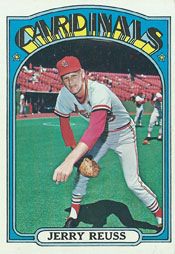
On Nov. 11, 2014, I visited the Dodgers Adult Baseball Camp at Historic Dodgertown in Vero Beach, Fla., to seek out Jerry Reuss for an interview about his time as a pitcher with the Cardinals.

Dressed in a home white Dodgers uniform, Reuss, 65, was patient, thoughtful, articulate and polite.

He debuted with the Cardinals in September 1969 and pitched for them in 1970 and 1971, posting an overall 22-22 record before he was traded to the Astros in April 1972.

In a 22-year major-league career, primarily with the Dodgers (nine years) and Pirates (six years), Reuss was 220-191 with a 3.64 ERA. In 2014, he published a book “Bring in the Right-hander,” a delightful retrospective on his career. You can order an autographed copy at his Web site www.jerryreuss.com.

jerry_reuss2Q.: Two months after the Cardinals traded Steve Carlton, they traded you. It was first reported you were traded because you were in a contract dispute with owner Gussie Busch. Later it comes out it was about your moustache. True?

Reuss: “It was about growing a moustache. Bob Broeg (a writer) had said something to that effect and I thought, ‘No, they wouldn’t be that concerned about that.’ I lived with that for 20 or 25 years.

“It wasn’t until the mid-90s when I was in St. Louis and I went to a ballgame and I saw Bing Devine, who was working as a scout. He had been the general manager of the Cardinals when I was traded. I said, ‘Bing, you got a minute?’ He said, ‘Yeah. Why don’t you sit down and we’ll talk.’ So I asked him about the deal. I figured enough time had passed that I could do that.

“He was more than happy to tell me. He said Mr. Busch at times would act on an impulse. This was one of those times. He insisted on me being traded because I had the moustache. Bing thought if given a little time he (Busch) would come to his senses and make a wise baseball decision rather than a personal decision.

“But he kept hammering about the moustache and would say, ‘Did you get rid of him yet? Why not?’ And the ultimatum was put like this: ‘If you don’t get rid of him, I’ll get rid of you and get somebody who will get rid of him.’ So when you’re faced with a situation like that, you do what has to be done.”

Q.: You still have a moustache and it has become something of a signature look for you…

Reuss: “Yeah. But when you look back about how that was the thinking in baseball in the early 70s and then just two or three years later baseball began to change with the times. Guys were coming in with long hair and beards. And you just wonder: What was the stink all about?

“So on the matter of just a little bit of facial hair _ you could barely see it _ people would ask, “Why didn’t you shave it?’ And I’d say, ‘There wasn’t a rule that the Cardinals had to be clean-shaven and be like a military situation. If it doesn’t bother anybody, if it’s not a rule, then what are we talking about here?’ ”

Q.: Your last year with the Cardinals, 1971, was the year your teammate, Joe Torre, led the National League in hitting and RBI and won the MVP Award. Could you see then the leadership qualities that later would make him a Hall of Fame manager with the Yankees?

Reuss: “Oh, sure. Lights out. At that early age, I just wondered whether there were guys like that on every team.

“He was managing the club on the field. Red (manager Schoendienst) just stepped back and said, ‘Joe, you have a grasp of it. You take care of it. When you’re on the field, you see things that I don’t.’ And Joe, being wise enough and knowing his boundaries, would go to Red and say, ‘Would you consider this or would you consider that?’

“Sometimes there was a lineup that was put out and Joe would go to Red and say, ‘This player won’t say it to you but he’ll say it to me. You might want to give him a day off.’ And Red would say, ‘All right. Let’s do that.’ He’d make the lineup change. Joe was able to get those things from players and he did it only because it helped the club. It wasn’t anything personal with the player.

“You could see the leadership. I’ve never come across another player who was like him. There were a couple that had some of those qualities _ I understand Cincinnati had a few. (Johnny) Bench was one of those guys _ that when he spoke, everybody just said, ‘Let’s reconsider this.’ Joe was that way all the time. Joe was more far-reaching. You knew he would be a manager.”

Q,: After leaving the Cardinals, you played for seven big-league teams. As a St. Louis native who began his career with the hometown team, did you ever hope to return to the Cardinals?

Reuss: “I never gave it a whole lot of thought. Once I got to Los Angeles (in 1979), I said, ‘This is home. This is where I want to be.’ It’s where I always wanted to play.

“Back in those days, it was one of the few grass fields. Lots of artificial turf then. My knees were feeling it. And then I became a ground ball pitcher and the infield I had behind me was particularly adept at playing at Dodger Stadium on the lawn.

“As a result, I had a good defensive ball club become a great defensive ball club. They got a lot of ground balls. That’s where my success was and that’s where I wanted to stay. When I was ready to change teams, I was past my prime. Rather than a lot of teams coming to me, I was going to them and just hoping for a chance.”

Q.: The player who had the most at-bats against you was

Reuss: “Pete Rose. Did you see what he hit against me?”

Q.: .244 in the regular season. (29-for-119).

Reuss: “I couldn’t believe that.”

Q.: What was your secret?

Reuss: “There was no secret. Pete hit me the same way he hit everybody else. It’s just that, when he hit the ball against me, more often it was right at somebody. Did you see the number of times he struck out against me? (9) He was making contact. He came up there swinging.”

Part 1: Jerry Reuss on Bob Gibson as a teammate: He was tough

Read Full Post »

Jerry Reuss Banner

Jerry Reuss, left-handed pitcher and St. Louis native, joined his hometown Cardinals at age 20 in 1969. He was a neophyte on a team of championship-tested veterans such as Bob Gibson, Steve Carlton, Tim McCarver, Lou Brock and Curt Flood.

On Nov. 11, 2014, I visited the Dodgers Adult Baseball Camp at Historic Dodgertown in Vero Beach, Fla., to seek out Reuss for an interview about his time with the Cardinals. I found him as he climbed the stands at Holman Stadium after coaching a morning game between campers.

Dressed in a home white Dodgers uniform with the familiar No. 49, Reuss, 65, quickly and graciously accepted my request for an interview, inviting me to find a seat with him in the shade in the stands. We sat near the top row along the first-base line. Reuss answered every question and was patient, thoughtful, articulate and polite.

A graduate of Ritenour High School in St. Louis, Reuss was selected by the Cardinals in the second round of the 1967 amateur draft. (Their first-round pick was catcher Ted Simmons.) Reuss debuted with the Cardinals in September 1969 and pitched for them in 1970 and 1971. He had a 22-22 record with the Cardinals before he was traded to the Astros in April 1972.

In a 22-year major-league career, primarily with the Dodgers (nine years) and Pirates (six years), Reuss was 220-191 with a 3.64 ERA. In 2014, he published a book “Bring in the Right-hander,” an anecdote-rich retrospective on his career. You can order an autographed copy at his Web site www.jerryreuss.com.

Here is Part 1 of 2 of my interview with Jerry Reuss:

jerry_reuss3Q.: Early in the 1969 season, you were a 19-year-old left-hander assigned by the Cardinals to Class AAA Tulsa. The manager there was Warren Spahn, perhaps the best left-handed pitcher all-time. What was it like for you to play for him?

Reuss: “Warren was a Hall of Fame player. We weren’t of the caliber he was. We didn’t have the experience he had. Some of the things he was doing, well, it was just new to us. And, at least for me, I had no experience whatsoever. So, whatever Warren said, I said, ‘Let’s do it.’ I didn’t even know enough to ask questions.”

Q.: In your major-league debut for the Cardinals on Sept. 27, 1969, at Montreal, you started, pitched seven scoreless innings, gave up just two hits, drove in a run with a single and got the win in a 2-1 Cardinals victory. The bullpen gave up a run in the eighth. Do you recall that your first big-league hit was the game winner in your first big-league win?

Reuss: “That hit turned out to be the difference in the ballgame. It’s the dream of everybody: get to the major leagues, win a ballgame and then have something really special to talk about. It had a little bit of drama.”

Q.:  Your batterymate in your big-league debut was Tim McCarver, who had been the Cardinals’ catcher in three World Series. What was it like pitching to McCarver?

Reuss: “In that particular game, all I know is I wondered whether he could hear my knees shaking. We talk a little bit about that now when I see him. He says, ‘I remember that.’ I think he’s being nice. Here’s a guy who caught some very important World Series games for the Cardinals. If he remembers my first game, that is a hell of a memory.”

Q.: Ted Simmons was your catcher at Tulsa and then with the Cardinals. He’s known for his hitting. Does he get the credit he deserves as a catcher?

Reuss: “Probably not because of contemporaries like Johnny Bench, Steve Yeager. As far as his game-calling ability, Cardinals pitchers later on told me, ‘This guy thinks it through.’ He had a game plan for everybody who came to the plate and then made the adjustments if the hitter made adjustments. He’d go out and let the pitcher know, ‘This is what I’m seeing here. They’re changing their feet or moving this way.’

“He became a student of the game. That may have made up for his lack of ability in other areas. He wasn’t the quickest down to second base and he wasn’t always able to hold on to some pitches, particularly early in his career. But he turned into a pretty good receiver.”

Q.: What was Bob Gibson like as a teammate?

Reuss: “He was tough. He demanded excellence of himself and everybody who played behind him. His feeling was, ‘If I’m going to come out here and work this hard and give what I give _ and he was hurting at this time physically; his elbow was killing him _ then I expect everybody to play like that. I expect that same intensity from anybody else.’ And he wasn’t afraid to let people know about it.

“You respect a guy like that _ You don’t like him because nobody likes to get called on the carpet _ but when you have an earned run average of 1.12 and 28 complete games in 1968 and have what many would consider the greatest season a pitcher could ever have, it’s hard to get right up to him and say no. He knew what he was talking about.”

Q,: What did you think of your fellow left-hander on the Cardinals, Steve Carlton?

Reuss: “With St. Louis, he showed just how good he could be. I don’t know that if he had stayed with St. Louis that he’d have had those same kinds of seasons he later had with the Phillies. When he went to Philadelphia, he changed his mental outlook.

“He didn’t like to run. So there was a Phillies strength and conditioning coach, Gus Hoefling, who said, ‘You don’t have to do that. Here’s what we’ll do. I’ll give you all the conditioning that you need.’ Steve bought into it. He believed it. If you believe something, then there’s a good chance it is going to work for you.

“He believed it would work. As a result, he won 27 games in 1972. He started doing things his way and developed into a Hall of Fame pitcher.”

Next: In Part 2 of the interview, Jerry Reuss offers his views on Joe Torre and Gussie Busch.


Read Full Post »

(Updated March 30, 2026)

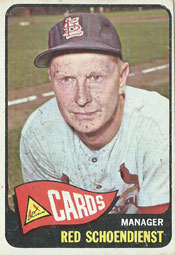
With the Cardinals in need of a public relations boost, Stan Musial went to bat for Red Schoendienst.

red_schoendienst8As usual, Musial delivered.

On Oct. 20, 1964, the Cardinals hired the popular Schoendienst to replace Johnny Keane as their manager. Four days earlier, Keane stunned the Cardinals by resigning less than 24 hours after leading St. Louis to a World Series championship.

Schoendienst, 41, a former second baseman who was a coach on Keane’s staff, had no managerial experience. “I never had really thought about managing,” Schoendienst said in his book “Red: A Baseball Life.”

According to broadcaster Harry Caray, in his book “Holy Cow,” the Cardinals had told Schoendienst that summer they wanted him to get experience managing in the minor leagues. Schoendienst said he told the Cardinals he had no desire to manage and would prefer to remain a major league coach for the next 25 years.

Fan favorite

Keane quit because Cardinals owner Gussie Busch fired general manager Bing Devine in August and plotted to replace Keane with former St. Louis shortstop Leo Durocher after the season. Even though Busch changed his mind about firing Keane after the Cardinals rallied to win the National League pennant and World Series crown, Keane refused to stay. His surprise departure triggered a firestorm of criticism against Busch and general manager Bob Howsam.

Desperate to repair the damage, Busch ordered Howsam to fire consultant Branch Rickey, who had advocated for Devine’s dismissal, and he formed a six-person executive committee to seek a replacement for Keane.

Musial, in his first year as Cardinals vice president after a stellar playing career, and Howsam were the key members of the committee. Joining them were Busch, club executive Dick Meyer and Cardinals board of directors members Jim Conzelman and Mark Eagleton.

According to multiple sources, Howsam favored hiring either White Sox scout Charlie Metro, who had managed for Howsam in the minor leagues at Denver, or former Giants manager Alvin Dark, a one-time Cardinals shortstop.

Musial advocated for Schoendienst, who was Musial’s friend and road roommate during their playing days together for St. Louis.

“I knew Red needed experience _ we all did _ but we felt he was the best man for the job,” Musial said, according to biographer George Vecsey.

Asked whether nice-guy Schoendienst was tough enough for the job, Musial told Bob Burnes of the St. Louis Globe-Democrat, “That would be one of the least of my worries about Red. He’s down to earth about baseball. He knows how the game is played. He knows what he wants and he can say so. He won’t have any problems with discipline.”

Said Schoendienst: “With Musial leading my support, it came down to as much a public relations decision as a baseball one and that’s where I had the advantage … The prevailing thought was the new manager needed to be someone who was a favorite of the fans.”

Quick decision

Schoendienst got tipped off by a Busch relative, Ollie Von Gontard, that the committee was considering him as a serious candidate.

Caray told Schoendienst, “Red, if you keep your nose clean with all the craziness that’s going on here, you’re going to wind up being manager of this club.”

Schoendienst said Busch called and asked to meet at the ballpark. Schoendienst said he met with Busch and Howsam. After Howsam quizzed Schoendienst about game strategies and player personnel evaluations, Schoendienst said the general manager “suddenly jumped up from his chair and asked how I would like to manage. I said that would be great and he said, ‘You’re my new manager.’ It happened so quickly I really didn’t have time to think about it.”

Said Schoendienst: “I felt comfortable that I could do the job and was ready to put my full-time energy and devotion into the post.”

Take my advice

Ed Spiezio, a Cardinals infielder, told Larry Harnly of The Journal-Register of Springfield, Ill., he didn’t expect Schoendienst to be elevated from coach to manager. “It really surprised me when they named Schoendienst manager,” Spiezio said. “… I never thought of him being the manager. He was so close to all the guys. Then all of a sudden he’s the manager.”

Cardinals players, who respected and supported Keane, were tolerant of Schoendienst, who avoided micro-managing while learning on the job.

In his book “Stranger to the Game,” pitcher Bob Gibson said, “The only problem I had with Schoendienst was that he wasn’t Johnny Keane, but he was a good man and a good man for us … Schoendienst, like Keane, respected our intelligence and our professionalism. His only rules were ‘Run everything out’ and ‘Be in by 12.’ Somehow, we got the words tangled up and lived instead by the motto ‘Run everything in and be out by 12.’ ”

Schoendienst said to the Globe-Democrat, “Managers don’t make rules on major league clubs. The players do. If the players show that they need to have a lot of regulations, I’ll issue those regulations. From what I’ve seen, though, most players don’t need a lot of tough regulations.”

Schoendienst also listened to his players. Said Gibson: “Red was uncertain of himself in the beginning, a fact which the ballplayers were well aware.”

Gibson said he and catcher Tim McCarver would sit on either side of Schoendienst in the dugout and offer suggestions to one another about game strategy. “We never actually told him to make a move; we were just there as birdies in the ear, now and then providing information he needed to make his decision,” Gibson said.

Center fielder Curt Flood, in his book “The Way It Is,” said of Schoendienst, “When he was required to think two or three moves ahead, as in choosing pinch-hitters or replacing pitchers, he accepted advice readily. It was given matter-of-factly, with every consideration for Red’s position.”

In the book “Few and Chosen,” McCarver said, “Red is one of the nicest people in the world, and that’s how he was as a manager. He was like a member of the family … and his approach to managing was fatherly or avuncular.”

The Cardinals finished seventh and sixth in Schoendienst’s first two years as manager, then won two consecutive pennants and a World Series title. He managed the Cardinals from 1965-76 and for parts of 1980 and 1990. His 1,041 wins rank second to Tony La Russa (1,408 wins) among Cardinals managers.


Read Full Post »

(Updated Oct. 20, 2018)

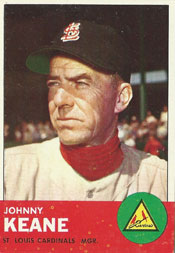
Gussie Busch broke Johnny Keane’s cardinal rule and Keane couldn’t forgive him.

johnny_keane2On Oct. 16, 1964, just 19 hours after the Cardinals won the World Series championship, Keane resigned as manager, stunning Busch, the club owner, who had expected to sign Keane to a contract extension that day.

Loyalty was sacrosanct to Keane. He had been loyal to the Cardinals, serving the franchise for 35 years. When Busch became disloyal to him, Keane’s personal code of conduct required he take action: He quit.

Surprising news

In the celebration that immediately followed the Cardinals’ World Series Game 7 victory over the Yankees on Oct. 15, Busch announced he would hold a news conference at the Anheuser-Busch brewery the next morning. Busch intended to present Keane with a three-year contract extension for $50,000 per year.

When Keane arrived at the brewery, he handed Busch a resignation letter 30 minutes before the news conference. Busch, in a hurry to begin the event, gave the letter to an assistant without reading it, according to the book “October 1964.” The assistant read the letter and insisted the owner do the same.

Flanked by Keane and general manager Bob Howsam, Busch, visibly shaken, announced Keane’s resignation to the surprised gathering, who were expecting a contract signing.

“This really has shocked me,” Busch said. “I didn’t know a thing about it until I saw Johnny this morning. All I can say is that I’m damned sorry to lose Johnny.”

Said Keane: “I told Mr. Busch not to make any offer. I handed him my resignation and said my decision was firm _ that I didn’t want to embarrass him _ but that no offer would be acceptable.”

In his book “Uppity,” Cardinals first baseman Bill White said, “I wasn’t there, but I was told Busch and Howsam looked as if Johnny had just kicked them in the teeth _ which, in effect, he had.”

The resignation letter was dated Sept. 28 _ the day after the Cardinals had completed a five-game sweep of the Pirates, with six games remaining in the regular season.

The decision had been made 10 days before then.

Higher calling

Keane, a St. Louis native, briefly studied for the priesthood at St. Louis Prepatory Seminary. At 18, he signed a Cardinals contract and was assigned to the minor leagues.

“I’ve been asked about that often,” Keane told The Sporting News. “Did I give up the priesthood for baseball? The answer is no. I knew after consultation with the priests at the seminary that the life was not for me.”

Keane was a baseball lifer. More specifically, a Cardinals lifer, or so it seemed.

He was an infielder in the St. Louis organization from 1930 until becoming a Cardinals minor league player-manager in 1938. He spent 21 seasons as a manager in the St. Louis farm system and had winning records in 17 of those years.

In 1959, Keane made it to the major leagues for the first time as a coach on the staff of Cardinals manager Solly Hemus. Keane replaced Hemus as St. Louis manager in July 1961.

Matter of principle

In August 1964, Busch, thinking the fifth-place Cardinals were out of contention, fired general manager Bing Devine and business manager Art Routzong. Both were friends of Keane.

Though Keane remained manager, published reports indicated Busch planned to replace Keane after the season with Dodgers coach and former Cardinals shortstop Leo Durocher. In his book “Nice Guys Finish Last,” Durocher said he and Busch met in St. Louis at the end of August and Busch told him he would become Cardinals manager after the season.

Keane felt betrayed.

In early September 1964, Yankees general manager Ralph Houk and club president Dan Topping decided to fire manager Yogi Berra but wanted to wait until after the season to tell him. Their top two candidates to replace Berra were Keane and Giants manager Al Dark. Houk and Topping sought and received permission from Busch and Giants owner Horace Stoneham to talk with Keane and Dark and had a “trusted emissary” conduct “a number of conversations with both in the ensuing weeks,” the Associated Press later reported.

Keane later told the St. Louis Post-Dispatch he hadn’t been in contact with Yankees officials before his resignation, but “other people, not the Yankees management, told me the Yankees were interested in me” as early as Sept. 22.

On Sept. 18, with the Cardinals 6.5 games behind the first-place Phillies, Keane and his wife privately agreed Keane would resign after the Cardinals’ final game, regardless of his job status.

On Sept. 25, Houk and Topping decided they’d hire Keane, according to the Associated Press. Three days later, on Sept. 28, Keane wrote and dated his resignation letter and put it aside.

Hold that letter

The Cardinals won four of their final six games, including a sweep of the Phillies, and clinched the pennant on the last day of the regular season.

The late-season surge prompted Busch to change course and he frantically tried to get Keane to accept a contract extension to remain Cardinals manager. On Oct. 2, with three games left in the regular season, Busch met Keane in the clubhouse and offered “a new contract at a substantial pay increase,” but Keane said he preferred to wait until after the World Series to discuss a contract offer, the Post-Dispatch reported.

On Oct. 4, after the Cardinals clinched the pennant that day with a win against the Mets, Busch approached Keane at the team party and offered him “whatever you want,” but Keane again said he wouldn’t talk terms until after the World Series, according to the Post-Dispatch.

In the World Series, the Cardinals won four of seven against the Yankees, clinching their first title in 18 years.

At the news conference the next day, Keane told reporters a series of “little things” led to his resignation. Pressed for details, Keane admitted Devine’s firing and Busch’s open flirtation with Durocher were factors that caused him to depart.

Devine and Keane became friends in 1949 when Devine was general manager of the Cardinals’ minor league club at Rochester and Keane was the manager.

In his book “The Memoirs of Bing Devine,” Devine said, “As a person, Keane impressed me as Stan Musial did … I’m talking about basic traits as a person.

“I didn’t think he needed to _ or should have _ quit the Cardinals because of me. But Johnny Keane was a loyal guy _ and that’s how he felt.”

Most Cardinals players said Keane’s resignation surprised them, but pitcher Roger Craig told United Press International he had predicted Keane’s decision in August when it became known Busch wanted Durocher as manager. “Knowing the pride he has,” Craig said of Keane, “I knew this would happen.”

In his book “Stranger to the Game,” pitcher Bob Gibson said, “My anger toward the ballclub _ and it was tangible _ stemmed largely from the needless nature of Keane’s departure … I stayed mad through the winter.”

Hours after Keane’s resignation became public, the Yankees fired Berra. Three days later, on Oct. 19, Houk met with Keane to discuss the job and the next day, Oct. 20, 1964, Keane was hired to replace Berra.


Read Full Post »

« Newer Posts - Older Posts »