Feeds:
Posts
Comments

Archive for the ‘Managers’ Category

Tony La Russa brought out the evil twin in Dusty Baker.

dusty_baker2On Sept. 3, 2003, the Cardinals and Cubs played the fourth game of an intense five-game series at Chicago’s Wrigley Field. La Russa, the Cardinals’ manager, and Baker, the Cubs’ manager, engaged in a shouting match that added a memorable but ugly chapter to the rivalry between the franchises.

In the second inning, Cubs starter Matt Clement hit Cardinals pitcher Dan Haren with a pitch. An inning later, Haren hit Clement. That prompted the theatrics from the managers.

Baker rushed onto the field, confronted the umpires, then pointed angrily at the visitors’ dugout, where La Russa stood, glaring.

“Even back in the dugout, Baker kept pointing and yelling as La Russa smirked,” wrote Chicago Sun-Times columnist Jay Mariotti.

“Baker hollered, ‘I’ll (mess) you up,’ at La Russa,” wrote St. Louis Post-Dispatch columnist Bernie Miklasz.

“TV cameras caught Baker telling La Russa he’d gladly take him on any time and La Russa telling him to bring it on,” reported Mike Kiley of the Sun-Times.

“The two managers yelled at each other from across the field,” wrote Joe Strauss of the Post-Dispatch. “Baker at one point flipped an obscene gesture at La Russa.”

Wrote Miklasz: “A rumpus with an opposing manager makes La Russa’s blood surge and raises his competitiveness to maximum-testosterone level.” Video

Cardinals fold after feud

The teams hardly needed motivation. The day before, they split a gritty doubleheader. The Cubs won the opener in 15 innings. The Cardinals won the second game, 2-0, behind Matt Morris. Cubs pitcher Kerry Wood twice knocked down Morris with pitches and dusted him with a third, prompting La Russa to say Wood “likes to scare people. I’ve heard he likes to hit people.”

Baker and Wood objected to La Russa’s remarks.

After the La Russa-Baker macho match that followed Haren and Clement being hit by pitches, the intensity was raised to a fever pitch.

The Cardinals, who entered the Sept, 3 game in first place in the National League Central, a half-game ahead of the Astros and 1.5 games ahead of the Cubs, led, 6-0, in the sixth, but the Cubs scored three in the sixth, three in the seventh and two in the eighth and won, 8-7. Boxscore

Wrote Miklasz: “La Russa was nearly inconsolable.”

Said La Russa: “As far as bad losses go, it’s tied for first with any that I can remember. There’s been some savage losses, but this is right there with the worst of them.”

A defiant Baker told the Post-Dispatch: “Nobody intimidates me but my dad and Bob Gibson and a bully I had in elementary school. And I grew bigger than him, so he couldn’t bully me.”

Mariotti suggested the Cubs change their logo because “a cuddly little cub doesn’t fit the image any more when Dusty Baker is threatening to kick Tony La Russa’s butt.”

Beware the Gemini

The next day, La Russa and Baker met on the field before the game and had what was described by Strauss as “a decidedly serious conversation” for about five minutes.

Said La Russa to the Post-Dispatch: “I explained to him that the Cardinals and my players come first with me and I recognized that the Cubs and his players come first with him. If we both have that understanding, I think it’s easy for us to maintain a respect and friendship with each other.”

Baker, in comments to both the Sun-Times and Post-Dispatch, revealed there is a bad Dusty that tries to overtake the good one.

“I’m not proud of myself when I display that kind of action because I don’t really like that person when he comes out,” Baker said. “And he rarely comes out unless he’s provoked to come out.

“I’m a Gemini and I’ve definitely got an evil twin. I don’t like that twin. That’s the mean side. He’s got to run his course, then go back in there for a while. Everybody has a side they don’t like. I can get even hotter.”

Previously: Dusty Baker ended playing career with Tony La Russa at helm
Read Full Post »

Whitey Herzog managed the Cardinals with a bold, creative style, which partly explains why he largely was successful. What elevated Herzog to Hall of Fame quality is he got his players to buy into that style.

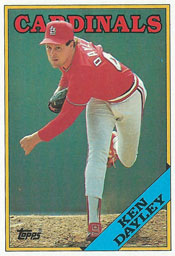
ken_dayleyA striking example of that occurred on Aug. 28, 1988, in a Sunday afternoon game between the Cardinals and Reds at Cincinnati.

Ken Dayley was one strike away from completing a three-inning save when Herzog abruptly pulled the reliever before he was finished pitching to the batter, Chris Sabo.

Dayley didn’t complain nor did anyone else with the Cardinals, which is testament to the trust and respect Herzog had with his players at that time.

Bob Forsch, in his last appearance as a Cardinal, started that game and pitched six innings. With the Cardinals ahead, 5-3, Forsch was relieved by Dayley after yielding a leadoff single to Sabo in the seventh.

Dayley held the Reds scoreless in the seventh and eighth.

In the ninth, Dayley retired the first two batters before Barry Larkin singled. Up next was Sabo.

A right-handed batter, Sabo, a rookie, presented a challenging matchup for the left-handed Dayley. The previous night, Sabo had four hits against the Cardinals, including three singles off left-handed pitching.

Cardinals closer Todd Worrell, a right-hander, was warming in the bullpen, but Herzog stayed with Dayley because Kal Daniels, a left-handed batter, was due up after Sabo. Herzog wasn’t figuring on Sabo hitting a home run. Dayley was unscored on in his last seven games.

Dayley got the count to 2-and-2 on Sabo. On the next pitch, Sabo drilled a line drive down the left-field line.

Worrell, who was in the left-field bullpen, told the St. Louis Post-Dispatch, “When it passed me, it was about three feet fair.”

Wrote the Associated Press: “Sabo’s liner flirted with the left-field foul screen … but the ball hooked at the last second.”

“It wasn’t foul by much, maybe two feet,” Cardinals left fielder Tom Lawless said.

Said Worrell: “You could slide a newspaper between the ball and the foul pole.”

Herzog immediately went to the mound and lifted Dayley for Worrell. The closer threw one pitch, a slider, which Sabo swung and missed by a foot, sealing the Cardinals’ 5-3 victory. Boxscore

“I’ll bet that was the easiest save he ever had,” Herzog said.

Said Dayley: “Whitey had seen enough. I don’t mind setting the table for him, but I’ll be damned if I’m going to feed him.”

Previously: Whiteyball: Willie McGee at shortstop; Ricky Horton in right

Read Full Post »

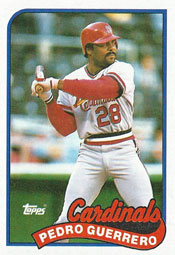
In the summer of 1988, some looked at Pedro Guerrero and saw a first baseman who was a defensive liability, a star diminished by injuries and a perceived lack of desire.

lana_turnerWhitey Herzog looked at Guerrero and saw Lana Turner.

On Aug. 16, 1988, the Cardinals, desperate to bolster a pop-gun attack, traded pitcher John Tudor to the Dodgers for Guerrero.

Because Guerrero had tendinitis in both knees and had spent most of June and July on the disabled list while recovering from a pinched nerve in his neck, some questioned whether the Cardinals had acquired damaged goods.

Responding to Rick Hummel of the St. Louis Post-Dispatch about those concerns, Herzog, the Cardinals’ manager, said of Guerrero, “His lower body isn’t the best in the world. His upper body looks like Charlie Atlas and his lower body probably looks like Lana Turner.”

Fortunately for the Cardinals, Guerrero could hit better than Turner, the long-legged actress of the 1940s and ’50s who played sultry roles in films such as “The Postman Always Rings Twice” and “Peyton Place.”

At the time of the trade, critics, such as columnist Scott Ostler of the Los Angeles Times, saw Guerrero as a one-dimensional player.

pedro_guerreroWrote Ostler: “When Guerrero isn’t hitting home runs and doubles _ which he hasn’t been doing much of lately _ he hurts you more ways than he helps you. Defense, for instance … The most you can say is that Guerrero sometimes makes the routine plays.”

The next Jack Clark

The Cardinals, though, needed a run-producer and they saw Guerrero as one of their best options. “He’s one of the few hitters in baseball who fits our need,” Herzog said. “He’s an impact player, like Jack Clark.”

St. Louis had tried to replace Clark _ who, as a free agent, departed the Cardinals for the Yankees after the 1987 season _ with Bob Horner, but that didn’t work. With the Cardinals out of contention by August 1988, management devised a plan for how to boost the team’s offense.

They decided to pursue during the impending off-season a pair of players who appeared headed toward free agency: Guerrero and Tim Raines of the Expos.

Guerrero was eligible to become a free agent after the 1988 season and the Dodgers expressed little interest in keeping him. Meanwhile, it widely was anticipated an arbitrator would declare Raines a free agent after ruling that team owners had colluded to limit offers to him when he first became eligible for free agency in November 1986.

Two factors caused the Cardinals to change those plans. First, word leaked that Raines was preparing to accept a three-year contract extension from the Expos. Also, there was speculation the Dodgers might trade Guerrero to the Phillies if they could get left-handed pitcher Don Carman in return.

Dodgers want Tudor

Concerned they might miss out on both Guerrero and Raines, the Cardinals pursued trade talks with the Dodgers. Seeking a left-handed starter to replace the injured Fernando Valenzuela, the Dodgers wanted Tudor, who was the National League leader in ERA at 2.29.

Cardinals general manager Dal Maxvill asked Herzog who he would want in return.

Said Herzog: “There’s only one guy I’d consider trading (Tudor) for.”

Guerrero.

The Cardinals agreed to a deal under one condition: Guerrero would have to accept a contract extension and relinquish his right to become a free agent that winter. Guerrero agreed and got an extension for three seasons at $6.2 million, including a $400,000 bonus, the Los Angeles Times reported.

“Basically, it’s a premier pitcher for a premier hitter,” Herzog said to the Associated Press.

Guerrero, 32, batted .298, with a .374 on-base percentage, in 59 games for the 1988 Dodgers.

Maxvill called Guerrero “an everyday player with outstanding run-producing potential.”

Said Cardinals pitcher Bob Forsch: “If he comes over and wants to play, he can help.”

Guerrero told the Associated Press, “I never thought I’d be a Cardinal. But now I’m here and I’m very happy … I always wanted a chance to play for Whitey.”

Tudor, 34, was going from an also-ran to a contender. He was a key starter for the Cardinals’ pennant-winning teams in 1985 and 1987. “I’ve enjoyed my time here,” Tudor said. “The people have been great to me and, as far as I’m concerned, there are no better fans in the world.”

Tudor was 4-3 with a 2.41 ERA in nine starts for the 1988 Dodgers, who won the World Series championship that year. Injured most of 1989, Tudor became a free agent after that season and returned to the Cardinals in 1990.

Guerrero hit .268 with five home runs and 30 RBI in 44 games for the 1988 Cardinals. He was outstanding in 1989, hitting .311 with 42 doubles and 117 RBI for St. Louis. His on-base percentage that season was .391.

As a Cardinal from 1988 to 1992, Guererro produced 505 hits in 500 games, posting a .282 batting average and .348 on-base percentage, with 44 home runs.

Previously: Redbirds ripoff: How Bob Horner replaced Jack Clark

Read Full Post »

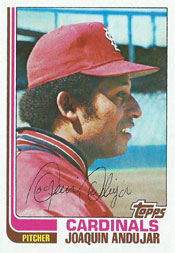
Joaquin Andujar had a nearly perfect first half of the 1985 season.

joaquin_andujar4The Cardinals’ right-hander produced 15 wins before the all-star break, but that wasn’t enough to get him the starting assignment for the National League.

Andujar was one of 10 all-star pitchers selected by Padres manager Dick Williams. At the time of the selections, Andujar had a 15-3 record. The Padres’ LaMarr Hoyt was 11-4 and won his last nine decisions. Williams said he wanted to see the outcome of the July 12 Padres vs. Cardinals game, matching Andujar against Hoyt, before naming his all-star starter.

“I don’t think I should have to pitch good tonight to be the (all-star) starter,” Andujar said to the Associated Press before the Padres-Cardinals game.

Miffed by what he considered a slight by Williams, Andujar told reporters he would skip the All-Star Game.

Informed of Andujar’s comments, Williams said, “Andujar deserves (the all-star start) as much as anybody. If you go by the numbers, he’s got the best. He’s on a 30-win collision course,” but Williams also noted Hoyt had pitched six years in the American League for the White Sox before joining the Padres and “that’s something to consider because he knows the hitters over there.”

Hoyt wins duel with Andujar

In the matchup against Hoyt, Andujar pitched well; Hoyt was better. Hoyt pitched seven scoreless innings, held the Cardinals to two hits and got the win in the Padres’ 2-0 victory at St. Louis. Andujar yielded two runs and eight hits and took the loss. Boxscore

Hoyt stretched his consecutive wins streak to 10 and improved his record to 12-4. Andujar dropped to 15-4 but still led the major leagues in wins. The Cardinals scored a total of one run in Andujar’s four losses.

With better support, Andujar might have been 19-0 at the break. The scores in his losses were 5-0 to the Giants, 1-0 and 3-1 to the Phillies and 2-0 to the Padres.

“I’ll be there (at the All-Star Game) … I hope Andujar comes, too,” Hoyt told United Press International. “He’s a good pitcher and he deserves to be there.”

Fire up the grill

Approached by reporters after his loss to the Padres, Andujar said, “I wasn’t trying to impress Dick Williams. He’s not a special guy.”

Asked what he would do during the all-star break, Andujar replied, “I’m going to work out every day and barbecue with my family. I’ll barbecue quail or anything.”

Said Williams to the Associated Press: “Now he’s got me a little mad.”

Williams named Hoyt the all-star starter. Andujar skipped the game.

Hoyt pitched three innings, giving up two hits and an unearned run, and got the win in a 6-1 National League victory. Boxscore

As Andujar himself was fond of saying, “There is one word in America that says it all, and that word is, ‘You never know.’ “

Read Full Post »

After 10 seasons wearing Kansas City Royals blue, Dan Quisenberry was startled when he put on his St. Louis Cardinals jersey, walked by a mirror and glimpsed how he looked in red.

dan_quisenberry“It’s pretty bright red,” Quisenberry said to the St. Louis Post-Dispatch. “My eyes are going to have to adjust.”

In July 1988, Quisenberry joined the Cardinals 10 days after being released by the Royals.

Departing Kansas City was emotional for Quisenberry, who earned 238 saves for the Royals. Quisenberry, who threw a sinker with a submarine delivery, was the closer on the Royals’ World Series championship team in 1985 and led the American League in saves five times.

In 1986, Quisenberry was signed to what the Royals called a lifetime contract. By 1988, the Royals were phasing out Quisenberry, 35, and grooming younger pitchers such as Steve Farr and Jeff Montgomery for the closer job. When Quisenberry was released on July 4, 1988, his season record was 0-1 with a 3.55 ERA in 20 games.

With tears welling, Quisenberry told Bob Nightengale of the Kansas City Star and Times, “After all of these years, it’s hard not to be emotional … It wasn’t a happy ending and it wasn’t very picturesque.”

Said Royals general manager John Schuerholz to the Associated Press: “The bottom line is effectiveness. It was purely and simply a baseball decision. His effectiveness was just not what it had been.”

Reunited with Whitey

Cardinals manager Whitey Herzog was the Royals’ manager in 1979, Quisenberry’s rookie season with Kansas City. Herzog and Cardinals general manager Dal Maxvill reached out to Quisenberry and signed him on July 14, 1988.

“A lot of it is being close to my home (in Leawood, Kan.),” Quisenberry told the Post-Dispatch. “One of the other reasons is that Whitey is the manager. I have the utmost respect for Whitey. He’s a real straight shooter.”

Quisenberry also was a friend of Cardinals coach Nick Leyva. They were college baseball teammates at La Verne in California.

Pitching primarily in middle relief, Quisenberry was 2-0 with a 6.16 ERA in 33 games for the 1988 Cardinals. St. Louis brought him back in 1989 and Quisenberry was 3-1 with six saves and a 2.64 ERA in 63 appearances.

Hit man

Because of the designated hitter rule in the American League, Quisenberry never batted in a big-league game with the Royals. He got his lone big-league hit on July 6, 1989, when he delivered a RBI-single against Tim Belcher of the Dodgers at St. Louis. Boxscore

Players in the Cardinals’ dugout “went into hysterics” after Quisenberry reached first base, the Post-Dispatch reported.

Cardinals fans gave Quisenberry a standing ovation as he stood on first.

”That was embarrassing,” Quisenberry said. ”I was hoping they’d stop. The cordial thing is to tip your hat, but I stuttered. It was a stutter tip.”

In the eighth, Quisenberry batted against Ricky Horton and struck out on three breaking pitches.

”I learned I’m a dead-red fastball hitter,” Quisenberry quipped. ”I probably should go back to Triple-A to learn how to hit the curveball.”

Read Full Post »

Tony La Russa had lots of time to think about his faltering Cardinals club during the 1998 all-star break. The Cardinals manager used that time off to devise a batting order that surprised players and fans, creating a controversy that lingered throughout La Russa’s tenure in St. Louis.

todd_stottlemyreIn July 1998, La Russa chose to bat the pitcher eighth rather than ninth in the order.

In an article for the St. Louis Post-Dispatch, reporter Rick Hummel referred to the decision as “The Great Experiment.”

Intelligent innovation or egotistical folly? La Russa’s move was labeled both.

Even with an offense powered by the record-setting home run pace of Mark McGwire, the bullpen-poor, error-prone 1998 Cardinals entered the all-star break having lost 10 of their last 12 games.

In their first game after the break, July 9 vs. the Astros at St. Louis, La Russa posted a batting order that had pitcher Todd Stottlemyre batting eighth and rookie second baseman Placido Polanco batting ninth.

Stottlemyre became the first major-league pitcher to bat anywhere but ninth in the order since the Phillies’ Steve Carlton on June 1, 1979, at Cincinnati.

(In that game, Phillies manager Danny Ozark batted Carlton eighth and shortstop Bud Harrelson ninth. Carlton went 0-for-3 and hit into a double play; Harrelson, who entered the game hitless in five at-bats that season, was 1-for-3 with a single. The Reds won, 4-2. Boxscore)

The Phillies had been shut out in their previous three games, so the move of Carlton to the eighth spot was a gimmick. Ozark never tried it again.

La Russa was committed to the strategy. He batted his pitcher eighth in each of the last 77 games of the 1998 season.

In the 1960s, Cardinals pitcher Bob Gibson had asked manager Red Schoendienst to bat him eighth and to move shortstop Dal Maxvill to the ninth spot. Schoendienst didn’t do it. “If he had,” Maxvill said to Hummel, “I would have been so ticked off I wouldn’t have talked to him for the rest of my life. I don’t think he would want to show me up.”

La Russa informed Hummel he sought the advice of Schoendienst, then a St. Louis consultant, and Cardinals instructor George Kissell before deciding to bat the pitcher eighth in 1998. “They said it was OK,” La Russa said.

In explaining his decision, La Russa told the Post-Dispatch, “I don’t see how it doesn’t make sense for the ninth-place hitter to be a legitimate hitter. This gives us a better shot to score runs. It’s an extra guy on base in front of Ray (Lankford), Mark (McGwire) and Brian (Jordan). The more guys who are on base, the less they’ll be able to pitch around Mark. I don’t have a problem with it.”

Cardinals’ first game with pitcher batting eighth

Polanco, appearing in his third big-league game, was 0-for-2 from the ninth spot on July 9, 1998, before Willie McGee pinch-hit for him in the seventh. Stottlemyre was 1-for-2. The pitcher led off the third with a single and scored on Royce Clayton’s double. Still, the Cardinals made four errors and grounded into three double plays. Houston won, 5-4. Boxscore

Said Stottlemyre: “I stink whether I hit eighth or ninth. I take my swings. I take my seat. And I get ready to pitch.”

The more La Russa continued to bat the pitcher eighth, the more the criticism grew.

“I think the National League is investigating the Cardinals and Tony,” catcher Tom Pagnozzi said after batting ninth for the first time.

Said La Russa: “It would be nice if it would become a non-issue.”

La Russa legacy?

According to the book “Cardinals Journal” (2006, Emmis Books), the 1998 Cardinals scored 4.98 runs per game with the pitcher batting ninth and 4.96 runs per game with the pitcher batting eighth.

From 1998 to 2011 (his last season as manager), La Russa batted the pitcher eighth 432 times. He batted Cardinals pitchers eighth in the last 56 games of 2007 and in 153 games in 2008.

(Until La Russa, the manager who had batted the pitcher eighth the most times in a season was Lou Boudreau of the 1957 Athletics. He batted the pitcher eighth for the first 56 games that season. Boudreau was fired in August that year.)

La Russa batted Cardinals pitchers eighth 55 times in 2009, 77 times in 2010 and 14 times in 2011.

Previously: Tony La Russa: Proud pupil of mentor Paul Richards

Read Full Post »

« Newer Posts - Older Posts »