Feeds:
Posts
Comments

Archive for the ‘Managers’ Category

Cot Deal spent 11 years in the Cardinals organization as a player, coach and manager. As a Cardinals pitcher, he yielded three consecutive home runs to the Reds in the ninth inning _ and won. In the minor leagues, he managed Bob Gibson.
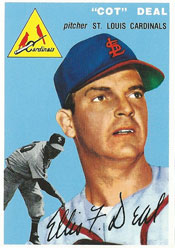
cot_dealHis most memorable feat occurred in his first year in the Cardinals system with Columbus (Ohio) of the Class AAA American Association. In what The Sporting News described as “one of the greatest exhibitions of mound stamina in minor league history,” Deal pitched a 20-inning complete game.

Though his 50 years in pro baseball sent him across the country, Deal always returned to his native Oklahoma. He was born Jan. 23, 1923, in Arapaho, population about 400, in Custer County. His given name was Ellis Deal, but he was called Cot as a boy because of his cotton-top hair color.

Signed by the Pirates while in high school, Deal was a third baseman and outfielder for three years in the Pittsburgh system before he entered military service. After three years as a training instructor for the Army Air Corps, Deal was discharged, acquired by the Athletics and sent to Class AAA Toronto, where he was converted to a pitcher.

In 1947, the Red Sox acquired Deal and he spent parts of the 1947 and 1948 seasons with Boston, posting a 1-1 record and 7.02 ERA.

Deal, 26, opened the 1949 season with Louisville, a Class AAA affiliate of the Red Sox. In May, he was traded to the Cardinals for a minor-league infielder and assigned to Columbus.

Four months later, Sept. 3, 1949, Deal started against Louisville, pitched 20 innings and got the win in Columbus’ 4-3 victory. Deal also contributed four hits.

Columbus likely would have won in the 10th if not for a loose shoe. With the score 1-1 and Les Fusselman on first base, Deal doubled to right. As Fusselman rounded third, he lost a shoe, hesitated and hobbled on one shoe to the plate, where he was tagged out.

Each team scored twice in the 12th. Columbus snapped the 3-3 tie in the bottom of the 20th on an RBI-single by Roy Broome off Gordon Mueller, who pitched nine innings in relief of starter Jack Griffore.

During the Louisville-Columbus game the next afternoon, “Deal was applauded and cheered every time he stuck his head out of the dugout,” The Sporting News reported.

In 1950, Deal pitched in three games for the Cardinals, but spent most of the season at Columbus. A switch-hitter, Deal went back to being an outfielder for Columbus in 1951 and hit 18 home runs, but returned to pitching the following year. Sent to Class AAA Rochester, Deal was 14-9 in 1952 and 16-9 in 1953.

Deal opened the 1954 season with the Cardinals and was part of the bullpen that posted the worst ERA (5.46) in Cardinals history. He appeared in 33 games and had a 2-3 record and 6.28 ERA.

Deal’s first win for the Cardinals came on July 10, 1954, at St. Louis against the Cubs. He pitched two scoreless innings in relief of starter Vic Raschi and earned the win when Joe Frazier, pinch-hitting for Deal in the ninth, hit a two-run walkoff home run against Bob Rush for a 2-1 Cardinals triumph. Boxscore

Deal’s second and final win for the Cardinals occurred in a wild Sunday afternoon game at Cincinnati. Entering in the third inning, Deal held the Reds scoreless for five innings and St. Louis went into the ninth with a 14-8 lead.

After retiring the first batter in the ninth, Deal yielded consecutive home runs to Gus Bell, Ted Kluszewski and Jim Greengrass. Deal was lifted but got the win when the Cardinals held on for a 14-12 victory. Boxscore

In 1956, Deal was a player-coach for Rochester manager Dixie Walker. He replaced Walker as manager in 1957. In 1958, Bob Gibson was promoted from the Cardinals’ Omaha farm club to Rochester in June and thrived under Deal. Gibson, 3-4 at Omaha, was 5-5 with a 2.45 ERA in 20 games for Rochester.

On Aug. 3, 1958, Deal lifted starter Lynn Lovenguth after one inning and brought in Gibson, who pitched eight innings, holding Miami to three hits and earning his first win for Rochester.

In his book ‘Stranger to the Game,” Gibson said, “Just like that, I was in the rotation. With regrets to Lovenguth, it was a good situation for me. Deal was actually a terrific guy, and black players were nothing new or objectionable to either Rochester or the International League.”

Deal returned to Rochester for a third season as manager in 1959. On Aug. 1, he resigned after Rochester lost 20 of 25 and was replaced by Reds pitching coach Clyde King. Reds manager Fred Hutchinson then hired Deal to be Cincinnati’s pitching coach.

Deal coached for 15 years in the big leagues, including serving as pitching coach for manager Johnny Keane with the 1965 Yankees.
Read Full Post »

(Updated Feb. 26, 2022)

In 1973, the Cardinals had such a dreadful start that general manager Bing Devine was asked almost daily whether he’d fire manager Red Schoendienst.

“I’m tired of hearing that question,” Devine said to The Sporting News. “I’ll be gone before Red.”

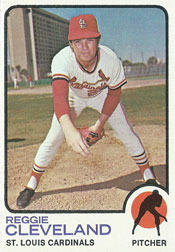
reggie_cleveland2The 1973 Cardinals lost their first five games and 12 of their first 13. Their 1-12 record ranked among the worst in big-league history, recalling the 0-13 start of the 1920 Tigers, the 1-12 record of the 1962 expansion Mets and the 1-15 mark of the 1969 Indians.

Nerves were raw; tension was high. After Cardinals starter Reggie Cleveland gave up a key two-run, two-out double to Bill Robinson in an April 22 loss to the Phillies, Schoendienst groused, “That’s why he’s a .500 pitcher.” Boxscore

The Cardinals’ skid extended into May. After the Giants beat the Cardinals, 9-7, on May 8 (Bob Gibson yielded four home runs, two to Bobby Bonds and one each to Willie McCovey and Dave Kingman), St. Louis had a 5-20 record, the worst in the major leagues, and was in last place in the National League East. Boxscore

The Cardinals were 1-7 in one-run decisions and 0-4 in extra-inning games.

After shoring up the bullpen by calling up left-handers Al Hrabosky and Rich Folkers from the minors and acquiring veteran junkball specialist Orlando Pena from the Orioles, as well as replacing Ray Busse at shortstop with Mike Tyson, the Cardinals began to stabilize, then thrive.

Regarding the replacement of Busse with Tyson, teammate Joe Torre told the New York Daily News, “Before Mike stepped in at shortstop, we were losing a lot of games early because of our infield. Routine ground balls were going straight into the outfield. We needed someone to hold the defense together.”

Years later, in an interview with Cardinals Magazine, Tyson credited Schoendienst and coach George Kissell.

“Red always put me in a good position,” Tyson said. “I didn’t have a particularly strong arm, but my range was good and I got rid of the ball quickly.”

As for Kissell, Tyson said, “George always had my back. Every day after practice in spring training he’d get a bucket of balls and he’d hit me grounder after grounder.”

From the low point of the 5-20 record, the Cardinals won 56 of their next 81 games, boosting their record to 61-50 by Aug. 5 and securing first place in the division, five games ahead of the second-place Cubs.

From there, the streaky Cardinals reverted to their early-season form.

Gibson injured his knee running the bases against the Mets and was sidelined from Aug. 4 to Sept. 29. From Aug. 6 to Aug. 18, St. Louis lost eight in a row and 11 of 12, falling to 62-61.

Overall, the Cardinals lost 31 of their last 51 games and finished in second place at 81-81, 1.5 games behind the Mets.

Read Full Post »

With a 76-78 record and fourth-place finish in the National League, the 1956 Cardinals lacked enough playing talent, but they did have a high level of leadership skill.

grady_hattonNine players on the 1956 Cardinals became major-league managers. The nine, in alphabetical order: Ken Boyer, Alvin Dark, Joe Frazier, Alex Grammas, Grady Hatton, Solly Hemus, Whitey Lockman, Red Schoendienst and Bill Virdon.

Hatton played 12 years (1946-56 and 1960) in the big leagues as an infielder for the Reds, White Sox, Red Sox, Cardinals, Orioles and Cubs. He had 1,068 hits and a .254 batting average.

As manager of the Astros from 1966-68, Hatton helped develop second baseman Joe Morgan, outfielders Rusty Staub and Jim Wynn and pitchers Larry Dierker and Don Wilson.

Hatton’s stint with the Cardinals was brief. His contract was sold by the Red Sox to the Cardinals on May 11, 1956. Three months later, the Cardinals sent him to the Orioles in a waiver transaction.

A left-handed batter, Hatton appeared in 44 games, mostly as a pinch-hitter and second baseman, and hit .247 for the 1956 Cardinals.

Hatton was acquired by general manager Frank Lane as part of a roster overhaul. Within a one-week stretch in May 1956, Lane acquired Hatton and two other infielders _ Bobby Morgan from the Phillies and Chuck Harmon from the Reds _ to bolster the bench.

“You can see what I was trying to do,” Lane said to The Sporting News. “I wanted to give the Cardinals a tough core; men who’ve been around and who play anywhere, any thing. It wasn’t guesswork. It was me, the coaches and the manager (Fred Hutchinson) pooling ideas, hoping to come up with a club that can go all the way.”

The 1956 Cardinals opened the season with a middle infield of Alex Grammas at shortstop and Red Schoendienst at second base, but after three games rookie Don Blasingame replaced Grammas.

Blasingame was better at second base than he was at shortstop, so in June 1956 the Cardinals swapped Schoendienst to the Giants for Dark, who became the shortstop, with Blasingame replacing Schoendienst at second.

Hatton, expected to back up Blasingame, batted .118 with runners in scoring position and .214 as a pinch-hitter.

On July 31, 1956, the Cardinals claimed Rocky Nelson, a left-handed batter, on waivers from the Dodgers. The next day, Hatton’s contract was sold to the Orioles. The Sporting News reported, “Hatton had not been delivering as the club’s left-handed batting specialist.”

Two years later, Hatton began his career as a manager, starting in the Orioles’ system before moving into minor-league jobs with the Cubs and Astros. In 1965, Hatton managed the Astros’ Class AAA Oklahoma City club to a 91-54 record, mentoring prospects such as catcher Jerry Grote, shortstop Sonny Jackson and future Cardinals pitchers Joe Hoerner, Chuck Taylor and Chris Zachary.

Hatton became manager of the Astros in 1966, replacing Lum Harris. Under Hatton, the Astros were 72-90 in 1966 and 69-93 in 1967. After winning five of their first six in 1968, the Astros faltered. From June 1 through June 17, they lost 14 of 16, including a four-game sweep by the Cardinals. Hatton was fired and replaced by Harry Walker, the former Cardinals player and manager.

“The problem is hitting,” Hatton said to The Sporting News. “We have not hit since the day we left spring training.”


Read Full Post »

In 1943, the defending World Series champion Cardinals shifted their spring training site from Florida to Illinois. Compared with where other big-league clubs had to go, the Cardinals considered themselves fortunate.

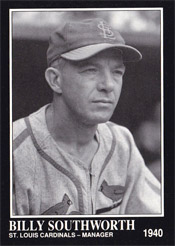
billy_southworth2With the United States pouring resources into its fight against Germany and Japan in World War II, big-league baseball offered to help conserve by placing travel restrictions on where clubs could train in the spring.

Clubs were ordered to choose sites north of the Potomac and Ohio rivers and east of the Mississippi River.

The Browns of the American League selected Cape Girardeau, Mo., located 135 miles south of St. Louis. (Because Cape Girardeau is on the west bank of the Mississippi, the Browns technically were in violation of the rules, but baseball officials allowed it.)

The Cardinals picked Cairo, Ill., the southernmost spring training site of all 16 major league clubs. Cairo, then a town of 14,000, is located where the Ohio River flows into the Mississippi. It is 40 miles south of Cape Girardeau.

“We’re going farther south than any other big-league training outfit,” Cardinals owner Sam Breadon said to The Sporting News. “We’ll be only a short distance from Tennessee and the weather down there is always from 12 to 15 degrees warmer than it is in St. Louis.”

Here is where the big-league teams trained in 1943:

NATIONAL LEAGUE

CLUB……………1943 TRAINING SITE……………1942 TRAINING SITE

Braves…………..Wallingford, Conn……………………..Sanford, Fla.

Cardinals……….Cairo, Ill……………………………………St. Petersburg, Fla.

Cubs………………French Lick, Ind……………………….Catalina Island, Calif.

Dodgers…………Bear Mountain, N.Y…………………..Havana, Cuba

Giants……………Lakewood, N.J………………………….Miami, Fla.

Phillies…………..Swarthmore, Pa……………………….Miami Beach, Fla.

Pirates……………Muncie, Ind…………………………….San Bernardino, Calif.

Reds………………Bloomington, Ind…………………….Tampa, Fla.

AMERICAN LEAGUE

CLUB……………1943 TRAINING SITE……………1942 TRAINING SITE

Athletics…………Wilmington, Del………………………..Anaheim, Calif.

Browns…………..Cape Girardeau, Mo…………………..DeLand, Fla.

Indians…………..West Lafayette, Ind……………………Clearwater, Fla.

Red Sox………….Medford, Mass………………………….Sarasota, Fla.

Senators…………College Park, Md………………………Orlando, Fla.

Tigers……………..Evansville, Ind…………………………Lakeland, Fla.

White Sox………..French Lick, Ind………………………Pasadena, Calif.

Yankees……………Asbury Park, N.J…………………….St. Petersburg, Fla.

The Cardinals didn’t report to Cairo, Ill., until mid-March, at least two weeks later than they usually went to St. Petersburg. They trained outdoors on a large field and indoors in a high school gym.

According to The Sporting News, the field drained well, “usable the day after a heavy rainfall,” and the gym was like “a steam room” because the Cardinals kept the temperature above 80.

Cardinals manager Billy Southworth projected a positive attitude, telling The Sporting News after the first week of workouts, “Let us have three days outdoors out of every five and we’ll be in thoroughly satisfactory condition for the pennant race. And let us have warm weather through most of the last two weeks and we’ll be in as good condition as we could attain anywhere in the country.”

The Cardinals’ Cairo spring didn’t hurt. They repeated as National League champions in 1943. They trained again in Cairo in 1944 and 1945 (winning a World Series title in 1944) before returning to St. Petersburg in 1946.

Previously: How Mort Cooper pitched 2 straight 1-hitters for Cardinals

Read Full Post »

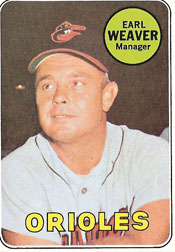
Stan Musial and Earl Weaver were Cardinals spring training teammates. Both were elected to the National Baseball Hall of Fame _ Musial for his accomplishments as a Cardinals player and Weaver for his success as an Orioles manager.

earl_weaverMusial, 92, and Weaver, 82, died on the same day, Jan. 19, 2013.

In March 1952, Musial, 31, was in his prime, having led the National League in batting average, triples and runs scored in 1951.

Weaver, 21, was in the Cardinals’ major-league camp for the first and only time. The 5-foot-7 second baseman was the youngest and shortest member of the Cardinals’ 40-man roster in March 1952, The Sporting News reported.

A St. Louis native, Weaver signed with the Cardinals at 17 in February 1948, a month after he was graduated from Beaumont High School. He played for the Woltman Jewelers team that won the St. Louis Intermediate Municipal League championship three times and also for the Fred W. Stockham American Legion team that won Missouri state titles in 1945 and 1947, The Sporting News reported.

In his first four seasons (1948-51) in the Cardinals’ farm system, Weaver played on four teams that won league championships: West Frankfort (Illinois State) in 1948, St. Joseph (Western Association) in 1949, Winston-Salem (Carolina) in 1950 and Omaha (Western League) in 1951. Weaver’s manager at Winston-Salem and at Omaha was George Kissell.

When Winston-Salem clinched the 1950 Carolina League title with a 3-1 victory over Burlington in Game 5 of the best-of-seven series, pitcher Vinegar Bend Mizell hit a home run and Weaver drove in the deciding runs with a bases-loaded single in the sixth inning. “Scouts of the parent St. Louis Cardinals describe Weaver as a Solly Hemus type,” The Sporting News declared, comparing Weaver with the Cardinals’ feisty shortstop.

After being named to the 1951 Western League all-star team along with Omaha teammate Ken Boyer, Weaver entered 1952 determined to win a spot on the Cardinals’ Opening Day roster as a backup to second baseman Red Schoendienst.

The Sporting News, in its March 5, 1952, edition, reported, “In Earl Weaver, the smallest athlete in camp _ 5 feet 7 _ the Cardinals have a fine infield prospect, a smooth workman around second base and a fair hitter.”

When the Cardinals opened their 1952 spring training schedule on March 8 against the Yankees at St. Petersburg, Fla., the top three in their batting order were Weaver at second base, Hemus at shortstop and Musial in left field. Weaver had two hits and Musial had one in the Yankees’ 11-5 victory over the Cardinals.

The next day, March 9, 1952, Weaver again batted leadoff and started at second base and Musial was in left field, batting third. Weaver and Musial went hitless, but the Cardinals beat the Yankees, 3-1.

What made that game remarkable is 10 of the players _ three Cardinals and seven Yankees _ became major-league managers. They were Weaver, Hemus and catcher Del Rice of the Cardinals; catchers Yogi Berra and Ralph Houk, shortstops Jerry Coleman and Gene Mauch, second baseman Billy Martin, pitcher Eddie Lopat and right fielder Hank Bauer of the Yankees.

(When manager Bauer was fired by the Orioles in July 1968, he was replaced by his first-base coach, Weaver.)

Weaver played and started in many spring training games for the 1952 Cardinals. Among his highlights:

_ On March 10, batting leadoff and playing second base, Weaver was 2-for-4 with two RBI in the Cardinals’ 8-5 victory over the Braves at Bradenton, Fla. Musial had a double in two at-bats.

_ On March 13, Weaver was 2-for-4 with a stolen base and Musial was 1-for-4 in the Reds’ 2-1 victory over the Cardinals at St. Petersburg.

_ On March 14, Weaver had two hits, including a home run off Bob Porterfield, when the Cardinals and Senators played to a 6-6 tie in a game called in the sixth inning because of rain at St. Petersburg.

_ On March 19, Weaver contributed a pinch-hit single for the Cardinals in a game won by the Red Sox, 3-2, at St. Petersburg. The starting left fielders were Musial and Ted Williams. Musial was 2-for-3; Williams, 0-for-3.

Though he impressed the Cardinals, Weaver was returned to the minor leagues at the end of spring training.

Weaver played two more seasons in the Cardinals’ system before his contract was purchased by Denver, a minor-league affiliate of the Pirates, in September 1953.

Weaver played 14 seasons in the minor leagues without appearing in a major-league game.

He established himself as big-league caliber as Orioles manager by winning 1,480 regular-season games, six division titles, four American League pennants and a World Series championship in 17 seasons.

Few recalled, though, his professional baseball career began as a Cardinals prospect who joined Musial as a regular for one glorious month in spring training.

Read Full Post »

In 1946, his first season as Cardinals manager, Eddie Dyer guided them to a World Series title.

Dyer had been a manager in the Cardinals’ farm system for 13 years (1928-36 and 1939-42) when he was chosen to replace Billy Southworth, who left after the 1945 season to manage the Braves. Dyer led the 1946 Cardinals to their ninth National League pennant and sixth World Series title.

Southworth was one of the most successful Cardinals managers. He led them to three NL pennants and two World Series championships. After the 1945 season, when the Cardinals placed second behind the Cubs, Southworth was approached by the Braves and offered a financial deal “that comes to a baseball manager only once in his career,” he told United Press.

Southworth, 52, was under contract to the Cardinals through the 1946 season. After hearing from the Braves, Southworth asked Cardinals owner Sam Breadon whether he would consider releasing him from the remaining year of his contract.

Breadon agreed, telling the Associated Press he “couldn’t stand in Southworth’s way.”

Southworth, who was earning $20,000 a year from the Cardinals according to multiple published reports, signed a three-year deal with the Braves. United Press reported the total value of the contract at $75,000 to $100,000. The Associated Press stated Southworth would earn $30,000 a year from the Braves. The Sporting News reported the contract was for $35,000 a year.

“The Braves offer was one which comes to a baseball man only once in a lifetime,” Southworth said to The Sporting News, “and I wish to state publicly how much I appreciate Mr. Breadon’s magnanimity in not putting any obstacle in my way to better myself. I have never had a harsh word with Mr. Breadon during all the years I worked for him in St. Louis.”

One reason Breadon was willing to allow Southworth to leave was he had Dyer available to replace him.

Dyer, 46, worked for the Cardinals as a player, minor-league manager and administrator, but he left in 1944 to tend to his various business interests in Houston. He was pleased to be asked to return to the Cardinals as manager.

“It was a big surprise to me,” Dyer said to the Associated Press when asked his reaction about being selected to replace Southworth, “although I always wanted to manage a big-league club.

“Since Billy Southworth had a contract with another year to run, I was surprised at his leaving the Cardinals. I made certain he hadn’t taken the step because of any disagreement with the club before I accepted the managership. I wouldn’t have taken the job under such a circumstance.”

United Press noted, “Since his entry into the St. Louis organization in 1922, Dyer has been one of the chain’s hardest and most unpublicized workers. Last year (1944), when Eddie left the Cards to go into the oil business in Houston, an attempt was made to alter his decision. He was told that he was next in line for the managerial job. Thinking Billy Southworth was a fixture for as long as he chose, Dyer declined.”

A graduate of Rice with a bachelor of arts degree, Dyer was signed to the Cardinals by Branch Rickey. A left-hander, Dyer pitched six seasons (1922-27) for the Cardinals, posting a 15-15 career record and 4.75 ERA before a sore arm ended his playing days.

Dyer became a Cardinals minor-league manager in 1928. He stayed in that role through 1936, then spent two years as a Cardinals minor-league executive before he returned to managing St. Louis minor-league teams from 1939-42.

Under Dyer, the Cardinals’ Houston farm club won Texas League championships in three consecutive seasons (1939-41).

Among the future Cardinals standouts groomed by Dyer in the minor leagues were outfielders Joe Medwick and Enos Slaughter, first baseman Johnny Mize and pitchers Howie Pollet and Harry Brecheen.

In 1943, after Rickey had departed the Cardinals for the Dodgers, Dyer became director of the Cardinals’ minor-league system. He was in that role until July 1944, when he accepted an opportunity to join his brother in an oil business.

With an influx of players preparing to return to the 1946 Cardinals after military service during World War II, Breadon saw Dyer as the ideal talent evaluator to sort through the roster options.

“I consider him the best judge of young ballplayers in the country, which makes him priceless at a time like this” Breadon said to The Sporting News.

Said Dyer: “All I ask of a ballplayer is that he stay in shape to play winning baseball. My theme song for years to my players has been, ‘Be mentally and physically fit to do your best and we won’t worry about the results.’ ”

Dyer led the 1946 Cardinals to a 98-58 record and the franchise’s fourth NL pennant in five years. (The Cardinals and Dodgers ended the regular season tied for first. St. Louis won a best-of-three playoff and advanced to the World Series, defeating the Red Sox in seven games.) Under Southworth, the 1946 Braves finished fourth at 81-71, their first winning season since 1938.

Dyer managed the Cardinals for five years and never had a losing season. In 1949, the Cardinals nearly won another pennant under Dyer but placed second, a game behind the Dodgers.

In 1948, his third season with the Braves, Southworth managed them to the NL pennant, their first since 1914.

Read Full Post »

« Newer Posts - Older Posts »