Feeds:
Posts
Comments

Archive for the ‘Managers’ Category

The actions of manager Eddie Stanky caused the Cardinals to forfeit a home game to the Phillies. When the Busch Stadium public address announcer declared the umpires had awarded the Phillies a victory, Cardinals fans cheered to show their displeasure with Stanky.
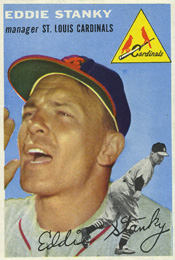
On July 18, 1954, the Cardinals forfeited a brawl-marred game to the Phillies because umpires ruled the combative Stanky, nicknamed “The Brat,” intentionally used stalling tactics in an attempt to avoid a loss.

After being suspended by National League president Warren Giles, Stanky issued an emotional public apology.

Pressure mounts

Booed with increasing regularity by Cardinals fans because his team was mired in sixth place in the eight-team league, Stanky was dealing with a series of setbacks and strains.

On July 17, a Saturday afternoon when the temperature reached 100 degrees, the first-place Giants built a 9-0 lead after three innings against the Cardinals at St. Louis. The Cardinals fought back impressively, scoring five runs in the sixth, three in the seventh and one in the eighth, tying the score, but the Giants won, 10-9, with a run in the 11th, dropping the Cardinals 17 games out of first with a 41-44 record. Boxscore

The next day, Sunday, July 18, the Phillies were in St. Louis for a doubleheader with the Cardinals.

Amid growing speculation about Stanky’s job security, club owner Gussie Busch issued a vote of confidence, saying, “I know there are many loyal Cardinal fans all over the country who are impatient and unhappy with the present standing … but I think it is altogether too simple and too easy to blame the manager every time something goes wrong or doesn’t work out exactly as it should.”

Adding to the drama was the matchup between Stanky and his Phillies counterpart. Three days earlier, the Phillies fired manager Steve O’Neill and replaced him with Terry Moore, the ex-Cardinals outfielder. When Stanky became Cardinals manager in 1952, Moore was on his coaching staff. Stanky fired him after the season. Moore reacted by ripping Stanky, telling reporters, “When he loses a ballgame, he acts more like a 9-year-old boy than a manager. The job is too big for him. Stanky is temperamentally unsuited for the job of manager.”

It was under this backdrop _ the booing by Cardinals fans, the speculation about his job status and the sight of Moore managing against him _ that Stanky approached the first game of the July 18 doubleheader.

Snap, crackle, pop

It didn’t unfold as Stanky hoped. The game was delayed 1 hour and 18 minutes by rain in the seventh. The Cardinals led 8-7 after eight. The Phillies scored three in the ninth for a 10-8 lead. The Cardinals rallied, tying the score in the bottom half of the inning on a two-out, two-run single by Solly Hemus, but the Phillies scored in the 10th, the Cardinals stranded Wally Moon on third with one out in the bottom half of the inning, and Philadelphia won, 11-10. Boxscore

In consecutive games, the Cardinals had scored 19 total runs _ and lost each by a run in extra innings.

Because of the rain delay and extra inning in the opener, the second game of the doubleheader didn’t begin until after 6 p.m. The Cardinals and umpires mistakenly thought a league rule prohibited ballpark lights from being turned on for a Sunday game beginning after 6. (The rule had been erased before the 1954 season.)

When the Phillies took an 8-1 lead, Stanky began making a series of deliberate pitching changes in an effort to prevent the game from being completed in the mandatory five innings before darkness arrived.

Each Cardinals reliever appeared to work slowly and issue pitches outside the strike zone. Tensions built as the game inched into the top of the fifth and darkness approached.

At that point, Cardinals catcher Sal Yvars and Phillies first baseman Earl Torgeson, who had a long-running feud, began fighting one another on the field. Moore raced toward the pair and grabbed Yvars. Stanky bolted toward the combatants and tackled Moore. The benches emptied and fighting continued until police broke up the melee.

When Stanky went to the mound to make another pitching change, umpire Babe Pinelli declared a forfeit in favor of the Phillies.

Wakeup call

Giles backed his umpires, saying, “The tactics employed in the game were palpably designed to delay the game.”

Stanky disagreed, telling the Associated Press: “My pitchers have been wild and ineffective all season, not only during this game.”

The next day, Giles suspended Stanky for five days and fined him $100. Yvars was suspended for three days and Torgeson for two.

Humbled, Stanky apologized for his actions and read a statement. Some excerpts:

“I called this press conference because of the impression I received Sunday when I heard the St. Louis people applaud Pinelli’s decision, forfeiting the game to the Phillies. I know in my heart indirectly that I have embarrassed and hurt the St. Louis people, baseball nationally, my reputation as a baseball man … and Gussie Busch and the Cardinals’ front office.

“… My spirit and desire to win could never be broken. However, my human and public relations will be improved. This affair Sunday has opened my eyes.”

Said Cardinals general manager Dick Meyer: “It takes a tremendous amount of fortitude to make the type of statement Eddie made unsolicited.”

Some were skeptical. “He said the same thing in 1952 right after he got the job, but the reform didn’t last long,” Moore said.

Stanky survived the season, but was fired in May 1955 after the Cardinals got off to a 17-19 start. Moore returned to the Cardinals in 1956 as a coach for manager Fred Hutchinson.


Read Full Post »

Fired up by the antics of manager Tommy Lasorda, fans at Dodger Stadium threw a barrage of souvenir baseballs and other items onto the field, prompting umpires to forfeit the game to the Cardinals.

On Aug. 10, 1995, a crowd of 53,361 packed Dodger Stadium for a Ball Night promotion and to see popular rookie starting pitcher Hideo Nomo face the Cardinals.

Tension began to build in the eighth inning. With the Cardinals ahead 2-1, the Dodgers had two on with two outs and Eric Karros at the plate. Karros was called out on strikes, argued the call and was ejected by plate umpire Jim Quick. Fans threw baseballs onto the field in protest.

After the Cardinals were retired in their half of the ninth, Raul Mondesi led off the bottom half of the inning. Mondesi took a pitch from Tom Henke and headed toward first base, thinking it was ball four, but Quick ruled the pitch a strike.

Mondesi eventually struck out, argued with Quick and was ejected. Lasorda rushed onto the field, jawed with Quick and was ejected as well.

With that, a hailstorm of baseballs was unleashed from the stands. Quick stopped play and a forfeit was declared, giving the victory to the Cardinals. Video

“We felt … the situation was getting out of hand,” Quick said to the St. Louis Post-Dispatch. Boxscore

(It was the first forfeit in the National League in 41 years. That game involved the Cardinals, too. On July 18, 1954, umpires forfeited to the Phillies the second game of a doubleheader at St. Louis because they believed Cardinals manager Eddie Stanky intentionally was using stall tactics.)

First-base umpire Bob Davidson called the decision to forfeit the Dodger Stadium game to the Cardinals “100 percent correct” and criticized Lasorda.

“This whole thing was Tom Lasorda’s fault,” Davidson said to the Associated Press. “He instigated the crowd, waving his arms. He has himself to blame, absolutely. He knows he’s to blame.”

Said Lasorda: “How did I instigate it? I was talking to Jim Quick. All I was asking was why he threw my players out. We didn’t throw the balls.”

Cardinals catcher Tom Pagnozzi told the Post-Dispatch, “Lasorda provoked the whole thing.”

Lasorda told the Los Angeles Times, “I’m disappointed in the ones who threw the balls, not the good fans.”

Cardinals players said they felt they were in danger because objects other than baseballs were thrown at them.

“I wasn’t too worried until a bottle of Southern Comfort flew out of the stands and hit me,” Cardinals right fielder John Mabry said to Bob Nightengale of The Sporting News. “I got hit by a rum bottle, too.”

Said St. Louis center fielder Brian Jordan: “I’m not going to stand out there and get busted in the head with a ball. The umpires made a good decision.”

Los Angeles Times columnist Mike Downey wrote, “Here, where fans are best known for leaving early, if this is the way people intend to behave, then please, leave early.”

Cardinals coach Bob Gibson said to Nightengale, “Dodgers fans used to be among the best in baseball. I’m afraid you can’t say that anymore.”

Said Quick: “I hope everybody has learned a lesson from this. I’ve been in the game 28 years and I’ve never been involved in a forfeit. This is very disappointing.”

Previously: Stayin’ alive: Baseball, drugs, rock n’ roll at Comiskey

Read Full Post »

(Updated Aug. 7, 2018)

Imagine a Cardinals lineup of Willie McGee at shortstop, Ricky Horton in right field and Jose Oquendo on the mound.

Manager Whitey Herzog could.

In 1987, during a blowout loss to the Phillies, Herzog made all of those unusual moves. He also batted Oquendo for Jack Clark and used John Tudor as a pinch-hitter with two runners on base.

On Aug. 7, 1987, the Cardinals were in first place in the National League East Division, but on that Friday night at Philadelphia’s Veterans Stadium the Phillies grabbed control early, scoring seven runs in the first two innings off Joe Magrane.

In the fifth inning, with the Phillies ahead 12-1, St. Louis had runners on first and second, two outs, when Herzog lifted Clark, the Cardinals’ slugging first baseman, for Oquendo.

Oquendo struck out against Phillies starter Shane Rawley and stayed in the game, replacing Ozzie Smith at shortstop.

In the eighth, Philadelphia led 12-4 and St. Louis had runners on first and third with one out. Reliever Bill Dawley was due to bat against Kent Tekulve, the Phillies’ sidearm-throwing right-hander. Herzog instead sent another pitcher, Tudor, a left-handed batter, to face Tekulve.

Tudor, a career .154 hitter, grounded into an inning-ending 4-6-3 double play, lost his balance as he tried to beat the relay throw and fell. “He runs down the line like a damn nut,” Herzog said to the St. Louis Post-Dispatch.

Things got even more strange.

Needing a pitcher to replace Dawley for the bottom of the eighth, Herzog turned to his shortstop. Oquendo already had played every position except pitcher and catcher in 1987.

To replace Oquendo in the infield, Herzog moved his center fielder, Willie McGee, to shortstop. The right fielder, John Morris, moved to center. That left the Cardinals without a right fielder. So Herzog put pitcher Ricky Horton in that spot.

It would be the only times in their big-league careers McGee would play shortstop and Horton would appear in the outfield.

Two balls were hit to right field. Both carried over the head of the harried Horton. The first, by Glenn Wilson, was ruled a double and drove in a run. The second was a single by Lance Parrish that scored Wilson.

“Horton played what must be described as periscope outfield,” the Post-Dispatch reported. “He would take two steps and watch from afar as the ball sailed over his head.”

“Some outfielders shy away from the walls,” Horton said to The Sporting News. “I just happened to shy away 30 yards from it.”

After watching the spectacle from the mound, Oquendo said, “I could have got out of the inning. We need better outfielders.”

Said Horton: “I apologized to Jose, but the good thing is I didn’t get anybody hurt, including myself.”

McGee handled his defensive chores at shortstop skillfully. With a runner on first, Milt Thompson grounded to McGee, who fielded the ball and threw to second for the forceout. Later in the inning, with Parrish at first, Steve Jeltz grounded to first baseman Jim Lindeman, who threw to McGee covering second for the forceout.

Oquendo surrendered three runs on four hits and a walk in his inning of relief work. He also hit a batter, his friend and fellow Puerto Rican Luis Aguayo.

“The best pitch he threw was when he hit the guy,” umpire Joe West said to the Post-Dispatch.

Before facing his first batter, Oquendo told catcher Steve Lake he could throw six different types of pitches. After his outing, Oquendo quipped, “He called the wrong pitches.”

Lake good-naturedly replied, “He says he’s got six pitches. I call fastball and he says, ‘Yeah.’ I call another fastball. ‘Yeah.’ Then I call something else. He says, ‘No.’ ”

(Oquendo would pitch for the Cardinals in two more games, one in 1988 and the other in 1991. He went four innings in 1988 against the Braves and took the loss in a 19-inning game won by Atlanta, 7-5.)

After the debacle in Philadelphia, a 15-5 Phillies win that broke a six-game losing streak, Herzog told the Associated Press, “In 162 games, you’ll have one like this.” Boxscore

Previously: How Andy Van Slyke amazed Jose Oquendo

Read Full Post »

(Updated Oct. 30, 2024)

Since 1967, the Cardinals have won World Series championships under three different managers.

Red Schoendienst, inducted into the National Baseball Hall of Fame as a player in 1989, managed the Cardinals to the 1967 World Series title against the Red Sox.
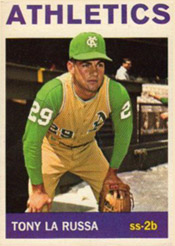
Whitey Herzog, inducted into the Hall of Fame as a manager in 2010, led the Cardinals to the 1982 World Series championship against the Brewers.

Tony La Russa, inducted into the Hall of Fame as a manager in 2014, guided the Cardinals to two World Series crowns _ 2006 against the Tigers and 2011 against the Rangers.

Here’s how key decisions made by those Cardinals managers helped lead to World Series titles:

RED SCHOENDIENST, 1967 World Series

Key decision: During the regular season, Schoendienst platooned Roger Maris in right field with Alex Johnson. For the World Series, Schoendienst decided to start Maris in every game, figuring his experience (Maris had played in five World Series for the Yankees) gave him the advantage.

“Maris is steady in the field,” Schoendienst said to The Sporting News. “He rarely makes a mistake out there and he doesn’t make mistakes running the bases. He has the advantage of having been through all that World Series pressure.”

It was the right move. Maris hit .385 (10-for-26) with seven RBI and made 15 putouts (with one error in 61 innings) during the seven-game Series.

Key fact: Schoendienst became the fourth manager _ and first in 36 years _ to start the same eight regulars in the same batting order for a World Series that went seven or more games, according to The Sporting News.

The other managers to do so were Jimmy Collins of the 1903 Red Sox, Fred Clarke of the 1909 Pirates and Connie Mack of the 1931 Athletics.

Excluding the pitcher, St. Louis’ batting order for all seven games was: Lou Brock, left field; Curt Flood, center field; Roger Maris, right field; Orlando Cepeda, first base; Tim McCarver, catcher, Mike Shannon, third base; Julian Javier, second base; and Dal Maxvill, shortstop.

Quotable: Bob Gibson was the winning pitcher for three of the Cardinals’ four victories. Asked what he told his team before Game 7, Schoendienst said to the Associated Press, “Nothing. I gave the ball to Gibson.”

WHITEY HERZOG, 1982 World Series

Key decision: After joining the Cardinals in June 1980, Herzog built the team around speed, defense and relief pitching. Two of his cornerstone acquisitions were catcher Darrell Porter and closer Bruce Sutter.

Porter hit .286 with five RBI and prevented eight wild pitches, earning the World Series Most Valuable Player Award. Sutter recorded two saves, including two hitless innings in the Game 7 clincher.

Wrote Palm Beach Post columnist Steve Hummer, “This is the Whitey Herzog Signature Model World Series.”

(According to Memories and Dreams, the magazine of the Baseball Hall of Fame, Tony La Russa said that during an off-season appearance he and Herzog made together in 1983, Herzog advised him about the importance of having a dependable closer. “He said, ‘You’re never a smart manager until you have a quality closer,’ ” La Russa recalled.)

Key fact: The Cardinals utilized speed (seven stolen bases to Milwaukee’s one) with a relentless array of singles and doubles (27 hits to 11 for Milwaukee in the final two games) to overtake the Brewers after losing three of the first five.

Said Tigers manager Sparky Anderson to The Sporting News: “That’s the one thing about a speed-versus-power World Series. Power can stop; can be stopped. Speed never stops.”

Quotable: After St. Louis won Game 7, Herzog said, “We ain’t the best team ever to win a World Series, but we sure as hell ain’t the worst. We played our game all the way: speed and defense, some hitting and some pitching.”

TONY LA RUSSA, 2006 World Series

Key decision: La Russa gambled by naming rookie Anthony Reyes rather than veteran Jason Marquis as the Cardinals’ Game 1 starting pitcher. Reyes was 5-8 during the regular season. He had the fewest wins of any Game 1 starter in World Series history.

“It’s not an easy call. We wrestled with this,” La Russa told the Associated Press.

Relying almost exclusively on a fastball, Reyes delivered. He held the Tigers to four hits and two runs over eight innings and St. Louis won, 7-2. It set the tone for a Series the Cardinals clinched in five games.

Key fact: La Russa became only the second big-league manager to win a World Series championship in each league. Sparky Anderson had done it with the 1975 and ’76 Reds and with the 1984 Tigers. La Russa had won with the 1989 Athletics.

Quotable: After earning the Series championship with a team that had 83 regular-season wins, La Russa told MLB.com, “It was really fun to be around this group. They were so determined.”

TONY LA RUSSA, 2011 World Series

Key decision: La Russa was concerned about starting ace Chris Carpenter in Game 7 on short rest. Starters Kyle Lohse and Edwin Jackson were fully rested. On the morning of Game 7, La Russa told reporters, he called pitching coach Dave Duncan, seeking advice.

“I called (Duncan) in the morning and I said, ‘How about the alternatives?’ He says, ‘Are you kidding? It’s Chris Carpenter.’ And he hung up.”

La Russa started Carpenter, who rewarded him with six solid innings and earned the win in the Cardinals’ 6-2 victory.

Key fact: With the win, the Cardinals improved to 7-1 when Game 7 of a World Series is played at St. Louis.

Quotable: Third baseman David Freese, winner of the 2011 World Series MVP Award, told New York Times columnist George Vecsey of La Russa, “He’s got a plan with every thought, with everything he says.”

Read Full Post »

(Updated Oct. 29, 2020)

Kansas City was a fitting site for Tony La Russa’s appearance as a manager in the All-Star Game.

La Russa, who left the Cardinals after leading them to the 2011 World Series title, came back and managed the National League to an 8-0 victory in the All-Star Game on July 10, 2012, at Kansas City. Boxscore
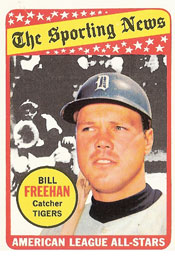
Kansas City was where La Russa scored his first big-league run, and had his first big-league at-bat and first big-league hit, when he was a rookie infielder for the Athletics in 1963.

Prime prospect

La Russa was a 17-year-old shortstop for Jefferson High School in Tampa, Fla., when he was signed by the Athletics to a package worth $100,000 on June 7, 1962, the same night he received his high school diploma. He batted .479 his senior season.

La Russa was signed by Athletics scout Charlie Gassaway and supervisor of scouts Joe Bowman. Because Major League Baseball didn’t have a draft at that time, any team could bid for a prospect. According to The Sporting News, 17 scouts representing 14 teams approached La Russa. The Yankees and Indians joined the Athletics as top bidders.

“We think he is one of the outstanding infielders in the country,” Bowman said. “He is the highest-priced infielder Kansas City ever signed.”

Athletics owner Charlie Finley met with La Russa to seal the deal, which included $8,000 toward a college education, plus a new car. La Russa chose a white Pontiac Bonneville with black leather interior, according to the book “Tony La Russa, Man on a Mission.”

Rushed to majors

After a summer of minor-league baseball in 1962, La Russa returned home to Tampa. While playing in a softball game, he injured his throwing arm, according to the “Man on a Mission” book. With his right arm in a sling, La Russa was unable to play in spring training for the Athletics in 1963.

La Russa, 18, made his major-league debut on May 10, 1963, as a pinch-runner for Chuck Essegian in the eighth inning of the Athletics’ game against the Twins at Minnesota. Boxscore

Utilized primarily as a pinch-runner by manager Eddie Lopat, La Russa appeared in his first 14 big-league games without an at-bat. He scored his first big-league run on July 13, 1963, in the second game of a doubleheader against the Indians at Kansas City.

Running for Gino Cimoli, La Russa scored from second on a bases-loaded double by Jerry Lumpe in the fifth inning. The game is noteworthy, not for La Russa’s run, but because Indians pitcher Early Wynn earned his 300th and last major-league win. Boxscore

A month later, La Russa got his first at-bat. It occurred on a Thursday afternoon, Aug. 15, 1963, at Kansas City. After replacing Lumpe at second base in the fifth inning, La Russa faced Tigers starter Hank Aguirre in the sixth and flied out to center fielder Bill Bruton. Boxscore

La Russa’s first major-league hit came two days later at Kansas City. Pinch-hitting in the sixth for pitcher Bill Fischer, La Russa hit a two-out triple to right off Orioles starter Steve Barber, a 20-game winner that year. Boxscore

According to the “Man on a Mission” book, La Russa, near the end of the season, told a Kansas City reporter, “I know I’ll be sent down next season and I’m looking forward to it. I’ve learned a lot from our players and also by watching such fine shortstops as (Wayne) Causey, Luis Aparicio, Zoilo Versailles and others. I’ve had plenty of help from everyone on the club, especially catcher Charlie Lau, who detected a hitch in my swing at the plate.”

It would be five years before La Russa would return to the major leagues. By then, the Athletics had moved from Kansas City to Oakland.

Read Full Post »

(Updated April 22, 2026)

When Mike Matheny played baseball for the University of Michigan, his coach the final two seasons was Bill Freehan, who had been an all-star catcher for the Detroit Tigers.

Freehan foresaw Matheny as a big-league ballplayer and manager. He mentored Matheny with those goals in mind and instilled confidence in the college catcher.

“It was very interesting that he saw that,” Matheny told Jenifer Langosch of MLB.com in February 2012. “It wasn’t just some random guy. It was a guy with great credibility.”

Freehan, an 11-time American League all-star and five-time Gold Glove Award winner who played 15 years (1961-76) for the Tigers, encouraged Matheny to take Spanish courses so he could communicate fully with Hispanic players.

“He (Freehan) called me into his office one day and said, ‘If you’re going to be in this game for a long time, even after your playing days, you need to change all your electives to learning Spanish,’ ” Matheny said to Chris Girandola of MLB.com.

Matheny earned his degree in sports management and communication, with a minor in Spanish. He managed the Cardinals from 2012-2018 and led them to a National League pennant in 2013.

A native of the Columbus suburb of Reynoldsburg, Ohio, Matheny was recruited to Michigan by baseball coach Bud Middaugh. After the 1989 season, Matheny’s first with the Michigan varsity, Middaugh resigned amid allegations he had diverted money to baseball players from the sale of football game programs.

Michigan athletic director Bo Schembechler turned to Freehan, who had been an all-America catcher at Michigan in 1961.

“Coach Freehan gave me a master’s course in catching,” Matheny told Steve Kornacki of MGoBlue.com, “and not just with the mechanics, but more so the mentality. He gave me the opportunity to learn how to run a pitching staff. Bud (Middaugh) called every pitch from the dugout my freshman year, like a lot of coaches do, but in our first intrasquad game (in 1990), Bill (Freehan) stopped practice and flat-out screamed at me when I looked into the dugout for his call. He said, ‘You’re the catcher! You’re in charge. You can see what’s going on. You have a brain, you can think. Call this game.’ ”

According to MGoBlue.com, Freehan got his former Tigers teammate, Hall of Famer Al Kaline, to help Matheny with his hitting.

“I’m swinging in the (batting) cages to get loose and I see this gentleman walking toward me,” Matheny recalled. “I just about fell over. It’s Al Kaline. I couldn’t believe it. I wish I could tell you that I wrote down every word in a notebook, but I was so in awe that I had trouble focusing. I’m thinking, ‘How does a superstar player take this much time to come down and work with a no-name, half-talented college guy?’ He stood out as such a top-shelf individual.”

In six seasons (1990-95), Freehan coached Michigan to a 166-167-1 record, including 76-89 in the Big Ten. In 1991, Freehan named Matheny co-captain. A three-year letter winner (1989-91) and academic all-Big Ten (1990), Matheny was named Michigan’s most valuable player in 1991. He also met his wife, Kristin, a varsity field hockey player for Michigan.

Matheny was selected by the Brewers in the eighth round of the 1991 major league draft, extending a tradition of Michigan baseball players who became professionals. Like Matheny, other Michigan standouts who would play for the Cardinals included infielders Dave Campbell, Chris Sabo and Ted Sizemore, and pitcher Lary Sorensen. Branch Rickey, who was Michigan’s baseball coach from 1910-13 while earning a law degree from the school, became manager and chief baseball executive of the Cardinals.

(Ted Simmons is a Michigan graduate. The physical education and speech major earned his degree in 1996, 29 years after enrolling. Simmons, a catcher, never played for Michigan’s baseball program. Instead, he signed with the Cardinals after graduating from high school in 1967.)

Matheny would go on to win four Gold Glove awards (with the Cardinals in 2000, 2003 and 2004, and with the 2005 Giants) and help St. Louis to four postseason appearances and a National League pennant.

Freehan won his Gold Glove awards in consecutive years (1965-69).

Previously: Bill Freehan, Lou Brock and a World Series controversy

Previously: Should Curt Flood have caught Jim Northrup’s drive?

Read Full Post »

« Newer Posts - Older Posts »