Feeds:
Posts
Comments

Archive for the ‘Managers’ Category

(Updated March 27, 2018)

Ron Plaza never played a game in the major leagues, but he influenced several Cardinals big-leaguers.

Plaza was a manager in the Cardinals’ farm system for six years, posting a 432-329 record. He also was an infielder in the Cardinals’ organization for 11 years.

St. Petersburg was the site of Plaza’s biggest success as a Cardinals minor-league manager. Replacing Sparky Anderson, Plaza managed St. Petersburg to a 96-43 record and the Florida State League championship in 1967. He was named winner of the Class A league’s Manager of the Year Award.

The other Cardinals farm clubs managed by Plaza were Billings (1963), Winnipeg (1964), Cedar Rapids (1965-66) and St. Petersburg (1968).

Among the players Plaza managed in the Cardinals’ system was pitcher Steve Carlton, who would earn election to the National Baseball Hall of Fame. Pitching for Plaza’s 1964 Winnipeg club, Carlton was 4-4 with a 3.36 ERA.

In the June 15, 1968, edition of The Sporting News, Carlton cited Plaza, Clyde King, Hal Smith, Grover Resinger and Billy Muffett as Cardinals instructors who had a positive influence on him. “I had good instructors all along the line,” Carlton said.

Future Cardinals who played for Plaza on the 1967 championship St. Petersburg team were outfielders Boots Day (70 RBI and 21 stolen bases in 136 games) and Jose Cruz (.278 batting average in 78 games) and pitcher Santiago Guzman (16-3, 1.74 ERA in 23 starts).

In 1968, pitcher Reggie Cleveland, who would go on to a 13-year major-league career, was 15-10 with a 2.77 ERA in 27 starts for Plaza’s St. Petersburg team.

After the 1968 season, Plaza was selected to the coaching staff of the Seattle Pilots, an American League expansion team managed by Joe Schultz, who had been a coach for the Cardinals from 1963-68. Plaza had played for three Cardinals farm clubs managed by Schultz: 1959 Omaha, 1961 Charleston and 1962 Atlanta.

In his book “Ball Four,” Pilots pitcher Jim Bouton wrote about Plaza.

The Pilots were relocated to Milwaukee after one season in Seattle and became the Brewers. Schultz and Plaza weren’t retained.

Plaza joined manager Sparky Anderson’s coaching staff with the 1978 Reds. He remained a Reds coach through 1983, serving under managers John McNamara and Russ Nixon.

In 1986, Plaza became a coach for manager Jackie Moore with the Athletics. After Moore was fired in June, Plaza served out the season for Moore’s replacement _ Tony La Russa.

As a player in the Cardinals’ organization, Plaza’s best year was 1956 when he hit .297 in 121 games as a second baseman for Class AAA Rochester, managed by Dixie Walker.


Read Full Post »

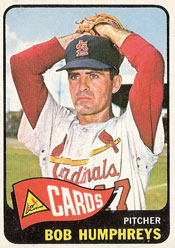
Bob Humphreys, a reliever for the 1964 World Series championship Cardinals, played a significant role in the professional baseball development of catcher Mike Matheny.

Matheny was drafted by the Brewers in 1991, played in their minor-league system and made his big-league debut with Milwaukee in 1994. He played for the Cardinals from 2000-2004 and was their manager from 2012-2018.

Humphreys was among his most influential Brewers instructors, Matheny told MLB.com. Humphreys was the Brewers’ coordinator of player development from 1984-94 and their coordinator of pitching and field development from 1994-95.

In 1964, Humphreys played a role in helping the Cardinals win the National League pennant and World Series title. Called up to St. Louis from Class AAA Jacksonville in July, the right-handed reliever went 2-0 with two saves and a 2.53 ERA in 28 appearances for the 1964 Cardinals.

Both of Humphreys’ wins occurred in September, when the Cardinals compiled a 21-8 record and overcame the first-place Phillies.

Humphreys was acquired by the Cardinals from the Tigers in a cash transaction in March 1963. He had the inscription “You can’t make it” on his glove as a motivational reminder of what the Tigers told him when he left their organization.

Humphreys started the 1963 season with Class AAA Atlanta and was 5-1 with a 1.13 ERA as a reliever before getting promoted to the Cardinals in late May.

He featured an unusual side-saddle windup, pumping two or three times with both hands to one side of his body.

In Humphrey’s second appearance for the Cardinals, on June 2, 1963, at St. Louis, he gave up home runs to Willie Mays and Orlando Cepeda. The home run by Mays hit the scoreboard in left field and traveled about 480 feet, according to The Sporting News. Boxscore

Humphreys spent most of the rest of the 1963 season on the Cardinals’ disabled list. In nine games for the 1963 Cardinals, Humphreys was 0-1 with a 5.06 ERA.

When the Cardinals sent Humphreys to Jacksonville at the end of spring training in 1964, he said he was tempted to quit baseball. Instead, he posted a 6-2 record and 3.07 ERA in 26 games for Jacksonville.

Along with Barney Schultz and Gordon Richardson, Humphreys helped revamp the Cardinals’ bullpen in the second half of the 1964 season.

“I didn’t think I’d get another chance up here after spring training,” Humphreys said in an August 1964 interview distributed by the Associated Press. “I allowed only one run in 9.1 innings and still didn’t make the team. I was going to quit if I didn’t get a chance to pitch more at Jacksonville.”

On Sept. 6, 1964, Humphreys, 29, earned his first big-league win. Facing the Cubs in St. Louis, the Cardinals scored twice in the ninth, tying the score at 4-4. In the 10th, Cardinals reliever Mike Cuellar yielded a walk and a double to the first two batters and was lifted for Humphreys.

After issuing an intentional walk to Ron Santo, loading the bases with none out, Humphreys retired Ernie Banks and Jimmy Stewart on forceouts and struck out Len Gabrielson without allowing a run.

In the 11th, Humphreys executed a successful sacrifice bunt, moving Tim McCarver to second and setting up Lou Brock for a game-winning single. Boxscore

“If I have to wait as long for my second big-league win as I did for my first, I’ll be an old man,” Humphreys said.

Three days later, Sept. 9, 1964, against the first-place Phillies at Philadelphia, Humphreys recorded his second win, along with his first major-league hit and first major-league RBI. The Cardinals scored twice in the ninth, tying the score at 5-5. Humphreys relieved and pitched two scoreless innings. In the 11th, the Cardinals scored five times for a 10-5 victory. Humphreys’ single scored Julian Javier from second with the final run. Boxscore

Humphreys appeared once for the Cardinals in the 1964 World Series against the Yankees and pitched a scoreless inning in Game 6. Boxscore

In April 1965, the Cardinals traded Humphreys to the Cubs for infielder Bobby Pfeil and pitcher Hal Gilson.

Humphreys pitched nine years in the big leagues for the Tigers, Cardinals, Cubs, Senators and Brewers, posting a 27-21 record, with 20 saves and a 3.36 ERA. From 1974-78, he was head baseball coach at Virginia Tech.

Humphreys returned to professional baseball as minor-league pitching coordinator for the Blue Jays. After five seasons with Toronto, he began his long run in player development with the Brewers.

In 2002, after a stint coaching his alma mater (Hampden-Sydney College), Humphreys returned to the Cardinals’ organization. He was the Cardinals’ minor-league field coordinator from 2002-2004 when Matheny was the Cardinals’ catcher.

Previously: Cardinals can thank Pat Hentgen for Mike Matheny

Read Full Post »

In 1977, Vern Rapp, a first-time big-league manager, got off to a rocky start with the Cardinals and never fully recovered.

Rapp, adhering to a policy of no facial hair for players, feuded with several Cardinals veterans, most notably reliever Al Hrabosky and outfielder Bake McBride, during his first season as Cardinals manager. Unable to improve his relationship with core players such as Ted Simmons and Lou Brock, Rapp was fired on April 25, 1978.

Giants want Rapp

After the Cardinals finished 72-90 in 1976, manager Red Schoendienst was fired. Wire service reports indicated the Cardinals were considering hiring Joe Altobelli to replace Schoendienst. Altobelli managed the Orioles’ Rochester farm team to an International League title in 1976.

Rapp, who managed the Expos’ Denver farm team to a division championship in 1976 and got named minor league manager of the year by The Sporting News, was reported to be the top choice of the Giants to replace manager Bill Rigney. United Press International reported Rapp would get the job because Giants owner Bob Lurie “was impressed with Rapp’s reputation as a winner, a no-nonsense field leader and a man able to relate to today’s younger players.”

The Cardinals surprised the Giants by offering their job to Rapp, who accepted. (The Giants then called Altobelli, who was in St. Louis and being offered a position in the Cardinals’ organization, and gave him the San Francisco managerial job).

St. Louis background

Rapp cited his connections to the city and the team for his decision in choosing the Cardinals instead of the Giants. Rapp, a St. Louis native, had been signed by the Cardinals as a catcher in 1946. He played in the Cardinals’ minor-league system from 1946-50 and from 1953-54.

From 1965-68, Rapp managed the Cardinals’ Class AA teams, leading Tulsa (1965) and Little Rock (1968) to Texas League championships. Among the future Cardinals he managed were pitchers Larry Jaster, Ron Willis, Wayne Granger and Jerry Reuss.

(Rapp left the Cardinals’ organization to become Class AAA manager of the Reds in 1969, joining Cincinnati general manager Bob Howsam, who had been general manager of the Cardinals when Rapp became a St. Louis minor-league manager in 1965. Rapp told the Associated Press he left the Cardinals for the Reds because “I felt stymied in Double-A.” During his tenure as Reds Class AAA manager from 1969-75, Rapp was credited with helping the careers of pitcher Gary Nolan and outfielder Ken Griffey Sr.)

After being selected to replace Schoendienst, Rapp told reporters, “This is like a dream come true.”

Conflict among Cardinals

The dream had its nightmare moments:

_ After feuding with Rapp, McBride was traded to the Phillies in June 1977.

_ Rapp suspended Hrabosky when the pitcher ignored a request to meet.

_ Later, Hrabosky ignored Rapp’s ban on facial hair and grew back his Fu Manchu moustache and beard. Team owner Gussie Busch ordered Rapp to lift the ban.

_ Rapp insulted Brock when he sent the veteran to pinch-hit, then removed him for Mike Anderson (a .221 hitter) when the opposing team changed pitchers.

_ During a team meeting, Brock urged Rapp to be less rigid in his dealings with players. Rapp told Brock, “I’ll never change,” and abruptly ended the meeting, The Sporting News reported.

Still, the 1977 Cardinals finished 83-79, improving their win total by 11 over the 1976 showing. After the season, Hrabosky was traded to the Royals.

Losing control

With Hrabosky and McBride gone and with Rapp having had a season of experience in the big leagues, it was hoped the turmoil would end in 1978. Not so. It boiled over on April 15 after the Phillies handed the Cardinals a 3-2 loss in 10 innings at St. Louis. Boxscore

Tensions were high in the clubhouse after the defeat. Catcher Ted Simmons turned on the stereo and music blasted across the room. “I was just trying to cool people off, keep ’em loose,” Simmons told The Sporting News days later.

Rapp was livid, thinking Simmons and the Cardinals were unfazed by the loss. Rapp beckoned Simmons into the manager’s office and an argument ensued. Rapp called Simmons “a loser” _ a label teammates and fans never would have associated with the hard-playing catcher.

Rapp eventually apologized. “There’s no one who has more individual capabilities of leadership than Ted Simmons,” Rapp told reporters days later. (When he was hired to manage the Cardinals, Rapp had said to The Sporting News, “Being an ex-catcher, I believe Simmons has the ability to handle the responsibility of being a leader on the field. I just want him to know that publicly.”)

Rapp’s stinging rebuke of Simmons had been heard by players _ and the friction wasn’t repairable. Days after the incident, Cardinals broadcaster Jack Buck broke the story, telling listeners about it as a way to explain the Cardinals’ poor play. With the Cardinals’ record at 6-11, general manager Bing Devine fired Rapp, citing “unrest on the ballclub” and calling the move “inevitable.”

Ken Boyer, the former Cardinals all-star third baseman, coach and minor-league manager who had left the organization after being passed over for the big-league job in favor of Rapp, was hired to replace the ousted manager.

“Things like this happen in this profession,” Rapp said to the Associated Press.

In 1979, Rapp joined the coaching staff of Expos manager Dick Williams and remained there through the 1983 season. Rapp was named manager of the Reds in 1984. In August, with Cincinnati at 51-70, Rapp was fired _ and replaced by Pete Rose.


Read Full Post »

When the Houston Colt .45s began play in the National League in 1962, one of the most anticipated homestands was the one with the Cardinals.

Houston had been a Cardinals minor-league affiliate from 1921-35 and from 1946-58. Many in the region were Cardinals fans.
The 1962 Cardinals had several close connections to Houston. Cardinals manager Johnny Keane and pitching coach Howie Pollet were Houston residents. Keane had played for Houston (1934-37) and also had managed the club (1946-48). Pollet had pitched for Houston (1939-41).

Also, Cardinals coach Harry Walker had been the last Houston manager (1956-58) while it was a Cardinals affiliate. Top 1962 Cardinals players, such as third baseman Ken Boyer and pitcher Larry Jackson, had played for the Houston farm club.

St. Louis made its first visit to Houston for the second homestand in Colt .45s history (the franchise changed its name to Astros in 1965). The Cardinals and Colt .45s were scheduled for three midweek night games April 24-26.

The Cardinals won one, lost one and tied another. Two games each were decided by a run and the other ended in a tie after 17 innings.

According to Clark Nealon of the Houston Post in a story for The Sporting News, Houston “waited years for the first National League series with the St. Louis Cardinals and when it came it was tremendous.”

Houston 4, Cardinals 3, April 24, 1962

In pre-game ceremonies, The Sporting News reported, each member of the Cardinals was “introduced individually to ringing applause.”

At the end, the cheers were for Houston starter Hal Woodeshick, who pitched a six-hitter.

Houston left fielder Don Taussig, who had played for the Cardinals in 1961, hit a solo home run off Jackson in the sixth.

With one on and two outs in the ninth, Bill White ripped a sinking liner that Houston right fielder Johnny Weekly snared at his shoetops.

Attendance was 19,335 _ impressive for a weeknight at a ballpark that seated about 25,000. Boxscore

Cardinals 5, Houston 5, 17 innings, April 25, 1962

In the afternoon, Keane was honored at a Chamber of Commerce luncheon and presented with a replica of a Colt .45 gun. He told the audience, “We’re a lot better club than we showed you on April 24.”

The Cardinals’ manager again was honored in ceremonies before the game. Among his gifts was a king-sized pass to “the first World Series game in Houston.” (It would be 2005 before Houston made its first World Series appearance.)

The game began at 8:02 p.m. It was halted at 1:15 a.m. because of a local curfew in Houston that forbid starting an inning after 12:50 a.m. The game was replayed on another date but all the statistics counted.

Boyer’s RBI-single to left in the ninth off Turk Farrell scored Julian Javier from second, tying the score 5-5.

Ed Bauta pitched eight scoreless innings for the Cardinals after entering in the 10th.

The Cardinals had runners on first and second with no outs in the top of the 17th, but Doug Clemens struck out and Red Schoendienst hit into a double play.

Six Houston pitchers struck out 18 Cardinals, including Boyer three times. Houston left 16 runners on base and the Cardinals stranded 15. Boxscore

Cardinals 3, Houston 2, April 26, 1962

The Cardinals were spared embarrassment by salvaging a victory in the series. Bob Gibson pitched a two-hitter for his first win of the season and Stan Musial drove in the deciding run with a two-out single in the eighth, scoring Curt Flood from third base. Boxscore

Part Two: Cardinals broke Astrodome hex with 19 RBI in one game

Part Three: Forsch vs. Forsch: Bob had edge in brotherly matchup

Read Full Post »

Pat Hentgen played one season for the Cardinals, but his impact on the franchise was significant.

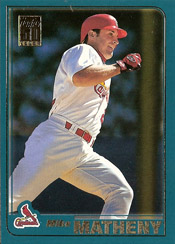
It was Hentgen who recommended the Cardinals sign Mike Matheny, a free agent, to a contract in December 1999. The Cardinals were looking for a backup to catcher Eli Marrero.

Matheny signed a one-year deal for $750,000, leapfrogged Marrero to become the starting catcher in 2000 and remained the Cardinals’  catcher for five seasons, helping them to four postseason appearances and their first National League pennant in 17 years.

After the 2011 season, Matheny became the Cardinals’ manager, replacing Tony La Russa, and led them to a National League pennant in 2013.

Hentgen, a right-handed starting pitcher who won the American League Cy Young Award in 1996, was acquired by the Cardinals from Toronto in November 1999 along with pitcher Paul Spoljaric in a trade for catcher Alberto Castillo and pitchers Lance Painter and Matt DeWitt.

Matheny had been Hentgen’s teammate with Toronto in 1999. Though Matheny was the backup to Blue Jays catcher Darrin Fletcher, he made a lasting impression on Hentgen because of his arm, defense, leadership and management of a pitching staff.

In an article in May 2000, the Associated Press reported the Cardinals signed Matheny “largely at the urging of Hentgen.”

“He was pretty vocal about it. He was on my side,” Matheny said. “That’s just the ultimate compliment _ when a pitcher with as much experience and success as Pat has had thinks that highly of me to put his name on the line.”

Matheny had a stellar start for St. Louis in 2000. He batted .313 in April and threw out 15 of the first 22 baserunners who attempted to steal.

When Marrero tore a ligament in his left thumb on July 1, the Cardinals had little help behind Matheny. A couple of weeks later, Matheny cracked a rib but continued to play. He wore a flak jacket and had his chest taped before every game.

Gritty determination was one element of Matheny’s leadership style. He also displayed respect and selflessness when the Cardinals acquired first baseman Will Clark from the Orioles on July 31, 2000.

For most of his 15-year big-league career, Clark had worn uniform No. 22 _ the same number worn by Matheny in his seven seasons in the major leagues. Matheny offered the number to Clark as a welcome to the Cardinals, asking for nothing in return. Clark was touched by the gesture. Matheny switched to uniform No. 44.

“It’s just a number,” Matheny told The Sporting News in September 2000. “I don’t see the big deal.”

Matheny hit .261 with 47 RBI in 128 games for the 2000 Cardinals. He sat out the postseason after he accidently severed two tendons and a nerve in his right ring finger while using a hunting knife he received as a 30th birthday gift. Matheny threw out 49 of 93 baserunners attempting to steal in 2000 and received the NL Gold Glove Award.

Hentgen had a 15-12 record and 4.72 ERA in 33 starts for the Cardinals. He became a free agent after the 2000 season and signed with the Orioles.

Read Full Post »

(Updated April 4, 2025)

To get insights into what made Tony La Russa a Hall of Fame manager, I recommend the book “The Wizard of Waxahachie.” Written by Warren Corbett, it is a well-researched biography of Paul Richards, a baseball innovator who had a long career as a player, manager and executive in the minors and majors.

Richards managed the White Sox and Orioles. He was director of player development for the White Sox when La Russa began his managerial career in the Chicago farm system. Richards became a mentor to La Russa.

In an interview with Cardinals Yearbook in 2014, La Russa said, “Managing is about preparation and leadership. It’s a message Paul Richards preached and it’s more true now than ever before.”

La Russa wrote the introduction to Richards’ biography. Reading it provides a link to the philosophies La Russa followed.

“During the three-year period from 1978 to 1980, when I’d managed in AA, AAA, and the White Sox, Paul’s influence was a career maker for me,” La Russa said. “He continually provided lessons on baseball fundamentals, strategies and leadership.

“To this day his emphasis on playing the game correctly and what that meant has been a key to my survival as a manager in baseball. His explanation of different offensive and defensive strategies has helped put my teams in a position to compete. And his leadership advice set the foundation for my contributions as a decision maker that I am expected to provide.

“My favorite example of a ‘Paulism’ was his principle that a manager should make decisions by ‘trusting your gut, not by trying to cover your butt.’ A manager’s decision must avoid the temptation of taking the popular or conventional path that your bosses, fans and media expect. Instead your responsibility as a manager is to decide what you think is your team’s best shot and then take it.”

La Russa was true to that principle throughout his Cardinals career.

An example of how La Russa applied Richards’ teachings is how he handled an incident in Game 2 of the 2006 World Series. Tigers pitcher Kenny Rogers appeared to be caught doctoring the baseball. La Russa told the umpires about the foreign substance on the ball but didn’t ask them to inspect Rogers. Critics claimed La Russa was protecting his friend, Tigers manager Jim Leyland. Instead, it was La Russa following a principle he learned from Richards, and later manager Sparky Anderson.

In the book “Tony La Russa: Man on a Mission,” author Rob Rains explained, “It was Anderson and Paul Richards who taught him the difference between having a strategy and a philosophy, and those thoughts filled his head as he watched Rogers pitch.”

La Russa explained, “I had the luxury and good fortune of teachers who taught me the difference between philosophy and strategy. In that situation, I might have strategized, ‘Hey, I can get this guy thrown out of the game.’

“Strategies have their place, but they don’t replace philosophy, because philosophy is what you represent, and what you want your team to represent … We want to win within our philosophy. Part of that philosophy is abhorring BS baseball. I don’t like it … I believe in the beauty of the competition. Let’s play the game. We get ready, they get ready. You play as hard as you can, and there’s a winner and a loser.

“I was so appreciative of all the teachers I had over the years, and in the end you just have to believe in the lessons you have learned about their philosophies.”

Read Full Post »

« Newer Posts - Older Posts »