Feeds:
Posts
Comments

Archive for the ‘Managers’ Category

Former Cardinals catcher Ted Simmons was inducted into the St. Louis Sports Hall of Fame on Nov. 16, 2010. Before a crowd of 1,500 at a downtown St. Louis hotel, Simmons was part of the hall’s second induction class, joining former Cardinals pitcher Dizzy Dean and former Browns first baseman George Sisler.

Simmons told the St. Louis Post-Dispatch the honor was “staggering.”

He also was interviewed by television station KSDK. Among the highlights of the KSDK interview:

_ Asked about his approach to hitting and why he became known for line drives, Simmons said he adopted a stroke similar to teammate Matty Alou by making a “top down” swing on pitches and trying to avoid hitting high fly balls into the spacious outfield of Busch Stadium.

_ Regarding the St. Louis Hall of Fame induction, Simmons said “it means I’ve basically been accepted in this community after being here for 35 years.” He called it “a very special honor for me.”

Simmons also concluded his first season as manager of the Peoria Saguaros in the Arizona Fall League, an experience that enhanced his reputation as a talent evaluator.

In an article by Jack Magruder of FOXSportsArizona.com, Simmons talked about his first managerial effort and how much he enjoyed working  from the third-base coaching box while his team was at bat.

Among those interviewed for the article was Kevin Towers, general manager of the Diamondbacks, who said of Simmons, “He has a great baseball mind, an incredible baseball mind … He’s a good man. Very loyal. Tough.”

Read Full Post »

One reason the Cardinals never reached the postseason during the 1970s is the trouble they had against manager Sparky Anderson’s Reds.

The Cardinals were 42-66 against the Reds in the nine seasons (1970-78) Anderson managed them. Only once in that stretch did St. Louis have a winning record against Cincinnati (7-5 in 1977).

Anderson led the Reds to two World Series titles and four National League pennants after a three-year stint as a manager in the Cardinals’ system.

Here are five of the most memorable games between the Reds and Cardinals when Anderson managed Cincinnati:

_ July 4, 1972: The Cardinals’ Scipio Spinks entered the game with a 2.33 ERA and ranked third in the NL in strikeouts, behind Steve Carlton and Tom Seaver.

On a rainy Independence Day in Cincinnati, Spinks was on first with one out when Luis Melendez doubled. Spinks, ignoring the stop sign from third-base coach Vern Benson, scored but tore ligaments in his right knee when he collided with catcher Johnny Bench. Boxscore

Spinks needed knee surgery and missed the rest of the season.

The Cardinals, 38-33 at the time, went into a tailspin. losing 10 of 13 from July 22 to Aug. 5, and finished 75-81. The Reds won the pennant.

Spinks returned in 1973, went 1-5 with a 4.89 ERA in eight starts, hurt his shoulder, and never pitched in the big leagues again.

_ July 7, 1974: The first game of a doubleheader at Cincinnati featured starting pitchers making their big-league debuts, Bob Forsch for the Cardinals and Tom Carroll for the Reds.

Forsch was good (6.2 innings, four hits, two runs); Carroll was better (seven innings, two hits, one run). The Reds won, 2-1.  Boxscore

Cesar Geronimo’s RBI-double in the second and solo home run in the seventh accounted for the Reds’ runs. Forsch said his pre-game instructions were to make sure not to walk Geronimo. He didn’t.

_ July 17, 1974: Bob Gibson struck out Geronimo to end the second inning and joined Walter Johnson as the only pitchers with 3,000 strikeouts.

Gibson was lifted after seven innings with the score 4-4. George Foster’s two-run double against Orlando Pena in the 12th gave the Reds a 6-4 victory at St. Louis. Boxscore

_ May 9, 1977: With the score 5-5 in the ninth at St. Louis, the Cardinals brought in closer Al Hrabosky. The Reds loaded the bases with no outs on a Ken Griffey single, a walk to Joe Morgan and Dan Driessen’s bunt single. Hrabosky, milking his “Mad Hungarian” act for all it was worth, then struck out George Foster, Johnny Bench and Bob Bailey.

In the 10th, the Reds threatened with two outs. Ray Knight singled and Griffey followed with a double to right. The relay throw to catcher Ted Simmons nailed Knight at the plate.

Simmons led off the bottom of the inning with a home run versus Dale Murray, giving St. Louis a 6-5 win. Boxscore

_ June 16, 1978: Tom Seaver pitched the only no-hitter of his career, beating the Cardinals, 4-0, at Cincinnati.

Seaver walked Keith Hernandez and Ken Reitz in the second. The Cardinals didn’t have another baserunner until pinch-hitter Jerry Mumphrey led off with a walk in the ninth.

Seaver, who pitched five one-hitters in his career (all with the Mets), then retired the side in order. Boxscore

Read Full Post »

(Updated Oct. 17, 2021)

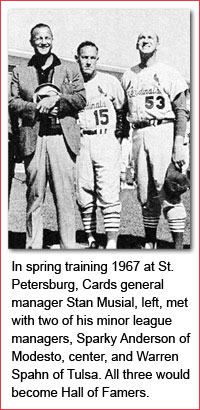
Sparky Anderson’s Hall of Fame managerial career, shaping the Reds and Tigers into championship clubs, might never have happened if not for the three years he spent as a minor-league manager in the Cardinals’ system.

Anderson was fired as manager of Toronto of the Class AAA International League after the 1964 season. He led Toronto to an 80-72 record, but was considered hot-tempered.

In his book, “The Main Spark,” Anderson said, “I wanted every decision on the field to go my way. Man, I battled those umpires. I fought them too hard and too often.”

No other offers came and at 30, after one season, his managerial future was cloudy.
In March 1965, Fred Koenig resigned suddenly as manager of the Cardinals’ Class A Rock Hill team in the Western Carolinas League. Koenig had to deal with a family matter.

With the start of spring training near, Cardinals general manager Bob Howsam was scrambling to find a replacement for Koenig.

Howsam contacted Dodgers executive Dick Walsh for advice. Walsh recommended Anderson, who had played in the Dodgers minor-league system.

Howsam’s top assistant, Sheldon “Chief” Bender, who ran the Cardinals’ farm system, expressed doubts about Anderson because of what he’d witnessed while watching a Cardinals farm club play Toronto the year before. Bender thought Anderson argued too much with umpires and was too harsh with veteran players on his team.

Howsam suggested Bender call Anderson and talk with him about the Rock Hill job. Anderson was selling cars at a dealership in Los Angeles.

According to “The Main Spark” book, Bender said to Anderson, “Do you want to manage?”

Anderson said yes.

“In Class A?,” Bender asked.

“I’d manage anywhere,” Anderson replied.

Bender asked Anderson whether he had learned to control his temper. Anderson said yes.

“If you’ve learned to control yourself,” Bender replied, “You’ve got the job.”

In his book, Anderson said getting the chance to manage the Cardinals’ farm club was “sheer luck” and the “break of a lifetime.”

The Cardinals didn’t stock Rock Hill with top prospects. The best players were pitchers Sal Campisi and Jerry Robertson and third baseman Len Boyer, younger brother of big leaguers Ken and Clete Boyer. Displaying a knack for the hyperbole he later became noted for, Anderson predicted Len Boyer “has the best potential of the family.”

Anderson managed Rock Hill to a 59-63 record.

In 1966, the Cardinals named Anderson manager of St. Petersburg in the Class A Florida State League. After an 0-5 start, St. Petersburg won 22 in a row, shattering the league’s consecutive wins record of 15 established by Daytona Beach in 1950.

The streak was broken when the Cocoa Astros beat St. Petersburg, 1-0. “The kids seemed like they didn’t want to believe it was over,” Anderson told The Sporting News. “I had to say, ‘Come on, let’s get in the clubhouse.’ ”

A couple of weeks later, Anderson and his team got involved in a marathon.

In a game that began on June 14 and ended at 2:30 a.m. on June 15, the visiting Miami Marlins beat St. Petersburg, 4-3, in 29 innings. “It was the darndest thing I’ve ever seen,” Anderson said.

It was the longest game, by innings, in the history of organized baseball. The game took 6 hours, 59 minutes. It began with a crowd of 750 and ended with about 150.

The score was 2-2 after nine innings. Each team scored in the 11th. Miami’s Paul Gilliford pitched 11 scoreless innings of relief and didn’t get the decision. A sacrifice fly by Carl Cmejrek with the bases loaded in the top of the 29th scored pitcher Mike Hebert from third. Hebert retired St. Petersburg in order in the bottom of the inning.

St. Petersburg, with pitchers Clay Kirby and Harry Parker, went on to a 91-45 record. Anderson was named the league’s all-star manager and strengthened his reputation within the Cardinals organization as an instructor.

In January 1967, Howsam left the Cardinals to become general manager of the Reds. Stan Musial, who replaced Howsam as Cardinals general manager, was tasked with choosing a manager for the Class AAA Tulsa team. Anderson was the top internal candidate, but Musial bypassed him and selected Warren Spahn to be manager of Tulsa.

Anderson was named manager of Class A Modesto of the California League. Three of his Modesto players _ pitchers Kirby and Ed Sprague and catcher Bill Plummer _ would play for him with the Reds.

Anderson led Modesto to a 79-61 mark and the league championship.

In the fall of 1967, Howsam wooed Anderson into the Reds organization as a minor-league manager at Class AA Asheville. According to The Sporting News, Anderson left the Cardinals because he was upset he hadn’t gotten the Tulsa job.

Two years later, Oct. 9, 1969, Howsam introduced Anderson as manager of the Reds.

He won the National League pennant in his first season at Cincinnati, and from there built one of the legendary managerial careers.

Read Full Post »

(Updated March 27, 2018)

Clyde King was a big-league pitcher who went on to manage the Giants, Braves and Yankees.

King also had a fascinating stint as a minor-league manager and coach in the Cardinals organization.

In 1959, former Cardinals pitcher Cot Deal was manager of St. Louis’ minor-league affiliate, the Rochester Red Wings. In July, Rochester went into a tailspin, losing 20 of 25, and fell into last place in the International League.

On Aug. 1, a frustrated Deal resigned in a dramatic clubhouse meeting. Rochester general manager George Sisler Jr. sought permission from the Reds to approach King, who was Cincinnati’s pitching coach.

King wanted to become a big-league manager and he believed managing in the minor leagues would pave the way. King accepted Rochester’s offer to become its manager and the Reds hired Deal to be their pitching coach.

Rochester went 21-19 under King in 1959.

In 1960, King transformed Rochester into a championship contender.

Helped by pitching talent such as Ray Washburn, Bob Gibson and Ray Sadecki, and bolstered by a lineup featuring sluggers Leon Wagner and Luke Easter, King led the Cardinals’ farm club to an 81-73 record. Rochester qualified for the playoffs, eliminated Richmond in the first round and lost to Toronto in the finals.

Rochester’s record was of secondary importance to Cardinals farm director Walter Shannon, who was upset because King played veterans ahead of prospects. Shannon ordered King replaced, but Rochester management, loyal to King, responded by dropping their affiliation with the Cardinals and becoming a farm team of the Orioles.

King continued to manage Rochester in 1961 and 1962.

In a surprising twist, King accepted an offer to become the Cardinals’ minor-league pitching coach in 1963. Eddie Stanky, a teammate of King with the Dodgers in the 1940s, had replaced Shannon as head of the Cardinals’ minor-league system.

In two years (1963-64) as Cardinals minor-league pitching coach, King mentored prospects such as Steve Carlton, Larry Jaster, Nelson Briles, Dick Hughes and Mike Cuellar.

“I suppose Clyde King did the most for me when he was the Cardinals’ minor-league pitching coach,” Carlton told The Sporting News. “He smoothed me out. He taught me how to use my arm to the best advantage.”

When Danny Murtaugh resigned as Pirates manager after the 1964 season, King and his friend, Cardinals minor-league manager Harry Walker, were interviewed for the job and became finalists. The Pirates picked Walker, who hired King to be Pirates pitching coach.

Read Full Post »

Tony La Russa and Dusty Baker, who feuded as opposing managers, have a long baseball history together.

La Russa and Baker were teammates on the 1971 Atlanta Braves. La Russa also was Baker’s last manager in the big leagues, with the Oakland Athletics in 1986.
After he was fired by the White Sox, La Russa was hired on July 7, 1986, to replace Jackie Moore with the Athletics.

Baker was a 37-year-old part-time outfielder and designated hitter for Oakland. He played in 33 games for La Russa. His best performance for his new manager came on July 18 when he slugged a two-run home run (the 242nd and last of his career) against Mark Clear, walked twice and scored twice in the Athletics’ 6-1 victory over the Brewers. Boxscore

“I was only with Tony for half a year, but we talked baseball all the time,” Baker told Rob Rains in the book “Tony La Russa, Man on a Mission.” “… He told me that one of the biggest mistakes he made was that at the end of my career he should have made me part of his coaching staff in Oakland.”

The biggest contribution Baker made to La Russa’s Athletics was his recommendation that Oakland take a chance on pitcher Dave Stewart, who had been released by the Phillies in May 1986. Baker and Stewart had been teammates on the Dodgers.

Oakland signed Stewart on May 23, 1986, but he languished in the bullpen. When La Russa arrived, along with pitching coach Dave Duncan, he put Stewart in the rotation.

Stewart started La Russa’s first game as Oakland manager, and beat Roger Clemens and the Red Sox in Boston. He went on to post a 9-5 record that season, won 20 or more in each of the next four seasons for La Russa and was the ace on Oakland’s three consecutive pennant-winning teams (1988-90).

Read Full Post »

Whitey Herzog showed appreciation during his Baseball Hall of Fame induction speech July 25, 2010, when he remembered Harry Craft for helping him.

“Harry Craft was a guy who was always in my corner,” Herzog told the crowd at Cooperstown, N.Y. “He kind of saved my career. Claimed me on waivers when I wasn’t doing so good at Washington.

“I was able to get nine years (in the majors). I wasn’t a very good player … I was the kind of player everyone wanted; when they got me, they didn’t know what the hell to do with me.

“Anyway, Harry Craft was great to me and I was wishing he would be here today.” (Craft died at 80 in 1995).

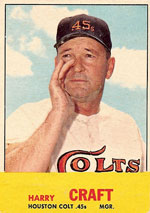
Craft managed Herzog twice: in the minor leagues at Class AA Beaumont, Texas, and in the major leagues with the Kansas City Athletics.

Herzog was a 20-year-old prospect in the Yankees system when he was sent to Beaumont in 1952. He struggled there, batting .198 in 35 games.

“I wasn’t ready for the pitching in the Texas League,” Herzog wrote in the book, “White Rat.” “The manager there in Beaumont was Harry Craft, who took a real liking to me. Harry had been a great defensive outfielder but a poor hitter, and I think I reminded him of himself.”

Herzog persevered and, four years later, reached the major leagues with the Washington Senators.

By 1958, struggling to hit the curve, Herzog’s baseball career was in jeopardy. Herzog began the season by catching President Eisenhower’s Opening Day first pitch from the boxseats. (According to the report in The Sporting News, “It was a low, spinning throw which just missed the dirt as Whitey made the stab.”)

In May, the Senators placed Herzog on waivers. Craft, who was managing the Athletics, urged the club to sign Herzog. He became a backup to first baseman Vic Power and to outfielders Roger Maris, Bob Cerv and Bill Tuttle.

“Harry picked me up, which prolonged my big-league career long enough to qualify under the pension plan,” Herzog said. “In baseball, you never burn any bridges.”

Read Full Post »

« Newer Posts - Older Posts »