Feeds:
Posts
Comments

Archive for the ‘Opponents’ Category

The Cardinals have been a part of the Royals’ history ever since Kansas City entered the American League as an expansion franchise in 1969.
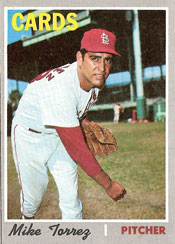
The Cardinals were the opponent for the Royals’ first game at Kansas City, an exhibition on Saturday, April 5, on the weekend before the opening of the 1969 regular season.

St. Louis won, 1-0, behind the pitching of Mike Torrez and Dave Giusti. Torrez, a native of Topeka, Kan., held Kansas City to three singles in five innings and scored the lone run. Left fielder Lou Brock drove in Torrez with a triple to right-center off Roger Nelson after Torrez had doubled into right field with two outs in the third.

Giusti, one of the Cardinals’ key off-season acquisitions, limited the Royals to a hit over the last four innings. In addition to Nelson, who went five innings, the Royals also pitched Bill Butler and Dave Wickersham.

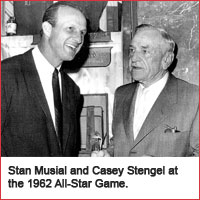
Stan Musial, who would be inducted into the National Baseball Hall of Fame that summer, delivered the ceremonial first pitch for the second and last game of the exhibition series the following day, Easter Sunday, April 6. St. Louis won, 6-5.

“If the Cardinals don’t clinch the pennant by July, there ought to be an investigation,” Royals coach Charlie Metro said to The Sporting News.

After winning National League pennants in 1967 and 1968, plus the 1967 World Series championship, the Cardinals were considered favorites to at least finish atop the NL East in 1969, the first year Major League Baseball split the two leagues into two divisions each. In addition to adding Giusti, a former Astro, St. Louis had acquired Vada Pinson from the Reds to replace Roger Maris in right field and Joe Torre from the Braves to replace Orlando Cepeda at first base.

“As much as everyone liked Roger Maris and appreciated what he did for us, I think Vada will help us more,” Cardinals reliever Ron Willis said.

Pinson hit .449 in spring training for St. Louis. Third baseman Mike Shannon batted .371 with 17 RBI in the spring exhibition season.

“Mike looks 50 percent better, at bat and at third base,” said St. Louis hitting coach Dick Sisler.

Said Cardinals infielder Phil Gagliano: “Those first three hitters (Brock, Curt Flood and Pinson) are tough. Moon (Shannon) will drive in 100 runs _ if Torre doesn’t get ’em first.”

After winning the two exhibition games at Kansas City, the Cardinals went to St. Louis to open the regular season with three games against the Pirates. “It’ll take a lot of luck to stop the Cardinals,” Pirates manager Larry Shepard said to the Associated Press. “They’re far and away the best club. This is the best team they’ve had in three years.”

Only Cardinals manager Red Schoendienst expressed caution. Asked whether the Cubs were the Cardinals’ top threat, Schoendienst said, “The Cubs and the Mets. The Mets have had great pitching the last couple of years and now some of their young guys at the other positions are coming through. They’re not making so many mistakes as they used to.”

Unfortunately for the Cardinals, Schoendienst was right and everyone else was wrong. The Pirates swept the opening series against the Cardinals. Pinson didn’t live up to expectations, batting .255 in 1969 and posting a weak on-base percentage of .303. Shannon fell far short of 100 RBI, with 55. The Cardinals finished in fourth place in the six-team NL East, a game behind the third-place Pirates.

The Mets, dubbed a miracle team by most, developed just as Schoendienst had feared, winning the division and league titles and defeating the Orioles in the World Series.

The Royals? The expansion club finished as high in the standings as the Cardinals _ fourth in the six-team American League West.
Read Full Post »

(Updated Dec. 15, 2018)

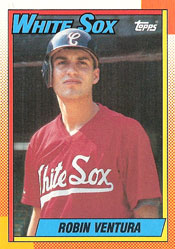
Robin Ventura had a record of delivering knockout blows against the Cardinals.

In a 16-year playing career (1989-2004) as a third baseman for the White Sox, Mets, Yankees and Dodgers, Ventura hit .250 versus the Cardinals, with five home runs and 19 RBI.
Two of his most devastating hits came on June 10, 1998, at Chicago. The Cardinals had built a 7-0 lead through five innings and were ahead of the White Sox, 8-4, entering the bottom of the ninth.

Curtis King retired the first two batters of the inning and needed one out to seal a Cardinals win, but Mike Caruso got an infield hit, Frank Thomas walked and Albert Belle slugged a three-run home run, making the score 8-7. Ventura followed with a home run, tying the score.

In the 11th, Belle singled with one out and Ventura hit a 3-and-0 pitch from Sean Lowe over the right-field fence for a two-run walkoff home run and a 10-8 White Sox victory. Boxscore

“I was just trying to get a pitch to hit in the air and I did,” Ventura said to the Arlington Daily Herald.

Asked about Ventura swinging on a 3-and-0 count, White Sox manager Jerry Manuel replied, “All three of those guys (Ventura, Belle and Thomas) have the green light to hit. They’re marquee players.”

Ventura became a free agent after the 1998 season and signed with the Mets. On June 17, 1999, he went 3-for-4 with two RBI and a run scored in the Mets’ 4-3 victory over the Cardinals at St. Louis. Ventura’s two-run home run to right-center in the sixth off Kent Mercker pushed the Mets’ lead from 2-1 to 4-1 and produced the winning run. Boxscore

“I made a bad pitch to Ventura and it cost me a game,” Mercker said to the St. Louis Post-Dispatch. “It was probably right down the middle of the plate. Three-and-two count, you leave a pitch down the middle to Robin Ventura … You expect bad things to happen.”

In 2000, Ventura had consecutive three-RBI games in Mets victories over the Cardinals at St. Louis, 5-2 on May 26 Boxscore and 12-8 on May 27. Boxscore

The Cardinals and Mets advanced to the National League Championship Series that year, with New York winning in five games. Ventura had the key hit in Game 4, a two-run first-inning double off Darryl Kile that landed between center fielder Jim Edmonds and right fielder J.D. Drew and gave New York a 3-2 lead. Ventura had a team-high three RBI in the game, which the Mets won, 10-6, at Shea Stadium. Boxscore

A year later, the Mets traded Ventura to the Yankees for outfielder David Justice. On June 15, 2003, Ventura won a classic duel with pitcher Woody Williams and lifted the Yankees to a 5-2 victory over the Cardinals in New York. Boxscore

In the sixth inning, with the Cardinals ahead 2-1, the Yankees had runners on first and second. Ventura faced Williams, who quickly got two strikes on the batter. Ventura fouled off four two-strike pitches. On the 10th pitch of the at-bat, Williams threw a high fastball on a 3-and-2 count and Ventura laced a two-run double into the gap in right-center, giving New York a 3-2 lead.

“That was a huge at-bat,” Yankees manager Joe Torre said to the New York Daily News. “He got behind and he was fighting off and fighting off. Those are the kind of at-bats we need.”

Read Full Post »

(Updated May 26, 2020)

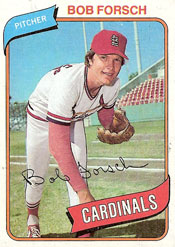
An official scorer’s ruling created a controversy when Bob Forsch pitched his first big-league no-hitter for the Cardinals.

Forsch’s gem in the Cardinals’ 5-0 victory over the Phillies on April 16, 1978, at St. Louis stirred an array of emotions. Boxscore
Garry Maddox opened the eighth against Forsch with a grounder to the left of third baseman Ken Reitz, who was playing in front of the bag. “I thought he might bunt,” Reitz told the Philadelphia Inquirer. The ball bounced into the outfield after Reitz appeared to tip it with his glove. Video at 8:36 mark

Official scorer Neal Russo, a reporter for the St. Louis Post-Dispatch, ruled it an error. The next batter, Bob Boone, grounded into a double play and Forsch retired the final four batters without incident for the first of his two big-league no-hitters. Video

It was the first Cardinals no-hitter in St. Louis since Jesse Haines achieved the feat against the Braves, also by a 5-0 score, on July 17, 1924. Boxscore

Varying opinions

The Phillies were unsparing in their criticism of Russo’s call.

“Base hit all the way,” Phillies manager Danny Ozark told Russo. “Reitz didn’t even touch the ball.”

Said Phillies third baseman Mike Schmidt: “Forsch pitched a dazzling one-hitter.”

Bake McBride, the Phillies’ right fielder and a former Cardinal, said, “We almost all fell off the bench when the call was made.”

Russo, who had 15 years of experience scoring National League games, never wavered. “I thought Reitz should have had it,” Russo told the Associated Press. “I called it immediately. It was an ordinary play, maybe a step to Reitz’s left. The ball wasn’t hit that hard. There was no doubt in my mind.”

Responding to the criticism, Russo said, “Of course, the Phillies, to a man, argued. That’s human nature.”

The Cardinals were just as adamant in their support of the call. Broadcaster Mike Shannon, the former Cardinals third baseman, told Russo, “It was an error, but it’s going to be controversial. Reitz had a chance to make the play and he didn’t.”

Catcher Ted Simmons told the Post-Dispatch, “It hit off his glove. If it wasn’t an error, I’d say so.”

Explained Reitz: “I thought the ball was hit a lot harder than it was. When I went for the ball, I double-pumped and when I came up with the glove the second time, the ball hit the webbing and went by me. I make that play 99 out of 100 times. This was the 100th time. It was an error all the way.”

Good luck

Somewhat lost amid the hubbub was the pitching of Forsch, who used mostly fastballs, curves and changeups to stop the Phillies. “He had full command of everything he threw,” Simmons said.

In a 2020 interview with Stan McNeal of Cardinals Gameday Magazine, Simmons recalled, “Forsch threw a profound power sinker,” and he used it to try to get the Phillies to hit grounders.

Said Forsch: “When I was warming up, I didn’t think I had real good stuff. So I just tried to keep the ball down in the first three innings and mixed up my pitches.”

Forsch’s biggest threat to the no-hitter was Schmidt, who hit three drives to the warning track. All were caught by center fielder Tony Scott. “1,200 feet of outs,” the Philadelphia Inquirer declared.

On a day when the temperature was 41 degrees, the wind was blowing in “and the ball carried like a shotput through the heavy river air,” wrote Bill Conlin of the Philadelphia Daily News.

“The ball Schmidt hit in the first inning I thought was going to hit the Stadium Club,” Forsch said candidly to the Philadelphia Daily News. “I think that’s a home run easy on a normal day here.”

Forsch concluded, “You’ve got to be lucky to pitch a no-hitter, and I was lucky, but I made some good pitches and any time I got into trouble I got right out of it.”

It was the first Cardinals no-hitter since Bob Gibson’s masterpiece against the Pirates in an 11-0 victory at Pittsburgh on Aug. 14, 1971. Simmons also was the catcher in that game. Boxscore

An appreciative Cardinals manager Vern Rapp said of Forsch, “He’s a complete pitcher now. He was a master out there this time. An artist.”

It would be the last win of Rapp’s tenure as St. Louis manager. After the Cardinals lost their next five in a row, Rapp was fired.

Previously: The story of how Bob Forsch converted to pitching

Read Full Post »

(Updated April 24, 2022)

The Cardinals played a significant role in the birth of the Mets as a National League franchise.

In 1962, the Cardinals were the opponent when the expansion Mets played their first spring training exhibition game and their first regular-season game. The Cardinals won both.

The Cardinals and Mets had their spring training camps in St. Petersburg, Fla., in 1962. Two former Cardinals player-managers, Rogers Hornsby and Solly Hemus, were on Mets manager Casey Stengel’s coaching staff. Former Cardinals on the 1962 Mets roster included catchers Hobie Landrith and Chris Cannizzaro, outfielder Bobby Gene Smith and pitchers Bob Miller, Craig Anderson and Herb Moford.

First game

On March 10, 1962, before an Al Lang Field crowd of 6,872, including baseball commissioner Ford Frick, the Cardinals beat the Mets, 8-0, in their spring training opener, the first game played by the expansion team.

Minnie Minoso and Gene Oliver each hit home runs for the Cardinals, who collected 12 hits. Mets starter Jay Hook allowed five runs in four innings. Curt Flood was the first batter to face the Mets. Stan Musial contributed a sacrifice fly for the Cardinals.

Three Cardinals pitchers, Lindy McDaniel, Ray Washburn and Curt Simmons, combined to limit the Mets to four hits, including a triple by Don Zimmer.

First win

The Mets earned their first victory the next afternoon, March 11, 1962, beating the Cardinals, 4-3, before 2,574 at St. Petersburg.

Larry Jackson and Paul Toth held the Mets scoreless on one hit through seven innings and the Cardinals built a 3-0 lead.

In the eighth, the Mets broke their streak of 16 consecutive scoreless innings when Choo Choo Coleman hit a two-run home run to right against Johnny Kucks. Elio Chacon, Rod Kanehl and Gus Bell followed with consecutive singles, tying the score.

The Mets won in the ninth against Ed Bauta when, with two outs and none on, Richie Ashburn doubled and Chacon followed with a RBI-single.

Bob Botz, a right-hander who pitched a scoreless top of the ninth, earned the first win in Mets history. Botz never appeared in a regular-season game for the Mets. On April 2, 1962, he was traded to the Braves. The Cardinals acquired him from the Angels in April 1963 and assigned him to the minor leagues.

Playing for keeps

The Mets went to St. Louis to open the regular season. At the hotel, several players got trapped in an elevator for 20 minutes. “It wasn’t like it was just a few guys,” pitcher Jay Hook told author Janet Paskin. “We were packed in there like sardines.”

Then, the April 10 opener was postponed because of rain. It was the first time a Cardinals home opener had been scratched in more than 25 years.

They played for real on April 11. According to the book “Tales from the 1962 Mets,” Sherman Jones was supposed to be the Mets’ starting pitcher, but he got sidelined when, while lighting a cigarette, the head of the match flew off and struck him in the eye, blinding him temporarily. Roger Craig got the start instead.

Musial, 41, was 3-for-3 with two RBI, a walk and a run, Bill White drove in three runs and Julian Javier contributed four hits and scored three runs as the Cardinals beat the Mets, 11-4, before 16,147 at St. Louis. Boxscore

Stengel, the Mets’ 71-year-old manager, managed the Braves when Musial made his big-league debut against them 21 years earlier in 1941.

“He’s the only player left from my last time in the National League,” Stengel said to the Associated Press. “No wonder they keep him around.”

Ashburn, the first batter in Mets regular-season history, flied out to center. Bell got the first Mets hit, a single to center in the second. Gil Hodges hit the first Mets home run, with none on in the fourth.

Larry Jackson pitched a complete game for the Cardinals. Craig lasted three innings and took the loss, his first of 24 in 1962.

Cardinals dominate

A week later, April 18, 1962, the Cardinals played their first game against the Mets at New York and it was another romp. Ken Boyer hit two home runs and scored four times, and Musial was 2-for-4 with two RBI and a run in a 15-5 Cardinals triumph before 4,725 on a Wednesday afternoon at the Polo Grounds. Boxscore

The win improved St. Louis’ record to 5-0. The Mets dropped to 0-6 on their way to a 40-120 season.

The Cardinals won 13 of 18 against the 1962 Mets. Musial hit .468 with four home runs, 15 RBI and 11 walks in 17 games against them. Other Cardinals who excelled against the Mets in 1962: White (.360 batting average, 19 RBI), Boyer (.329, 23 RBI), Flood (.392, 13 RBI), Washburn (4-0 record), Jackson (3-0) and McDaniel (1-0, four saves).

The 1962 Cardinals batted .311 against the Mets, with 30 home runs.

Previously: An interview with former Cardinals pitcher Al Jackson

Read Full Post »

When the Cardinals played in Dodger Stadium for the first time the weekend of May 18-20, 1962, they felt right at home. The Cardinals swept the three-game series, receiving complete-game wins from each of their starting pitchers, and Stan Musial stroked a single, surpassing Honus Wagner to become the National League all-time hits leader.

Moved from Brooklyn to Los Angeles after the 1957 season, the Dodgers played four years at the Coliseum while Dodger Stadium was being built. On April 10, 1962, in the first regular-season game at Dodger Stadium, the Reds defeated the Dodgers, 6-3. Boxscore
As the Cardinals-Dodgers series opened May 18, the Dodgers were in second place, three games behind the Giants, at 23-12. The Dodgers had won four in a row and eight of their last nine. The Cardinals were in third place at 18-13 and had lost five of their last seven.

The Cardinals’ arrival brought out the entertainment crowd. While the Cardinals were warming up before the first game, comedian Milton Berle, seated near the dugout, performed card tricks for Musial, Red Schoendienst and Ernie Broglio, the Los Angeles Times reported.

The opener matched Johnny Podres against Larry Jackson. In the first inning, Ken Boyer smashed a drive that struck Podres in the left forearm. Podres threw three pitches out of the strike zone to the next batter, Gene Oliver, and walked off the field, unable to pitch. X-rays revealed a severe bruise, no fracture.

Bill White drove in three runs, Charlie James scored three runs and knocked in two, and Jackson went the distance as the Cardinals won, 8-3, before 38,951. Boxscore

“I had a pretty good curve and fastball,” Jackson told the St. Louis Post-Dispatch.

The story the next night, May 19, normally would have been the pitching of Cardinals left-hander Ray Sadecki. The Dodgers had defeated six consecutive left-handers and Sadecki was 0-3 in his career against them, but Sadecki changed the script, pitching his first complete game of the season and got the win in the Cardinals’ 8-1 triumph before 44,559. Boxscore

The headlines, however, went to Musial, the 41-year-old left fielder. His single to right field in the ninth inning off a curve from Ron Perranoski gave Musial his 3,431st hit and moved him ahead of Wagner for No. 1 on the NL career list, breaking a mark that had been held for 45 years. Dodgers first baseman Wally Moon, a former Cardinals teammate, fielded the throw from right fielder Frank Howard and handed the ball to Musial, who received a standing ovation.

“Stan hit a good curveball,” Perranoski told The Sporting News.

Said Musial: “I never worked so hard for two hits.”

(Musial had hit the record-tying single off Juan Marichal in San Francisco on May 16, ending a string of 15 hitless at-bats. He went hitless in nine more after that until he connected on the 0-and-1 pitch from Perranoski.)

“At least I got it in a beautiful new park and against the Dodgers, who have been good to me over the years,” Musial said.

Only Ty Cobb (4,191) and Tris Speaker (3,515) had more career hits than Musial at that time.

After the game, Musial and teammates Boyer and Schoendienst went to the Stadium Club at the ballpark. Musial enjoyed a steak sandwich and French fries. As Neal Russo reported in The Sporting News, few tables had a trio with more hits _ a total surpassing 7,000.

Exhausted by the strain to break the record, “I just about wilted when I got to first base with the record hit,” Musial said.

While Musial sat out the series finale on Sunday afternoon, May 20, Schoendienst, 39, started at second base for the fifth consecutive game. He was filling in for Julian Javier, who was sidelined because of a torn fingernail on his right index finger.

Curt Simmons yielded three runs, none earned, and got the complete-game win in the Cardinals’ 4-3 victory before 38,474. Boxscore

The Cardinals had swept a series in Los Angeles for the first time since the Dodgers left Brooklyn. They moved into a second-place tie with the Dodgers and got within 4.5 games of the Giants.

Previously: How Stan Musial turned in a great comeback year at 41

Read Full Post »

(Updated Feb. 19, 2023)

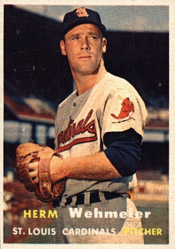
In a classic example of the adage “if you can’t beat ’em, join ’em,” the pitcher who posted the worst career record against the Cardinals got traded to them and enjoyed the best stretch of his big-league tenure.

In 31 appearances against the Cardinals for the Reds and Phillies from 1949-1956, Herm Wehmeier was 0-14 with a 4.89 ERA.

(Yovani Gallardo has the second-worst career mark versus the Cardinals. In 19 starts against the Cardinals, Gallardo was 1-11 with a 6.45 ERA.)

Wehmeier’s 14th loss to St. Louis occurred May 9, 1956, in the Cardinals’ 3-0 victory over the Phillies. Boxscore

Two days later, on May 11, 1956, the Cardinals traded pitchers Harvey Haddix, Stu Miller and Ben Flowers to Philadelphia for Wehmeier and pitcher Murry Dickson. The deal was unpopular with many Cardinals fans. Haddix won 20 in 1953 and 18 in 1954. Though his record in 1955 fell to 12-16, many saw him as a pillar of St. Louis’ rotation.

Cardinals coach Terry Moore, who was the Phillies’ manager when Philadelphia acquired Wehmeier from the Reds in 1954, recommended Wehmeier to St. Louis general manager Frank Lane. According to The Sporting News, Lane said he sought Wehmeier “because he can be depended upon to trouble Brooklyn and Milwaukee, teams the Cards must stop to win.”

Cardinals pitching coach Bill Posedel was successful in working with Wehmeier. Reporting for The Sporting News, Bob Broeg wrote, “Wehmeier began to work with a high leg kick, similar to Paul Derringer’s, and … he concentrated on letting up on his fastball and curve when the opposition would expect the Wehmeier of old to try to bust his fastball by ’em.”

The results were impressive. Wehmeier won eight of nine decisions for the 1956 Cardinals from July 21 to Sept. 11. He saved his best for his last start of the year.

On the morning of Saturday, Sept. 29, the next-to-last day of the 1956 season, the Braves held first place in the National League, a half-game ahead of the Dodgers.

That day, the Dodgers swept a doubleheader against the Pirates. The Braves entered their night game at St. Louis knowing they needed to win to keep a share of first place. Milwaukee started its ace, Warren Spahn, against Wehmeier.

(In his autobiography, “I Had a Hammer,” Hank Aaron called Wehmeier “my worst nightmare,” because in 1955 he batted .105 against him, with two singles in 19 at-bats.)

Spahn and Wehmeier dueled into the 12th inning with the score tied 1-1. In the bottom of the 12th, Rip Repulski lashed a double against Spahn, scoring Stan Musial from second and giving the Cardinals a 2-1 victory. Boxscore

In Aaron’s book, Spahn said, “Beyond a doubt, that Saturday game in St. Louis was the most heartbreaking moment I had in 21 years of baseball.”

The loss dropped the Braves a game behind the Dodgers, who clinched the pennant the next day. The win capped a successful season for Wehmeier. The right-hander finished 12-9 with a 3.69 ERA for St. Louis. It would be the most single-season wins he’d post in his big-league career.

Wehmeier was named the Cardinals’ 1957 Opening Day pitcher by manager Fred Hutchinson. The assignment was especially important for Wehmeier because he would be facing the Reds in Cincinnati.

A Cincinnati native, Wehmeier had been an outstanding athlete at Western Hills High School. When he signed with the Reds at age 18, he was billed as a hometown hero. Instead, plagued by wildness and high expectations, Wehmeier was a bust. In nine seasons with the Reds, Wehmeier was 49-69. He issued more walks (591) than strikeouts (478) and became a target of fan hostility.

“He was one of the greatest natural athletes we ever had in Cincinnati,” Reds general manager Gabe Paul said. “But never in my long baseball experience have I heard a man booed as bitterly as was Wehmeier. Nothing he could do was right. Even when he won, they booed him.”

Wrote Broeg: “One of Wehmeier’s troubles as a Red was that the former Cincinnati high school hero tried too hard. The more red-necked he became and the harder he tried to throw, the wilder he became, either walking himself into trouble or getting the ball up where power hitters and others could swing for the fences.”

When Wehmeier took the mound in the Cardinals’ 1957 opener, his mother, father, sister and brother were in the stands. What they witnessed must have stunned many Reds fans. Wehmeier pitched a complete game and got the win in the Cardinals’ 13-4 victory. Boxscore

Wehmeier was winless in May and June, but recovered to win five consecutive decisions from Aug. 24 to Sept. 15. He finished the 1957 season at 10-7 with a 4.31 ERA.

In May 1958, Wehmeier was sent to the Tigers in a waiver deal. He suffered an elbow injury soon after and, at 31, his playing career was done. His big-league record: 92-108. For St. Louis, Wehmeier was 22-17.

Wehmeier scouted for the Reds for three years (he recommended they sign another phenom from Western Hills High School, Pete Rose) and then left baseball. He worked for a trucking company in Texas.

In May 1973, Wehmeier, 46, was testifying during a theft trial in federal court in Dallas when he suffered a fatal heart attack. In an obituary, The Sporting News reported, “Wehmeier was on the witness stand testifying for the government when he collapsed. The case involved theft of merchandise from a shipping company of which Wehmeier was an official.”

Previously: An interview with former Cardinals pitcher Al Jackson

Read Full Post »

« Newer Posts - Older Posts »