Feeds:
Posts
Comments

Archive for the ‘Opponents’ Category

After giving Curt Flood a chance at the center field job, the Cardinals decided they needed an upgrade at the position. The player they wanted was Bill Bruton.
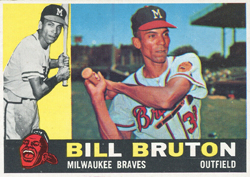
A left-handed batter, Bruton became the Braves’ center fielder in 1953 and helped transform them into National League champions in 1957 and 1958. 

In December 1960, the Cardinals made multiple offers for Bruton, including one that likely involved trading Bob Gibson.

Impact player

Bruton got his start in pro baseball when his father-in-law, future Hall of Fame third baseman Judy Johnson, put out the word about him, The Sporting News reported. Bruton was 24 when Braves scout Johnny Ogden signed him in 1950.

Bruton made an impact his first season in the minors, swiping 66 bases for Eau Claire. The next year, he had 27 triples for Denver.

“I’ve seen no player in baseball today who is as fast as Bruton,” Braves scout Walter Gautreau told The Sporting News.

With Class AAA Milwaukee in 1952, Bruton totaled 211 hits and scored 130 runs.

Before the 1953 season, the Braves relocated from Boston to Milwaukee and Bruton was named their Opening Day center fielder.

Splendid start

The Braves began the 1953 season at Cincinnati. Bruton, 27, had a dazzling debut. Batting leadoff, he had two hits, a stolen base and scored a run.

Described by the Cincinnati Enquirer as a “mercury-footed” outfielder who covered center “like the morning dew,” Bruton made six putouts, “two of them only short of sensational.”

“In the third inning, he leaped high in front of the center field seats to take what looked like a surefire double away from Willard Marshall,” the Enquirer reported. “He repeated the performance at the expense of Bobby Adams in the ninth.” Boxscore

The Braves took a flight to Milwaukee after the game and were greeted at the airport by 1,500 admirers, according to United Press.

Heroics at home

The next day, in their first regular-season home game since moving from Boston, the Braves played the Cardinals, and Bruton again was sensational.

In the eighth inning, with the score tied at 1-1, the Cardinals had two on and two outs when Stan Musial drove a Warren Spahn pitch into left-center. Bruton made a running catch, depriving Musial of a two-run double.

In the bottom half of the inning, the Braves had two outs and none on when Bruton, described by The Sporting News as the “Jesse Owens of the baselines,” hit an inside fastball from Gerry Staley over the head of right fielder Enos Slaughter for a triple. Sid Gordon’s single scored Bruton, giving the Braves a 2-1 lead.

The Cardinals tied the score in the ninth.

Batting with one out and none on in the 10th, Bruton got a knuckleball from Staley. “Man, it just hung there,” Bruton told the Associated Press.

Bruton drilled the pitch to deep right. According to the St. Louis Post-Dispatch, Slaughter “ran back to the waist-high wire fence, reached up and almost made the catch, but as his fingers began to close on the ball, his elbow struck sharp prongs protruding from the wire barrier.”

The impact jarred the ball loose and it dropped over the fence for a home run, Bruton’s first in the majors. It also turned out to be his only home run of the season and his only walkoff home run in 12 years in the big leagues. Boxscore

As Bob Broeg of the Post-Dispatch noted, Bruton’s dramatics made him “as popular in Milwaukee as beer and cheese.”

Multiple talents

Bruton was the Braves’ center fielder for eight years (1953-60). Hank Aaron, who joined the Braves in 1954, was his outfield teammate for seven of those seasons.

The Braves won the pennant in 1957 but Bruton sat out the World Series because of a knee injury. The next year, when the Braves repeated as National League champions, Bruton had a .545 on-base percentage in the World Series, reaching base 12 times (seven hits and five walks) in 22 plate appearances.

Bruton led the National League in stolen bases three times: 1953 (26), 1954 (34) and 1955 (25).

In 1960, Bruton, 34, had one of his best seasons, leading the league in runs scored (112), triples (13) and assists by a center fielder (11). He also ranked fourth in hits (180).

The Braves, though, had been searching for a second baseman ever since Red Schoendienst came down with tuberculosis, and general manager John McHale decided Bruton’s trade value would bring an experienced infielder.

Determined to deal

The Cardinals preferred Bruton to Flood.

In three seasons as Cardinals center fielder, Flood’s batting average and on-base percentage decreased every year: 1958 (.261 batting average, .317 on-base percentage), 1959 (.255 and .305) and 1960 (.237 and .303). He also had a mere two stolen bases in both 1958 and 1959, and none in 1960.

“We’ve been interested in Bruton for some time,” Cardinals general manager Bing Devine told the Post-Dispatch.

According to The Sporting News, the Cardinals offered their shortstop, Daryl Spencer, for Bruton. Spencer had been a second baseman with the Giants.

When the Braves reacted unenthusiastically, the Cardinals approached the Phillies about making a three-way trade with the Braves.

According to the Associated Press, the Braves were interested in Phillies second baseman Tony Taylor and reliever Turk Farrell. In exchange, the Phillies wanted outfielder Wes Covington from the Braves, and first baseman Joe Cunningham and pitcher Bob Gibson from the Cardinals, the Philadelphia Daily News reported. Bruton would go to the Cardinals.

(Later that month, the Cardinals offered Gibson to the Senators for Bobby Shantz.)

According to The Sporting News, the three-way deal “went down the drain” when the Phillies “stepped up their demands.”

“We wanted to make a deal,” Cardinals manager Solly Hemus said, “but it wound up with the Phillies wanting too many of our established players. We would have had to give up four or five, and would have gotten one or two.”

The Cardinals tried again to interest the Braves in a swap of Spencer for Bruton. “The Braves began to warm up to his possibilities,” The Sporting News reported, but then the Tigers entered the picture.

Flood is the answer

When the Tigers proposed dealing second baseman Frank Bolling to the Braves for Bruton, talks with the Cardinals ceased. Braves general manager John McHale had been general manager of the Tigers and he was an admirer of Bolling.

“When I was at Detroit, I thought Bolling was just as valuable to the club as Harvey Kuenn or Al Kaline,” McHale told The Sporting News.

To ensure the Tigers didn’t waver, McHale sweetened the deal. On Dec. 7, 1960, the Braves traded Bruton, catcher Dick Brown, infielder Chuck Cottier and pitcher Terry Fox for Bolling and a player to be named, outfielder Neil Chrisley.

According to the Sporting News, Hemus contacted Tigers manager Bob Scheffing and asked whether the Tigers would flip Bruton to the Cardinals, but was told no.

Don Landrum, acquired from the Phillies in September 1960, opened the 1961 season as the Cardinals’ center fielder. The Cardinals also tried Don Taussig and Carl Warwick there.

In July, Hemus was fired and replaced by Johnny Keane, who committed to Flood in center. Flood rewarded Keane’s confidence by hitting .324 in July, .330 in August and .355 in September. He went on to be the center fielder on Cardinals clubs that won three league championships and two World Series titles.

Read Full Post »

(Updated Jan. 15, 2025)

Imagine going to a regular-season game in St. Louis and getting to see Bob Gibson, Sandy Koufax and Don Drysdale pitch.

It happened on May 12, 1962, in a game Koufax started for the Dodgers against the Cardinals. Gibson and Drysdale relieved and were the winning and losing pitchers in a 15-inning, 6-5 Cardinals victory.
Gibson pitched five innings of scoreless relief. Drysdale gave up the winning run and barely avoided a serious injury.

Fit to be tied

The Saturday night game at the original Busch Stadium matched Koufax against Ernie Broglio.

When Koufax was lifted for a pinch-hitter in the seventh, the Cardinals led, 4-3. They increased the lead to 5-3 with a run in the eighth against Larry Sherry.

Bobby Shantz, who relieved Broglio in the sixth, held the Dodgers hitless until the ninth when eighth-place hitter Larry Burright followed a walk to Daryl Spencer with a two-run home run, tying the score at 5-5.

Two nights earlier, when Burright hit his first big-league home run against Bob Bruce of the Colt .45s, the Long Beach Press-Telegram reported that Dodgers manager Walter Alston said to him, “I hope that doesn’t make you a home run hitter. I don’t want you swinging for the fences.”

In the bottom of the ninth, when Red Schoendienst singled to right, Bill White tried to score the winning run from second, but was thrown out at the plate on a powerful peg by right fielder Frank Howard.

Costly outing

Making his first relief appearance of the season, Gibson (3-2, 4.02 ERA) entered in the 11th. Two nights earlier, he’d pitched 4.2 innings in a start against the Giants and gave up five runs.

Against the Dodgers, Gibson got into a jam in the 12th when they loaded the bases with two outs. Though pinch-hitters Duke Snider, Andy Carey, Doug Camilli and Norm Sherry were available, Alston let rookie pitcher Pete Richert bat and he grounded out.

In the 13th, Richert tore a muscle in his elbow pitching to White. Dodgers first baseman Tim Harkness said he could hear the muscle rip loose. “It sounded like two sticks clicking together,” Harkness told the Los Angeles Times.

Another rookie, Joe Moeller, relieved Richert and held the Cardinals in check until Snider batted for him in the 15th. The Dodgers got a runner, Burright, to second with two outs before Maury Wills, a .211 career hitter against Gibson, struck out.

Emergency call

Alston needed a replacement for Moeller in the bottom half of the 15th. He chose Drysdale (5-1, 2.98 ERA) to make his first relief appearance of the season. Two nights earlier, Drysdale pitched a complete game against the Colt .45s.

“I knew I didn’t have a thing left,” Drysdale told the Los Angeles Times. “I told them so in the bullpen.”

Rookie outfielder Doug Clemens, a replacement for Minnie Minoso, who was injured the previous night when he crashed into a wall, led off with a single. Julio Gotay, attempting a sacrifice bunt, was hit by a Drysdale pitch.

As the next batter, Gibson, backed away from a pitch, catcher John Roseboro fired a strike to second, picking off Clemens for the first out of the inning.

When he resumed pitching to Gibson, Drysdale felt something pop in his right elbow. Gibson drew a walk, advancing Gotay to second.

Drysdale fanned Curt Flood for the second out.

Julian Javier, a career .195 hitter versus Drysdale, was up next. Drysdale got two strikes on him, followed by three consecutive pitches outside the zone.

At 12:58 a.m., nearly five hours after the game began, Javier hit a blooper to the opposite field. The ball landed barely fair, just inside the right field line. Gotay, who was running with the payoff pitch, easily scored from second. Boxscore

If Javier had made the third out, the game would have been declared a tie because the National League had a curfew that barred the start of an inning after 12:50 a.m. The game would have been replayed another time.

Upset with the outcome, Drysdale stormed into the clubhouse and “smashed a mirror with his fist and kicked a sandbox,” the Los Angeles Times reported.

“My arm was stiff. I didn’t want to pitch but Alston asked me to go in,” Drysdale told Sport magazine. “I didn’t argue. I’d never argue with him.”

Fortunate recovery

When he showed up at the ballpark the next day, Drysdale “had a Band-aid on his right pinkie, and his left big toe was taped, souvenirs of his outburst,” according to the Los Angeles Times.

The good news was his elbow was OK.

“When I rolled over in bed early this morning, the elbow popped back into position,” Drysdale said.

Drysdale went on to have a career year, earning the 1962 National League Cy Young Award. He led the league in wins (25), strikeouts (232) and innings pitched (314.1).

Against the Cardinals in 1962, Drysdale was 2-4. He had winning records versus each of the other eight National League teams that season.

In addition to his 41 starts, Drysdale made two relief appearances in 1962 _ the one against the Cardinals and another on July 8 when he earned a save for Koufax versus the Giants. Boxscore

In the book “We Would have Played For Nothing,” slugger Frank Robinson said Drysdale “was the toughest pitcher for me to hit off of in my career … His fastball would tail in on you, slide away, and would be on top of the plate … When I would finish four at-bats against Drysdale, it was like wrestling a horse or a mule, or being in a fight. That’s how tired I would be after the game.”

Gibson finished 15-13 with a 2.85 ERA in 1962 and tied Bob Friend of the Pirates for the league lead in shutouts (5). With 208 strikeouts, Gibson ranked third in the league behind Drysdale (232) and Koufax (216).

In addition to his 30 starts, Gibson made two relief appearances in 1962 _ the one against the Dodgers and another July 29 when he was credited with a save versus the Mets. Boxscore


Read Full Post »

Unwanted by Joe Torre and Bob Gibson with the Braves, Phil Niekro was coveted by the Cardinals.

Looking to bolster their starting pitching in 1984, the Cardinals made a pitch to Niekro, who asked for and received his release from the Braves after they told him he wasn’t in their plans.
Niekro was approaching his 45th birthday, but the Cardinals, and other clubs, were confident the knuckleball pitcher remained effective.

Old pro

In 1983, Niekro, 44, had a poor start to the season. After a loss to the Astros on June 21, his record was 2-6 with a 5.04 ERA.

“On 3-and-2 counts, he didn’t trust his knuckleball and, turning to his fastball, now semi-fast, he was often only setting himself up,” columnist Furman Bisher observed in The Sporting News.

Braves manager Joe Torre and pitching coach Bob Gibson lost confidence in Niekro, but, lacking a better option, kept him in the rotation.

Niekro and his knuckleball warmed with the weather. On Aug. 24, he beat the Cardinals, limiting them to two runs in seven innings. Boxscore

“I’m a better pitcher in the second half of the season,” Niekro told the St. Louis Post-Dispatch. “In the spring, I go out there and seem to try to throw the knuckleball through the catcher’s mitt. When it gets hot, it makes you slow down and think a lot better.”

Niekro finished the season 11-10 with a 3.97 ERA in 201.2 innings pitched. He was 1-1 with a 2.45 ERA in three starts against the Cardinals. It was the 16th time Niekro had achieved double-digit wins in a season for the Braves.

Power vs. finesse

Niekro’s good finish didn’t change the minds of Torre and Gibson. They informed Braves owner Ted Turner they didn’t want Niekro in the starting rotation in 1984.

Turner met with Niekro, suggested it was time to quit playing and offered him his choice of other jobs, including a chance to manage in the minors. Niekro said Turner also told him he would override the decision of Torre and Gibson if Niekro wanted, but Niekro instead asked for his release.

“The coaching staff does not want me to pitch here,” Niekro said to the Atlanta Constitution. “I’m not going into spring training holding Ted Turner’s hand, pitching under his shadow.”

Referring to Gibson, Niekro told Chris Mortensen of the Atlanta Constitution, “One of the coaches thought I should have retired in May or June. This coach stated, ‘Phil Niekro is 100 years old and he ought to quit right now.’ “

Regarding Torre, who was Niekro’s catcher in the 1960s, Niekro said, “I’ve gotten along with him about as well as any manager I’ve had. I just haven’t gotten along as well when it comes to pitching.”

Tim Tucker of the Atlanta Constitution wrote, “A lot of it has to do with the almost fanatical preference of Joe Torre and Bob Gibson for power pitchers. They simply would rather not have a knuckleballer on the staff.”

In his book “Stranger to the Game,” Gibson said, “I had been of the opinion that our talented young pitchers would be more of an asset to the ballclub than Niekro at age 45.

“I certainly believed in an organization’s loyalty to its cornerstone players, but at some point loyalty steps aside and good judgment takes over.”

Fitting in

Niekro’s unceremonious departure surprised many. Gibson acknowledged, “The Niekro affair had made me an unpopular figure in town and in certain parts of the front office.”

Noting that Niekro won his fifth Gold Glove Award in 1983, columnist Bill Conlin of The Sporting News wrote, “Niekro’s knuckleball is undiminished, he’s still among the best at holding runners on first and fielding his position, and he’s the kind of individual any manager would like to have around a young pitching staff.”

The Phillies’ Pete Rose told the Atlanta paper, “Are you telling me the Braves think they have 10 better pitchers than Phil Niekro? if so, I haven’t seen them.”

Pitcher Gaylord Perry said, “If he can get a park that suits his style, he can win 15 to 17 games again.”

The Cardinals considered Busch Memorial Stadium that kind of ballpark.

Of the five teams that pursued Niekro, the Cardinals appeared to have the strongest interest. Other suitors were the A’s, Pirates, White Sox and Yankees. 

Niekro became a target after a proposed trade in which the Cardinals would send Neil Allen, Ken Oberkfell and Jim Adduci to the Orioles for Dennis Martinez, Tim Stoddard and Benny Ayala didn’t materialize, according to The Sporting News.

Money matters

At the 1983 baseball winter meetings, Cardinals manager Whitey Herzog said, “I’d like to have Phil Niekro.”

Cardinals general manager Joe McDonald told The Sporting News, “I would think Phil would want to pitch somewhere where he would get the ball regularly. He’d get the ball with us.”

Niekro wanted to play in a World Series before he retired and the Cardinals had won the title in 1982.

McDonald said Herzog determined Glenn Brummer, backup to starting catcher Darrell Porter, would be best suited to handle the knuckleball and catch Niekro.

According to the Post-Dispatch, the Cardinals offered Niekro his choice of one-year offers. One was for a flat salary of just less than $500,000. The other had incentives that could increase the total contract to more than $500,000.

Atlanta Constitution sports editor Jesse Outlar wrote, “It’s the guess here that he’ll be on the Cardinals’ payroll before Christmas. Niekro mentions the Cardinals frequently during conversations.”

According to the Post-Dispatch, Niekro’s brother, Joe, an Astros pitcher, told a sports banquet that Phil’s first choice was the Cardinals.

It was a bit surprising then when on Dec. 30 Niekro and his agent, Bruce Church, declined both Cardinals offers.

“All I can say is their interest in Phil was not followed up with what I would consider to be reasonable financial opportunities,” Church said to the Atlanta Constitution.

McDonald told the Post-Dispatch, “I thought we made an outstanding offer considering everything.”

A week later, Niekro accepted a two-year, $1.4 million offer from the Yankees. In addition to the guaranteed $700,000 per season, the contract included incentives that could increase Niekro’s annual income to more than $800,000, according to the Atlanta Constitution. The deal also included a no-trade clause.

“I don’t think anybody in their right mind could have turned this down,” Niekro said.

Niekro, who turned 45 in April 1984, was 16-8 for the Yankees in 1984 and 16-12 for them in 1985. Video

In “Stranger to the Game,” Gibson said, “It turned out Niekro did have some good pitching left in him and he still could have been valuable to the Braves, but in his absence younger arms like Rick Mahler’s and Pascual Perez’s came along nicely.”

Niekro pitched for the Indians in 1986. In 1987, when he was 48, Niekro was with the Indians and Blue Jays before finishing his playing career with a start for the Braves in Atlanta against the Giants. Boxscore


Read Full Post »

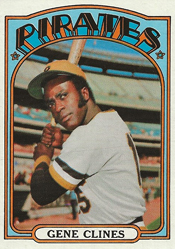
A clever bit of baserunning by Gene Clines fooled Cardinals center fielder Jose Cruz and helped the Pirates to a comeback victory.

An outfielder who played 10 seasons (1970-79) in the majors, primarily with the Pirates and Cubs, Clines hit for average and ran well.
He was especially effective against the Cardinals. A career .277 hitter in the majors, he batted .316 versus the Cardinals.

Hit and run

A right-handed batter, Clines was 19 when he was picked by the Pirates in the sixth round of the 1966 amateur baseball draft. He reached the majors with Pittsburgh in June 1970.

In his first three big-league seasons, Clines, used mostly as a backup outfielder and pinch-hitter, batted .405 in 31 games in 1970, .308 in 97 games in 1971 and .334 in 107 games in 1972.

Clines figured he’d earned a shot to be a starter. “All He Does Is Bat .300,” declared a headline in The Sporting News.

What he didn’t do was hit home runs. He totaled one in his first three big-league seasons.

The Pirates went to spring training in 1973 with outfield openings in right and left.

Clines was bypassed for both.

Pirates manager Bill Virdon chose a catcher, Manny Sanguillen, to be the Pirates’ 1973 Opening Day right fielder, replacing the late Roberto Clemente, and a first baseman with creaky knees, Willie Stargell, to play left.

“It seems like they don’t have any plans for me,” Clines said to The Pittsburgh Press.

Virdon explained that playing Stargell in left opened a spot at first for another slugger, Bob Robertson. Virdon said he liked Sanguillen in right because he threw better than Clines and was a better run producer.

“A home run and RBI man can give the team more of a boost,” Virdon told The Pittsburgh Press. 

Timely triple

The Pirates opened the 1973 season at Pittsburgh against the Cardinals. St. Louis led, 5-2, until the Pirates scored five runs in the eighth inning.

Batting for pitcher Jim Rooker, Clines’ triple against Diego Segui drove in the tying and go-ahead runs. Clines hit the ball into the gap in left-center. Lou Brock attempted a backhanded grab, but the ball bounced off his glove.

“That ball was catchable,” Brock said to The Pittsburgh Press. “When it hits off the glove like that, you’ve just got to hang on.”

Cardinals manager Red Schoendienst told the St. Louis Post-Dispatch, “You got to make those plays if you’re going to win.” Boxscore

Faked out

Two days later, in their second game of the season, the Cardinals led the Pirates, 3-2, in the bottom of the ninth.

With one out and none on, Clines batted for pitcher Nelson Briles and singled against starter Rick Wise. Rennie Stennett followed with a single to center.

Center fielder Jose Cruz gloved the ball just as Clines rounded second base. “No one in the stadium, particularly Jose Cruz, expected Clines to go to third,” The Pittsburgh Press reported.

Clines did what he called “a little stutter step” and appeared to be applying the brakes.

“A magnificent decoy,” Bob Smizik of The Pittsburgh Press observed.

Cruz dropped his arms. When Clines saw that, he shifted into high gear, bolted toward third and got there without drawing a throw.

“Cruz appeared befuddled, not knowing where to throw the ball,” Al Abrams of the Pittsburgh Post-Gazette noted. “He could have thrown out the fleet Clines by 10 feet had he been thinking.”

Schoendienst told the Post-Dispatch, “If he throws to third, the runner has to stop at second.”

Virdon, a center fielder before becoming Pirates manager, said, “You don’t make any money holding the ball out there.”

Cruz explained to the Pittsburgh Post-Gazette, “I heard Brock yelling, ‘Third base,’ but I thought it would be too late.”

Clines said to The Pittsburgh Press, “It’s a gamble, but I don’t think about being thrown out.”

Big run

The significance of Clines’ daring dash was illustrated when the next batter, Sanguillen, lofted a fly ball to medium right-center.

If Clines had held at second, Sanguillen’s fly ball would have been a harmless second out and the Cardinals still would have led by a run.

With Clines at third, Sanguillen’s fly ball became a scoring opportunity.

Stennett, thinking the ball might drop for a hit, moved part way toward second. Cruz, sensing he might nab Stennett, looked to first base, but no one was on the bag. First baseman Joe Torre had moved to the center of the diamond to cut off a throw if Stennett attempted to continue to second.

When Cruz hesitated, “I thought I could make it,” Clines told The Pittsburgh Press.

He raced toward the plate and easily beat Cruz’s throw, scoring the tying run.

In the 10th, Bob Robertson belted a home run against Wayne Granger, giving the Pirates a 4-3 victory. 

Asked about Cline’s performances, Virdon told the Post-Gazette, “You know, I think Gene is trying to give me some kind of message.”

Clines told The Sporting News, “I just want to remind them that I’m here and can do the job.” Boxscore

Gene the machine

Sanguillen eventually returned to catching, and Clines became the right fielder on June 15, but a month later he tore ligaments in his right ankle and was replaced by Richie Zisk.

Clines, who was hitting .291 before the injury, finished at .263 for the season, but he batted .368 against the Cardinals. It was one of four seasons in which Clines hit better than .360 versus the Cardinals. The others were 1971 (.361), 1975 (.364) and 1978 (.368).

In that 1978 season, when he was with the Cubs, Clines had a .500 on-base percentage against the Cardinals, getting seven hits and five walks in 24 plate appearances.

Clines was productive versus two of the era’s best pitchers _ Bob Gibson and Tom Seaver. He had the same career batting average against each (.364), producing four hits in 11 at-bats versus Gibson and the same versus Seaver.

On Sept. 1, 1971, Clines, the center fielder, was part of the first big-league starting lineup of all African-American and Hispanic players. Boxscore and Video interview

After his playing days, Clines coached for 20 years in the majors with five clubs _ Cubs, Astros, Mariners, Brewers and Giants.

Read Full Post »

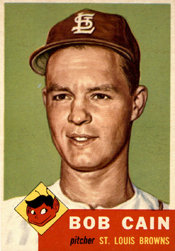
In the span of eight months, Bob Cain was the starting and winning pitcher in two of the most unusual baseball games _ one against the St. Louis Browns and the other for them.

On Feb. 14, 1952, Cain was acquired by the Browns in a trade with the Tigers.
Six months earlier, when baseball’s greatest showman, Browns owner Bill Veeck, devised the stunt of sending 3-foot-7 Eddie Gaedel to bat in a game versus the Tigers, Cain was the pitcher who stood on the mound in disbelief.

The following spring, as a member of Veeck’s Browns, Cain used artistry instead of antics to make a mark, prevailing against Bob Feller in a duel of one-hitters.

Cain is able

Born in Longford, Kansas, Cain was a youth when his family moved 35 miles south to Salina, Kansas, the heart of wheat country. His father operated a taxicab company. Cain impressed in amateur baseball and was 18 when he signed with the Giants.

A left-handed pitcher, Cain played one season of minor-league ball at the Class D level in 1943 before serving two years (1944-45) in the military. When he returned, the Giants kept him in their farm system until he was traded to the White Sox in June 1949.

Called up by the White Sox in September 1949, Cain, 24, made his debut with three scoreless innings of relief against the Red Sox. He struck out Ted Williams the first time he faced him. In the book “We Played the Game,” Cain recalled, “He was surprised a rookie would throw a 3-and-2 curveball.” Williams would hit .200 in 10 career at-bats versus Cain. Boxscore

In May 1951, Cain was traded to the Tigers. A month later, he pitched a shutout against a Yankees lineup featuring Mickey Mantle, Joe DiMaggio and Yogi Berra. It was the first time the Yankees failed to score that season. Boxscore

Two weeks later, Cain held the Indians to two runs, but was a hard-luck loser. The opposing starter, Bob Feller, pitched a no-hitter. Boxscore

Then came the encounter with Eddie Gaedel.

Show time

Cain was the Tigers’ starter against the Browns in the second game of a doubleheader on Aug. 19, 1951, at Sportsman’s Park in St. Louis.

The Browns posted a lineup with rookie Frank Saucier as the leadoff batter, but, when it came time for him to bat in the first inning, Bill Veeck, always eager to upstage the buttoned-down Cardinals, sprung his surprise with Eddie Gaedel.

Wearing a uniform with the fraction one-eighth as his number and holding a toy bat, Gaedel, 26, who worked in Chicago as a courier for a livestock business journal, approached the plate with strict instructions from Veeck to not swing at any pitches.

When plate umpire Ed Hurley saw Gaedel in the Browns uniform of 9-year-old Bill DeWitt Jr. (the current Cardinals owner who was the son of Browns general manager Bill DeWitt Sr.), he went toward the Browns’ dugout and demanded an explanation from manager Zack Taylor. After Taylor showed Hurley the paperwork proving Gaedel had signed a Browns contract that was sent to the American League office, Hurley permitted Gaedel to bat.

“You should have seen the look on the face of Bob Cain,” Gaedel told The Sporting News. “His jaw dropped and his eyes almost popped out of his head.”

Cain called out to his catcher, Bob Swift, “Got any idea what to do with this fellow?”

Swift, who, like Cain, hailed from Salina, Kan., went to the mound for a conference with his pitcher.

When Swift went back behind the plate, he stretched out on his stomach to give Cain a low target, but Hurley told him to get up. So Swift knelt on both knees.

Gaedel crouched in the batter’s box, making the strike zone microscopic. Standing in against Cain was a risk for any batter. He finished second in the league that year in most batters hit by pitches (14).

In “We Played the Game,” Cain said, “I didn’t know whether to throw the ball underhanded or overhanded to Gaedel. I just wanted to be careful not to hit him. Dizzy Trout told me later that if he’d been the pitcher he’d have thrown the ball right between his eyes.”

While Swift was urging him to get the ball lower, Cain threw four overhanded pitches, all high, and Gaedel was awarded first base.

“The balls I threw to him, they were over his head, even though they’d have been strikes on normal batters,” Cain told the Salina Journal. “He was bending over to where the strike zone was only about an inch.”

In “We Played the Game,” the left-hander said, “I’d have given my right arm just to have gotten one strike on him.”

Gaedel later told Bob Broeg of the St. Louis Post-Dispatch that as he made his way to first, “For a minute, I felt like Babe Ruth.”

Gaedel was lifted for pinch-runner Jim Delsing and Cain settled down. He allowed no earned runs in 8.1 innings and got the win in the Tigers’ 6-2 victory. Boxscore

Cain was 11-10 for the 1951 Tigers. He ranked second on the club in wins, but his ERA was 4.70 and he totaled more walks (82) than strikeouts (58).

Pair of aces

Looking to shake up the roster after finishing 73-81 in 1951, the Tigers traded Cain, pitcher Gene Bearden and first baseman Dick Kryhoski to the Browns in February 1952 for pitcher Dick Littlefield, first baseman Ben Taylor, outfielder Cliff Mapes and catcher Matt Batts.

“Cain was the most valuable parcel the Tigers gave up in the deal,” the Detroit Free Press declared.

The last-place Browns (52-102) were happy to get a pitcher of Cain’s caliber. Veeck told The Sporting News, “He’s a bona fide starter. Just what we need.”

Cain liked the Browns because Veeck gave him the salary he wanted. In “We Played the Game,” Cain said, “Veeck was one of the nicest, most honest men in baseball, a great guy to play for.”

Cain’s first regular-season start for the Browns came against his former team, the Tigers, at Detroit. He yielded one run in nine innings and got the win. Boxscore

A week later, Cain was matched in a start versus Bob Feller for the first time since Feller pitched his no-hitter against him the year before.

Cain pitched a one-hitter. So did Feller.

The win went to Cain, who pitched a shutout in a 1-0 Browns victory at St. Louis.

“I owed this one to Feller,” Cain told The Sporting News. “It was just my turn to get the good break.”

It was the second time two pitchers achieved one-hitters in the same game in the majors. In 1906, the Cubs’ Mordecai Brown and the Pirates’ Lefty Leifield did it in a 1-0 Cubs triumph. Boxscore

The Browns got their run against Feller in the first inning. Bobby Young led off with a triple over the head of left fielder Jim Fridley. Marty Marion followed with a hard grounder to third baseman Al Rosen, who bobbled the ball for an error, enabling Young to score. Boxscore

It was the 11th of Feller’s 12 one-hitters in the majors, and the only one he lost. Feller also pitched three no-hitters.

The Indians’ lone hit was a single by Luke Easter in the fifth inning. Easter tormented Cain, hitting .368 with five home runs against him in his career.

In “We Played the Game,” Cain said, “I’d like people to remember how I pitched against Bob Feller. Being able to pitch against someone I knew would be a Hall of Famer gave me inspiration.”

Cain finished the 1952 season with a 12-10 record for the Browns. He and Satchel Paige, 48, tied for the team lead in wins.

The next year, his last in the majors and the last for the Browns in St. Louis, Cain was 4-10 with a 6.23 ERA.

After his playing career, Cain worked for Kraft Foods.

In June 1961, when Eddie Gaedel died at 36, Cain and his wife drove from their home near Cleveland to attend the funeral in Chicago. Veeck was ill and unable to be there. Cain was the only baseball person who went.

“I never even met him,” Cain said, “but I felt obligated to go.”

Read Full Post »

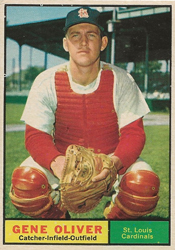
Gene Oliver didn’t deliver as many home runs as the Cardinals hoped he would, but he did hit one for them that made him popular in San Francisco.

In 1962, Oliver was the Cardinals’ starting catcher. He got the job because the Cardinals thought he could hit with consistent power and drive in runs. Instead, he finished fourth on the club in home runs (14) and sixth in RBI (45).

Oliver’s shining moment came in the Cardinals’ last game of the season when his game-winning home run against the Dodgers kept them from clinching the National League pennant and gave the Giants a chance to enter a playoff.

Big bopper

Oliver was born in Moline, Ill., one of the Quad Cities along the Mississippi River. He was a standout high school athlete in neighboring Rock Island, Ill. Oliver was considered a professional baseball prospect until, as a prep football player, he suffered a shoulder separation that hindered his ability to throw a baseball.

He went to Northwestern on a football scholarship for one year, returned to Moline, got a job with IBM and married, according to The Sporting News.

“I was ready to forget about pro baseball,” Oliver said, “but my wife insisted I try again because she didn’t want me to go through life wondering whether I might have made it.”

Oliver worked out daily at the YMCA and rebuilt his arm strength. Acting on a tip, the Cardinals monitored him and liked what they saw. Oliver was 21 when Cardinals scout Joe Monahan signed him to a contract in 1956.

Playing mostly outfield and first base, Oliver hit 39 home runs for Class D Ardmore (Okla.) in 1956 and 30 home runs for Class B Winston-Salem in 1957. He advanced to Class AAA Rochester in 1958 and, with his arm strength improving, he also did some catching.

The Cardinals called up Oliver in June 1959, but he spent the next season in the minors.

Because of his power potential and ability to play three positions, Oliver was a candidate for a utility spot with the Cardinals in 1961, but he reported to spring training at 238 pounds.

Describing his physique as “balloon-like,” The Sporting News reported the Cardinals were close to giving up on Oliver until he made amends by focusing on conditioning. He was 210 pounds when the Cardinals opened the 1961 season with him on the roster as a reserve.

In May 1961, the Cardinals sent Oliver to their Portland farm club in Oregon. A month later, the Cardinals’ catcher, Hal Smith, had to quit playing because of a heart ailment. Oliver, playing first base, was hitting with power for Portland. With Bill White having a lock on the Cardinals’ first base job, the club sent Smith to Portland to tutor Oliver in becoming a catcher.

“His throwing has improved and, yes, I think he has a good chance to stick in the majors,” Smith told The Sporting News.

Oliver hit .302 with 36 home runs and 100 RBI for Portland. His on-base percentage was .422. He returned to the Cardinals in September 1961, started 12 games at catcher and “showed 100 percent improvement behind the plate,” The Sporting News reported.

Getting his chance

The top three home run hitters for the 1961 Cardinals _ Ken Boyer (24), Bill White (20) and Stan Musial (15) _ totaled fewer home runs than Roger Maris had (61) for the 1961 Yankees. The Cardinals “desperately needed a power hitter,” The Sporting News reported. “They may have the answer in Gene Oliver.”

Oliver, 27, reported to spring training in 1962 at a fit 210 pounds and won the starting catcher job. His backups when the season opened were left-handed batter Carl Sawatski, 34, and defensive specialist Jimmie Schaffer, 26. Catching prospect Tim McCarver, 20, was deemed not ready and sent to the minors.

To the disappointment of the Cardinals, Oliver failed to provide power production early in the 1962 season. He hit one home run in April and one in May.

On April 22 at St. Louis, the Cardinals, trailing the Cubs, 5-1, loaded the bases with two outs in the bottom of the ninth. Curt Flood, hitting .519 on the young season, was due to bat. Flood had two singles and a walk in the game, but manager Johnny Keane sent Oliver to bat for him.

“We needed the knockout blow,” Keane told The Sporting News. “We knew we could count on Flood for a hit, but we needed more than that.”

Oliver struck out looking against Cal Koonce, ending the game. Boxscore

In June, Oliver switched from a 33-ounce bat to a 35-ounce model, but it didn’t help increase his home run totals much.

Decking the Dodgers

Through August, Oliver had seven home runs for the season. He told The Sporting News that Keane said to him, “We’ve got a lot of singles hitters on this club, and we need punch from you.”

Keane determined Oliver had become defensive in his swing because he was reluctant to strike out. He advised Oliver to take “a good cut because we don’t care how many times you strike out.”

Oliver hit seven home runs in September. The big blow was the last.

On Sept. 30, 1962, the last scheduled day of the regular season, the first-place Dodgers were one game ahead of the Giants in the National League standings. If the Dodgers beat the Cardinals that afternoon in Los Angeles, they’d clinch the pennant and advance to the World Series.

At San Francisco, the Giants beat the Colt .45s, 2-1, on a tie-breaking home run by Willie Mays against Turk Farrell in the eighth inning. Boxscore

At Los Angeles, the Cardinals and Dodgers were locked in a scoreless duel. About the time the Giants’ win was posted on the scoreboard, Oliver batted against Johnny Podres with one out in the eighth.

“I went up to the plate looking for a curve, looking for the long ball,” Oliver told the St. Louis Post-Dispatch. “That’s all Podres throws me, breaking stuff.”

Podres, pitching on his 30th birthday, threw two fastballs to Oliver for strikes. Oliver turned to catcher John Roseboro and said, “You’ve really fooled me.”

The next pitch was a curve that missed, making the count 1-and-2. Podres came back with another curve, and Oliver lined it over the fence in left for a home run.

Oliver’s home run, combined with the five-hit shutout pitched by Curt Simmons, gave the Cardinals a 1-0 victory and dropped the Dodgers into a first-place tie with the Giants. Boxscore

“I pitched the best game of my life,” Podres said to the Los Angeles Times. “Even the pitch to Oliver was a good one, a curve in tight.”

Yes, Podres said, his performance against the Cardinals was better than the shutout he pitched to win Game 7 of the 1955 World Series for the Dodgers versus the Yankees. Boxscore

In the ensuing best-of-three playoff to determine the 1962 National League champion, the Giants prevailed.

Toast of the town

Restaurant owners Leo Giorgetti and Sam Marconi invited Oliver and his wife to San Francisco on an all-expenses paid trip for the first two games of the 1962 World Series.

Giorgetti and Marconi owned The Iron Horse restaurant and the Gold Street saloon. The Iron Horse was popular with athletes and entertainers. Joe DiMaggio and Marilyn Monroe had their wedding reception there.

Dubbing Oliver’s appearance as “San Francisco Appreciation Day,” the restauranteurs took out an advertisement in the San Francisco Examiner, informing fans that, after the Thursday afternoon Game 1 of the World Series, an autograph party with the Cardinals catcher would be held at the Gold Street saloon from 7 pm to 9 pm, followed by dinner at The Iron Horse.

Oliver also was “the key figure in an impromptu parade” on the first day of the World Series, Bob Burnes of the St. Louis Globe-Democrat reported.

According to Burnes, Oliver “has become the most lionized visitor in recent San Francisco history.”

Moving on

The fanfare in San Francisco was heady stuff for a player who hit .258 overall for the 1962 Cardinals and .190 with runners in scoring position.

Back in Moline, Ill., for the winter, Oliver worked for a clothing store, Mosenfelder’s, selling suits.

Entering spring training in 1963, Stan Musial told The Sporting News, “We can look for more long ball from Gene Oliver. He seems to have found himself.”

It became apparent, though, that Tim McCarver was the Cardinals’ best catcher in 1963. In the book “We Played the Game,” McCarver said Oliver “was a good hitter but had a weak throwing arm.”

On June 15, 1963, the Cardinals traded Oliver and pitcher Bob Sadowski to the Braves for pitcher Lew Burdette. To make room for Oliver on their roster, the Braves sent catcher Bob Uecker to the minors.

Oliver had his best season with the 1965 Braves, hitting 21 home runs. In June 1967, the Braves traded him to the Phillies _ for Bob Uecker.

As a big-leaguer, Oliver hit 93 home runs, including four versus Sandy Koufax. Oliver had a career batting average of .392 against Koufax (20 for 51).

Read Full Post »

« Newer Posts - Older Posts »