Feeds:
Posts
Comments

Archive for the ‘Opponents’ Category

(Updated Sept. 12, 2021)

Three future Hall of Famers converged on center stage for a climactic scene in a Cardinals classic. On the mound, Bob Gibson. Behind the plate, Ted Simmons. In the batter’s box, Willie Stargell.

On Aug. 14, 1971, Gibson got his lone no-hitter when he struck out Stargell for the last out.
Finishing a no-hitter is a formidable task under any circumstance, but for Gibson the degree of difficulty was heightened. Stargell was leading the majors in home runs and RBI.

Simmons, in his first full season as Cardinals catcher, had an intriguing role in the drama. He earned respect with his bat, but took pride in his catching, too. Being involved in a Gibson no-hitter would help secure Simmons’ reputation.

Pride still matters

Gibson earned his second National League Cy Young Award in 1970. At 35, he looked as dominant as ever at the start of the 1971 season, winning three of his first four decisions. The only loss in that stretch was in extra innings to the Cubs’ Ferguson Jenkins.

Trouble soon followed. In his last April start, Gibson got shelled in a loss to the Mets’ Tom Seaver. In May, Gibson was 1-3 with a 5.21 ERA. He tore a thigh muscle late in the month and didn’t pitch from May 30 through June 20. When he returned, he lost two June starts, dropping his record to 4-7 with a 4.31 ERA.

Losing none of his intensity and focus, Gibson told The Sporting News, “I get paid for winning,” and he set his sights on earning the money.

Gibson was 5-2, including consecutive shutouts of the Phillies and Mets, with a 1.95 ERA in seven starts in July.

“Pride keeps him going,” teammate Joe Torre told The Sporting News. “He’s the greatest competitor I ever saw.”

On Aug. 4, with Simmons catching, Gibson struck out nine, including Willie Mays twice, and beat Gaylord Perry and the Giants for his 200th career victory. Boxscore

Overpowering stuff

Ten days later, Gibson was the starter against the Pirates on a Saturday night at Three Rivers Stadium in Pittsburgh.

The Cardinals knocked out Pirates starter Bob Johnson in the first inning and also pounded relievers Bob Moose and Bob Veale. Gibson contributed three RBI. Simmons had four hits, a RBI and scored three times. Torre also had four hits and a RBI, and scored twice.

On the mound, Gibson was in command.

“This was the first time in my life I ever was overpowered by anyone,” Pirates center fielder Al Oliver said to the St. Louis Post-Dispatch. “I never was able to get my bat around in time.”

Pirates second baseman and future Hall of Famer Bill Mazeroski told the Associated Press, “Gibson was throwing them right where he wanted. He hit the outside corner every time. I broke two of my bats.”

Simmons told the Baseball Hall of Fame yearbook in 2021, “I can remember specifically thinking in the fourth inning that I was watching something that was pretty special … The slider was just so wicked. Complete and total command of a fastball that he could ride and sink, four-seam and two-seam.”

When the Cardinals scored three runs in the eighth to take an 11-0 lead, the outcome wasn’t in doubt. The focus was on whether the Pirates would get a hit. Gibson never had pitched a no-hitter at any level, amateur or professional.

“In the last two innings, I was bearing down extra hard,” Gibson told The Sporting News. “I was trying not to make any bad pitches. Even when I was falling behind in the count, I was being careful not to groove any pitches. I was throwing sliders and curves on 3-and-2 counts.”

Despite his best efforts, Gibson made a mistake to Dave Cash. With two outs in the eighth, Gibson said he hung a slider. Cash hit a high bouncer to third. For a moment, Joe Torre couldn’t see it in the lights.

“It scared the heck out of me, man,” Torre told the Baseball Hall of Fame yearbook in 2021. “I’m thinking, ‘I’m going to whiff this thing,’ but it didn’t happen. I was able to make the play.”

Stretching on tiptoes, he snared the ball and fired a throw to first to nip Cash.

Friend or foe?

“By the ninth inning, I was so nervous my knees were actually knocking,” Gibson said in his book “Stranger to the Game.”

The first batter was Vic Davalillo, a former Cardinal who started in right field instead of Roberto Clemente. Gibson got him to ground out to shortstop Dal Maxvill.

Al Oliver followed and grounded out to second baseman Ted Kubiak.

Willie Stargell was all that stood between Gibson and a no-hitter _ and he stood like a giant from the left side of the plate.

“His weight shifting rhythmically from one foot to the other, his bat moving in circles like an airplane propeller, Stargell creates a feeling of menace as he waits for the pitch,” Newspaper Enterprise Association reported.

At that point in the season, Stargell had 39 home runs and 101 RBI. No one else in the majors had more.

Stargell also had hit four home runs in his career versus Gibson then.

(The final career numbers for Stargell against Gibson: .290 batting average, .388 on-base percentage, five home runs, 20 walks and 41 strikeouts. According to baseball-reference.com, Stargell struck out more times versus Gibson than he did against any other pitcher. Gibson and Phil Niekro were the only pitchers to issue as many as 20 walks to Stargell.)

In “Stranger to the Game,” Gibson said, “Aside from former teammates, the only opposing player I ever really made friends with was Willie Stargell. I don’t have a good excuse for this, except that Stargell’s personality left me no choice. I was just fortunate he didn’t spread around the league that I was a nice guy or something. I couldn’t have that.”

Caught looking

Increasing the tension with every pitch, Gibson got ahead in the count, 1-and-2, on Stargell. On the next one, “I was looking for a fastball,” Stargell told The Sporting News.

Instead, with his 124th pitch of the game, Gibson threw a slider.

Stargell watched it go into Simmons’ mitt and heard umpire Harry Wendelstedt call, “Strike three!”

“That last pitch to Stargell really exploded,” Cardinals manager Red Schoendienst said to The Sporting News.

Stargell said the slider “cut over the plate at the last instant.” Boxscore and Video

“You can tell all those people who have been saying that Gibson was washed up that they should have been at the plate with a bat in their hands,” Stargell said.

Jack Buck, calling the ninth inning on the KMOX radio broadcast, said after the completion of the no-hitter, “If you were here, it would have made you cry.” Audio broadcast of Jack Buck and Jim Woods

Gibson’s no-hitter was the first in a big-league game in Pittsburgh since 1907 when rookie Nick Maddox of the Pirates did it against the Dodgers at Exposition Park. No big-leaguer pitched a no-hitter at Forbes Field, the Pirates’ home from 1909-69.

Gibson finished the season with a 16-13 record, 3.04 ERA, 20 complete games and five shutouts, his most since his most dominant season in 1968.

Read Full Post »

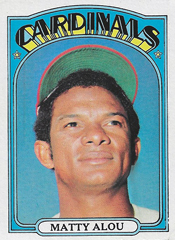
Matty Alou had the perfect audience to appreciate a daring dash around the bases.

On Aug. 7, 1971, Alou used skill, imagination and nerve to produce the winning run for the Cardinals in a victory versus the Dodgers at St. Louis.

With the score tied at 2-2, Alou batted with one out and none on in the 10th inning. He reached base on a bunt single, then made a fearless sprint from first to home while the Dodgers botched every attempt to catch him.

Alou’s aggressive baserunning was reminiscent of Enos Slaughter, who scored the winning run for the Cardinals on a mad scramble from first to home in Game 7 of the 1946 World Series.

Twenty-five years later, Slaughter and several of his contemporaries were in St. Louis for a reunion of the 1946 World Series teams and were at the ballpark to witness Alou’s performance.

Making it happen

After sweeping the Giants, the Cardinals (62-50) were seven games behind the division-leading Pirates (69-43) as they entered a three-game series with the Dodgers at Busch Memorial Stadium.

The opening game, played on a Saturday night, featured left-handed starting pitchers Claude Osteen of the Dodgers and Steve Carlton of the Cardinals. The Dodgers went ahead, 2-0, with a pair of runs in the sixth, but the Cardinals tied the score in the seventh on a RBI apiece by Jim Beauchamp and Jerry McNertney.

When the game moved to the bottom of the 10th, Pete Mikkelsen, a former Cardinal, came in to pitch. He struck out the first batter, Julian Javier, before Alou, batting .325, stepped to the plate.

Batting left-handed, Alou executed a drag bunt between first base and the mound. Another former Cardinal, first baseman Dick Allen, fielded the ball, but Alou eluded his tag attempt and reached base safely.

Meeting over

Cleanup batter Joe Torre was up next, but Mikkelsen was focused on Alou. He gathered second baseman Jim Lefebvre and shortstop Maury Wills for a conference between the mound and second to discuss whether to try a pitchout on the first pitch.

As the group gabbed, Alou realized no one had called timeout, so he bolted for second. “I thought I could beat them to the base,” Alou told the Los Angeles Times.

Dodgers manager Walter Alston said, “There’s an umpire at every base. All you’ve got to do is call time.”

Though caught by surprise, Lefebvre got to the bag before Alou did. “The consensus among the Dodgers was Alou would have been out by 10 feet if Mikkelsen had made a good throw,” the St. Louis Post-Dispatch reported.

Instead, Mikkelsen hurried a high toss to Lefebvre. As Lefebvre reached for it, the ball went off the top of his glove and into center field. Alou kept running and headed to third on Mikkelsen’s error.

“I went to third because I know on the AstroTurf the ball would go a long way,” Alou explained to the Los Angeles Times.

However, Alston noted, “The ball only went 15 feet.”

Bold move

Lefebvre got to the ball, but failed to field it cleanly while trying to keep an eye on Alou.

“When I saw Lefebvre couldn’t pick the ball up, I thought I could score,” Alou told the Los Angeles Times.

Alou sped for the plate and arrived ahead of Lefebvre’s throw to catcher Joe Ferguson, giving the Cardinals a 3-2 triumph. Boxscore

“I’ve never seen anything like that,” Alston told the Post-Dispatch, “and I never want to see it again.”

Dom DiMaggio, center fielder for the Red Sox team that opposed the Cardinals in the 1946 World Series, said, “They were running fools then, like Alou now.”

In baseball, though, a bum one day can be a hero the next. Sure enough, the day after his role in the Dodgers’ lapse, Lefebvre got redemption, hitting a three-run home run against Jerry Reuss and helping the Dodgers recover for a 4-2 victory. Boxscore

Alou finished with 192 hits, 85 runs and a career-high 74 RBI for the 1971 Cardinals.

Read Full Post »

In a lineup featuring future Hall of Famers Stan Musial, Red Schoendienst and Enos Slaughter, it was Erv Dusak who delivered two of the most important hits for the 1946 Cardinals.

On July 16, 1946, Dusak hit a three-run walkoff home run in the ninth, enabling the Cardinals to complete a four-game sweep of the front-running Dodgers.

Two months later, in the last week of the regular season, Dusak hit another walkoff home run, a solo shot in the 10th inning against the Reds, for a victory that kept the Cardinals in first place.

Power prospect

An outfielder, Dusak was one of three players who made his major-league debut with the Cardinals in September 1941 after being called up from the Rochester farm team. The others were Musial and third baseman Whitey Kurowski.

In his book “Stan Musial: The Man’s Own Story,” Musial said Cardinals executive Branch Rickey didn’t say much to him when he joined the team.

“It was obvious that the player on his mind was Dusak, not Musial, and I can see why,” Musial recalled. “Erv was a strapping right-handed power hitter who ran well, fielded well and threw considerably better than I did.”

Unfortunately for Dusak, pitchers quickly discovered a weakness. “Erv had too much trouble with the breaking ball to last long in the big leagues,” Musial said.

Dusak spent most of 1942 back at Rochester. Following the season, he enlisted in the Army and spent three years (1943-45) in World War II service.

In 1946, the Cardinals opened the season with an outfield of Musial and Slaughter in the corners and Terry Moore in center. Dusak made the team as a reserve.

Swing series

The Dodgers set the early pace in the 1946 National League race, winning eight of their first nine.

When they came to St. Louis for a four-game series in July, the Dodgers (49-28) were 4.5 games ahead of the Cardinals (45-33).

The series began with a doubleheader at Sportsman’s Park on Sunday July 14. The Cardinals won the opener, 5-3. Slaughter drove in four runs, including two on a tie-breaking home run in the eighth, and Ted Wilks pitched four scoreless innings in relief of Johnny Beazley. Boxscore

In the second game, Musial led off the 12th with a walkoff home run against Vic Lombardi, giving the Cardinals a 2-1 triumph. Boxscore

Game 3 of the series was played on Monday night July 15. Schoendienst had three RBI and the Cardinals prevailed, 10-4.

In the third inning, the Dodgers thought their left fielder, Pete Reiser, snared a drive by Slaughter, but umpire Al Barlick ruled Reiser trapped the ball. Dodgers manager Leo Durocher argued and was ejected. Boxscore

The next day, Tuesday July 16, National League president Ford Frick suspended Durocher for five days and fined him $150 for “laying hands on” Barlick during the rhubarb, the New York Daily News reported. Durocher departed St. Louis rather than stick around for that night’s series finale.

Setting the stage

With coach Chuck Dressen as acting manager for Game 4 of the series, the Dodgers took a 4-2 lead into the bottom of the ninth.

“The big crowd, almost silent, appeared to have given up,” the St. Louis Star-Times reported. “Most Brooklyn writers had their stories written.”

Cardinals manager Eddie Dyer told The Sporting News, “It looked like we were goners.”

The Cardinals had the bottom of their order due to face left-hander Joe Hatten.

Hatten got ahead in the count, 1-and-2, to the first batter, Marty Marion, “when the miracle happened,” the St. Louis Post-Dispatch noted.

Hatten grazed Marion on the side of his uniform jersey with a pitch, putting him on first.

Clyde Kluttz, a catcher acquired from the Phillies in May, singled to left, moving Marion to second.

After Dyer sent Dusak to bat for pitcher Howie Pollet, Dressen went to the mound to talk to Hatten. A right-hander was ready in the bullpen, but Dressen stuck with Hatten, a decision some speculated Durocher would not have made.

Fantastic finish

Dusak, batting .229 for the season, was given the bunt sign. After he failed in his first attempt to bunt successfully, he was permitted to swing away. He lashed at Hatten’s second pitch and fouled it off.

Hatten’s next two pitches missed the strike zone, evening the count at 2-and-2. He came back with a fastball and Dusak connected.

“The wallop rang out like a pistol shot,” the St. Louis Globe-Democrat reported.

According to the Star-Times, “There was a terrific crack and everybody knew at once it was all over.”

The ball carried over the left-field wall and landed 10 rows up in the bleachers, turning the two-run deficit into a 5-4 victory and a series sweep. Boxscore

“Frenzied spectators unloosed a thunderous shout and kept it up for many minutes,” the Globe-Democrat reported. “So jubilant were the Cardinals players that they gathered at the plate and almost mobbed Dusak as he scored.”

The New York Daily News noted, “The Dodgers, with their chins sunk against their chests, trudged forlornly off the field, while all around them Redbird fans joined the St. Louis players in whistling, stomping and jumping with joy.”

Dusak was “as happy as a youngster who had just seen Santa Claus for the first time,” the Globe-Democrat declared.

In the locker room, a young bleacher fan showed up with the home run ball and presented it to Dusak, the Star-Times reported.

“He hit one of the most beautiful home runs I ever expect to see,” Dyer told The Sporting News.

Encore performance

By sweeping the series, the Cardinals (49-33) moved within a half-game of the Dodgers (49-32).

“No series played by the Dodgers all season gave them more of a jolt,” Dyer said to The Sporting News.

The Cardinals and Dodgers waged a fierce fight for first place the remainder of the season.

On Sept. 24, the Cardinals (94-55) held a half-game lead over Brooklyn (94-56) heading into a game against the Reds at St. Louis.

The Reds started Johnny Vander Meer, the left-hander who pitched consecutive no-hitters in 1938.

Vander Meer limited the Cardinals to two singles through eight innings and took a 1-0 lead into the ninth, but Musial tied the score with a two-out RBI-single.

In the 10th, Dusak batted with none on. Working the count to 3-and-1, he got a fastball and pulverized it. The ball cleared the wall in left and “landed only a few feet in front of the concession stand at the back of the bleachers,” the Globe-Democrat reported.

Dusak’s second walkoff home run of the season gave the Cardinals a 2-1 victory and put them a game ahead of the Dodgers with four to play. Boxscore

Mobbed again by his teammates, Dusak was carried off the field on the shoulders of Dyer and coach Mike Gonzalez, the Cincinnati Enquirer reported.

Change in plans

More drama followed. The Cardinals lost three of their last four games and the Dodgers won two of four, leaving the clubs tied for first at the end of the regular season. A best-of-three playoff was held and the Cardinals won the first two games, clinching their fourth pennant in five years.

The Cardinals then prevailed in a seven-game World Series versus the Red Sox.

Dusak hit .240 with nine home runs for the 1946 Cardinals. As a pinch-hitter, he was 4-for-10. Three of the hits were home runs.

In 1947, Dusak batted .284 for the Cardinals, but slumped to .209 in 1948. He decided to become a pitcher and returned to the minors in 1949.

Dusak pitched in 14 games for the Cardinals in 1950 and five more in 1951 before he was traded to the Pirates.

The Dodgers got a bit of revenge on May 22, 1951, when Gil Hodges hit a grand slam against Dusak. Boxscore

Dusak’s big-league career statistics: .243 batting average, 24 home runs, 0-3 pitching record, one save, 5.33 ERA.

Read Full Post »

The Cardinals decided nights in red satin weren’t for them.

In 1946, the Cardinals planned to take a bold departure from their traditional look. They bought red satin uniforms to wear during night road games.

When it came time to don the shiny red fabric in a game, however, the Cardinals backed out and stuck with their flannels.

Pajama game

Satin baseball uniforms made a sensation at the American Association All-Star Game at Toledo in 1938. The minor-league all-stars, including Ted Williams, wore red, white and blue satin uniforms for the night game, according to the National Baseball Hall of Fame.

In the 1940s, with night games becoming more commonplace, a few National League teams decided to try satin uniforms because the material reflected the ballpark lights.

Satin is a fabric weave that produces a smooth, soft, glossy material with a luxurious look. It is made of silk, polyester or nylon.

According to the National Baseball Hall of Fame, the Dodgers, Braves and Reds experimented with satin uniforms in the 1940s.

Innovative executive Branch Rickey chose to have the Dodgers wear satin uniforms in 1944. The former Cardinals administrator got the idea from watching All-American Girls Professional Softball League teams play in satin uniforms under the lights in 1943, Newspaper Enterprise Association reported.

Rickey planned for the 1944 Dodgers to wear white satin uniforms with blue piping for night home games, and blue satin uniforms with white piping for night road games.

“Rickey decided to make Them Beautiful Bums even more colorful,” Newspaper Enterprise Association declared.

United Press described the Dodgers’ outfits as “satin pajamas” and “Little Lord Fauntleroy uniforms.” 

The Brooklyn Daily Eagle called the uniforms “satin nightgowns” and rated the home whites as looking better than the road blues. “The flashy white undies with the blue stripes stood out particularly well,” the Brooklyn newspaper noted.

According to Brooklyn Daily Eagle columnist Tommy Holmes, “The players were expecting a lot of razzing from the wisecrackers, but witticisms from the cash customers were conspicuous by their absence.”

Newspaper Enterprise Association concluded, “The next thing you know they’ll be playing baseball without spikes and with chewing tobacco checked in the clubhouse.”

Fashion faux pas

Two years later, in 1946, the Cardinals purchased bright red satin uniforms for road night games, The Sporting News reported, but the duds never got worn by the big-leaguers.

The St. Louis Star-Times reported Cardinals players “refused to wear” the satins. The St. Louis Globe-Democrat claimed the Cardinals “considered the new satin suits too effeminate.” According to The Sporting News, manager Eddie Dyer determined “the uniforms were too fancy for the Cardinals.”

The Cardinals sold the red satins to Fred C. Steffens, a St. Louis sportsman, who donated the brand-new uniforms to the North Side Teen Town baseball team of St. Louis, the Star-Times reported.

On June 12, 1946, Cardinals pitcher Ken Burkhart presented the uniforms to the youth team at St. Louis’ Sherman Park.

Comfortable in their own skin, as well as in their familiar uniforms, the Cardinals went on to win the 1946 National League pennant and beat the Red Sox for the World Series championship.

Sharp-dressed men

While the 1946 Cardinals balked at wearing satin, the 1946 Braves embraced the idea.

On May 11, 1946, the Braves debuted their satin uniforms in a Saturday night home game against the Giants. It was the first time a big-league night game was played in Boston. Boxscore

The Boston Globe described the Braves’ outfits as “a slithery uniform of white satin with scarlet piping, which shine like lingerie in a department store window.”

Among the Braves swathed in satin were a group of former Cardinals, including manager Billy Southworth, center fielder Johnny Hopp and first baseman Ray Sanders. “A sight to behold,” the St. Louis Post-Dispatch declared.

The Reds wore satin uniforms in 1948. After playing the Cardinals on a steamy Friday night in St. Louis on July 9, the Reds switched to gray flannels the following night.

According to The Sporting News, Reds players “complained the satins were too uncomfortable during the sweltering heat.”

After Reds general manager Warren Giles, acting on the recommendation of manager Johnny Neun, approved the scrapping of satin for flannel for the Saturday, July 10 game, “the fancy monkey suits went out.” the Cincinnati Enquirer reported.

Soon after, satin uniforms, like top hats and knickers, faded out of style.

Read Full Post »

(Updated April 25, 2026)

Dubbed by Sports Illustrated as the “busiest and brainiest relief pitcher in baseball,” Mike Marshall usually was effective against the Cardinals, but they also had some spectacular successes, twice beating him with walkoff home runs.

A right-hander with remarkable stamina, Marshall was the first relief pitcher to win a Cy Young Award. It happened in 1974, when he pitched for the Dodgers in 106 games, a major-league record for most appearances in a season by a pitcher.

A student of body movement who earned a doctorate in exercise physiology, Marshall developed an approach that enabled him to pitch often and well throughout most of the 1970s. He was an innovator, educator and baseball rebel.

Changing course

At age 11, Marshall was a passenger in a car that was struck by a train near his home in Adrian, Mich. Marshall’s uncle was killed in the accident and Marshall suffered a back injury, according to Sports Illustrated.

Despite an aching back, Marshall became a standout high school athlete in multiple sports, including as a baseball shortstop. He was 17 when he signed with the Phillies in September 1960.

While playing shortstop in the Phillies’ farm system, Marshall enrolled at Michigan State and attended classes during the baseball off-seasons.

Marshall hit for average in the minors, but his back bothered him, making it difficult for him to field grounders, and he told the Phillies he wanted to pitch, the Detroit News reported.

Marshall had a 3.39 ERA in 44 games for Phillies farm clubs in 1965. The Tigers purchased his contract in April 1966 and brought him to the big leagues in 1967. He pitched for the Seattle Pilots, an American League expansion team, in 1969 and the Astros in 1970.

At Michigan State, Marshall earned a bachelor’s degree in physical education in 1965 and a master’s degree in 1967. His mentor was William Heusner, a professor in kinesiology, the study of body movement. Heusner made Marshall an assistant, giving him a chance to teach.

Describing himself as an educator first and ballplayer second, Marshall told The Sporting News that as a teacher, “I feel I am performing a function that makes me feel vital as a human being.”

Marshall’s academic work helped him develop an approach to pitching. He taught himself to throw a screwball without straining his arm, but the Tigers, Pilots and Astros prohibited him from throwing the pitch.

“Those three were linked by a common denominator of insecurity,” Marshall told The Sporting News. “They couldn’t accept someone trying anything different, or admit that another man’s way might be right.”

Good match

Marshall’s baseball career took an upturn in June 1970 when the Astros traded him to the Expos. Gene Mauch was Expos manager and he encouraged Marshall to throw the screwball.

“It was Mauch who allowed Marshall to develop the concepts, the artistry, the free expression Marshall exhibits on the mound,” The Sporting News noted.

Marshall said, “Our relationship was poetry. I felt we talked as peers.”

Mauch showed faith and patience. Marshall was 3-7 with the 1970 Expos. The first time he faced the Cardinals was as a starter on Aug. 8 and he gave up five runs in 2.1 innings. Boxscore

The turning point came the next year when Marshall focused on relieving and earned 23 saves for the 1971 Expos.

“I’d say 1971 was my most satisfying season,” Marshall told The Sporting News. “That was the year I realized I was a major-league player.”

Marshall had a spectacular August for the 1971 Expos, with five saves and an 0.83 ERA, but suffered a setback against the Cardinals in September.

On Sept. 24, 1971, Joe Hague hit a walkoff grand slam against Marshall in the 10th inning, giving the Cardinals a 10-6 victory. It was the first walkoff home run allowed by Marshall in the majors. Boxscore

Head of the class

In the next two seasons with the Expos, Marshall had 14 wins, 18 saves and a 1.78 ERA in 1972, and 14 wins, a league-leading 31 saves and a 2.66 ERA in 1973. He led the league in games pitched _ 65 in 1972 and 92 in 1973.

During those two seasons, Marshall won or saved 77 of the Expos’ 149 victories.

The Sporting News noted, “Marshall has revolutionized the thinking about relief pitchers, about their conditioning, about their concepts while on the mound.

“He has applied his understanding of kinesiology to the screwball, which he can make move in more than one direction, and to a conditioning program that makes it possible for him to pitch with a frequency and consistency that is beyond the capabilities of all other pitchers.”

Speaking out

After the 1973 season, Marshall was named Expos player of the year by the Montreal chapter of the Baseball Writers Association of America. The honor came with a $5,000 check from O’Keefe Brewery, a sponsor of Expos games, but Marshall refused to accept the money.

“I don’t feel I should compete against my own teammates for money like this,” Marshall said to The Sporting News.

Marshall requested in writing that the brewery donate the money to sickle cell anemia research. When he learned the brewery instead gave the $5,000 to an amateur baseball program, Marshall objected and pressured the brewery to honor his request, The Sporting News reported.

Marshall created another controversy when, in an interview with a Michigan reporter, he criticized the Expos’ defensive play.

“Who the hell wants to go back and pitch for that defense any more?” Marshall said. “Second base was terrible. There’s no way we can play another year with Ron Hunt … Third base was terrible. We have absolutely no defense with Bob Bailey. Zero. You can put a high school kid out there and get the same production out of our defense.”

Marshall apologized, but the controversies lingered. In his book “Oh, Baby, I Love It,” catcher Tim McCarver said he and Marshall didn’t get along when they were Expos teammates. McCarver said Marshall specialized “in being an asshole” and was “a totally self-centered man.” Described by Sports Illustrated as a “brooding intellectual of the bullpen” with a “mantle of Kierkegaardian gloom,” Marshall was traded by the Expos to the Dodgers for outfielder Willie Davis in December 1973.

Special season

Dodgers manager Walter Alston let Marshall pitch as much as he wanted. Marshall pitched in 13 consecutive Dodgers games and was 6-0 with two saves and 1.67 ERA in that stretch.

“What he has done is against everything that I ever felt was physically possible,” Dodgers pitcher Jim Brewer told The Sporting News.

Another Dodgers pitcher, Andy Messersmith, said to Sports Illustrated, “He’s a unique and complex individual. There is no one like him in this game. He’s small and rotund, but I haven’t seen anything athletic he can’t do if he puts his mind to it. I’ve never known Mike to go into anything, even Frisbee throwing, without some thought about the muscles involved.”

Marshall was 15-12 with a 2.42 ERA for the 1974 Dodgers and led the league in games pitched (106) and saves (21). He pitched 208.1 innings in relief. The Dodgers won the pennant, and in the World Series against the Athletics, Marshall pitched in all five games, allowing one run in nine innings. Video

Sports Illustrated said of the 1974 National League Cy Young Award winner: “It is his knowledge of his own body, its strengths and limitations, that allows him to pitch in as many as 100 games a season.”

Magic numbers

At his peak, Marshall was dominant against the Cardinals, with ERAs of 1.10 in 1972, 1.69 in 1973 and 1.06 in 1974. In 1976, Marshall made three appearances versus the Cardinals and got wins in all three, posting a 1.08 ERA.

After being traded by the Dodgers in June 1976, Marshall pitched for the Braves, Rangers, Twins and Mets. With the Twins, he was reunited with Mauch and was the American League leader in saves (32) and games pitched (90) in 1979.

In 96 career innings versus the Cardinals, Marshall gave up only two home runs to them. The first was the walkoff grand slam by Joe Hague in 1971. The other came in Marshall’s final season, 1981, with the Mets.

On Sept. 12, 1981, Julio Gonzalez hit a two-run walkoff homer run versus Marshall in the 13th inning, giving the Cardinals a 4-2 triumph. It was Gonzalez’s first homer in the big leagues in three years. Boxscore

Marshall finished with a career record of 97-112 and 188 saves. Against the Cardinals, he was 6-7 with 33 saves.

Marshall is one of five pitchers to pitch in 90 or more games in a big-league season. The list:

_ Mike Marshall: 106 (1974 Dodgers), 92 (1973 Expos) and 90 (1979 Twins).

_ Kent Tekulve: 94 (1979 Pirates), 91 (1978 Pirates), 90 (1987 Phillies).

_ Salomon Torres: 94 (2006 Pirates).

_ Pedro Feliciano: 92 (2010 Mets).

_ Wayne Granger: 90 (1969 Reds).

Read Full Post »

When his arm was sound, Ernie White had the talent to be an ace on the Cardinals’ pitching staff.

In June 1941, White pitched consecutive two-hit shutouts for the Cardinals against the Dodgers and Giants.

The back-to-back gems were the centerpieces in a stretch of 27.2 scoreless innings pitched by White, a left-hander who threw hard with an easy motion.

White earned 17 wins for the 1941 Cardinals, but arm ailments kept him from ever having another double-digit win season.

Turning pro

In 1937, White, 20, was pitching for a textile mill team in his native South Carolina when he was discovered and signed by Cardinals scout Frank Rickey, brother of club executive Branch Rickey, according to the Society for American Baseball Research.

White made his Cardinals debut in 1940 and was a prominent part of the pitching staff in 1941.

Besides White, the 1941 Cardinals pitching staff for manager Billy Southworth included Lon Warneke, Mort Cooper, Max Lanier, Harry Gumbert and Howie Krist. All posted double-digit win totals for the 1941 Cardinals.

On June 7, 1941, the Cardinals started Sam Nahem against the Giants at the Polo Grounds. A New York native, Nahem had a law degree from St. John’s University and enjoyed classical music and literature.

A right-hander, Nahem gave up three runs and was relieved by White with none out in the second. Referring to Nahem as the “boy lawyer,” J. Roy Stockton of the St. Louis Post-Dispatch wrote dismissively, “The Brooklyn barrister didn’t have his usual stuff. Southworth told Sam to spend the rest of the afternoon reading, or something.”

White pitched eight scoreless innings of relief and got the win as the Cardinals prevailed, 11-3. Boxscore

Right stuff

White’s next appearance came on June 15 in a start versus the Dodgers in the second game of a doubleheader at St. Louis.

With two outs and none on in the third inning, pitcher Hugh Casey doubled for the Dodgers’ first hit of the game. White hit Pee Wee Reese with a pitch and walked Billy Herman, loading the bases.

“Ernie was plainly rattled,” W. Vernon Tietjen of the St. Louis Star-Times observed.

Up next was Pete Reiser, who hit a hard grounder to the right side toward Don Padgett, a hulking catcher and outfielder who was making a rare start at first base.

“Padgett threw his 215 pounds at the ball, stuck out his glove and, sure enough, when he picked himself up the ball was stuck in it,” Tietjen wrote in the Star-Times.

Padgett tossed to White, covering first, for “a sensational putout.”

In the bottom half of the third, White doubled, sparking a three-run Cardinals uprising.

White allowed one other hit, a double by Reese in the sixth, and finished with a two-hit shutout in the Cardinals’ 3-0 victory. Boxscore

Special talent

The shutout of the Dodgers ran White’s scoreless innings streak to 17.

His next appearance came June 21 in a start versus the Giants at St. Louis. White pitched another two-hit shutout. The Giants’ hits were singles by Billy Jurges in the second and Mel Ott in the fourth.

In the sixth, White stroked a RBI-single against Bill Lohrman, “a drive that took Lohrman’s cap right off his head and made him wonder, no doubt, if perhaps he wasn’t wearing his protective helmet during the wrong part of the game,” the Post-Dispatch noted. Boxscore

Four days later, on June 25, White started against manager Casey Stengel’s Braves at St. Louis.

In the second, with two outs and Braves runners on second and third, Sibby Sisti grounded a ball just out of the reach of second baseman Creepy Crespi. The hit scored both runners, ending White’s scoreless streak at 27.2 innings.

White held the Braves scoreless in the last seven innings and got the win as the Cardinals triumphed, 6-2. White also drove in one of the Cardinals’ runs with a sacrifice fly.

The win boosted White’s record for the season to 5-1 and kept the Cardinals in first place, a half-game ahead of the Dodgers. Boxscore

In the Star-Times, W. Vernon Tietjen wrote, “Everybody knows baseball pennants are rarely, if ever, won without a Paul Derringer or Bucky Walters, a Dizzy Dean, a Carl Hubbell or a Red Ruffing. Everybody knows, too, that the Cardinals are still leading this race without a substantial facsimile thereof. A good many persons strongly suspect, however, that the Cardinals have one in the making in Ernest Daniel White.”

White “has all the attributes of pitching greatness,” Tietjen declared. “His fastball, delivered with no more apparent effort than a warmup pitch, leaves batters wondering where it went.”

Career curtailed

The Cardinals (97-56) finished in second place, 2.5 games behind the champion Dodgers (100-54). White was 17-7 and was third in the National League in ERA at 2.40. He had 12 complete games and three shutouts.

An arm ailment sidelined White for part of the 1942 season, but he pitched a shutout in Game 3 of the World Series, leading the Cardinals to a 2-0 victory over the Yankees at New York. The Yankees’ lineup featured four future Hall of Famers: Bill Dickey, Joe DiMaggio, Joe Gordon and Phil Rizzuto. Boxscore

According to the Society for American Baseball Research, White was the first pitcher to shut out the Yankees in a World Series game since the Cardinals’ Jesse Haines did it in 1926.

White had a shoulder injury in 1943. He entered the Army in January 1944, fought in the Battle of the Bulge in World War II and was discharged in January 1946.

He returned to baseball, but his arm wasn’t right. The Cardinals released White in May 1946 and he signed with the Braves, rejoining his former Cardinals manager, Billy Southworth. His final season in the majors was 1948 and he departed with a career mark of 30-21 with a 2.78 ERA.

White went on to manage teams in the farm systems of the Braves, Reds, Athletics, Yankees and Mets for 15 seasons.

In 1963, 22 years after his scoreless innings streak ended against Casey Stengel’s Braves, White became a coach on the staff of Stengel’s Mets. 

Read Full Post »

« Newer Posts - Older Posts »