Feeds:
Posts
Comments

Archive for the ‘Opponents’ Category

For a guy who lacked speed, Joe Torre hit a surprisingly high number of triples during his prime years with the Cardinals.

Torre led the Cardinals in triples in 1970 and 1971, and ranked second on the club in 1969 and 1972.

On May 29, 1971, Torre hit a walkoff three-run triple against his former team, the Braves, erasing a 7-5 deficit in the ninth inning and giving the Cardinals an 8-7 triumph.

It was one of a team-high eight triples Torre produced in 1971, a year when he led the National League in hitting, total bases and RBI.

Three bases

Torre was 20 when he hit his first big-league triple on June 22, 1961, for the Braves against the Giants’ Billy Loes at Milwaukee. Boxscore

In nine seasons with the Braves, the most triples Torre hit in a year were five in 1964. Two of those triples came on Sept. 24 in a game against the Phillies, who were in a skid that enabled the Cardinals to rise up and win the pennant. Boxscore

Traded to the Cardinals for Orlando Cepeda in March 1969, Torre embarked on a four-year stretch of impressive triples production.

A right-handed batter, Torre had 29 triples for the Cardinals from 1969-72.

In 1969, when Lou Brock led the Cardinals in triples with 10, Torre and Vada Pinson tied for second with six apiece.

Torre topped the Cardinals in triples in 1970 (9) and 1971 (8).

Brock was the team triples leader in 1972 with eight, and Torre and Ted Simmons each had six, tying for second.

Though Torre’s line-drive stroke was ideal for Busch Memorial Stadium in St. Louis, he had more triples on the road than he did at home in three of the four seasons between 1969 and 1972.

In his final two Cardinals seasons, Torre had two triples in 1973 and one in 1974.

In 18 years in the majors, Torre hit 59 triples, including 32 for the Cardinals.

Zoned in

Weight loss was a contributing factor in Torre’s high number of triples with the Cardinals.

In his book “Chasing the Dream,” Torre said he went on a diet during spring training in 1970 and his weight dropped from 228 pounds to 208. During the season, he slimmed down to 195 pounds.

Splitting his time between catching and playing third base in 1970, Torre batted .325 with 203 hits and 100 RBI.

He followed that with a career year in 1971. Batting cleanup in every game, Torre led the National League in batting average (.363), hits (230), total bases (352) and RBI (137), and won the Most Valuable Player Award.

“I was locked in all year,” Torre said in his book. “I used to go home and know what pitches I was going to hit off the pitcher the next day. It was weird. I had such a feeling of concentration, of being able to block everything out. The more hits you get, the more confident you are. The key is your confidence level.”

Torre was hot from the start of the season and never cooled off. He hit safely in the first 22 games of the season. For the month of April, Torre batted .366 and had 34 hits in 24 games.

Finding the gap

In May 1971, Torre batted .355. He capped the month with his game-winning triple against the Braves on the Saturday night of Memorial Day weekend at St. Louis.

After the Braves broke a 5-5 tie with two runs in the top of the ninth, they brought in Cecil Upshaw to pitch the bottom half.

The first two batters, Lou Brock and Matty Alou, each singled. With the runners on first and second, none out, Ted Simmons bunted. Upshaw reached for the ball and bobbled it, enabling Simmons to safely reach first and loading the bases for Torre.

Upshaw and Torre were Braves teammates from 1966-68. As a Cardinal, Torre had faced Upshaw three times and was hitless against the right-hander who threw nearly underhanded with a sweeping delivery from below the waist.

Getting a pitch to his liking, Torre lined it into right-center, clearing the bases and ending the game with his triple. Boxscore

Torre went on to hit .382 with runners in scoring position in 1971.

He was remarkably consistent overall, hitting .324 or better in every month of the season. He hit .356 versus right-handers and .376 against left-handers in 1971.

“I had a ton of hits to right field that year, even more than I usually did,” Torre said in his book. “My philosophy on hitting was pretty simple: Dare them to jam you. I think there are a lot more hits on the handle than on the end of the bat.”

Read Full Post »

During the Memorial Day weekend in 1991, the Cardinals faced Cy Young Award winners in consecutive games. The results were strikingly different.

In the first game, on Sunday, May 26, 1991, against the Mets’ Dwight Gooden, the Cardinals totaled 23 hits and won 14-1.

In the second game, on Monday, May 27, against the Pirates’ Doug Drabek, the Cardinals totaled one hit and lost 8-0.

Except for the pitcher, the Cardinals used the same starting lineup in each game _ Bernard Gilkey, Ozzie Smith, Ray Lankford, Pedro Guerrero, Felix Jose, Todd Zeile, Tom Pagnozzi and Jose Oquendo.

The contrasting outcomes illustrated baseball’s unpredictability.

Hitting at will

The pitching matchup of Dwight Gooden versus Omar Olivares at New York’s Shea Stadium looked to be lopsided in favor of the Mets. Recalled from the minors, Olivares was making his first major-league start of the season. Gooden was 5-3 with a 2.97 ERA. He was 11-5 versus the Cardinals since entering the majors.

On cue, the Mets took a 4-1 lead into the sixth, but then the Cardinals flipped the script, rallying for 13 runs in the final four innings against Gooden and relievers Alejandro Pena and Pete Schourek.

Gooden gave up five runs in six innings, or half as many as he did in 47 innings against the Cardinals throughout 1985, when he received the National League Cy Young Award.

Eleven of the Cardinals’ hits came against Gooden. Pena gave up five hits and Schourek allowed seven. Seventeen of the 23 hits were singles and the Cardinals hit no home runs.

Gooden literally was knocked out of the game when he was struck near the left wrist by Ozzie Smith’s liner. X-rays revealed a bruise, but no fracture.

Smith had four hits, a walk and scored three runs.

Catcher Tom Pagnozzi also had four hits, including his first triple in the big leagues, and contributed a career-high six RBI.

“The Mets turned Tom Pagnozzi into Yogi Berra,” the New York Daily News proclaimed.

First baseman Pedro Guerrero also had a triple, his first since June 1990. “When Guerrero and I get a triple in the same game, it’s a strange game,” Pagnozzi told the St. Louis Post-Dispatch. Boxscore

Adding to the strangeness was the sight of former Cardinals second baseman Tommy Herr playing the outfield for the only time in the majors. Herr replaced Mets center fielder Keith Miller, who twisted an ankle.

In another twist, Pagnozzi’s six RBI were the most in a game by a Cardinal since Herr had six against the Mets in 1987. Boxscore

Hitting his spots

The next day, the Cardinals opened a series against the Pirates on Memorial Day afternoon at Busch Memorial Stadium in St. Louis.

Doug Drabek, the 1990 National League Cy Young Award winner, was matched against Bob Tewksbury. Five days earlier, on May 22 at Pittsburgh, Drabek lost to the Cardinals, giving up nine hits and four runs in seven innings and dropping his season record to 2-7.

At St. Louis, the temperature was 94 degrees and the heat helped Drabek to focus. “Hot as it is you better throw strikes, make them hit it,” Drabek said to the Pittsburgh Press. “You don’t want to spend a lot of time out here.”

Mixing fastballs, sliders and curves with pinpoint control, Drabek held the Cardinals hitless until Bernard Gilkey lined a single to center with two outs in the sixth. The ball fell about 10 feet in front of center fielder Andy Van Slyke.

“I told myself that with two outs I should be four or five steps closer, but I didn’t listen to my instincts,” said Van Slyke, the former Cardinal.

Drabek threw a total of 91 pitches. He got 14 outs on ground balls and struck out two.

Hitting better than the entire Cardinals team, Drabek also produced three singles and scored a run. Boxscore

Read Full Post »

An arduous journey from New York to Cincinnati for a group of Cardinals ended in a madcap taxi ride with Stan Musial behind the wheel and the cab driver on the hood of the speeding vehicle.

On May 24, 1946, a national railroad strike caused the Cardinals to alter their travel plans and find a way to get to Cincinnati for a game that night against the Reds.
The Cardinals got it done, but it wasn’t easy.

Rough road

In New York on Thursday afternoon, May 23, the Cardinals played the Giants at the Polo Grounds. Afterward, they planned to depart by train at 7:30 p.m. for Cincinnati, but while the game was under way, railroad workers went on strike.

The strike wasn’t the only jolt the Cardinals got that day. They also learned that three of their players, pitchers Max Lanier and Fred Martin and infielder Lou Klein, left the club, accepting offers to play in Mexico.

Cardinals traveling secretary Leo Ward arranged for the team to spend the night in New York and take a 9 a.m. flight the following day from New York to Dayton, The Sporting News reported. From Dayton, the Cardinals planned to take a bus to Cincinnati for an 8:30 p.m. game against the Reds at Crosley Field.

To the Cardinals’ dismay, the plan unraveled when the federal Office of Defense Transportation, in need of alternatives because of the railroad strike, appropriated the plane the team was going to use, the St. Louis Star-Times reported.

The Cardinals had to scramble to find another way to get to Ohio.

Reds derailed

Meanwhile, the Cardinals’ scheduled opponent was having its own travel woes.

The Reds played a night game against the Braves at Boston on Wednesday, May 22, and planned to travel to Ohio by train on May 23. They got as far as Buffalo when the railroad strike hit.

Reds officials rented taxicabs to take the team from Buffalo to Cleveland, The Sporting News reported. The Reds arrived in Cleveland at 1:30 a.m. on May 24 and slept on cots in a hotel banquet room. After daybreak, they chartered a bus and set out for Cincinnati.

Baseball odyssey

Back in New York, the Cardinals located a plane to take them to Cincinnati. The TWA plane had room for 21 Cardinals. The others would have to take a bus.

Leaving New York in the afternoon, the flight carried manager Eddie Dyer, coach Mike Gonzalez, catchers Ken O’Dea and Del Rice, infielders Jeff Cross, Whitey Kurowski, Red Schoendienst and Dick Sisler, outfielders Buster Adams, Erv Dusak, Terry Moore, Stan Musial, Enos Slaughter and Harry Walker, and pitchers Red Barrett, Al Brazle, Harry Brecheen, Ken Burkhart, Blix Donnelly, Howie Krist and Ted Wilks.

Boarding a Greyhound bus in New York were 11 Cardinals: coach Buzzy Wares, pitchers Johnny Beazley, Murry Dickson, Johnny Grodzicki, Howie Pollet and Willard Schmidt, catchers Joe Garagiola and Clyde Kluttz, and outfielders Bill Endicott, Danny Litwhiler and Walter Sessi. The bus was headed to Washington, D.C. From there, the Cardinals chartered another bus to complete the trek to Cincinnati, expecting to arrive on Saturday, May 25.

Cardinals shortstop Marty Marion refused to travel by plane, and team officials didn’t think his aching back could handle the long bus rides, so he remained in New York, waiting for the railroad strike to end.

Waiting game

The Cardinals’ charter flight was scheduled to arrive in Cincinnati at 5:30 p.m., the St. Louis Post-Dispatch reported, but storms grounded the plane in Columbus.

Meanwhile, the bus carrying the Reds from Cleveland got to Cincinnati at 3:10 p.m., according to the Cincinnati Enquirer.

By the time the Cardinals left Columbus, it was clear they wouldn’t arrive in time for the scheduled start of the game. With a Friday night crowd of 26,190 arriving at Crosley Field, the Reds decided to wait. The fans were given a fireworks show to help them stay patient.

It was about 9 p.m. when the Cardinals arrived at Cincinnati’s Lunken Airport. Located on the east side of town near the Ohio River, the airport was about nine miles from Crosley Field.

A fleet of taxicabs and a police escort awaited the Cardinals when they got off the plane. Outfielders Musial, Moore, Slaughter and Adams climbed into one of the cabs and the convoy roared off toward the ballpark.

On the way, the hood of the cab carrying Musial and his group sprang up and wouldn’t stay down.

In the driver’s seat

In his book, “Stan Musial: The Man’s Own Story,” Musial recalled, “The cabbie, desperate, finally suggested that one of us players ride on the hood to keep it in place.”

“Oh, no you don’t,” Musial responded. “You ride the hood, cabbie, and I’ll drive.”

Musial took the wheel and the cabbie got atop the hood. 

“Man, that was something,” Musial said. “With my head out the side window so I could see around the cabbie, I drove at high speed and we managed to keep up with the caravan. When we wheeled into the Crosley Field parking lot, I was laughing, but some of the guys with me were a little white.”

Show must go on

According to The Sporting News, the Cardinals got from the airport to the ballpark in 14 minutes.

The game started at 9:42 p.m. one hour and 12 minutes later than scheduled, but less than 45 minutes after the Cardinals landed at the airport, the Dayton Daily News reported.

The Cardinals’ starting lineup was Red Schoendienst, Terry Moore, Stan Musial, Enos Slaughter, Whitey Kurowski, Dick Sisler, Ken O’Dea, Jeff Cross and Harry Brecheen.

Reds pitcher Ewell Blackwell took advantage of the weary Cardinals, pitching a four-hitter in a 5-1 win. Boxscore

Getting it done

The Cardinals and Reds had a scheduled off day on Saturday, May 25. The bus carrying the remaining Cardinals got to Cincinnati at 7:15 that night, according to The Sporting News.

On Sunday, May 26, the Cardinals and Reds split a doubleheader. Afterward, with the railroad strike ended, the Cardinals boarded a train to Chicago to open a series the next afternoon with the Cubs. They were joined there by Marty Marion, who took a train from New York to Chicago.

Undeterred by their trying travels, the Cardinals went on to win the 1946 National League pennant and World Series championship.

Read Full Post »

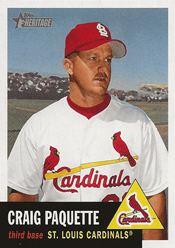
It took a long time for Craig Paquette to get his first pinch-hit home run in the majors, but it was worth the wait.

On May 25, 2001, Paquette hit a three-run home run as a pinch-hitter in the ninth inning, lifting the Cardinals from a 4-2 deficit to a 5-4 victory over the Reds at Cincinnati. Paquette’s home run against closer Danny Graves came on a 1-and-2 pitch with two outs.
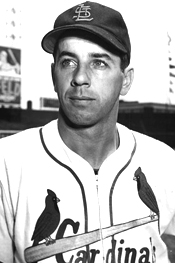
Until then, Paquette, a utility player in his ninth season in the big leagues, hadn’t hit a home run as a pinch-hitter, and had been hitless in six career at-bats versus Graves.

La Russa connection

A right-handed batter with power, Paquette played multiple infield and outfield positions. Third base was the position he played the most.

Paquette’s first three years (1993-95) in the majors were with the Athletics when Tony La Russa was manager. After the 1995 season, La Russa went to the Cardinals and Paquette was released. He signed with the Royals and led them in home runs (22) and RBI (67) in 1996. Paquette was the Royals’ Opening Day third baseman in 1997 but was sent to the minors in midseason.

A free agent, Paquette signed with the Mets but injured an ankle and was sidelined most of the 1998 season. He was mired in the minors when the Cardinals acquired him from the Mets in July 1999 for Shawon Dunston.

La Russa told The Sporting News that Paquette “always has had a power swing. He’s got such a live bat, the ball jumps.”

Valuable versatility

The move to the Cardinals revived Paquette’s career. He hit .287 with 10 home runs for them in 1999.

In 2000, Paquette filled in for injured starters Fernando Tatis at third, Mark McGwire at first and Fernando Vina at second. Paquette had single-season career highs in games played (134), doubles (24) and walks (27). Of his 94 hits, 41 were for extra bases.

Pinch-hitting was a different story. Paquette had one hit in 12 at-bats as a Cardinals pinch-hitter in 2000.

Contender at third

After the Cardinals traded Fernando Tatis to the Expos in December 2000, Paquette and Placido Polanco went to spring training as the leading candidates for the third base job.

“The reason we traded Tatis is, between Paquette and Polanco, we would have a plus at third base,” La Russa told St. Louis Post-Dispatch columnist Bernie Miklasz. “If you want to look at it honestly, both of them are going to play better defense because they pay more attention to it.”

La Russa said he thought Paquette could hit 30 home rums if he played an entire season as a starter, The Sporting News reported.

At spring training, La Russa indicated Paquette would be the Cardinals’ 2001 Opening Day third baseman. Miklasz noted Paquette was versatile, “works hard” and was “an intense competitor,” but wondered whether as a starter “he might be overexposed.”

La Russa eventually opted to go with Polanco as the Opening Day starter at third base.

Clout in clutch

The versatility of Paquette and rookie Albert Pujols gave La Russa lots of lineup options in 2001. Paquette played five positions: first, second, third, left field and right field.

When the Cardinals opened a series against the Reds at Cincinnati’s Cinergy Field, formerly Riverfront Stadium, on May 25, Paquette was on the bench.

In the eighth inning, with the Reds ahead, 4-2, the Cardinals had a runner on base, two outs and Pujols at the plate. Reds manager Bob Boone brought in Graves, who ended the threat with a strikeout of Pujols.

As heavy rain fell, Graves stayed in to pitch the ninth and gave up singles to Edgar Renteria and Kerry Robinson. With two outs, Paquette batted for pitcher Alan Benes.

When the count got to 1-and-2 on Paquette, Reds fans stood and applauded, anticipating Graves would end the game on the next pitch. Instead, he hung a curveball and Paquette hit it over the wall in left for a home run, giving the Cardinals a 5-4 lead.

“If you want to call it a curveball, I guess that’s what it was, but it was really more of a spinner,” Graves told The Cincinnati Post. “I just kind of fluttered it up there. You can’t take credit away from Paquette, but that was my third-best pitch, and he smoked it.”

In retrospect, Graves said, he should have thrown his best pitch, a sinker. “I tried to get too tricky,” Graves said to the Cincinnati Enquirer. “If he hits a good sinker and beats me, fine.”

According to The Sporting News, the Cardinals had been winless in the last 77 games in which they trailed after eight innings until Paquette worked his magic. “I was just hoping he would leave one up, and he did,” Paquette said to the Post-Dispatch.

Cardinals closer Dave Veres retired the side in order in the bottom of the ninth, sealing the victory. Boxscore

Unsatisfying ending

Paquette, 32, had a big season for the 2001 Cardinals. He hit .282 with 15 home runs and 64 RBI. As a pinch-hitter, he hit .304. In June, facing the Cubs’ Tom Gordon, he hit his second pinch-hit home run. Overall, Paquette batted .372 with runners in scoring position.

Granted free agency after the 2001 season, Paquette signed with the Tigers.

Released in April 2003, Paquette was added to the Cardinals’ Memphis farm club on May 10. According to the Post-Dispatch, he had an agreement he could leave after a certain period of time if he wasn’t called up to the Cardinals.

On May 23, Paquette pulled himself from the lineup before a game at Memphis and went home. “My heart wasn’t in it,” he told the Post-Dispatch.

When utility player Eli Marrero got injured, Paquette was disappointed the Cardinals didn’t choose him to be the replacement.

“They had 14 days to make a move and they didn’t do it,” Paquette said. “I didn’t want to go to triple-A, but I did it for the Cardinals. I’m not putting on a triple-A uniform again.”

Read Full Post »

Even when he was their teammate, Stan Rojek was battered and bruised by Cardinals pitching.

On May 17, 1951, the Cardinals acquired Rojek, a shortstop, from the Pirates for outfielder Erv Dusak and first baseman Rocky Nelson.

Two years earlier, while with the Pirates, Rojek was hit by pitches twice in a game against the Cardinals. The second one struck him in the head and put him in the hospital.

After he got sent to the Cardinals, the danger didn’t dissipate. One of their pitchers plunked him during batting practice, cracking a shoulder blade and ending his season.

Pirate in pain

Born and raised in North Tonawanda, N.Y., near Buffalo, Rojek signed with the Dodgers in 1939 and made his debut with them three years later, but he wasn’t going to displace Pee Wee Reese at shortstop.

In November 1947, the Dodgers dealt Rojek to the Pirates and he became their shortstop. Rojek batted .290 for the 1948 Pirates and ranked third in the National League in hits (186).

The next year, on April 27, 1949, in the Pirates’ first visit of the season to St. Louis, Rojek was hit in the back by a Gerry Staley pitch in the fifth inning. In the bottom half of the inning, while turning a double play, Rojek’s low, underhand toss to first came close to striking baserunner Red Schoendienst. The Cardinals accused Rojek of trying to hit Schoendienst, but Rojek laughed at the suggestion, according to The Pittsburgh Press.

In the seventh, Cardinals baserunner Joe Garagiola slid into Rojek at second and Rojek stepped on him with his spikes, The Sporting News reported.

When Rojek batted in the ninth, the first pitch from Ken Johnson was high and inside, brushing him off the plate.

“I didn’t think he’d try to knock me down a second time after brushing me back on the first pitch,” Rojek said, according to The Pittsburgh Press. “So I dug in for what I thought would be a pitch on the outside corner.”

Instead, Johnson’s second pitch headed toward Rojek’s head. “When I saw the ball coming at me, it was too late to duck out of the way,” said Rojek.

The ball hit Rojek flush on the left ear. He wore neither a batting helmet nor a protective lining in his cap.

According to The Sporting News, Rojek dropped his bat and staggered toward the first-base line “with blood coming out of his ear.” As Pirates rushed from the dugout to his aid, Rojek was a few feet from the plate when he fell into the arms of teammate Eddie Stevens, who gently laid him on the ground.

As the Pirates waited for a stretcher to arrive, they confronted Johnson and Garagiola, accusing the pitcher and catcher of conspiring to bean Rojek.

According to The Sporting News, Johnson replied, “I’m only the pitcher.” To some, his response indicated Garagiola called the pitch. Garagiola “was so nervous and afraid that he almost cried,” The Sporting News reported.

Rojek was taken into the clubhouse to await an ambulance. When the game ended, Cardinals manager Eddie Dyer went to see Rojek and said, “I’m sorry, Stan. I hope it’s nothing serious.”

According to The Pittsburgh Press, a groggy Rojek replied, “Thanks, Eddie.”

Some Pirates were unmoved and exchanged harsh words with Dyer. Outfielder Wally Westlake told Dyer, “Get the hell out of here with your apologies,” The Pittsburgh Press reported. Boxscore

Owning the plate

At the hospital, X-rays showed Rojek suffered a concussion, but no fracture. He had swelling under his ear and two stitches were required to close the wound.

Johnson called Rojek at the hospital the next morning and said he never intended to hurt him.

Some suggested Rojek put himself at risk because of a batting stance “in which his head is almost over the inside corner of the plate,” The Pittsburgh Press noted.

Phillies pitcher Schoolboy Rowe told The Sporting News that Rojek “hogs the plate, leans over it as if he were trying to count the specks of dust on it.”

National League president Ford Frick said umpires determined Johnson was not throwing at Rojek. “They even pointed out that the ball was almost a strike, but because Rojek was crouched over the plate, it hit him in the head,” Frick said. “Stan just froze up there, they said.”

Rojek returned to the Pirates’ lineup a week later. For the season, he hit .244.

In 1950, the Pirates platooned Rojek and Danny O’Connell at shortstop. The next year, at spring training, George Strickland won the shortstop job and Rojek was deemed expendable.

Bad break

The Cardinals needed help at shortstop in 1951. Marty Marion, who played the position from 1940-50, became their manager in 1951 and was unable to continue playing because of a knee ailment.

At spring training, reserve second baseman Solly Hemus volunteered to play shortstop. The Cardinals opened the season with him, but when he struggled to hit they sought an alternative.

The Cardinals acquired Rojek, 32, at Marion’s request.

Platooning with Hemus, Rojek took advantage of the opportunity, hitting safely in 13 of the first 14 games he played for the Cardinals.

Three months later, during batting practice on Aug. 8, Cardinals pitcher Red Munger hit Rojek with a pitch, cracking his left shoulder blade. Done for the season, Rojek was sent home. He hit .274 in 51 games for the Cardinals and .319 with runners in scoring position.

Hemus surged after Rojek departed and hit .281 for the season.

Projecting Hemus to remain their shortstop in 1952, the Cardinals sent Rojek to the Browns for the $10,000 waiver price in January 1952.

Read Full Post »

(Updated June 9, 2024)

The Whitey Herzog style of baseball was capsulized in the 10th inning of a game at the Astrodome.

On May 12, 1981, a squeeze bunt by Tommy Herr scored Gene Tenace with the go-ahead run, and Jim Kaat retired the side in order in the bottom half of the inning, carrying the Cardinals to a 3-2 victory over the Astros.

Baserunning, sacrificing, advancing runners and lockdown relief pitching were essential elements in the blueprint Herzog devised to make the Cardinals contenders.

Clear philosophy

Herzog became Cardinals manager in June 1980. Given the additional role of general manager soon after, he began to transform the Cardinals, who hadn’t won a pennant since 1968, into a fundamentally sound unit. Their approach became known as Whiteyball.

When Herzog was a Yankees prospect in the 1950s, manager Casey Stengel mentored him and influenced the methods Herzog brought to the Cardinals.

Though Stengel’s Yankees clubs were known for power hitting, “they based their dynasty on being the best defensive team and best baserunning team in the league,” Herzog said in his 1999 book “You’re Missin’ a Great Game.”

“Casey’s Yankees understood something our game has just about forgotten: that baseball, more than anything else, is a game of intelligence, craft and doing the little things right,” Herzog said in his book.

In describing the approach he took to rebuilding the 1980s Cardinals, Herzog said, “First, in the modern game, with all its specialization, you had to have that great stopper in the bullpen.

“Second, to shrink a huge ballpark like Busch Stadium down to size, you needed good athletes with speed. You also needed pitchers who threw strikes and let the other team make contact. Forget strikeouts. Their hitters wouldn’t be able to put many over the wall, and your track stars could run down the balls that stayed in.

“Finally, because that turf is so fast, you wanted batters who hit the upper half of the baseball, smacked it on the ground and took off. That would create new ways to get on base, stir up trouble and score runs.”

Herzog correctly concluded, “The right personnel at Busch Stadium wouldn’t look like much. They wouldn’t have to be big. They’d have to be smart.”

Fundamentally smart

One of the players who epitomized the caliber of baseball Herzog wanted was the second baseman, Tommy Herr. After trading Ken Reitz to the Cubs in the deal that brought closer Bruce Sutter to the Cardinals in December 1980, Herzog shifted Ken Oberkfell to third base to open a spot for Herr at second.

In “You’re Missin’ a Great Game,” Herzog described Herr as having “a fine mind for the game” and someone who would “make a hell of a coach.”

As a fielder, Herr “was never out of defensive position his whole time with me,” Herzog said. “Fundamentally, he was such a smart player. He never screwed up a ground ball or a play that he should have made. He never made a mental mistake.”

At the plate, Herr was “the most amazing hitter I had those years” in St. Louis, Herzog said.

“I can’t think of a better example of how having a plan, a sense of the situation you’re in, can help you succeed,” said Herzog. “If there was one guy I managed that I would want hitting for me in the stretch drive, it’d be hard to pick between (the Royals’) George Brett and Tommy.”

Herzog told Cardinals Magazine, “Herr was steady as a rock and as good a clutch ballplayer as I’ve ever seen.”

Whitey’s way

The 1981 Cardinals were 15-7 entering a three-game series against the Astros at Houston. The opener became a showcase for how Herzog changed the Cardinals’ culture. In the fourth inning, Keith Hernandez singled, stole second, advanced to third on an error and scored on Sixto Lezcano’s sacrifice fly.

The Astros countered in the bottom half of the inning with a two-run home run by Jose Cruz, the former Cardinal, but those were the only runs allowed by starter Bob Forsch. In seven innings, Forsch struck out just one, but allowed no hits from the fifth through seventh.

In the eighth, the Cardinals tied the score against starter Bob Knepper. Oberkfell singled and stole second. With two outs, Garry Templeton, batting right-handed, grounded a single to the opposite field, driving in Oberkfell. “I placed it pretty good,” Templeton told the St. Louis Post-Dispatch.

Sutter relieved Forsch and held the Astros scoreless in the eighth and ninth.

Getting it done

In the 10th, left-handed Astros closer Joe Sambito relieved Knepper. First up for the Cardinals was Gene Tenace, a right-handed batter.

Acquired from the Padres in December 1980, Tenace was adept at reaching base (.388 career on-base percentage) and played for three World Series championship Athletics clubs.

“You put my name on the lineup card and the only thing I’ll guarantee you is 100 percent,” Tenace told the Post-Dispatch.

Tenace hit a double to the base of the wall in left-center. Oberkfell moved him to third with a sacrifice bunt placed between the pitcher and third baseman.

Up next was Herr. When the count got to 2-and-1, Herzog called for the suicide squeeze.

“I wasn’t really expecting it,” Herr told Rick Hummel of the Post-Dispatch.

Tenace said, “Once you get the sign, you try to maintain your composure. If you trigger it too soon, it’s going to backfire. If you break too quick or too early, it’s not going to work. The runner makes the play. You’ve got to time the pitcher. When he puts his leg up, you break.”

Herr decided he would try to bunt the ball toward the middle of the diamond. “Usually, you try to bunt to either first base or third base, but in that situation, if you just get it on the ground, it’s going to score a run,” he said.

Herr bunted toward the mound and Tenace barreled down the line. “The ball had a little backspin,” Herr said. “The backspin deadened it enough.”

Sambito gloved the ball and flicked it to catcher Alan Ashby, but Tenace dived safely across the plate, giving the Cardinals a 3-2 lead. Ashby threw wildly to first base and Herr scurried to second on the error.

After lifting Sutter for a pinch-hitter, Herzog turned to 42-year-old Jim Kaat to protect the lead. Kaat did the job, retiring all three batters he faced. Boxscore

The 1981 Cardinals went on to achieve the best overall record in the East Division at 59-43, but didn’t get to the playoffs because of the lame decision by baseball officials to award split-season division titles _ one based on records before the players’ strike and another based on records after the strike.

Read Full Post »

« Newer Posts - Older Posts »