Feeds:
Posts
Comments

Archive for the ‘Opponents’ Category

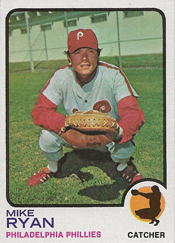
Mike Ryan connected with Steve Carlton behind the plate, not at the plate.

A catcher of superior defensive skills, Ryan played in the 1967 World Series for the Red Sox against the Cardinals.

Ryan played in 11 seasons in the big leagues because of his glove work and strong throwing arm. His career batting average with the Red Sox (1964-67), Phillies (1968-73) and Pirates (1974) was .193.

Ryan’s strength and weakness were illustrated by his interactions with Carlton. With the Phillies from 1968-71, Ryan was hitless in 26 at-bats against the Cardinals’ left-hander. When Carlton got traded to the Phillies in 1972, Ryan became one of his catchers in an award-winning season.

New England tough

Ryan was born in Haverhill, Massachusetts, about 35 miles north of Boston and near the border of New Hampshire. He grew up a Red Sox fan and took up catching when he was 9. “A catcher’s mitt wasn’t the first glove I owned, but it was my favorite,” Ryan told the Philadelphia Inquirer. “I guess I liked the idea of being in on every play.”

A prominent sandlot player, Ryan signed with the Red Sox when he was 18 and played in their farm system from 1961-64.

On the last weekend of the 1964 season, injuries left the Red Sox short of catchers and they called up Ryan. Manager Billy Herman put him in the starting lineup in a Saturday game against the Senators at Boston’s Fenway Park. Bill Monbouquette pitched a shutout for the Red Sox. Ryan caught seven innings and drove in two runs in his major-league debut. Boxscore

With a Massachusetts accent described by the Philadelphia Inquirer as “thick as chowder,” Ryan was a natural for the Red Sox. He spent part of 1965 with them and was their Opening Day catcher in 1966 and 1967. In August 1967, the Red Sox acquired catcher Elston Howard from the Yankees and he supplanted Ryan as the starter for the pennant stretch.

Howard, 38, appealed to Red Sox manager Dick Williams more than Ryan, 25, did because Howard had played in nine World Series for the Yankees. Ryan objected to being displaced and spoke out about it. He considered himself a better defensive catcher than Howard, and Howard (.147) did even less at the plate for the Red Sox than Ryan did (.199).

“They put the screws to me around here,” Ryan told the Boston Globe.

The Red Sox clinched the American League pennant on the last day of the 1967 season. In the World Series versus the Cardinals, Howard did most of the catching. Ryan’s only appearance came in Game 4 at St. Louis when he replaced Howard in the fifth inning and went hitless in two at-bats against Bob Gibson. Boxscore

During the regular season, Red Sox ace Jim Lonborg, who won the 1967 American League Cy Young Award, started more games with Ryan as his catcher than he did with Elston Howard, or backups Russ Gibson and Bob Tillman.

In a tribute to Ryan in the Eagle-Tribune of North Andover, Massachusetts, Lonborg said, “He taught me what New England toughness was all about. Broken fingers, cracked ribs. The game must go on.”

Two months after the Cardinals prevailed in the 1967 World Series, Ryan was traded to the Phillies. “I’m glad to get away, to get a chance,” Ryan told the Boston Globe.

Good field, no hit

Ryan “has a strong arm, a sure glove and handled Boston’s young pitchers intelligently,” the Philadelphia Daily News noted.

He was the Phillies’ Opening Day catcher in 1968 and 1969. In the off-seasons, Ryan and his wife collected antiques. “The catcher has a poet’s soul,” wrote the Philadelphia Inquirer’s Bill Lyon.

Ryan led National League catchers in percentage of runners caught attempting to steal (57.6) in 1968 and in assists (79) in 1969, but his batting marks for those seasons were .179 and .204. “Mike Ryan can’t hit a lick and that’s the pity of it,” Bill Conlin of the Philadelphia Daily News wrote. “He’s tried a dozen stances and a jillion bats, but nothing has helped.”

Ryan told Sandy Padwe of the Philadelphia Inquirer, “There have been times I was so confused that I didn’t even know my name when I went up to bat. The whole thing is so frustrating. It takes so much out of you. Maybe I’m just not a hitter, but I can’t believe that.”

Collecting Cardinals

In October 1969, looking to get more production from the catcher position, the Phillies acquired Tim McCarver from the Cardinals and Ryan became a backup.

McCarver and Ryan were involved in a freak occurrence on May 2, 1970, in a game at San Francisco. In the sixth inning, a foul tip by Willie Mays fractured McCarver’s right hand. Ryan replaced him. After Mays singled and Willie McCovey doubled, Ken Henderson singled to right. Ron Stone’s throw to Ryan nailed McCovey at the plate, but Ryan fractured his left hand when spiked by McCovey. Boxscore

McCarver hit .287 in 1970 and .278 in 1971, but his defensive skills were slipping.

The Phillies acquired Steve Carlton from the Cardinals in February 1972. The deal reunited Carlton with McCarver, who was Carlton’s catcher with the Cardinals from 1965-69, but Phillies manager Frank Lucchesi was becoming disenchanted with McCarver’s weak throwing.

“If Mike Ryan had McCarver’s .280 bat, he would be a six-figure everyday player, a great star,” declared the Philadelphia Daily News. “If McCarver had Ryan’s sure, soft hands and lightning release, he’d be an all-star.”

Neither Carlton nor McCarver got off to a strong start with the 1972 Phillies. At the end of May, Carlton was 5-6 and McCarver was batting .208. “The Phillies watched McCarver three-hop balls to second and handle pitches as if they were live grenades while waiting for a bat which never came around,” according to the Philadelphia Daily News.

On June 14, 1972, McCarver was dealt to the Expos for catcher John Bateman.

Teaching and helping

With Bateman starting and Ryan backing up, Carlton had a big season (27-10, 1.97 ERA) for a bad team (59-97) and won the 1972 National League Cy Young Award. “I could have told the hitters what was coming and they still wouldn’t have touched Steve,” Ryan told The Sporting News. “He dominated hitters.”

In 1973, rookie Bob Boone became the Phillies’ catcher, Bateman departed and Ryan remained the backup. In two seasons (1972-73) together, Carlton and Ryan formed the Phillies’ battery in 10 games. Ryan also was reunited in 1973 with Lonborg, who was acquired by the Phillies.

Ryan finished his playing career in 1974 with the Pirates. He was a manager in the Pirates’ farm system for two years (1975-76) and mentored a teen catching prospect, Tony Pena. Ryan also managed Phillies minor-league teams for two seasons (1977-78) and helped advance the career of outfielder Lonnie Smith.

For 16 years (1980-95), Ryan was a Phillies coach. The Phillies got to the World Series three times in that stretch, including 1993, when their catcher was Darren Daulton, who bonded with Ryan. “He’s as solid as they come,” Daulton told the Philadelphia Inquirer. “How much do I think of him? I named my son for him: Zachary Ryan Daulton.”

Read Full Post »

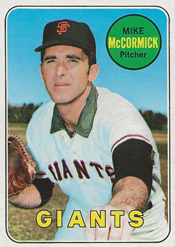
In the year he won the National League Cy Young Award, Mike McCormick did his part to try to enable the Giants to keep pace with the Cardinals in the pennant race, but he didn’t get enough help from a pair of future Hall of Famers on the pitching staff.

McCormick, a left-hander, pitched 16 years in the major leagues. He had his best season in 1967 when he was 22-10 with a 2.85 ERA for the Giants.

Relying on a screwball to keep batters off stride, McCormick was 3-0 in three starts against the 1967 Cardinals.

The Cardinals finished with a 101-60 record, 10.5 games ahead of the second-place Giants (91-71). One reason the Giants couldn’t catch the Cardinals was the performances of two starters destined for Cooperstown, Juan Marichal and Gaylord Perry. Marichal was 0-2 versus the Cardinals in 1967 and Perry was 0-5.

ERA leader

A baseball standout from Alhambra, Calif., McCormick was 17 when he signed with the Giants for $50,000 in August 1956. He went directly to the majors and made his debut with a scoreless inning of relief versus the Phillies on Sept. 3, 1956. “He could really throw when I first saw him,” Giants second baseman Red Schoendienst told The Sporting News.

McCormick’s first decision in the big leagues was a loss to the Cardinals in a start on Sept. 15, 1956, at the Polo Grounds in New York. Alvin Dark, who became McCormick’s manager with the 1961-62 Giants, hit a home run against him. Boxscore

The Giants moved from New York to San Francisco after the 1957 season. At their Bay Area home, McCormick and his wife became collectors of antique clocks. “I specialize in school and railroad clocks from the period between 1860 and 1880,” McCormick told The Sporting News.

In 1960, McCormick led the National League in ERA at 2.70. The runner-up was the Cardinals’ Ernie Broglio (2.74). Hall of Fame left-hander Carl Hubbell, the Giants’ farm director, told the Sporting News, “McCormick has a lot of what I call pitching instinct. He doesn’t have a set pattern for pitching to any particular hitter, but he senses what to throw next. Mike amazes me with his poise and control.”

Two years later, the Giants won the National League pennant, but McCormick, who developed a left shoulder injury, was limited to 98.2 innings and had a 5-5 record. He didn’t pitch in the World Series against the Yankees.

After the season, the Giants traded him to the Orioles. “He had a sore arm, a hot temper and a fastball he thought he could throw past any batter,” The Sporting News noted.

Continuing to experience shoulder pain, McCormick was 6-8 for the Orioles in 1963 and 0-2 in 1964 before he was demoted to the minors. In April 1965, the Orioles dealt McCormick to the Senators and he was 19-22 for them over two seasons before being traded back to the Giants in December 1966.

“We think he can help us in relief and as a spot starter,” said Giants general manager Chub Feeney.

Pitching lessons

No longer a power pitcher, McCormick, 29, relied on control and changing speeds in his second stint with the Giants.

It wasn’t an easy transition. Because of rainouts and days off, he made a mere two starts in April 1967. At the end of May, his record was 3-2 with a 4.64 ERA and manager Herman Franks sent him to the bullpen. One of McCormick’s relief appearances came June 16, 1967, against the Cardinals. He pitched 4.1 innings and allowed one run. Boxscore

Returned to the starting rotation, McCormick won seven consecutive decisions from June 19 to July 15. One of those wins was June 27, 1967, a shutout versus the Cardinals at St. Louis. McCormick scattered seven hits and walked none. In contrast, Cardinals starter Steve Carlton walked six in 4.2 innings and gave up four runs. Boxscore

Cardinals hitting coach Dick Sisler said batters made the mistake of trying to pull McCormick’s screwball.

“You can’t play long ball against a screwball,” Sisler told the St. Louis Post-Dispatch. “You’ve got to hit to the opposite field.”

Doing his part

On Aug. 10, 1967, the Giants opened a four-game series against the Cardinals at St. Louis. The Giants were nine games behind the first-place Cardinals and needed to win the series if they were going to challenge for the pennant. “If anybody can catch them, it’s us,” McCormick said.

Hoping to set the tone, McCormick prevailed in the opener, limiting the Cardinals to six hits in a 5-2 victory.

“When he makes you hit his pitch, he’s got you,” Sisler said. “When he wins, I’d say that nine out of 10 batters swing at bad pitches.” Boxscore

Unfazed, the Cardinals won the final three games of the series, beating Gaylord Perry and two former Cardinals, Lindy McDaniel and McCormick’s road roommate, Ray Sadecki. The Giants left St. Louis 11 games behind with 47 left to play.

Top of his game

McCormick faced the Cardinals for the final time in 1967 on Aug. 23 at San Francisco and beat them again, pitching another shutout. His ERA versus the Cardinals for the season was 0.86. Boxscore

“McCormick has done about all he can to stall the Cardinals’ pennant express,” declared the Post-Dispatch.

Said Cardinals outfielder Roger Maris: “He’s always on the borderline with his pitches. He’s on the inside corner or the outside corner, or right on the borderline high or low, but he never has thrown me a pitch down the middle of the plate.”

In games not started by McCormick, the Giants were 4-11 versus the Cardinals in 1967.

McCormick led the league in wins (22) and became the first Giants left-hander with 20 in a season since Johnny Antonelli in 1956. In winning the Cy Young Award, McCormick got 18 of 20 votes from the baseball writers.

McCormick followed the 1967 season with 12 wins for the Giants in 1968 and 11 in 1969 before he was traded to the Yankees in 1970. His last season in the majors was 1971 with the Royals. He finished with a career record of 134-128.

Read Full Post »

(Updated Nov. 24, 2024)

An impressive collection of managerial talent participated in an important game in the evolution of the Cardinals.

The Cardinals played a regular-season home game at Sportsman’s Park in St. Louis for the first time on July 1, 1920.

In addition to managers Branch Rickey of the Cardinals and George Gibson of the Pirates, seven of the players in the game went on to manage in the big leagues.

Moving in

The Cardinals had been playing their home games at dilapidated Robison Field until club owner Sam Breadon convinced his counterpart with the American League Browns, Sportsman’s Park landlord Phil Ball, to take in the cash-strapped Cardinals as a tenant.

The move to renting at Sportsman’s Park enabled Breadon to demolish Robison Field and sell most of the property to the city of St. Louis for $200,000 and sell the rest of the land for $75,000 to a trolley company.

On June 6, 1920, a Sunday afternoon, the Cardinals played their last game at Robison Field before going on a road trip for the rest of the month. Boxscore.

When the Cardinals got back from the trip, their first game at Sportsman’s Park was scheduled for a Thursday afternoon against the Pirates.

Attracting a crowd

The Pirates vs. Cardinals game was the feature of a program of events held at Sportsman’s Park that day to benefit the St. Louis Tuberculosis Society.

Described by the St. Louis Star-Times as an “athletic carnival.” the program included a five-inning matchup between Army and Navy baseball teams and the completion of a high school boys’ road run. The Navy beat the Army, 7-5. The game between the Pirates and Cardinals was scheduled to follow at 4 p.m.

According to an advertisement in The Sporting News, the price for a ticket to the day’s entire program ranged from 50 cents to $1.50.

Customers poured into Sportsman’s Park early. By 2 p.m., “the reserved seats were taken,” the St. Louis Post-Dispatch reported.

Those with tickets for unreserved seats, referred to by the Post-Dispatch as “the unseated mob,” preferred standing room on the field to the “sun-baked bleachers” and they “swarmed into roped off areas” on both sides of left and right fields.

When the game began, attendance was 20,000, the Star-Times estimated.

Lots of leaders

Lineups for the two teams featured these future big-league managers:

_ Pirates center fielder Max Carey, who became manager of the Dodgers (1932-33).

_ Pirates right fielder Billy Southworth, who became manager of the Cardinals (1929 and 1940-45) and Braves (1946-51). Southworth managed the Cardinals to three National League pennants and two World Series titles. He also won a pennant with the Braves.

_ Pirates shortstop Bill McKechnie, who became manager of the Pirates (1922-26), Cardinals (1928-29), Braves (1930-37) and Reds (1938-46). McKechnie managed the Cardinals to the 1928 pennant. He also won a pennant and World Series title with the Pirates, and two pennants and a World Series championship with the Reds.

_ Pirates first baseman Charlie Grimm, a St. Louis native who became manager of the Cubs (1932-38, 1944-49 and 1960) and Braves (1952-56). Grimm managed the Cubs to three pennants.

_ Cardinals left fielder Burt Shotton, who became manager of the Phillies (1928-33), Reds (1934) and Dodgers (1947-50). Shotton managed the Dodgers to two pennants.

_ Cardinals second baseman Rogers Hornsby, who became manager of the Cardinals (1925-26), Giants (1927), Braves (1928), Cubs (1930-32), Browns (1933-37 and 1952) and Reds (1952-53). Hornsby managed the Cardinals to their first pennant and World Series title in 1926.

_ Cardinals third baseman Milt Stock, who managed the Pirates for one game in 1951 and was a longtime coach in the majors.

Five of the participants in the game _ Carey, Hornsby, McKechnie, Rickey and Southworth _ would be inducted into the National Baseball Hall of Fame. Carey and Hornsby got in as players, Southworth and McKechnie as managers and Rickey as an administrator.

Pirates prevail

The Pirates led, 2-0, through seven innings, but the Cardinals got a run in the eighth and another in the ninth, tying the score at 2-2.

In the 10th, Cardinals starter Ferdie Schupp was relieved by Bill Sherdel, whose “slants were eaten up like hot waffles,” according to the Pittsburgh Daily Post.

Carey led off with a single to left and Southworth struck out looking. Possum Whitted singled to right and Carey dashed to third, beating the throw of right fielder Joe Schultz.

Whitted rounded first on the play, drawing a throw from third baseman Milt Stock. Carey broke for home as Stock’s throw went to first baseman Jack Fournier. Whitted got back to the bag safely and Fournier hurried a throw toward home plate, hoping to nail Carey.

“Fournier should have had him by 40 feet,” the Pittsburgh Press declared, but the low toss eluded catcher Verne Clemons. As the ball rolled toward a dugout, Carey crossed the plate, putting the Pirates ahead, 3-2, and Whitted went to third.

Rattled, Sherdel walked McKechnie. Grimm doubled to center, scoring Whitted and giving the Pirates a 4-2 lead. The Pirates scored twice more against Sherdel and went on to a 6-2 victory. Boxscore

Though the outcome of their first game at Sportsman’s Park wasn’t what the Cardinals wanted, the move there was hailed as a positive for the franchise.

In its July 8, 1920, edition, The Sporting News reported, “Everyone seems happy over the shift of the Cards to the Browns’ park. The attendance at the games played there has been all that could be asked for by the club management, and everything has run smoothly to date.”

St. Louis fans of both the Browns and Cardinals, however, had a reputation for being tough on visiting players.

In his book “Busting ‘Em,” Ty Cobb said, “The two worst towns on the American League circuit for rooters riding visiting ballplayers are St. Louis and Philadelphia.”

Regarding fans in St. Louis, Cobb said, “It seems as if about half the spectators there attend the game for the fun of panning the visiting players. The names that the occupants of the bleachers call the outfielders could not be printed on asbestos paper. If they ever get a winner in St. Louis, every visiting ballplayer will have to have police protection each time the home club loses a close game.”

In the book “The Glory of Their Times,” Pirates right fielder Paul Waner recalled that when he reached the majors in 1926 his teammates warned him about the fans in St. Louis.

“So the first time we went into St. Louis, I figured if they jumped on me I’d have a little fun,” Waner said. “Sure enough, as soon as I showed up in right field, they started in and gave me a terrible roasting. I turned around and yelled, ‘They told me about all you fans in St. Louis, that all the drunken bums in the city come here, and now that I’m here, I see it’s true.’ Oh, did they scream!”

Waner said months later he won over the fans in St. Louis when he handed a ball to “some old fellow” in the stands.

The Cardinals continued to play at Sportsman’s Park, later renamed Busch Stadium, until May 1966 when they moved into a new stadium downtown.

Read Full Post »

With two swings in one game, Biff Pocoroba created quite a bit of damage against the Cardinals.

A switch-hitting catcher, Pocoroba played 10 years in the major leagues, all with the Braves.

Born in Burbank, Calif., “Biff” was Pocoroba’s given name, not a nickname.

Selected by the Braves in the 17th round of the 1971 amateur baseball draft, Pocoroba reached the majors in 1975. He became the Braves’ starting catcher in 1977 and hit .290 with 24 doubles and an on-base percentage of .394. The Braves rewarded him with a six-year, $1 million contract.

In 1978, Ted Simmons of the Cardinals was voted starting catcher for the National League all-star team and his backups were the Reds’ Johnny Bench and the Phillies’ Bob Boone. When an injury made Bench unavailable for the All-Star-Game in San Diego, Pocoroba was chosen to replace him and caught an inning. Boxscore

A month later, Pocoroba injured his right shoulder and was out for the rest of the season. During rotator cuff surgery in September 1978, Dr. Frank Jobe transferred muscle from Pocoroba’s lower bicep to his shoulder, the St. Louis Post-Dispatch reported.

When Pocoroba returned to the Braves in June 1979, Bruce Benedict had taken over as the starting catcher.

Danger zone

On May 14, 1982, Pocoroba was in the lineup against the Cardinals in Atlanta. The Cardinals were in first place in the East Division and the Braves led the West. The pitching matchup was Joaquin Andujar for the Cardinals and Phil Niekro for the Braves. During Niekro’s Hall of Fame career, Benedict and Pocoroba caught more of his games than any other catchers.

While batting in the second inning, Pocoroba’s foul tip broke the right index finger of Cardinals catcher Darrell Porter. After the inning, Porter was replaced by Orlando Sanchez. The injury sidelined Porter for three weeks.

Pocoroba helped Niekro hold the Cardinals scoreless for eight innings. He threw out two base runners, Keith Hernandez and Mike Ramsey, attempting to steal.

Trailing 1-0, the Cardinals rallied for a run in the top of ninth versus Braves closer Gene Garber. Lonnie Smith singled, swiped second, moved to third on Ozzie Smith’s bunt hit and scored on Hernandez’s sacrifice fly.

Biff bops

In the bottom half of the ninth, Cardinals reliever Doug Bair retired the first two batters before Pocoroba came to the plate.

“I was looking for a fastball because Bair had been getting ahead of batters with the pitch,” Pocoroba told the Atlanta Constitution.

Bair told the Post-Dispatch, “I tried to throw the ball low and away. He’s a first-ball, fastball hitter. I threw it right in his wheelhouse.”

Pocoroba hit Bair’s first pitch over the fence in right for a walkoff home run and a 2-1 Braves victory. Boxscore

It was Pocoroba’s first home run since August 1980 versus the Cardinals’ Bob Forsch. It also was the first home run Bair allowed in 22 innings in 1982.

The Cardinals and Braves went on to win division titles and met in the 1982 National League Championship Series. The Cardinals won the pennant, sweeping the Braves in three games. Pocoroba had one at-bat in the postseason. Porter was named most valuable player in both the NL Championship Series and in the World Series versus the Brewers.

Read Full Post »

(Updated Dec. 28, 2024)

Dick Allen capped one of his best performances for the Cardinals by hitting a grand slam against the pitcher who got traded with him to St. Louis.

On June 2, 1970, Allen had seven RBI for the Cardinals in their 12-1 victory over the Giants at St. Louis.

Allen had a run-scoring single and a two-run home run versus Giants starter Gaylord Perry. The grand slam came against Jerry Johnson, who was traded with Allen and Cookie Rojas by the Phillies to the Cardinals in October 1969 for Curt Flood, Tim McCarver, Joe Hoerner and Byron Browne.

On May 19, 1970, the Cardinals dealt Johnson to the Giants for pitcher Frank Linzy. Johnson was making his fifth appearance for the Giants when he faced Allen for the first time.

New look

Looking to shake up the Cardinals, who lost six of their last seven, manager Red Schoendienst changed the batting order for the series opener versus the Giants at Busch Memorial Stadium.

Schoendienst had been featuring a top five of Jose Cardenal, Julian Javier, Lou Brock, Dick Allen and Joe Torre. Against Perry and the Giants, Schoendienst went back to the batting order he used to open the season, with Brock in the leadoff spot, followed by Cardenal, Allen and Torre. Joe Hague batted fifth, and Javier dropped to the seventh spot, behind Ted Simmons.

“The big reason for the change is getting Allen back up there to No. 3 where he can hurt people even more,” Schoendienst told the Associated Press.

To the St. Louis Post-Dispatch, Schoendienst explained, “I like to bat Cardenal second, especially against right-handers, because he has good bat control and can hit that outside pitch to right. and I want to be sure Allen gets to bat in the first inning.”

Played on a damp Tuesday night, the game attracted a crowd of 11,111, a number the Post-Dispatch described as “a poker player’s dream.”

Eight future Hall of Famers were in the lineups: Willie Mays, Willie McCovey and Gaylord Perry for the Giants, and Lou Brock, Joe Torre, Ted Simmons, Steve Carlton and Allen for the Cardinals. On the bench were three more: Schoendienst and pitchers Juan Marichal of the Giants and Bob Gibson of the Cardinals.

Carlton pitched a four-hitter and would have had a shutout if not for McCovey’s home run, a 420-foot drive into the bleachers in right-center. “I told myself to throw him a really nasty slider, but I hung it,” Carlton told the Post-Dispatch.

Carlton also contributed three singles. “That was just a little cream topping,” Carlton said.

Power source

Allen was in top form from the start.

In the first inning, Allen’s single versus Perry scored Cardenal from second.

In the fifth, Allen, a right-handed batter, sliced a Perry slider over the wall in right for a two-run homer. The ball “landed in the runway behind the right-field fence,” according to the Post-Dispatch. Impressed by Allen’s ability to drive the ball the opposite way, Cardinals coach George Kissell told the Post-Dispatch, “He hits them to right like a left-handed golfer.”

Allen had astonishing power, even though his right hand was weakened three years earlier when pieces of glass from a broken headlight on a car he was pushing severed nerves in his palm.

“I worked hard to get that hand so that I could use it again,” Allen told Dick Young of the New York Daily News. “I got a job as a bricklayer’s helper. For nothing. A friend of mine gave me the job. He wanted to pay me. He kept throwing money at me and I kept throwing it back. I wanted to work for nothing. It made me keep thinking of why I was doing it. I asked him for a slow bricklayer, though.”

Run producer

Allen and Perry faced one another frequently. Allen would finish his career with 30 hits and 31 strikeouts versus the spitball specialist.

Jerry Johnson was a different story. He was Allen’s teammate with the Phillies in 1968 and 1969, and for a brief time with the 1970 Cardinals. Johnson began the 1970 season in the minors, got called up to the Cardinals on May 1 and was 2-0 with one save in seven relief appearances for them before he was traded.

In the seventh inning, Johnson relieved Perry and deprived Allen of another RBI, striking him out on a slider with a runner on third and none out.

An inning later, Allen came up against Johnson with the bases loaded and hit a fastball into the seats in left-center for his fifth grand slam in the big leagues. He’d hit three more grand slams before his career was done. Boxscore

The home run would be the only base hit Allen would get in 12 career at-bats versus Johnson.

Allen had one other game with seven RBI. It occurred Sept. 29, 1968, for the Phillies against the Mets at Shea Stadium in New York. Allen hit a two-run home run versus Tom Seaver, a solo shot off Cal Koonce and a grand slam against Ron Taylor, the former Cardinal.

Read Full Post »

Cardinals third baseman Tommy Glaviano experienced a fielder’s worst nightmare.

On May 18, 1950, Glaviano made four errors, including three in a row in the ninth inning, in a game against the Dodgers at Ebbets Field in Brooklyn. The Cardinals, who led 8-0 entering the eighth inning, lost 9-8.

The Cardinals committed a total of six errors in the game, but the most costly were Glaviano’s gaffes in the ninth, when the Dodgers scored five times in what the New York Daily News described “as miraculous a finish as this famed Ebbets Field grotto had ever seen.”

Hot corner hustler

Glaviano was born and raised in Sacramento. The Cardinals signed him when he was 17. After two seasons in the Cardinals’ farm system, Glaviano served three years (1943-45) in the Coast Guard before returning to the minors.

After producing a .415 on-base percentage in 106 games for Columbus, Ohio, in 1948, Glaviano won the Cardinals’ third base job at spring training in 1949.

At 5 feet 9 and 175 pounds, Glaviano was “a short, stocky throwback to the glamorous Gashouse Gang era,” The Sporting News reported.

Bob Broeg of the St. Louis Post-Dispatch described Glaviano as “a sawed-off Pepper Martin.”

Glaviano, 25, made his major-league debut on April 19, 1949, in the Cardinals’ season opener versus the Reds at Cincinnati.

The Reds led, 1-0, in the sixth inning and had runners on second and third, with two outs, when Harry Brecheen got Virgil Stallcup to hit a slow grounder. Glaviano went far to his left, gloved the ball and whipped a side-armed throw to first. The ball sailed off target, struck Stallcup in the left cheek and bounced away, allowing both runners to score on the error. The Reds won, 3-1. Boxscore

Glaviano and another rookie, Eddie Kazak, split time at third base for the 1949 Cardinals. Glaviano hit .267 and played the last three weeks of the season with torn cartilage in his throwing arm, The Sporting News reported.

Good start to season

In 1950, Kazak was the Opening Day third baseman for the Cardinals, but Glaviano took over a week into the season. “The pitchers feel better with him at third,” Cardinals manager Eddie Dyer told The Sporting News.

Batting leadoff, Glaviano quit swinging for homers and got more selective at the plate. “He’s learning how to hit outside pitching to the opposite field,” Dyer said.

Glaviano hit .342 in his first 20 games for the 1950 Cardinals and made four errors. He “has covered more ground than any Cardinals third baseman in years,” Broeg noted in the Post-Dispatch.

Storm clouds

On a raw overcast Thursday afternoon with a temperature of 50 degrees, the Cardinals played the finale of a three-game series at Brooklyn after losing the first two to the Dodgers.

Glaviano’s home run leading off the fourth inning against starter Joe Hatten extended the Cardinals’ lead to 4-0.

With the Cardinals ahead, 8-0, in the sixth, errors by Glaviano and second baseman Red Schoendienst put Dodgers runners on first and third with none out. Starter Howie Pollet escaped unscathed, getting Jackie Robinson on a grounder to the mound, Carl Furillo on a pop foul and Gil Hodges on a strikeout.

“Here was a game that appeared so far gone that even the manager had given up on it, and you couldn’t blame him,” Dick Young wrote in the New York Daily News. The Dodgers “had looked more miserable than the weather. They hadn’t hit, their pitching had been punk, and even their defense, which has been Brooklyn’s matchless pride, had been butchered.”

Pollet limited the Dodgers to four hits through seven innings, but in the eighth it began to rain and his back stiffened. Furillo hit a three-run home run. After Duke Snider and Bruce Edwards each singled, putting runners on first and third with two outs, Gerry Staley relieved Pollet and yielded a run-scoring single to Pee Wee Reese, cutting the Cardinals’ lead to 8-4.

Throwing away a win

With rain falling steadily, Jim Russell led off the Dodgers’ ninth with a double against Staley and came home on Jackie Robinson’s double, making the score 8-5.

Al Brazle relieved and retired Furillo for the first out. Hodges hit a grounder to short, but Marty Marion “slipped on the muddy infield and couldn’t get his body behind a throw to first,” the Post-Dispatch reported.

Robinson stayed at second on the play and Hodges was safe with an infield single. Brazle walked Snider, loading the bases.

Roy Campanella hit a one-hopper to Glaviano, who hoped to start a game-ending double play. In his haste, Glaviano made a wide throw to second and Schoendienst had to leave the bag to catch it. Robinson scored from third on the error, cutting the Cardinals’ lead to 8-6, and the bases remained loaded.

Rookie Cloyd Boyer relieved Brazle and got Eddie Miksis to hit a high bouncer directly to Glaviano. Instead of throwing to second for a likely forceout and the start of a possible game-ending double play, Glaviano fired the ball toward home. The wild toss pulled catcher Del Rice off the plate and he “had to dive flat on his face for the save,” the New York Daily News reported.

Hodges scored from third on Glaviano’s second consecutive error, getting the Dodgers within a run at 8-7, and the bases still were full.

Reese came up next and hit a sharp grounder to Glaviano, who was positioned near the bag. “He had planned to scoop it up, step on third and fire to first” to complete a game-ending double play, the New York Daily News reported.

Instead, in moving toward the bag, Glaviano let the ball trickle through his legs and roll into short left field for an error. Snider and Campanella scored. giving the Dodgers a 9-8 victory. Boxscore

Stayin’ alive

Dick Young’s lead paragraph in the next morning’s New York Daily News was a gem: “Joe Garagiola didn’t get any sleep last night. He lay awake to make sure his roommate, Tommy Glaviano, wouldn’t take a walk out a window.”

The St. Louis Globe-Democrat described the collapse as “one of the goofiest shows” staged by the Cardinals. The Post-Dispatch called it “a cruel body blow.”

In the clubhouse, Glaviano sat with his head lowered, “trying to fight back tears that wanted to pour like the chilling rain which fell from the time the Dodgers’ bats first began to rattle,” the Post-Dispatch reported.

“The kid’s insides are eating him out,” said Cardinals reserve infielder Eddie Miller, “but he’ll be all right.”

Dyer said, “That was the most bitter defeat of any I’ve had in the years I’ve managed.”

In the Post-Dispatch, Broeg described Glaviano as a third baseman “with a thick chest, courage and agility” as well as “a scatter arm.”

“About his arm,” Dyer said, “it hasn’t been as accurate since he hurt his right shoulder two years ago at Columbus. I think it locks on him when he throws in a hurry, spoiling his aim.”

Dyer stuck with Glaviano at third base the rest of the 1950 season. He hit .285 with 29 doubles and scored 92 runs. His 25 errors at third base were one less than the 26 of the Giants’ Hank Thompson, who made the most misplays among 1950 National League third basemen.

Marty Marion became Cardinals manager in 1951 and decided at spring training to move Glaviano to center field. On April 10, a week before the regular season opened, Glaviano crashed into an outfield wall pursuing a drive in an exhibition game against the Browns and injured his right shoulder.

Glaviano wasn’t the same after the injury. He was a utility player for the Cardinals in 1951 and 1952. The Phillies claimed him on waivers and he spent 1953, his final season in the majors, with them.

Read Full Post »

« Newer Posts - Older Posts »