Feeds:
Posts
Comments

Archive for the ‘Opponents’ Category

For the 1953 St. Louis Browns, a downtrodden group accustomed to having the odds stacked against them, the numbers 14 and 18 added up to one in a million as they arrived in New York to play the Yankees.

Fourteen was the number of consecutive losses the Browns had suffered. Eighteen was how many the Yankees had won in a row. Recalling the team’s mindset entering the four-game series at home with the Browns, Mickey Mantle told “Voices From Cooperstown” author Anthony J. Connor, “We figured there’s at least four more wins.”

What the Yankees didn’t factor, though, was another number: 47. The oldest player in the majors, Browns pitcher Satchel Paige, turned 47 in 1953. At least that was his listed age. As the St. Louis Post-Dispatch suggested, Paige “is believed to be older than the American League,” which was formed in 1901.

Paige’s favorite number was zero. Those were the number of runs he allowed in securing the victory that ended the Browns’ skid and snapped the Yankees’ winning streak.

Together again

The story of Leroy “Satchel” Paige’s stint with St. Louis begins in July 1951. That was when Bill Veeck bought the Browns from Bill DeWitt Sr. and his brother, Charlie. A few days after Veeck closed the deal, he watched a dreary doubleheader in which Browns pitchers issued 15 walks to Philadelphia Athletics batters, losing both games. Boxscore and Boxscore

That’s when Veeck reached out to Paige, who was pitching for the Chicago American Giants of the Negro American League, and brought him back to the majors. “One thing about Satch is that he can get the ball over (the plate),” Veeck told the Post-Dispatch.

As owner of the Cleveland Indians, Veeck gave Paige his first shot at the big leagues, signing him in July 1948. Paige rewarded him, posting a 6-1 record and helping the Indians become World Series champions that year. After the following season, in 1949, Veeck sold the club and Paige was released by the new regime.

Senior league

Paige began pitching in baseball’s Negro League in 1927. He signed with the Browns on July 14, 1951, a week after he turned 45. Many suspected he was older than that. Even Veeck told the Post-Dispatch, “He’s at least 51.”

Trying to unravel the mystery of how ancient Paige was became baseball’s top parlor game. 

After attempting to determine Paige’s true age, columnist Henry McLemore of the McNaught Syndicate informed readers, “I have come to the conclusion that Satchel was 10th off the Ark, and that while the waters were receding he practiced his curveballs.”

Noting that Paige is “the only baseball player in the world whose birthdays run backward instead of forward,” the Post-Dispatch concluded, “While Satch may be 50, his arm is only 25.”

After joining the 1951 Browns, Paige was invited to attend a gathering of 700 scientists that summer at the International Gerontological Congress at the Hotel Jefferson in St. Louis. Paige was a guest of the group’s president, Dr. E.V. Cowdry, professor of anatomy at Washington University school of medicine.

The “purpose of the congress is the discussion of aging, a subject close to Satch’s heart,” the Post-Dispatch reported. “Satch told the scientists he is still going strong because he works every day in the summer, hunts every day in the winter, eats lots of seafood, shuns beer, whiskey, chicken livers and lamb, and likes to sleep.” He added, “When I smoke, I don’t inhale _ just blow it out my nose.”

Mound magician

After making two starts for the 1951 Browns, Paige was moved to the bullpen, a role that better suited a pitcher of his advanced years. In 20 relief appearances, he totaled three wins and six saves using what the New York Times described as “an amazing assortment of trick deliveries” that included a hesitation pitch. According to the St. Louis Globe-Democrat, the pitch got that name because when Paige threw it he went into a “big windup, stepped forward and stooped his body, but his arm continued in a wide arc” before he flipped the ball across the plate. “Damndest changeup pitch I ever saw,” Joe DiMaggio told the Times.

In a game against the Red Sox at Fenway Park, Paige got an 0-and-2 count on Ted Williams. On the next delivery, Paige went into a leisurely windup, and Williams moved forward in the batter’s box, expecting the hesitation pitch or something similar. Instead, Paige zipped a fastball, startling Williams, who swung late and missed for strike three.

Irate, Williams stomped to the dugout and “smashed his bat into pieces,” the Boston Globe reported. “He first whacked it against the railing of the runway leading to the dressing room. When that didn’t suffice, Williams flung the bat toward the rack. He still wasn’t satisfied, so he smashed it on the floor.”

During Ted’s tantrum, Paige was laughing on the mound, according to the Globe. He told the newspaper, “I’ve never seen anything like it in the big leagues. He was sore because I crossed him up.” Boxscore

For his career, Williams batted .222 (2 for 9) versus Paige. Both hits were singles. That was better than Joe DiMaggio did. The Yankee Clipper went hitless (with three strikeouts) in eight at-bats against Paige.

[In his induction speech at the Baseball Hall of Fame in 1966, Williams said, “I hope Satchel Paige and Josh Gibson somehow will be inducted here as symbols of the great Negro (League) players who are not here because they were not given a chance.”]

Winners and losers

In 1952, Paige had 12 wins, 10 saves and a 3.07 ERA for the Browns. His last season with them was 1953.

The 1953 Browns lost nine in a row in May. Then came the 14-game skid in June. All 14 losses came at home. The Browns took a 19-38 record into the June 16 series opener against the Yankees at New York. Winners of 18 in a row, the Yankees were 41-11. Furthermore, their starting pitcher for the first game was Whitey Ford, who, in two seasons with them, was 16-0 as a starter.

A former Yankee, Duane Pillette, was matched against Ford that night. Pillette’s ERA for the season was 5.73.

What should have been a mismatch turned out to be a competitive contest. The Browns scored three runs against Ford, who was lifted after five innings. Pillette limited the Yankees to one run through seven.

In the eighth, after Billy Martin singled with one out, Pillette went to a 2-and-0 count on Joe Collins. Browns manager Marty Marion opted to lift Pillette for Paige.

(Perhaps looking to change the Browns’ luck, Marion, the former Cardinals shortstop, put himself in the starting lineup that night for the only time in 1953. Furthermore, he played third base for the first time in his career.)

Paige ambled from the bullpen to the mound. It took him about 10 minutes to stroll out there, according to the New York Daily News. As the Globe-Democrat noted, “His pants cuff was dragging but there was nothing wrong with the elastic in his arm.”

His first pitch to Collins was out of the strike zone, making the count 3-and-0. Then he retired him on a soft fly. After falling behind 3-and-0 to Irv Noren, Paige got him to pop out to the catcher.

With the Browns still holding a 3-1 lead, Mickey Mantle led off the bottom of the ninth against Paige. With two strikes, Mantle decided to try for a bunt single. In the book “Voices From Cooperstown,” Mantle said a bunt made sense to him because Paige “couldn’t hardly get off the mound.”

“I knew that if I could poke it past him I could beat him to first base,” Mantle said to the New York Times.

Instead, Mantle fouled the ball back to the screen on the bunt attempt, striking out. (More than a decade later, according to the Times, Mantle’s decision to bunt still rankled Whitey Ford. “That was a really stupid play,” Ford told Mantle. “I was so mad at you.” Mantle replied, “I still say it’s not necessarily such a bad play.”)

Paige retired Yogi Berra for the second out, but Gene Woodling singled, bringing Gil McDougald to the plate. Paige fell behind in the count, then got McDougald to pop up in foul territory, but catcher Les Moss dropped the ball.

McDougald fouled off two more pitches. As the Globe-Democrat noted, Paige “got the last bit of good theatre and ham out of the situation.”

With the count 3-and-2, McDougald popped up again _ this time in fair territory, near the mound. Marty Marion, who hadn’t made a play all night, rushed over from his spot near third base and caught the ball for the final out.

In the jubilant clubhouse, Satchel Paige said to the Associated Press, “Man, there’s no team I like to beat better than them Yankees.” Boxscore

Read Full Post »

During their primes, Rocky Colavito in the American League and Ken Boyer in the National were prominent run producers. At one point, the Tigers and Cardinals considered swapping them for one another.

Late in their careers, Colavito and Boyer became teammates _ with the White Sox, who got them for a pennant chase, and with the Dodgers, who hoped they’d boost a popgun attack.

Urban and rural

A son of Italian immigrants, Rocco Colavito grew up in a Bronx tenement. His father, who came to America after serving in the Italian army during World War I, was a truck driver. When Rocky was 9, his mother died, and his older sister ran the household.

Colavito was a Joe DiMaggio fan. According to the book “Don’t Knock The Rock,” Colavito “copied DiMaggio’s wide open batting stance. When he was privileged to see his idol play, he made mental notes of DiMaggio’s every movement, his every mannerism, and tried, on the field and before the mirror in the small bedroom he shared with his two older brothers, to make them his.”

In 1950, Colavito, 17, tagged along with some sandlot pals to a tryout with a Cleveland Indians scout. Colavito’s strong throwing arm earned him a contract and he entered the Cleveland farm system in 1951.

Kenton Boyer grew up in rural Missouri. His father was a laborer. His mother did laundry for others. Their home lacked electricity and indoor plumbing during Ken’s formative years, according to a 2016 biography of Boyer.

His father instilled Ken and his brothers with a passion for baseball. “Fifty-cent baseball gloves were typical gifts on Christmas Day,” biographer Kevin D. McCann noted. “Spring couldn’t come soon enough to use them and they often ran outside to play catch in the snow. When authentic baseballs were scarce, they threw homemade ones made of string and put together by their mother, or simply hit corncobs with a bat.”

In 1949, the year he turned 18, Ken Boyer impressed his favorite team, the Cardinals, in a series of tryouts. They signed him and sent him to the minors.

(All seven Boyer brothers played professional baseball. Clete, Cloyd and Ken reached the majors. Len, Lynn, Ron and Wayne stayed in the minors.)

High performance

Right-handed batters with power, Colavito and Boyer became big-leaguers in 1955 _ Rocky, an Indians outfielder; Ken, a Cardinals third baseman _ and it didn’t take long for them to achieve prominence.

With Cleveland, Colavito twice led the American League in extra-base hits. He and Harmon Killebrew each clouted a league-high 42 home runs in 1959. In a game at Baltimore that year, The Rock slammed four home runs. Boxscore

(The only other American League players with four-homer games: Lou Gehrig, 1932 Yankees; Pat Seerey, 1948 White Sox; Mike Cameron, 2002 Mariners; Carlos Delgado, 2003 Blue Jays; and Josh Hamilton, 2012 Rangers.)

Two days before the 1960 season opener, general manager Frank Lane (who, when he was with the Cardinals, traded Red Schoendienst and tried to deal Stan Musial and Ken Boyer) sent Colavito to the Tigers for American League batting champion Harvey Kuenn. “I traded a hamburger for a steak,” Lane said.

(For the multitudes of irate Colavito fans in Cleveland, Lane’s comment “may be remembered longer than Marie Antionette’s ‘Let them eat cake,’ ” Boston Globe columnist Harold Kaese suggested.) 

Colavito totaled 45 home runs and 140 RBI for the Tigers in 1961 and followed that with 37 homers and 112 RBI in 1962, the year he led the American League in total bases for the second time.

Meanwhile, Boyer excelled for the Cardinals. With the exception of 1957, when he temporarily was moved to center field, Boyer had 90 or more RBI and more than 20 home runs each season from 1956-62. In that seven-year stretch, he hit better than .300 five times and won multiple Gold Glove awards.

Blame game

Following the 1962 season, frustration was high among Tigers and Cardinals followers. Neither team had been in a World Series since the mid 1940s. More was wanted from Colavito and Boyer.

Colavito’s critics pointed to his .236 batting average with runners in scoring position in 1962.

As for Boyer, he struck out 104 times in 1962 _ the first Cardinal with 100 whiffs since Steve Bilko in 1953. (By comparison, Colavito, with his 37 homers, fanned a mere 68 times in 1962, and never totaled 100 strikeouts.)

“The boo birds probably would shed few tears if Ken Boyer were dealt,” The Sporting News noted in October 1962.

A Colavito-for-Boyer deal seemed to some a good fit.

With Willie Horton in the wings, the Tigers considered Colavito expendable. With Stan Musial nearing retirement, the Cardinals needed a corner outfielder.

According to Boyer’s biography, asked in October 1962 about a possible deal for Colavito, St. Louis general manager Bing Devine said, “We’ll take a hard-hitting outfielder, but I don’t think Detroit would be willing to let Colavito go.”

The Cardinals instead made a trade with the Cubs for right fielder George Altman, who wasn’t the big bopper they expected.

Talk of a Colavito-for-Boyer deal was renewed during the 1963 season. In the Detroit Free Press, columnist Joe Falls wrote, “From all you hear, it looks as if The Rock will be wearing another uniform by the time the 1964 season rolls around _ a National League uniform, at that. The best bet is he will go to the Milwaukee Braves or St. Louis Cardinals in a deal for Eddie Mathews or Ken Boyer.”

According to Bob Burnes of the St. Louis Globe-Democrat, the Cardinals lost interest when the Tigers wanted a player in addition to Boyer.

Lowering their sights, the Tigers sent Colavito, Bob Anderson and cash to the Kansas City Athletics in November 1963 for Jerry Lumpe, Ed Rakow and Dave Wickersham. After a season with the A’s, Colavito returned to Cleveland in 1965 and led the league in RBI (108) and walks (93).

Meanwhile, Boyer enjoyed a career year with the 1964 Cardinals, driving in a league-high 119 runs, belting a grand slam in the World Series and helping the Cardinals become champions. He was named the National League Most Valuable Player Award winner.

Twelve months later, Boyer was shipped to the Mets.

To the rescue

Managed by Eddie Stanky, the 1967 White Sox relied on starting pitching (Joe Horlen, Gary, Peters, Tommy John), a strong bullpen (Bob Locker, Hoyt Wilhelm, Wilbur Wood), defense and speed (Don Buford, 34 steals; Tommie Agee, 28).

Run production was a weakness. No one on the 1967 White Sox hit 20 home runs or produced 65 RBI. Yet, in late July, the White Sox were atop the American League standings.

If they could add a proven run producer or two, the White Sox figured to enhance their chances of winning the pennant.

On July 22, 1967, the White Sox got Boyer, 36, from the Mets. A week later, they picked up Colavito, 34, from Cleveland.

The deals reunited Boyer and Colavito with Eddie Stanky. Stanky was Boyer’s first manager in the majors with the 1955 Cardinals, and he coached with Cleveland when Colavito was there in 1957-58.

Boyer hit .377 in his first 15 games with the White Sox. Against Cleveland’s Luis Tiant, Boyer’s two-out single tied the score in the ninth, and Colavito’s two-run homer in the 10th won it. Boxscore

The next night, Boyer stroked four hits and scored twice, and Colavito contributed three hits, three runs and a RBI in another win at Cleveland. Boxscore

Asked to assess the value of Boyer and Colavito, Stanky said to the Chicago Tribune, “They’ve given us extra-base punch, but just as important is the big psychological lift. You can sense this on the field and in the clubhouse.”

Boyer belted a Mike Marshall slider for a game-winning homer against the Tigers at Detroit. Boxscore

A week later, after Boyer and Colavito helped in a win versus the Athletics, Stanky told the Tribune, “I don’t know where we’d be without them, but we can’t expect Ken and Rocky to do it all by themselves. We need a couple of other fellows to start picking us up with their bats.” Boxscore

The support, however, didn’t come. The White Sox batted .215 in August and .213 in September. They fell out of first but stayed in the race.

On Sept. 13, in the 17th inning of a scoreless game against Cleveland, Boyer singled with one out. Buddy Bradford ran for him, moved to second when Bobby Tiefenauer’s knuckler eluded rookie catcher Ray Fosse, and scored the winning run on Colavito’s single. Boxscore

Two weeks later, Boyer hit a home run against Sam McDowell in a 3-1 victory that put the White Sox a game out of first. Boxscore

If the White Sox won the pennant, Boyer would face the Cardinals in the 1967 World Series, but Chicago lost its last five games and the Red Sox emerged as American League champions.

Colavito and Boyer combined to produce 50 RBI for the 1967 White Sox.

Finishing up

In March 1968, the Dodgers obtained Colavito. Two months later, they added Boyer. Though the Dodgers had stellar pitching (Don Drysdale, Don Sutton, Claude Osteen and Bill Singer), the hitters lacked pop. Their home run leader was Len Gabrielson (10). Their top RBI producer was Tom Haller (53).

Playing in the National League for the first time, Colavito struggled (.204, three homers). Boyer did better, batting .271. Though he only had 221 at-bats, he ranked third on the Dodgers in RBI (41).

The last hurrah for Boyer and Colavito as teammates came on June 3, 1968. Each had a RBI in a 2-0 win versus Bob Veale and the Pirates. Boxscore

A month later, the Dodgers released Colavito and he finished the season, his last, with the Yankees. Boyer played one more year with the 1969 Dodgers.

Both men became major-league coaches _ Colavito with the Indians and Royals; Boyer with St. Louis _ and Boyer also managed the Cardinals.

Read Full Post »

A trade of Dave Parker for George Hendrick during their playing days would have been a headliner. That didn’t happen, but this did: Parker and Hendrick essentially were swapped for one another as coaches.

After coaching for the Angels in 1997, Parker became Cardinals hitting coach. He replaced Hendrick, who took the Angels coaching job Parker vacated.

Parker’s stint with St. Louis lasted one season. Though the Cardinals had the highest home run total in the National League with Parker as hitting coach in 1998, he wasn’t brought back. Manager Tony La Russa said Parker wasn’t dedicated to the job because he was spending time on the Popeyes fried chicken restaurant he owned in Cincinnati.

A success in the restaurant business, Parker capped his athletic career on Dec. 8, 2024, when a committee elected him to the Baseball Hall of Fame for his playing feats. The 16-member committee included former Cardinals Lee Smith, Ozzie Smith and Joe Torre, and Dick Kaegel, a former St. Louis Post-Dispatch reporter.

Show time

A left-handed batter and right fielder, Parker hit for average and power, produced runs and played with flair for the Pirates (1973-83), Reds (1984-87), Athletics (1988-89), Brewers (1990), Angels (1991) and Blue Jays (1991).

Nicknamed “Cobra” for the way he waved the bat before uncoiling with a quick swing, Parker was the National League batting champion in 1977 (.338) and 1978 (.334). He led the league in hits (215) and doubles (44) in 1977 and was the NL Most Valuable Player Award recipient in 1978.

A three-time Gold Glove Award winner with a powerful throwing arm, Parker played for two World Series champions (1979 Pirates and 1989 Athletics) and the 1988 pennant-winning A’s.

A career .290 hitter, he batted .314 versus the Cardinals. He totaled 2,712 hits and 1,493 RBI in 19 seasons in the majors.

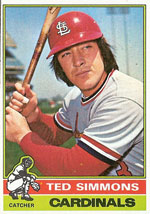
(Parker respected fellow mashers. In his memoir, Keith Hernandez recalled, “Dave Parker, one of the most talented players I’ve ever seen, came strolling up to Ted Simmons and me after witnessing a round of batting practice in Pittsburgh and exclaimed, ‘You two are the hittingest white boys I’ve ever seen.’ Simmons laughed and I loved it: I’m Keith Hernandez, Hittingest White Boy.”)

Parker made his mark in other ways, too. He was one of the first ballplayers to wear an earring on the field (a diamond with a dangly cross) and one of the first to perform a showboating home run trot.

(Parker developed variations of his trot. He’d shoot at a base with his fingers as he neared it, according to the Post-Dispatch. Or, he’d trudge toward first “like a fat man up Heartbreak Hill,” Stan Sutton of the Louisville Courier-Journal noted, and slowly circle the bases. “I’ve hit over 300 of these,” Parker told the Los Angeles Times in 1989. “I deserve the opportunity to run them out any way I want.”)

Testifying in a 1985 federal drug trial regarding cocaine distribution among ballplayers, Parker detailed his cocaine use from 1976 to 1982, and identified colleagues who used the drug, in exchange for immunity.

Business decisions

In 1992, Parker sought to own a business in Cincinnati, where he grew up and still resided. According to the Cincinnati Enquirer, “A broker suggested Parker open a Burger King restaurant. Before the deal closed, the broker instead directed Parker to Popeyes because there were 18 Burger Kings in the region and one Popeyes.”

Parker and his wife, Kellye, bought a Popeyes on busy Reading Road in Roselawn, a Cincinnati neighborhood. According to the Enquirer, Parker could be found in the dining area or in the kitchen “where he regularly preps food or helps staff.”

“We call our Roselawn restaurant the colonel-killer,” Parker told the newspaper. “I think there are something like three KFCs that have gone out of business on Reading Road since we’ve been there.”

During the summer of 1996, Parker met with Terry Collins, then manager of the Astros, who were in town for a series against the Reds. Parker and Collins were teammates in the minors. Parker told him he was interested in getting back into baseball, the Los Angeles Times reported.

In November 1996, a month after the Astros fired him, Collins was hired to manage the Angels. He retained Rod Carew as hitting coach, but added Parker to the staff. Though Parker had no coaching experience, “He bring tremendous credibility,” Collins told the Times. “He knows how to win, what it takes to win. He brings the presence and knowledge of what it takes to be successful.”

Parker, 45, said to the Times, “I know I have to display clubhouse leadership. That was the understanding when I took the job.”

Or, as the Times put it, Parker was enlisted “to help give the Angels a long-needed kick in the rear end.”

Another motivation for Parker was his appearance on the Baseball Hall of Fame ballot for the first time in 1997. As he told the Post-Dispatch, “With the Hall of Fame voting, I came back to baseball just to be more visible.”

Parker was assigned to be the first base coach and instruct the outfielders, a group that included Jim Edmonds.

Here’s the plan

As a player, George Hendrick totaled 1,980 hits, including 267 home runs, and never struck out as many as 90 times in a season. In his two years as Cardinals hitting coach, the team ranked a lackluster seventh in the National League in runs scored in 1996 and 11th in 1997. Worse, the 1997 Cardinals struck out more than any other team in the league.

The combination of the strikeouts and the hitters’ lack of application frustrated Hendrick. Though manager Tony La Russa was interested in having him return in 1998, Hendrick opted to leave, the Post-Dispatch reported.

In October 1997, Parker, who played for La Russa when he managed the Athletics, was hired to replace Hendrick. “Parker will be entrusted with correcting the Cardinals’ strikeout total,” the Post-Dispatch reported.

Parker told the paper, “When I played for Tony, I taught Jose Canseco a two-strike stance and he cut down on his strikeouts quite a bit (from 157 in 1987 to 128 in 1988). He also hit 17 home runs (from a total of 42) with his two-strike stance.”

By encouraging a batter with two strikes in the count to spread out his stance and cut down his swing, “You concentrate on just putting the ball in play,” Parker said to reporter Rick Hummel. “You look for the fastball and adjust to everything else.”

Working with a 1998 Cardinals lineup that included Ron Gant, Brian Jordan, Ray Lankford and Mark McGwire, Parker arranged contests during batting practice at spring training. According to the Post-Dispatch, “Coaches call out situations to the hitters and points are subtracted for bad execution, such as not moving a runner along. At the end of the competition, the losing side of hitters has to serve drinks and sandwiches.”

Parker told the newspaper, “You put it in their heads every day and eventually it gets there. You get a guy at third base with less than two outs, you don’t swing at a slider away … It’s constant repetition.”

One and done

Though the Cardinals still struck out a lot (1,179 times), they scored more runs in 1998 (810) than they did in 1997 (689).

Afterward, Parker told the Post-Dispatch, “If they want me back, I’d come back.” However, the Cardinals informed him he wasn’t wanted because his business interests interfered with his coaching duties.

“Coaching is a commitment,” La Russa told the Post-Dispatch. “I don’t know any coach who’s really outstanding that can have a conflict (of interest). The entrepreneur side of (Parker) prevented a total dedication to coaching … Coaching, if you do it right, consumes you. If you get into professional coaching and managing, if you have a business, you’d better find somebody to run it for you. He made a decision to divide his interests, and you can’t do that.”

Parker told the newspaper, “I really enjoy baseball, but I just don’t like being away from business … It’s tough being gone for eight months a year. My wife is working almost to death.”

Regarding his stay with St. Louis, he added, “If I had known it would have been so short, I never would have left the Angels.”

Mike Easler replaced Parker. Soon after, Mark McGwire sued People First Inc, distributor of a pain reliever, The Freedom Formula, saying the company falsely claimed he endorsed the product.

According to the Post-Dispatch, the lawsuit contended that “Dave Parker, who promoted The Freedom Formula, distributed the product to McGwire and several teammates (in 1998). Parker asked McGwire to pose for a photograph of him holding a bottle of The Freedom Formula. As a courtesy to Parker, McGwire posed for the picture but never consented to its use for any commercial purpose.”

(McGwire’s lawyer told the newspaper the dispute had nothing to do with Parker’s departure from the Cardinals. The suit was dropped when People First Inc. agreed to stop using McGwire’s likeness, the Post-Dispatch reported.)

Parker’s Popeyes restaurant continued to do well and he eventually opened a second one in Forest Park, a Cincinnati suburb.

Read Full Post »

The Cardinals acquired right-hander Bob Purkey to be their fifth starter. It turned out they got a whole lot more from him.

On Dec. 14, 1964, the Cardinals traded Roger Craig and Charlie James to the Reds for Purkey, projecting him to join a rotation with Bob Gibson, Ray Sadecki, Curt Simmons and Tracy Stallard.

Purkey, 35, delivered 10 wins for the 1965 Cardinals, and also provided a bonus. Gibson credited Purkey with making him a better pitcher.

In his autobiography “Stranger to the Game,” Gibson said, “Purkey knew how to pitch and win. I learned more about pitching from Purkey in one season as his teammate than I did from any pitching coach I ever had.”

Pitching lessons

Gibson, 29, was the Cardinals’ ace, winning 19 in 1964 and then two more in the World Series, including Game 7, but Purkey helped him improve.

In his autobiography, Gibson said, “Purkey taught me a way to take advantage of my bad curveball. I seldom threw my curve because I was afraid of hanging it, but Purkey convinced me that a hanging curve can oddly enough be an effective pitch to left-handed hitters, who dive into (it) expecting the ball to break. So I’d leave the curveball hanging inside now and then to left-handed hitters.

“Another pitch Purkey added to my repertoire was the backup slider _ a slider that doesn’t break away from a right-handed hitter but holds its course and maybe even bends back a little like a screwball,” Gibson said in his autobiography. “Purkey explained that, especially in day games, hitters will recognize the spin on a pitch, and when they identify a slider they will instinctively lean out in anticipation of the ball breaking away from them. A quick backup slider, consequently, ought to result in broken bats and balls hit weakly off the fists.”

Gibson told Purkey he sometimes accidently threw sliders that backed up but didn’t know how to deliver the pitch on purpose.

In the book “Sixty Feet, Six Inches,” Gibson said Purkey “showed me how to do it purposely by raising your arm a little too high and then throwing it like mad, as hard as you can.”

As Gibson noted in his autobiography, “So I started deliberately overthrowing the slider on occasion, and just like that I had a nasty new pitch.”

The Tigers’ Willie Horton told Cardinals Magazine it was a backup slider Gibson threw him for his 17th strikeout to finish Game 1 of the 1968 World Series. Gibson said to Cardinals Yearbook he was trying to pitch a slider, but “I overthrew it and didn’t get it where I wanted. Instead of breaking outside, it went right at him. He flinched and it broke over the plate for strike three. I had missed by a big margin, but it was a good place to miss.”

In “Sixty Feet, Six Inches,” Gibson said of the backup slider, “Purkey had it perfected, but it takes a lot of guts to throw something that stays over the plate and doesn’t really do much. The vast majority of the time, I wasn’t that courageous. It’s not a pitch that children should try at home.”

Learning the craft

Born in Pittsburgh, Purkey grew up in the Mount Washington neighborhood across the river from downtown. He didn’t play for a baseball team until he was 13. Purkey took up pitching because his favorite player was the Cardinals’ Harry Brecheen. “I’d go to Forbes Field whenever (Brecheen) was pitching,” Purkey recalled to the St. Louis Post-Dispatch. “I admired his style, his guts.”

Purkey, 18, signed with the hometown Pirates in 1948 for $150 a month. After four years in the minors and two in the Army, he reached the majors with the Pirates in 1954 when Branch Rickey was general manager. In his first start, Purkey beat the Cardinals and held Stan Musial hitless. Boxscore

At spring training in 1955, Purkey was given special instruction to learn an extra pitch. “Rickey himself took charge and showed some of us how to throw the knuckleball,” Purkey told the Post-Dispatch.

Purkey added the knuckler to an arsenal that included a sinker and slider. “He used to throw you everything but the kitchen sink,” the Dodgers’ Ron Fairly said, according to the Post-Dispatch. “Now he throws the sink, too.”

Joe Brown replaced Rickey as general manager in 1956 and a year later he dealt Purkey to the Reds for reliever Don Gross. “The worst trade I ever made,” Brown later told the Pittsburgh Post-Gazette.

The Reds were managed by former catcher Birdie Tebbetts, and he and Purkey clicked. Purkey, who never had a winning season with the Pirates, was 17-11 for the 1958 Reds.

“I didn’t become a pitcher until I joined Birdie Tebbetts,” Purkey explained to the Post-Dispatch. “Birdie told me I’d been a defensive pitcher, meaning I nibbled too much at the corners and fell behind too much on the ball-and-strike count. He knew I could get the ball over. ‘Be aggressive,’ he told me. ‘Get that first pitch over with good stuff on it and challenge the hitter.’ “

Under control

With the Reds, Purkey began using the knuckleball more frequently. “It took five years to develop the knuckler where I could throw it effectively in a game,” he told the Post-Dispatch.

The Cardinals’ Ken Boyer said to The Cincinnati Post, “When he gets ahead of you (with the sinker), he throws you that knuckler _ and he has a good one.”

In a September 1961 win against the Cardinals, Purkey threw five consecutive knuckleballs to Stan Musial and struck him out looking. (As usual, Musial adjusted and hit .323 with three home runs versus Purkey for his career). Boxscore

“Of all the knuckleball pitchers I’ve seen, I’d have to rate Purkey’s second only to Hoyt Wilhelm’s,” Darrell Johnson, who caught in the majors for six years, told the Post-Dispatch.

Unlike many other knuckleballers, Purkey was a control pitcher. He walked 49 in 250 innings in 1958; 43 in 218 innings in 1959.

Because batters knew he threw strikes, Purkey made sure they didn’t get too comfortable at the plate. He eight times ranked among the top 10 in the league in hitting batters with pitches. He plunked 14 in 1962. A favorite target was the Cardinals’ Curt Flood, who got struck by Purkey pitches five times in his career.

“He’d brush back his own grandma if she crowded home plate and took too firm a toehold in the batter’s box,” Bob Broeg wrote in the Post-Dispatch.

Purkey said to Broeg, “Willie Mays must have thought I was the meanest man in the league. I’d brush him back, pitch him tight, brush him back, pitch him tight.”

Highs and lows

After being fired by the Cardinals, Fred Hutchinson became Reds manager and led them to a National League pennant in 1961. Purkey, who won 16 that season, got the start in Game 3 of the World Series versus the Yankees.

Ahead 2-1, Purkey got a slider too high to Johnny Blanchard, who tied the score with a home run in the eighth, and then a slider too low to Roger Maris, who won it for New York with a home run in the ninth. Regarding the Maris homer, Purkey said to the Dayton Daily News, “It looked to me, when he hit it, like a guy swinging at a golf ball with his No. 9 iron.” Boxscore

Everything came together for Purkey the next season. He had the best winning percentage (.821) in the league, with a 23-5 record for the 1962 Reds. Purkey won his first seven decisions and was 13-1 after beating Sandy Koufax and the Dodgers on June 22. Boxscore

Purkey tore a muscle in his right shoulder at spring training in 1963. He rebounded in 1964, winning eight of his last 11 decisions and finishing at 11-9.

Wrapping it up

Starting against the Reds in the 1965 Cardinals’ home opener, Purkey’s knucklers rolled toward the plate like beach balls. Vada Pinson hit one for a three-run homer and Gordy Coleman clouted another for a grand slam. After allowing nine runs in six innings, Purkey told the Post-Dispatch, “I just did a lousy job of pitching and I had the daylights kicked out of me.” Boxscore

With a 9.00 ERA after his first four starts, the Cardinals sent him to the bullpen for a month. When he returned to the rotation, he gradually got better. For the month of July, Purkey was 3-1 with a 1.76 ERA in four starts.

A week after he turned 36, Purkey pitched well against the Astros, but lost, 3-2, to 18-year-old Larry Dierker. In his next start, Purkey shut out the Giants and beat 44-year-old Warren Spahn. Boxscore and Boxscore

In April 1966, the Cardinals sold Purkey’s contract to the Pirates and he played his final season with them. His career record: 129-115, including 103-76 with the Reds. Purkey was 17-11 against the Cardinals.

Though he experienced tragedy in 1973 when his son, Bob Jr., died of a heart ailment at 18, Purkey had a long and successful second career operating an insurance agency in the Pittsburgh suburb of Bethel Park.

Read Full Post »

When the Cardinals offered Rico Carty the chance to begin his professional baseball career with them, the right-handed power hitter from the Dominican Republic was receptive. Then again, Carty was agreeable to signing with any club.

Away from home for the first time, Carty, 19, played in the Pan-American Games at Chicago in 1959. Impressed by his hitting, several big-league clubs sought to sign him.

“The Cardinals made the best offer, $2,000, and I wanted to go with them,” Carty told the St. Louis Post-Dispatch.

Unschooled in English, Carty signed with the Cardinals and also with at least three other teams _ Braves, Giants and Pirates. “I didn’t know you couldn’t sign with more than one club,” Carty told the Associated Press.

Carty also was under contract to Estrellas, a professional team in the Dominican Republic. When the Braves made a deal with Estrellas to acquire the rights to Carty, he became a member of the Milwaukee organization and all other contracts were voided, the Post-Dispatch reported.

A National League batting champion (.366 in 1970), Carty played for 15 seasons with the Braves and five other clubs in a career marked by health and injury woes, conflict and controversies.

Finding his way

Carty had 15 brothers and sisters. His father worked in a sugar mill and his mother was a midwife. As a teen, Carty became an amateur boxer, winning 17 of 18 bouts, but quit at the insistence of his mother, according to the Post-Dispatch.

His slugging on the diamond got him to the pros, but his fielding held him back. When Carty entered the Braves’ farm system in 1960, they tried him at catcher. As Carty recalled to the Atlanta Journal, “I was really brutal catching.”

With the Austin (Texas) Senators in 1963, Carty was moved to the outfield. He produced 100 RBI and was hailed “the best hitting prospect in the organization,” according to The Sporting News.

Called up to the Braves in September 1963, Carty, 24, made his major-league debut in a pinch-hitting stint at St. Louis and struck out against Ray Sadecki. Boxscore

Big-league bat

Batting .408 at spring training in 1964, Carty made the Braves’ Opening Day roster and continued his torrid hitting.

On May 23, 1964, at Milwaukee, Carty clouted two home runs for five RBI against the Cardinals’ Roger Craig. Boxscore

Carty’s hitting, combined with his adventures in the outfield, made him the darling of the bleacher fans at Milwaukee’s County Stadium. “They cheer every move he makes,” The Sporting News noted. “He is a thrill a minute fielder, the type who starts the wrong way on a ball and winds up making a circus catch.”

For the season, Carty hit .330. Against the Cardinals, who became 1964 World Series champions, the rookie batted .343 in 18 games.

Applying the hammer

The Braves moved to Atlanta after the 1965 season and Carty became a fan favorite there, too.

“Carty can most definitely charm the fans,” Frank Hyland of the Atlanta Journal observed. “They love him and he plays them like a drum. There is perhaps no athlete in any sport who makes himself as available as Carty.”

Rod Hudspeth of the Atlanta Journal added, “Carty has a lot of ham and a little con artist in him. He knows exactly when to turn and flash the big smile to a fan wanting a snapshot, the precise time to sign autographs and milk the most mileage from them, and the opportune moment to toss a baseball into the stands and get the big crowd reaction.”

Inside the clubhouse, it was a different story. “He was not well-liked by many teammates,” the Journal reported. Columnist Furman Bisher noted, “Teammates give him wide berth, even fellow Dominicans Felipe Alou and Sandy Alomar.”

In his autobiography “Alou: My Baseball Journey,” Felipe Alou said, “About the only guy I ever saw Hank (Aaron) have a problem with was Rico Carty … Rico was easy to have a problem with. He was defiant, belligerent, constantly challenging … Rico was a brawny guy who liked to intimidate people.”

On a Braves charter flight from Houston to Los Angeles in 1967, Carty got into an argument with Aaron and it boiled over into a fight.

In his autobiography “I Had a Hammer,” Aaron said, “Carty was playing cards two rows behind me when I heard him call me a ‘black slick.’ I stood up and asked him what he said, and he repeated it … A second later, we were swinging at each other … My fist went right by his head and put a hole in the luggage rack of the plane. Our teammates finally broke it up. I think there were three guys holding me.”

Aaron and Carty each told the Atlanta Constitution he was sorry the fight happened, but Aaron added, “He called me a name that I couldn’t take, and I would have fought anybody for that. It was a matter of principle and pride … If I’m called that name again, I’ll fight again.”

Carrying on

At spring training in 1968, Carty was diagnosed with tuberculosis. While undergoing six months of treatment in a sanatorium at Lantana, Fla., Carty received a letter from Cardinals manager Red Schoendienst, who was stricken with tuberculosis shortly after he played for the Braves in the 1958 World Series. “He said I was lucky that I would not have to be cut, like him,” Carty told Ira Berkow of Newspaper Enterprise Association. (Schoendienst underwent surgery to remove part of an infected lung.)

Back with the Braves in 1969, Carty suffered three shoulder separations but hit .342, helping Atlanta win a division title. Columnist Jesse Outlar noted, “That seemed inconceivable. You simply don’t spend an entire year in a hospital, then belt major league pitching at that clip with bum or sound shoulders.”

Carty, 30, reached his peak with the 1970 Braves. He batted .423 for April, .448 for May and put together a 31-game hitting streak. Though left off the All-Star Game ballot, a flood of write-in votes from the fans made him a National League starting outfielder along with Hank Aaron and Willie Mays.

A month later, Carty got into a clubhouse scuffle with teammate Ron Reed

The season ended with Carty as the league leader in hitting (.366) and on-base percentage (.454). He produced the highest batting average to lead the National League since Stan Musial hit .376 for the Cardinals in 1948.

Tough to take

Good times were followed by the bad. In December 1970, Carty suffered a triple fracture of his left knee, plus torn cartilage, when he collided with Matty Alou while chasing a fly ball during a game in the Dominican Republic. The severity of the injury prevented Carty from playing in 1971.

More trouble awaited.

In August 1971, while Carty and his brother-in-law, Carlos Ramirez, were in a car at a stoplight in Atlanta, two off-duty policemen pulled up alongside and accused them of being “cop-killing niggers,” the Atlanta Journal reported.

Carty noticed a uniformed officer inside a police car nearby and drove up to report what had happened. The off-duty cops followed and there was an altercation. Carty said the three white policemen beat him and his brother-in-law, using a billy club and the butt of a revolver. Carty and his relative were handcuffed and arrested on charges of assault and creating turmoil.

Atlanta mayor Sam Massell said the police actions appeared to be “blatant brutality,” United Press International reported.

Upon review, the three cops were fired by Atlanta police chief Herbert Jenkins. According to the Atlanta Constitution, Jenkins called it “the worst case of misconduct of a police officer I’ve ever seen.”

In dismissing all charges against Carty and his brother-in-law, Municipal Court Judge Robert M. Sparks Jr. said the defendants were “shamefully handled.”

Soon after, in an unrelated incident, Carty’s barbecue restaurant in Atlanta was destroyed in a fire.

Slow motion

Carty’s attempt to come back from the shattered knee and other ailments (he was hospitalized for pleurisy in 1971) was a struggle. At 1972 spring training, he said to United Press International, “When I came back after being sick with tuberculosis, it was just a matter of resting and building up my strength. Now there is pain to overcome. It does not hurt when I bat, but when I run it hurts.”

Braves manager Lum Harris told the wire service, “Rico never was a speedster, but I’ve never seen him as slow as he is now.”

Carty played in 86 games for the 1972 Braves, hit .277 and was traded to the Rangers for pitcher Jim “Pink” Panther.

The Rangers figured Carty to be an ideal designated hitter, but manager Whitey Herzog wasn’t impressed with what he saw. In the book “Seasons in Hell,” Herzog said to author Mike Shropshire, “When Rico runs from home plate to first, you could time him with a sundial.” Herzog also said he thought Carty was “crazier than a peach orchard sow.”

After a game against the Orioles, Carty told Shropshire he intentionally fouled off a pitch he thought was ball four because he didn’t want to spoil Jim Palmer’s bid for a perfect game. When Shropshire informed Herzog of this, the manager rolled his eyes and replied, “What a bunch of crap.”

According to the Fort Worth Star-Telegram, Herzog and Carty almost got into a dugout fistfight in June after Carty cussed Herzog for not backing him in a dispute with an umpire over a called strike. Soon after, Carty was sent packing. He finished out the season with the Cubs and Athletics.

Unwanted in the majors, Carty, 34, went to the Mexican League in 1974.

Another stab

Once again, Carty showed it was unwise to count him out. He hit .354 in the Mexican League. That impressed the Cleveland Indians, who brought him back to the majors in August 1974.

In four seasons with Cleveland, Carty batted .303, but he and manager Frank Robinson clashed. Robinson described his relationship with Carty as “a cold war,” the Associated Press reported.

Carty and Robinson soon were gone from Cleveland. Carty had one more big season, 1978, when he combined for 31 home runs and 99 RBI with the Blue Jays and Athletics.

During a road trip with the Blue Jays in 1979, a toothpick pierced Carty’s finger when he reached into a travel bag. Carty removed part of the toothpick, but the tip remained lodged under the skin.

“The thing keeps me from gripping the bat right, but they tell me it will work its way out eventually,” Carty told the Toronto Star.

The finger got infected and Carty “had to squeeze pus from his hand before hitting,” the Star reported.

Though the sliver finally was removed, his batting average sank like a martini olive untethered from its cocktail stick. He ended the season, his last, at .256.

That cost Carty a .300 career batting mark. He settled instead for .299.

Read Full Post »

As a high school all-star, Don Ferrarese impressed Babe Ruth, who, like the California teen, knew what it was like to be a left-handed pitcher with stuff. Later, when Ferrarese was in the majors, he hit like Ruth, too, at least for one game _ cracking three consecutive doubles.

In his first big-league start, Ferrarese struck out 13. In his first win, he held the Yankees hitless for eight innings, then completed the shutout by retiring Mickey Mantle with the potential tying run in scoring position.

For Stan Musial and Ted Williams, Ferrarese was as hard to hit as it was to say his name correctly.

Ferrarese (pronounced “Fer-ar-ess-ee,” with the emphasis on the “ess”) ended his playing career as a Cardinals reliever and was especially effective against left-handed batters. He also pitched for the Orioles (1955-57), Indians (1958-59), White Sox (1960) and Phillies (1961-62).

Meeting Babe

Born in Oakland, Don Ferrarese was the son of Italian immigrants, Hugo and Bruna Ferrarese. (“I am a rare Italian that cannot sing a note,” Don told the Victorville, Calif., Daily Press.) The family moved to Lafayette, Calif., and that’s where Don attended high school while working in his parents’ produce business.

(Ferrarese went to Acalanes High School, also the alma mater of Hall of Fame quarterback Norm Van Brocklin.)

As a prep freshman, Ferrarese was a left-handed second baseman. A math teacher suggested he try pitching, the Oakland Tribune reported.

Though he was short and slight, Ferrarese’s pitches had speed and movement. After his senior season, he was chosen for an August 1947 prep all-star game sponsored by Hearst newspapers at the Polo Grounds in New York. Other future big-leaguers invited to play included Gino Cimoli, Dick Groat and Bill Skowron.

Babe Didrikson Zaharias performed a golf and baseball skills exhibition as part of the entertainment before the game, which drew 31,232 customers.

Starting for the U.S. all-stars, Ferrarese pitched three scoreless innings and lined a double to the wall in left against the Metropolitan all-stars. Named most valuable player of the game, Ferrarese was presented a trophy by Eleanor Gehrig, widow of Lou Gehrig. A spectator was the game’s honorary chairman, Babe Ruth.

“Babe Ruth asked to meet me,” Ferrarese told Newspaper Enterprise Association. “He was in the front row of box seats, all hunched over and wearing a camel’s hair beanie. Ruth had throat cancer, so it was hard to hear him.”

(Ruth died a year later at 53.)

Ferrarese enrolled at Saint Mary’s College in California, pitched well as a freshman and caught the attention of Jimmy Hole, a scout for the 1948 Oakland Oaks of the Pacific Coast League. The Oaks’ manager was Casey Stengel. Ferrarese signed with them for $4,000 in June 1948, three days before he turned 19, and was sent to Stockton of the California League.

The little left-hander was effective _ when he got the ball over the plate, which wasn’t often enough. In his first three seasons in the minors, he walked 48 in 32 innings with Stockton, 184 in 188 innings with Albuquerque, and 209 in 185 innings with Wenatchee (Wash.).

The best experience Ferrarese had at Wenatchee was he met Betty Jean Olsen, “who ate lunch at the same restaurant where he ate breakfast at noon,” according to the St. Louis Post-Dispatch.

The couple married and Ferrarese did a two-year hitch in the Army. After his discharge, he pitched poorly (6.28 ERA) for the 1953 Oakland Oaks.

Then he got the break his career needed.

True grit

After the Dodgers fired manager Chuck Dressen, who led them to two National League pennants in three seasons, he went to Oakland to manage the 1954 Oaks. Ferrarese won 18 that season and struck out 184.

“It was Chuck Dressen who helped me most,” Ferrarese said to the New York Daily News. “Chuck taught me how to throw my curve and helped me with my control.” He also told Newspaper Enterprise Association, “I was strictly a thrower before Dressen got hold of me in Oakland.”

Dressen said to the Baltimore Sun, “He’s got a great curve, and can really fire that ball when he relaxes and doesn’t try to aim it.”

The Oaks capitalized, selling Ferrarese’s contract to the White Sox for $30,000 in December 1954. The White Sox then packaged him in a trade with the Orioles.

Ferrarese, 5-foot-9, 170 pounds, opened the 1955 season with the Orioles, made six relief appearances and was sent down to the San Antonio Missions. In 12 games for them, including nine starts, he was 9-0 with a 1.48 ERA.

Sticking with the Orioles in 1956, Ferrarese’s first start came against the Indians, who won, 2-1, though Ferrarese struck out 13. “When you’ve got a curve like he has and don’t have to be afraid to throw it when you’re behind, you’re a tough man,” Indians pitching Mel Harder said of Ferrarese to the Baltimore Sun. Boxscore

Ferrarese’s next start was another nail-biter. Displaying what the Sun called “170 pounds of grit and heart,” he entered the ninth at Yankee Stadium with a 1-0 lead (Ferrarese’s single drove in the run) and a chance for a no-hitter. First up in the inning was Andy Carey, who, like Ferrarese, had attended Saint Mary’s College.

Carey swung down on a pitch. The ball struck near home plate and bounced high over the mound _ a classic Baltimore chop. Ferrarese pedaled backward, peering for the ball in the afternoon glare, while Carey raced toward first. “I lost it in the sun as it was coming down,” Ferrarese told the Baltimore newspaper.

As the ball plopped into Ferrarese’s glove, he stumbled slightly, then bounced a hurried throw to first _ too late to nab Carey, who reached base with the first hit.

After Billy Martin struck out, Hank Bauer blooped a single off the bat handle into short left, moving Carey to second. Pitcher Don Larsen, pinch-hitting for second baseman Bobby Richardson, popped out to the catcher. Mickey Mantle, leading the American League in hitting, was next.

According to the Baltimore Sun, Mantle “swung viciously” at a Ferrarese curve and lofted a gentle fly to center for the final out. Boxscore

“That near no-hitter Ferrarese pitched ranks as one of my big thrills,” Orioles manager Paul Richards told the Sun. “It really was something to watch him battle them inning after inning and finish up strong after Carey got that first hit.”

Yankees manager Casey Stengel said to the newspaper, “I thought he deserved a no-hitter. Neither hit was a good one.”

On the move

The magic didn’t last. Two weeks later, Ferrarese faced the Yankees again and gave up seven runs in two innings. He finished the 1956 season at 4-10.

The next year, demoted to Vancouver and instructed to develop a slider, Ferrarese became “almost discouraged enough to quit,” the St. Louis Post-Dispatch reported. A teammate, former Cardinals outfielder Joe Frazier, showed him how to throw the pitch. “I’ve had a good slider ever since,” Ferrarese said.

Traded to the Indians for Dick Williams in April 1958, Ferrarese started against the Orioles four months later, pitched 11 scoreless innings, then walked Williams with the bases loaded in the 12th and lost, 1-0. Boxscore

In 1959, Ferrarese won four of his first six decisions for the Indians. A highlight came on May 26 when he smacked three doubles versus the White Sox’s Dick Donovan and pitched 6.1 scoreless innings for the 3-0 win at Chicago’s Comiskey Park. Ferrarese drove in two of the runs and scored the other. “There was nothing fluky about Ferrarese’s hits: all were hard smashes into right-center,” the Akron Beacon Journal reported. Boxscore

A month later, inflammation spread throughout Ferrarese’s left shoulder. After the season, he was dealt to the White Sox, who sent him to the minors. Eventually, his shoulder healed and the Phillies acquired him in April 1961. He didn’t throw as hard, but his control was better.

Appearing in 42 games, including 14 starts, for the 1961 Phillies, Ferrarese had the best ERA (3.76) for a team that lost 107 games, including 23 in a row.

Lefty specialist

Early in the 1962 season, the Cardinals acquired two left-handed relievers _ Ferrarese from the Phillies (for Bobby Locke) and Bobby Shantz from Houston.

Between May 13 and June 12, Ferrarese made nine relief appearances totaling 12.2 innings for the Cardinals, didn’t allow a run and got a win against the Phillies at St. Louis. Boxscore

In his first appearance at Philadelphia since the trade, he clouted the lone home run of his big-league career, a two-run shot versus Jim Owens. Boxscore

Ferrarese earned a save for the Cardinals against the Reds, striking out Vada Pinson to end the game with the potential tying run on second. Boxscore

As a Cardinal, left-handed batters hit .195 against Ferrarese. For his career, he limited them to a .214 batting average. Stan Musial hit .091 (1 for 11) versus Ferrarese and Ted Williams was at .143 (1 for 7).

(A right-handed batter, the Cardinals’ Julian Javier, who had a career .299 batting mark against left-handers, was hitless in 15 at-bats versus Ferrarese.)

In February 1963, the Cardinals dealt Ferrarese to Houston for pitcher Bobby Tiefenauer, but Ferrarese opted to go home and help his parents run Hugo’s Deli in Apple Valley, Calif.

After his folks retired in 1974, Ferrarese owned and operated Ferrarese’s Ristorante in Victorville, Calif., and then another restaurant, Hugo’s, in Apple Valley. He also ran a commercial real estate company.

A charitable foundation created by Ferrarese provided college scholarships to students based on how much they’d done to help their communities.

Read Full Post »

« Newer Posts - Older Posts »