Feeds:
Posts
Comments

Archive for the ‘Opponents’ Category

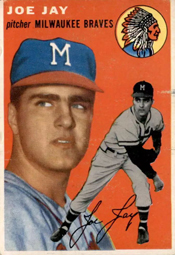
The Milwaukee Braves looked at Joey Jay and saw a problem pitcher. Fred Hutchinson looked at him and saw an ace.

A right-hander, Jay became the first former Little League player to reach the majors when he joined the Braves out of high school at 17 in 1953.

At 6-foot-4, 225 pounds, Jay looked like a man but acted like a boy. He was immature, got labeled a spoiled kid and the Braves were reluctant to pitch him.

Fred Hutchinson, when he managed the Cardinals, got a look at what Jay was capable of accomplishing. In 1958, Jay, who had seven wins that year as a fill-in starter, was 3-1 with an 0.86 ERA versus the Cardinals.

Two years later, when Hutchinson was Cincinnati manager, the Reds acquired Jay at Hutchinson’s urging and he prospered, achieving consecutive 21-win seasons and helping the club become 1961 National League champions.

Not ready for prime time

As a Little Leaguer in Connecticut, Jay played first base. He was a pitcher in high school. Multiple pro teams were interested, including the Pirates. Jay met with their general manager, Branch Rickey, but accepted a $40,000 bonus from the Braves, in part, because his summer league coach was a Milwaukee scout, according to Sports Illustrated.

Because of the bonus amount, Jay was required under baseball rules then to be on the Braves’ roster for two full years before he could be sent to the minors.

The teen didn’t receive much of a welcome when he joined the Braves in June 1953. He rarely pitched and manager Charlie Grimm “never said two words to me,” Jay told The Sporting News.

According to Sports Illustrated’s Walter Bingham, “Jay quickly won himself a reputation as an eater and sleeper of championship caliber. He seldom was seen awake without a candy bar or a soft drink, often with both. He would eat in the bullpen during games. At one point, he weighed 245 pounds, which, even at his height, made him look fat.

“On his first trip with the Braves, he overslept one day and arrived at the park 20 minutes before game time. Some of the older players, who resented bonus players anyway, didn’t let Jay forget it. Another time, Jay fell asleep on the bus coming back from Ebbets Field. When the bus arrived at the hotel, all the players tiptoed off and the bus driver drove away still carrying Jay, fast asleep.” 

Jay pitched 10 innings for the 1953 Braves and didn’t allow a run, but he was unhappy. “I felt I was a burden on the club,” he told The Sporting News. “My dad finally talked me out of quitting.”

The following year, he totaled 18 innings for the 1954 Braves and then 19 innings for the 1955 club before being sent to Toledo. Jay was in the minors in 1956 and for most of 1957.

“He hadn’t grown up,” Ben Geraghty, who managed Jay with Wichita in 1957, told Sports Illustrated. “He had an awful temper.”

One day, Jay got mad during a game, sulked and began lobbing pitches. Afterward, Geraghty said to him during a team meeting “that if he didn’t have the guts to act like a man, he could clear out,” Sports Illustrated reported.

Jolted, Jay went on to post a 17-10 record for Wichita.

Looking good

Jay, 22, began the 1958 season in the Braves’ bullpen, struggled (9.00 ERA in four appearances) and was “the lowest-ranking” of the club’s relievers, according to The Sporting News.

When starter Bob Buhl went on the disabled list in May because of elbow pain, Gene Conley replaced him but disappointed.

In desperation, manager Fred Haney started Jay on June 13 at St. Louis. He held the Cardinals scoreless and got the win in a game shortened to six innings because of rain.

“Stan Musial (0-for-2 with a walk) praised Jay” for showing the ability “to get over his good fastball, curve, changeup and slider,” the St. Louis Post-Dispatch reported. Boxscore

Nine days later, matched against Sal Maglie, Jay was a hard-luck loser in a 2-1 Cardinals triumph, but his impressive pitching in two starts versus St. Louis convinced Haney to keep him in the rotation. Boxscore

“He has the confidence to throw his best curve at two balls and no strikes,” Braves catcher Del Crandall told Sports Illustrated.

In seven July starts for the 1958 Braves, Jay was 5-2 with a 1.39 ERA. Two of those wins came against the Cardinals _ a four-hitter to beat Maglie at St. Louis on July 15, and a two-hit shutout at Milwaukee a week later. Boxscore and Boxscore

“There isn’t a better pitcher in our league right now,” Braves coach Whit Wyatt said to The Sporting News.

The good vibes didn’t last long, though. Jay pulled a tendon in his right elbow and was limited to 11 innings in August. Then, in his lone September appearance, a relief stint against the Cardinals, he fractured his left ring finger when he knocked down a hard grounder from Irv Noren. Boxscore

Milwaukee won the pennant but didn’t include Jay (7-5, 2.14 ERA) on the World Series roster.

Change of scenery

Jay regressed in 1959 (6-11, 4.09 ERA).  “He just won’t do anything in pregame drills,” Haney complained to Sports Illustrated. “He’s fat and he’s too lazy to get in shape.” In 1960, he was 9-8.

Fred Hutchinson, fired by the Cardinals near the end of the 1958 season, became Reds manager in July 1959 and needed pitchers. The Reds allowed the most runs in the National League in 1959 and the second-most in 1960.

Hutchinson and Braves pitcher Lew Burdette had homes on Anna Maria Island in Florida and attended cookouts together. Hutchinson asked Burdette about Jay and Burdette recommended him, Jay told the Cincinnati Enquirer.

In December 1960, the Reds dealt shortstop Roy McMillan to the Braves for Jay and Juan Pizarro. (Pizzaro was flipped to the White Sox for third baseman Gene Freese, who played for Hutchinson with the Cardinals.)

Jay got off to a shaky start in his Reds debut at St. Louis. In the first inning, after he gave up two runs, he walked a batter to load the bases with two outs. Jay expected to be lifted when Hutchinson came to the mound. Instead, the manager challenged him: “Don’t walk yourself out of there. Make them knock you out.”

As author Doug Wilson noted in a book about Hutchinson, “Jay, surprised and grateful, pitched his way out of the jam. Jay lost his first three decisions in 1961 but his manager stuck with him. Jay responded to this confidence by turning into one of the best pitchers in the league.” Boxscore

“That’s all I did for him: Let him pitch,” Hutchinson told The Sporting News.

Joining a rotation with Jim O’Toole and Bob Purkey, Jay helped transform the Reds’ pitching staff from one of the worst in the league to the best.

In his book “Pennant Race,” reliever Jim Brosnan recalled how during a clubhouse meeting at Pittsburgh a confident Jay held a scorecard in one hand and a cigar in the other while going over the Pirates’ batters. After the game, which Jay won, he sat next to Brosnan on the bus ride to the airport and puffed on a pipe.

“You always smoke a pipe when you win?” Brosnan asked him. “Usually you got a cigar in your mouth.”

“Pipe relaxes me,” Jay replied. “You should try one.”

Jay still packed on the pounds _ “I’m about 12 jelly rolls and 15 cream puffs too heavy,” he told Brosnan. “I buy them for the kids, then eat them myself” _ but was fattening up on wins, too. He led the league in wins (21) and shutouts (four) as the 1961 Reds (93-61) won a pennant for the first time in 21 years.

In the World Series against the Yankees, Jay got the Reds’ only win _ a four-hitter in Game 2. Video and Boxscore

Ups and downs

Jay won 21 again in 1962, though he was 0-3 versus the Cardinals. The 1962 Reds (98-64) totaled five more wins than they did in their championship season, but finished in third place.

On the final day of the 1963 season, Stan Musial played his last game for the Cardinals and exited after getting a pair of singles against Jim Maloney. The Cardinals won in the 14th on Dal Maxvill’s RBI-double versus Jay. He lost 18 that season, including all four decisions against the Cardinals. Boxscore

Jay was involved in another noteworthy game on the last day of the 1964 season. The Cardinals and Reds entered the day tied for first place.

At Cincinnati, Jay relieved in the fifth with one out, two on and the Phillies ahead, 4-0, and got Tony Taylor to ground into a double play. In the sixth, however, Jay gave up a two-run single to Tony Gonzalez and a three-run homer to Dick Allen. The Phillies won, 10-0, enabling the Cardinals to secure the pennant when they beat the Mets. Boxscore

In spring 1966, Cardinals general manager Bob Howsam agreed to trade Nelson Briles, Steve Carlton, Phil Gagliano and Mike Shannon to the Reds for Leo Cardenas, Gordy Coleman and Jay, but the deal was blocked by Cardinals upper management, The Sporting News reported.

Soon after, in June 1966, Jay was dealt to the Atlanta Braves and he completed his career with them that season.

Jay was 99-91 in the majors. Willie Mays batted .200 (8-for-40) against him and Stan Musial was at .208 (10-for-48).

In his autobiography, Musial said of Jay, “Fred Hutchinson gave him confidence and a good talking-to. At Milwaukee, Jay struck me as having pretty good stuff … but he threw a lot of slow curves and wasted his fastball. When the Reds got him, Hutchinson … made him throw that good fastball for strikes.”

Read Full Post »

Rudy May pitched 16 years in the majors. He never appeared in an All-Star Game, and he lost more than he won, but at times he nearly was unhittable, performing on a par with teammates such as Nolan Ryan, Catfish Hunter and Jim Palmer.

One of May’s nicknames was The Dude. He got it, the Baltimore Sun noted, because of “his funky wardrobe” and “unflappable optimism.”

He was an interesting dude for more reasons than that though. His boyhood friend was Joe Morgan, the future Hall of Fame second baseman. May’s first marriage was to a rhythm and blues singer. When he wasn’t playing baseball, May worked as a licensed commercial scuba diver.

Though he spent most of his baseball career in the American League, the Cardinals saw plenty of him during a stint with the Montreal Expos and sought to sign him when he became a free agent.

Early journeys

Though born in Kansas, May was raised in Oakland. That’s where he and Joe Morgan became friends. They’d go to Arroyo Viejo Park near their homes and “we’d pitch and catch for hours,” May recalled to the Montreal Gazette. May and Morgan also were baseball teammates at Castlemont High School.

A left-hander, May was with four organizations in his first three seasons as a pro. He was 18 when the Twins signed him in November 1962. They sent him to Bismarck, N.D., and, though he won 11 and struck out 173 in 168 innings there, he also walked 120 and threw 25 wild pitches.

After a season (1964) in the White Sox system, May was traded to the Phillies, who flipped him to the Angels for Bo Belinsky.

May, 20, made the 1965 Angels’ Opening Day roster as a starter. “We never had any question about Rudy’s stuff being major league,” Angels pitching coach Marv Grissom told the Oakland Tribune. “The only question is his control.”

In his big-league debut, May was matched against Detroit’s Denny McLain. The rookie held the Tigers hitless until Jake Wood doubled with one out in the eighth. May completed nine innings, striking out 10 and allowing the one hit, but the Tigers won in the 13th. Boxscore

In his next appearance, a start versus the Yankees and Mel Stottlemyre, May gave up his first home run, a Mickey Mantle solo shot, and lost, 1-0. Boxscore

Treasure hunts

During that 1965 season, outfielder Leon Wagner introduced May to Eleanor Green, a singer with the group The Superbs.

“She was only 18 and she was singing at this club in L.A. and I thought when I saw her that, ‘whoo-eee _ this was some kind of chick,’ ” May said to the Los Angeles Times. “She’d had these two hit records that year _ ‘Baby, Baby All The Time,’ and ‘Baby’s Gone Away‘ … I really came on strong. She showed me who the real pro was. She put me off good.

“Later that year, I was peddling my threads _ you know, just walking around, cooling it _ in Hollywood when I stopped at this club and saw this same girl. I sent a note backstage and she came out to met me. It was different this time, man … Three weeks later, we flew to Las Vegas and got married.”

While his personal life was on the upswing, May’s pitching career hit a sour note. He hurt his shoulder, developed arm problems and was demoted to the minors.

Limited to 35 innings pitched in 1966 and 84 in 1967, May “admits he thought about saying goodbye to baseball” until his wife convinced him to continue, the Los Angeles Times reported.

May wanted a backup plan, though. A recreational scuba diver since his teens, May took commercial diving courses in 1967, earned a license and began spending winters “working on salvage and construction projects beneath the sea,” United Press International reported.

Asked about his most dangerous dive, May told the wire service that while working on a salvage project about 400 feet under the surface, “I got the bends and blacked out. I was in a coma in a depression chamber for about six hours.”

On the road again

May spent a third consecutive season in the minors in 1968. Pitching for El Paso, May was 2-7, then performed his own salvage operation, closing with six consecutive wins. The Angels brought him back to stay in 1969.

May’s highest win total for the Angels was 12 in 1972. In a game against the Twins that year, he struck out 16. Rod Carew and Harmon Killebrew each fanned twice. Boxscore

The wins, though, didn’t come often enough. In seven seasons with the Angels, May was 51-76. In June 1974, they shipped him to the Yankees. He won 14 for them in 1975, got traded to the Orioles in 1976 and won 15 that year.

May did even better in 1977, winning 18 for the Orioles and leading the staff in shutouts (four), but after the season he was on the move again, getting traded to the Expos.

His first win in the National League came against the Cardinals. Boxscore

Expected to be a big winner, as he had been with the Orioles, May was mediocre with Montreal. In one stretch, he lost three in a row to the Cardinals, including two in three days. Removed from the rotation by manager Dick Williams, May broke an ankle in July. Given a start against the Cardinals when he returned two months later, May crafted a gem, pitching a three-hitter for the win. Boxscore

He finished the 1978 season with an 8-10 mark, including 3-3 versus St. Louis.

Back in the groove

May was deep in Dick Williams’ doghouse as the 1979 season got underway. As the Montreal Gazette noted, “May was not only out of the rotation, but he wasn’t even called when the Expos needed fifth and sixth starters. If that wasn’t bad enough, he wasn’t used in important relief assignments.”

He asked to be traded but the Expos didn’t oblige. It turned out well for them. Needing relief help in July, Williams called on May and he delivered.

Then, on July 31, May got his first start of the season and came through with a three-hit shutout against the Cardinals.

“There wasn’t any team in the world that could have hit him tonight,” Cardinals manager Ken Boyer told the St. Louis Post-Dispatch.

Cleanup hitter Ted Simmons, unable to get a ball out of the infield, said to the Montreal Gazette, “May has an exceptional curveball and, when he gets it over like he did tonight, he’s virtually unbeatable.”

After watching May blank the Cardinals, scout and former Yankees pitcher Eddie Lopat told the Gazette, “I’ve never seen him pitch better. He’s right back where he was when he won those 18 games with Baltimore. Tonight he had command of all his pitches _ fastball, slider and curve. When he has control of his breaking ball, he’s almost impossible to beat.” Boxscore

For the month of July, May was 4-0 with a 1.44 ERA in 25 innings pitched.

Moved into the rotation in September, May contributed a 10-3 record and 2.31 ERA for the 1979 Expos.

In demand

Seeking left-handed pitching, the Cardinals pursued May and a couple of their former players, John Curtis and Al Hrabosky, in the free agent market.

General manager John Claiborne “expressed serious interest in May and Hrabosky,” the Post-Dispatch reported.

However, May took a three-year deal totaling $1 million from the Yankees. “Our offer was not in the ballpark,” Claiborne confessed to the Post-Dispatch.

After Hrabosky signed with the Braves and Curtis went to the Padres, the Cardinals shifted gears. To fill their left-handed pitching spots, they got free agent Don Hood in March 1980 and acquired Jim Kaat from the Yankees a month later.

Kaat turned out well for the Cardinals, helping them become World Series champions in 1982, and May turned out well for the Yankees. He was 15-5 for them in 1980 and had the best ERA (2.46) in the American League.

May credited Hall of Fame pitcher Whitey Ford, a Yankees spring training instructor, with helping his approach.

“Ford told me I should learn to pitch when I didn’t have it all going for me,” May said to the Montreal Gazette. “I had it in my head that the only way to get guys out was to strike them out. Ford taught me the mechanics of pitching. He showed me how to mix up my fastballs. I’ve always had a good curve, but he showed me how to take something off my curve as well.”

In 1981, May pitched in three World Series games for the Yankees. The next season, when he turned 38, he appeared in 41 games and his ERA was 2.89.

He pitched for the final time in 1983 and completed his career with a 152-156 mark. Jim Rice, who batted .706 (12-for-17) against May, was sorry to see him go. George Brett, a career .174 hitter (4-for-23) versus May, felt differently.

Read Full Post »

Looking to strengthen a starting rotation that already included 30-game winner Dizzy Dean, Branch Rickey, the Cardinals’ teetotaling general manager, acquired the Cubs’ Pat Malone, who drank highballs as fervently as he threw high fastballs.

Three weeks after the Cardinals beat the Tigers in World Series Game 7, Rickey traded catcher Ken O’Dea for Malone and cash on Oct. 26, 1934.

A husky right-hander, Malone, 32, was a two-time 20-game winner who twice helped the Cubs earn National League pennants (1929 and 1932), dethroning the Cardinals each time.

A fierce competitor, Malone had a reputation as a baseball bad boy off the field. “Pat was a problem child,” the Minneapolis Star noted. “He loved his firewater.” According to Sec Taylor of the Des Moines Register, “He just couldn’t leave the bottle alone.”

As the St. Louis Post-Dispatch put it, Malone could be found “where the lights are bright and the glasses tinkling.”

On the urging of manager Frankie Frisch, Rickey took a chance on the hurler.

Malone “ought to win 15 games for us,” Frisch said to the Post-Dispatch.

Rickey predicted to the St. Louis Star-Times, “I believe he’ll win 20 games for us.”

As it turned out, Malone never pitched in a regular-season game for the Cardinals.

Rough and tumble

Born in Altoona, Pa., Perce Leigh Malone was named in honor of a family friend, Perce Lay, a brakeman on the Pennsylvania Railroad, but he preferred to be called Pat. As The Sporting News noted, “Nobody called him Perce from the day he was able to put his hands up, and Pat was handy with his dukes.”

Malone went to work for the railroad as a fireman when he was 16. A year later, he joined the Army as a cavalry soldier. After his military service, Malone went back to railroading and also played sandlot baseball. His first year as a professional pitcher was 1921 with Knoxville.

He spent seven seasons in the minors. When he got to the Cubs in 1928, Malone lost his first five decisions. Manager Joe McCarthy stuck with him and the grateful rookie finished the season with 18 wins. “He thought McCarthy was the greatest guy in the world and McCarthy, who liked his spirit, thought right well of him, too,” New York Sun columnist Frank Graham observed.

According to the Minneapolis Star, “McCarthy never questioned (Malone’s) conduct off the field so long as he produced on it.”

Catching Malone’s blazing fastball took a toll on Gabby Hartnett, whose hand “often was puffed to three times its normal size,” The Sporting News noted.

The Cubs became National League champions in 1929 and Malone was a major factor. He led the league in wins (22), shutouts (five) and strikeouts (166). His record that season against the defending champion Cardinals was 5-0.

Malone won 20 again in 1930, but McCarthy was fired near the end of the season and replaced by Rogers Hornsby.

In the book “The Man in the Dugout,” Cubs second baseman Billy Herman told author Donald Honig, “Hornsby tried to have discipline on the club, but he had some bad actors and couldn’t control them _ fellows like Pat Malone and (outfielder) Hack Wilson. They’d get drunk and get into fights.”

As Si Burick of the Dayton Daily News noted, Malone “was mixed up in several unpleasantries as a direct result of his convivial escapades.” In one of those incidents, Malone assaulted two Cincinnati sports reporters.

Behavior clause

Charlie Grimm took over for Hornsby during the 1932 season and guided the Cubs to a pennant, but he and Malone had a falling out in 1934. Malone won eight of his last 10 decisions, raising his 1934 season record to 14-7, but Grimm yanked him from the starting rotation after Aug. 24. Malone said the Cubs had promised to give him a $500 bonus for each win above 15 and that’s why Grimm stopped starting him, the Star-Times reported.

Malone wanted out. During the 1934 World Series, he met with Frankie Frisch, who asked Rickey to arrange a trade, the Star-Times reported.

As the Post-Dispatch noted, “Malone is not exactly the kind of player Branch Rickey would choose.” To close the deal, the Cubs gave the Cardinals “considerable cash,” according to the Star-Times.

Rickey “practically clinched the 1935 National League championship for the Cardinals” when he got Malone to join a starting rotation with Dizzy Dean, Paul Dean, Bill Walker and Bill Hallahan, the Star-Times proclaimed.

The good vibes evaporated, though, when Rickey mailed a contract to Malone offering a 1935 salary of $5,000, a 50 percent cut from his pay with the Cubs in 1934. Malone sent back the document, unsigned, with a note: “Haven’t you made a mistake and sent me the batboy’s contract?”

According to the St. Louis Globe-Democrat, Rickey said the low offer was his way of emphasizing to Malone that the Cardinals didn’t consider him of much value unless he agreed to curb his drinking. Rickey said he didn’t plan to keep Malone unless he expressed “a strong determination to be a very, very well-behaved boy,” the Post-Dispatch reported.

Malone came to St. Louis, met with Rickey for more than two hours, promised he’d behave, and emerged with a signed contract. According to the Post-Dispatch, the contract had “a provision for a bonus if he refrained from tasting liquor during the training and league seasons, and for heavy fines if he wandered from the straight and non-intoxication path.”

Both appeared satisfied. Rickey said to the Post-Dispatch, “I expected to find horns on this man, Malone, but he hasn’t any.”

Malone told the newspaper, “Rickey isn’t the big, bad wolf I expected to meet.”

Math problem

A portly Malone lumbered into Cardinals spring training headquarters at Bradenton, Fla., in 1935. “There isn’t a uniform in camp big enough to give Malone arm freedom,” the Star-Times noted.

Following a morning of workouts early in camp, Malone accepted an invitation from Dizzy Dean to play golf that afternoon. After six holes, Malone “broke down. He sent his caddy back to the clubhouse with his sticks, called for a taxicab and went to the club’s hotel,” the Post-Dispatch reported. “Straight to his room he went, without bothering about food, and he was snoring before 6 o’clock.”

The next morning he told the newspaper, “I can barely move one leg after another. I never knew what work was until I came to this Cardinals camp.”

Determined to show the Cardinals he could contribute, Malone became “one of the hardest workers on the field,” the Post-Dispatch reported. “He showed the zest of a rookie.”

According to the Globe-Democrat, “Pat has given every indication of his willingness, nay, his eagerness, to cooperate to the fullest to become a regular and reliable starting pitcher when the season opens.”

Branch Rickey saw it differently. On March 26, 1935, he sold Malone’s contract to the Yankees, who were managed by Joe McCarthy, for a reported $15,000. According to the Post-Dispatch, Malone said to Rickey, “If you had kept me, I’d have shown you something. I’d have worked my head off and won for you.”

Describing the trade as a “surprise,” the Post-Dispatch added that Malone’s conduct “on and off the field during the training season has been all that anyone could have asked.”

While offering no specific reasons for the deal, Rickey said to the Star-Times, “I feel relieved considerably now that Malone is off our ballclub … After surveying conditions here for a week, I realized Malone was not the type I desired on a world championship team or a team that is going to try to win another pennant.”

Rickey told the Post-Dispatch, “There are four phases of arithmetic: addition, multiplication, division and subtraction. Applied to baseball, subtraction is the most important … I have subtracted Malone from the Cardinals’ roster. He cannot lose any games. He cannot lead any of our little boys astray. Ergo, the Cardinals are stronger.”

End of the line

Used primarily by McCarthy as a reliever, Malone was 19-13 with 18 saves in three seasons with the Yankees, helping them to two American League pennants (1936 and 1937).

Released in 1938, Malone joined the minor-league Minneapolis Millers at spring training in Daytona Beach, Fla., and was fitted for a uniform. “He stood there, a Coca-Cola in one hand and a cigarette in the other, while two men plied his Ruthian form with tape measures,” the Minneapolis Star reported.

Trouble soon followed. Manager Donie Bush told the newspaper, “Malone began drinking while the team was at Daytona Beach and we had several arguments about it then.”

Bristling against discipline by a minor-league club, Malone rebelled and twice was suspended within a week early in the season for getting drunk. He pitched for two more minor-league teams in 1938, his final year in professional baseball, before returning home to Altoona.

In October 1939, the Yankees were headed to Cincinnati for the World Series when the train stopped in Altoona for about 10 minutes. Malone climbed onboard, spent time with Joe McCarthy and went through the cars, saying hello to the players, according to columnist Frank Graham.

When it came time for the train to depart, Malone said to McCarthy, “Well, Joe, I wish to hell I was going with you.” McCarthy replied, “I wish you were, too, Pat.”

According to Harold C. Burr of the Brooklyn Eagle, Malone “stood on the station platform and watched the lighted windows of the Pullmans go streaking past. It was Malone’s wistful farewell to baseball.”

Read Full Post »

A month into his rookie year with the 1963 Reds, Pete Rose was struggling to hold on to his job. Then he played the Cardinals for the first time and got his career back on track.

Making a leap from the Class A level of the minors to the big leagues, Rose won the starting second base spot with the Reds at 1963 spring training. Once the season began, the player who would become baseball’s all-time hits king looked feeble at the plate.

Rose was batting .158 for the season when the Reds opened a four-game series against the Cardinals on May 3, 1963, at Cincinnati. Cardinals pitching turned out to be the remedy for Rose’s slump. He produced seven hits in 14 at-bats and drew five walks in the four games. He also totaled four RBI and scored three times, helping the Reds win three of the four.

After that, Rose thrived and went on to win the 1963 National League Rookie of the Year Award. The switch-hitter eventually totaled 4,256 career hits.

The Cincinnati Kid

A Cincinnati native, Rose was 19 when scout Buzz Boyle signed him for the Reds. Boyle said most clubs overlooked Rose because he only weighed 150 pounds in high school. “Knowing his family and seeing the kid and knowing his ambition, I felt he was well worth the chance,” Boyle told the Cincinnati Enquirer. “I don’t think he can be a mediocre player.”

Though he wasn’t on the Reds’ 40-man roster, Rose was invited to their Tampa spring training camp for a look in 1963 after hitting .330 for manager Dave Bristol’s Class A Macon (Ga.) Peaches the year before.

Don Blasingame, a former Cardinal who hit .281 for Cincinnati in 1962, was the Reds’ incumbent second baseman. Blasingame had a strong connection with Reds manager Fred Hutchinson. He was the second baseman when Hutchinson managed the Cardinals (1956-58) and again when Hutchinson led the Reds to a National League pennant in 1961.

Conventional wisdom had Rose ticketed to start the 1963 season at Class AAA San Diego but he took advantage of the spring training invitation with the Reds.

“The most exciting young ballplayer in the Cincinnati camp this spring is Pete Rose,” Si Burick of the Dayton Daily News proclaimed. “He gives the club added speed, enthusiasm, drive. He wants to play. Hutchinson has become so fond of the youngster, he doesn’t want to let him out of his sight.”

Hutchinson said to the Cincinnati Enquirer, “You’ve got to like a kid like Rose. He’s the winning type of player that a manager looks for.”

Reds third baseman Gene Freese told the newspaper, “Pete is another Nellie Fox, with power.” (Fox, a future Hall of Famer, was the all-star second baseman for the White Sox.)

Before a spring training game, Hutchinson and Phillies manager Gene Mauch watched Rose take his cuts in the batting cage. According to Si Burick, Hutchinson said to Mauch, “This boy came to play. He runs to first when he draws a walk and we’ve timed him going down to first on a pass in 4.2 seconds.”

The newspaper noted Rose was “nicknamed Charlie Hustle by his teammates.”

Asked by Si Burick why he ran hard to first base when issued a walk, Rose replied, “When I was a little kid, my dad took me to (Cincinnati’s) Crosley Field to see the Reds play the Cardinals. I saw (Enos) Country Slaughter run to first on a walk and I figured if it was good enough for him it was good enough for me.”

Bumpy beginning

As spring training neared an end, Hutchinson sought the advice of his coaches on whether Rose should be the Reds’ second baseman. According to Ritter Collett of the Dayton Journal Herald, Hutchinson asked them, “Do any of you think we’d hurt our chances by giving him a trial? Is there any of you who feels he hasn’t earned it?”

The answers to both were no.

Si Burick reported that on the day before the Reds’ season opener, Blasingame shook hands with Rose and said, “Kid, good luck. You’ve got a chance to make a lot of money in this game. Don’t do anything foolish to waste your chance.”

Rose told Burick, “You have to respect him for that.”

In the Reds’ season opener at home against the Pirates, Rose, batting second, was the first Cincinnati player to reach base (on a four-pitch walk from Earl Francis) and the first to score (on Frank Robinson’s home run). He helped turn three double plays. Rose also struck out looking and booted a routine grounder. In explaining the error, Rose told the Dayton Daily News, “I was still cussing myself for looking at that (third) strike. I wasn’t thinking about my job in the field.”

Hutchinson said to the newspaper, “He’ll learn that all this is part of the game … If you brood about a mistake and it leads to another mistake, you can’t make it in this game.”

Asked whether he was nervous in his debut, Rose replied to the Dayton Journal Herald, “Sure, I was nervous, but not scared. There’s a difference.” Boxscore

Hutchinson started Rose in the first six games (he batted .130), then benched him for Blasingame. As the Reds headed on a trip to Los Angeles and San Francisco, there was speculation Rose “probably will be dropped off at San Diego” to join the farm club there, the Journal Herald reported.

Instead, after Blasingame made eight consecutive starts at second and batted .160, Hutchinson restored Rose to the starting lineup on April 27.

Power hitter

When the first-place Cardinals (15-7) arrived in Cincinnati on May 3 for a weekend series with the ninth-place Reds (7-11), Rose was in a funk. He had one hit in 15 at-bats since regaining his starting status and was “perilously close to a return to the minors,” according to the Dayton Daily News.

The task didn’t figure to get any easier against the Cardinals’ Game 1 pitcher, Ernie Broglio. He was 3-0, and two of the wins were shutouts.

In his first at-bat against Broglio, Rose grounded out, but the next two turns at the plate were spectacular. Rose drove a Broglio pitch over the head of George Altman in right for a triple. Then he slammed a Broglio fastball for a two-run home run, “a prodigious blast that soared high over the center field wall,” the Daily News reported.

The homer, RBI and multi-hit game all were firsts for Rose as a big leaguer.

(According to the Daily News, after the home run, Rose crowed, “Sixty more and I tie [Roger] Maris.” Overhearing the remark, Hutchinson barked, “Don’t let that homer give you the idea you’re a slugger.”)

Facing Diomedes Olivo, 44, in the ninth, Rose, 22, grounded to short and nearly beat the throw to first. According to the Daily News, the brash rookie turned to umpire Jocko Conlan, 63, and said, “I need those close ones, Jocko. I’m only hitting .170.” Conlan replied, “I don’t care if you’re hitting .470. You’re still out.” Boxscore

Going against Gibson

In Game 2 of the series, Rose was perfect, with two singles and three walks in five plate appearances. He had a single and two walks against starter Bob Gibson, and a single and a walk versus Ed Bauta.

Rose’s one-out walk against Gibson in the third ignited a four-run outburst from the Reds, who won, 6-0, for the second day in a row. Boxscore

In his 1994 book “Stranger to the Game,” Gibson said, “For a singles and doubles hitter, Pete Rose carried himself with a big man’s swagger and could give a pitcher a hard time just through his sheer will to make something happen.”

(Gibson versus Rose was the ultimate in competitiveness and intensity. For his career against Gibson, Rose had a .307 batting average and .385 on-base percentage, with 35 hits, 12 walks and three hit by pitches. In 1967, Gibson and Rose were involved in a brawl. Another time, Gibson said in his autobiography, “I thought for sure I was getting to Pete Rose when I knocked him down and he got up and spit at me. When he got back to the dugout, though, I saw [manager] Sparky Anderson say something to him. I heard later Sparky advised Rose never to show me up.”)

On the way

The series ended with a Sunday doubleheader. Rose had two walks (one each against Ray Sadecki and Ron Taylor) in the opener, a 5-4 Reds triumph, and three hits (two versus Curt Simmons and one against Bobby Shantz) with two RBI in the finale, a 7-4 victory for the Cardinals. Boxscore and Boxscore

Steadied by his performances against the Cardinals, Rose produced consistently the remainder of his rookie season. On May 24, Hutchinson moved him into the leadoff spot and kept him there. In July, Blasingame was dealt to the Senators.

Rose played in 157 games for the 1963 Reds, batted . 273 and led the team in runs scored (101). He also ranked second on the club in hits (170), doubles (25), triples (nine) and walks (55).

Rose remained a thorn against Cardinals pitching. In 18 games against St. Louis in 1963, Rose had a .373 batting mark and a .435 on-base percentage. He had more hits (28) and more RBI (eight) versus the Cardinals than he did against any other club that year.

In nine games at St. Louis in 1963, Rose hit .419. Before the last of those games, the season finale, Rose shook hands with Stan Musial near the batting cage. Playing the final game of his career, Musial smacked two singles, both past Rose at second and into right field. Musial’s 3,630 hits were the National League record until Rose broke the mark 18 years later in 1981. Boxscore

Rose, who went 3-for-6 with a walk in Musial’s last game, finished his career with a .299 batting mark versus the Cardinals. Following the 1978 season, after he became a free agent and left the Reds, Rose considered an offer from the Cardinals but opted to sign instead with the Phillies.

Read Full Post »

In a bid to contend with the Cardinals and others for the 1964 National League pennant, the Giants added the majors’ first Japanese import to their bullpen.

On Sept. 1, 1964, Masanori Murakami, 20, became the first Japanese native to play in the big leagues when he pitched in relief for the Giants against the Mets.

Possessing impressive command of his pitches, Murakami, a left-hander, made an impact. Though the Giants didn’t win a pennant in either of his two seasons with them, Murakami “was right at the top among relief pitchers in the National League,” Giants general manager Chub Feeney told the San Francisco Examiner in 1965. “Possibly only Ron Perranoski of the Dodgers was better.”

In two years with the Giants, Murakami was 5-1 with nine saves and struck out 100 batters in 89.1 innings.

He faced the Cardinals four times, all in 1965, and was 1-0 with a save.

Baseball rebirth

Murakami was born during World War II in Otsuki, Japan, a silk production center, on May 6, 1944.

After the war, Tsuneo “Cappy” Harada, a Japanese-American who served the Allies in military intelligence, was assigned by General Douglas MacArthur to encourage the resumption of baseball in Japan, according to the Hartford Courant.

Helping Harada in his efforts was Lefty O’Doul, two-time National League batting champion. O’Doul made multiple trips to Japan to promote baseball before the war and became a national institution, according to Red Smith of the New York Herald Tribune. In return visits there after the war, O’Doul was an influence on young Masanori Murakami, according to the Examiner.

Murakami was 19 when he joined the Nankai Hawks of the Japan Pacific League in September 1963. Cappy Harada was scouting for the San Francisco Giants then. Harada arranged with Nankai to let three of their teen prospects _ Murakami, infielder Tatsuhiko Tanaka and catcher Hiroshi Takahashi _ join the Giants’ organization in 1964. “They sent me over … to study the baseball system,” Murakami said years later to the New York Times.

New world

After getting a look at the Japanese teens in 1964 spring training, the Giants determined Murakami could pitch for the Class A Fresno farm club. The other two players were sent there with Murakami to observe before they’d join a rookie level farm team at Twins Falls, Idaho, in June.

The agricultural Fresno area then was home to 15,000 Japanese-Americans. Murakami and his two countrymen resided in the home of Keek Saiki and his wife Fumiko. “They drink milk by the gallon,” Fumiko said to the Examiner, “and go for fried chicken and westerns on TV. They are very quiet, write letters a yard long and ask where they can swim.”

Murakami’s manager at Fresno was Bill Werle. A former left-handed reliever for the Cardinals, he saw Murakami had the makeup to be a closer. “His control is incredible,” Werle told the Examiner. “That’s why I put him in tight spots in late innings … His low curve makes the batsmen tap grounders for double plays.”

Murakami was 11-7 with 11 saves and a 1.78 ERA for Fresno. He struck out 159 batters in 106 innings. Murakami made one start _ on Japanese-American Night in Fresno _ and pitched a complete game in a 3-2 win over Reno.

“He was too good for the league,” Werle told the Los Angeles Times.

The 1964 Giants entered September in third place in the National League and were a half game ahead of the Cardinals when they called up Murakami. Attempting the leap from Class A to the majors was formidable. The cultural significance of being the first Japanese-born big leaguer added to the challenge.

Big Apple

The rookie joined the Giants in New York for their series against the Mets. At Shea Stadium, he was greeted by general manager Chub Feeney and several Japanese reporters and photographers.

Murakami carried with him a Stan Musial model glove. When asked by the Examiner whether Musial was one of his favorites, Murakami shrugged. His English was limited.

Feeney “trailed him around the field, pen in hand, before the game,” trying to get Murakami to sign a major-league contract, the Times reported. Murakami didn’t want to sign until he understood what the contract meant. Feeney scrambled to find an interpreter and eventually got Murakami’s signature.

With the Mets ahead, 4-0, Giants manager Al Dark brought in Murakami to pitch the eighth. According to Newsday, “Many of the (39,379) fans stood and cheered when the pitcher came into the game.”

Mets starter Al Jackson told the newspaper, “We thought he might be a little nervous, but he wasn’t.”

Actually, Murakami told the San Francisco Chronicle, “I was afraid.” To calm his nerves, he said he hummed the tune “Sukiyaki” as he walked to the mound.

Murakami struck out the first batter, Charlie Smith. Chris Cannizzaro singled, then Ed Kranepool struck out and Roy McMillan grounded out. “As Murakami, with a spring in his gait and a wad of chewing gum in his mouth, strode toward the Giants’ dugout, Mets fans stood and cheered,” the Associated Press reported.

Stadium organist Jane Jarvis saluted Murakami’s successful debut with “The Japanese Sandman.” Boxscore

The next day, from Lefty O’Doul’s saloon near San Francisco’s Union Square, Examiner columnist Prescott Sullivan wrote that Murakami’s debut made the proprietor the happiest man in town. “Such was his joy, that for a period of six seconds, shortly before 11 a.m. when a slow bartender was on duty, all drinks served at his Geary Street tavern were on the house,” Sullivan noted.

Back in New York, Murakami was a guest on Ralph Kiner’s TV show, but, even with an interpreter, something got lost in translation, according to the Examiner.

Kiner: “What is your best pitch?”

Murakami: “Koufax.”

Kiner: “Who is your favorite pitcher?”

Murakami: “Curveball and a little bit changeup.”

Murakami asked to meet 74-year-old Mets manager Casey Stengel, who spoke his own unique style of English, Stengelese. Stengel posed with Murakami for a photo. Asked what he thought of him, Murakami said to the Examiner, “Nice old man. Very friendly.”

Sudden impact

In his first nine appearances for the 1964 Giants, covering 11 innings, Murakami didn’t allow a run. His first big-league win came against Houston at San Francisco’s Candlestick Park. Murakami pitched three scoreless innings and the game ended when Matty Alou of the Dominican Republic slugged a home run (his first in two years) against French-Canadian Claude Raymond in the 11th. Boxscore

In his next appearance, against the Cubs, Murakami faced three future Hall of Famers, Billy Williams, Ron Santo, Ernie Banks, and retired them in order. Boxscore

Described by the Examiner as “the slingin’ samurai,” he finished with a 1-0 record, one save and a 1.80 ERA for the 1964 Giants, striking out 15 and walking one in 15 innings. Batters hit .163 against him.

The Giants and Nankai Hawks both wanted Murakami to pitch for them in 1965, causing a dispute between the clubs. The matter got settled in late April 1965 when the Hawks agreed to let Murakami play for the Giants on the condition he’d be allowed to return to Japan in 1966 if he desired.

Murakami made his first appearance for the 1965 Giants on May 9, three days after he turned 21. (Murakami and teammate Willie Mays shared a birthday.)

When the Giants were at home, Murakami resided at the Benjamin Franklin Hotel in San Mateo. On the road, his roommate was fellow left-handed reliever Bill Henry, 37, a Texan, who began playing professional baseball in 1948 with the Clarksdale Planters of Mississippi.

Popular with teammates, Murakami “has an innate dignity, a quiet confidence and a sly sense of humor,” the Examiner’s George Murphy observed.

Giants manager Herman Franks was trying to find the players who were helping Murakami learn English. When Franks went to the mound to talk to Murakami during a game, the pitcher smiled and said to him, “Take a hike.” (Or words a good deal stronger than that.) Franks told the Examiner, “I don’t think he knows what he’s saying.”

Reliable reliever

Murakami beat the Cardinals the first time he faced them. With the score tied at 2-2 and Cardinals runners on first and second, one out, Murakami relieved Frank Linzy. He got Tim McCarver to pop out to second and fanned Carl Warwick. After Tom Haller’s two-run homer against Bob Gibson in the top of the 13th, Murakami retired the Cardinals in order for the win. Boxscore

A month later, with the Giants clinging to a 3-2 lead, the Cardinals had Julian Javier on second, two outs, in the ninth when Murakami relieved Linzy and struck out Bill White for the save. Boxscore

Murakami was especially effective against the Dodgers. In eight appearances covering 11 innings versus the 1965 Dodgers, he allowed one run (for an 0.82 ERA) and struck out 11. He also got his first big-league hit, a bunt single, against the Dodgers’ Sandy Koufax. Boxscore

Because of his delayed start to the season, Murakami wasn’t available when the Giants’ bullpen lost games to the Dodgers on April 30 and May 7.

“We lost the pennant to the Dodgers by only two games, and I missed one month,” Murakami said to Jim Murray of the Los Angeles Times. “If I pitched more, we would have won the pennant.”

Murakami was 4-1 with eight saves for the 1965 Giants. He struck out 85 in 74.1 innings and held batters to a .206 average.

Times have changed

Afterward, Murakami opted to play for the Nankai Hawks. “Murakami explained he wanted to stay with the Giants in 1966, but pressure from his parents, among others, forced him to return to Japan,” the Examiner reported.

Years later, asked by Jim Murray whether he wished he had stayed a Giant, Murakami replied, “Oh, yes.”

Murakami pitched in Japan for 18 years. His best season was 1968 when he was 18-4 with a 2.38 ERA for the Nankai Hawks. His teammates that season included second baseman Don Blasingame, a former Cardinal, and first baseman Marty Keough, who would become a Cardinals scout.

In 1983, when he was 38, Murakami attempted a comeback with the Giants but was released in spring training. “Fastball not so fast,” he told the Examiner.

Thirty years passed between the time Murakami last pitched for the 1965 Giants and the next Japanese player, Hideo Nomo of the 1995 Dodgers, reached the majors. A Japanese network arranged to televise Nomo’s games and hired Murakami as a broadcaster. On Aug. 5, 1995, at Candlestick Park, Murakami was honored by the Giants and threw the ceremonial first pitch. Then Nomo took the mound and hurled a one-hit shutout. Boxscore

Nomo received the 1995 National League Rookie of the Year Award. More Japanese players followed. The Cardinals signed their first, outfielder So Taguchi, in January 2002. In 2024, the most celebrated player in the game was the Dodgers’ Shohei Ohtani of Japan.

Read Full Post »

Call it boldly creative or plain folly, 72-year-old Mets manager Casey Stengel defied convention when he chose an 18-year-old rookie first baseman to be his Opening Day right fielder against the 1963 Cardinals.

Ed Kranepool was the teen Stengel started that day, putting him in the No. 3 spot in the order ahead of cleanup hitter and future Hall of Famer Duke Snider.

Twelve years earlier, when he managed the Yankees, Stengel made a similar move, selecting a 19-year-old rookie shortstop to be his Opening Day right fielder against the 1951 Red Sox. Mickey Mantle batted third that day ahead of cleanup hitter and future Hall of Famer Joe DiMaggio. Boxscore

Mantle went on to become an acclaimed slugger and a Hall of Famer. Not so with Kranepool. Though he spent 18 seasons with the Mets and set their franchise record for most games played (1,853), Kranepool was a career .261 hitter who did some of his best work late in his playing days as a pinch-hitter.

Preps to pros

Kranepool’s father, a U.S. Army sergeant, was killed in action serving in France during World War II in the summer of 1944. Kranepool was born a few months later, in November, and was raised in the Bronx by his mother, Ethel.

At James Madison High School, Kranepool, a left-handed batter, broke the school home run record of Hank Greenberg, who became a Hall of Fame first baseman with the Tigers.

In June 1962, scout Bubber Jonnard, a former Cardinals catcher, and scouting supervisor Johnny Murphy went to the Kranepool house with an offer from the Mets. “I can still remember when they signed me on the dining room table,” Kranepool said to the New York Times years later. “I got $85,000 _ that included the bonus and salary.”

(Kranepool bought his mother a house in White Plains, N.Y., with some of the bonus money, according to Newsday. He bought himself a white Thunderbird.)

Kranepool went to the minors, hit .301 in 41 games and was called to the Mets in September 1962. He was 17 when he got into three games that month against the Cubs. After his first hit, a double sliced to left against Don Elston, “I was so happy, I danced around second base,” Kranepool told the Times.

Casey’s boy

At spring training with the 1963 Mets, Kranepool became a favorite of Stengel and Mets owner Joan Payson. Kranepool described Payson to the Times as “like a grandmother to me.” 

Over the objections of his boss, club president George Weiss, who wanted Kranepool to play in the minors all season, Stengel insisted on him being on the Mets’ 1963 Opening Day roster. “He’s a ballplayer,” Stengel said to Newsday. “He stands up there with that bat in his hands and he’s not afraid of anybody.”

Kranepool told the newspaper, “I appreciate what Casey is doing for me. Very few managers would ever look at an 18-year-old.”

(Stengel was 22 when he debuted with the 1912 Dodgers and went 4-for-4 with a walk against the Pirates.)

Duke Snider, acquired from the Dodgers a week earlier, made his Mets debut in the season opener against the visiting Cardinals. Snider, 36, was twice the age of Kranepool, 18. It was a striking contrast to see the teen prospect in right field, and the graying former Brooklyn favorite positioned beside him in center.

(Snider, though, was a comparative pup to the Cardinals’ left fielder, 42-year-old Stan Musial.)

After the Cardinals cruised to a 7-0 victory on Ernie Broglio’s two-hitter, Stengel said to Newsday, “I thought we had two good players today _ one of them (Kranepool) is maybe too young and the other (Snider) is maybe too old.”

Regarding Kranepool, Stengel told the New York Daily News, “The kid in right didn’t look a bit nervous and he was the one everybody seemed worried about.” Boxscore

The next day, the Mets were shut out again (on Ray Washburn’s four-hitter), but Kranepool had two of the hits. Boxscore

Ups, downs

Kranepool’s first month with the 1963 Mets was fun. He hit a home run in their first win and batted .300 for April. “He excited the imagination with his good early start,” Newsday noted.

The good times faded quickly, however. Overmatched, especially against veteran left-handers, Kranepool slumped. When the Cardinals’ Curt Simmons struck him out four times in a game, Dick Young of the Daily News wrote, “Kranepool was made to look sick by Simmons.” Boxscore

Hearing the cheers turn to jeers, Kranepool batted .175 in May, .169 in June and got ornery. (Asked a decade later how he would describe himself during his early days with the Mets, Kranepool told Times columnist Dave Anderson, “Young, temperamental, a spoiled brat.”

Kranepool’s road roommate, pitcher Larry Bearnarth, said to Newsday, “He started getting very defensive when things got bad. Instead of trying to overlook things, everything bothered him. He heard people yell at him, or took to heart the little needling that all young fellows get.”

Hitless in July, Kranepool was taking his cuts in the batting cage when Snider suggested he quit trying to pull the ball so much. According to the Daily News, Kranepool snapped at Snider, “You’re not going so hot yourself.” (Snider hit .243 for the 1963 Mets.)

Though Snider laughed off Kranepool’s remark, the incident displeased Stengel, who believed young players shouldn’t disregard the advice of respected veterans.

Kranepool was shuffled off to Buffalo, a Mets farm club.

Snider said to Newsday, “He’ll be better off down there … I was sent down twice before I stuck and those two seasons in the minors helped.”

Change of tune

If the demotion was meant to serve as a wakeup call, it worked. Kranepool went 4-for-5 in his first game with Buffalo, and kept on hitting. His attitude was better, too. When Buffalo teammate Marv Throneberry, who played for Stengel with the Yankees and Mets, offered advice, Kranepool listened. “Marv has helped me tremendously,” Kranepool told the Buffalo Courier Express.

In 53 games with Buffalo, Kranepool hit .310. The Mets rewarded him with a September promotion. In his first game back, Kranepool played left field for the first time in his life and, batting in the leadoff spot, smacked four singles against the Cardinals. Boxscore

(Overall, Kranepool hit .209 for the 1963 Mets, but .265 against the Cardinals.)

Lost luster

When Kranepool pulled a thigh muscle the first week of 1964 spring training, Stengel seemed to sour on him. “You don’t pull muscles when you’re 19 if you’re in shape,” Stengel said to Newsday.

According to the newspaper, “Casey thinks Kranepool could run faster, throw harder, hustle more often.”

When Kranepool hit .167 in April and .184 in May, a couple of fans at Shea Stadium unfurled a banner: “Is Kranepool Over the Hill?”

He was 19.

The player who had bristled at Duke Snider’s suggestion now sought the advice of retired masters. Kranepool “has discussed hitting at every opportunity with Stan Musial, Paul Waner and any other acknowledged expert he has been able to find,” Times columnist Arthur Daley wrote.

Kranepool did better the second half of the 1964 season. He nearly sank the Cardinals’ pennant hopes. On the penultimate day of the season, Kranepool drove a curveball from former teammate Roger Craig deep to left-center for a three-run homer, the game-breaking blow in a Mets victory at St. Louis. The loss dropped the Cardinals into a tie for first with the Reds. Boxscore

(St. Louis won the pennant the next day, winning the season finale against the Mets while the Reds lost to the Phillies.)

Gap hitter

On July 16, 1967, reliever Jack Lamabe woke up in his St. Louis hotel room as a member of the Mets. When he got to Busch Memorial Stadium for that day’s doubleheader, he learned he’d been traded to the Cardinals.

The 1967 Cardinals were on their way to becoming World Series champions, but Kranepool knocked them backwards that Sunday afternoon. His two-run homer versus Ray Washburn carried the Mets to a 2-1 victory in Game 1. In the second game, Kranepool slugged another two-run homer, against Lamabe, giving the Mets the lead and sparking them to a sweep. Boxscore and Boxscore

Two years later, Kranepool hit a home run in Game 3 of the 1969 World Series versus Orioles reliever Dave Leonhard. Video

Kranepool, though, never hit more than 16 homers in a season. He said to columnist Arthur Daley, “I’m primarily a line drive hitter, don’t strike out much, and can wait for the final split second before committing myself.”

That approach helped Kranepool become a deluxe pinch-hitter late in his career. As a pinch-hitter, he batted .486 in 1974, .400 in 1975, .400 again in 1976 and .448 in 1977.

Turn back the clock

Kranepool batted .313 (36 hits, including two home runs) versus Bob Gibson and had some big years against the Cardinals (.323 in 1967, .429 in 1971, .348 in 1972 and .440 in 1974).

Nonetheless, he didn’t become the standout some hoped he’d be when he got the big bonus and reached the majors rapidly. As Newsday’s Tony Kornheiser noted, “There is a certain sadness to his career. It speaks of broken promises and wasted youth … He has never really been a symbol of the Mets. When the team was bad, he wasn’t bad enough. When the team was good, he wasn’t good enough.”

Looking back, Kranepool told Newsday’s Steve Jacobson it would have been better for him to spend three seasons in the minors before coming to the Mets.

“I might have been good at 20 instead of mediocre at 17 and staying there,” Kranepool said. “I might have grown and matured in three years in the minors.”

Read Full Post »

« Newer Posts - Older Posts »