Feeds:
Posts
Comments

Archive for the ‘Opponents’ Category

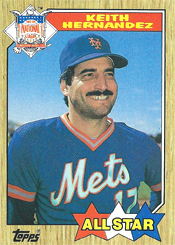
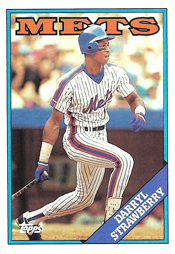
Early in spring training in 1989, Mets teammates Keith Hernandez and Darryl Strawberry provided a snapshot of the season ahead and it wasn’t pretty.

On March 2, 1989, Hernandez and Strawberry got into a scuffle while the Mets gathered for a team photo at training camp in Port St. Lucie, Fla.

Hernandez, the former Cardinal, and Strawberry were two of the Mets’ most prominent players and their fight was visible evidence all was not right with team chemistry.
“It is not without reason the Mets have a psychiatrist on the premises,” New York Daily News columnist Mike Lupica observed.

Sticks and stones

In a four-year stretch from 1985-88, the Cardinals and Mets ruled the National League East. The Cardinals won the division title in 1985 and 1987; the Mets did it in 1986 and 1988. Hernandez, the smooth-fielding first baseman acquired from the Cardinals in 1983, and Strawberry, the slugging right fielder, were instrumental in the Mets’ success.

When Strawberry showed up at training camp in 1989, he informed the Mets he wanted to renegotiate a contract which had two years remaining. “I feel I’m not being appreciated for what I’ve done,” Strawberry said to the New York Times.

Mets management was uninterested in reworking the agreement and Hernandez sided with the front office, telling a newspaper Strawberry was “getting bad advice” and “a deal’s a deal.”

At the photo session on a Thursday morning before workouts began, Strawberry said to Hernandez, “Why did you say those things about me?’

Hernandez replied, “I’m tired of your baby stuff.”

Strawberry said, “I’ve been tired of you for years,” and took a swing at Hernandez.

The backhand punch grazed Hernandez on the cheek, according to the Daily News.

Pitchers Dwight Gooden and Bob Ojeda restrained Strawberry, and pitcher Randy Myers grabbed Hernandez and lifted him off the ground to keep him from going after Strawberry, the Daily News reported. Video

“Another day in fantasy land,” said Mets pitcher Ron Darling. “Like Barnum and Bailey and the great traveling show.”

The photo session continued, with Gary Carter and Howard Johnson sitting between Hernandez and Strawberry, the SunSentinel of Fort Lauderdale reported. Strawberry and Hernandez took batting practice on separate fields. Later, they met together with team psychiatrist Dr. Alan Lans and shook hands, the New York Times reported.

“Do not believe anything was resolved beyond a truce,” Lupica wrote in the Daily News. “The two men still do not like each other.”

With management refusing to budge on his demand for a new contract, Strawberry capped the day by skipping an intrasquad game and walking out of camp, saying he wouldn’t return unless the Mets agreed to renegotiate.

“Someday, a Met will go on the disabled list with hurt feelings,” Lupica predicted.

Strawberry smooch

The next day, March 3, Strawberry didn’t show at training camp and was fined by the club.

With the Mets playing the Dodgers in an exhibition game at Port St. Lucie on March 4, the soap opera took a twist when Strawberry returned with a grand entrance.
As a public address announcer called their names in pre-game introductions, Mets players emerged one by one from the dugout and formed a line on the field. After Hernandez came out, Strawberry’s name was called and the prodigal player appeared to a chorus of boos from the home crowd. Strawberry acknowledged the fans by gesturing for more boos, the Daily News reported.

As Strawberry lined up next to Hernandez, they hugged and Strawberry kissed him on the right cheek.

“It took all of three seconds for Darryl Strawberry to offer Keith Hernandez the ultimate olive branch,” the Daily News reported.

Strawberry, claiming the kiss was spontaneous, declared the fight “should have never happened” and said, “We’re friends now.”

“Me and Keith have had a special relationship and I don’t want it to be destroyed by what happened in the past,” Strawberry said.

Hernandez told Gannett News Service, “It should be water under the bridge. We’ll just go forward from here. We’re here to play ball.”

Sad season

Both Hernandez and Strawberry had subpar seasons for the 1989 Mets and their performances were factors in why the team failed to reach the postseason.

Hernandez hit .233 with a paltry 19 RBI. He became a free agent after the season and signed with the Indians.

Strawberry hit .225 with 29 home runs. He played another year for the Mets, fulfilling the contract, became a free agent and joined the Dodgers in 1991.

The 1989 Mets finished at 87-75, six games behind the first-place Cubs and a game ahead of the third-place Cardinals.

Read Full Post »

Five years after he faced the Cardinals in his 12th World Series with the Yankees, Mickey Mantle knew he wouldn’t play in another.

On March 1, 1969, Mantle, 37, announced his retirement, bringing an end to the career of one of baseball’s most exciting and popular players.

Hampered by leg injuries and other ailments, Mantle’s performance declined steadily in the years after he hit .333 with three home runs in the 1964 World Series against the Cardinals.

On the day Mantle made his retirement announcement at the Yankees’ spring training base in Fort Lauderdale, Fla., his friend and former teammate, Roger Maris, was visiting the Cardinals’ camp across the state in St. Petersburg. Maris, who retired after playing in a second consecutive World Series for the Cardinals in October 1968, said he wasn’t surprised by Mantle’s decision and “seemed relieved his former teammate had hung up his uniform,” according to Bob Broeg of the St. Louis Post-Dispatch.

Mick and The Man

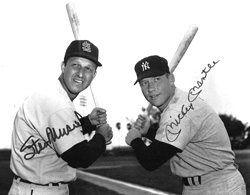
Mantle was born in Oklahoma and his boyhood baseball idol was the Cardinals’ Stan Musial. In 1946, when he was 14, Mantle and his father went to St. Louis to see a Cardinals game and were in a hotel elevator when Musial got on, according to author Jane Leavy in the book “The Last Boy.” Mantle’s dad wouldn’t allow him to ask Musial for an autograph. “A glimpse of a hero was enough,” Leavy wrote.

On the day he signed with the Yankees in 1949, Mantle told them Musial was his favorite player, but general manager George Weiss instructed him to tell the media Joe DiMaggio was his baseball hero, according to the Leavy book.

Mantle, a switch-hitting outfielder, had astonishing power and speed, but eventually became hampered by injuries, most significantly to his knees.

Mantle led the American League in home runs four times and earned the Triple Crown in 1956 when he topped the AL in batting average (.353), home runs (52) and RBI (130). He won the league’s Most Valuable Player Award three times and slugged 18 World Series home runs.

In 1964, Mantle had his last big season, batting .303 with 35 home runs, 111 RBI, and led the league in on-base percentage at .423. In Game 3 of the World Series versus the Cardinals, his home run against Barney Schultz leading off the bottom of the ninth gave the Yankees a 2-1 walkoff win. Boxscore He also hit a home run off Curt Simmons in Game 6 and another against Bob Gibson in Game 7.

In each of the next four seasons, Mantle failed to hit .300 or produce 60 RBI, but his on-base percentage remained high, ranging between .379 and .391.

After hitting .237 in his final year, 1968, Mantle decided he was finished, but the Yankees and the players’ union asked him to delay an announcement until spring training, according to the Leavy book. The Yankees wanted to use his popularity to sell tickets and the union wanted to use his clout in labor negotiations.

In the Nov. 17, 1968, New York Daily News, columnist Dick Young broke the story of Mantle’s intention to retire and reported, “Official announcement will be withheld until Mickey joins the Yankees at their training camp in March.”

Time to go

When Mantle arrived in Fort Lauderdale on Feb. 28, 1969, he still was on the Yankees’ active roster. He spoke privately that night with Yankees manager Ralph Houk and informed him he wanted to retire. The next morning, Mantle had breakfast with team president Michael Burke and gave him the same news.

Burke, like Houk, told Mantle he could keep playing for the Yankees, but Mantle’s mind was made up.

The Yankees hastily arranged an afternoon news conference and Mantle made his decision public.

“I can’t play anymore,” Mantle said to the Associated Press. “I don’t hit the ball when I need to. I can’t steal when I need to. I can’t score from second when I need to.”

Mantle said “my right knee is what they call a 100 percent disability _ there’s nothing left to fix.”

“I was actually dreading playing another season,” Mantle said, adding, “I figured it would be best for the team if I stop now.”

After 18 Yankees seasons (1951-68), Mantle finished with a .298 batting average, 536 home runs, 1,509 RBI, 2,415 hits and a .421 on-base percentage. It bothered him he didn’t hit .300 for his career, a goal he would have achieved if he had quit a season sooner. “If I kept playing, I would only keep lowering my average,” he said. “I have known for two years that I couldn’t hit anymore, but I kept trying.”

He told The Sporting News, “It has become embarrassing to have young kids throw the ball past me.”

Yankees royalty

Reactions to Mantle’s decision brought a flood of tributes.

_ Musial told the Post-Dispatch, “If he’d been completely sound physically, I think he would have been the best ballplayer any of us ever saw.”

_ DiMaggio said to The Sporting News, “I know exactly how Mickey feels. They all told me I had a couple of years left when I quit, but I couldn’t bounce back anymore.”

_ In an editorial, The Sporting News declared, “This last of the Yankees superstars captured the public fancy as did few players before him and certainly none since. A Mantle arrives about as frequently as the birth of quintuplets.”

_ Broeg wrote in the Post-Dispatch, “For the first time in the nearly half-century since New York acquired Babe Ruth, the Yankees are a bunch of nondescript guys named Charlie Smith. Retirement of Mickey Mantle did more than take from baseball the bat of a big-name player, for it also deprived the Yankees of their last vestige of playing field glamour.”

_ Dick Young wrote in the New York Daily News, “There is much more than muscle in Mickey Mantle. There is class and guts, and his own special kind of dignity, and there is enough pride for 10 men. I suppose it was the pride, after all, that made him decide he’d had it.”

Read Full Post »

Joe Presko pitched for the Cardinals at a time when the Dodgers dominated the National League.

Presko was with the Cardinals from 1951-54, a period when the Dodgers won two National League pennants and twice finished in second.

Those Dodgers teams were immortalized in the Roger Kahn book “The Boys of Summer” and featured players such as Roy Campanella, Gil Hodges, Pee Wee Reese, Jackie Robinson and Duke Snider.

Presko was 24-36 with a 4.70 ERA in his four seasons with St. Louis, but those numbers look better when excluding his performances against the Dodgers. Presko was 2-11 with a 6.33 ERA versus the Dodgers and 22-25 against the rest of the National League.

Big talent

Presko, a 5-foot-9 right-hander with a boyish appearance, didn’t play organized baseball until his senior year in high school in Kansas City, Mo., according to the St. Louis Post-Dispatch. Because he threw hard, he got the attention of Yankees scout Bill Essick, who concluded Presko was too small to play professional baseball.

After graduating high school, Presko was playing for a drug store team in Kansas City when the Cardinals got a tip to give him a look, The Sporting News reported. Scout Runt Marr liked what he saw and signed him.

Presko rapidly rose through the Cardinals’ minor-league system, producing win totals of 16 in 1948, 14 in 1949 and 16 again in 1950.

Cardinals manager Marty Marion kept him with the big-league club after spring training in 1951. “He has a fastball that breezes right by you if you guess it’s a curve,” said Marion. “He throws everything with the same motion, seemingly the same speed.”

On May 3, 1951, Presko got a win in his major-league debut with four innings of one-hit relief against the defending National League champion Phillies. Presko yielded a solo home run to the second batter he faced, Eddie Pellagrini, and retired the next 11 in a row. Boxscore

Referring to him as Little Joe, the Post-Dispatch reported Presko “won the admiration of his teammates.”

In his second Cardinals appearance, Presko got a save with two scoreless innings against the Dodgers. Boxscore

Hot streak

Marion moved Presko into the starting rotation and after losses to the Giants and Reds on the road he made his first appearance before the home crowd in St. Louis on May 17, 1951, in a start against the Phillies.

Described by Bob Broeg of the Post-Dispatch as looking “more like a bat boy than a major-league pitcher,” Presko outdueled Phillies ace Robin Roberts and pitched a complete game in a 2-1 Cardinals victory.

“He throws as hard as any little man I ever saw _ and just by flicking his wrist,” said Cardinals pitcher Harry Brecheen.

Said Cardinals catcher Del Rice: “It was a pleasure catching him. His fastball is sneaky because he throws with such an easy motion. He’s got good control and he works with you as you move your target, hitting your glove outside or inside, high or low, and comes side-armed whenever you give him the sign.” Boxscore

Presko won five consecutive decisions between May 17 and June 8 for the 1951 Cardinals. Broeg, who began referring to the baby-faced rookie as “Baby Joe,” declared him “the nicest gift from the Cardinals’ farm system since Red Schoendienst came up six years ago.”

Presko’s winning streak ended on June 14, 1951, when Hodges hit a two-run home run with two outs in the ninth, lifting the Dodgers to a 2-1 victory. Boxscore

Hodges would remain a nemesis, hitting four home runs against Presko in his career.

Arm ailment

In late June 1951, Presko developed a sore arm and a month later it was discovered he’d torn tendons in the right shoulder. He sat out the last two months, finishing the season at 7-4 with a 3.45 ERA.

Presko returned to the Cardinals in 1952 and achieved one of his career highlights on June 10 when he pitched a 10-inning shutout against the Dodgers at St. Louis.

After Presko retired the Dodgers in the top of the 10th, he felt a twinge in his right shoulder and was told by player-manager Eddie Stanky he was done for the night. When Stanky batted for Presko to lead off the bottom of the 10th, he was booed.

“Everyone knows there’s nothing I like better than winning, but I just couldn’t take a chance of hurting Joe Presko,” Stanky said. “I took him out because of his shoulder. He’s had his arm hurt once before and I don’t want it to happen again.”

After Stanky grounded out, Solly Hemus was hit by a pitch from Chris Van Cuyk and Schoendienst followed with a game-winning triple, enabling Presko to earn the win. Boxscore

Presko lost six of his last seven decisions in 1952 and finished at 7-10 with a 4.05 ERA. He was 6-13 in 1953 and 4-9 in 1954. One of the highlights of his final St. Louis season in 1954 was a win versus the Dodgers with a scoreless inning of relief on April 28. Boxscore

After spending 1955 with the Cardinals’ farm club at Omaha, Presko was taken by the Tigers in the Rule 5 draft of unprotected players. He pitched briefly for the Tigers in 1957 and 1958.

Read Full Post »

In 1960, while pursuing a pennant with the Pirates, pitcher Bob Friend twice surrendered game-winning home runs to Stan Musial in a two-week span in the heat of the National League title chase.

Friend was a durable, dependable right-hander for 16 big-league seasons, 15 with the Pirates.

Friend led the National League in ERA (2.83) in 1955, tied for the league lead in wins (22) in 1958 and twice pitched the most innings (314.1 in 1956 and 277 in 1957).

When the Pirates won their first pennant in 33 years in 1960, Friend was 18-12 with a 3.00 ERA and led the staff in starts (37), shutouts (four), innings pitched (275.2) and strikeouts (183).

He might have won 20 if not for the home run heroics of Musial.

Power stroke

On Aug. 11, 1960, the Cardinals opened a five-game series against the Pirates at Pittsburgh. The second-place Cardinals, who were five games behind the Pirates, started Ernie Broglio against Friend in Game 1.

The Pirates scored a run in the fifth, the Cardinals tied the score at 1-1 in the eighth and both starting pitchers still were in the game as it entered the 12th.

Bill White opened the inning with a single. After Ken Boyer flied out, Musial, who had doubled twice in the game, came to the plate.

Friend’s first pitch to him was a fastball and Musial hit it into the upper deck in right for a two-run home run, giving the Cardinals a 3-1 lead.

The Pirates scored a run in the bottom half of the 12th, but Broglio struck out Dick Stuart with the potential tying run at second, securing a 3-2 victory and moving the Cardinals within four games of the Pirates. Boxscore

When Friend got into the clubhouse, he “disgustedly tossed his glove toward his locker,” the Pittsburgh Post-Gazette reported.

“I can’t pitch any better,” Friend said to The Pittsburgh Press. “I tried to get Musial to hit to center field and pitched him over the outside of the plate, but he went right with me. The fastball was on the outside of the plate and yet he pulled it into the seats.”

Friend told the St. Louis Post-Dispatch, “I thought I had as much stuff as I ever had and threw as hard as I did any time this season.”

Musial, typically modest, said, “Bob is a good pitcher, real fast and cagey. I guess I was kind of lucky to tag him the way I did.”

Told the home run was the 424th of his major-league career, Musial replied, “That’s quite a few for a singles hitter.”

Musial visited his hometown of Donora, Pa., during the series and took heat for beating the Pirates. He told the Post-Dispatch, “My old friends kept asking me, ‘What did you have to do that for?’ ”

Behind the pitching of Bob Gibson, the Cardinals won the second game of the series, getting within three of first place, but the Pirates won the last three, pushing their lead to six.

Oldie but goodie

Two weeks later, the first-place Pirates came to St. Louis for a three-game series. The Cardinals were in third place, 8.5 games behind the leaders.

In the series opener, on Aug. 26, 1960, Friend again was matched against Broglio.

In the seventh inning, with the scored tied at 1-1, Musial, hitless in three at-bats, came up with a runner on first and one out.

Friend got ahead on the count, 1-and-2, and tried to jam Musial on the fists with a fastball. The pitch was inside, but low, and Musial hit it to the pavilion roof in right for a two-run home run.

“It was the only ball I hit good during the game,” Musial said.

Said Friend: “Pretty soon I’ll be talking to myself.”

Broglio retired the Pirates in order over the last two innings and Musial’s home run proved the difference in a 3-1 Cardinals triumph. Boxscore

“Like I always say, there’s room in this game for old men who can hit,” said Musial, 39.

For his career, Musial hit .277 with five home runs against Friend.

The Cardinals went on to sweep the series and get within 5.5 games of first place, but the Pirates didn’t falter. Friend played a prominent role down the stretch, winning four of his last five decisions.

Friend, who pitched for the Yankees and Mets in his final season (1966), posted a 197-230 career mark. Versus the Cardinals, he was 19-28 with seven shutouts.

On Aug. 15, 1951, in his rookie season, Friend, 20, pitched his first big-league shutout with a two-hitter against the Cardinals at Pittsburgh. The Cardinals’ two hits came in the second inning on singles by Nippy Jones and Bob Scheffing. Boxscore

Using a sinker and curve, Friend recorded a career-high 11 strikeouts in a win versus the Cardinals on Aug. 20, 1959, at Pittsburgh. Boxscore

Read Full Post »

The Pirates came close to convincing the Cardinals to send them Stan Musial, but settled instead for Murry Dickson.

On Jan. 29, 1949, the Cardinals sold the contract of Dickson, a starting pitcher, to the Pirates for $125,000.

The Pirates were willing to pay almost three times as much if the Cardinals included Musial in the deal. The purchase price would have been $310,000 _ $250,000 for Musial, the reigning National League batting champion, and $60,000 for Dickson, the Pittsburgh Post-Gazette reported.

One of the Cardinals’ owners was willing but the other wasn’t, so Musial remained with St. Louis.

Right stuff

Dickson was born in Tracy, Mo., a town along the Platte River in the western part of the state. He was 20 when he signed with the Cardinals in 1936.

A right-hander with a slight build, Dickson began his professional career with Grand Island of the Nebraska State League in 1937 and worked his way through the Cardinals’ system.

After posting a 22-15 record for Houston of the Texas League in 1939, Dickson was rewarded with a promotion to the Cardinals and made his major-league debut on Sept. 30, 1939, with 3.2 scoreless innings of relief against the Cubs at Chicago. Boxscore

Dickson made another September appearance with the Cardinals in 1940 after posting a 17-8 record for Columbus, Ohio. He spent all of 1941 in the minors and stuck with the Cardinals in 1942.

The Cardinals won National League pennants in 1942 and 1943. Dickson was 6-3 in 1942, 8-2 in 1943 and made a relief appearance in the World Series versus the Yankees before entering the Army.

Dickson was assigned to a reconnaissance unit in Europe during World War II, achieved the rank of sergeant and earned four battle stars. General George S. Patton wanted Dickson to be his driver, but Dickson asked to be assigned elsewhere, according to the Society for American Baseball Research.

After two years of military service, Dickson returned to the Cardinals in 1946, achieved a record of 15-6 with a 2.88 ERA and helped them win another pennant. In the 1946 World Series against the Red Sox, Dickson started Game 3 and Game 7. He was the losing pitcher in Game 3 and got no decision in Game 7, though the Cardinals won.

Pursuing a deal

In his book, “Stan Musial: The Man’s Own Story,” Musial said Dickson “liked to experiment with pitches. He had the widest assortment I ever saw _ fastball, curve, slider, knuckler, sinker, screwball _ and a remarkable arm.”

Dickson was 13-16 in 1947 and 12-16 in 1948, when he gave up 39 home runs, but Cardinals manager Eddie Dyer liked him and wanted him in the starting rotation.

The Pirates liked Dickson, too. He was 0-5 against them in 1948, but with a 2.17 ERA, and the Pirates were convinced he’d improve their starting staff.

After the 1948 season, the Pirates began a “relentless pursuit” of Dickson, according to The Pittsburgh Press.

Pirates majority owner and president Frank McKinney was a friend of Cardinals president Robert Hannegan, who co-owned the St. Louis club with Fred Saigh. McKinney and Hannegan were powerful figures in the national Democratic Party and confidantes of President Harry Truman.

While attending the 1948 World Series, McKinney met with Hannegan to discuss a deal for a pitcher. Hannegan offered a choice of four _ Dickson, Red Munger, Howie Pollet and Ted Wilks, The Pittsburgh Press reported.

“Dickson was the pitcher we wanted,” McKinney said.

McKinney said he and Hannegan continued to negotiate, including when they were in Washington, D.C., for Truman’s inauguration on Jan. 20, 1949.

“I worked on this deal for a long time,” McKinney said.

Wait a minute

At some point, the trade talks between McKinney and Hannegan focused on Musial.

In a column headlined “Bucs Almost Had Musial,” Post-Gazette sports editor Al Abrams reported McKinney “had just about convinced Robert Hannegan to sell him Musial and Murry Dickson in one package.”

While at Truman’s inauguration, Hannegan, who suffered from hypertension, said he was advised by his doctor to sell his share of the Cardinals because of the stress the job was causing him. Hannegan planned to sell his share to Saigh.

McKinney’s $310,000 bid for Musial and Dickson was appealing to Hannegan, who “wanted to get back the money he invested in Cardinals stock and get out of baseball because of ill health,” the Post-Gazette reported.

When Saigh was told of the proposed Pirates deal, he objected to Musial being included. “Saigh would have blown his top had such a deal gone through,” the Post-Gazette reported, “and no one could blame him. The move would have wrecked the St. Louis club.”

On Jan. 26, 1949, Hannegan called McKinney, told him Musial wasn’t available and the price for Dickson had gone up to $125,000. “(He) told me to make up my mind within an hour,” McKinney said to The Pittsburgh Press.

McKinney called Pirates manager Billy Meyer, who said, “Get Dickson.”

Hannegan and McKinney made the deal but agreed to keep it quiet because the next day, Jan. 27, 1949, Hannegan announced he sold his shares to Saigh, who gained control of the franchise.

Two days later, it was Saigh who announced Dickson’s contract was sold to the Pirates.

Pinpoint control

Dickson was 12-14 for the 1949 Pirates, but 5-3 versus the Cardinals, who finished a game behind the pennant-winning Dodgers.

Musial said Dickson liked to pitch from behind in the count and get overeager batters to chase pitches. “He had such great control that instead of coming in there with a fat one, he could catch a corner with a pitch that looked good, but wasn’t,” Musial said.

In five seasons with the Pirates, Dickson was 66-85. He went to the Phillies in 1954 and they traded him back to the Cardinals on May 11, 1956, with Herm Wehmeier for Harvey Haddix, Stu Miller and Ben Flowers.

Dickson was 13-8 for the Cardinals in 1956 and 5-3 in 1957 before he hurt his right shoulder and was released.

He pitched for the Athletics and Yankees in 1958, making two relief appearances for New York in the World Series against the Braves, and for the Athletics again in 1959 when he was 43.

Dickson’s career record in the big leagues was 172-181, including 72-54 for the Cardinals.

Read Full Post »

(Updated Nov. 8, 2024)

As a 22-year-old rookie, Mel Stottlemyre pitched with poise and precision for the Yankees against the Cardinals in the 1964 World Series.

Stottlemyre started three World Series games versus the Cardinals and was matched against Bob Gibson in each. Stottlemyre got a win in Game 2, a no-decision in Game 5 and a loss in Game 7. He had a 3.15 ERA in 20 innings and yielded no home runs to the Cardinals.

Relying primarily on sinkers and sliders, Stottlemyre didn’t possess an overpowering fastball like Gibson did, so he tried to get groundouts rather than strikeouts.

In his victory over the Cardinals, Stottlemyre got 18 of the 27 outs on ground balls, according to The Sporting News. Of the 35 Cardinals batters he faced, nine hit the ball into the air, the St. Louis Post-Dispatch reported.

Stottlemyre “pitched impressively with a sinker that was so good he needed only three outfield putouts,” Post-Dispatch sports editor Bob Broeg noted.

Yankee from Yakima

Stottlemyre was born in Hazleton, Mo., a village along the Big Piney River near Mark Twain National Forest in the southern part of the state. His father was a pipefitter and moved the family to Oregon and South Carolina before settling in Mabton, a town in Yakima Valley in Washington state, in the early 1950s.

Stottlemyre attended Yakima Valley Community College, joined the baseball team and was taught to throw a sinker by coach Chuck Brayton.

“He was a hard worker and a dedicated pitcher from the start,” Brayton told The Sporting News.

The Yankees’ Eddie Taylor, the only scout to make Stottlemyre an offer, said, “What impressed me most was he always pitched winning baseball and had a free-throwing arm. His fastball was really not much, but he had that effortless way of throwing the ball. What kept me interested was his sinker.”

Stottlemyre, who didn’t get a signing bonus, was assigned to the Class D level of the minor leagues in 1961.

In 1964, he was at Class AAA Richmond, Va., and had a record of 13-3 with a 1.42 ERA. Seeking a replacement for Whitey Ford, who had a hip problem, the Yankees called up Stottlemyre in August.

The right-hander made his major-league debut on Aug. 12, 1964, pitched a complete game and got the win in a 7-3 Yankees triumph over the White Sox. Stottlemyre went on to post a 9-3 record and 2.06 ERA for the Yankees, who won the American League pennant by finishing a game ahead of the White Sox.

“He filled a big pitching gap when we needed it,” Yogi Berra, manager of the 1964 Yankees, told Super Sports magazine. “He kept coming through for us in the clutch. Few rookies had as much poise as he had.”

Go low

After Ray Sadecki beat Ford in Game 1 of the World Series, Stottlemyre was matched against Gibson in Game 2 at St. Louis on Oct. 8, 1964.

“I was very nervous,” Stottlemyre recalled to Super Sports magazine in 1969. “People said I didn’t look it, but I was. The whole idea of me pitching in the World Series was too much to believe.”

Stottlemyre dodged trouble in the sixth when struck on the right wrist by a Lou Brock shot. Stottlemyre retrieved the ball, threw out Brock and assured Berra the wrist was all right.

“It was numb for a little bit, but that feeling went away,” Stottlemyre told the New York Daily News.

In the eighth, with the Yankees ahead, 4-1, the Cardinals put runners on second and third with none out. “I thought about taking Stottlemyre out,” Berra said. “One more hit and I would have.”

Relying on the sinker, Stottlemyre got Curt Flood to ground out to third and Brock to ground out to short. Carl Warwick scored from third on Brock’s groundout, cutting the Yankees’ lead to 4-2, but the Cardinals had two outs and a runner, Jerry Buchek, on second. Buchek moved to third on catcher Elston Howard’s passed ball and Bill White walked, bringing cleanup hitter Ken Boyer to the plate.

Stottlemyre’s first pitch to Boyer was a mistake, high and inside, but Boyer swung and missed. Howard went to the mound and reminded Stottlemyre to keep the ball down and away. Boyer grounded out softly to short, ending the inning.

“When Stottlemyre got in the jam, I expected to get a good shot at him, but he didn’t give in,” Boyer said.

Said Howard: “He has more poise than any other young pitcher I’ve ever caught. Base hits don’t rattle him. He keeps coming back.”

The Yankees went on to an 8-3 victory. The first four batters in the Cardinals’ order, Flood, Brock, White and Boyer, were held hitless.

In his book, “Pride and Pinstripes,” Stottlemyre said, “In addition to my sinker, I was able to use my backdoor slider effectively against their left-handed hitters. I dropped it on the outside corner to their lefties to get some key strikes. I’d have to say it was the best game I ever pitched, considering the circumstances.”

Stottlemyre’s line: 9 innings, 7 hits, 3 runs, 2 walks 4 strikeouts.

Gibson’s line: 8 innings, 8 hits, 4 runs, 3 walks, 9 strikeouts.

“We have a pretty good-hitting ballclub, but we couldn’t get much off that kid,” Gibson said. “He’s nothing but good. I’d have had to be awfully good to beat him today.” Boxscore

Dueling aces

Stottlemyre and Gibson both were good in Game 5 at Yankee Stadium. The Cardinals prevailed, 5-2, on Tim McCarver’s three-run home run off Pete Mikkelsen in the 10th.

Stottlemyre’s line: 7 innings, 6 hits, 2 runs, 2 walks, 6 strikeouts.

Gibson’s line: 10 innings, 6 hits, 2 runs, 2 walks, 13 strikeouts. Boxscore

Stottlemyre and Gibson started Game 7 on two days’ rest at St. Louis. They were tired but Gibson was better, going the distance in a 7-5 Cardinals triumph.

Stottlemyre’s line: 4 innings, 5 hits, 3 runs, 2 walks, 2 strikeouts.

Gibson’s line: 9 innings, 9 hits, 5 runs, 3 walks, 9 strikeouts. Boxscore

In his book, Stottlemyre said, “What nobody ever really knew about that last game was my shoulder stiffened up after I fell on it reaching for an errant throw as I covered first base.”

In 11 big-league seasons, all with the Yankees, Stottlemyre was 164-139 with a 2.97 ERA.

He served as pitching coach for the Mets (1984-93), Astros (1994-95), Yankees (1996-2005) and Mariners (2008). The 1986 Mets and the Yankees of 1996, 1998, 1999 and 2000 won World Series championships.

Read Full Post »

« Newer Posts - Older Posts »