Feeds:
Posts
Comments

Archive for the ‘Opponents’ Category

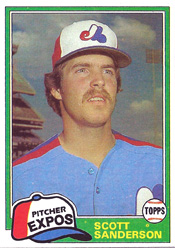
Scott Sanderson enhanced his status as a starter by pitching a 10-inning gem against the Cardinals before the largest crowd to attend a baseball game in Montreal.

Sanderson was 23 and in his second major-league season with the Expos when he earned the complete-game win versus the Cardinals in the second game of a doubleheader on Sept. 16, 1979, before 59,282 spectators at Olympic Stadium.
After yielding seven hits in 4.1 innings, Sanderson retired the next 17 Cardinals batters in a row. Sanderson earned the win, but his effort was overshadowed by second baseman Dave Cash, whose improbable grand slam with two outs in the bottom of the 10th lifted the Expos to a 5-1 victory.

Big chance

Banished to the bullpen in late July by Expos manager Dick Williams after a stretch of ineffective starts, Sanderson’s stint against the Cardinals was a turning point in his big-league career.

The Cardinals and Expos played consecutive doubleheaders Sept 15-16. In the opener of the Sept. 16 doubleheader, Expos starter Ross Grimsley was lifted after two innings and the club used three relievers in a 4-3 loss to the Cardinals.

Looking to salvage a split of the doubleheader before the big crowd, the Expos needed a strong performance from Sanderson, who was making his second start since July 27 and seeking his first win since Aug. 1.

“I was hoping somewhere along the way I could be used as a starter and help this team out when it needed it,” Sanderson said to the Montreal Gazette.

The Expos scored a run in the first against Cardinals starter John Denny on Cash’s RBI-double and the Cardinals tied the score in the second on Ken Oberkfell’s sacrifice fly, scoring Jerry Mumphrey from third.

Denny went seven innings, but Sanderson kept going. “I wanted to go as long as I could,” Sanderson said.

Unbelievable error

After the first two Expos batters made outs in the bottom of the 10th, “the game looked as though it would go on forever,” the Gazette reported.

Gary Carter sparked the rally when he looped a liner to left and hustled to second for a double, beating the throw from Lou Brock. Jerry White was walked intentionally, bringing left-handed batter Warren Cromartie to the plate to face left-hander Darold Knowles.

Cromartie hit a routine grounder “ever so softly” to Oberkfell at second base, the Gazette reported, for what appeared to be an inning-ending out.

According to the St. Louis Post-Dispatch, “Oberkfell fielded the ball cleanly enough, then inexplicably, as he prepared to throw to first, dropped it. Desperately, he reached for the ball on the ground but fumbled it again.”

Cromartie was safe at first and the bases were loaded.

“Obie wouldn’t boot that play away again if he tried for 100 years,” said Cardinals manager Ken Boyer.

Cromartie theorized Oberkfell made the error “because he was watching me bust my ass down to first.”

Said Oberkfell: “It was the easiest ball hit to me all day. I don’t know how I did it.”

Cashing in

Boyer brought in right-hander George Frazier to face Cash, who’d spent most of the season as a utility player before replacing Rodney Scott at second base in late August.

Cash hit Frazier’s third pitch over the left-field wall for his first home run of the season and the only grand slam of his 12-year career in the major leagues.

“I knew if I could hang in there long enough I’d get a chance,” Cash said to the Post-Dispatch.

In a baseball version of the red carpet treatment, Williams and Expos outfielder Ellis Valentine stretched out towels from the entrance of the clubhouse to Cash’s locker cubicle as the hitting hero arrived from the field.

“Almost overlooked in the euphoria,” the Gazette reported, was the effort of Sanderson, who showed the Expos he had the right stuff to stay a starter. Boxscore

Consistent winner

Sanderson finished the 1979 season with a 9-8 record and 3.43 ERA for the second-place Expos.

In 19 seasons (1978-96) in the major leagues, Sanderson, a right-hander, was 163-143 with a 3.84 ERA. His career record versus the Cardinals was 10-11 with a 3.63 ERA.

Sanderson pitched for the Expos (1978-83), Cubs (1984-89), Athletics (1990), Yankees (1991-92), Angels (1993), Giants (1993, White Sox (1994) and Angels again (1995-96).

Playing for manager Tony La Russa and pitching coach Dave Duncan, Sanderson was 17-11 with a 3.88 ERA in 34 starts for the 1990 Athletics, who won the American League pennant. The 17 wins were his single-season career high.

In six seasons with the Expos, Sanderson was 56-47 with a 3.33 ERA. In six seasons with the Cubs, he was 42-42 with a 3.81 ERA.

Read Full Post »

(Updated April 17, 2026)

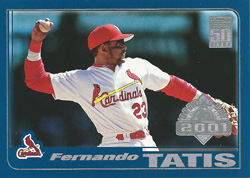
Two swings in one inning assured third baseman Fernando Tatis a place in Cardinals lore.

On April 23, 1999, Tatis became the only major-league player to hit two grand slams in one inning. The Cardinals’ cleanup hitter achieved the feat against Chan Ho Park in the third inning of a Friday night game at Dodger Stadium in Los Angeles.

With his clouts, Tatis, 24, also established a major-league mark for most RBI in an inning, with eight.

Tatis is the only Cardinals player to hit two home runs in an inning.

If not for a late batting order change, Tatis might not have gotten the chance.

Power vs. power

Tatis was supposed to bat fifth in manager Tony La Russa’s lineup, but when Eric Davis was a late scratch because of a bruised left hand, La Russa moved Tatis into the cleanup spot.

The Dodgers scored a run in the first and another in the second against starter Jose Jimenez and led 2-0.

In the third for the Cardinals, Darren Bragg singled, Edgar Renteria was hit by a pitch and Mark McGwire singled, loading the bases for Tatis.

With the count 2-and-0, Mike Shannon, broadcasting the game on television, predicted to viewers Tatis would be looking for a fastball.

“You’re going to see power against power here,” Shannon said.

Park threw a fastball and Tatis hit it deep over the left-field wall and into the Dodgers’ bullpen for his first grand slam in the big leagues.

“There wasn’t any doubt about that one,” Shannon said.

Said broadcast partner Joe Buck: “That was McGwire distance right there.”

Beating the odds

The Cardinals scored three more runs in the inning before reloading the bases with one out for McGwire. Park retired McGwire on a fly to right and the runners held, bringing up Tatis again with the bases packed.

With the count 3-and-1, Park threw a hanging slider and Tatis hit it over the wall in left-center.

“Swing and a long one. There it is folks! Baseball history,” Shannon told his audience. “Wow! Get those record books out, folks.” Video

“I didn’t think the second ball would go out,” Tatis said to the Los Angeles Times. “I still can’t believe I did it.”

McGwire told the St. Louis Post-Dispatch, “You’ve got a better chance of winning the lottery.”

Park, 25, became the first pitcher to give up two grand slams in one inning since rookie Bill Phillips of the 1890 Pirates against the Cubs.

“This can happen to the best of us,” Park said. “It was just a bad day.”

Said Dodgers manager Davey Johnson: “Chan Ho pitched … defensive. He wasn’t really going after guys.”

After the second grand slam, Park was relieved by Carlos Perez and the Cardinals went on to a 12-5 victory. Boxscore

Exclusive club

Tatis became the second National League player to hit two grand slams in a game. The first was Braves pitcher Tony Cloninger against the Giants in 1966. Since then, one other National League player, Josh Willingham of the Nationals versus the Brewers in 2009, hit two grand slams in a game.

In the American League, 10 players have hit two grand slams in a game. They are: Tony Lazzeri (1936 Yankees), Jim Tabor (1939 Red Sox), Rudy York (1946 Red Sox), Jim Gentile (1961 Orioles), Jim Northrup (1968 Tigers), Frank Robinson (1970 Orioles), Robin Ventura (1995 White Sox), Chris Hoiles (1998 Orioles), Nomar Garciaparra (1999 Red Sox) and Bill Mueller (2003 Red Sox).

Tatis batted .438 against Park in his career, with seven hits in 16 at-bats. The grand slams were Tatis’ only home runs against him.

Park, who had 124 wins in 17 years in the majors, gave up seven career grand slams. In addition to the two by Tatis, the others were hit by Travis Lee of the Diamondbacks, Matt Walbeck of the Angels, Jim Edmonds of the 2001 Cardinals, Jacque Jones of the Twins and A.J. Pierzynski of the White Sox.

Tatis, who played 11 years in the majors, hit 113 career home runs and eight were grand slams. In addition to the two he hit versus Park, the others came against Billy Brewer of the Phillies, Russ Springer of the Diamondbacks, Daniel Garibay of the Cubs, Damian Moss of the Braves, Buddy Carlyle of the Braves and Franklin Morales of the Rockies.

Read Full Post »

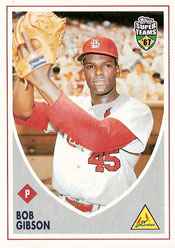
Bob Gibson and Jim Baxes, two rookies whose careers went in opposite directions, are connected by one swing of the bat.

On April 15, 1959, Gibson made his major-league debut for the Cardinals against the Dodgers at Los Angeles and the first batter he faced, Baxes, hit a home run.

Gibson went on to have a Hall of Fame career. Baxes played one year in the major leagues.

Who are you?

After posting a 2.84 ERA in 190 innings pitched for Cardinals farm teams in 1958, Gibson was a candidate to earn a spot on the big-league club’s 1959 Opening Day roster.

Early in spring training at the Cardinals’ camp in St. Petersburg, Fla., first-year manager Solly Hemus approached a player and asked, “Are you Olivares?”

The player replied, “No, I’m Bob Gibson.”

According to The Sporting News, Gibson turned to a teammate and said, “I must have made a hell of an impression on the manager. After a week, he doesn’t even know who I am.”

Gibson’s fastball got him the attention he desired and the 23-year-old rookie won a spot on the 1959 Cardinals’ pitching staff as a reliever.

Though the St. Louis Post-Dispatch expressed concern Gibson “needs either a better curve or a changeup to go with his blazer and his slider,” Cardinals pitching coach Howie Pollet said, “He’s fast enough to throw one quick one by them a lot of times, even when they’re looking for it. Within a few weeks, we might have him getting his breaking ball over better.”

In a column for the Post-Dispatch on the eve of the 1959 season opener, Bob Broeg, rating the Cardinals’ pitchers, said, “If there’s one who does stir the imagination a bit, though he’s green, it’s Bob Gibson.”

Waiting his turn

Meanwhile, at Dodgers spring training camp in Vero Beach, Fla., Baxes, a 30-year-old rookie, was manager Walter Alston’s surprise choice to open the regular season as the third baseman.

Baxes’ father immigrated to the United States from Greece in 1900, went to work in a San Francisco rope factory, married and started a family. His son, Dimitrios Speros Baxes, became known in the Russian Hill neighborhood of San Francisco as Jim.

Jim Baxes and his younger brother, Mike, developed into professional ballplayers. Mike made it to the majors with the Athletics in 1956, but Jim, who started his career in the Dodgers’ farm system in 1947, waited 12 years until getting his shot in the big leagues in 1959.

Baxes was a right-handed power hitter who slugged 30 home runs for Fort Worth in 1953 and 28 home runs for Spokane in 1958, but, according to the Los Angeles Times, he was a “ferocious flailer” who swung and missed too often.

“I’m confident I can cut it,” Baxes said to The Sporting News. “I’ve improved the last couple of seasons and I don’t think my age will prove any handicap.”

Temper tantrum

After losing three of their first four games of the 1959 season, the Cardinals faced Dodgers right-hander Don Drysdale at the Los Angeles Memorial Coliseum.

In the sixth inning, Stan Musial of the Cardinals tried to score from second on Joe Cunningham’s line single to center, but was called out by umpire Dusty Boggess.

“I almost fell off the bench when Musial was called out,” Hemus told the Post-Dispatch.

Convinced he slid into the plate before catcher John Roseboro applied a high tag after fielding a throw from Don Demeter, Musial argued with Boggess, “but he was Casper Milquetoast compared to his boss,” the Los Angeles Times reported.

Hemus ran onto the field, charged at Boggess, “threw his cap to the ground and repeatedly kicked the dirt” before he was ejected, according to the Post-Dispatch.

“He took the ballgame away from us,” Hemus said. “That was the worst so-called exhibition of baseball umpiring I ever saw.”

Rude greeting

In the seventh inning, with the Dodgers ahead, 3-0, Gibson, wearing uniform No. 58, relieved starter Larry Jackson. Baxes led off and hit Gibson’s third big-league pitch into the seats in left-center for his first big-league home run.

Gibson “received a rough welcome into major-league warfare,” the Post-Dispatch reported.

Baxes gave Gibson “quite an initiation,” the Los Angeles Times wrote.

Gibson retired the next three batters in order, getting Drysdale to line out to second, Ron Fairly to fly out and Wally Moon to ground out.

In the eighth, Roseboro singled, moved to second on Demeter’s sacrifice bunt, stole third and scored on Charlie Neal’s sacrifice bunt. Gil Hodges, the last batter Gibson faced in the game, popped out to the catcher. Boxscore

Gibson made two more relief appearances for the Cardinals before he was sent back to the minor leagues on April 28, 1959.

In his book, “Stranger to the Game,” Gibson said, “Hemus had me convinced that I wasn’t any damn good and consequently I wasn’t.”

Different paths

On May 9, three weeks after his home run against Gibson, Baxes was assigned to the minors because the Dodgers wanted Jim Gilliam at third base. The demotion was devastating to Baxes, who batted .303 for the Dodgers. “I think that entitled me to a better chance than I received,” Baxes said to the Associated Press.

Baxes refused to report to the minors, went home to Long Beach, Calif., and got a job at a sheet metal company. The Indians, seeking a backup infielder, contacted the Dodgers and on May 22, 1959, Baxes was dealt to Cleveland.

In his first at-bat for the Indians, on May 23, 1959, Baxes slugged a pinch-hit home run against Jim Bunning of the Tigers. Boxscore

Baxes played in 77 games for the 1959 Indians and hit 15 home runs, but he wasn’t brought back. He played two more seasons in the minors, finishing in 1961 with a Cardinals farm club, the Portland Beavers.

Gibson, meanwhile, was called up to the Cardinals on July 29, 1959, and put in the starting rotation.

Read Full Post »

Stepping foot on foreign soil for the first time in the regular season, the Cardinals felt the ground shift beneath them.

On April 14, 1969, the Cardinals opposed the Expos at Montreal in the first regular-season major-league game played outside the U.S.

Led by the slugging of Mack Jones, the Expos, a National League expansion team, overcame a seven-run inning by the Cardinals and won, 8-7, before 29,184 at sold-out Jarry Park.

It was a joyous day for the baseball fans of Montreal, who naturally were proud to have a team and were thrilled to win a home opener against the two-time defending National League champion Cardinals, but there were glitches.

Though the weather was sunny, the playing field was a mess, despite the efforts of the grounds crew.

“When the frost began to thaw underground, the mound and area behind the plate sank a few inches,” according to The Sporting News, and the field became soft and lumpy.

“It was like running on a hunk of Gouda cheese,” the Montreal Gazette noted.

Oh, Canada

The National League awarded Montreal a franchise, even though it didn’t have a suitable ballpark. The Expos had a few months to renovate 3,000-seat Jarry Park and get it up to major-league standards before the start of the 1969 season.

The Expos opened their inaugural season with six road games, three at New York against the Mets and three at Chicago against the Cubs, and won two.

Four days before the home opener, Expos management “feared the game might never happen” because Jarry Park wasn’t ready, The Sporting News reported, but workers “toiled around the clock.”

About 3,000 temporary folding chairs still were being installed in sections of the ballpark on game day, delaying the opening of the gates. Expos general manager Jim Fanning pitched in, putting up chairs in the section behind home plate, the Gazette reported.

“Stadium workers were still bolting in seats and shoveling snow as the first fans arrived,” the Canadian Broadcasting Corporation (CBC) reported.

Sinking feeling

Players were disappointed to find the field “rough” and “rubbery,” according to The Sporting News.

Cardinals third baseman Mike Shannon teasingly told the St. Louis Post-Dispatch that his burly teammate, Joe Torre, will “sink six inches into that infield.”

Torre good-naturedly replied, “This soft infield ought to bring everyone else down to my speed.”

The infield was “extremely spongy and seemed to have foam rubber under it,” the Post-Dispatch reported. Cardinals shortstop Dal Maxvill said, “You step here and ground sinks a yard away.”

Indeed, the ground literally was shifting. “As the earth settled, the mound dropped five inches below the official 10-inch height, which was already five inches lower than last year’s regulation elevation,” the Gazette observed. “Pitchers had the feeling they were throwing uphill.”

“To further complicate the situation,” the Gazette added, “home plate was off kilter and pointing slightly toward left field.”

The ground was so soft “plate umpire Mel Steiner was standing ankle deep in the turf behind home by the end of the game,” according to the Associated Press.

According to columnist Bob Addie in The Sporting News, catchers Tim McCarver of the Cardinals and John Bateman of the Expos “were sunk in the soft stuff up to their ankles. It was the first time a catcher ever had to throw from a foxhole.”

“I’ve played on some bad diamonds, but this is the worst,” said Cardinals center fielder Curt Flood. “I pray I don’t get killed out there.”

Flood continued, “It was unbelievable. The infield was soft and it was tough to go from first to third. A stolen base is going to be unheard of here until something is done about it. You just can’t get the proper footing …. The outfield is rough and it’s tough to figure out which way the ball is going to bounce.”

Flood’s remarks offended Expos manager Gene Mauch, who wanted him fined. “The commissioner should turn Flood upside down and shake a little money out of his pocket,” Mauch said to The Sporting News. “It’s not in the best interest of baseball to say what he did.”

Recalling his days as Phillies manager, Mauch said, “The infield at Jarry Park was better than the infield when we played at Busch Stadum for the first time” after the downtown ballpark opened in St. Louis in 1966.

Hits and errors

For the first game at Montreal, the batting orders were:

_ Cardinals: Lou Brock, left field; Curt Flood, center field; Vada Pinson, right field; Joe Torre, first base; Mike Shannon, third base; Tim McCarver, catcher; Julian Javier, second base; Dal Maxvill, shortstop; Nelson Briles, pitcher.

_ Expos: Don Bosch, center field; Maury Wills, shortstop; Rusty Staub, right field; Mack Jones, left field; Bob Bailey, first base; John Bateman, catcher; Coco Laboy, third base; Gary Sutherland, second base; Larry Jaster, pitcher.

Jaster was a former Cardinal and Laboy was developed in their farm system.

Jones, nicknamed “Mack the Knife,” looked sharp. In the first inning, he hit a three-run home run, and in the second he produced a two-run triple.

“I hit a pretty good breaking ball for the homer and the triple was a fastball,” Jones said.

The Expos added a run in the third on Jaster’s single and led, 6-0, but in the fourth they committed five errors and a balk, helping the Cardinals score seven times. Maxvill’s grand slam, his only one in the majors, and Torre’s two-run homer were the big hits.

Referring to the Expos’ miscues, Cardinals manager Red Schoendienst said, “They tried to give us the game, but we didn’t want it.”

The Expos tied the score, 7-7, in the bottom of the fourth and got the winning run in the seventh when pitcher Dan McGinn drove in Laboy from second with a single against Gary Waslewski. McGinn, a former punter for Notre Dame’s football team, got the win with 5.1 scoreless innings and avenged the loss he suffered seven months earlier in his major-league debut for the Reds against the Cardinals.

Said Cardinals general manager Bing Devine: “It was a badly played game on both sides, but we’re not supposed to be playing as badly as the Expos.” Boxscore and video


Read Full Post »

(Updated June 15, 2023)

Joe Gibbon grew up as a Cardinals fan in Mississippi, passed up a career in basketball for baseball and pitched in the major leagues for 13 seasons.

Gibbon spent his big-league career in the National League with the Pirates (1960-65 and 1969-70), Giants (1966-69), Reds (1971-72) and Astros (1972).

A left-hander who threw sidearm and possessed a sinking fastball, Gibbon was used as a starter and reliever. He had a record of 61-65 with 32 saves and a 3.52 ERA in the majors. Gibbon was 38-46 with a 3.98 ERA as a starter and 23-19 with a 2.73 ERA as a reliever.

Against the Cardinals, Gibbon was 3-9 with three saves and a 5.05 ERA, giving up 155 hits in 117.2 innings. Curt Flood batted .531 in 49 at-bats versus Gibbon, but Lou Brock hit .159 in 44 at-bats.

In the book “We Played the Game,” Cardinals catcher Tim McCarver, comparing the pitching motions of National League left-handers, said, “Sandy Koufax came over the top, so he wasn’t as frightening as left-handers like Joe Gibbon and (Pirates teammate) Fred Green.”

In his book, “Baseball for Brain Surgeons and Other Fans,” McCarver explained why he thought Gibbon was intimidating for a left-handed batter to face: “On his delivery, he’d drop his arm to first and our rear ends would follow. It was impossible to stay in against him. I said, ‘I’m going to stand away from the plate and I’ll take anything inside,’ but when I moved off the plate, he’d cleverly follow me with his sinker. I still couldn’t extend my arms. I’d lose all sense of where I was in the box.”

Hoops talent

Gibbon was born and raised in Hickory, Mississippi, a town named after President Andrew Jackson, who earned the nickname “Old Hickory” because of his toughness as an Army general.

Gibbon followed the Cardinals as a youth and his favorite player was Stan Musial, according to the Society for American Baseball Research. Gibbon listened on radio to the broadcast of Game 7 of the 1946 World Series when Harry Walker of the Cardinals drove in Enos Slaughter with the winning run against the Red Sox. Walker would become one of Gibbon’s managers in the big leagues.

At 6 feet 4, Gibbon was talented in baseball and basketball, excelling in both sports at the University of Mississippi. In the 1956-57 NCAA Division I basketball season, Gibbon was second in the nation in scoring, averaging 30 points and 14.1 rebounds a game. Grady Wallace of South Carolina averaged 31.2 points and he and Gibbon finished ahead of Seattle’s Elgin Baylor (29.7) and Kansas’ Wilt Chamberlain (29.6).

Gibbon was drafted by the NBA Boston Celtics but signed with the baseball Pirates in 1957. In 1959, his third season in the Pirates’ farm system, Gibbon was 16-9 with a 2.60 ERA for Class AAA Columbus, Ohio, gaining him a spot in the majors with the 1960 Pirates.

Rookie success

After earning two wins in relief in April 1960 for the Pirates, Gibbon’s first win as a big-league starter came against the Cardinals on May 19 at Pittsburgh.

Matched against 19-year-old Ray Sadecki, who was making his major-league debut for the Cardinals, Gibbon pitched six scoreless innings before yielding a run in the seventh and another in the eighth. The second run was scored by Musial, who walked in a pinch-hit appearance the first time he faced Gibbon.

Gibbon pitched 7.1 innings, allowing two runs, striking out seven and getting the win in an 8-3 Pirates triumph over the Cardinals. Boxscore

The Pirates won the 1960 National League pennant and Gibbon contributed with a 4-2 record. In the 1960 World Series against the Yankees, Gibbon made two relief appearances, surrendering a three-run home run to Mickey Mantle in Game 2 Boxscore and pitching a scoreless inning in Game 3. The Pirates won the championship in Game 7.

Birthday blast

In 1961, Gibbon earned 13 wins for the Pirates, but against the Cardinals he was 0-3 with a 7.71 ERA.

On Aug. 9, 1961, the Cardinals’ Julian Javier broke up a scoreless game with a grand slam against Gibbon in the eighth inning at Pittsburgh. Javier, a former Pirates prospect playing on his 25th birthday, hit an outside fastball down the right-field line and over the wall at Forbes Field. Boxscore

Six years later, on June 29, 1967, Gibbon started for the Giants against the Cardinals at St. Louis. The Giants scored 11 runs in the top of the first against Bob Gibson and Nelson Briles, but Gibbon couldn’t take advantage of the gift. He gave up two runs in the bottom half of the inning without getting an out and was lifted for a reliever. Boxscore

Read Full Post »

(Updated April 13, 2020)

Don Newcombe was as tough on the Cardinals with a bat as he was with pitches.

Newcombe was a hard-throwing, hard-hitting pitcher who spent his prime years with the Dodgers.

At 6-4, 220 pounds, Newcombe was an imposing figure on the mound, where he threw right-handed, and at the plate, where he hit left-handed.

In 10 years in the major leagues, Newcombe had a 149-90 record and hit .271 with 15 home runs. Against the Cardinals, Newcombe was 23-11 and hit .299 with six home runs.

In 1955, when he was 20-5 for the champion Dodgers, Newcombe “toyed with the Cardinals as though they were a sandlot team,” the St. Louis Post-Dispatch reported. Newcombe was 4-0 with a 1.75 ERA and batted .524 with seven RBI versus the 1955 Cardinals.

Newcombe “is downright unbelievable these days,” marveled the Post-Dispatch. “The way he’s going, the only question is whether he can throw as hard as he can hit, or hit as hard as he can throw.”

Rookie vs. Redbirds

Newcombe, 22, made his major-league debut for the Dodgers against the Cardinals on May 20, 1949, at St. Louis and it was a hard-luck initiation.

With the Cardinals ahead, 3-2, Newcombe relieved Rex Barney to open the bottom of the seventh inning. The St. Louis Star-Times, getting its first glimpse of the rookie, described him as “bull-shouldered” and a “massive mountain man.”

Newcombe struck out the first batter, Chuck Diering, on three pitches _ two fastballs and a curve _ and Red Schoendienst followed with a lined single to right.

Next up was Stan Musial. Newcombe fooled him with a low, outside pitch, causing Musial to check his swing, but the ball met his bat and was blooped into shallow left for a single, moving Schoendienst to second.

Newcombe overpowered the next batter, Eddie Kazak, who topped the ball to short so weakly Pee Wee Reese had no play.

The infield single loaded the bases for Enos Slaughter, who drove Newcombe’s first pitch deep down the left-field line for a bases-clearing double. Newcombe was relieved by Erv Palica and the Cardinals won, 6-2. Boxscore

“I had good stuff,” Newcombe said to The Brooklyn Daily Eagle. “My arm felt good and loose, too.”

According to a Saturday Evening Post article reported on in The Sporting News, when Newcombe struck out Diering, “the Negro fans in the right field stands at Sportsman’s Park went wild. White fans resented this _ cheers for the visiting Negro player and hoots for the hometown Cardinals. So when the Cardinals began pounding away at Newcombe, the white fans gave him the business.”

Three months later, on Aug. 24, 1949, in what The Brooklyn Daily Eagle called “quite possibly the most important single game the Dodgers will have this season,” Newcombe pitched a shutout and drove in three runs in a 6-0 victory over the Cardinals at Brooklyn. The win moved the Dodgers within a game of the first-place Cardinals. Boxscore

Newcombe is “the closest thing to a real blow-’em-down pitcher the National League has seen since Mort Cooper was at his best,” declared the Post-Dispatch.

Solved by Stan

The Dodgers won the 1949 pennant, finishing a game ahead of the Cardinals. Newcombe posted a 17-8 record, pitched 244.1 innings and won the National League Rookie of the Year Award.

In the 1994 book “We Played the Game,” Newcombe said as a rookie, “I had the talent and desire _ and I was cocky. I knew I was good, as good or better than the white guys who were trying to keep me from being there.”

Newcombe led the National League in winning percentage in 1955 (20-5, .800) and 1956 (27-7, .794), and was 4-0 versus the Cardinals in each season.

The Cardinal who hit Newcombe the hardest was Musial. Newcombe gave up more home runs (11) to Musial than to any other batter. Musial hit .349 against him.

In “We Played the Game,” Newcombe said, “I pitched toward batters’ weaknesses. Except for Stan Musial and Hank Aaron, they all had weaknesses, even Willie Mays.”

On June 21, 1956, during a season when Newcombe won both the Cy Young Award and the National League Most Valuable Player trophy, Musial hit a pair of two-run home runs and a single against him, but the Dodgers won, 9-8, with a four-run rally in the bottom of the ninth. Boxscore

Newcombe and Carl Erskine were the pitchers when Musial hit for the cycle against the Dodgers on July 24, 1949, at Brooklyn. Musial tripled against Newcombe and had a single, double and home run off Erskine. Boxscore

In his 1964 autobiography, “Stan Musial: The Man’s Own Story,” Musial said, “Newk had as great control for a hard thrower as any pitcher I ever faced. I hit him good, but he had a good fastball and curve.”

Read Full Post »

« Newer Posts - Older Posts »