Feeds:
Posts
Comments

Archive for the ‘Opponents’ Category

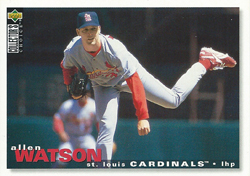
Allen Watson, a Cardinals pitcher struggling to get outs, and Orestes Destrade, a Marlins batter struggling to get hits, took out their frustrations on each other.

On May 22, 1994, Watson hit Destrade with a pitch, triggering a fight on the field at Joe Robbie Stadium in Miami.
Watson and Destrade were ejected and each received a suspension _ Watson for eight games and Destrade for four. Cardinals outfielder Bernard Gilkey and Marlins pitcher Luis Aquino also got ejected for instigating another fight and Gilkey got a four-game suspension for inadvertently making contact with umpire Charlie Reliford.

Bruised feelings

Watson entered the Sunday afternoon start with a 6.70 ERA for the season and Destrade came in batting .210.

In the first inning, Destrade hit a two-run double against Watson. In the second, Watson yielded a solo home run to Rich Renteria and two-run home runs to Carl Everett and Jeff Conine, giving the Marlins a 7-2 lead. Everett’s home run was his first in the major leagues.

After Conine delivered the Marlins’ third home run of the inning, Destrade stepped to the plate and Watson’s first pitch hit him in the back.

“Obviously, it was intentional,” Destrade said to the St. Louis Post-Dispatch.

Said Watson: “I was trying to throw inside and it ran too much and hit him.”

Sticks and stones

Destrade charged toward Watson, who removed his glove and flung it hard in self-defense. The mitt struck Destrade, knocking the eyeglasses off his face. Columnist Bernie Miklasz of the Post-Dispatch said Watson displayed “his best location of the day” with his glove toss.

“I knew he was going to charge, so I wasn’t going to stand there and get my head kicked in,” Watson said.

Destrade grabbed Watson in a headlock and landed a punch to the face.

“I fight with my fists,” Destrade said to the Palm Beach Post. “I didn’t throw my helmet at him. He has to take his medicine.”

As both benches emptied, Watson and Destrade grappled until separated by teammates.

“Basically, he’s a wimpy, little gutless college boy,” Destrade said. “He was trying to make up for stinking. What he did isn’t being an athlete. It’s being a wimp.”

Replied Watson, “A wimp? I was calling for him to come out. I charged at him, too. I didn’t back down. That’s not being a wimp.”

Redbirds rally

Rich Rodriguez relieved Watson and pitched 3.2 scoreless innings. As Rodriguez was returning to the dugout after an inning, a fan threw a cup of beer at him and Rodriguez hurled his glove at the guy.

“It wasn’t an Anheuser-Busch product,” Rodriguez said. “That’s what got me upset.”

The Cardinals scored four in the sixth to get within a run at 7-6. The Marlins responded with two runs in the bottom half of the inning against John Habyan to go up 9-6.

Rob Murphy held the Marlins scoreless in the seventh and eighth, keeping the Cardinals in the game.

In the ninth, the Cardinals had two outs and none on against Marlins closer Jeremy Hernandez, who had nine saves and a 1.42 ERA on the season.

After Jose Oquendo walked and advanced to second on a wild pitch, Mark Whiten drove him in with a double, making the score 9-7. Ray Lankford’s single scored Whiten and got the Cardinals within one at 9-8. After Luis Alicea singled for his fifth hit of the game, Gregg Jefferies doubled down the right-field line, plating Lankford and Alicea for a 10-9 Cardinals lead.

“I had nothing on any of my pitches,” Hernandez said. “I probably should have told the coaches I felt terrible.”

In the bottom of the ninth, Mike Perez struck out Kurt Abbott, hit Bret Barberie with a pitch and got Dave Magadan to ground into a game-ending double play. Boxscore

Destrade played two more games for the Marlins, got released and never played in the big leagues again.

Read Full Post »

Like a couple of grand chess masters, managers Joe Torre of the Cardinals and Jim Leyland of the Pirates engaged in a series of maneuvers designed to outwit the other. Torre won, and the result was as unusual as it was satisfying.

On May 17, 1994, Torre utilized six pitchers to achieve a shutout against the Pirates at Pittsburgh.

At the time, the Cardinals tied a National League record. Since then, several teams have used more than six pitchers to record a shutout. The Indians established a major-league record by using nine pitchers in a shutout against the Tigers on Sept. 17, 2016, according to the Elias Sports Bureau. Boxscore

Tom terrific

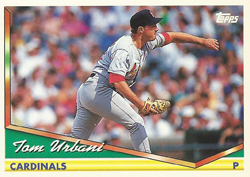
The Cardinals-Pirates game was played on a 40-degree Tuesday night at Three Rivers Stadium. The starting pitchers were left-handers Tom Urbani for the Cardinals and Zane Smith for the Pirates.

Urbani entered the start with a season record of 0-3 and a 5.04 ERA. The Cardinals wanted to send him to the minor leagues, but balked when left-hander Rheal Cormier injured his shoulder.

Both starters worked fast and the first seven innings were played in less than 90 minutes. The Cardinals scored a run in the sixth and another in the seventh and led 2-0.

The Pirates’ lone hit against Urbani was a single by Carlos Garcia leading off the fourth.

“I set up hitters and I got them out the way I wanted to get them out,” Urbani said to the St. Louis Post-Dispatch.

Torre observed, “Even when he didn’t hit his spots, he had enough on the ball where they didn’t get good wood on it.”

Mix and match

In the eighth, the Pirates had two on via walks with two outs when Torre lifted Urbani and brought in right-hander John Habyan to face Lance Parrish. Leyland countered by using Dave Clark, a left-handed hitter, to bat for Parrish and Habyan walked him, loading the bases.

Torre called for left-hander Rob Murphy to pitch to Orlando Merced, a switch-hitter, but again Leyland countered and switched to right-handed batter Don Slaught. Murphy got Slaught to hit a grounder to shortstop Ozzie Smith, who threw to second baseman Jose Oquendo for the inning-ending force on Clark.

In the ninth, Torre used three pitchers to get three outs.

Garcia led off with a single against Mike Perez. After Jay Bell popped out to second, left-hander Rich Rodriguez came in to face the former Cardinal, Andy Van Slyke.

A left-handed batter, Van Slyke turned on a Rodriguez fastball and hit it high and far. Van Slyke’s drive had home run distance but landed a few feet foul down the right-field line.

“I was able to get away with a pitch,” Rodriguez said. “I had new life and once I did I figured I’d better make something happen.”

Rodriguez switched to sliders and struck out Van Slyke.

Playing the percentages, Torre brought in right-hander Rene Arocha to face right-handed Brian Hunter and got him to fly out to shallow left, ending the game.

Urbani pitched 7.2 innings, limiting the Pirates to one hit and four walks, and earned his second career win in the big leagues. Boxscore

In using Habyan, Murphy, Perez, Rodriguez and Arocha to complete the shutout, Torre emptied his bullpen.

“I didn’t have any left,” Torre said to the Associated Press. “(Arocha) was the last I had.”

Read Full Post »

(Updated Sept. 15, 2025)

On the night he pitched an immaculate inning, the Cardinals’ Bob Gibson also was perfect at the plate.

An immaculate inning is defined as using the minimum number of pitches, nine, to strike out the minimum number of batters, three.

On May 12, 1969, Gibson faced three Dodgers batters in the seventh inning and struck out each on three pitches. He also produced three singles and a walk in four plate appearances, scored a run and stole a base in the Cardinals’ 6-2 victory at St. Louis.

“Gibson did everything but put in AstroTurf,” the St. Louis Post-Dispatch marveled.

9 perfect pitches

Gibson, 33, achieved his feat versus the trio of Len Gabrielson, Paul Popovich and John Miller. Gabrielson, a left-handed batter, and Popovich, a switch-hitter batting left, both struck out swinging. Miller, a right-handed batter substituting for starting pitcher Claude Osteen, struck out looking.

“I was throwing hard. All were good pitches,” Gibson said to the Post-Dispatch. “Good and low, most of them. Right on the corners. I don’t do that. Not nine straight pitches.”

Cardinals catcher Joe Torre said, “I’d just like to know what that Miller kid was thinking when Gibson shook me off twice on an 0-and-2 pitch. He shook me off a slider and then he shook off a curve. Then I called for a fastball and that’s what Gibson wanted. The kid took it.”

Gibson pitched a seven-hitter, fanned six and “proved he is just as good as ever _ and that’s almost as good as a pitcher can be,” the Los Angeles Times declared.

He told the Post-Dispatch he ached after throwing 123 pitches and the pain “starts here _ at the tip of my fingers _ and works up the arm and then into the shoulder and around down my side and all the way down to here _ my toes.”

In a 2014 interview with Cardinals Yearbook, Torre said, “Gibson was tough to catch because he never threw the ball straight. Throwing hard is one thing, but having the ball move all over the place was something else. Gibby probably beat up your thumb more than anybody because he could sail it, cut it, sink it … He could do a lot of stuff, but everything was power, power, power.”

Another Cardinals catcher, Tim McCarver, said of Gibson in the book “Few and Chosen,” “I always felt he could throw any pitch at any time to a right-handed hitter with William Tell accuracy … He could throw the ball within two baseball widths of the outside corner, with movement and at 95 mph. I never caught anybody else like that”

Hit and run

Gibson made the Dodgers hurt for intentionally walking Steve Huntz, batting .083, to load the bases with two outs in the fourth. Gibson followed by drilling a two-run single, extending the Cardinals’ lead to 3-0. In the seventh, Gibson scored on Julian Javier’s two-run single against Alan Foster.

With the Cardinals ahead, 6-2, in the eighth, Gibson worked a one-out walk from former teammate Pete Mikkelsen and swiped second. It was his second stolen base of the season and one of five steals for Gibson in 1969. He had 13 stolen bases in his Cardinals career. Boxscore

Read Full Post »

Dave Pallone was a minor-league umpire who caused a major ruckus when he ejected three prominent Cardinals for arguing one call.

On May 9, 1979, Pallone, substituting for major-league umpires who were on strike, tossed manager Ken Boyer, first baseman Keith Hernandez and catcher Ted Simmons in the ninth inning of a game at Houston’s Astrodome.

Pallone also ordered all of the players on the Cardinals’ bench to go inside the clubhouse and stay there until needed.

Pallone’s antics were part of a wild game in which the Astros prevailed over the Cardinals, 5-4, in 16 innings.

Questionable call

When big-league umpires went on strike in March 1979, the American League and National League brought in retired and amateur umpires and also hired eight replacement umpires, including Pallone, from the minor leagues.

Pallone was the second-base umpire in the Cardinals-Astros game.

In the ninth inning, with the score tied at 4-4, the Astros had Jimmy Sexton on first base with none out and Terry Puhl at the plate against Will McEnaney, the former Reds reliever who was making his first appearance with the Cardinals.

Puhl, looking to advance Sexton to second, bunted. McEnaney fielded the ball and threw to shortstop Garry Templeton, who was covering second. McEnaney’s throw was wide of the bag and Templeton had to reach to catch it.

Templeton said he kept his foot on the bag long enough to record the out, but Pallone disagreed and ruled Sexton safe at second.

“Bad call,” Templeton said to the St. Louis Post-Dispatch. “I couldn’t stand there all day.”

Law and order

Pallone’s call prompted multiple Cardinals to rush toward him to protest.

Hernandez arrived first. “When I ran up to him,” Hernandez said, “I couldn’t slow down. I bumped him inadvertently.”

Pallone said to Hernandez, “Don’t you bump me,” and ejected him.

When Simmons and Boyer joined the argument, Simmons called Pallone a scab for working in place of the strikers.

“That’s what he is, isn’t he?” Simmons said.

Pallone objected and ejected Simmons.

After Boyer voiced his views in language he admitted “you couldn’t print,” he was tossed, too.

When angry Cardinals flung towels, a baseball and a jacket from the dugout onto the field, Pallone ordered all the players on the bench to go into the clubhouse, though he didn’t eject them.

“Any time you throw equipment onto the field, you can’t let them sit on the bench,” Pallone told the Post-Dispatch.

Said Boyer: “I doubt very seriously if that guy knew what he was doing.”

Missed opportunities

After order was restored, the Astros had Sexton on second, Puhl on first and none out, but McEnaney worked out of the jam. Craig Reynolds grounded into a force, and after Jeffrey Leonard walked, loading the bases, ex-Cardinal Jose Cruz bounced into a double play.

Entering extra innings, Cardinals coach Red Schoendienst instructed the bench players to return to the dugout and Pallone made no attempt to send them back.

“You just can’t stop the game every time and ask them to leave,” Pallone said.

Joaquin Andujar, the future Cardinals ace, worked two innings in relief for the Astros and escaped a tight spot in the 11th. With one out and George Hendrick on third, Ken Reitz grounded to Reynolds at short and Hendrick was thrown out at home. “You’ve got to take a chance with one out,” third-base coach Jack Krol said.

The Cardinals, though, weren’t done. Lou Brock singled and Bernie Carbo walked, loading the bases, before Andujar struck out Templeton.

In the 14th, the Astros loaded the bases with none out, but Tom Bruno kept them from scoring. After Bob Watson flied out to shallow left, Julio Gonzalez was supposed to try a suicide squeeze, but he missed the sign, took the pitch and Leonard, running from third to home, was tagged out. The inning ended on Gonzalez’s fly out to right.

Bruno’s luck ran out in the 16th when Watson looped a soft liner just beyond second baseman Ken Oberkfell, scoring Leonard from third with the winning run. Boxscore

Controversial career

A few days later, after the big-league umpires ended their strike, the American League and National League formally hired the eight replacement umpires and allowed them to stay.

Pallone was treated as an outcast by the union umpires, but he remained in the National League from 1979 to 1988, and worked the 1987 League Championship Series in which the Cardinals beat the Giants despite four home runs by Leonard.

On April 30, 1988, Pallone and Reds manager Pete Rose got into an argument during a game in Cincinnati. Rose thought Pallone poked him and he shoved the umpire in retaliation. Rose was ejected and Pallone was removed from the game for his protection when fans pelted the field with debris. Video.

Rose was suspended for 30 days and fined for his actions.

Five months later, Pallone was forced to resign for what was termed unprofessional behavior. He briefly was linked to a police investigation of a male sex ring in upstate New York, but charges never were filed against him.

Pallone wrote a book, “Behind the Mask: My Double Life in Baseball,” about his umpire career and his life as a gay man, and said he had sexual relationships with players.

Read Full Post »

Much like being forced to ride in the back of a bus, African-American customers attending a National League Cardinals game or an American League Browns game at Sportsman’s Park in St. Louis were restricted to seats behind the outfield walls.

On May 4, 1944, the Cardinals and Browns became the last big-league teams to end segregated seating.

Until then, African-Americans, or anyone defined as Negroes, could purchase tickets only in the outfield bleachers or in the outfield pavilion at Sportsman’s Park. The pavilion was a roofed section behind the right-field wall. A 25-foot screen, extending from right to right-center, was built atop the wall.

Blacks weren’t allowed to sit in Sportsman’s Park’s double-decked grandstand, meaning any seats behind home plate and along the lines, or, in other words, the seats with the best views.

African-American baseball fans in St. Louis were unable to buy tickets to seats of their choice to watch Cardinals clubs featuring Rogers Hornsby in the late 1920s, or the Gashouse Gang of the 1930s, or the Stan Musial teams of the early 1940s.

Three years after the racist restriction was lifted, Jackie Robinson of the Dodgers integrated the big leagues in 1947. Dodgers executive Branch Rickey, credited with bringing Robinson to the majors, was head of Cardinals baseball operations during the time Sportsman’s Park had segregated seating.

Bowing to racism

Located at the corner of North Grand and Dodier, Sportsman’s Park was home to both St. Louis teams from 1920-53. The Browns moved to Baltimore after the 1953 season and Sportsman’s Park was renamed Busch Stadium. The Cardinals played there until they moved into a downtown stadium in 1966.

Sportsman’s Park was owned by the Browns, but both they and the Cardinals agreed to segregated seating.

In his book, “Branch Rickey: A Biography,” author Murray Polner said Rickey approached Cardinals owner Sam Breadon in the 1930s about the possibility of ending the discriminatory seating policy.

Rickey said his proposal received “effective opposition on the part of ownership and on the part of the public, press, everybody.”

According to the book, Breadon told Rickey he personally didn’t care about segregated seating but believed removing the restrictions would be bad for business.

Rickey said the city of St. Louis had no ordinance segregating blacks from whites at Sportsman’s Park and the decision was made by the clubs. Rickey suggested Breadon end the Cardinals’ policy without making a formal announcement, but there was no interest.

Unable to generate support, Rickey “backed away, unwilling to offend Breadon or white customers.”

Right stuff

Satchel Paige had the courage to do what the Cardinals and Browns would not.

On July 4, 1941, the Kansas City Monarchs and Chicago American Giants were scheduled to play a special holiday Negro League game at Sportsman’s Park. The St. Louis Stars, a Negro National League team, had played their home games at Stars Park at the corner of Laclede and Compton before disbanding after the 1931 season.

Paige, the ace pitcher and showman, was the gate attraction for the game at Sportsman’s Park and he refused to play unless seating that day was unrestricted for all customers, according to Timothy M. Gay, author of the book “Satch, Dizzy & Rapid Robert: The Wild Saga of Interracial Baseball Before Jackie Robinson.”

Unwilling to risk playing without Paige, officials gave in to his demand.

In a March 2010 guest column for the St. Louis Post-Dispatch, Gay wrote, “Thanks to Satchel Paige’s gutsy stand, blacks could sit wherever their pocketbooks would allow.”

An interracial crowd of 19,178 came to see Paige and the Monarchs win, 11-2. “It was almost unheard of in the St. Louis of that era for the races to commingle at a public venue,” Gay wrote, “but they did that day.”

In its game report, the Post-Dispatch declared the crowd was “the largest ever to witness a Negro baseball game in St. Louis.”

Paige pitched four entertaining innings. In the third, he “waved in his outfielders and gave the next batter his old trouble ball,” the Post-Dispatch reported. “His trouble ball is a hard fast one, usually thrown at the handle of the bat, because Satchel says no living human can hit such a ball with the handle.”

Paige struck out the batter.

“The record crowd enjoyed every minute that the master showman worked,” the St. Louis Star-Times reported.

Keep it quiet

Following Rickey’s advice from years earlier, the 1944 decision to end the segregated seating practice of the Cardinals and Browns was done without fanfare and received brief mention in publications. There were no press conferences nor any statements made to media.

“Restrictions confining Negroes to the right field pavilion have been lifted by both the Cardinals and the Browns, with the colored fans now being allowed to purchase grandstand seats,” The Sporting News reported. “St. Louis had been the only major-league city with this discriminatory rule.”

The Associated Press reported the St. Louis teams “have discontinued their old policy of restricting Negroes to the bleachers and pavilion at Sportsman’s Park.”

Breadon couldn’t be reached for comment, the Star-Times noted, and Browns general manager Bill DeWitt Sr. declined to comment.

Pioneer players

On May 21, 1947, Robinson became the first African-American to play at Sportsman’s Park in a big-league game. The largest weekday crowd of the season, 16,249, came to see Robinson and the Dodgers play the Cardinals. “About 6,000 were Negroes,” according to the Post-Dispatch.

“Robinson was cheered each time he went to bat and the Dodgers as a team received more vocal encouragement than they usually get at Sportsman’s Park,” the Post-Dispatch reported. Boxscore

Two months later, the Browns followed the Dodgers and Indians, becoming the third big-league club with African-American players.

On July 17, 1947, second baseman Hank Thompson made his major-league debut for the Browns versus the Athletics before 3,648 at Sportsman’s Park. Boxscore Another black player, outfielder Willard Brown, debuted with the Browns two days later against the Red Sox before 2,434 at Sportsman’s Park.

Paige would play three seasons (1951-53) for the Browns.

The Cardinals waited until 1954 before first baseman Tom Alston integrated the team.

As late as 1961, the Cardinals had segregated housing for their players at spring training in Florida until first baseman Bill White, with the help of civil rights activist Dr. Ralph Wimbish, led an effort to have integrated accommodations.

Read Full Post »

Larry Wilson caused NFL quarterbacks to lay awake at night with worry and Bill Nelsen was no exception.

Nelsen had a prominent role in the play that defined the Pro Football Hall of Fame career of Wilson, the St. Louis Cardinals safety who was as tough as any player in the NFL.

On Nov. 7, 1965, in a game between the Cardinals and Pittsburgh Steelers at Busch Stadium in St. Louis, Wilson intercepted a pass from Nelsen while wearing casts on both fractured hands.

Wilson’s performance remains an enduring testament to his willpower and illustrates why he was so widely respected.

Mind game

Wilson, who played his entire professional career (1960-72) with the Cardinals, fractured his hands in a game against the New York Giants on Oct. 31, 1965, at New York.

Cardinals head coach Wally Lemm said Wilson would play the following Sunday versus the Steelers at St. Louis. Wilson “may be handicapped in making interceptions,” Lemm said to the St. Louis Post-Dispatch, “but he’ll play if at all possible. He’s too valuable a man in all ways to do without.”

Nelsen, in his third NFL season and his first as the Steelers’ starting quarterback, said he had a premonition Wilson would pick off one of his passes.

“I just knew Larry Wilson was going to get an interception,” Nelsen told the Post-Dispatch. “Lying awake the night before the game, I was thinking there was no way he could catch one with his hands wrapped up to protect his fractures, but I knew he was going to get one.”

Finding a way

Wilson’s interception set up a Cardinals touchdown in the final 75 seconds of the first half.

The Steelers led, 3-0, and had possession at their 20-yard line when Nelsen threw toward the middle of the field. Wilson caught the ball against his chest at the Steelers’ 37 and returned it to the 3.

“It nestled into my arms nicely,” Wilson said to the Associated Press. Video

Noting Wilson made the only interception of the game, Post-Dispatch sports editor Bob Broeg wrote, “Wilson did what teammates with healthy and unencumbered fingers couldn’t do.”

Asked by Sports Illustrated in a 1995 interview whether it was painful to have Nelsen’s pass hit his damaged hands, Wilson replied, “The only painful thing about it was I should have scored.”

Steelers offensive line coach Ernie Hefferle called the wiry Wilson “one of the gutsiest players in football.”

“I believe he wants to make every tackle,” Hefferle told the Pittsburgh Post-Gazette.

Getting open

On the first play after Wilson’s interception, halfback Bill Triplett ran three yards for a touchdown and the Cardinals led 7-3 at halftime.

The Cardinals held a 14-3 lead entering the fourth quarter, but the Steelers rallied and went ahead, 17-14, with 1:12 to play.

Taking possession at their 20, the Cardinals noticed the Steelers moved into a prevent defense. Completing a couple of short passes across the middle, quarterback Charley Johnson advanced the Cardinals to their 41 with 46 seconds to go. “In their prevent defense, the Steelers had put three backs on one side to cover the receivers coming out of our double-wing formation,” Johnson told the Post-Dispatch.

Johnson asked Billy Gambrell, a slight speedster, if he could beat the safety. Gambrell said he could and Johnson called the play.

With split end Sonny Randle running a route down the left side, Gambrell cut across the middle. Gambrell caught Johnson’s pass at the Steelers’ 20 and sped into the end zone for a 59-yard touchdown reception.

Said Steelers head coach Mike Nixon, “We had two men covering Gambrell … One of the two should have been with him, but the little guy got away from both.”

The Cardinals won, 21-17. Boxscore

Making the plays

Wilson played again the next week against the Chicago Bears, but re-injured his right hand and sat out four games.

He returned for the season finale on Dec. 19 against the Cleveland Browns at St. Louis and intercepted three Frank Ryan passes, returning the first one more than 90 yards for a touchdown. Video

Wilson made a total of 52 career interceptions for the Cardinals.

In May 1968, three years after Wilson picked off his pass in St. Louis, Nelsen was traded by the Steelers to the Browns, and his career took off. Nelsen played five seasons (1968-72) with the Browns and started in five playoff games for them.

Nelsen had his best season in 1969 when he threw for 2,743 yards and 23 touchdowns in leading the Browns to a 10-3-1 record. He tied Fran Tarkenton of the Giants for second in the NFL in touchdown passes in 1969, trailing only the Los Angeles Rams’ Roman Gabriel, who had 24.

Read Full Post »

« Newer Posts - Older Posts »